TL;DR
- A bull nose edge is a fully rounded countertop edge with no sharp corner.
- On laminate you get it three ways: self-edge with a router, a factory post-form profile, or an applied edge strip.
- Installed cost runs $5 to $30 per linear foot depending on method and labor.
- It stays popular because it's safe around kids, wipes clean in one pass, and looks more finished than a raw square edge.
What is a bull nose edge profile on a countertop?
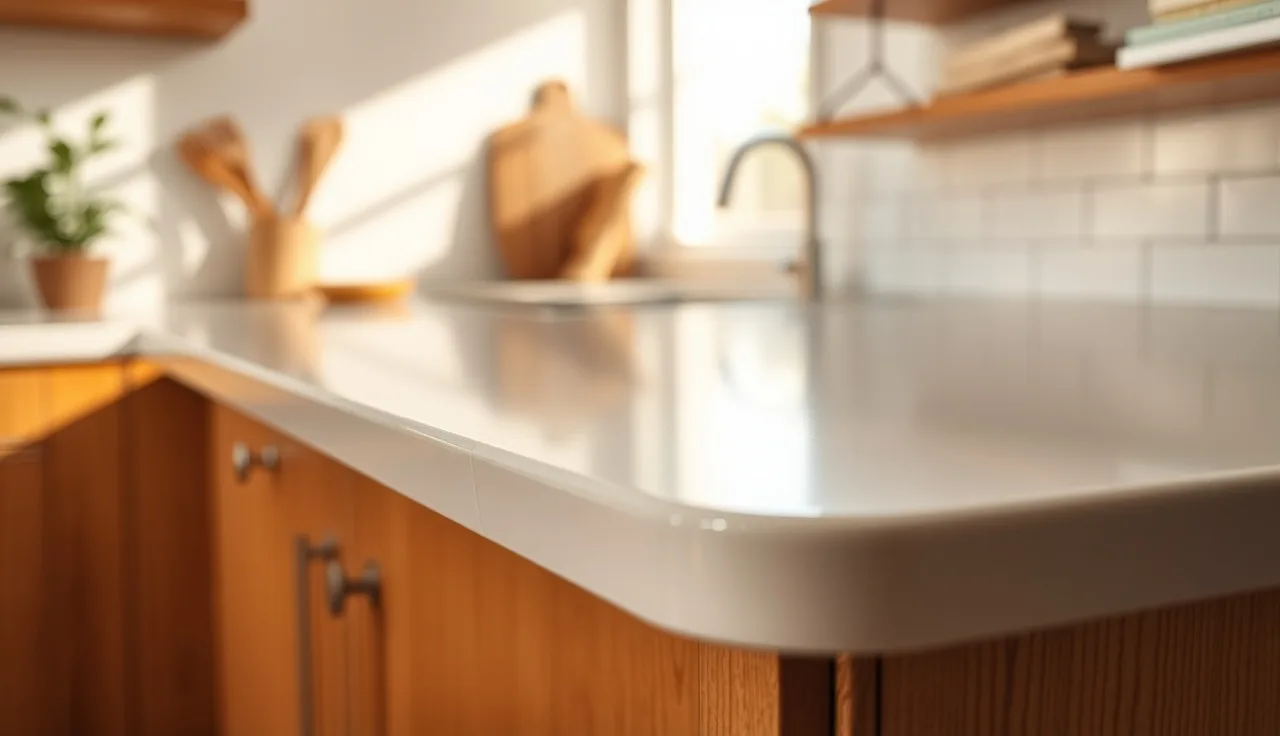
A bull nose edge is exactly what the name sounds like. The front edge of the countertop rounds into a smooth, continuous arc. A full bull nose rounds the entire thickness into a half-circle, so the top surface curves down and the bottom of the edge curves back up. A demi-bull nose (also called a half bull nose or eased bull nose in some catalogs) rounds only the top corner and leaves the bottom flat.
On stone like granite or quartz, a fabricator cuts that curve with a CNC router and polishes it. Laminate is different. Laminate is a thin surface layer bonded to a particleboard or MDF substrate, so you can't just route the edge and expose raw substrate. The round shape has to be built into the substrate first, or applied separately.
The bull nose is one of the oldest edge profiles on any countertop material, and it earned its keep. It doesn't trap crumbs the way a square edge does. It's less likely to chip. It's safe around kids because there's no hard corner to catch a hip on. Those practical reasons kept it around through decades of design trends, more than looks ever did.
What are the different ways to get a bull nose edge on laminate?
There are three practical routes, and they aren't interchangeable. Each one produces a different look, needs a different skill level, and costs differently.
Post-form laminate countertops are the simplest answer. A post-form top is made as a single piece: the laminate is heated and bent around a pre-shaped particleboard substrate in a factory press. The front edge comes out of the factory already rounded. Most post-form tops use a slight bull nose or coved front edge and a matching backsplash cove at the wall. This is the cheap top you see at home centers for $15 to $45 per linear foot installed [1]. The round is built in. You can't change it.
Self-edge with a router is the custom approach. A fabricator cuts the substrate to the finished thickness, shapes the particleboard or MDF edge with a round-over bit, then wraps the laminate sheet over that curve with contact cement. The laminate follows the shape. Done well, the seam where laminate meets substrate is nearly invisible. Done poorly, you get a visible glue line or a lifted edge. This method gives you real flexibility in radius and lets you match any laminate pattern, including wood grains where grain direction matters.
Applied edge strips and banding are the budget third option. Iron-on or peel-and-stick edge banding in matching laminate colors goes onto a pre-routed substrate. The radius is limited by how far the banding bends before it cracks, usually a gentle curve, not a tight full bull nose. T-mold strips made of PVC or aluminum are another option; they press into a routed slot in the substrate edge and give a rounded or beveled profile. These don't look as good as a proper self-edge, but they're manageable as a DIY repair on countertops you already own.
For a laminate countertop built from scratch, most fabricators default to self-edge. It looks better and it holds up longer.
How much does a bull nose edge on laminate cost?
Cost depends on which method you use and where you live. Here's the honest breakdown.
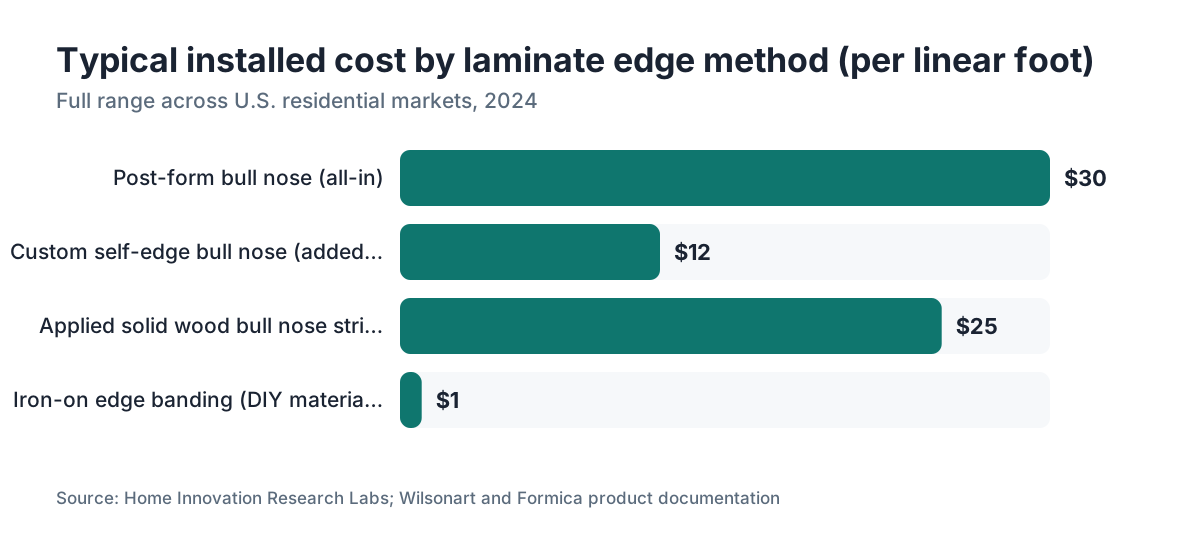
Post-form tops come pre-edged from the factory. Installed price for a standard post-form run, edge included, is roughly $15 to $45 per linear foot in most U.S. markets as of 2024, and regional labor rates push that range around [1]. The edge adds nothing extra because it's part of the slab.
Custom self-edge work adds $5 to $15 per linear foot to a fabricator's base price, depending on profile complexity and how much hand-finishing it needs. A full bull nose with a tight radius takes more time than a simple eased edge. Expect to pay at the upper end for a true rounded profile.
Premium applied edges, like solid wood banding routed to a bull nose, can run $20 to $30 per linear foot installed if a carpenter does it right. That's expensive for laminate and rarely worth it unless you're matching existing cabinetry or blending into a butcher block section. The solid-wood edge techniques overlap, so the butcher block countertops guide covers that ground.
DIY edge banding from a hardware store runs $0.50 to $2.00 per linear foot in materials. Labor is your time. The result rarely matches factory post-form or a professional self-edge, especially on a full bull nose where the radius is tight enough to stress cheap banding.
| Method | Typical material cost | Typical installed cost | DIY-friendly? |
|---|---|---|---|
| Post-form (built-in bull nose) | $10 to $30/LF slab only | $15 to $45/LF | Yes, with basic tools |
| Custom self-edge (router + laminate) | $3 to $10/LF added | $8 to $20/LF added to base | Moderate skill needed |
| Applied wood banding | $5 to $15/LF materials | $20 to $30/LF installed | Difficult for bull nose |
| Iron-on edge banding | $0.50 to $2/LF | DIY only | Yes, limited radius |
How does bull nose compare to other laminate edge profiles?
Edge profiles on laminate aren't purely decorative. Each one has a practical trade-off.
A square edge (also called flat or eased) is the simplest and cheapest. It exposes the laminate edge directly, and if the substrate is particleboard, that edge is the most vulnerable spot on the whole top. Water intrusion at a square edge is the number-one cause of laminate swelling and delamination. A bull nose wraps the laminate fully around the curve, which protects the substrate better when someone drags a wet sponge across the edge day after day.
A beveled edge (usually 45 degrees) looks more contemporary. It doesn't trap crumbs like a square edge, but it still has a sharp bottom corner. Some people find it uncomfortable to lean against.
An ogee or dupont edge has decorative curves and shows up mostly on stone. On laminate it's possible only as an applied routed wood strip, which adds cost and a visible seam.
A waterfall edge, where the laminate runs straight down to the floor on a peninsula, is a design trend on stone and even some laminate panels. That's a structural detail rather than an edge profile, but people ask about it alongside edges, so it belongs here.
For most kitchens the bull nose wins on durability and comfort. It's the right call for homes with kids, for countertops near sinks, and anywhere the edge gets regular contact. The one place it looks dated is a very modern flat-panel kitchen where a thick square edge in a contrasting color is part of the design language.
Comparing laminate to stone? The guides on granite countertops and marble countertops show how edge profiles price out differently in natural stone.
Can you add a bull nose edge to an existing laminate countertop?
Honest answer: it's hard, and the result rarely matches starting fresh.
If your existing top has a square edge, adding a bull nose means routing the substrate edge into a round, then covering it. When the top laminate is still in good shape, you have to route the edge without cutting into that top sheet, then apply new banding around the fresh curve. Getting banding to bond cleanly on a curve without bubbles or lifted seams takes practice and the right contact cement technique.
A more realistic retrofit is gluing on a wood edge strip, routing it to a bull nose, then painting or staining it to match or contrast. This works and holds up fine if the wood is sealed properly. You'll always see the seam where wood meets laminate.
Most people who want to change an existing edge are chasing water damage at a square edge that swelled the substrate. If that's you, the swelling means the particleboard is already compromised, and a new top usually makes more sense than repairing and re-edging the old one.
Fabricators who specialize in laminate can re-edge a countertop, but the labor often approaches half the price of a new top. Get a quote both ways before you commit.
What radius should a bull nose edge be on a laminate countertop?
Standard laminate countertop thickness is 1.5 inches (the substrate plus the laminate face and backing sheet). On a full bull nose, the radius equals half the thickness, so 3/4 inch is standard for a 1.5-inch top.
Some post-form tops use a slightly tighter or softer radius depending on the manufacturer's tooling. Factory post-form edges typically run a 1/2-inch to 3/4-inch radius. On a custom self-edge, the fabricator matches the substrate thickness to whatever radius they're routing.
A demi-bull nose rounds only the top corner, usually to a 1/4-inch or 3/8-inch radius, leaving the bottom flat. It reads softer than a square edge but skips the full rounded look of a true bull nose.
Radius matters most for DIY banding. Standard iron-on banding (typically 15-mil-thick high-pressure laminate) cracks if you bend it to a radius tighter than about 1 inch. That means iron-on banding can't handle a true 3/4-inch full bull nose. You'd need flexible PVC banding or a factory-made T-strip instead. This is the single most common mistake in a DIY bull nose retrofit.
How is a bull nose edge actually applied in a laminate fabrication shop?
Here's how the process runs in a shop that does custom laminate work.
The fabricator cuts the substrate (usually 3/4-inch particleboard topped with another 3/4-inch build-up strip to reach 1.5 inches) to the finished dimensions. A round-over router bit set to the correct radius shapes the front edge. That edge gets sanded smooth, because any bump in the substrate telegraphs through the thin laminate.
Contact cement goes on both the back of the laminate strip and the shaped edge. Both surfaces have to become tacky first, usually 5 to 10 minutes depending on humidity and the specific adhesive. Then the fabricator presses the laminate around the edge, working from the center out to push air bubbles away. Laminate on a curve wants to spring back, so clamping or rolling with a J-roller isn't optional.
Once the cement cures, a router with a flush-trim bit removes the excess laminate on the top and bottom, then the edge gets filed and sanded clean. The top laminate sheet goes on next, and its front edge is trimmed flush with the curved edge laminate below. That's the seam that, on a good job, you can barely find.
This is skilled work. On a granite or quartz job, a CNC machine cuts the profile with diamond tooling and polishes it mechanically. Laminate self-edging is closer to handcraft than machine work. Shops that quote laminate by the whole job instead of a detailed breakdown tend to underestimate edge complexity. Fabrication software that tracks edge linear footage separately from slab area (like the quoting tools at SlabWise) helps shops price this right instead of eating it as margin.
The countertop installation guide walks through the full workflow, including what to expect from a fabricator visit.
Is a bull nose edge safe and comfortable to use daily?
Yes, and this is one of the underrated arguments for it.
Kitchen edges take a lot of incidental contact. Hips brush past while you cook. Forearms rest while you chop. Kids run through. A square edge is fine until you catch it wrong, then it's sharp enough to leave a mark. A bull nose spreads that contact across the full curve, which is noticeably kinder to lean on.
For households with young kids or older family members, rounded edges are a real safety consideration. The American Academy of Pediatrics recommends childproofing kitchens against sharp-corner injuries [2], and while countertop edges aren't called out by name, the principle carries. A 3/4-inch bull nose has no corner to open a cut.
The rounded edge cleans easier too. A square edge has two corners where grease and crumbs collect. A bull nose has none; a damp cloth wipes the whole profile in one pass.
One mild downside. The curved surface doesn't grip a thin cutting board set at the edge as well as a square edge does. Trivial for most people, but worth knowing.
How long does a bull nose edge on laminate last?
A properly done self-edge bull nose should last as long as the countertop itself, which is typically 15 to 20 years under normal residential use before the pattern shows wear or the substrate starts pulling moisture near the sink [3].
The edge is usually the first place trouble shows. Contact cement can fail if the surface was contaminated before bonding, or if the top sat under sustained heat (a slow cooker or electric skillet parked on the edge for years). Delamination at the edge corner is the most common failure.
Post-form edges last about as long. The whole-top construction makes edge delamination less common, but the coved backsplash joint is where moisture usually enters first on post-form tops.
Catch a lifting edge early and re-gluing with fresh contact cement is a straightforward fix. Wait until the lift creeps into the top surface and the repair gets much harder. Edge re-glue is genuinely DIY-able: clamp, heat gently with a heat gun to reactivate old cement or apply fresh, press, and hold.
What design styles suit a bull nose edge on laminate?
The bull nose is most at home in traditional, transitional, and family-practical kitchens. It reads warm and approachable rather than sharp-edged modern.
In a shaker-cabinet kitchen with white or off-white laminate in a solid or subtle pattern, a bull nose looks exactly right. In a wood-grain laminate kitchen meant to read like real wood, the rounded edge echoes how solid wood usually gets profiled.
In a very contemporary flat-panel kitchen with high-gloss laminate and handleless cabinets, the bull nose can look off. Those kitchens usually want a square edge with a thick substrate, or a mitered edge that exaggerates thickness. It's a subjective call, so talk to your fabricator before defaulting to bull nose on a modern job.
Color and pattern matter too. On a solid-color laminate, the seam where the edge meets the top is subtle. On a stone-look laminate with heavy veining, the seam shows because the vein pattern doesn't line up at the edge. Some fabricators order extra laminate to book-match the edge on patterned sheets. Most don't bother, and most homeowners never notice.
For how the same profile reads in other materials, the guides on Corian countertops and Cambria countertops cover solid surface and engineered quartz.
How does a laminate bull nose edge compare to Formica or other brand options?
Formica is a brand name that went generic for high-pressure laminate, the way Kleenex means tissue. The edge profiles you can get on Formica, Wilsonart, Pionite, and other HPL brands are basically the same, because they're all 1/32-inch to 1/16-inch laminate sheets bonded to a substrate. The edge profile is a substrate and fabrication question, not a brand question.
That said, some brands sell pre-formed edging strips in matching colors and patterns. Formica offers matching edge banding in many of its patterns, which helps on a self-edge job where you want the color to match without ordering a full sheet just for the strips.
Wilsonart sells both standard HPL and its own post-form countertop products, some with factory bull nose edges. So if you're specifying by brand, ask the supplier which edge profiles come pre-formed versus which ones need custom work. That's the question that saves you money.
The Formica countertops guide covers the brand's product lines in more detail.
What should you ask a fabricator before ordering a laminate countertop with a bull nose edge?
A few questions that actually matter:
Ask whether the bull nose is a self-edge (laminate wrapped around the substrate) or an applied strip. The method drives both durability and appearance.
Ask what radius they use for a full bull nose. If it's anything other than half the countertop thickness, ask why. A 1.5-inch top with a 1/8-inch radius is a demi-bull, not a full bull, and it looks very different.
Ask whether the edge laminate comes from the same sheet or a different run. Color lot variation in laminate is real, and edges cut from a different dye lot can show a visible color difference.
Ask how they handle the seam at the sink cutout. The edge around an undermount sink opening is often squared even when the front edge is rounded, because wrapping the profile inside a cutout is very hard. If you want a consistent look, you may need to spec a drop-in sink.
Ask about the warranty. Most fabricators warrant laminate labor for 1 year, and manufacturers like Wilsonart and Formica warrant their materials for 5 to 10 years against manufacturing defects [4][5], though that doesn't cover installation or edge delamination from moisture.
Shops that run fabrication software can pull an itemized quote showing edge linear footage separately from field area, so you see exactly what the edge work costs. That line-item transparency is worth asking any shop for, and it's part of what SlabWise's quoting module generates automatically for fabricators who use it.
Frequently asked questions
What is the difference between a full bull nose and a demi bull nose on laminate?
A full bull nose rounds the entire edge into a half-circle, so the profile curves from the top surface all the way to the bottom. A demi bull nose (also called a half bull nose) rounds only the top corner and leaves the lower portion flat. On a 1.5-inch laminate top, a full bull nose has a 3/4-inch radius; a demi typically uses a 1/4-inch to 3/8-inch radius. The demi looks more modern and is slightly easier to fabricate.
Can I add a bull nose edge to my existing laminate countertop myself?
You can try, but a clean result is hard. The approach is to rout the substrate edge to a round-over, then apply flexible banding over the curve. Standard iron-on laminate banding is too stiff for a tight bull nose radius and tends to crack. Flexible PVC banding or a glued wood strip routed after attachment work better. Most people who attempt this find the seam visible enough that they wish they'd replaced the countertop instead.
How much does a bull nose edge add to a laminate countertop quote?
On a custom self-edge job, expect $5 to $15 per linear foot added to the base price for the edge work. On a post-form countertop, the bull nose is built into the slab price and adds nothing extra. Total installed cost for post-form laminate with a bull nose edge is typically $15 to $45 per linear foot including materials and labor, depending on your region and the layout complexity.
Does a bull nose edge protect laminate countertops from water damage?
Better than a square edge, yes. A properly wrapped self-edge bull nose encases the substrate fully in laminate, giving moisture fewer entry points. The most vulnerable spot on any laminate edge is the seam where the top sheet meets the edge strip; keeping that seam tight and sealed with the right adhesive is what keeps water out. Post-form bull nose edges have no seam at all on the front profile, one reason they're considered more water-resistant.
What tool do I need to rout a bull nose edge on a laminate countertop substrate?
A trim router or full-size router with a round-over bit in the correct radius. For a 3/4-inch full bull nose, you need a 3/4-inch radius round-over bit. These are widely available from brands like Freud or Whiteside. You also need a pilot bearing on the bit to follow the substrate edge. After routing, sand the profile smooth before applying laminate, because any ridge telegraphs through the thin sheet.
Is a bull nose edge more expensive than a square edge on laminate?
On custom work, yes. A bull nose costs more because it requires routing the substrate edge and wrapping the laminate around the curve, both slower than trimming a flat edge. The premium is usually $5 to $15 per linear foot. On post-form countertops sold at home centers, the bull nose is factory-built and there's no upcharge; you're buying the profile you see on the slab.
What adhesive is used to attach laminate to a bull nose edge?
Contact cement is standard. Both water-based and solvent-based formulas work; solvent-based (like DAP Weldwood original) gives a stronger initial bond and more open time, which matters on curved work where you're positioning carefully. Apply to both surfaces, let each get tacky, then press. A J-roller helps clear air bubbles on the curve. Some shops use a heat gun to reactivate dried contact cement during repairs.
Can you get a bull nose edge on a laminate countertop with an undermount sink?
Not cleanly around the cutout itself. Wrapping a bull nose around the inside edge of a sink opening is extremely hard with laminate because the substrate edge is exposed and the laminate has to bend in a compound curve. Most fabricators square the cutout edge or use a small eased edge inside, even when the front edge is rounded. This is one reason laminate pairs better with drop-in sinks than undermount sinks.
How long does it take to fabricate a bull nose edge on laminate in a shop?
Routing the substrate profile and applying the edge laminate on a typical 10-linear-foot kitchen run takes an experienced fabricator 1.5 to 3 hours, depending on how many inside and outside corners are involved. Corners eat the time: the laminate has to be cut, fitted, and blended at each one, and any misalignment shows. Outside corners in particular need careful scribing or a small radius cut to avoid a visible gap.
Does the bull nose edge style ever go out of fashion?
It cycles. The full bull nose was everywhere in kitchens from the 1980s through the early 2000s, which tied it to that era's look. It fell out of favor in high-end design as waterfall edges and thick square profiles got trendy. But in practical family kitchens and budget remodels, it never really left. Right now it reads comfortable and approachable rather than dated, especially on laminate where material cost is already modest.
What laminate brands offer matching edge banding for bull nose applications?
Formica, Wilsonart, and Pionite all offer pre-finished edge banding in many of their standard laminate colors and some patterns. The banding comes in 1-inch and 1.5-inch widths. Matching is good for solid colors; patterned laminates may show a slight sheen or texture difference between the field sheet and the banding depending on the manufacturing run. Always order banding and field laminate from the same dye lot if color consistency matters.
Is a laminate bull nose edge appropriate for bathroom vanity countertops?
Yes, and it's arguably better suited there than in kitchens. Bathroom vanity tops see less cutting-board use and less heat, so the laminate holds up well. The bull nose is comfortable for someone leaning over the vanity. Water splashing is the main concern, and a properly bonded edge keeps moisture out. Post-form vanity tops with built-in bull nose edges are sold specifically for this at most home centers.
How do I repair a bull nose laminate edge that is starting to peel?
If the edge is just lifting at the tip, slip a thin spatula under the laminate, clean out any debris, apply fresh contact cement to both surfaces with a small brush, let both sides get tacky (about 5 minutes), then press firmly and clamp or roll with a J-roller. For larger delamination, you may need to remove the edge strip entirely and reapply. Act early: once the substrate gets wet and swells, the geometry changes and the old laminate won't lie flat again.
Sources
- Home Innovation Research Labs, National New Home Survey: Laminate remains one of the most common countertop materials in U.S. homes, with post-form laminate countertops typically installed for $15 to $45 per linear foot in the residential market.
- American Academy of Pediatrics, Healthychildren.org, Home Safety: The AAP recommends childproofing kitchens to reduce injury risk, including attention to sharp corners on furniture and counters.
- U.S. Bureau of Labor Statistics, Consumer Expenditure Survey: Kitchen remodeling data indicates laminate countertops have an average useful life of 15 to 20 years under standard residential use.
- Wilsonart International, Laminate Warranty Documentation: Wilsonart warrants its high-pressure laminate against manufacturing defects for 10 years from the date of purchase under residential use conditions.
- Formica Group, Product Warranty: Formica Corporation warrants its laminate products against manufacturing defects for 5 years under residential use.
- National Kitchen and Bath Association (NKBA), Design & Planning Guidelines: NKBA planning guidelines address countertop edge profiles as a factor in both safety and ergonomics for kitchen design.
- U.S. Consumer Product Safety Commission (CPSC), Home Safety Reports: CPSC data on home injury reports includes kitchen sharp-edge injuries as a documented category in residential accident statistics.
- Occupational Safety and Health Administration (OSHA), Woodworking Machinery Standard 29 CFR 1910.213: OSHA woodworking standards govern router and shaping equipment use in fabrication shops, relevant to laminate edge routing operations.
- Forest Products Laboratory, USDA, Wood Handbook Chapter 11: Wood-Based Composite Materials: USDA research on particleboard and MDF substrate properties documents moisture absorption characteristics relevant to countertop substrate durability.
- Freud America Inc., Router Bit Product Specifications: Freud specifies round-over router bits in radii from 1/8 inch to 1 inch for use in laminate and wood edge-profiling applications.
Last updated 2026-07-09