
TL;DR
- For most commercial settings, an eased or slightly beveled edge wins.
- It resists chipping, hides minor wear, cleans in one wipe, and costs the least to fabricate.
- Decorative profiles like ogee and dupont look great but trap grease and cleaning residue, add 25 to 40% to edge fabrication cost, and chip more visibly under the daily punishment of a commercial kitchen or busy retail counter.
Why does edge profile matter more in commercial settings than at home?
A home counter takes a beating twice a day. A restaurant prep line, a hotel check-in desk, or a hospital nurses' station sees hundreds of contacts per shift. That gap in use frequency turns a small design choice into a real maintenance and safety problem.
Edge profile drives four things commercial operators care about: chip resistance, cleanability, injury risk, and fabrication cost. A sharp 90-degree square edge looks crisp in a showroom and chips badly when a bus tub catches it at the end of a long dinner service. A full bullnose rounds away the chip risk but creates a thick drip line that sends liquids onto the floor instead of into a sink.
ADA compliance matters too. The 2010 ADA Standards for Accessible Design don't name a countertop edge profile, but Section 307 on protruding objects means blade-thin overhangs at face height are a liability in public spaces, and Section 904.4 governs sales and service counter geometry [1]. Facilities managers in healthcare and education tend to spec an eased or radius edge partly for that reason.
Commercial rooms add chemical exposure on top of everything else. Cleaning crews use quaternary ammonium compounds, bleach solutions, and degreasers that would never touch a home kitchen. Quartz is non-porous and handles most of these fine. But profiles with tight coves and fillets hold cleaning residue, and that residue can dull the resin binder over time. Simple profiles wipe clean in one pass.
What are the most common quartz edge profiles and what does each one cost?
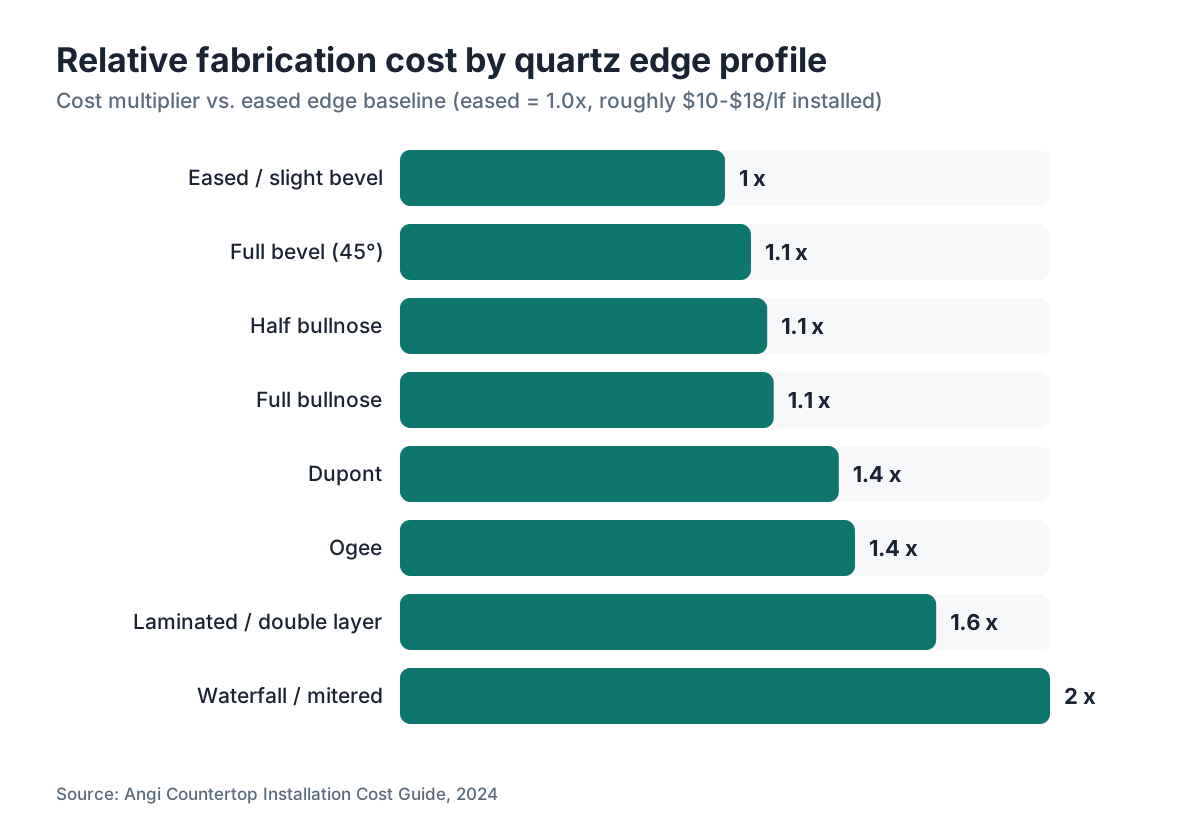
Edge profiles fall into three rough tiers: simple, compound, and decorative. Fabricators price edges per linear foot, and the complexity of the router pass drives the number.
| Profile | Description | Relative fab cost (vs. eased) | Commercial suitability |
|---|---|---|---|
| Eased (slight bevel) | ~1/8" bevel on top corner | Baseline | Excellent |
| Bevel (full bevel) | 45-degree chamfer, usually 1/4" | +5 to 10% | Very good |
| Bullnose | Full round, top and bottom | +10 to 15% | Good (some drip issues) |
| Half bullnose | Round on top only, square bottom | +10 to 15% | Good |
| Ogee | S-curve profile | +25 to 40% | Poor (traps soil) |
| Dupont | Step with round nosing | +20 to 35% | Fair |
| Waterfall (mitered) | Edge continues slab face to floor | +60 to 100% | Specialty only |
| Laminated (double layer) | Two layers stacked for thick look | +40 to 80% | Poor (seam line) |
These premiums track typical fabricator pricing for 3cm quartz. Eased edges often run $10 to $18 per linear foot installed, with decorative profiles reaching $25 to $45 per linear foot or more depending on region and shop overhead [2]. A 30-foot island perimeter at $35/lf for an ogee instead of $13/lf for an eased edge is a $660 upcharge per counter, plus harder cleaning for the life of the install.
Run that across a full build-out and the gap gets loud. For 200 linear feet of counter, the difference between an all-eased spec and an all-ogee spec can top $4,000 in fabrication cost alone, before any maintenance labor over the lease term.
Which edge profiles hold up best in restaurant and food-service environments?
Food service has a specific set of demands: NSF-minded surfaces, frequent harsh cleaning, heavy contact from pans and equipment, and health inspectors who look at crevices. The eased edge with a 1/8" or 1/4" bevel is the workhorse here.
It wipes down fast, presents no crevice for food debris, and if it chips at the corner the damage is small and usually invisible unless you go looking. Most commercial stainless steel counters use similar geometry for the same reasons.
A full bevel or pencil edge (a very slight rounding, smaller than a true bullnose) is a solid second choice. The flat chamfer angle traps nothing and gives a cleaner sightline than the square-ish eased edge.
The NSF/ANSI 2 standard for food equipment requires that joints and seams be designed to resist food accumulation [3]. That standard governs equipment, but health departments in many states apply the same logic to countertop specs during plan review. An ogee or cove profile fails that logic test on sight: there's a concave section that's structurally harder to clean than a flat or convex surface.
For front-of-house bars and host stands where looks matter more than pure utility, a half bullnose is the best middle ground. It rounds the top edge, which cuts chip risk and the sharp-edge injury hazard, keeps a simple underside, and doesn't create a serious soil trap. It does drip more than an eased edge, so placement matters. Fine at a bar where a floor drain handles spills. Less ideal at a service counter dripping onto carpet.
What edge profiles work for healthcare and hospitality countertops?
Healthcare adds infection control to the list. CDC guidance on environmental infection control in healthcare facilities points toward non-porous, easily cleanable surfaces [4]. Any edge that creates a shadow line or crevice where biofilm could form is a problem.
Hospital purchasing teams and healthcare designers usually spec an eased edge or a very slight radius for nurse stations, medication rooms, and procedure rooms. Some specs go further and require at least a 1/8" (3mm) radius on all exposed edges to kill the micro-crack-collecting sharp corner entirely.
Hotels split by area. Back-of-house rooms (housekeeping, laundry, receiving) follow food-service logic: simple edges, fast cleaning. Guest-facing spaces like concierge desks and lobby bars can carry more decorative profiles because they don't see the same abuse and they'll be refinished or replaced on a renovation cycle, typically every 7 to 10 years in full-service hotels [5].
For hotel bathrooms, the common spec is a 3/4" radius bullnose or an eased edge. The rounded bullnose protects guests from sharp corners, which is both a comfort and a liability call. A guest bleeding on a counter edge is a real incident type that produces litigation, and hotel-chain risk managers know it.
Quartz holds up well in both settings because the resin binder makes the surface non-porous, unlike natural stone, which can hold moisture and bacteria at the crystal grain boundaries. For how materials compare across these rooms, the kitchen countertops guide covers material trade-offs in detail.
How do edge profiles affect ADA compliance and injury liability?
The 2010 ADA Standards for Accessible Design, published by the U.S. Department of Justice, set work surface heights and clear floor space, but they don't mandate a specific edge profile [1]. The connection to edge profile comes from two places.
First, Section 307.4 addresses protruding objects. An overhang that sticks out more than 4 inches between heights of 27 and 80 inches is a hazard for people using canes or who are blind. A very thick laminated double-edge, or a counter with an unusually large overhang, could trip that concern in a public-facing space. The Access Board publishes the technical criteria behind those provisions [7].
Second, and more useful day to day: building codes in most states adopt the International Building Code, and commercial general contractors carry liability insurance that adjusters read closely after injuries [8]. A sharp square edge at hip height on a checkout counter isn't specifically banned. But when someone bruises a hip on it and files a premises claim, the operator's attorney wishes the spec had called for a rounded edge. A visible bevel or bullnose performs better in that scenario.
OSHA doesn't regulate countertop edges directly. Its General Duty Clause (29 U.S.C. § 654) requires employers to furnish a workplace "free from recognized hazards that are causing or are likely to cause death or serious physical harm" [6]. If a sharp counter edge causes repeated worker injuries at a prep station, OSHA can cite the employer under that clause even without a countertop-specific rule. An eased or beveled edge removes that exposure at near-zero cost.
Does edge profile affect how easy a commercial countertop is to fabricate and install?
Yes, and the time difference is real money for both fabricators and buyers.
A standard eased edge on 3cm quartz is a single router pass with a common bit. Most production shops edge a linear foot in under two minutes at this profile. An ogee needs a dedicated bit, a slower feed rate, and often a second pass to clean up the cove. Dupont and waterfall edges need even more setup.
For fabricators bidding commercial work, edge complexity feeds straight into templating-to-installation time and bit wear cost. A 200-linear-foot job with uniform eased edges might take four to five hours of edge work. The same job in ogee might take eight or nine, plus bit replacement.
Shops running quoting software like SlabWise can assign per-profile cost multipliers so the edge upcharge flows into the bid automatically instead of getting forgotten on a fast commercial quote. That matters most on large jobs where edge footage stacks up across dozens of stations.
Installation complexity scales the same way. A bullnose on a corner needs a radius corner piece or a mitered bullnose, which is an extra cut. Ogee corners are harder to match cleanly. Simple profiles at inside and outside corners are straightforward. On a build-out with 40 or 50 corners, the gap between simple and ornate can add half a day of labor or more.
Which edge profiles hide wear and minor chipping best over time?
Quartz chips at edges, not in the field. The resin-bound composition is fairly chip-resistant compared to marble or granite, but it isn't indestructible. Impact at the corner of an edge is where damage lands: a falling stock pot, a bus tub swung into the side of an expo counter, a dolly clip.
A 1/4" bevel or a true eased edge hides minor chipping better than a square edge. The chamfer means there's no sharp-corner geometry to break off cleanly, and the damaged area sits on the bevel face, less visible from standing height. A bullnose is similarly forgiving. A small chip on a rounded surface reads as a worn spot, not a missing corner.
An ogee or dupont does the opposite. It concentrates stress at the tight inner radius of the cove. When that area chips, the damage is obvious because the curved geometry is now broken. Matching a repair on a complex profile also takes a skilled hand. Color-matched epoxy that looks fine on a flat bevel looks clumsy in a cove.
For any commercial room with heavy daily use, the long-term appearance argument points at simple profiles. The quartz field will look nearly the same in year five as year one. The edge is where age shows up first.
How do different profiles compare for cleanability in a commercial environment?
Clean-in-place speed matters when your crew has 200 stations to wipe in a shift. A complex edge adds maybe 5 seconds per linear foot of cleaning time. That sounds trivial until you multiply it across 500 linear feet of counter and 365 days.
The cleanability ranking, best to worst:
- Eased or beveled: single flat or angled surface, one wipe motion clears the full edge.
- Half bullnose: one convex curve, still a single motion.
- Full bullnose: convex top and bottom, slightly more surface area, still fast.
- Pencil or micro-bevel: same as eased, sometimes easier because the micro-radius keeps the cloth from snagging.
- Dupont: the step creates a small horizontal ledge that traps liquid and debris. Needs a second wipe motion.
- Ogee: the concave cove is the problem. Debris lodges in the bottom of the S-curve. It takes a tool or a fingernail to clean out.
- Laminated edges: the seam line between the two layers is a crack that collects everything over time, especially in a humid commercial kitchen.
NSF/ANSI 2 language, noted above, says joints and seams in food-contact surfaces must be "smooth, easily cleanable, and sealed" against accumulation [3]. Any profile with a horizontal ledge or concave recess fails that principle as applied to commercial food prep surfaces.
For operators running a franchise or chain concept, the edge spec sheet isn't a design decision. It's a sanitation policy. Getting it wrong creates audit exposure.
What edge profile should you specify for an office or retail commercial build-out?
Office and retail rooms have more design latitude than food service or healthcare because the sanitation burden is lower. The practical case for simple profiles still holds.
For offices, especially break rooms, reception desks, and conference credenzas, a half bullnose or eased edge hits the right balance. It looks finished and professional, a standard cleaning service wipes it down fast, and it dodges the chipping risk a square edge carries on a busy reception counter that sees laptop bags, boxes, and deliveries all day.
Retail counters at checkout or service points take real abuse. A jewelry or cosmetics counter might see light use. A hardware store checkout sees hundreds of heavy products slid across it daily. For high-traffic retail, the eased edge or full bevel is the right call. The visual simplicity also lets the quartz color and pattern carry the look instead of adding noise at the edge.
High-end retail (flagship apparel, luxury goods, hotel boutiques) is the one commercial context where a slightly more decorative profile earns its keep. A 3/4" pencil radius or a soft bullnose with a very slight bottom bevel reads as refined without the maintenance penalty of a full decorative profile. Most cambria countertops commercial installs in luxury retail use this approach.
For build-out fundamentals, the countertop installation guide covers substrate requirements, overhang limits, and seam placement that shape edge choices.
How should fabricators bid edge profiles on commercial quartz jobs?
Commercial jobs carry larger linear footage than residential, so edge pricing errors hurt more. A $5/lf miss on a 300-foot job is $1,500 out of margin before you start.
The practical approach is a multiplier per edge type in your quoting system. Use the eased edge as your baseline unit cost (actual time plus bit cost plus setup), then apply multipliers: bevel at 1.1x, bullnose at 1.15x, dupont at 1.35x, ogee at 1.4x, waterfall or mitered at 2.0x or higher depending on thickness.
Corner type needs its own line item. A miter corner on a bullnose edge is not covered by the per-linear-foot edge price. It's a separate cut. On a job with 40 outside corners, 40 miter charges at $25 to $50 each adds $1,000 to $2,000 that vanishes from margin if it's not in the quote.
The other commercial-specific issue is field edge. Plenty of commercial counters butt against walls, cabinets, or equipment and never get an exposed finished edge. Count only the exposed edge footage, not the total perimeter. That's easy to miss on a fast takeoff from a dense commercial drawing.
SlabWise's quoting tools let fabricators set per-profile edge cost rules that apply during takeoff, which cuts the odds of an exposed-edge count error on a complex floor plan. That kind of systematic check pays off more on commercial than residential because the drawings are busier and have more edge interfaces.
When you're presenting material options to a commercial client, the trade-offs in the granite countertops and marble countertops guides are worth a read for competitive context.
What quartz edge profiles do most commercial specs actually call for?
Read enough commercial construction specs and a pattern shows up fast: countertop edge profiles almost always land in one of three buckets, eased, bevel, or bullnose. The CSI MasterFormat Section 12 36 16 (Stone Countertops) and related sections call for edge profiles by name and radius dimension, but decorative profiles rarely appear unless the project is high-end hospitality or luxury retail [7].
That dominance reflects three realities: maintenance cost, warranty terms, and the fact that commercial projects get value-engineered. When a GC starts cutting costs, the ogee upgrade on the break room counter is one of the first things to go.
Quartz manufacturers push simple profiles in their own commercial literature too. Cambria, one of the larger U.S. quartz makers, publishes care guidance noting that countertop edges need the same routine cleaning as the surface [9]. Its commercial spec sheets consistently show eased or radius edges as standard.
Here's the upshot. If you're a fabricator asked to spec a commercial project from scratch, defaulting to eased with a 1/8" bevel is almost always right. If the designer pushes for more, the half bullnose is your next stop. Anything past that needs a specific reason, and preferably a written note from the client confirming they understand the maintenance trade-off.
Frequently asked questions
What is the most durable edge profile for a commercial quartz countertop?
The eased edge (1/8" or 1/4" bevel on the top corner) is the most durable option for commercial quartz. It removes the sharp-corner geometry that breaks off under impact, cleans in a single wipe, and costs the least to fabricate. A full bevel is nearly as durable and works as an aesthetic upgrade with no meaningful maintenance trade-off.
Are ogee or dupont edges appropriate for commercial quartz countertops?
Rarely. Ogee and dupont profiles look attractive in showrooms but trap grease, cleaning residue, and debris in their coves and steps. They cost 25 to 40% more per linear foot, chip more visibly when damaged, and are harder for cleaning crews to sanitize. Stick with simpler profiles in any food-service or healthcare setting.
Does ADA require a specific countertop edge profile?
No. The 2010 ADA Standards for Accessible Design set counter heights and clear floor space but don't mandate an edge profile. Indirectly, the protruding-object provisions in Section 307 can make very thick or wide overhangs a concern in public spaces. Most facilities managers spec a rounded or beveled edge for injury prevention and liability reasons, not because ADA requires it.
How much more does a decorative edge profile cost per linear foot on a commercial quartz job?
Eased edges typically run $10 to $18 per linear foot installed. Decorative profiles like ogee or dupont add 25 to 40% on top of that, pushing costs to $25 to $45 per linear foot or more depending on region and shop overhead. On a 200-linear-foot job, switching from eased to ogee can add $4,000 or more in fabrication cost alone.
What edge profile is best for a commercial kitchen countertop?
Eased or bevel. Both resist chipping, clean fully in one wipe, and line up with NSF/ANSI 2 logic on easily cleanable food-contact surfaces. Avoid any profile with a concave cove or a horizontal step ledge. The concave section of an ogee traps food debris and cleaning residue in ways that can become a health department concern during inspection.
Can a bullnose edge cause slip hazards or drainage issues on a commercial counter?
A full bullnose drips liquids off the outer radius, sending them onto the floor rather than back toward a sink. In a commercial kitchen, that adds to wet floor conditions. Near drains or over anti-fatigue mats it usually isn't a big deal. At a checkout or service counter over carpet or dry floor, consider a half bullnose or eased edge instead.
How do I specify a quartz edge profile in commercial construction documents?
Reference the profile by name and dimension in Division 12 of your specs (typically Section 12 36 16 for stone countertops under CSI MasterFormat). Example language: "Top edges: 1/4" eased bevel. Bottom edges: square." Include a detail drawing for anything more complex than eased. Require samples or mockups for decorative profiles so the GC can verify what's being bid.
What edge profile should I use for a hospital or healthcare countertop?
An eased edge with a minimum 1/8" radius is the healthcare standard. CDC infection control guidance points toward easily cleanable, non-creviced surfaces. Some healthcare specs require a full 1/8" to 1/4" radius on all exposed edges to remove micro-crack-collecting sharp corners. Avoid laminated or double-layer edges entirely, since the seam line harbors biofilm over time.
Does the edge profile affect a quartz countertop's warranty in commercial settings?
Most quartz manufacturer warranties (including Cambria, Silestone, and Caesarstone) exclude non-residential installations or offer separate commercial warranties with different terms. Edge profiles aren't usually a warranty condition by themselves, but impact damage to an edge is nearly always excluded. A chip-resistant profile like eased or beveled reduces the chance of edge damage that turns into an out-of-pocket repair.
What edge profile is easiest for a commercial cleaning crew to maintain?
Eased or pencil edge is fastest: one wipe stroke clears the full edge surface. Convex profiles like bullnose also clean quickly. Avoid concave profiles (ogee cove) and step profiles (dupont), which need a second motion or a tool to clean thoroughly. On a 500-linear-foot install, a complex edge adds measurable cleaning labor every shift over a multi-year lease.
Is a laminated or mitered edge a good choice for commercial quartz counters?
Almost never. Laminated (double-layer) edges look substantial but the seam line between layers traps moisture and debris. In a commercial kitchen or healthcare room, that seam is a sanitation concern. The cost premium (40 to 80% over a simple edge) plus the maintenance burden is hard to justify unless it's a high-end hotel lobby or luxury retail space where the aesthetic payoff is clear.
How does edge profile choice affect quartz countertop fabrication time on large commercial jobs?
A lot. An eased edge is a single router pass at high feed rate. An ogee or dupont needs a slower pass, a dedicated bit, and often a cleanup pass. On a 200-linear-foot job, the gap between eased and ogee can be four or five extra fabrication hours plus bit replacement. For fabricators bidding commercial work, that labor difference belongs in the edge line-item price.
Can quartz edge profiles be repaired if they chip in a commercial environment?
Yes, but quality varies. A color-matched epoxy fill on a simple eased or bullnose edge is hard to spot from normal standing distance. The same repair on an ogee or dupont is obvious because the curved geometry is disrupted. Simple profiles chip less and repair more cleanly when they do. On a busy commercial counter, plan for some edge wear and spec accordingly.
Does quartz edge profile affect compliance with NSF or health department standards?
NSF/ANSI 2 (Food Equipment) requires food-contact surfaces to be easily cleanable and joints to be sealed or designed to resist food accumulation. The standard governs equipment rather than built-in counters, but health departments in many states apply the same logic during plan review. Profiles with concave sections (ogee) or horizontal step ledges (dupont) run against that principle. Eased and bevel profiles align with it cleanly.
Sources
- U.S. Department of Justice, 2010 ADA Standards for Accessible Design: ADA Standards Sections 307 (protruding objects) and 904.4 (sales and service counters) set counter height and overhang requirements relevant to commercial countertop edge design
- Angi (formerly HomeAdvisor), Countertop Installation Cost Guide: Countertop edge profiles range from roughly $10-$18/lf for simple eased edges to $25-$45/lf or more for decorative profiles depending on region and shop
- NSF International, NSF/ANSI 2 Food Equipment Standard: NSF/ANSI 2 requires that joints and seams in food-contact surfaces be sealed or designed to be easily cleanable and to resist food accumulation
- CDC, Guidelines for Environmental Infection Control in Health-Care Facilities: CDC guidelines for healthcare environmental infection control emphasize non-porous, smooth, easily cleanable surface materials in clinical and patient care areas
- American Hotel and Lodging Educational Institute (AHLEI): Full-service hotels typically renovate guest-facing front-of-house spaces on a 7-10 year cycle, affecting countertop and surface spec longevity requirements
- OSHA, General Duty Clause, Occupational Safety and Health Act of 1970, 29 U.S.C. § 654: OSHA's General Duty Clause requires employers to provide a workplace free from recognized hazards likely to cause death or serious physical harm, applicable to sharp countertop edges in commercial workplaces
- U.S. Access Board, ADA and ABA Accessibility Guidelines: The U.S. Access Board publishes the technical criteria underlying the 2010 ADA Standards, including Section 307 on protruding objects applicable to commercial counter overhangs
- International Code Council (ICC), International Building Code: Most U.S. states adopt the IBC, which governs commercial construction standards including premises liability exposure for hazardous design features like sharp horizontal projections
- Cambria, Care and Maintenance Guidance: Cambria care and maintenance guidance notes that countertop edges require the same routine cleaning as the surface, and its commercial spec sheets show eased or radius edges as standard
- Natural Stone Institute (formerly Marble Institute of America), Countertop Fabrication Standards: Industry fabrication standards from the Natural Stone Institute address edge profile types, router bit specifications, and quality standards for finished edge work on stone countertops including quartz
Last updated 2026-07-09