TL;DR
- Two-centimeter stone takes most of the same edge profiles as 3cm, but complex profiles like ogee need a laminated edge to build thickness first.
- Eased and bevel cut directly into 2cm stock.
- Prices run from free (included in fabrication) up to about $35 per linear foot for multi-step ogee or stacked laminate work.
What is a 2cm countertop and how does thickness affect the edge?
Two-centimeter stone is roughly 3/4 inch thick. Standard 3cm slabs run 1-1/4 inch. In the U.S. residential market, 3cm has largely taken over for granite and quartz, but 2cm still shows up in a few places: imported marble and quartzite that was never cut in 3cm, budget quartz lines, commercial jobs, and laminate or solid-surface tops that are thinner by design.
Thickness drives everything about the edge. With 3cm you have 1.25 inches to profile, enough to cut an ogee or cove or any multi-step detail in a single pass. With 2cm you have about 0.75 inches. Simple profiles (eased, bevel, half-bullnose, pencil round) all cut cleanly in 2cm stock. Complex profiles that need vertical height look compressed or fail structurally at that thickness. A full bullnose on 2cm ends up small and slightly awkward. A waterfall edge feels flimsy.
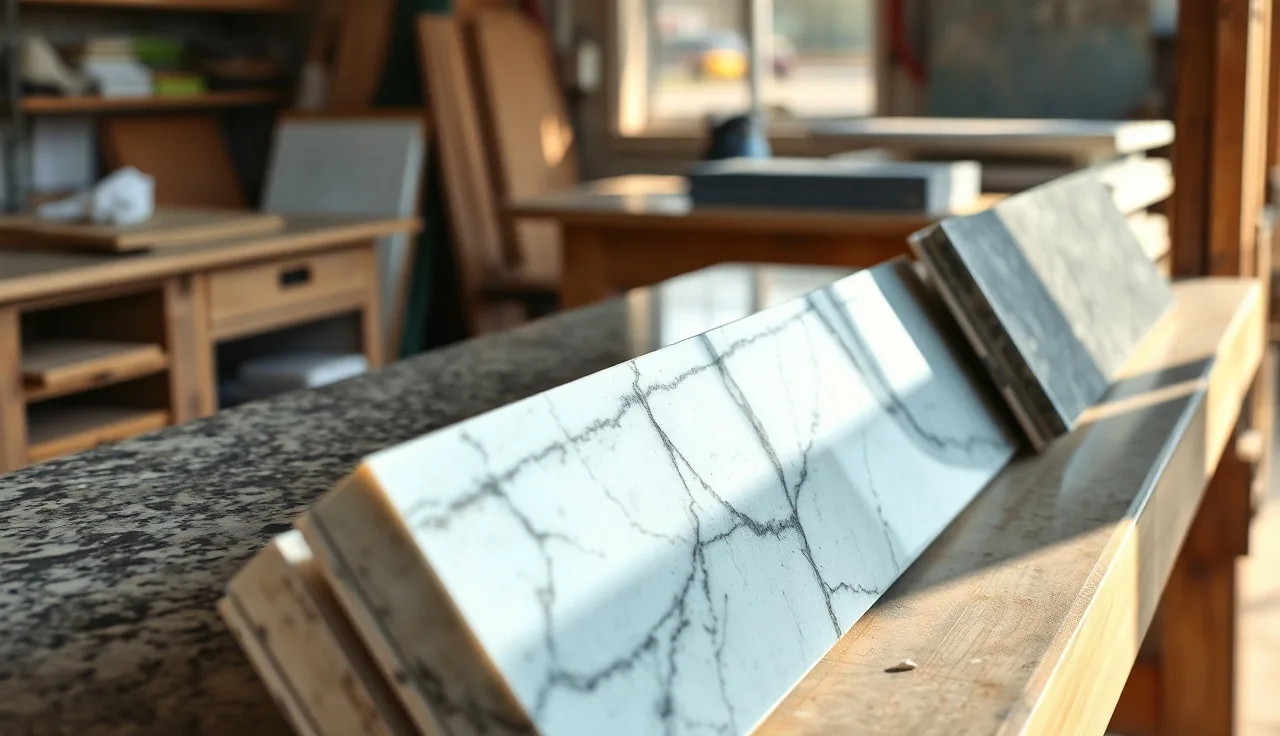
The fix fabricators have used for decades is laminating the front edge. You glue a strip of matching stone under the front face, double the visible thickness to something near 1.5 inches, then profile that composite edge. You get the look of a thicker slab with a more complex profile. You also pay for both the lamination labor and the profile cut, and if the stone has strong veining, you get a visible seam line unless the strips are bookmatched carefully.
Which edge profiles actually work on 2cm without laminating?
Most homeowners and even some fabricators skip past this question. Here's what cuts cleanly in native 2cm, no lamination needed.
| Profile | Works in 2cm? | Notes |
|---|---|---|
| Eased (straight with slight top-corner break) | Yes | Most common default, free or very low cost |
| Bevel (angled top face) | Yes | Typically 45-degree cut, looks clean on thin stone |
| Pencil round / micro bevel | Yes | Subtle radius on top edge only |
| Half bullnose (top round only) | Yes | The bottom edge stays square |
| Full bullnose | Marginal | Visually small; some fabricators refuse on 2cm |
| Ogee | No (needs lamination) | Multi-step S-curve needs more height to read properly |
| Double ogee | No | Needs 3cm or laminated 2cm |
| Dupont / cove ogee | No | Same height issue |
| Waterfall / mitered | Needs lamination | Done regularly on 2cm with a mitered return |
| Chiseled / rock face | Marginal | Depends on stone; very thin chisel marks can chip |
| Stacked laminate (double thickness) | Yes, but it IS lamination | This is the classic 2cm workaround |
The rule of thumb most fabricators use: if a profile's vertical height needs more than about 20mm of material to look right, laminate first. That boundary isn't written in any code. It's shop knowledge, passed down over years of cutting stone and watching what chips.
What do different edge profiles cost on 2cm countertops?
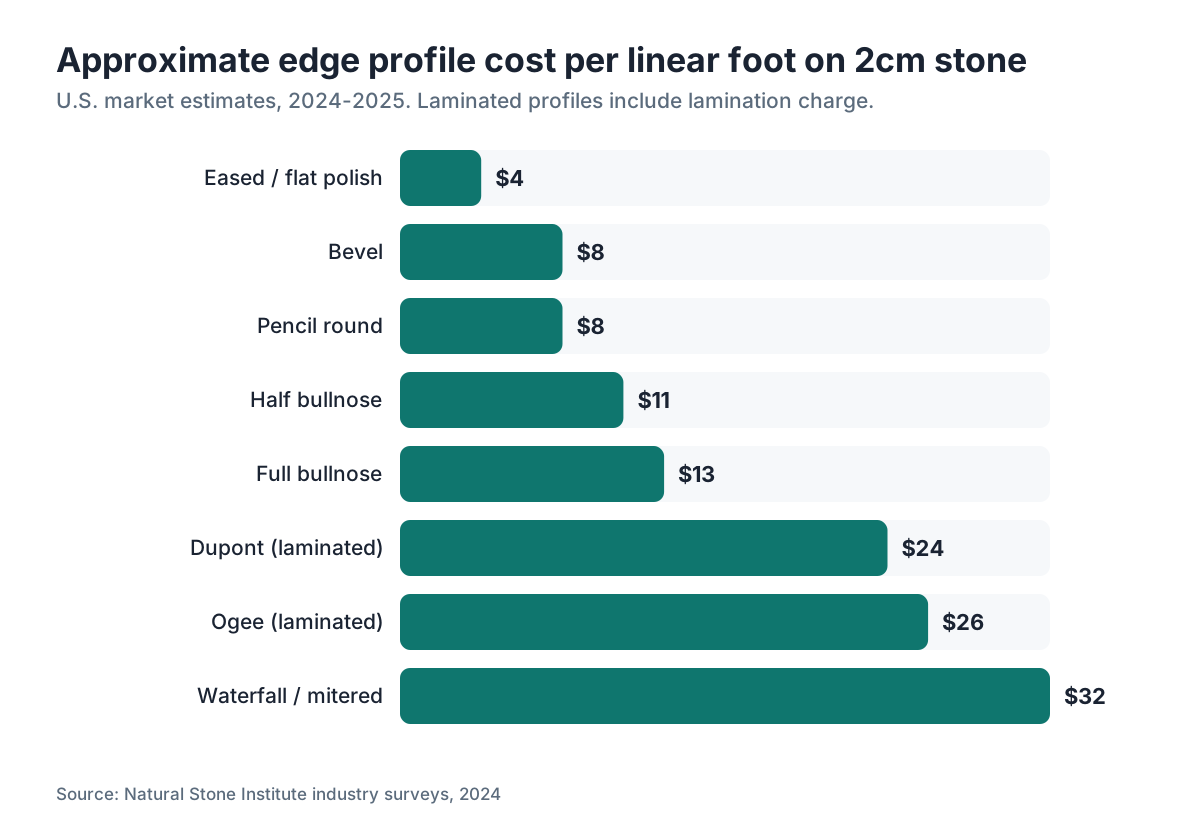
Edge pricing swings with region, shop overhead, and stone type, so the ranges here are honest estimates, not guarantees. The structure holds everywhere: simple profiles are cheap or free, complex profiles cost more, and lamination adds a separate charge on top of the profile charge.
Typical edge profile pricing per linear foot (2cm stone, U.S. market, 2024-2025 estimates):
| Profile | Approximate cost per LF |
|---|---|
| Eased / flat polish | $0, $6 (often included) |
| Bevel | $4, $10 |
| Pencil round / micro bevel | $4, $10 |
| Half bullnose | $6, $14 |
| Full bullnose | $8, $16 |
| Ogee (laminated 2cm) | $18, $30 |
| Dupont / cove | $16, $28 |
| Waterfall / mitered edge | $20, $40 |
| Lamination strip (added to above) | $10, $20 additional |
These numbers track what fabricators report in regional surveys from the Natural Stone Institute, formerly the Marble Institute of America [1]. The NSI notes that edge labor is one of the most variable cost items in a fabrication job because it turns so heavily on machine setup time and wheel change frequency.
If you're building a quote and want to see how edge choices ripple through the total, SlabWise's instant quote calculator lets you pick profile type and length and watch the line-item cost update in real time. That's the fastest way to see the real dollar gap between, say, a bevel and an ogee before you commit.
Here's what homeowners underestimate. Edge footage adds up fast. A standard U-shaped kitchen easily has 30 to 40 linear feet of edged perimeter. At $20 per foot extra for an ogee over an eased edge, that's a $600 to $800 difference on the edge upsell alone.
What is the most popular edge profile for 2cm countertops?
Eased edge wins for 2cm by a wide margin. It's a flat-polished face with the top and sometimes bottom corners knocked back slightly to stop chipping. It works in 2cm with no adjustment, it machines fast, and it looks clean in modern and transitional kitchens alike.
Bevel is probably second, especially on marble and quartzite where the slight angle catches light and brings out the stone's character. Half-bullnose comes next, big in the 2000s and still requested often in traditional and transitional designs.
Full bullnose has lost ground. In 2cm it doesn't have the material to produce the generous rounded look homeowners picture from showroom samples cut in 3cm. Many fabricators quote it but warn the customer upfront that it'll look thinner than expected.
The trend toward thicker countertops, driven by design media's love of dramatic mitered waterfall islands, has actually pushed some imported marble buyers toward 2cm with a mitered laminated front. You get the visual of a 4cm slab for less cost per square foot than buying true 4cm material.
In bathrooms and laundry rooms, where 2cm stone is more common and the tops are smaller, a simple eased or pencil round edge is usually the right call. Nobody in a powder room is going to appreciate a full ogee on a 4-inch-deep vanity strip.
How does edge profile choice affect durability on 2cm stone?
Thinner stone chips more easily than thick stone, full stop. That's mechanics, not opinion. A 2cm slab has less material between its top surface and the edge profile, so a sharp impact on the edge corner sits closer to the main body of the slab.
Eased and beveled edges help. Knocking back the sharp 90-degree corner reduces the stress concentration at the edge, which makes the countertop less likely to chip from a dropped pan or a hard bump from an open dishwasher door. A full bullnose, counterintuitively, can be vulnerable on thin stone because the profile leaves a thin cross-section at the side of the curve.
Chiseled and leathered rock-face edges look rustic and interesting but are genuinely risky on 2cm. The chiseling can seed micro-fractures close to the surface, and you have less margin before those fractures reach the structural body of the top.
Rank the choices for 2cm durability and it comes out roughly like this: bevel or eased are best, half-bullnose is good, full bullnose is acceptable, ogee on a laminated edge is fine once laminated (though the laminate seam is a weak point), and chiseled is not recommended. For care guidance by stone type, the Natural Stone Institute publishes maintenance standards that touch on edge fragility [2].
Does edge profile affect how a 2cm countertop is installed?
Yes, in a few specific ways. A flat eased edge has no overhanging profile element, so it installs cleanly against cabinetry with no clearance issue. A profile with a lower cove or ogee detail can force the fabricator to notch or adjust the cabinet top edge to avoid interference, especially on face-frame cabinetry where the stile comes up flush with the countertop bottom.
Mitered waterfall edges on 2cm need careful templating because the miter angle has to account for the laminate strip if one is present. If that strip isn't glued and clamped perfectly flush before you template the miter return, the waterfall panel won't sit plumb. It's a process discipline problem, not an impossible one, but it's why waterfall islands on 2cm tend to carry higher labor quotes than the same design in 3cm.
Overhang support is the other factor. Seating overhangs need corbels or brackets once they pass certain thresholds. The National Kitchen and Bath Association design guidelines call for 15 inches of overhang for seating at counter height [8]. On unsupported cantilever, industry guidance from the Tile Council of North America has historically referenced 1/3 of the countertop depth as the maximum for stone [3]. At 2cm, most fabricators drop that limit further and want corbels at 10 to 12 inches of overhang or less.
If you're planning a countertop installation yourself or supervising a crew, ask specifically about overhang support for 2cm before the slab goes on the cabinets.
How do edge profile options differ for 2cm quartz versus 2cm natural stone?
The physics are the same but the behavior isn't always identical. Engineered quartz (brands like Cambria, Silestone, MSI) is more uniform than natural stone, with no natural fissures or soft spots for a polishing wheel to catch. That makes profiling 2cm quartz a bit more predictable than profiling 2cm marble or limestone, which can hide soft inclusions or existing microfissures.
That said, cambria countertops and other premium quartz lines usually ship in 3cm in the U.S., so you'll mostly meet 2cm quartz in imported lines or commercial work. When you do, the profile list is essentially the same as for natural stone, with the same lamination requirement for complex edges.
Softer natural stones (limestone, travertine, some marbles) are more likely to show micro-chipping on aggressive profiles at 2cm. Harder stones (quartzite, granite) handle thin profiles better. The Mohs hardness scale gives a rough guide: granite runs 6 to 7, quartzite 7 and up, marble and travertine 3 to 4 [4]. Below Mohs 5, complex edges on 2cm are genuinely risky.
For granite countertops, 2cm is rare in the current U.S. market but more common in imported slabs from Brazil and India. Granite profiles cleanly for simple edges; the stone is hard enough that chip risk from profiling is low. For marble countertops, a bevel or half-bullnose is the safest choice in 2cm, because marble's relative softness pushes chip risk up on complex edges during fabrication and in daily use.
What edge profiles work for non-stone 2cm countertop materials?
Not every 2cm countertop is stone. Laminate, solid surface (like Corian), and some porcelain slabs all run around 2cm or less in standard builds.
For laminate countertops and formica countertops, the edge works on a different principle. You're profiling a substrate (usually particleboard or MDF) that gets wrapped or capped. Laminate tops typically use a postformed rounded edge (a gentle bullnose formed by bending the laminate sheet), a square edge with a matching laminate strip, or a wood edge cap. There's no stone to profile; the edge detail comes from how the laminate is applied.
Solid surface is more interesting. Materials like corian countertops run 12mm to 19mm thick (roughly 1/2 inch to 3/4 inch) and route to almost any profile because the material is a uniform acrylic or polyester blend with no grain or cleavage planes. Ogee, dupont, beveled, bullnose, and custom router shapes all work. Lamination for a thicker look works too, and the seam is virtually invisible when heat-fused correctly. The NSI comparison of solid surface versus stone touches on this fabrication difference [5].
Porcelain slab tops at 12mm have become popular. They're very hard but also brittle. Complex profiles are genuinely risky, especially internal coves. Most porcelain fabricators stick to eased or mitered waterfall edges and skip ogee or bullnose on thin porcelain for that reason.
How should I choose the right edge profile for my 2cm countertop?
Start with function, then style. Here's the decision logic most experienced designers and fabricators actually run.
High-traffic kitchen with kids and dogs? A sharp eased edge is safer for the adults and the stone. A rounded half-bullnose helps if you've got small children who might bump the edge at head height. Complex coves and ogees collect crumbs and are harder to wipe down, which matters in a kitchen and barely matters in a bathroom.
Showpiece island in a light-use kitchen? The visual drama of a laminated dupont or ogee might be worth the premium. Be honest about how the kitchen actually gets used before you commit.
Style matters too. In a contemporary or minimalist kitchen, an eased edge almost always beats an ornate ogee. In a traditional kitchen with raised-panel cabinetry and detailed moldings, an ogee or dupont picks up those details. A bevel works in transitional spaces, which describes most American kitchens.
Ask your fabricator to show you cut samples in 2cm, not the 3cm samples on display. The proportions change hard. What looks elegant in 1.25-inch granite can look pinched in 3/4-inch marble. Don't skip this.
Before you meet with a fabricator, remember that the same edge profile gets quoted differently by every shop in your material and region. Getting at least three quotes for the identical profile spec is standard advice, and writing down exactly which profile you're specifying saves confusion later.
How do fabricators actually cut edge profiles on 2cm stone?
The main tool is a CNC router or bridge saw with diamond profile wheels. Each shape needs a specific wheel or a sequence of wheels. An eased edge might be one wheel pass on a CNC machine. An ogee needs three or more passes with different wheels, which is why it costs more: more machine time, more wheel wear, more setup.
For 2cm, setup is trickier in some respects because the thinner slab has to be fixtured more carefully to stop vibration. A slab that vibrates during profiling throws chatter marks into the polished surface that then have to be hand-polished out.
Lamination happens before profiling. The strip gets cut, epoxied, and clamped, then cured, and the composite edge runs through the profile sequence as one piece. The color-matched epoxy at the seam matters: a visible glue line on a laminated edge is a quality problem, not a limit of the technique.
Hand profiling still happens in shops doing high-end custom work, especially for very complex or custom profiles on expensive stone. Hand work is slower and costs more, but a skilled polisher can match profiles to irregular edges or repair chips in ways a CNC wheel can't. OSHA rules also govern how these shops run, including silica dust controls that apply to CNC routing and edge profiling of natural stone [9].
For fabricators running quoting software, edge selection often drives a large variable in total job cost. Shops on platforms like SlabWise can configure edge pricing by profile type and linear footage so quotes update automatically as edge choices change. That kills the common problem of quoting a job with a default edge and then having to recalculate when the customer upgrades to a dupont.
What are the common mistakes people make with 2cm edge profiles?
The biggest one is picking an edge from 3cm samples and getting surprised by how different it looks in 2cm. Showrooms overwhelmingly display 3cm because that's what most U.S. residential jobs use. If you're getting 2cm stone, ask to see that specific profile cut in 2cm, or at minimum ask your fabricator to describe how it'll translate.
Second: not budgeting for lamination on a complex edge. A customer who prices an ogee at $20 per foot and then finds a $15 per foot lamination charge on top is going to be unhappy. Get the full edge spec in writing before signing.
Third: over-specifying the edge for the material. A high-drama dupont on a honed Carrara marble 2cm vanity top, in a bathroom that gets daily toothpaste splatter and wet hands, will look rough within a year. The profile traps soap scum and the marble scratches. An eased edge on the same slab cleans easier and holds up longer. For care after installation, especially on softer stones, see our guide on how to clean stone countertops.
Fourth: ignoring the underside. On 2cm with a laminated edge, the underside of the strip is visible from the front at eye level, like at a kitchen island. A neat, flush laminate with a color-matched seam reads fine. A messy one looks amateurish. Ask to see finished laminated edge examples from your fabricator before committing.
Frequently asked questions
Can you put a full bullnose edge on 2cm stone?
Yes, but it looks smaller than a bullnose on 3cm. A full bullnose on 2cm produces a tight radius that many homeowners find underwhelming. Fabricators often suggest a half-bullnose instead, which reads more proportional on thin material. If you want a dramatic rounded edge, laminating the front first to create roughly 4cm of visible thickness gives the bullnose more material to shape.
Does a 2cm countertop edge chip more easily than a 3cm edge?
Generally yes. Less material at the edge means less buffer between a sharp impact and the countertop's main body. Eased and beveled edges cut this risk by removing the sharp 90-degree corner that's most vulnerable. Hard stones like granite and quartzite hold up better than softer materials like marble and travertine, which can chip on complex profiles even in 3cm.
How much does it cost to add a laminated edge to a 2cm countertop?
Lamination typically adds $10 to $20 per linear foot on top of the profile charge, based on pricing patterns in the Natural Stone Institute's industry surveys. Total cost for a laminated ogee or dupont on 2cm stone usually runs $28 to $50 per linear foot all-in, depending on region, shop overhead, and stone type. Get this as a separate line item in your quote.
What is the easiest edge profile to clean on a 2cm countertop?
Eased edge, by a lot. It's a flat face with a slight corner break, so there are no coves or curves to trap crumbs, soap, or water. Ogee and dupont profiles have internal curves that collect debris and need a brush or narrow cloth to clean properly. Bevel is second easiest. If easy cleaning matters to you, keep the profile simple.
Is an ogee edge possible on a 2cm quartz countertop?
Yes, but only with a laminated edge. An ogee needs more vertical height than 2cm provides for the S-curve to read correctly. Your fabricator glues a strip of matching quartz under the front edge, bringing total visible thickness to roughly 4cm, then cuts the ogee into that composite. The seam on quartz is usually tighter than on natural stone because engineered quartz has a more consistent color.
What edge profile looks best on a thin marble countertop?
For 2cm marble, a bevel or eased edge tends to look the most refined. The slight angle of a bevel catches light beautifully on veined marble and needs no lamination. A half-bullnose is also popular. Avoid aggressive profiles like ogee or chiseled edges on thin marble; the material's relative softness puts complex edges at real risk of chipping during fabrication and daily use.
Do I need extra support brackets if I choose a waterfall edge on a 2cm island?
Yes. The waterfall edge is a vertical mitered return panel, not a structural cantilever itself. The island top still needs support for any overhang. At 2cm, most fabricators recommend corbels or metal brackets for any overhang beyond about 10 to 12 inches, more conservative than the 1/3-depth rule applied to thicker material. Confirm the specific requirement with your fabricator before templating.
Can you profile 2cm porcelain slab with an ogee edge?
Most fabricators avoid ogee and cove profiles on thin porcelain because the internal curve of an ogee leaves a cross-section that can fracture during machining. Eased and mitered waterfall edges are the standard choices for 2cm porcelain. Waterfall miters on porcelain are actually common and look striking, but they need a very precise miter cut because porcelain has no forgiving flex.
What is a dupont edge and how does it compare to an ogee on 2cm stone?
A dupont edge has a convex top curve that transitions to a straight vertical face, without the reverse curve an ogee has. It's simpler to machine than a full ogee, so it costs slightly less and has fewer internal curves that could chip. On 2cm with lamination, a dupont reads well and gives a more classic look than a plain bevel without the full complexity of an ogee.
How do I tell my fabricator exactly what edge profile I want?
Use the profile name and ask to see a physical sample cut in the same material and thickness you're ordering. Bring a photo if you have one. Specify in writing whether you want the underside also profiled or left square. For laminated edges, confirm whether the lamination charge is in the per-foot price or added separately. Get all of this in your written quote before deposit to avoid disputes.
Does the edge profile choice affect the countertop's resale value?
Marginally. A very dated or unusual edge, like a highly ornate double ogee in a contemporary house, can look out of place and sometimes gets flagged in real estate staging advice. A clean eased or bevel edge is neutral and appeals to most buyers. The countertop material and its condition matter far more to resale than the specific edge profile.
Are there edge profiles that are only available in 3cm and not 2cm?
Any multi-step profile that needs more than about 20mm of vertical height won't work in native 2cm without lamination. That includes most double ogee, triple pencil, and cove-ogee combinations. With lamination, most of those become possible. The practical exception is very ornate architectural profiles from custom furniture-grade millwork, which fabricators won't attempt on 2cm regardless of lamination.
Sources
- Natural Stone Institute, Fabrication, Installation, and Care standards: Edge labor is among the most variable cost items in a fabrication job, depending on machine setup time and wheel change frequency; NSI publishes industry cost surveys referenced by U.S. fabricators.
- Natural Stone Institute, Stone Maintenance and Care guidelines: NSI care and maintenance standards address edge fragility by stone type, relevant to hardness differences between marble, granite, and quartzite.
- Tile Council of North America, TCNA Handbook: Industry guidelines historically reference 1/3 of countertop depth as a maximum unsupported cantilever for stone countertops.
- U.S. Geological Survey, Mohs Hardness Scale mineral reference: Granite Mohs hardness 6-7, quartzite 7+, marble and travertine 3-4; hardness affects edge chip resistance.
- Natural Stone Institute, Dimensional Stone Design Manual: Design manual covers 2cm versus 3cm slab applications, laminated edge construction, and profile specifications for residential countertops.
- Marble Institute of America (now Natural Stone Institute), Countertop Installation standards: Installation standards address overhang support thresholds and laminated edge requirements for thin stone slabs.
- U.S. Geological Survey, Granite mineral and rock overview: USGS documents granite as a hard igneous rock, Mohs 6-7, supporting edge durability claims relative to softer stones.
- National Kitchen and Bath Association, Design Guidelines: NKBA guidelines specify 10-12 inch minimum knee clearance and 15 inch overhang for seating at kitchen islands, relevant to overhang and edge support decisions.
- Occupational Safety and Health Administration, Stone fabrication industry standards: OSHA standards cover stone fabrication shop operations including silica dust controls relevant to CNC routing and edge profiling of natural stone.
- International Residential Code, IRC Section R301, structural loading: IRC structural load provisions apply to countertop support requirements including bracket and corbel specifications for cantilevered stone.
Last updated 2026-07-09