TL;DR
- Corian solid surface supports more edge profiles than stone because the material is thermoformable and bonds with a color-matched adhesive that hides the joint.
- Standard options include eased, beveled, bullnose, ogee, and dupont.
- Custom profiles, laminated build-ups, and routed decorative shapes are all possible.
- Profile complexity adds roughly $5 to $30 per linear foot above a simple eased edge.
What makes Corian edge profiles different from stone or laminate edges?
Corian is acrylic-based, so it can be routed, sanded, thermoformed, and chemically bonded in ways granite and quartz simply can't. Two pieces of Corian fuse with color-matched adhesive so the joint practically disappears. That single fact changes everything at the edge.
With granite or marble countertops, the fabricator routes a profile into the slab thickness you already have, usually 3/4 inch or 1-1/4 inch. You work with the material you've got. With Corian, a fabricator can bond a second or third strip of material under the top surface to build up thickness, then rout any profile into that laminated block. The result can look like a 3-inch-thick countertop even though the sheet itself is only 1/2 inch thick.
Compare that to laminate countertops or Formica countertop edge profiles, which are largely stuck with the particleboard core and the thin laminate skin. Formica edges are usually post-formed (a rounded front lip molded during manufacturing), beveled, or capped with a separate strip. You get maybe four or five practical options, and every one shows a visible line at the edge. Corian's edge vocabulary is far wider.
Corian does have one limit stone doesn't. Very sharp 90-degree inside corners are a stress point and can crack over time. Fabricators put a small radius even on "square" interior corners for that reason [1].
What are the standard Corian edge profiles available?
Most fabricators offer a core set of profiles cut with standard router bits on a CNC machine or by hand. Here's what you'll actually run into.
Eased edge (also called slightly eased, or a 1/8-inch radius): The top corner gets a tiny break so it's not razor-sharp. This is the default on almost every quote. It looks clean and modern, and it's what you get if you don't specify anything else. Cost adder: $0, it's included.
Beveled edge: The top corner is cut at an angle, usually 45 degrees, sometimes shallower. A 1/4-inch bevel is subtle. A 3/4-inch bevel is more architectural. This profile is common on contemporary kitchens and adds a small amount, usually $2 to $5 per linear foot.
Half bullnose: The top corner rounds to a half-circle. It softens the look without making the edge look thick. Popular in bathrooms.
Full bullnose: Both the top and bottom corners round over into a complete dome. It needs enough material thickness to pull off cleanly, which is why fabricators often laminate a strip underneath before routing. Adds roughly $8 to $15 per linear foot on top of a base eased edge, depending on whether lamination is needed [2].
Dupont edge (or DuPont edge): A squared-off top with a small cove routed just below it, then a slight outward flare at the bottom. It reads formal and traditional. Common in classic kitchens where you want a decorative profile without going full ogee.
Ogee: An S-curve, with a concave cove on top and a convex roundover below. This is the most traditional-looking profile and the most divisive. Some homeowners love the furniture feel. Others find it dated. It photographs well in cream or white kitchens. It's also one of the more time-intensive profiles to sand and polish on solid surface.
Waterfall / chiseled / mitered: Less a router profile, more a fabrication technique. The countertop material runs vertically down the side of the cabinet run in a continuous sheet, meeting the floor or a panel below at a mitered joint. This works beautifully with Corian because the joint can be made nearly invisible. On stone, the same look demands perfect grain matching and a conspicuous seam.
Cove / reverse bevel: A concave curve cut into the edge face. Less common, but useful when you want shadow and depth without adding thickness.
Custom profiles beyond these are entirely possible. Fabricators with CNC equipment can run nearly any shape if you supply a template or a drawing. Expect setup fees of $50 to $200 for a custom bit or CNC program, plus the per-linear-foot labor [2].
How does laminated edge build-up work, and when do you need it?
Standard Corian sheet stock is 1/2 inch thick. A 1/2-inch edge can only take so much profile before you're routing through most of the material and weakening the edge. For anything past a simple eased or beveled profile, fabricators laminate one or two extra strips under the front edge to build thickness.
A single lamination (1/2 inch added) brings the visible edge face to 1 inch. A double lamination (1 inch added) brings it to 1-1/2 inches, enough material for a full bullnose, an ogee, or most decorative profiles. The strips get cut from the same sheet material, glued with color-matched solid surface adhesive, then routed as one piece. Done well, you can't see the joint [1].
The added cost is partly material (extra sheet stock) and partly labor (cutting, gluing, clamping, waiting for cure, then routing). Typical lamination adder: $4 to $12 per linear foot. Some fabricators bake one lamination into their standard pricing for profiles that need it. Others line-item it separately. Ask directly when you're getting quotes.
On an island with 20 linear feet of visible edge, a double-laminated ogee might add $240 to $480 to the edge work alone. That's real money. Know what you're ordering.
IKEA solid surface countertops (their BADELUNDA line) ship as flat sheets with a factory eased edge. IKEA does not offer custom edge profiles at the point of sale. Homeowners who want a different profile on IKEA solid surface countertops either hire a local fabricator to reroute the edge after purchase or accept the factory finish [3].
Which edge profile is best for a kitchen vs. a bathroom?
There's no single right answer, but fabricators lean on the same practical patterns again and again.
In kitchens, especially with young kids or heavy daily use, a simple eased or half-bullnose edge is easier to live with. Sharp beveled edges and ogee profiles have small grooves and transitions that catch crumbs and take more careful cleaning. An eased edge wipes clean in one pass.
For a more formal or traditional kitchen, a dupont or ogee profile adds detail that reads well from across the room. These show up most in white or painted cabinet kitchens where the countertop edge is right in your eyeline.
In bathrooms, half-bullnose and full bullnose profiles are everywhere, partly because bathroom counters see lighter use and partly because the rounded softness fits the space. Laminated full bullnose on a vanity looks genuinely upscale without costing a fortune.
For bars and outdoor counters (Corian works outdoors with some caveats around UV exposure), a simple eased or beveled edge is more practical because it's easier to repair if it chips or scuffs.
For a kitchen island waterfall, the mitered full-height edge keeps getting more popular, and Corian handles it better than most materials because the joint can be made virtually invisible. Budget accordingly. A full waterfall panel on one side of an island can add $300 to $700 depending on panel height and finish work [2].
How much do different Corian edge profiles cost per linear foot?
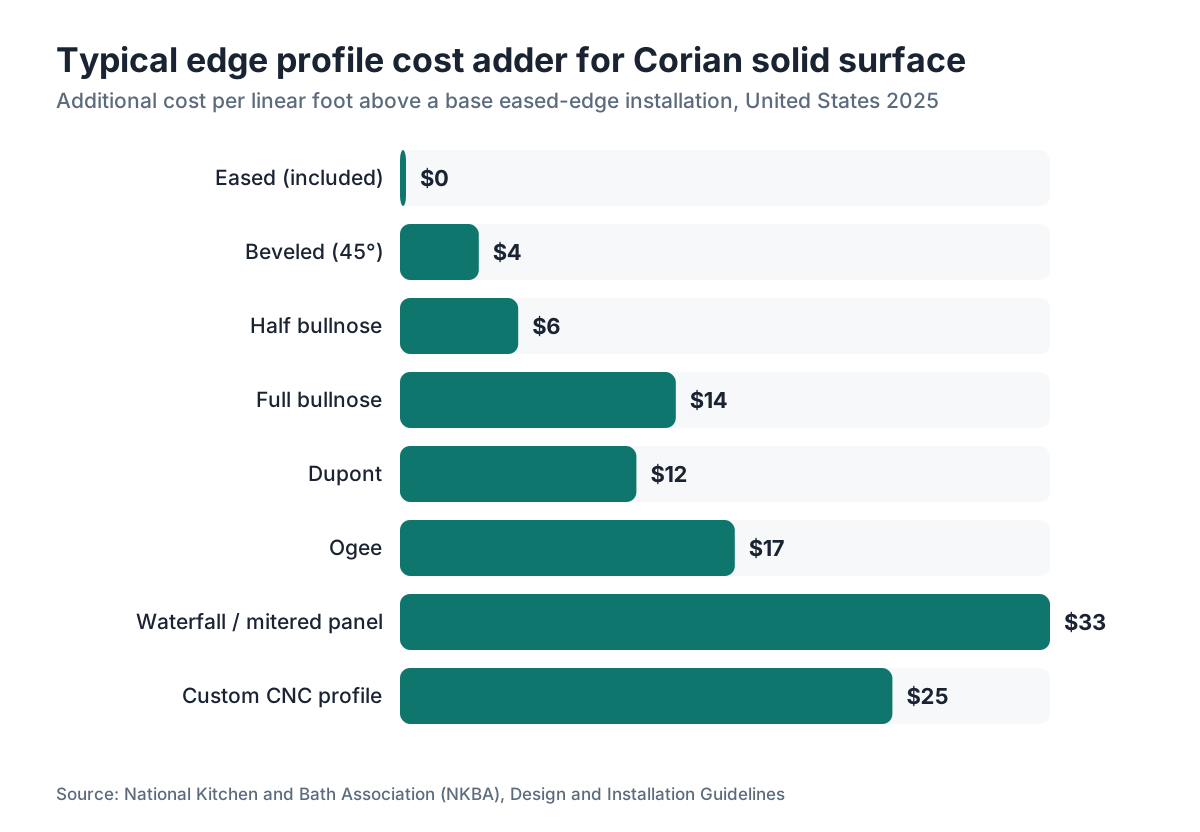
Pricing shifts by region and fabricator, but the table below reflects the typical adder above a base eased-edge installation in the United States as of 2025. These are not total countertop prices. They're the edge upcharge specifically [2].
| Edge Profile | Lamination Needed? | Typical Cost Adder (per LF) |
|---|---|---|
| Eased (1/8" radius) | No | $0 (included) |
| Beveled (45°) | No | $2 to $5 |
| Half bullnose | No | $4 to $8 |
| Full bullnose | Usually 1x | $10 to $18 |
| Dupont | Usually 1x | $8 to $15 |
| Ogee | Usually 1x-2x | $12 to $22 |
| Waterfall / mitered | Full panel | $25 to $40+ |
| Custom CNC profile | Varies | $15 to $35 + setup |
A few things to keep in mind. These are adders: you still pay the base fabrication and material cost on top. If your countertop perimeter is mostly against walls and only a few linear feet are truly visible (the front of an island, the exposed side of a peninsula), the edge upcharge on a nice profile is often smaller than people expect. Twenty linear feet of ogee at $12 per foot is $240. And some fabricators fold edge profiles into their per-square-foot pricing and never itemize them. Get a written quote that breaks out edge treatment separately so you can compare apples to apples.
For context, a typical kitchen countertop job has roughly 25 to 40 linear feet of exposed edge, depending on layout. Upgrading from eased to full bullnose on 30 linear feet might cost an extra $300 to $450. Upgrading to a waterfall island edge on the same job might add $600 to $900 for the panel work alone.
Can Corian edges be repaired or changed after installation?
Yes, and this is one of the genuine advantages of solid surface over stone or laminate. Because Corian is a uniform acrylic material all the way through, a fabricator or even a skilled homeowner can sand, reroute, and refinish an edge in place.
For minor chips or scratches on an eased or bullnose edge, fine-grit sandpaper (220 grit, then 400, then Scotch-Brite) restores the surface without leaving a visible patch. The DuPont technical bulletin on Corian repair specifies wet sanding starting at 220 grit for deeper scratches, moving to 400 and then a Scotch-Brite pad for matte finishes, or to 1200 and automotive polish for gloss [4].
To actually change an edge profile after installation, a fabricator brings a router to the site or pulls the countertop section and remachines the edge in the shop. Rerouting from eased to beveled is straightforward. Rerouting from eased to full bullnose is harder because it usually needs an added lamination strip, which means the countertop may have to come out. Get a quote before you commit to a post-installation edge change.
Laminate edges (Formica countertop edge profiles) don't repair the same way. Once the thin laminate skin chips or delaminates, the fix is almost always visible. That's one reason solid surface commands a higher price: the repairability is real.
For general countertop care beyond edges, the principles in our guide on how to clean stone countertops overlap partly, though solid surface asks less of you than natural stone.
How does quoting edge profiles work for fabricators?
For fabricators, edge profiles are one of the most common sources of quote errors and margin leakage. An eased edge and a double-laminated ogee take wildly different amounts of time and material, yet some shop software or manual quote sheets treat every edge as a single line item.
The better approach is to quote edge by type and by linear footage, separate from the slab area. For each run of countertop, record the profile type, the number of laminations required, whether it's a straight run (CNC-friendly) or curved (hand-work), and whether the client wants a matte, semi-gloss, or high-gloss finish. Gloss finishing adds polishing time, so it belongs in the estimate.
Shops running purpose-built quoting software can set per-profile pricing rules so the system calculates edge costs automatically when the job is drawn. SlabWise, for example, lets fabricators configure edge profile price tiers by linear foot so quotes auto-update when the profile selection changes. That removes the manual math and catches the lamination adder for you.
For curved countertops (kidney-shaped islands, rounded breakfast bars), every profile except eased and simple bevels needs hand-routing and hand-sanding, because CNC toolpaths get messy on compound curves. Price curved edge work at 1.5x to 2x the straight-run rate, or you'll lose money on it.
Putting the agreed edge profile in writing on the sales order matters more than most fabricators think. "Bullnose" means different things to different homeowners: some mean half bullnose, some mean full bullnose, some mean a simple roundover. Get a physical sample or a cross-section drawing signed off before you cut.
How do Corian solid surface edge profiles compare to quartz or granite?
The comparison comes up constantly, so here it is plainly. Corian gives you a wider profile menu and field repairs; stone gives you hardness at the surface. That's the whole tradeoff in one sentence.
Granite and quartz slabs are usually 3/4 inch or 1-1/4 inch thick (called 2cm and 3cm in the industry). Fabricators rout profiles directly into the edge. You can get eased, beveled, bullnose, ogee, and ogee-with-cove profiles in stone, and the material is hard enough that high-detail profiles hold up well. But stone can't be thermoformed, can't be bonded invisibly, and chips at sharp corners if you hit them hard enough.
Granite countertops and Cambria countertops (an engineered quartz) offer basically the same edge profile menu as each other, with some variation in what individual fabricators will cut. Edge pricing for stone runs close to solid surface: roughly $0 for eased, up to $20 to $30 per linear foot for a complex mitered waterfall.
Corian solid surface edge profiles have three things stone doesn't. The joint can be made invisible when laminating thickness. The material is field-repairable. And thermoformed curves are possible, bending Corian around a radius with heat. Stone's edge over Corian is hardness and scratch resistance on the field of the counter, not at the edge.
IKEA solid surface countertops are a lower-cost entry into this category with far less fabrication flexibility than custom solid surface. The factory edge on IKEA products is a simple eased profile, and the material runs thinner (around 30mm / 1-3/16 inch) than full-thickness Corian [3].
Formica countertop edge profiles (post-formed laminate) are the most limited option, mostly restricted to the rounded post-form edge or flat laminate-cap edges. They're also the cheapest, which is the legitimate reason to choose them.
What finish options come with each edge profile?
The edge profile and the edge finish are two separate decisions that play off each other. Corian ships from the factory in matte and semi-gloss, and fabricators can deliver the edge in matte, semi-gloss, or high-gloss depending on how far they push the sanding and polishing progression.
Matte finish on an edge is the most forgiving. Scratches are nearly invisible, and re-sanding a matte edge to remove a chip is quick. Most fabricators default to matte or semi-gloss.
High-gloss edges on an ogee or full bullnose look striking, but they show fingerprints and fine scratches more readily. They also take real bench time to produce. Expect to pay a premium of $3 to $8 per linear foot for a high-gloss edge finish on top of the profile adder.
Matte and high-gloss can live on the same countertop. A matte field (the horizontal surface) with a semi-gloss edge is a popular combination because the edge detail reads clearly without going flashy.
According to the Corian Design product technical guide, "The surface can be restored to its original finish using fine abrasives" for both matte and gloss variants, though gloss requires extra polishing steps [4]. That repairability applies to the edge just as much as the field surface.
For homeowners weighing all the material options, our guide to kitchen countertops covers how finishes compare across materials.
How do you choose the right edge profile for your design?
The honest answer: most people overthink the edge profile and underthink the color and thickness. An eased edge in a beautiful color beats a fussy ogee in a color that fights your cabinets.
Here's a practical framework anyway.
Match the profile formality to the cabinet style. Shaker cabinets in white or off-white pair naturally with dupont or half-bullnose. Flat-panel modern cabinets pair best with eased or mitered waterfall. Raised-panel traditional cabinets can carry an ogee without looking overdone.
Think about who uses the counter. Young kids and elderly family members benefit from edges without sharp corners. A beveled 45-degree edge has a surprisingly aggressive corner if you bump it at hip height. Full bullnose and eased edges are safer in that context.
Treat the front of islands and peninsulas differently from perimeter counters. Island edges get seen from multiple angles and from across the room, so a more detailed profile reads better there. Perimeter counters against walls are mostly seen from above, so the edge detail matters less.
Get physical samples. Most Corian fabricators can cut a short sample of an edge profile in the material and color you're considering. A 6-inch sample you can hold beats any rendering.
If you're unsure about edge costs across the whole project, the instant quote tool at SlabWise lets homeowners enter dimensions and edge selections to see itemized pricing before they contact a fabricator. It won't replace a formal shop quote, but it gives you a realistic range to check against.
For any countertop installation, lock the edge profile in writing in the contract before the template appointment. Changes after templating are possible but may cost you rework fees.
Are there edge profiles specific to sinks, cooktops, or backsplash transitions?
Yes, and these get forgotten in the first design conversation more often than not.
At an undermount sink, the edge that wraps the cutout is a separate profile from the outside countertop edge. The common options: a simple eased edge around the sink opening (clean, easy to wipe), a small cove cut that throws a subtle shadow line, or a slightly beveled reveal. Sharp inside corners at the sink opening should always get a radius to prevent stress cracking, especially in light colors where cracks show easily [1].
At the cooktop, the cutout edge is usually left as a simple eased profile because it won't be seen and because a thin, detailed profile right next to a heat source could show scorch marks more readily.
At the backsplash transition (where the countertop meets the wall tile or the solid surface backsplash), the detail matters visually. If the countertop and backsplash are the same Corian material, a coved backsplash (a curved transition from horizontal to vertical, sometimes called a marine edge or integral backsplash) kills the joint entirely. This is one of the genuine design advantages of solid surface: a coved backsplash with no visible joint is impossible in stone or laminate.
Corian countertop solid surface edge profiles at the backsplash transition are worth thinking about for hygiene too. A coved joint with no seam has nowhere for water or bacteria to collect. In commercial kitchens, coved backsplash junctions are often required by health code for exactly this reason [5].
For homeowners exploring other materials beyond solid surface, our overview of butcher block countertops covers edge and backsplash transitions for wood.
Frequently asked questions
What is the most popular Corian edge profile for kitchens?
Eased edge (a small 1/8-inch radius on the top corner) is the most commonly specified profile because it's included in base pricing, cleans easily, and suits modern and transitional kitchens. Half bullnose is the next most popular choice, especially on islands. Ogee and dupont profiles stay popular in traditional-style kitchens with raised-panel cabinets.
Can I get a waterfall edge on Corian countertops?
Yes. Corian suits waterfall edges well because the vertical panel bonds to the countertop with color-matched adhesive, making the joint nearly invisible. The panel is typically a separate piece of Corian sheet stock, cut and mitered to meet the countertop at a clean 45-degree joint. Expect a cost adder of $300 to $700 per waterfall panel depending on height and length.
How do Corian edge profiles compare to Formica or laminate edges?
Formica and laminate countertop edges are limited to post-formed rounded profiles, 45-degree bevels, and laminate-capped flat edges. You get four or five real options total. Corian offers a dozen or more standard profiles plus custom routed shapes, laminated build-ups with hidden joints, and thermoformed curves. Laminate edges can't be repaired invisibly. Corian edges can be sanded and refinished in place.
Does the edge profile affect the durability of Corian countertops?
Yes, indirectly. Sharp inside corners (like a square 90-degree inside corner on a cutout) are stress points that can crack under impact. Fabricators always add a small radius there. On outside edges, a simple eased or bullnose profile is less likely to chip than a fine-detail ogee because there's more material supporting the outermost corner. High-traffic kitchens do better with simpler, sturdier profile shapes.
What edge profile works best for Corian bathroom vanities?
Half bullnose and full bullnose are the most popular choices for bathroom vanities because the rounded softness suits the space and there are no sharp edges at hip height. Dupont profiles are also common in more traditional bathrooms. For a modern floating vanity, an eased or slightly beveled edge with a mitered front apron gives a clean, architectural look.
Can a fabricator change the edge profile after the countertop is installed?
A simple reroute from eased to beveled can be done in place with a handheld router and careful masking. More complex changes, like adding a full bullnose that needs lamination, usually require removing the countertop section, doing the lamination and rerouting in the shop, then reinstalling. Get a written quote before you assume a post-install change is cheap or simple.
How do I specify a Corian edge profile on a quote or contract?
Use the profile name plus the approximate dimension ("full bullnose, 1-inch reveal, single lamination") and ask the fabricator for a physical cross-section sample or a shop drawing to sign off. Vague terms like "rounded edge" mean different things to different shops. A signed drawing or sample prevents disputes at installation and protects both you and the fabricator.
Do IKEA solid surface countertops come with edge profile options?
No. IKEA solid surface countertops (currently the BADELUNDA series) ship with a factory eased edge. IKEA does not offer custom edge profile selection at point of sale. Some homeowners hire a local fabricator to reroute the edge after purchase, which is technically feasible but adds cost and may void any warranty claims on the material.
What is a dupont edge on Corian countertops?
A dupont edge (sometimes written DuPont edge) has a squared-off top face, a small concave cove routed below it, and a slight downward flare at the bottom. It looks more formal than a plain eased edge but less ornate than an ogee. It needs one lamination strip to have enough material depth and typically adds $8 to $15 per linear foot to the edge cost.
Is an ogee edge worth the extra cost on Corian countertops?
It depends on the kitchen style. In a classic or traditional kitchen with raised-panel cabinets and detailed hardware, an ogee edge looks intentional and complete. In a modern or transitional kitchen, it often looks out of place. The cost adder ($12 to $22 per linear foot) is real, and the profile collects crumbs more readily than simpler options. I'd pick it only when the cabinet style genuinely calls for it.
Can Corian edges be thermoformed into curved shapes?
Yes. Corian and most solid surface materials can be heated to roughly 150 to 180 degrees Celsius and formed over a mold, allowing curved countertop edges and shapes that are impossible in stone. This is more common in commercial settings (curved reception desks, bar fronts) than in residential kitchens, but residential applications are possible with the right fabricator equipment.
Does edge profile affect the countertop quote significantly?
On a typical kitchen with 30 linear feet of visible edge, upgrading from eased to full bullnose adds roughly $300 to $450. Upgrading to a waterfall island panel can add $400 to $700. These are real but manageable numbers relative to total project cost. The bigger driver of total price is usually square footage and material color, not edge profile.
What is an integral backsplash or coved backsplash on solid surface?
An integral coved backsplash is a continuous curve that transitions from the horizontal countertop surface up to a vertical backsplash panel, all in the same Corian material with no joint. The curve (the cove) is thermoformed or routed. It removes the seams where water and bacteria collect. It's common in health-code-sensitive commercial kitchens and is an option in residential solid surface installations too.
Sources
- DuPont / Corian Design, Fabrication and Installation Guide: Solid surface sharp interior corners should always receive a radius to prevent stress cracking; laminated edges are cut from the same sheet material and bonded with color-matched adhesive
- National Kitchen and Bath Association (NKBA), Design and Installation Guidelines: Edge profile upcharge ranges and lamination cost adders for solid surface countertops in U.S. fabrication market
- IKEA, BADELUNDA countertop product page: IKEA solid surface countertops ship with a factory eased edge; custom edge profiles are not offered at point of sale
- Corian Design, Technical Data and Repair Guide: "The surface can be restored to its original finish using fine abrasives"; wet sanding from 220 grit for deeper scratches, progressing to 400 and Scotch-Brite for matte or 1200 and automotive polish for gloss
- U.S. Food and Drug Administration, Food Code 2022: Commercial kitchen surfaces should be smooth and free of seams and cracks to prevent bacteria accumulation; coved junctions at wall-floor and counter-backsplash transitions are a common compliance method
- International Surface Fabricators Association (ISFA), Solid Surface Fabrication Standards: Standard solid surface sheet thickness is 1/2 inch; lamination to achieve decorative edge profiles is a recognized fabrication practice
- Occupational Safety and Health Administration (OSHA), Hazard Communication for Fabrication Shops: Routing and sanding acrylic solid surface generates fine particulate requiring ventilation and respiratory protection in fabrication environments
- U.S. Environmental Protection Agency (EPA), Acrylic Polymer Manufacturing: Acrylic solid surface materials (PMMA-based) are non-porous and do not require sealing, supporting their use in food-contact applications
- Formica Corporation, Laminate Countertop Edge Treatment Options: Laminate (Formica) countertop edge options include post-formed rounded, bevel, and laminate-capped flat edges; typically four to five practical choices compared to solid surface
- NSF International, Standard 51: Food Equipment Materials: Solid surface materials including Corian meet NSF/ANSI 51 requirements for food-contact surfaces when properly installed without open seams
Last updated 2026-07-09