What Is Beveled Edge? Definition & Guide
Quick Definition
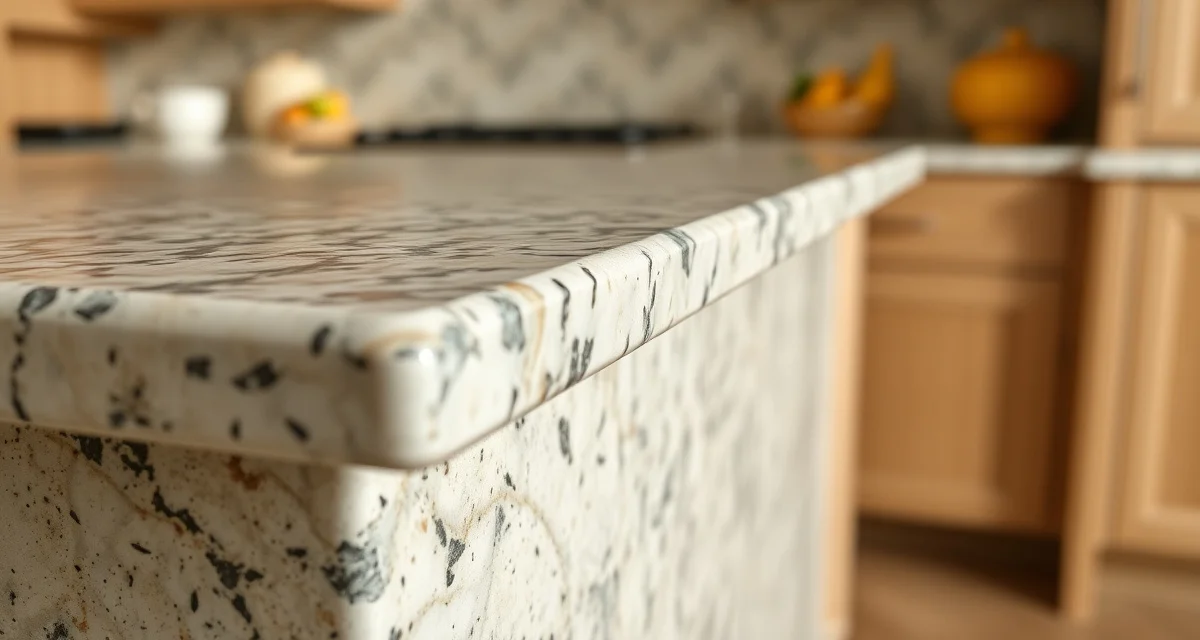
A beveled edge is a countertop edge profile where the top corner of the slab is cut at an angle - typically between 25 and 45 degrees - creating a flat, angled face that transitions from the top surface to the vertical edge. It is one of the most popular edge treatments in granite, quartz, and marble fabrication because of its clean, modern appearance and practical durability.
TL;DR
- A beveled edge features a flat, angled cut along the top edge of a countertop slab
- Standard bevel angles range from 25 to 45 degrees, with 45 degrees being most common
- It is more durable than sharp square edges because the angle resists chipping
- Beveled edges work well on granite, quartz, marble, and most natural and engineered stones
- Fabrication requires a straight-line polisher or CNC router with an angled wheel
- Cost is moderate - usually $8 to $20 per linear foot depending on material and shop
- A bevel can be paired with a laminated edge for a thicker slab appearance
How a Beveled Edge Is Made
The fabrication process for a beveled edge is straightforward compared to more ornate profiles like ogee or dupont. Here is the typical workflow in a countertop shop:
Calculate your material waste savings
See exactly how much slab material and money you could save with optimized cutting layouts.
Try the free Waste Calculator- Slab cutting: The countertop piece is cut to final dimensions on a bridge saw or CNC machine.
- Edge profiling: A fabricator uses an angled grinding wheel or CNC router programmed with a bevel profile to remove material from the top corner at the desired angle.
- Polishing: The angled surface is polished through progressively finer grits (typically 50-grit through 3000-grit) until the bevel matches the top surface finish.
- Quality check: The fabricator inspects the bevel for consistent width and angle along the entire length.
Most shops can produce a standard bevel in a single pass on a CNC edge polisher. Manual fabrication with a hand polisher takes longer but gives the fabricator more control on curved sections and inside corners.
Beveled Edge vs. Other Common Edge Profiles
Choosing an edge profile is one of the first decisions homeowners and designers make during a countertop project. Here is how the beveled edge stacks up against other popular options:
| Edge Profile | Description | Relative Cost | Durability | Style |
|---|---|---|---|---|
| Beveled | Flat angled cut, 25-45° | $$ | High | Modern, clean |
| Eased | Slightly rounded top corner | $ | High | Simple, minimal |
| Bullnose | Fully rounded half-circle | $$ | Very high | Traditional, soft |
| Ogee | S-shaped decorative curve | $$$ | Moderate | Ornate, classic |
| Waterfall | Flat mitered 90° continuation | $$$$ | High | Ultra-modern |
| Dupont | Step-down with curved transition | $$$ | Moderate | Decorative |
| Chamfer | Small flat cut at 45° (narrower than bevel) | $ | High | Subtle, understated |
Beveled Edge vs. Eased Edge
The most common comparison. An eased edge simply rounds off the sharp top corner by a few millimeters. A beveled edge removes a larger, visible flat surface at an angle. The bevel is more noticeable and adds more visual dimension. Both are durable; the bevel costs slightly more because it requires more precise machining.
Beveled Edge vs. Chamfer
These two are often confused. A chamfer is a very small bevel - usually 2-3mm wide - that is almost invisible from a distance. A true beveled edge has a wider flat face, typically 10-15mm or more, and is a deliberate design element rather than just a safety treatment.
When to Use a Beveled Edge
A beveled edge is a strong choice in several scenarios:
- Kitchen countertops: The angled cut catches light and creates a subtle shadow line that defines the edge of an island or perimeter counter.
- Commercial reception desks: The clean geometry fits modern office design without the softness of a bullnose.
- Bathroom vanities: Bevel edges resist chipping better than square edges in high-traffic bathrooms.
- Outdoor kitchens: The flat angle sheds water more effectively than a rounded profile.
Materials That Work Best
Beveled edges are suitable for nearly every countertop material, but they look especially sharp on:
- Granite: The angle highlights the depth of natural stone grain patterns
- Quartz: Engineered stone holds a clean, precise bevel line because of its uniform composition
- Quartzite: Hard enough to maintain the bevel angle without micro-chipping
- Marble: Works well, but softer marble varieties may require more careful polishing
Cost of a Beveled Edge
Pricing varies by region, material, and shop, but here are typical ranges for 2026:
| Factor | Range |
|---|---|
| Standard bevel on granite | $8-$15/linear foot |
| Standard bevel on quartz | $10-$18/linear foot |
| Standard bevel on marble | $12-$20/linear foot |
| CNC-fabricated bevel | $10-$22/linear foot |
| Hand-polished bevel (curved sections) | $15-$30/linear foot |
For a typical 40 linear-foot kitchen, adding a beveled edge runs roughly $320 to $720 on top of the base countertop price.
Beveled Edge Fabrication Tips for Shops
If you run a fabrication shop, here are practical notes on producing consistent beveled edges:
- CNC programming: Set the bevel angle as a parameter in your CAM software so every piece in a job matches. A 1-degree variance is visible at seam joints.
- Tool wear tracking: Angled polishing wheels wear unevenly. Track usage per wheel and replace before inconsistencies show.
- Template accuracy: The bevel adds a visible reference line. If the template is off by even 1/16", the bevel will highlight the error at seams. This is where template verification tools pay for themselves - SlabWise's 3-layer template check catches dimensional errors before they reach the CNC.
- Seam planning: Place seams at inside corners whenever possible. A bevel seam on a straight run is harder to hide than an eased edge seam.
How Fabrication Software Helps with Edge Profiles
Modern fabrication software, including SlabWise, lets shops assign edge profiles to each countertop segment during the quoting and layout phase. This matters because:
- Accurate quoting: Different edge profiles have different labor costs. Assigning the profile during quoting prevents undercharging.
- CNC file generation: Edge profile data flows directly into CNC toolpath generation, reducing manual programming.
- Slab nesting: Edge profile assignments affect how pieces are oriented on the slab for optimal material usage. SlabWise's AI nesting engine accounts for edge profiles when calculating layouts, helping shops get 10-15% better yield from each slab.
What angle is a standard beveled edge on a countertop?
Most fabricators cut beveled edges at 45 degrees, though angles between 25 and 45 degrees are common. The wider the angle, the more visible the flat face becomes.
Is a beveled edge the same as a chamfer?
No. A chamfer is a very small bevel (2-3mm wide) that is barely visible. A beveled edge has a wider angled face (10-15mm or more) that serves as a deliberate design feature.
Does a beveled edge chip easily?
No. Beveled edges are more chip-resistant than square or eased edges because the angled cut distributes impact force. Granite and quartz bevels are especially durable.
How much does a beveled edge cost?
Typically $8 to $20 per linear foot, depending on the material and whether it is CNC-machined or hand-polished. A full kitchen runs $320 to $720 for the edge upgrade.
Can you put a beveled edge on quartz?
Yes. Quartz is one of the best materials for a beveled edge because its uniform composition produces clean, consistent bevel lines with minimal polishing effort.
Is a beveled edge modern or traditional?
Beveled edges lean modern. Their clean geometry and shadow lines fit contemporary kitchens well, though they are versatile enough for transitional designs too.
Can a beveled edge be combined with a laminated edge?
Yes. Many fabricators laminate a second piece of stone underneath the countertop lip and then bevel the top edge. This creates a thicker-looking slab with a visible bevel detail.
How do fabricators polish a beveled edge?
Using angled polishing wheels or pads, progressing from coarse (50-grit) to fine (3000-grit). CNC edge polishers automate this process. Hand polishing is used for inside curves and tight corners.
What is the difference between a beveled edge and a waterfall edge?
A beveled edge is an angled cut on the top corner of a horizontal countertop surface. A waterfall edge is a design where the countertop material continues vertically down the side of a cabinet, creating a floor-to-counter stone face.
Does edge profile choice affect slab waste?
Yes. More ornate profiles like ogee require wider slab strips for the edge detail, increasing material usage. Beveled edges are efficient because they do not require extra material beyond the standard slab thickness.
Start Quoting Edge Profiles Faster
SlabWise lets your shop assign edge profiles during the quoting process, automatically factor them into pricing, and send polished quotes in 3 minutes instead of 20. Try it free for 14 days - no credit card required.
Try These Free Tools
- Nesting Optimizer -- AI-powered slab layout that maximizes yield considering vein direction and defects.
- Defect Mapping -- Upload a slab photo and AI maps every fissure, pit, and color issue.
- Value Engineering -- Find dollar-quantified suggestions to save material without cutting margin.
Sources & Further Reading
- Natural Stone Institute - Fabrication Guidelines and Best Practices
- International Surface Fabricators Association - Waterjet Cutting Technology Standards
- ASTM International - Standard Guide for Abrasive Waterjet Machining
- OSHA - Safety Guidelines for Waterjet Operations