TL;DR
- Etching is a chemical reaction, not a scratch.
- Acids in food and cleaners dissolve the calcium carbonate in marble and leave dull, lighter spots on the surface.
- Sealing does not stop it.
- Your only real defenses are a honed finish, avoiding acids, or accepting etching as part of owning marble.
- Explain that clearly and you prevent returns, disputes, and angry buyers.
What actually is marble etching, in plain terms?
Etching is a chemical reaction. That is the single sentence to repeat to every buyer, because most people assume any mark on a countertop is a stain or a scratch, and etching is neither.
Marble is calcium carbonate, the same mineral compound as limestone and travertine. When an acid touches that surface, a small reaction dissolves a thin layer of the stone. What you get is a dull, lighter-looking spot with a slightly different texture from the polished surface around it. Run a fingernail across it and you can sometimes feel a faint depression. It is not dirt, so cleaning does not remove it. It is not abrasion, so a scratch-repair product does not touch it.
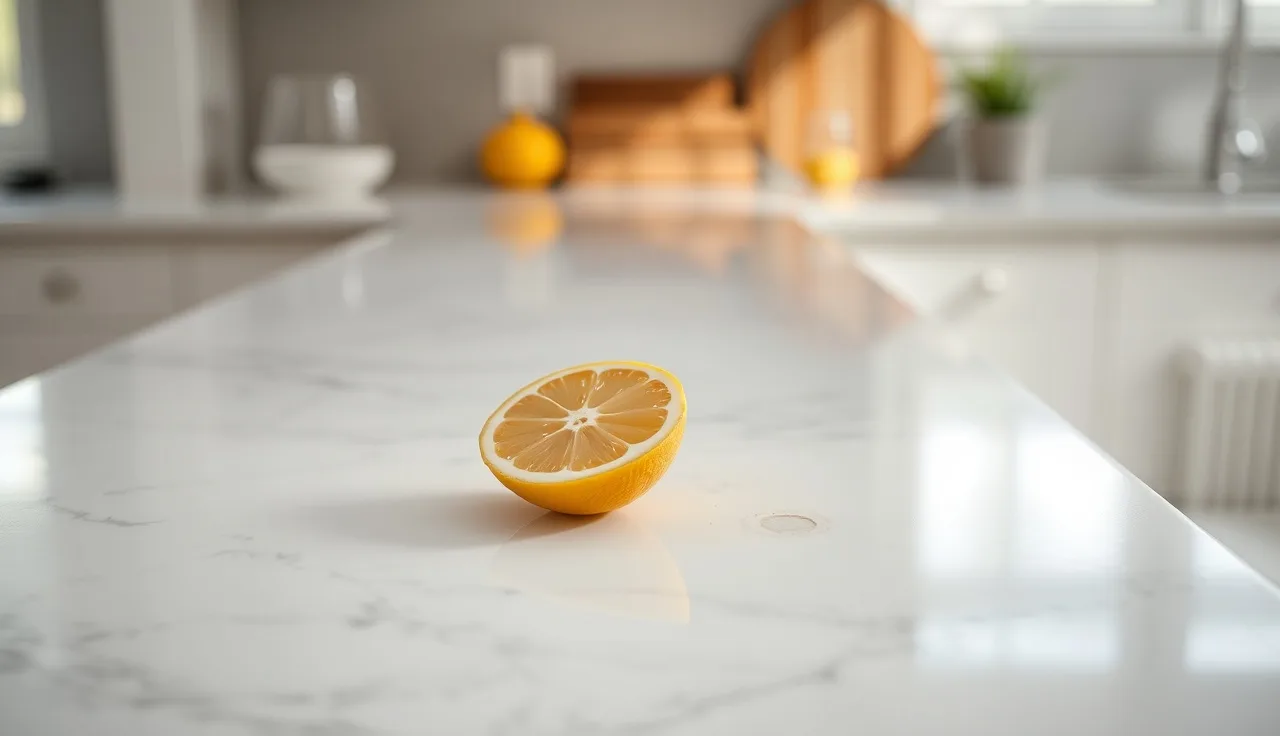
The reaction is fast. A lemon wedge left on polished Calacatta for 30 seconds can leave a visible etch. Wine, tomato juice, vinegar, most citrus juices, coffee, and plain sparkling water are all acidic enough to do it [1]. So is nearly any household cleaner that is not pH-neutral, including plenty of products labeled for stone.
The chemistry is real and well documented. Calcium carbonate reacts with hydrogen ions from any acid to produce calcium ions, water, and carbon dioxide [10]. The surface changes at a microscopic level. No amount of buffing with a household cloth reverses that.
Why doesn't sealing protect marble from etching?
Sealing does not stop etching, and this gap causes more post-sale conflict than anything else. Get it into the open early.
A sealer is an impregnating product. It fills the microscopic pores of the stone to slow liquid absorption, which protects against staining (pigmented liquids soaking in and leaving a discolored mark). Staining and etching are two different processes.
Etching does not need the acid to penetrate at all. The reaction happens at the surface, the moment the acid meets the calcium carbonate. A fully sealed marble slab etches just as readily as an unsealed one [2]. This surprises almost every homeowner, because sealers get marketed with language that implies full protection. The honest message: seal marble to resist stains, not to resist etching.
Many fabricators and suppliers skip this distinction. Some are rushing the sale. Some assume the buyer already knows. They do not. A buyer told "we sealed it, you're good to go" who then finds etch marks after their first dinner party is a buyer calling you for a refund or a replacement slab. Three minutes on this conversation saves hours of dispute.
If a buyer asks whether a pricier sealer solves it, the answer is still no. Nano sealers, fluoropolymer sealers, and topical coatings that sit above the stone do provide a measurable short-term barrier, but topical coatings change the look and eventually wear through. No product on the market makes marble etch-proof under everyday kitchen use.
What are the most common causes of marble etching in kitchens?
Buyers need a concrete list, not abstract chemistry. Here is what actually causes it in a normal kitchen.
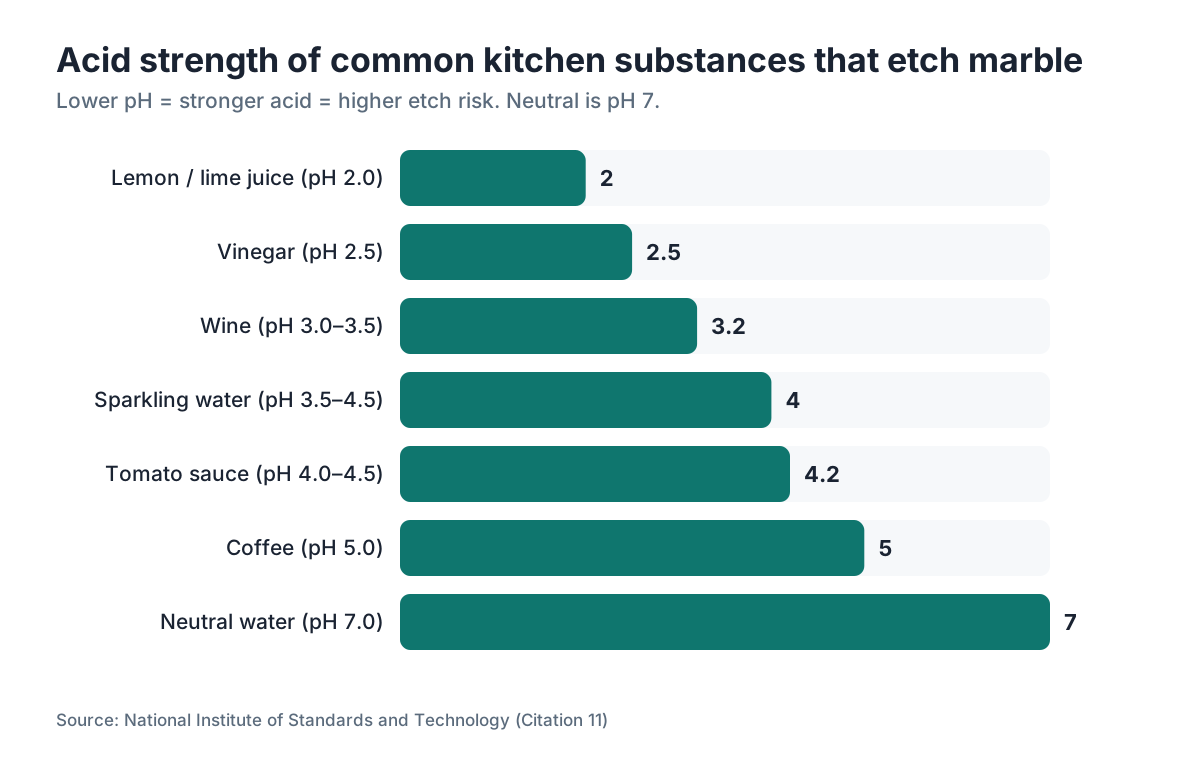
| Substance | Approximate pH | Etch risk |
|---|---|---|
| Lemon / lime juice | 2.0 | Very high |
| Vinegar | 2.5 | Very high |
| Wine (red or white) | 3.0-3.5 | High |
| Coffee | 5.0 | Moderate |
| Sparkling water | 3.5-4.5 | Moderate |
| Tomato sauce | 4.0-4.5 | High |
| Many glass cleaners | 2.5-4.0 | High |
| Most bathroom cleaners | 1.0-3.0 | Very high |
| Tap water (neutral) | 7.0 | None |
Anything below a pH of 7 is acidic, and the lower the number the faster the reaction [11]. The worst practical offenders in most kitchens are lemon and lime, vinegar-based salad dressings and cleaners, and wine [1]. In bathrooms, where etching often goes unnoticed until it is severe, toothpaste and cleaning sprays are the main culprits.
Water rings from sparkling water or sparkling juice on a marble island are a common buyer complaint that fabricators rarely warn about. Still water at a neutral pH will not etch marble. Any carbonated drink with a low pH absolutely can, especially if the glass sits in one spot for several minutes.
Cleaning products deserve their own warning. Many buyers reach for whatever all-purpose spray is already under the sink, and a large share of those products sit under pH 5. Only pH-neutral cleaners are safe for marble [3]. Say that out loud instead of burying it on a generic care card.
What does an etch mark look like, and how is it different from a stain?
An etch looks lighter and dull. A stain looks darker. That is the fastest way to tell them apart, and it matters because buyers send you photos and expect a diagnosis over text.
An etch mark on polished marble reads lighter than the surface around it. On white or very light marble like Carrara, it can hide in flat lighting but jump out under raking light or a phone flashlight held at an angle. On darker marbles it shows as a dull, whitish haze. The mark often takes the shape of whatever caused it: a ring from a glass, a drip from a lemon, an irregular patch where a cleaning spray sat.
A stain is the opposite. Stains run darker than the surrounding stone because a pigmented liquid soaked into the pores and left its color. Red wine stains look faint pink-gray. Cooking oil looks like a dark, greasy shadow. You can sometimes lift a stain with a poultice. You cannot lift an etch that way.
Some marks are both. Red wine left on unsealed marble long enough can etch the surface and stain the pores at the same time. That is the worst case, and one more reason immediate cleanup matters.
Fabricators building client education materials can attach care guides straight to a quote in SlabWise, so the buyer gets this alongside their price instead of as an afterthought at install [4].
The practical test: does the mark look lighter or darker? Lighter and dull is an etch. Darker and maybe shiny is a stain. Those two questions let a buyer describe the problem accurately when they call.
Can etching be fixed or repaired?
Yes, and it depends on severity and finish. Light etching on polished marble buffs out. Deep etching needs a pro. Honed marble mostly hides the problem to begin with.
Light etching on polished marble comes back with a marble polishing powder or compound. These use a mild abrasive to re-polish the dulled area up to its original sheen. For a homeowner willing to put in the work, this is a legitimate DIY repair for surface-level etching [5]. The result is rarely perfect, especially on heavily figured marble, where matching the depth and clarity of a factory polish by hand is close to impossible.
Deep or widespread etching needs professional honing and re-polishing by a stone restoration contractor. Not cheap. Expect $5 to $15 per square foot or more depending on severity and the contractor's rate, and results vary [6]. A heavily etched slab that was never cared for can cost more to restore than to replace.
Honed marble is a different story. Honing removes the high polish and leaves a matte or satin surface. The stone still etches chemically, but because it is already matte, the etch does not create the same visual contrast. Plenty of designers and kitchen showrooms recommend honed marble for busy kitchens for exactly this reason. The stone still etches. It just does not shout about it.
Leathered finishes behave much like honed. They hide etching better than polished but are not immune. Buyers who love polished white marble and also cook heavily with citrus are the ones who need this conversation most.
What finish should buyers choose to minimize visible etching?
Finish is the single most practical decision a buyer can make to cut the visual impact of etching. Honed hides it. Polished shows everything.
Polished finish: a high, mirror-like sheen. Every etch shows up as a dull patch against the gloss. Beautiful. High-maintenance in a working kitchen.
Honed finish: satin to matte, no reflective sheen. Etch marks blend in far better because the whole surface is already matte. The stone still etches and the reaction still happens, but the contrast between etched and un-etched areas is much smaller. This is the practical choice for buyers who want marble in a busy kitchen and do not want to flinch at every lemon wedge.
Leathered finish: a textured, slightly matte surface made by brushing the stone after honing. Hides etching about as well as honed, and hides fingerprints and water spots better than polished or honed. The texture can trap crumbs and grime, so it wants more active cleaning.
Here is the honest take from stone people who put marble in their own kitchens: if you want polished marble in a heavily used kitchen, go in knowing you will have etch marks within weeks and make peace with that, or choose honed. For a bathroom vanity with light use or a fireplace surround, polished is far more forgiving, because the acid exposure is low.
For how different natural stones compare on durability and maintenance, see our guide to marble countertops and our overview of kitchen countertops.
How should a fabricator or salesperson explain etching without losing the sale?
Tell the buyer the truth in 45 seconds and you keep the sale. The fear is that mentioning etching sends buyers running to quartz. In practice the opposite happens. Buyers who feel informed trust you. Buyers who feel ambushed later resent you.
Here is a script that works without turning into a lecture:
"Marble is a natural stone, and it reacts with acids the same way a seashell does if you drop it in vinegar. The surface picks up dull spots over time from lemon juice, wine, vinegar-based products, things like that. It's called etching, and it's not a defect, it's just how marble behaves. We can talk about whether a honed finish suits you better, because it hides that a lot more than polished does. Either way, I want you to know what to expect so you still love this choice three years from now."
That covers the cause, sets real expectations, offers a fix, and makes you the advisor instead of the salesperson hiding bad news.
Then document it. Have the buyer initial a care acknowledgment form at the sale or at install. This is not adversarial. It is a record that you disclosed how the material behaves. Most countertop disputes that reach small claims or chargeback fights come down to the seller not disclosing a known characteristic of a natural material [7].
For shops handling high volumes of marble quotes, building the disclosure into the quote document itself, instead of a separate form that gets lost, keeps it consistent. That is the kind of workflow good shop software handles, whether you run a quoting tool like SlabWise or your own process.
Is marble still worth buying if it etches so easily?
Yes, for the right buyer in the right room. This is a values question, not a technical one, and buyers deserve a straight answer instead of cheerleading.
Marble has a look nothing else quite copies. The depth, the veining, the way light moves across it. Engineered quartz and porcelain, even the best large-format slabs, cannot match it exactly. For a buyer who prizes that look and accepts the maintenance, marble is worth it.
The unhappy buyers are the ones who wanted the look but expected the stone to act like something tougher. They put it in a busy family kitchen, they cook with citrus and vinegar all week, and nobody warned them about the weekly etch marks. That gap between expectation and reality is the problem, not the stone.
Honed marble in a light-use spot (a bathroom vanity, a fireplace surround, a butler's pantry) tends to keep buyers happy for years. Polished Calacatta on a primary kitchen island in a household that cooks every day is a commitment to careful habits or regular professional restoration.
Alternatives worth naming: quartzite countertops look like marble and do not etch the same way, though slabs vary widely and some "quartzite" is really marble under a trade name. Granite countertops resist acid far better. Engineered quartz is essentially etch-proof for practical purposes. Cambria countertops market their etch resistance against natural stone directly.
For buyers who genuinely want marble but worry about etching: honed finish, a no-acid cleaning routine, a marble polish compound in the cabinet for touch-ups, and realistic expectations. That combination works.
What care routine actually prevents etching damage from getting worse?
Preventing new etches is the whole game. Once an etch exists, it exists until you mechanically remove or blend it.
The practical rules for marble owners:
Wipe spills immediately. Not after the meal. Not after the guests leave. Now. The longer an acid sits, the deeper the reaction runs and the more visible the mark.
Use only pH-neutral cleaners. A product labeled "stone safe" or "for natural stone" is a reasonable start, but check the label for pH. Truly neutral sits between 6.5 and 7.5. The Marble Institute of America recommends pH-neutral cleaners for marble care [3].
Treat cutting boards and trivets as habits, not optional gear. A cutting board does more than stop scratches. Cutting citrus directly on marble is the fastest way to carve a severe etch.
Skip vinegar-based DIY cleaners, including the popular vinegar-and-water and vinegar-and-dish-soap recipes. These home remedies are specifically damaging to marble, limestone, and travertine [3].
Reseal annually with an impregnating sealer to protect against staining. It does nothing for etching, but it does guard against the stain half of any spill that also etches.
For more on safe cleaning methods, see our guides on how to clean stone countertops and how to clean soapstone countertops, which share some of the same care principles.
How does marble etching compare to damage on other countertop materials?
Buyers comparing materials deserve a straight side-by-side. Granite resists acid well. Quartz and porcelain do not etch at all. Marble trades that toughness for a look nothing else matches.
| Material | Etching risk | Staining risk | Scratch risk | Heat resistance |
|---|---|---|---|---|
| Polished marble | Very high | Moderate (if unsealed) | Low | High |
| Honed marble | High (less visible) | Moderate | Low | High |
| Granite | Very low | Low (if sealed) | Very low | High |
| Quartzite | Varies by slab | Low to moderate | Low | High |
| Engineered quartz | Essentially none | Very low | Low | Moderate (can scorch) |
| Porcelain slab | None | None | Low to moderate | High |
| Laminate | None | Low to moderate | High | Low |
| Butcher block | None | Moderate | High | Moderate |
Granite is the natural stone with the best acid resistance for practical kitchen use [8]. Engineered quartz and porcelain slabs cut etching out entirely, which is why they dominate high-traffic kitchen installs. If a buyer's main concern is low maintenance, point them there and mean it.
Butcher block countertops, laminate countertops, and Corian countertops all carry their own damage profiles and repair stories worth knowing if the buyer is genuinely undecided.
The Marble Institute of America describes etching as a natural characteristic of calcium carbonate stone rather than a manufacturing defect [9]. That framing, natural characteristic rather than defect, is worth borrowing in your own sales language.
What should be in a marble care disclosure or acknowledgment form?
A written care disclosure is your best defense against a dispute you cannot win. Sell or install marble without one and you are a single unhappy buyer away from an argument that is very hard to prove.
A good marble care disclosure covers:
A plain-language explanation that marble etches on contact with acids, including common foods and many household cleaners. The word "etching" should appear and be defined.
A statement that etching is a natural characteristic of calcium carbonate stone and is not a manufacturing defect or installation error.
A statement that sealing protects against staining but does not prevent etching.
A list of the most common causes: citrus, vinegar, wine, carbonated beverages, non-pH-neutral cleaners.
A recommendation for pH-neutral cleaners only.
A repair note: light etching can be addressed with marble polishing compound, severe etching needs professional restoration.
A buyer signature and date.
Keep it to one page. Nobody signs something that takes ten minutes to read. The goal is a clear record that the buyer was informed before install, not a legal brief.
Many countertop businesses attach this to the installation sign-off or drop it into the final project packet. Fabricators using shop software can set it as a standard document in the job folder so it never gets skipped. For stone retailers moving large volumes, attaching the disclosure to the digital quote gets it in front of the buyer early, not on install day when they are distracted.
Frequently asked questions
Will sealing my marble countertop prevent etching?
No. Sealing protects marble against staining by filling pores and slowing liquid absorption, but etching is a surface chemical reaction that does not require the acid to penetrate the stone. An acid like lemon juice reacts with the calcium carbonate at the surface instantly, sealed or not. Seal marble to prevent stains. Accept that etching is a separate issue sealing does not solve.
Is a marble etch mark permanent?
Light etching can often be repaired with a marble polishing powder or compound that re-polishes the dulled area. Deep or widespread etching needs professional honing and polishing, which typically costs $5 to $15 per square foot or more depending on severity and local rates. Etching on honed marble is less visible to begin with, so repair is needed less often.
What is the difference between a marble etch and a marble stain?
An etch is lighter than the surrounding stone and has a dull, matte look, caused by a chemical reaction that removes surface material. A stain is darker than the surrounding stone, caused by a pigmented liquid soaking into the pores. You can sometimes lift a stain with a poultice. You cannot lift an etch by cleaning. Some spills, like red wine, cause both at once.
Does honed marble etch less than polished marble?
Honed marble etches the same amount chemically. The difference is visibility. Polished marble has a high sheen, so a dull etch creates obvious contrast against the reflective surface. Honed marble has a matte finish, so an etch blends in far more. For buyers who want marble in a working kitchen, honed is usually the more practical finish for exactly this reason.
Can I use vinegar to clean my marble countertop?
No. Vinegar has a pH around 2.5, acidic enough to leave a visible etch on marble within seconds of contact. That includes DIY all-purpose recipes mixing vinegar with water, dish soap, or essential oils. Use only pH-neutral cleaners made for natural stone. The Marble Institute of America and stone care professionals consistently recommend this.
How do I explain marble etching to a buyer without scaring them away?
Be direct and brief. Tell them marble reacts with acids the way a seashell does in vinegar, that it's called etching, that it's natural behavior and not a defect, and that a honed finish hides it much better than polished. Buyers who feel informed trust you. Buyers surprised later blame you. A 45-second honest explanation at the point of sale prevents the disputes that show up six weeks after install.
Is quartzite the same as marble? Does it etch the same way?
True quartzite is a metamorphic rock made mostly of quartz and does not etch the way marble does. But many slabs sold as quartzite are actually marble or dolomitic marble with significant calcium carbonate content, and they do etch. The reliable test is the acid test: a drop of muriatic acid or even lemon juice on an inconspicuous spot. Fizzing means calcium carbonate is present. No fizzing means true quartzite.
What countertops should buyers choose if they do not want to deal with etching at all?
Engineered quartz, porcelain slab, and granite are the main alternatives. Quartz and porcelain do not etch in practical kitchen use. Granite resists acid far better than marble because it is not calcium carbonate. Cambria quartz, among other brands, markets etch resistance as an advantage over natural stone. Each alternative has trade-offs in look and other durability traits worth comparing.
How fast does etching happen on marble?
Very fast. Lemon juice or vinegar can leave a visible etch on polished marble in 30 seconds or less. Diluted acids like sparkling water or wine take longer but still etch if left in place for several minutes. Immediate cleanup is the most effective habit a marble owner can build. Blotting, not wiping, reduces the chance of spreading the acid across a larger area.
Should I get a marble care form signed at installation?
Yes, and ideally earlier, at the point of sale or with the final quote. A written care disclosure the buyer signs protects you in disputes and confirms the buyer understands what they are agreeing to. The form should define etching in plain language, state that it is a natural characteristic and not a defect, list common causes, and confirm that sealing does not prevent it. Keep it to one page.
Can sparkling water etch marble?
Yes. Sparkling water and carbonated drinks typically sit at a pH between 3.5 and 4.5 because dissolved carbon dioxide forms carbonic acid. A glass of sparkling water or sparkling juice left on polished marble can etch it within minutes. This is one of the most common and least-expected sources of etch marks buyers run into after installation.
Does marble in a bathroom etch as much as marble in a kitchen?
Bathroom marble etches differently but can still take real damage. The main culprits are toothpaste (mildly acidic and abrasive), many bathroom sprays and mold removers (often highly acidic), and some hair products. Bathrooms have lower overall acid exposure than kitchens, so etching tends to be slower and less dramatic, but it still adds up. Honed marble in a bathroom is still the more forgiving choice.
What is the best cleaner for marble countertops?
A pH-neutral cleaner made for natural stone. Look for a stated pH between 6.5 and 7.5. Common options include dedicated stone soap products. Avoid anything with vinegar, citrus, bleach, or ammonia. Plain warm water and a soft cloth handle routine wiping. The Marble Institute of America recommends pH-neutral cleaners for all calcium carbonate stones, including marble, limestone, and travertine.
Sources
- Marble Institute of America, Care and Maintenance Guidelines: Common acids including lemon juice, vinegar, wine, coffee, and many household cleaners cause etching on marble and other calcium carbonate stones
- Marble Institute of America, Stone Consumer Tips: Sealers protect against staining by filling pores but do not prevent etching because etching is a surface chemical reaction not dependent on liquid absorption
- Marble Institute of America, Cleaning Natural Stone: Only pH-neutral cleaners are recommended for marble; vinegar and vinegar-based products are specifically identified as damaging to calcium carbonate stone
- SlabWise, Countertop Quoting and Shop Management Software: Reference to attaching care documents directly to quotes in countertop shop software workflows
- Natural Stone Institute, Residential Fabrication Guidelines: Light surface etching on polished marble can be addressed with marble polishing compounds applied by a homeowner
- Natural Stone Institute, Stone Restoration Standards: Professional stone restoration and re-polishing for etched marble surfaces, with costs varying by severity and region
- U.S. Federal Trade Commission, Consumer Protection and Sales Disclosure: Disputes over consumer goods frequently center on a seller failing to disclose known characteristics of the product before sale
- Natural Stone Institute, Stone Comparison and Selection Guide: Granite has significantly higher acid resistance than marble for kitchen countertop use due to its silicate mineral composition versus calcium carbonate
- Marble Institute of America, Natural Stone Characteristics: The Marble Institute of America describes etching as a natural characteristic of calcium carbonate stone, not a manufacturing defect
- U.S. Geological Survey, Mineral Resources Program: Marble is composed primarily of calcium carbonate, which reacts with acid in a well-documented chemical reaction producing calcium ions, water, and carbon dioxide
- National Institute of Standards and Technology: pH values for common kitchen acids: lemon juice approximately 2.0, vinegar approximately 2.5, wine approximately 3.0 to 3.5, sparkling water approximately 3.5 to 4.5
Last updated 2026-07-10