TL;DR
- Countertop materials fail at wildly different temperatures.
- Granite, quartzite, and soapstone shrug off a hot skillet.
- Engineered quartz, laminate, and solid surface warp, crack, or discolor at temperatures a pan off the stove hits easily.
- This guide gives the actual thresholds for each material, explains why they differ, and shows how to talk about it honestly with homeowners.
Why does heat resistance matter for countertops?
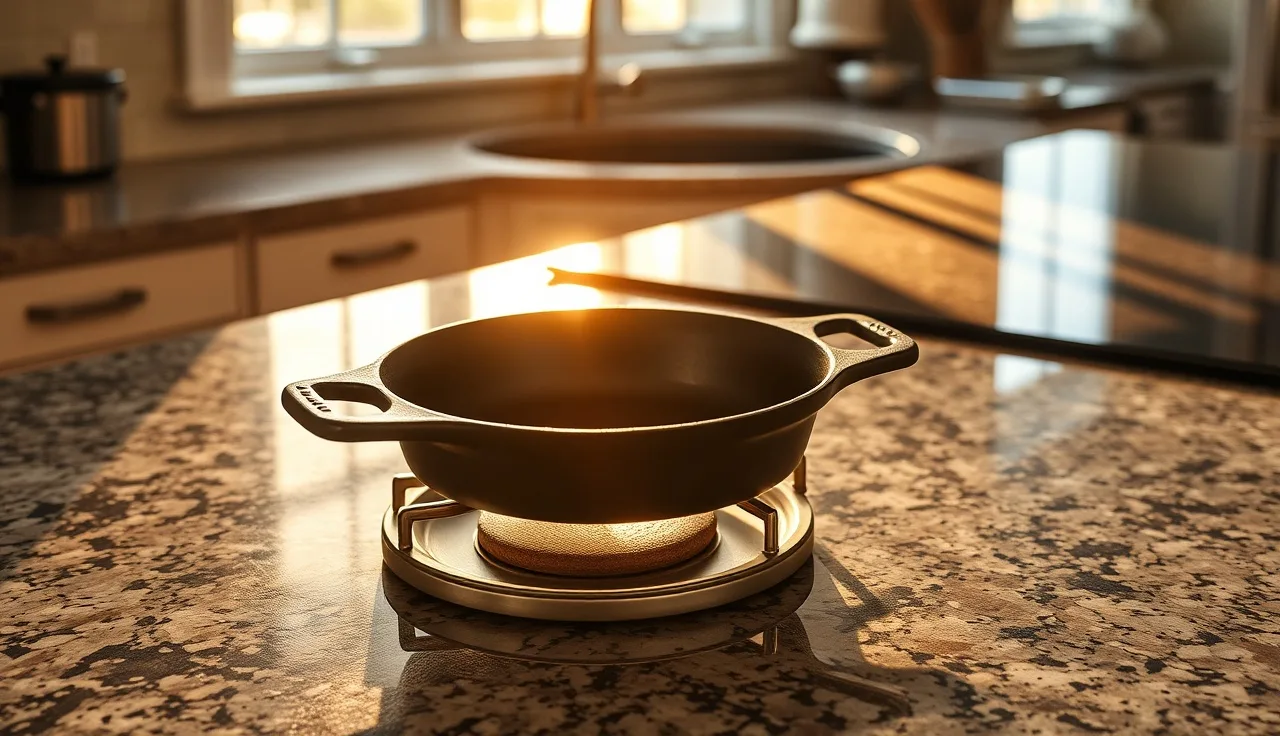
Most homeowners set a hot pan down without thinking twice. That one habit is probably the single most common source of countertop damage that shops get calls about after installation. A cast-iron skillet pulled from a 500°F oven can hold that surface temperature for several minutes. A pizza stone straight out of a 550°F oven radiates heat even longer. If the countertop under it can't take the thermal load, you end up with scorched resin, cracked stone, or bubbled laminate.
The conversation about heat matters before the sale, not after. Homeowners who understand what their material can and can't do are the ones who stay happy. The ones who hear nothing about it call back angry six months later.
So the physics is worth understanding plainly. It protects fabricators from warranty headaches, and it helps homeowners buy the right slab the first time.
What temperature can each countertop material actually handle?
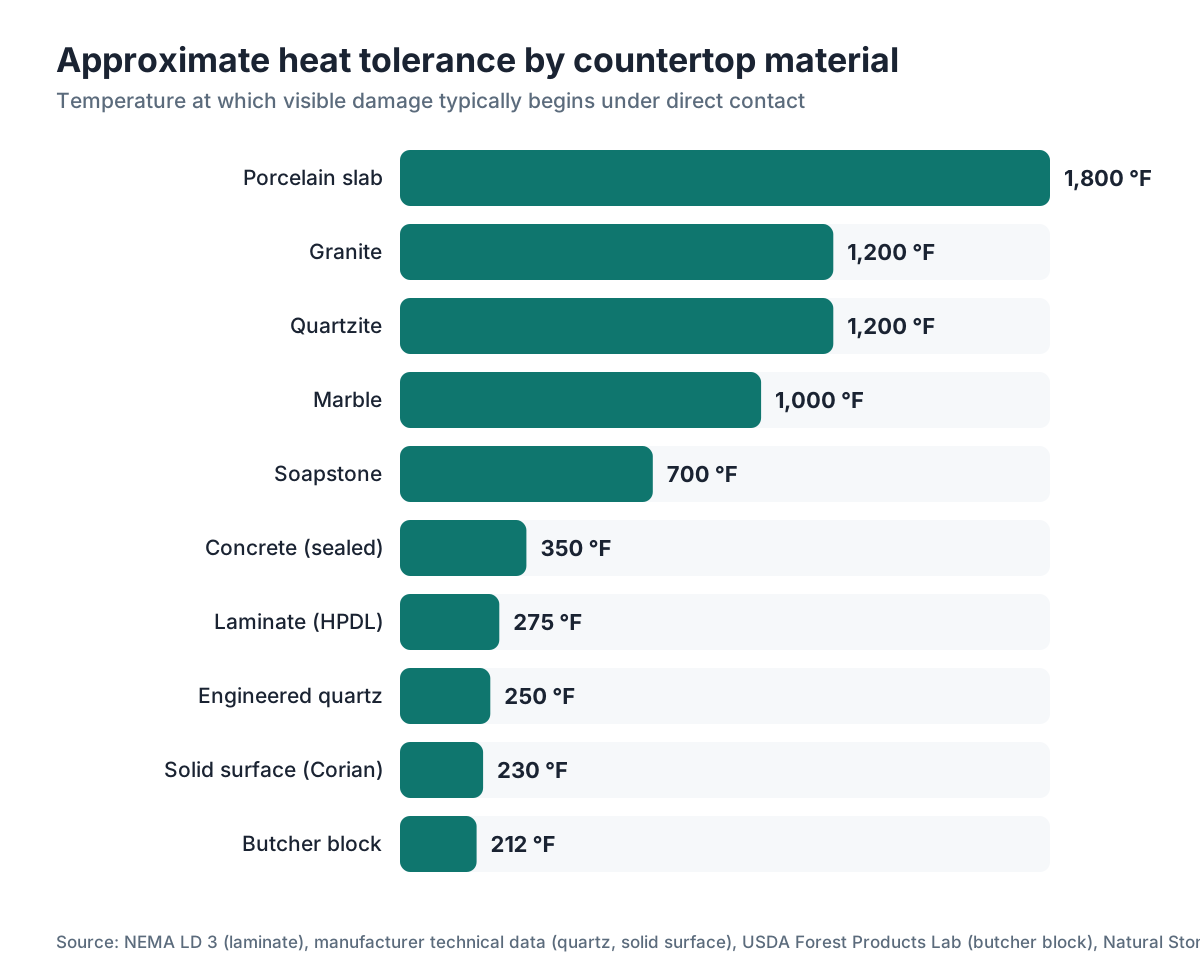
Homeowners want real thresholds, not vague reassurances. The table below pulls from manufacturer technical data, materials science references, and independent testing where available. Ranges exist because performance depends on slab thickness, the specific resin or binder used, and how the heat lands (direct contact versus radiant heat from above).
| Material | Approximate heat threshold | What happens at failure |
|---|---|---|
| Granite | ~1200°F+ sustained [1] | Thermal shock cracking from sudden cold after heat; rare |
| Quartzite | ~1200°F+ sustained [1] | Similar to granite; rare cracking at seams |
| Marble | ~1000°F sustained [11] | Scorching or etching from hot acidic pans possible |
| Soapstone | ~700°F+ [6] | Discoloration (darkens) but rarely cracks |
| Engineered quartz | ~150-300°F [2] | Resin binder discolors, cracks, or warps |
| Laminate (HPDL) | ~275°F [3] | Surface bubbles, blisters, delamination |
| Solid surface (Corian-type) | ~212-250°F [4] | Warping, scorching, permanent discoloration |
| Porcelain tile/slab | ~1800°F+ [5] | Extremely heat resistant; grout joints are the weak point |
| Butcher block | ~212°F [8] | Scorching, charring; oil finish can degrade with long exposure |
| Concrete | ~350°F+ | Base is heat tolerant; sealer burns or discolors |
A few things jump out. Engineered quartz, the top-selling countertop material in North America right now, has the lowest heat threshold of any stone-look option. Its resin binder (typically polyester or acrylic, roughly 7 to 10% of the slab by weight) softens and discolors well below the temperature of a pan fresh off a gas burner [2]. Granite and quartzite are natural minerals that formed under enormous heat deep in the earth, so a skillet from the oven doesn't touch them. That contrast is the single most useful thing to explain to a homeowner.
Why does engineered quartz fail at lower temperatures than natural stone?
Engineered quartz (brands like Cambria, Silestone, Caesarstone) is roughly 90 to 93% ground quartz bound with polymer resins, pigments, and sometimes mirror or glass flecks [2]. The quartz crystals are extremely heat resistant. The resin is not. Polymer resins start to soften somewhere between 150°F and 300°F depending on the formulation, and a pan off a medium-high burner clears that easily.
Here's the line to give a homeowner surprised that quartz, a stone product, loses to granite on heat. The stone part is fine. The glue holding it together is the problem.
Every engineered quartz manufacturer I know of voids its warranty for heat damage. Cambria's product care documentation, for instance, tells owners to use trivets and hot pads. The rest of the category says the same. A homeowner who buys quartz thinking it's basically stone, then treats it like granite, is heading for an expensive surprise. Your job is to close that gap before they sign anything.
Is granite actually heat-proof, or is that a myth?
Granite is about as close to heat-proof as a residential countertop gets. It's an igneous rock that formed above 1200°F, so a 500°F skillet doesn't threaten the mineral structure [1]. Dealers are on solid ground telling homeowners granite handles normal cooking heat without damage.
Two real caveats belong in that conversation. First, thermal shock. Hit one small spot on a room-temperature slab with concentrated heat over and over, especially near an existing micro-crack, and you can eventually make a crack grow. Rare in residential kitchens, but it happens. Second, the sealer. Granite is porous and almost always sealed after fabrication. Most sealers are resin-based, and a very hot pan sitting directly on that surface can dull or strip the sealer in that spot. The stone is fine. The surface treatment isn't [11].
So the honest answer: granite is far more forgiving with heat than almost any other common countertop. A trivet is still a good habit, mostly to protect the sealer and keep the surface clean.
For a deeper look at what granite can and can't handle, see our guide on granite countertops.
What about marble, quartzite, and soapstone?
Marble is a metamorphic rock and handles heat well structurally. The kitchen problem with marble is chemical, not thermal. Acids from tomato sauce, citrus, or a hot acidic pan etch the calcite surface and leave dull spots. A hot pan carrying acidic residue is a double threat. Marble won't crack from the heat of a normal pan, but it can etch or stain [11].
Quartzite is metamorphosed sandstone, dense and tough, with heat tolerance close to granite's. The confusion is between quartzite (a natural stone) and engineered quartz (a manufactured slab). The names sound alike and the materials behave nothing alike under heat. Clearing that up is one of the most useful things a fabricator can do during a showroom visit. Our how to clean quartzite countertops guide covers its full care profile.
Soapstone is the quiet overachiever. It's dense, nonporous, and has been used for wood-burning stoves and laboratory counters for exactly one reason: it takes heat [6]. It darkens where heat contacts it repeatedly, which some people love and others don't. It won't crack from a hot pan. Our how to clean soapstone countertops guide has the basics.
How hot does a pan or pot actually get on a countertop?
This is the piece that makes the thresholds mean something. Homeowners assume a pan "cools down" fast once it leaves the stove. It doesn't. At least not fast enough to matter.
A stainless pan pulled from a 375°F oven holds surface temperatures between 300°F and 400°F for two to three minutes after you set it down. Cast iron, with much higher thermal mass, stays above 300°F for five minutes or longer [7]. That's well past the point where engineered quartz or solid surface starts to fail.
Gas burners on high can push a pan surface past 500°F. Electric coil burners run around 300 to 500°F at the coil. Induction heats the pan directly and reaches similar temperatures at the base [7].
The practical upshot: "I'll just be careful" is not a plan for heat-sensitive materials. Trivets or silicone hot pads are the answer, not caution.
What's the right way to explain heat resistance without scaring homeowners away from a material?
Aim for honesty without alarm. Most homeowners adapt their habits fine once they know why. Here's a framing that works in a showroom.
Start with what the material actually handles. "This is quartz, which is basically ground stone held together with resin. The stone part takes extreme heat, but the resin can't, so we recommend a trivet for anything off the stove or out of the oven." That's it. You told them the truth, explained the why, and handed them the fix. You didn't call the material fragile or hint they're buying something second-rate.
Then contrast it with natural stone if it fits. "Granite and quartzite don't have that limit, because they're solid mineral all the way through. They're more forgiving if you forget the trivet." Now the homeowner has real information to weigh against price and looks.
Avoid mush like "fairly heat resistant" or "handles most heat." Those phrases mean nothing and come back to bite you when someone calls with a scorched quartz slab saying they thought it was heat resistant. Give a specific threshold, or at minimum a clear "use a trivet" instruction in writing at the time of sale. Some shops include a one-page care card with every install. Good practice.
Fabricators who want material specs sitting right next to project quotes can look at tools like SlabWise, which pulls product details into the quoting workflow so limitations don't get lost between the showroom and the install date.
Does laminate or solid surface have any heat resistance at all?
Not much. High-pressure decorative laminate (HPDL), the category that includes Formica, has a published heat resistance around 275°F in some manufacturer specs [3]. That's below the surface temperature of a pan fresh off a moderate burner. Set a skillet on laminate and you'll get immediate bubbling or blistering in the decorative layer. The damage is permanent and usually not repairable without replacing the section.
For more on what laminate can and can't handle, see our laminate countertops and formica countertops guides.
Solid surface, which includes Corian, is acrylic or polyester resin with mineral filler. It softens around 212°F to 250°F [4]. That's barely above boiling water, so a full pot set directly on solid surface is a marginal situation, and a pan from a 375°F oven will damage it. The one thing solid surface has going for it is repairability: a pro can sometimes sand out scratches and minor burns. Real heat warping is permanent.
In a kitchen that sees heavy cooking, laminate and solid surface need a genuine talk about trivet discipline, not a passing mention. Light cooks will be fine with either. That honest read on lifestyle fit is worth more than any spec sheet. Our corian countertops guide has more.
What about porcelain slabs and concrete countertops?
Porcelain slab counters took off in the last several years partly because of heat and scratch resistance. Fired ceramic is extremely stable at high temperatures, well above anything a residential kitchen generates [5]. The surface won't discolor, crack, or warp from a hot pan. Grout joints in a tiled application are a different story, but large-format porcelain slabs without grout are genuinely heat resistant.
Concrete counters are heat tolerant in the base material but almost always sealed, and the sealer is the limit. Most penetrating and topical sealers start to show damage (whitening, bubbling) above 300°F to 400°F. Same fix: trivets. Some fabricators use food-grade beeswax or non-polymer finishes that take heat better, though they need more upkeep.
Both materials are worth naming as genuinely heat-tolerant options when a homeowner asks for something truly low-worry in a cooking-heavy kitchen.
Does butcher block handle heat well?
No. Wood is organic and scorches above roughly 212°F with sustained contact. A pan at 400°F leaves a visible burn on butcher block fast [8]. Butcher block has plenty of other qualities homeowners love, and the heat limit is easy to live with once they know it going in.
The finish is the bigger heat concern. Oil-finished butcher block, the most common food-safe option, can go rancid or color unevenly under sustained high heat. Some finishes contain volatile compounds that can smoke if heated enough. A hot pan from a home oven won't start a fire, but it will mark the wood and possibly the finish.
Butcher block belongs in kitchens where the owner understands the maintenance trade-offs and accepts them. Our butcher block countertops guide has the full care picture.
What should fabricators do at installation to protect themselves and the homeowner?
Deliver a written care card with every installation. That's the single most protective move. It doesn't need to be fancy. A half-page with the material name, the heat limit in plain language, and a trivet recommendation is enough. That card is a record that the homeowner was informed.
Some shops go further and photograph the finished install with a time stamp, log the specific slab lot and material, and note care recommendations in their job management software. For a shop running several jobs a week, that documentation is the difference between a clean warranty dispute and a messy one.
The other move is being direct in the sales conversation. Don't bury the heat limit in fine print or count on the homeowner to read the manufacturer's care guide. Tell them out loud, in plain language, before they sign. Homeowners who feel set up for failure are the ones who leave bad reviews and dispute invoices. The ones told the truth upfront almost always adapt.
If you run a countertop shop and want material specs and care notes built into your quoting process automatically, SlabWise is made for that, connecting material details to quotes and job records from the start.
For the broader install process, see our countertop installation guide.
Are there any industry or safety standards that cover countertop heat resistance?
There's no single federal standard setting a heat resistance requirement for residential countertops. The closest references come from voluntary industry bodies and manufacturer test protocols.
The ANSI/KCMA A161.1 standard for kitchen and vanity cabinets includes a surface heat resistance test, but it applies to cabinet surfaces, not countertops [9]. The NEMA LD 3 standard covers high-pressure decorative laminates and includes heat resistance testing; it specifies a test using a 325°F source applied for one minute [3]. Products that pass get labeled, which is where the published HPDL figures come from.
Engineered quartz makers mostly rely on their own testing and publish results in product technical data sheets. The NSF/ANSI 51 standard covers food-contact materials but focuses on cleanability and chemical safety, not thermal performance [10].
The takeaway for both sides of the table: the most reliable heat data comes from the manufacturer technical sheet for each specific product, not from a single industry-wide rating. Ask your supplier for the technical data sheet on anything you're specifying, especially engineered or composite products.
Frequently asked questions
Can I put a hot pan directly on granite?
Granite handles the heat of a pan from a residential oven without cracking or discoloring. The mineral structure formed above 1200°F, so a 500°F skillet is no threat to the stone. The main risk is the sealer, which is resin-based and can dull or strip in a small spot under sustained heat. For the granite itself, it's the most heat-tolerant common countertop material you can buy.
Will a hot pan crack quartz countertops?
Yes, it can. Engineered quartz uses polymer resin as a binder, and that resin degrades between 150°F and 300°F depending on the formulation. A pan from a 375°F oven clears that easily. The result is usually discoloration, surface cracking, or small fractures near the heated spot. Most quartz warranties explicitly exclude heat damage, so the repair is typically the homeowner's cost.
What countertop is best if I do a lot of cooking and don't want to worry about heat damage?
Granite, quartzite, and large-format porcelain slabs are your best options. All three have heat tolerance well above anything a home kitchen produces. Soapstone is also very heat resistant, though it darkens with exposure over time. If you cook heavily and set pans down without thinking, natural stone or porcelain is genuinely the low-worry choice compared to quartz, laminate, or solid surface.
Does marble crack from heat?
Marble is structurally heat resistant and won't crack from a typical cooking pan. The bigger issue is etching: acids combined with heat attack the calcite surface and leave dull spots. The stone is stable at normal cooking temperatures, but it's not the best choice for someone who cooks aggressively and often, mainly because of chemical sensitivity rather than thermal failure.
What temperature does Corian or solid surface fail at?
Solid surface materials like Corian start to warp or scorch around 212°F to 250°F. That's just above boiling water, so a pan from even a moderate oven will cause damage. A pro can sometimes sand out minor burns since solid surface is uniform all the way through, but significant warping is permanent. Trivets are mandatory with this material in an active kitchen.
Does laminate countertop melt or blister from heat?
Yes. High-pressure decorative laminate has a heat resistance threshold around 275°F per NEMA LD 3 testing. A hot pan well above that, set directly on laminate, blisters or bubbles the surface immediately. The damage is permanent. Laminate works fine for kitchens that see light cooking use, but it's a real liability in a house where pans come off the stove constantly.
How do I explain countertop heat resistance to a homeowner without losing the sale?
Be direct and pair the limitation with the fix. "This material can be damaged by a very hot pan, so we recommend trivets, which most people use anyway" is honest and doesn't alarm anyone. Then contrast it with the material's strengths in looks, price, and durability. Homeowners given real information are far more satisfied than the ones who discover a limitation after the fact.
Can you repair heat damage on a countertop?
It depends on the material. Solid surface can sometimes be sanded and refinished for minor burns. Granite and quartzite rarely need repair since heat damage is uncommon, but a cracked slab may need a professional epoxy fill. Quartz heat damage (resin discoloration or cracking) is generally not repairable and requires slab replacement. Laminate heat damage is permanent and usually means replacing the section. Always check the warranty before promising a repair.
Is porcelain slab truly heat resistant?
Yes. Fired porcelain is one of the most heat-resistant countertop materials available. The ceramic body tolerates temperatures well above anything a home kitchen produces without damage or discoloration. Large-format porcelain slabs without grout joints are a legitimate heat-worry-free option. The main trade-offs are brittleness at edges and the need for careful fabrication during cutting and installation.
What happens to butcher block countertops from heat?
Wood scorches. A hot pan on butcher block leaves a burn mark above roughly 212°F sustained. The damage is visible and permanent, though light burns can sometimes be sanded out if caught early. The finish, usually food-safe oil, is also vulnerable to heat. Butcher block works well in kitchens where the owner uses cutting boards and trivets consistently and treats the surface as a workspace, not a landing pad for hot cookware.
Do countertop warranties cover heat damage?
Almost never for engineered products. Engineered quartz, laminate, and solid surface warranties routinely and explicitly exclude heat damage. Makers of these products recommend trivets in their published care instructions, and heat contact is treated as user error. Natural stone warranties, where they exist, are typically limited to manufacturing defects rather than damage from use. Read the warranty terms before selling or buying a material.
Should fabricators include heat resistance information in their contracts or care documents?
Yes, and it's a practical protection as much as a service. A written care card delivered at installation creates a record that heat limitations were disclosed. It cuts the chance of a disputed claim months later. Include the specific material name, the heat threshold in plain language, and a trivet recommendation. Some fabricators photograph the care card being handed over and log it in their project records.
Is soapstone heat resistant enough for a kitchen?
Soapstone is very heat resistant and was historically used for lab counters and wood stoves. It handles direct heat from pans without cracking. It will darken in spots where heat repeatedly contacts it, which changes its look over time. That darkening isn't structural damage, and many soapstone owners find it adds character. For a cooking-heavy kitchen with no interest in trivets, soapstone is one of the more forgiving choices.
What is thermal shock and can it damage a stone countertop?
Thermal shock is what happens when a material sees a sudden, extreme temperature change across a small area, causing differential expansion that can crack the stone. In residential kitchen use, true thermal shock is rare. It would take something like plunging a very hot pan into a cold puddle of water on the stone repeatedly. Normal cooking heat doesn't cause thermal shock in granite or quartzite under typical conditions, though existing micro-cracks can grow if stressed over time.
Sources
- Penn State Department of Geosciences, Igneous Rock Formation: Granite forms at temperatures exceeding 1200°F in the earth's crust, establishing its baseline thermal tolerance.
- Ceramic Tech Today / American Ceramic Society, engineered quartz composition: Engineered quartz slabs are approximately 90-93% ground quartz bound with polymer resins, pigments, and additives; the polymer binder controls heat tolerance.
- National Electrical Manufacturers Association, NEMA LD 3 High-Pressure Decorative Laminates standard: NEMA LD 3 specifies a heat resistance test for HPDL products at 325°F applied for one minute; products that pass are rated accordingly.
- DuPont Corian Product Care and Maintenance Documentation: Solid surface materials including Corian can warp or discolor from sustained heat above approximately 212°F to 250°F; manufacturer guidance recommends trivets.
- Tile Council of North America, ANSI A137.1 Specifications for Ceramic Tile: Fired porcelain ceramic tile is tested to withstand temperatures well above residential kitchen cooking temperatures without structural failure.
- U.S. Geological Survey, Soapstone (Talc) Mineral Resources: Soapstone's dense talc-mineral composition made it a traditional material for laboratory countertops and stove linings due to its thermal stability.
- USDA Food Safety and Inspection Service, Safe Minimum Internal Temperatures: Reference for cooking temperatures used to contextualize the surface temperatures of cookware removed from ovens and stove burners in residential kitchens.
- Forest Products Laboratory, USDA, Wood Handbook: Wood as an Engineering Material: Wood begins to char and discolor with sustained surface exposure above approximately 212°F (100°C); higher temperatures cause rapid combustion risk.
- Kitchen Cabinet Manufacturers Association, ANSI/KCMA A161.1 Standard: ANSI/KCMA A161.1 includes heat resistance surface testing applicable to cabinet finishes, providing a reference point for surface thermal performance standards.
- NSF International, NSF/ANSI 51 Food Equipment Materials Standard: NSF/ANSI 51 covers food-contact material safety including cleanability and chemical safety but does not set thermal performance thresholds for countertop surfaces.
- Natural Stone Institute, Natural Stone Care and Maintenance: Natural Stone Institute documentation notes that marble and granite are structurally tolerant of high heat but that sealers and surface treatments may be affected.
Last updated 2026-07-11