TL;DR
- Caesarstone Frosty Carrina (color 2141) is a cool white quartz with fine grey veining.
- Free or low-cost samples come from Caesarstone's website, big-box stores, and authorized dealers.
- A sample shows base tone and pattern character but not full slab variation.
- Installed cost runs $55 to $100 per square foot including fabrication.
What exactly is Caesarstone Frosty Carrina?
Frosty Carrina is Caesarstone's color 2141, a white engineered quartz with soft grey veining that loosely mimics Carrara marble. The background is a cool, slightly blue-tinted white, not a warm cream. The veining stays subtle and fairly even across the slab, which makes it one of the more predictable patterns Caesarstone sells.
Caesarstone is an Israeli-founded manufacturer that went public on NASDAQ in 2012. It runs production plants in Israel, the United States (Richmond Hill, Georgia), and India [1]. Its quartz surfaces are made from roughly 90 to 93 percent ground quartz bound with polymer resins and pigments, which is the standard recipe for engineered quartz across the industry [2].
Frosty Carrina has been in the catalog for years and keeps ranking as one of Caesarstone's top-selling whites. The reason is simple. It threads the needle between a clean modern look and a warmer marble-adjacent feel. If you've ever picked up a white quartz chip in a showroom that felt almost universally likable, there's a decent chance it was this one.
Want the wider view before you lock in on quartz? The kitchen countertops guide covers the full field.
How do you get a Caesarstone Frosty Carrina sample?
Four practical routes get a physical sample into your hands, and they range from a 4-inch chip to a full slab at a fabricator's yard.
Start with Caesarstone's own website (caesarstone.com), which has a sample ordering tool. As of mid-2025, samples ship free or for a small fee depending on your region and whether you're on a consumer or trade account. The sample is typically 4 inches by 4 inches. That's enough to check color but not enough to see a full veining repeat.
Home Depot and Lowe's both carry Caesarstone displays in their flooring and countertop sections. You can usually pull a small chip from the rack at no charge, or an associate can order a larger sample. Availability swings by location, so call ahead.
Any authorized Caesarstone fabricator or stone dealer keeps full-size sample boards, often 12 by 12 inches or bigger. These beat the small chips because you can hold them against your cabinets in real light. The dealer locator on caesarstone.com finds authorized shops near you.
The best option costs nothing but a drive. Some fabricators let you walk their yard and look at full slabs in stock. A 4-inch chip cannot tell you what an 8-foot run looks like at 8 a.m.
One honest note. Frosty Carrina is a consistent pattern, but consistent in engineered quartz still means some batch variation. The sample you hold might be slightly lighter or darker than the slab that shows up at your job site. Ask which lot the slab came from, and ask to see the actual slab before you sign off.
What does the Frosty Carrina sample actually tell you (and what it doesn't)?
A small sample nails three things: the base color, the general character of the veining, and the surface finish. Frosty Carrina ships polished by default, and you can read that gloss clearly on even a small chip.
What it won't show is how the veining books across a long run. Engineered quartz gets its pattern during production, so two slabs from different runs can look noticeably different side by side. Frosty Carrina is one of the steadier SKUs precisely because the veining is fine and diffuse rather than dramatic. Variation still exists.
A sample also can't predict how the color reads in your lighting. Cool-white quartz can look almost blue-grey under LEDs with a high color temperature (4000K or above) and much warmer under 2700K to 3000K bulbs. Hold the sample in your actual kitchen at different hours before you decide.
And a chip can't represent the edge profiles you'll choose. Eased, beveled, and mitered waterfall edges change the visual weight of the counter a lot. Ask for a physical edge sample separately if that matters to you.
For care comparisons across stone types, the how to clean stone countertops guide is a reliable reference.
How much does Caesarstone Frosty Carrina cost installed?
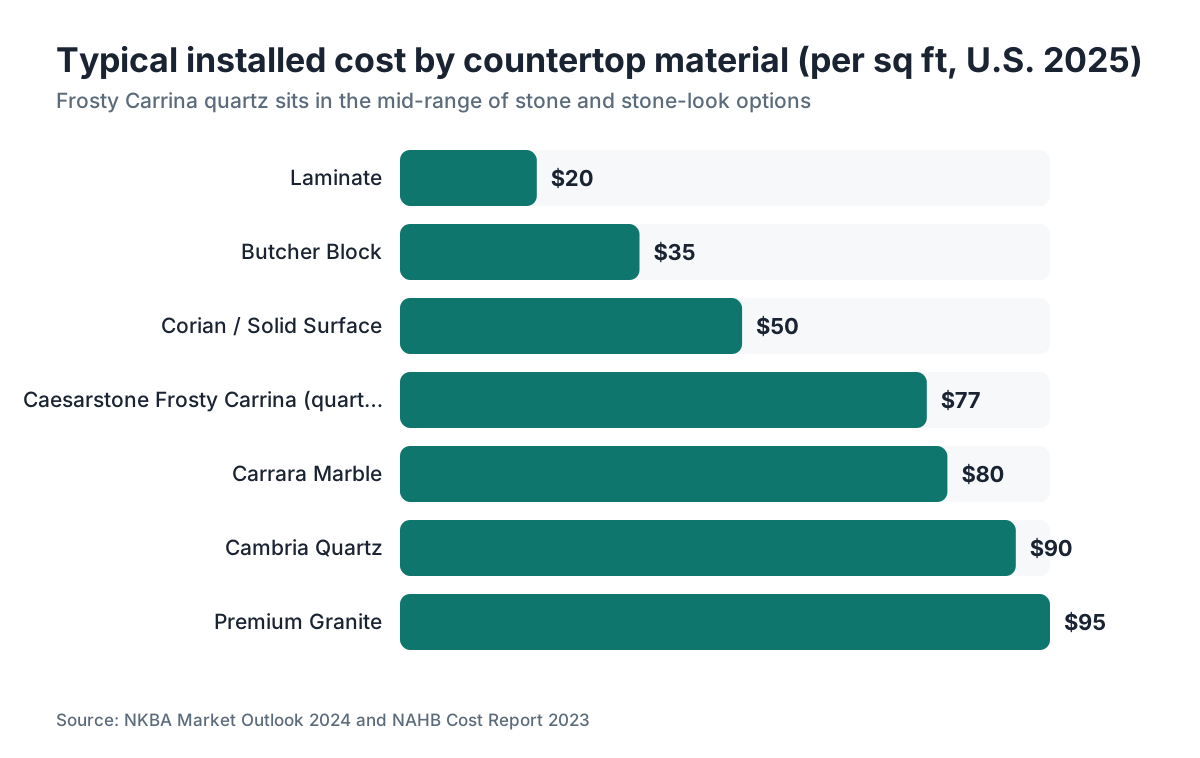
Installed cost for Frosty Carrina runs roughly $55 to $100 per square foot, fully installed, in most U.S. markets as of 2025. The range is wide for real reasons. Fabrication labor, edge complexity, cutout count, local market conditions, and shop overhead all move the number.
Material-only cost (slab price before fabrication) sits around $60 to $85 per square foot for Frosty Carrina at retail, though fabricators rarely sell material alone. What you actually buy is the package: slab, template, cut, polish, and install.
Here's where the money goes on a typical project.
| Cost component | Typical share of total |
|---|---|
| Slab material | 40 to 50% |
| Fabrication labor (cut, polish, edge) | 25 to 35% |
| Template and installation | 10 to 20% |
| Sink cutout, edge upgrades, other extras | 5 to 15% |
A standard kitchen with roughly 40 square feet of counter lands at $2,200 to $4,000 installed at common price points. A large kitchen with 70 square feet can hit $5,000 to $7,000 with premium edges and multiple cutouts.
Frosty Carrina sits in Caesarstone's mid-tier band. Not the cheapest, not the priciest. Competing white quartz from Cambria or Silestone lands in a similar installed range. The Cambria countertops piece runs a direct price comparison.
Get at least three quotes. Pricing in this trade varies more than most homeowners expect.
How does Frosty Carrina compare to real marble and other white countertop options?
The comparison everyone makes is Frosty Carrina versus Carrara marble. They look alike in a photo, and the name is a deliberate nod. In practice they behave nothing alike.
Carrara marble is natural stone quarried in Italy. It's porous, it etches from acids (lemon juice, vinegar, wine), and it develops a patina over time that some people love and some people hate. Frosty Carrina is engineered quartz: non-porous, acid resistant, dimensionally stable. It won't etch. It won't need sealing. But it will chip at edges, and it will show heat damage if you set a hot pan directly on it, because the resin binders don't take sustained heat the way natural stone does.
Cook hard and want zero maintenance? Frosty Carrina is the practical pick. Want organic depth and aging character? Marble is the real thing, and no engineered product fully copies it.
Other white quartz options worth a look:
| Product | Brand | Character vs. Frosty Carrina |
|---|---|---|
| Ella | Caesarstone | Brighter white, less veining |
| Calacatta Nuvo | Caesarstone | Bolder, thicker veining |
| Brittanicca | Cambria | More dramatic pattern, higher price |
| Silestone White Storm | Silestone | Warmer white, slightly different texture |
| Eternal Calacatta Gold | Silestone | Gold-toned veining, more premium feel |
On a tighter budget, laminate countertops and Formica countertops now come in convincing white-marble prints at a fraction of the price. Not the same, but worth knowing.
If natural stone is still on the table, read marble countertops and granite countertops before you finalize anything.
Is Caesarstone Frosty Carrina durable enough for a busy kitchen?
Yes, with two honest caveats: heat and edge impact. Everything else about engineered quartz scores well on durability. The Marble Institute of America and NSF International both note that engineered quartz is non-porous and does not need periodic sealing, unlike most natural stones [3]. Frosty Carrina has a Mohs hardness around 7, harder than most metals and highly resistant to everyday scratching from knives and cookware.
Heat first. The polymer resin that binds the quartz particles can yellow or craze under sustained high heat. Caesarstone's technical guidance tells you to always use trivets or hot pads. A hot pan straight off the burner can cause thermal shock that damages the surface for good, and that damage is not covered under warranty [4].
Edge impact second. Polished quartz edges, especially sharp profiles like pencil or flat eased, can chip when a heavy object strikes them. That's more an installation and edge-selection issue than a material defect. Bullnose and eased edges shrug off impact better than sharp square profiles.
In a busy kitchen with kids and heavy cooking, Frosty Carrina holds up under realistic daily use. Use trivets. Don't cut on the surface (it dulls your knives more than it hurts the quartz). Wipe spills promptly even though the surface is non-porous, because standing water at seams can eventually reach the substrate.
Want to see what high-maintenance stone demands instead? The how to clean quartzite countertops article lays out the daily grind of natural stone.
What is Caesarstone's warranty on Frosty Carrina?
Caesarstone offers a lifetime limited warranty on residential products sold in the United States through authorized dealers. It covers defects in material and workmanship and explicitly excludes damage from improper installation, heat, physical impact, chemical exposure, and normal wear [4].
The warranty transfers to a new owner if you sell the home, which matters for a pre-sale renovation.
Four warranty mechanics to understand before you buy:
Register it yourself through Caesarstone's website within the defined window after purchase. Fabricators sometimes forget to mention this step.
Claims require proof of purchase and proof of professional installation by an authorized fabricator. DIY installation typically voids the warranty.
Authorized dealer status matters. Buying through an unauthorized distributor or the secondary market can affect warranty validity. Verify your fabricator's authorization on caesarstone.com before you sign a contract.
Caesarstone's 2023 annual report lists warranty-related liabilities as a line item the company actively manages, which confirms the warranty is a funded commitment rather than marketing language [1]. Getting a claim honored can still take documentation and persistence, same as most manufacturer programs.
How do you care for and clean Caesarstone Frosty Carrina?
Day-to-day care is genuinely simple. Warm water and mild dish soap handle most messes. A soft cloth or sponge does the job. No sealing, ever.
For tougher residue like dried food or a grease splatter, a non-abrasive household cleaner works. Caesarstone's care guide recommends products like Simple Green for stubborn spots [5]. Skip anything abrasive (scrubbing pads, powder cleansers) because it dulls the polished surface over time.
What to actively keep off Frosty Carrina:
- Bleach and bleach-based cleaners at high concentration. A roughly 10 percent diluted bleach solution is fine for disinfecting but shouldn't sit on the surface.
- Nail polish remover, paint thinner, or acetone. These can attack the resin binders.
- Standing water at seams and along the backsplash edge. The quartz is fine. The substrate and adhesive underneath are not.
- Steam cleaners and pressure washers, which force moisture into seams.
Staining from coffee, red wine, or turmeric comes up constantly because the surface is white. In practice Frosty Carrina resists staining well precisely because it's non-porous. Wipe spills before they dry and you'll rarely see a problem. If a dried stain shrugs off soap, a paste of baking soda and water left a few minutes usually lifts it without hurting the finish.
The general principles in the how to clean stone countertops guide apply here, even though quartz is engineered rather than natural.
How does the fabrication and installation process work for Frosty Carrina?
Once you've picked Frosty Carrina and signed with a fabricator, the job runs in four steps: template, fabrication, delivery, install.
Templating happens after your old counters come out (or on a new-construction rough-in). A technician builds a precise digital or physical template of your layout. Most shops now use CNC-compatible digital templating tools, which cut measurement error way down. A template appointment takes one to two hours for an average kitchen.
Fabrication happens at the shop. The fabricator feeds the template data into a CNC waterjet or bridge saw and cuts the Frosty Carrina slabs to your exact dimensions. Edge profiles get ground and polished. Sink and cooktop cutouts happen here too. Frosty Carrina helps at this stage: the white background makes cut lines easy to mark, and the even veining means the fabricator doesn't sweat matching a bold pattern across a seam (though seam placement still matters visually).
Delivery and install usually land on the same day, one to two weeks after templating at most shops. Two installers is standard for a kitchen. Slabs go in with adhesive and support brackets at seams. Caulk runs along the backsplash and around the sink. Install for an average kitchen takes three to five hours.
For shops juggling multiple jobs, quoting and material planning is where software earns its keep. SlabWise's quoting and nesting tools help shops cut material waste on jobs where slab utilization decides the margin, which bites hardest on mid-priced SKUs like Frosty Carrina where the margin is already thin.
Read the full countertop installation overview before your templating appointment.
What kitchen styles and cabinet colors work best with Frosty Carrina?
Frosty Carrina's cool white base pairs most naturally with cabinetry that also reads cool: white, light grey, navy, sage green, or two-tone setups with white uppers and a deeper lower. It can work with warm wood, but you'll feel the tension between cool stone and warm oak or walnut. Some people like that tension. Others find it off-putting.
Behind the sink and range, white subway tile with grey grout is the obvious pairing, and it works because the grey grout echoes the veining. Large-format white or light grey porcelain tile reads well too.
Floor color matters. Light wood reads fresh and Scandinavian with Frosty Carrina. Dark hardwood or dark tile builds a stronger contrast that can look deliberate and sophisticated, as long as the rest of the room supports it.
Hardware finish is forgiving. Brushed nickel, polished chrome, and matte black all work. Brass and gold are popular right now and they warm up the cool white nicely, though that pairing rewards confidence in the overall design.
One underrated point. Frosty Carrina's quiet veining makes it a good background in kitchens that already carry a lot of visual texture, like open shelving stacked with objects, a busy backsplash, or bold hardware. It doesn't fight for attention.
Exploring non-stone options that complement the same look? Butcher block countertops and Corian countertops both work well on an island, where a contrasting material can anchor the room.
Where can fabricators source Caesarstone Frosty Carrina slabs and what should they know?
Fabricators buy Caesarstone through the company's authorized U.S. distributor network. Caesarstone runs distribution centers across the country, and shops typically order through a regional sales rep. Frosty Carrina is a standard SKU, so it's generally in stock at most distributors without a long lead time, unlike the more exclusive colorways.
Slab sizes for Caesarstone quartz are primarily 56 inches by 120 inches (standard) and 63 inches by 131 inches (jumbo). Frosty Carrina comes in 2 cm and 3 cm. Most residential kitchens use 3 cm because it eliminates the plywood substrate and gives a more substantial edge, though 2 cm with laminated edges still shows up in some applications.
For production shops, the even veining is a small win. Seam matching is less demanding than on a bold diagonal pattern, which means slightly less labor per job and fewer callbacks.
Pricing to fabricators is confidential and varies by volume agreement, but the general wholesale range (slab price without fabrication) runs $28 to $45 per square foot depending on distributor, quantity, and any promo pricing in effect. Those figures come from distributor price sheet discussions in the trade, not published rates, so treat them as rough orientation rather than hard benchmarks.
If you track material cost and waste per job, the yield gap matters: a 56-by-120-inch slab holds about 26.2 square feet, a 63-by-131-inch jumbo about 36.1 square feet. That difference reshapes how you price seam-heavy layouts. Run the nesting before you quote and you'll dodge the margin surprises that come from underestimating material use.
Check Caesarstone's technical data sheets and installation guides on the professional portal for current tolerances and adhesive recommendations [5].
Is Frosty Carrina a good choice for bathrooms and other non-kitchen applications?
Yes for bathrooms, laundry rooms, and commercial interiors. No for anything outdoors.
Bathroom vanities are a natural fit. The non-porous surface handles splashing, soap scum, and cosmetics without etching or staining. The white-grey palette pairs with almost any tile and fixture. One practical note: bathrooms often run more complicated layouts than kitchens (vessel sinks, undermount sinks with offset drains, integrated backsplashes), so template accuracy matters even more.
Outdoors, skip it. Caesarstone rates its quartz surfaces for indoor use only. Extended UV exposure yellows the resin binders, and outdoor temperature swings stress the material. For an outdoor kitchen surface, look at porcelain slab or genuine granite.
For commercial jobs (restaurant counters, reception desks), Caesarstone does sell Frosty Carrina and it performs well. But the residential lifetime warranty doesn't apply. Commercial warranty terms are separate and shorter.
Laundry and craft room counters are good candidates. The durability and cleanability that earn Frosty Carrina its keep in a kitchen carry over to any room where a work surface takes regular abuse.
Frequently asked questions
Can I get a free Caesarstone Frosty Carrina sample?
Yes. Caesarstone ships samples through their website at no charge or for a small shipping fee depending on your region. Home Depot and Lowe's stores often have small chips you can take for free. For the most useful sample, ask an authorized fabricator or stone dealer for a 12-by-12-inch board, which shows the veining pattern far better than a 4-inch chip.
How accurate is a small sample compared to the full installed slab?
A small sample shows the base color and general veining character accurately. It won't show how the pattern reads across a long run or how color shifts under your kitchen lighting. Frosty Carrina is one of the more consistent engineered quartz patterns, so sample-to-slab variation is relatively low, but you should still view the actual slab at the fabricator's yard before final sign-off.
What is the difference between Caesarstone Frosty Carrina and Calacatta Nuvo?
Both are white quartz with grey veining, but Calacatta Nuvo has bolder, thicker, more dramatic veining and a brighter white background. Frosty Carrina is subtler and more uniform, closer to Carrara marble. Want a quiet surface that doesn't compete with other design elements? Frosty Carrina. Want a statement? Calacatta Nuvo.
Does Frosty Carrina need to be sealed?
No. Engineered quartz including Caesarstone Frosty Carrina is non-porous by manufacture. It never needs sealing, at installation or later. Anyone offering to sell you a sealing service for quartz is selling you something you don't need. Sealing products made for natural stone can leave a residue on quartz and are not recommended.
Will Frosty Carrina show fingerprints and smudges?
On a polished white quartz surface, fingerprints and smudges show, especially in raking light or near windows. That's true of essentially any polished countertop. A quick wipe with a damp cloth clears them. If fingerprints genuinely bug you, a honed or matte finish shows less daily marking, but Frosty Carrina is widely available only in polished.
Can you put hot pans directly on Caesarstone Frosty Carrina?
No. Caesarstone explicitly warns against setting hot pots or pans directly on any quartz surface. The polymer resin binders can crack or discolor from sustained heat, and heat damage is excluded from the warranty. Always use a trivet or hot pad. This is the single most common cause of non-warranty damage on quartz countertops across all brands.
How long does it take from ordering to installation for Frosty Carrina?
Typical lead time from signing a contract to installed counter is two to four weeks at most shops, assuming Frosty Carrina slab stock is available at your regional distributor. The sequence: measure and template (one appointment), fabrication (three to seven business days at most shops), then installation. Busy shops during kitchen renovation season (spring and fall) can run four to six weeks.
Is Frosty Carrina discontinued?
As of mid-2025, Frosty Carrina (color 2141) remains an active product in Caesarstone's standard collection. It's one of their longest-running and highest-volume SKUs. That said, manufacturers do discontinue colors. If you're doing a phased renovation or planning a future addition, buy extra material from the same production lot while you can and store it with your fabricator.
What edge profiles are available for Caesarstone Frosty Carrina?
Caesarstone doesn't dictate edge profile; your fabricator's capability and your preference decide it. Common options include eased, bevel, bullnose, ogee, mitered waterfall, and dupont. Most CNC-equipped shops can cut any standard profile. Edge work is priced per linear foot and adds $10 to $30 per linear foot above a basic eased edge for more complex profiles.
How does Frosty Carrina handle visible seams?
Seams on any quartz surface show if you look for them, but Frosty Carrina's fine, even veining makes matching easier than a bold-pattern product. A skilled fabricator can orient the pieces so the veining flows across a seam. The fill material at seams should be color-matched to the background white. Poor seaming is a fabrication quality issue, not a material one.
What are the standard slab dimensions for Caesarstone quartz?
Caesarstone produces slabs in two primary sizes: 56 by 120 inches (standard, about 26 square feet) and 63 by 131 inches (jumbo, about 36 square feet). Both come in 2 cm and 3 cm thickness. Most residential kitchen installs use 3 cm because it reads more substantial at the edge and doesn't need a plywood buildup for support.
Does Caesarstone Frosty Carrina contain any harmful chemicals?
Caesarstone publishes Safety Data Sheets through its professional portal. The finished slabs are inert in use. The industry's real concern is silica dust during dry fabrication, an occupational health issue for fabricators, not homeowners. OSHA's silica standard (29 CFR 1926.1153) requires engineered controls during cutting and grinding [6]. Installed, finished quartz poses no silica exposure risk to homeowners.
Can I install Caesarstone Frosty Carrina myself and keep the warranty?
No. Caesarstone's warranty requires professional installation by an authorized fabricator, and DIY installation voids it. That's a firm exclusion in the warranty documentation. Beyond the warranty, quartz slabs are heavy (a 3 cm slab weighs roughly 18 to 20 pounds per square foot) and precise cutting requires professional equipment. DIY full-slab installation is not practical or advisable.
How does Frosty Carrina compare in price to marble and other natural stones?
Installed Frosty Carrina runs $55 to $100 per square foot. Comparable Carrara marble installed typically runs $60 to $100 per square foot for mid-grade material, with premium lots higher. The prices overlap more than most people expect. The real gap is long-term maintenance: marble needs periodic sealing and etches from acids, adding ongoing cost and care that quartz avoids entirely.
Sources
- Caesarstone Ltd. Annual Report 2023, SEC Filing (Form 20-F): Caesarstone is publicly traded on NASDAQ, founded in Israel, with manufacturing in Israel, the U.S. (Georgia), and India; warranty-related liabilities are a managed line item in their financials.
- Marble Institute of America (MIA+BSI), Engineered Stone Technical Guide: Engineered quartz surfaces are composed of approximately 90 to 93 percent ground quartz bound with polymer resins and pigments.
- NSF International, NSF/ANSI 51 Food Equipment Materials standard overview: Engineered quartz is non-porous and does not require periodic sealing, unlike most natural stones.
- Caesarstone USA, Warranty and Care and Maintenance guidance: Caesarstone offers a lifetime limited residential warranty that excludes heat, impact, chemical, and improper installation damage; the company recommends always using trivets or hot pads.
- Caesarstone USA, Care and Maintenance guide: Caesarstone recommends warm water and mild soap for routine cleaning and non-abrasive cleaners such as Simple Green for stubborn spots; technical data sheets are on the professional portal.
- U.S. Occupational Safety and Health Administration, Respirable Crystalline Silica Standard for Construction, 29 CFR 1926.1153: OSHA's silica standard requires engineered controls during dry cutting and grinding of quartz-containing materials; this is an occupational exposure concern during fabrication, not in finished installed products.
- OSHA, Occupational Exposure to Respirable Crystalline Silica: Final Rule, Federal Register (2016): The silica final rule (effective 2016-2018 for construction) established permissible exposure limits and required wet cutting and local exhaust ventilation for operations involving engineered stone.
- Marble Institute of America (MIA+BSI), Countertop Industry Overview: Engineered quartz captures a significant share of the residential countertop market; quartz and natural stone combined represent the dominant premium countertop category in U.S. kitchen remodels.
- National Kitchen and Bath Association (NKBA), 2024 Kitchen and Bath Market Outlook: Quartz surfaces remain the top specified countertop material in kitchen remodels per NKBA designer surveys; white and grey tones are consistently the most specified colorways.
- NAHB, Cost of Constructing a Home 2023 Report: Countertop material and installation costs represent a meaningful share of kitchen finish costs in new construction and remodel projects; installed stone countertop ranges align with industry survey data.
- U.S. Environmental Protection Agency, Indoor Air Quality resources (radon): EPA notes that engineered quartz, unlike some natural granites, does not emit radon, making it a safe choice from an indoor air quality standpoint.
Last updated 2026-07-09