TL;DR
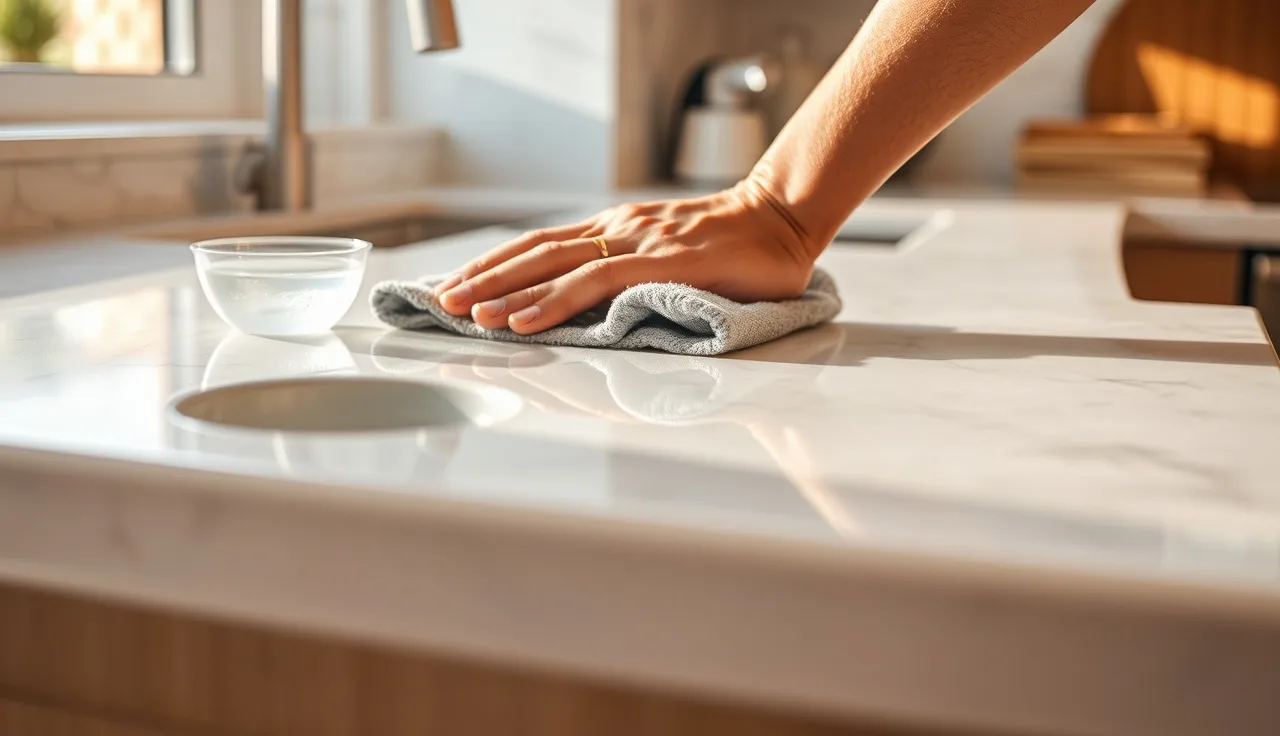
- Warm water and a few drops of dish soap on a soft cloth is all most quartz countertops need day to day.
- Skip anything with a pH above 9 or below 4.
- That rules out bleach, vinegar, Windex, and scrubbing pads.
- Those products dull the resin binder that holds the surface together and can void the manufacturer warranty.
What makes quartz countertops different from natural stone?
Quartz countertops are engineered slabs, not stone cut from a quarry in one piece. A typical slab is roughly 90 to 94 percent ground quartz crystals bound with 6 to 10 percent polyester resin, plus pigments and sometimes recycled glass or mirror flecks [1]. That resin is what makes quartz non-porous and stain-resistant. It is also what makes the surface vulnerable to chemicals that would never touch granite or marble.
Natural stone like granite countertops and marble countertops is porous and needs sealing. Quartz does not, because the resin fills the pores at the factory. The flip side: that resin can cloud, discolor, or break down when it meets solvents, strong alkalis, or long UV exposure. The rules for cleaning quartz come from resin chemistry, not stone chemistry.
This is why you cannot clean quartz the way you clean quartzite countertops. Quartzite is a natural metamorphic stone that needs sealing and tolerates pH-neutral stone cleaners. Quartz has no sealer to maintain, but it has a resin matrix you can genuinely wreck with the wrong product.
Here is the takeaway. Quartz is not indestructible just because it is hard and non-porous. It is engineered with trade-offs, and every cleaning rule traces back to one of them.
What pH range is safe for quartz countertops?
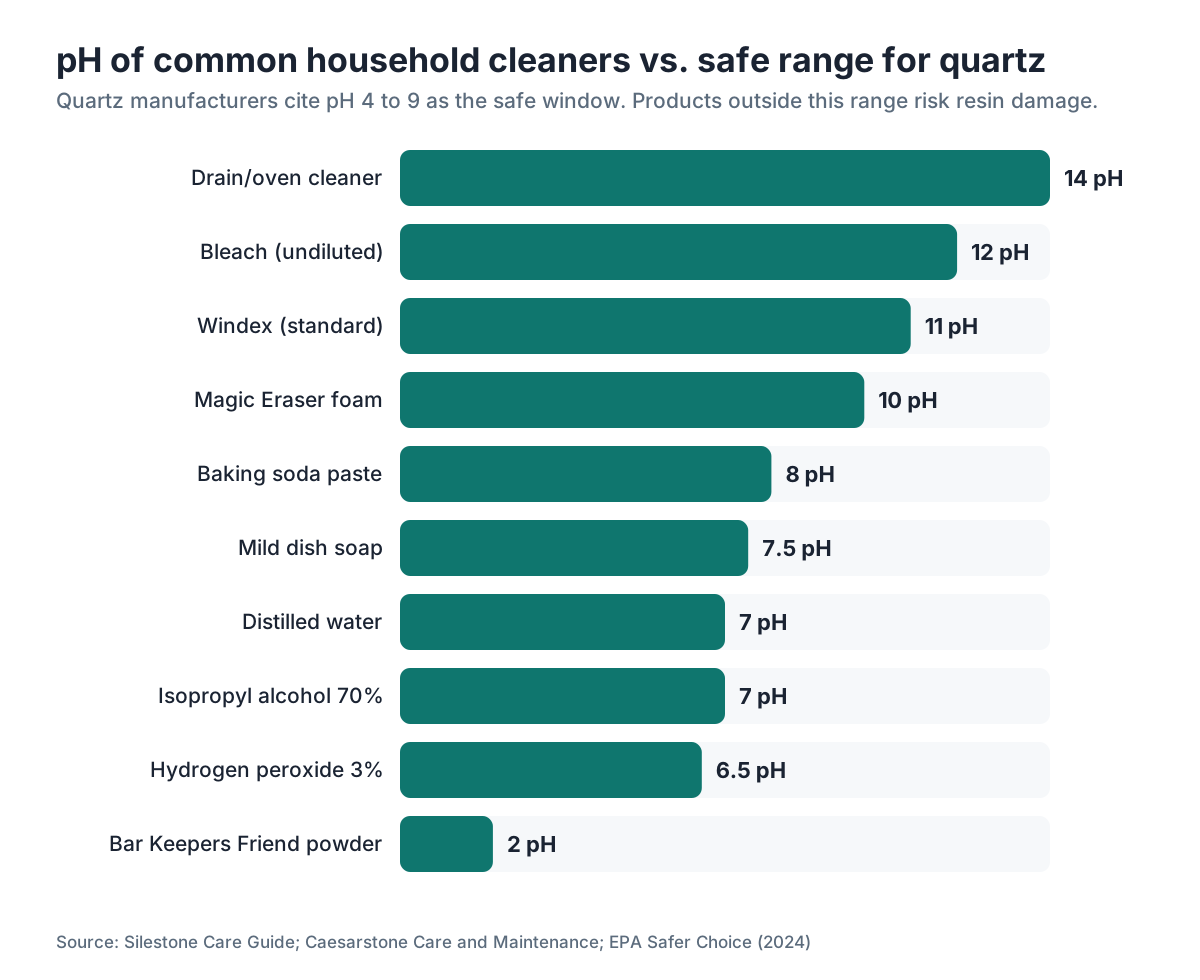
Most quartz makers publish a safe window of roughly pH 4 to 9 in their care guides [2]. Below 4 you are in acid territory (vinegar sits around 2.4, most toilet bowl cleaners drop below 2). Above 9 you hit strong alkali (bleach solutions run 11 to 13, oven cleaners can reach 14). Both extremes attack polyester resin and cause dulling, micro-etching, or a permanent white haze.
Silestone's care guide states that "bleach and products with high alkaline or acidic levels can damage the surface" [2]. Caesarstone's warranty excludes damage from chemical cleaners used outside the recommended range [4].
Here is where common household products fall.
| Product | Approximate pH | Safe for quartz? |
|---|---|---|
| Distilled water | 7.0 | Yes |
| Mild dish soap + water | ~7.5 | Yes |
| Windex glass cleaner | ~11 | No |
| White vinegar | ~2.4 | No |
| Bleach (undiluted) | ~12 | No |
| Hydrogen peroxide 3% | ~6.5 | Usually yes (short contact) |
| Isopropyl alcohol 70% | ~7 | Yes (brief use) |
| Mr. Clean Magic Eraser | ~10 | No |
| Baking soda paste | ~8.3 | Marginal, avoid |
| Bar Keepers Friend (wet) | ~2 | No |
Stick to cleaners labeled for quartz or engineered stone, or plain dish soap and water. If you are unsure about a product, test it on a hidden spot like the inside of a cabinet cutout and wait 24 hours before touching the full surface [3].
What is the best cleaner for quartz countertops day-to-day?
Warm water with two or three drops of a mild, pH-neutral dish soap (Dawn or equivalent) on a microfiber cloth is the best daily cleaner for quartz. It sounds boring. It is also what every major manufacturer recommends, and it works because quartz is non-porous and does not trap oils or bacteria the way wood does.
Wipe the surface after cooking, rinse the cloth well, then do a second pass with a clean damp cloth so you do not leave a soapy film. Dry with a soft towel. The whole thing takes about 90 seconds and keeps the surface looking new for years.
For a weekly clean, dedicated quartz cleaners add mild surfactants that cut grease a little better than soap alone. Weiman Quartz Cleaner, Method Daily Granite and Stone Cleaner (which works on quartz despite the name), and Sprayway Granite and Stone Cleaner all sit inside the safe pH window and leave no film that builds up. Worth having if you cook a lot.
A non-abrasive cleaner means no grit, no powders, no rough pads. The quartz crystals are hard (7 on the Mohs scale), but the resin between them is softer, and gritty cleaners score that resin over time [1]. Use microfiber cloths or soft sponges.
Here is something most cleaning guides skip. Built-up residue from spray cleaners gets mistaken for etching all the time. If your counter looks hazy and you have been using an all-purpose spray, wipe it with a plain damp cloth first. The haze usually lifts. If it does not, you probably have real resin damage from a pH-unsafe product.
Which household cleaners should never touch quartz?
This is where most quartz damage happens, because these products are common and they work great on other surfaces.
Bleach is the worst offender. Sodium hypochlorite at pH 11 to 13 breaks down the polyester resin over repeated use, leaving permanent discoloration and a chalky, rough texture. Even a bleach spray used on a nearby surface can splash onto quartz and do damage [2].
Vinegar, lemon juice, and acidic produce come next. Plenty of natural-cleaning guides push white vinegar for everything. On quartz it is a mistake. The acetic acid etches resin the same way it etches marble. Lemon juice (pH around 2), lime juice, and long contact with tomato sauce or citrus peels all cause it.
Abrasive powders and pads. Comet, Ajax, and similar scouring powders are too rough. So are steel wool, coarse sponges, and even some "non-scratch" pads with enough grit to matter. The damage rarely shows on day one. Repeated use dulls the finish a bit at a time.
Nail polish remover surprises people. Acetone is a solvent that dissolves polyester resin. Blot a spill fast and you are probably fine. Let it sit, or use it as a cleaner, and the damage is permanent [3].
Windex and most glass cleaners run alkaline (pH 10 to 12) from the ammonia. Ammonia attacks resin and leaves a white, streaky haze that does not wipe off.
Magic Erasers feel soft but they are micro-abrasive melamine foam with a pH near 10. The abrasion and the alkalinity are both problems. Frequent use visibly dulls a glossy finish.
Paint remover, oven cleaner, and drain cleaner are high-pH solvents. One application can cause damage you cannot undo, and it likely voids the warranty [6].
How do you remove tough stains from quartz countertops?
Quartz shrugs off most food and drink stains because the surface is non-porous. The trick is acting within an hour or so, before a stain dries and hardens.
For fresh coffee, tea, wine, or juice, wipe with a damp cloth right away. If a faint shadow stays behind, a little isopropyl alcohol (70 percent) on a soft cloth usually clears it. Rub gently, then rinse with water.
For dried food (pasta sauce, egg, batter), reach for a plastic putty knife or the edge of a plastic spatula, never a metal scraper. Lift the crust gently, then follow with dish soap and water. Quartz is hard enough that plastic will not scratch it.
Grease comes off with a dedicated quartz cleaner or a bit of dish soap worked in with a soft cloth. It does not penetrate the surface, so all it needs is a surfactant.
Permanent marker or ink responds to isopropyl alcohol on a cotton ball, applied right to the mark. Do not scrub. Blot, then rinse.
Limescale and hard-water deposits are where homeowners slip up. The instinct is vinegar or CLR. Both are too acidic for quartz. Use a calcium and limescale remover made for engineered stone instead (Bar Keepers Friend sells a non-acidic spray for stone that is separate from the original powder). Check the pH before you buy. Weiman also makes a limescale formula that stays in the safe range.
Dried paint comes off with a small amount of denatured alcohol on a cloth. Blot, do not rub, and rinse quickly. Do not let any solvent sit longer than 30 seconds.
One more thing. Discoloration that will not clean off is usually resin damage, not a stain, and cleaning will not bring it back. A fabricator can sometimes polish a small area, but once the resin is chemically altered, re-fabrication is the only real fix. That is the whole reason the cleaning rules matter.
Does cleaning quartz wrong actually void the warranty?
Yes, and this is not fine print nobody enforces. Silestone, Caesarstone, Cambria, and MSI Q Premium all put care and maintenance clauses in their limited warranties, and every one of them excludes damage from improper chemicals [4][6].
Caesarstone's warranty says coverage does not apply to "damage caused by use of improper cleaning products, chemicals, or solvents" [4]. Cambria's care instructions warn against any cleaner with bleach or a high pH, and the warranty mirrors that language [6].
In practice, quartz warranty claims for fabrication defects are rare, but surface-damage claims do come up. When a homeowner files for a cloudy or discolored top, the manufacturer sometimes asks what cleaning products got used. Say bleach spray or an ammonia cleaner, and the claim usually gets denied.
Fabricators see these disputes land on their customers. If you run a shop, dropping the manufacturer's care guidelines into your handoff packet protects the customer and your reputation at the same time. SlabWise's job-tracking tools let you attach a care sheet to each finished project, so the paper trail exists when a warranty question shows up a year later.
For homeowners: keep the care card that came with your install, or download the care PDF from your manufacturer's site. The warranty and the cleaning rules live in the same document.
Can you use dish soap on quartz countertops every day?
Yes. Mild dish soap in warm water is the daily cleaner nearly every major quartz brand recommends. It is safe because most dish soaps (Dawn, Seventh Generation, Palmolive) sit between pH 7 and 8, comfortably inside the safe window for quartz resin [2].
The one catch with daily use is residue. Too much soap, or a rinse you skipped, leaves a thin film that reads as streaky or dull. That is not damage. Wipe with a clean damp cloth and dry it, and it clears. Use a few drops per cleaning, not a full squeeze.
Anti-bacterial dish soaps with added bleach, or heavy-duty degreaser formulas, are fine once in a while. Check that they do not list bleach or citrus extracts as active ingredients before you make them a daily habit.
What about disinfecting quartz countertops safely?
This is a real concern, especially in a kitchen where raw meat gets prepped. The problem is that a lot of effective disinfectants are either too acidic or too alkaline for quartz.
Isopropyl alcohol at 70 percent is the safest disinfectant for quartz. The CDC documents 70 percent isopropyl alcohol as effective against many common pathogens [5]. Its pH sits near neutral and it has no corrosive chemistry, so it leaves the resin alone. Apply it with a soft cloth, let it sit about 30 seconds (contact time matters for disinfection), then wipe and rinse.
Diluted bleach (one tablespoon per gallon of water, per CDC guidance for kitchen surfaces) gets suggested for quartz too. Some manufacturers say no outright; others allow brief contact at that dilution followed by an immediate rinse [2][5]. My read of the guidance overall: skip bleach if you can. The long-term damage risk is not worth it when 70 percent isopropyl alcohol does the same job safely.
Quaternary ammonium wipes (like Lysol Disinfecting Wipes) sit around pH 6 to 7 and are generally fine for brief use. Check the label for bleach or acid additives before you use them routinely.
Steam cleaners are a no. Quartz is heat-resistant, but the resin is less tolerant than the stone itself, and prolonged steam can affect it. Most manufacturers say to avoid steam cleaners entirely [3].
Are there natural or DIY cleaners that work on quartz?
The honest answer is that most popular DIY recipes are not safe for quartz. Vinegar sprays, baking soda pastes, citrus-infused cleaners, and castile soap with essential oils all bring either a pH problem or a residue problem.
Water handles most daily cleanup. Not a thrilling answer, but an accurate one. Warm water with minimal dish soap is itself a DIY solution, and it is the right one.
The one DIY option that earns its place is a dilute isopropyl alcohol spray for disinfecting: 70 percent IPA in a spray bottle, applied and wiped off quickly. Mix it from drugstore rubbing alcohol and distilled water if you want it cheap. It works and it is safe.
Baking soda paste gets recommended for scrubbing, but at pH 8.3 with mild abrasive grit, it sits right on the edge of acceptable. I would not use it regularly. Once for a stubborn stain, rinsed well, will not destroy anything. It is just not a routine cleaner.
Compare that to butcher block countertops, where lemon and salt scrubs are a legitimate method, or soapstone countertops, where mineral oil is part of the care routine. Every surface has its own chemistry, and the DIY recipes floating around online mostly ignore that.
How often should you clean quartz countertops and what routine actually works?
Quartz does not need a complicated schedule. Here is a routine that matches how kitchens actually get used.
After every cooking session: wipe with a damp microfiber cloth. If there is grease or food, add two drops of dish soap and rinse clean. Dry with a soft towel to head off water spots, especially with hard water.
Weekly: a dedicated quartz cleaner (Weiman, Method Stone, or similar) and a clean microfiber cloth. This clears any film and keeps the surface bright. Four minutes.
As needed for stains: handle them the same day. Dried stains are still removable, but fresh spills lift with a lot less effort.
What to skip is sealing. Granite countertops typically need sealing every one to three years, and marble countertops need it more often, but quartz needs no sealer ever [1]. The resin is the seal. Anyone selling you a quartz sealer is selling you something you do not need.
Polishing is optional. Some homeowners run a quartz-specific polish once or twice a year to keep the gloss up. It shows most on dark colors, where water spots and fingerprints stand out. It is not required maintenance.
For fabricators, a one-page care card handed over at job completion cuts callbacks and warranty questions hard. The routine above is what belongs on that card.
How does cleaning quartz compare to cleaning other countertop materials?
Every countertop material has its own rules, and mixing them up is where damage starts.
Granite countertops are porous. They want a pH-neutral stone cleaner (not daily dish soap, since surfactants degrade the sealer over time) and periodic resealing. Quartz needs no sealer and tolerates mild dish soap.
Marble countertops are the touchiest of the bunch. Even slightly acidic water etches them over time. Marble wants a dedicated marble cleaner and careful handling. Quartz is far more acid-tolerant than marble, though it shares marble's weakness against strong alkalis.
Quartzite countertops get confused with quartz constantly, but quartzite is natural stone. It needs sealing and a pH-neutral cleaner, much like granite.
Laminate countertops and Formica countertops take a broader range of household cleaners but suffer from abrasives and strong solvents. More forgiving than quartz on pH, less forgiving on mechanical abrasion.
Corian countertops are solid-surface acrylic and can be lightly sanded to erase scratches. More tolerant of some solvents than quartz, but still keep harsh acids away.
Concrete countertops need sealing and care products matched to the specific sealer used.
The common thread: read the care guide for your exact surface. This market is not uniform, and advice that works for one material can ruin another.
If you are a fabricator helping customers pick, kitchen countertops walks through the full set of material trade-offs.
| Material | Needs sealing? | Safe pH range | Biggest cleaning risk |
|---|---|---|---|
| Quartz (engineered) | No | 4 to 9 | Bleach, acids, solvents |
| Granite | Yes (1 to 3 yrs) | 6 to 8 | Acidic cleaners, sealer strippers |
| Marble | Yes (frequent) | 7 to 8 | Any acid |
| Quartzite | Yes | 6 to 8 | Acids, undetected porosity |
| Laminate | No | 4 to 10 | Abrasives, standing water at seams |
| Butcher block | Oil regularly | Broad | Water saturation, bleach |
| Corian | No | 4 to 10 | Abrasives (except light sanding) |
What do quartz manufacturers actually recommend? A look at the major brands
The major quartz brands publish care documents, and they line up with each other more than you would expect. Here is what they say.
Silestone (Cosentino) recommends warm water with a neutral pH soap, or a dedicated stone cleaner. It specifically prohibits bleach and "products with high alkaline or acidic levels" [2], and rules out abrasive cleaners and pads.
Caesarstone recommends water and mild soap for daily cleaning with a soft cloth or non-scratch sponge. Its care guide says, "Prolonged exposure to strong chemicals and solvents such as paint removers and furniture strippers should be avoided" [4]. It lists isopropyl alcohol as acceptable for occasional stain removal [3].
Cambria recommends a pH-balanced cleaner or mild dish detergent, and explicitly bans bleach, paint removers, and oven cleaner. It also flags that "permanent exposure to direct sunlight may cause discoloration" from UV hitting the resin [6], which is separate from cleaning but worth knowing for a sunlit or outdoor install.
MSI Q Premium Natural Quartz publishes guidance that mirrors the others: safe cleaners, no bleach, no acids, no abrasive pads [11].
The unanimity on bleach and acids is meaningful. This is not one cautious manufacturer. It is an industry-wide position rooted in resin chemistry.
Got a brand not listed here? Its site has a care PDF. Download it, bookmark it. The guidance can shift for specialty finishes (leather, concrete-look, matte), where the surface treatment differs from a standard polished top. Matte finishes in particular show damage from bad cleaners faster than polished ones, because the texture exposes more surface area.
Frequently asked questions
Can I use Clorox wipes on quartz countertops?
Most Clorox wipe formulations contain bleach or citric acid, both of which can damage quartz resin over time. Occasional use is unlikely to cause immediate visible harm, but regular use risks dulling the surface and may void your warranty. For disinfection, 70 percent isopropyl alcohol on a soft cloth is a safer routine choice that is also effective against common kitchen pathogens.
Why does my quartz countertop look dull or hazy after cleaning?
Two causes are common. First, product residue from spray cleaners builds up and creates a hazy film. Wipe with a clean damp cloth and dry thoroughly; the haze often lifts. Second, chemical damage from an alkaline or acidic cleaner has dulled the resin surface. Residue-related haze is reversible. Resin damage is not, and that surface area would need professional polishing or replacement.
Is vinegar safe to use on quartz countertops?
No. White vinegar has a pH around 2.4, which is acidic enough to etch and dull the polyester resin that binds engineered quartz. Diluting it does not make it safe enough for routine use. This is one of the most common cleaning mistakes on quartz because vinegar is widely recommended for general kitchen surfaces, but it is not appropriate for quartz or any resin-based engineered stone.
What removes dried food or grease from quartz without scratching it?
Use a plastic putty knife or plastic spatula edge to gently lift dried food, then follow up with warm water and a few drops of dish soap on a microfiber cloth. For grease, a small amount of dish soap worked in with a soft cloth handles it well. Never use metal scrapers or rough sponge pads, which can score the resin surface even on hard quartz.
Do quartz countertops need to be sealed?
No. Engineered quartz is manufactured with a polyester resin binder that fills all the pores during production. The surface is non-porous without any additional treatment. Unlike granite or marble, quartz never needs a topical sealer. If someone is selling you quartz sealer, you do not need it and should not apply products not approved by the manufacturer.
What is the best way to disinfect quartz without damaging it?
Isopropyl alcohol at 70 percent concentration is the safest disinfectant for quartz. Apply with a soft cloth, allow 30 seconds of contact time, then rinse with water and dry. The CDC documents 70 percent isopropyl alcohol as effective against common pathogens. Avoid bleach-based disinfectants for routine use; they sit outside the safe pH range and can degrade quartz resin with repeated exposure.
Can you use Bar Keepers Friend on quartz countertops?
Bar Keepers Friend original powder has a pH around 2 due to oxalic acid content. It is not safe for quartz and will etch the resin surface. Bar Keepers Friend makes a separate spray cleanser for stone surfaces with a gentler pH profile; check the label before using it and test on a hidden spot first. The original powder form should not be used on quartz under any circumstances.
Will bleach ruin quartz countertops?
Repeated exposure to bleach will damage quartz. Bleach solutions typically run pH 11 to 13, well above the safe limit of pH 9 that most manufacturers cite. The alkali breaks down the polyester resin, causing permanent dulling, discoloration, and a rough texture. Most major quartz brands explicitly exclude bleach damage from their warranties. One accidental splash rinsed quickly is unlikely to cause visible damage, but bleach should not be part of any quartz cleaning routine.
Can steam cleaners be used on quartz countertops?
Most quartz manufacturers advise against steam cleaners. While the stone component of quartz tolerates heat reasonably well, prolonged steam application can soften or discolor the polyester resin binder. High-pressure steam also forces moisture into seams and caulk joints around sinks, which can cause edge-related problems over time. Stick to damp cloth cleaning and avoid steam as a regular method.
How do you get water spots off quartz countertops?
Water spots from hard water are mineral deposits, mostly calcium and magnesium carbonate. On quartz, the safe removal method is a dedicated limescale remover formulated for engineered stone (check that it is pH-safe, above 4), or a cloth dampened with a small amount of isopropyl alcohol rubbed gently over the spots. Dry the surface immediately after to prevent new spots. Never use vinegar or CLR, which are too acidic for quartz.
Is Method granite and stone cleaner safe for quartz?
Yes. Method Daily Granite and Stone Cleaner is formulated at a pH close to neutral and is widely used on engineered quartz despite the granite label. It contains plant-based surfactants and no bleach or strong acids. Many quartz owners and fabricators use it as a weekly surface cleaner alongside or instead of plain dish soap and water. It is one of the better non-abrasive cleaner options for quartz available at mainstream retailers.
Can I use Windex on quartz countertops?
No. Most standard Windex formulations contain ammonia, which creates an alkaline pH of around 10 to 12. That falls outside the safe range for quartz resin and causes a white haze or streaking that can become permanent with repeated use. Some ammonia-free versions of Windex are closer to neutral pH and less risky, but dedicated quartz or stone cleaners are a better choice if you want a spray-format product for regular use.
How do you clean quartz countertops around the sink where hard water builds up?
The sink area collects hard water deposits faster than the rest of the counter. Daily drying with a soft towel after use prevents most buildup. For existing deposits, use a quartz-safe stone cleaner with limescale-targeting surfactants, or dab a cloth with isopropyl alcohol and rub gently. Avoid leaving any standing water or dish soap residue near the sink edge, which speeds up mineral accumulation. Recaulk the sink joint if it is cracking, as water under the edge causes more damage than surface deposits.
What should a fabricator include in a quartz care handout for customers?
A useful handout covers: daily cleaning with dish soap and water, the banned products list (bleach, vinegar, abrasives, acetone, ammonia cleaners), stain removal steps for common culprits (coffee, grease, ink), the fact that quartz never needs sealing, and the manufacturer warranty contact. One page, plain language. Attaching this to the job record in your project management system means it is retrievable if a warranty question comes up later.
Sources
- USGS Mineral Resources Program, Quartz Industrial Minerals: Engineered quartz countertops are approximately 90 to 94 percent ground quartz crystals bound with polyester resin and pigments; Mohs hardness of quartz is 7.
- Silestone by Cosentino, Care and Maintenance Guide: Silestone states bleach and products with high alkaline or acidic levels can damage the quartz surface; recommends neutral pH soap and water for daily cleaning.
- Caesarstone, Care and Maintenance: Caesarstone recommends testing cleaners on a hidden area; advises against acetone, paint removers, and steam cleaners; permits isopropyl alcohol for occasional stain removal.
- Caesarstone Limited Warranty: Caesarstone warranty explicitly excludes damage caused by improper cleaning products, chemicals, or solvents from warranty coverage.
- CDC, Cleaning and Disinfecting Your Facility: CDC documentation confirms 70 percent isopropyl alcohol is effective against common pathogens; diluted bleach guideline for kitchen surfaces is one tablespoon per gallon of water.
- Cambria Surfaces, Care and Cleaning Guide: Cambria recommends pH-balanced cleaner and explicitly prohibits bleach, paint removers, and oven cleaners; warns prolonged direct sunlight may cause UV-related resin discoloration.
- NSF International, Drinking Water Standards and Testing: Distilled water has a pH of approximately 7.0; used as neutral pH reference point in cleaning safety comparisons.
- EPA, Safer Choice Program Ingredient Standards: EPA Safer Choice standards document pH ranges and surfactant safety for household cleaning products, supporting safe pH range identification for stone surfaces.
- OSHA, Hazard Communication Standard (29 CFR 1910.1200): OSHA hazcom documentation identifies bleach (sodium hypochlorite) solutions at pH 11 to 13 and the corrosive properties of strong alkalis and acids referenced in quartz care guidance.
- Natural Stone Institute, Stone Care Guidelines: Industry guidance on safe pH range of 4 to 9 for engineered stone surfaces and distinction between natural stone and resin-bound engineered quartz care requirements.
- MSI Surfaces, Q Premium Natural Quartz Care and Maintenance: MSI Q Premium published care guidance prohibits bleach, acids, and abrasive pads; recommends mild pH-balanced soap and water for daily quartz countertop cleaning.
Last updated 2026-07-09