TL;DR
- Stone Concepts Misterio Calacatta is an engineered quartz slab with a white-and-gold Calacatta marble look.
- Installed prices run $55 to $100 per square foot depending on edge profiles and cutouts.
- It needs no sealing, resists most household stains, and works in both kitchens and bathrooms.
- The 3 cm thickness is standard for kitchens; 2 cm works for vanities with a substrate.
What is Stone Concepts Misterio Calacatta quartz?
Stone Concepts is a quartz surface brand sold through stone distributors and fabricators across North America. Their Misterio Calacatta pattern sits in the white-ground, gold-veined category that homeowners most often associate with Italian Calacatta marble. The difference is that this is engineered quartz, meaning crushed quartz aggregate (roughly 90 to 93% by weight) gets bound with polymer resins and pigments under high pressure to produce a consistent, non-porous slab [1].
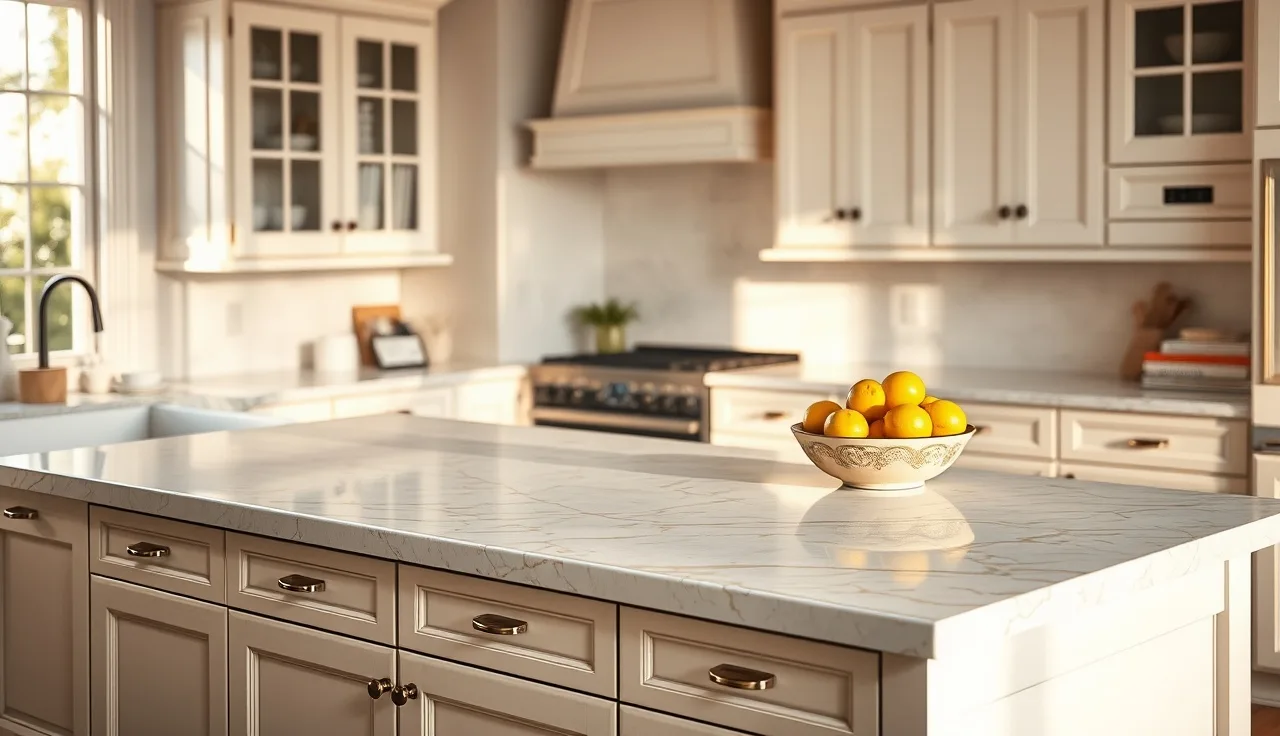
The veining on Misterio Calacatta runs in longer, more dramatic sweeps than softer Carrara-style patterns. The background is a warm white, not a cool blue-white, so it reads warmer under kitchen task lighting and pairs well with cream or greige cabinetry. Gold and taupe veins give it the "luxury marble" appearance without the porosity or upkeep of real Calacatta marble.
One thing to know upfront: Stone Concepts distributes through regional stone yards, so availability varies by market. If your local fabricator doesn't carry it, they may stock a comparable pattern from a brand like Cambria or MSI. Check the distributor's current slab inventory before you design your layout around a specific lot number, because veining can shift between production runs.
How does Misterio Calacatta quartz compare to marble and other quartz brands?
The comparison most buyers want is quartz versus real Calacatta marble, and the honest answer is that the two materials behave very differently in daily use.
Real Calacatta marble is calcite-based, which means it etches when acids touch the surface. Coffee, lemon juice, tomato sauce, even water with dissolved minerals can leave dull spots [2]. Quartz has no calcite. The resin binder makes the surface non-reactive to mild acids, so you get the look without the etch risk. That matters a lot in a working kitchen.
Here is a side-by-side comparison across the factors that affect cost and daily life:
| Factor | Misterio Calacatta Quartz | Real Calacatta Marble | Cambria Quartz |
|---|---|---|---|
| Porosity | Non-porous | Porous, etches | Non-porous |
| Sealing required | No | Yes, 1 to 2x/year | No |
| Typical installed price | $55, $100/sq ft | $90, $200/sq ft | $70, $120/sq ft |
| Heat resistance | Moderate (use trivets) | High | Moderate (use trivets) |
| Scratch resistance | Good (Mohs ~7) | Fair (Mohs ~3) | Good (Mohs ~7) |
| UV resistance | Fair (may yellow indoors near windows) | Good | Brand-dependent |
| Consistency between slabs | High | Low (natural variation) | High |
Against other quartz brands, Misterio Calacatta sits in the mid-tier. Cambria, which manufactures in the US and offers a lifetime warranty [3], typically costs $10 to $30 per square foot more installed. MSI and Silestone occupy similar price territory to Stone Concepts. The veining style is the real differentiator. Misterio Calacatta leans toward the bold-vein look, so if you want something subtler, a different pattern in the same line or a competing brand's Carrara-style pattern fits better.
If you're still weighing engineered stone against natural alternatives, the marble countertops and granite countertops guides cover the maintenance and pricing picture for those materials.
What does Stone Concepts Misterio Calacatta quartz cost installed?
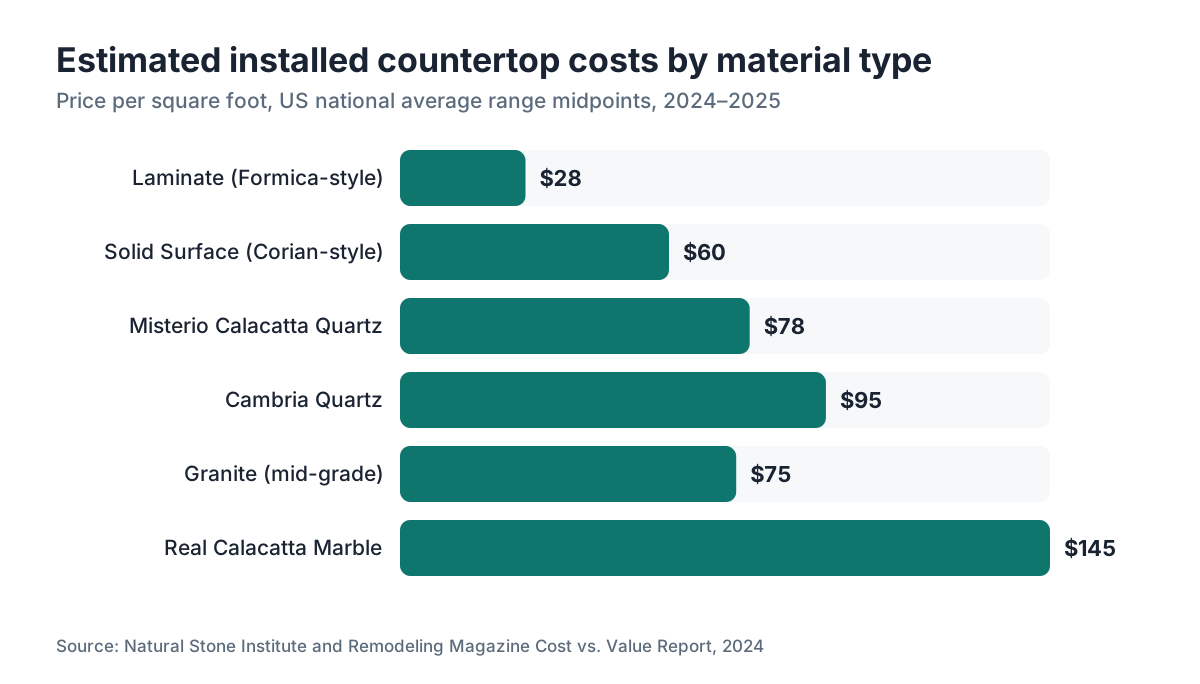
Installed prices for Misterio Calacatta quartz run roughly $55 to $100 per square foot in most US markets as of mid-2025. That range sounds wide, but the spread is real and comes from five variables: your local labor rates, the fabricator's overhead, edge profile choice, number of cutouts, and whether you need a specialty install like a waterfall edge or book-matched layout.
Here is how the cost breaks down at the line-item level for a typical kitchen project:
- Material (slab cost to fabricator): $25, $50/sq ft depending on lot and distributor markup
- Fabrication labor (cutting, edging, polishing): $15, $30/sq ft
- Installation and haul-away: $10, $20/sq ft
- Edge upgrade (ogee, waterfall): add $15, $40 per linear foot
- Sink cutout: $100, $200 each
- Cooktop cutout: $75, $150 each
A 40-square-foot kitchen with an undermount sink and a simple eased edge lands somewhere around $2,200 to $4,000 installed. A larger kitchen at 60 square feet with a waterfall island and specialty edges can reach $7,000 to $10,000 without breaking any rules of thumb.
Vanity countertops are smaller, but per-square-foot prices don't drop proportionally. A 25-square-foot bathroom vanity with one sink cutout might cost $1,400 to $2,500 installed because the minimum shop charges still apply. Small jobs often carry a minimum charge of $500 to $800 regardless of square footage, so the math is different than scaling a kitchen quote down.
Fabricators using quoting software like SlabWise can give you an itemized breakdown of material waste, edge footage, and cutout costs within minutes of getting your measurements. That helps you compare bids on equal footing rather than comparing totals that bundle line items differently.
For broader context on what countertop projects cost across material types, the kitchen countertops overview has current pricing data.
Is Misterio Calacatta quartz good for a kitchen countertop?
Yes, with one honest caveat about heat.
Engineered quartz handles what a kitchen surface faces day to day: cutting prep (still use a board to protect the finish), spills of acidic foods, cleaning with standard countertop sprays, and impact from pots and pans. The non-porous surface means bacteria can't work down into the material the way they can with porous stone or wood [4].
The heat caveat is real. Quartz resin binders can discolor or crack under sudden heat above roughly 150 degrees Celsius (300 degrees Fahrenheit) [5]. Set a hot pan straight from the burner onto quartz and you can leave a permanent thermal mark, and that damage is not covered under most manufacturer warranties. Always use a trivet or hot pad. This is the same advice that applies to any quartz brand, not something specific to Misterio Calacatta.
The Misterio Calacatta pattern is a good kitchen choice because the white-and-gold veining has enough movement to hide fingerprints and minor smudges between cleanings. That's a practical edge over solid-white or very dark surfaces. It photographs well too, which matters if you plan to list the home.
Thickness matters. For kitchen countertops, 3 cm (about 1.25 inches) is the standard. It's strong enough to span standard cabinet runs without extra substrate, and it looks proportionally right with most cabinet door heights. Some fabricators offer 2 cm material at a lower price point, but 2 cm quartz needs a buildup strip along the front edge or a plywood substrate to be structurally sound for kitchen use.
Is Stone Concepts Misterio Calacatta quartz good for a bathroom vanity?
Bathroom vanities are a strong application for this material. The non-porous surface handles moisture, soap residue, makeup products, and toothpaste without absorbing staining agents. Quartz vanity tops stay looking clean more easily than marble, which can pull pigment from makeup and dull from contact with glycolic acid or vitamin C serums.
For a vanity, 2 cm thickness is common and structurally adequate when the top sits on a cabinet with a plywood or MDF substrate. If you want an integrated or thick-mitered edge that makes the top look like 3 cm or more, fabricators can build that up with a laminated edge strip. Many high-end bathroom remodels use this trick to get a substantial profile without paying for a full 3 cm slab.
One practical note: vanity backsplashes get constant water spray and humidity. Quartz handles this fine, but the seam between the countertop and backsplash piece needs correct siliconing. A poor silicone joint lets water work into the cabinet below over time. Ask your fabricator specifically about how they run silicone at seam joints.
The Misterio Calacatta warm white works with white or cream fixtures. If your bathroom leans cool (gray cabinets, chrome fixtures, white subway tile), look at the Stone Concepts Skara pattern, which trends cooler and more minimal, before committing. Seeing large samples of both under your bathroom's lighting at different times of day is time well spent.
For care after installation, the how to clean stone countertops guide covers daily and deep-cleaning routines that apply to quartz surfaces.
How do you clean and maintain Misterio Calacatta quartz countertops?
No sealing required. Ever. That's the single biggest maintenance advantage quartz has over natural stone, and it's permanent, not "for the first few years."
For daily cleaning, warm water and a few drops of dish soap on a soft cloth handles almost everything. Wipe up spills promptly, especially high-pigment stuff (red wine, turmeric, beet juice) even though the surface is non-porous, because dried-on residue can bond to the resin and take more scrubbing to remove.
For stuck-on food or grease, let a damp cloth sit on the area for a few minutes to soften the residue, then wipe. A plastic scraper is safe; metal scrapers are not. Never use scouring pads, steel wool, or abrasive powders. They won't damage the quartz crystals, but they will scratch the resin finish, which shows as dull patches over time.
Cleaning products to avoid on quartz include bleach at high concentrations, oven cleaners, drain cleaners, paint removers, and anything with trichlorethane or methylene chloride. These can break down the resin binder [6]. Standard countertop sprays (Simple Green, Method, Mrs. Meyer's) are fine. Diluted isopropyl alcohol works well for disinfecting.
For bathroom vanities, watch out for nail polish remover (acetone). It's the most common chemical damage claim on quartz warranty work. Keep it off the surface, and if it spills, rinse right away with water.
Quartz makers generally recommend against prolonged UV exposure, worth knowing if you have a skylight directly above a kitchen island or a south-facing window above a bathroom vanity. Long-term UV can cause slight yellowing in some quartz formulations. Stone Concepts' specific UV data isn't published, but this is a known industry-wide limit of polymer-resin composite surfaces [1].
What thickness should you order for Misterio Calacatta quartz?
Two thicknesses dominate the quartz market: 2 cm (about 3/4 inch) and 3 cm (about 1 1/4 inch). A third option, 1.2 cm, exists for very specific uses like cabinet door overlays or thin backsplash panels, but it's not relevant for countertop fields.
3 cm is the right choice for kitchen countertops in almost every situation. It spans a standard 24-inch cabinet without flex, looks proportionally right, and needs no substrate. Most fabricators quote kitchen work in 3 cm by default. If a quote comes in noticeably lower than others and you can't figure out why, ask specifically whether it's priced for 2 cm or 3 cm material.
2 cm works well for bathroom vanities, especially when the cabinet top supports the full field of the stone. It's lighter, which matters for floating vanity installs, and often comes in at a lower material cost. The edge treatment matters with 2 cm: a simple mitered edge or laminated edge strip makes the vanity look more substantial without much added cost.
Book-matched installs, waterfall islands, and full-height backsplashes are aesthetic choices that drive cost hard regardless of thickness. A waterfall edge on a kitchen island needs additional slab material (often a whole extra slab), precise seam alignment, and more fabrication labor. Budget at least $1,500 to $3,000 extra for a full waterfall if you want it done well.
How does Misterio Calacatta compare to Stone Concepts Skara quartz?
Stone Concepts Skara comes up alongside Misterio Calacatta as an alternative in the same brand family. Where Misterio Calacatta has a warm white background with gold and taupe veining, Skara typically reads cooler, with gray or silver-toned veining on a white or light gray ground.
The practical performance between the two is identical. Both are quartz composites, both are non-porous, both use the same maintenance routine. The choice is purely aesthetic.
Skara suits bathrooms and kitchens with cool-toned palettes: gray shaker cabinets, brushed nickel or matte black hardware, large-format light gray tile floors. Misterio Calacatta fits better with warm whites, cream cabinetry, gold or unlacquered brass fixtures, and wood tones.
If you're looking at both and can't decide from small samples, ask the fabricator for a large remnant of each, at least 12 by 24 inches, and bring them home to check under your actual lighting at different times of day. Kitchen and bathroom lighting both shift a lot between morning and evening, and a pattern that looks clearly right in the showroom can look different on-site.
What are the best edge profiles for Misterio Calacatta quartz in kitchens and bathrooms?
Edge profiles change both the look and the cost of a countertop project. Here are the common options and what they actually cost:
- Eased (flat with a slight top corner bevel): Standard, usually included in the base price. Clean, contemporary.
- Beveled (angled top edge, typically 45 degrees): Minor upcharge, $5, $10/linear ft. Adds a subtle detail without weight.
- Bullnose (fully rounded top edge): Small upcharge. Traditional, good for kids' kitchens because there's no sharp corner.
- Ogee (S-curve profile): $15, $30/linear ft upcharge. Traditional, ornate. Works with the Calacatta look if the kitchen style supports it.
- Miter/waterfall (stone wraps vertical face of island): Major upcharge, $40, $80/linear ft for the mitered edge itself, plus extra slab material. Very high-end look but adds significant budget.
- Double waterfall (both ends of island): Budget for an additional full slab and $2,000, $4,000 in extra fabrication.
For the Misterio Calacatta pattern, an eased or beveled edge keeps the look clean and lets the stone be the focal point. Ogee can work in a more traditional kitchen but can feel heavy. Waterfall islands are popular with dramatic-veined patterns like this one because the vein direction can be matched (or intentionally contrasted) at the miter.
In bathrooms, eased or soft-beveled edges are the most practical. Ogee profiles on a vanity collect soap residue in the curve if not dried regularly.
How do fabricators quote and template Misterio Calacatta quartz jobs?
Quartz jobs follow a standard workflow: measure, template, fabricate, install. The details matter for getting an accurate quote.
Templating is the process of creating a precise digital or physical template of your countertop layout. Most professional fabricators now use digital templating tools (laser measuring arms or photogrammetry setups) that capture your exact countertop shape, including out-of-square walls, curved edges, and the precise locations of sink and cooktop openings. A digital template cuts the chance of field errors and makes it easier to lay the cut plan against the actual slab to manage veining direction and reduce waste.
For Misterio Calacatta, which has directional veining, layout decisions happen at the template stage. Where do seams fall? Do you want the vein to flow continuously across a seam (requires careful slab layout), or is a break acceptable? On an island, does the vein run with the long dimension or across it? These choices affect how much of a slab gets used and whether you need more than one slab.
A standard 3 cm quartz slab is typically 55 to 65 inches wide by 110 to 130 inches long, giving a net usable area of roughly 40 to 55 square feet after edge waste and cutout waste [7]. A 50-square-foot kitchen often needs more than one slab if the layout has overhangs and an island, or if you want to manage veining direction carefully.
Fabricators running shop management software can model the cut layout against digital slab dimensions before cutting, which reduces material waste and gives a more accurate quote. That's the kind of planning that separates a $500 material overrun from a clean job.
For guidance on what the installation process looks like from the homeowner's side, the countertop installation guide walks through the whole sequence.
What warranty does Stone Concepts quartz carry, and what voids it?
Confirm Stone Concepts' warranty terms directly with your fabricator or the regional distributor, because terms vary by market and get updated periodically. Quartz warranties in the industry typically run 10 years to lifetime, covering manufacturing defects such as delamination, excessive variation from product standards, and structural failure under normal use [3].
What voids quartz warranties across virtually all brands, including Stone Concepts:
- Heat damage from direct contact with pots, pans, or heat guns above manufacturer-specified temperature thresholds
- Chemical damage from solvents, strong alkalis, or industrial cleaners
- Impact cracks from a sharp or heavy blow
- Outdoor installation (UV exposure and freeze-thaw cycles degrade the resin)
- Improper installation (this is why using a certified or experienced fabricator matters)
Sink cutouts are a specific warranty gray area. Stress cracks at sink corners are one of the more common failure points in quartz installations. They usually come from an undersized or badly shaped cutout radius rather than a material defect. A properly cut sink opening has a radius at each corner, never a square inside corner, to spread stress. If a crack appears at a sink corner, expect a negotiation between the homeowner, fabricator, and brand rep about fault.
Keep your purchase invoice, the product name and lot number, and any warranty documentation. You'll need them if a claim comes up two years after installation.
Is quartz a better choice for kitchens than laminate or solid surface?
Depends entirely on budget and how long you plan to stay in the house.
Laminate (including Formica and similar brands) runs $15 to $40 per square foot installed, roughly half or less the cost of quartz. Modern laminate patterns have gotten quite good at mimicking stone visually. The tradeoffs are real though: laminate can't be repaired if it chips at an edge, it can swell if water gets under a seam, and it won't send the same resale signal as stone or engineered stone. If budget is the constraint, laminate is a practical choice. See the laminate countertops and formica countertops guides for current pricing.
Corian and other solid-surface materials run $45 to $75 per square foot installed. Their biggest advantage is fully integrated sinks with no visible joint and the ability to sand out scratches. The downside is lower heat resistance than quartz and a slightly plasticky look under direct light that some buyers notice.
For a full remodel where you plan to stay or sell within 10 years, quartz generally makes sense. Low maintenance, durability, and strong buyer appeal in the US market justify the premium over laminate for most situations. If you're doing a short-term rental renovation or a budget flip, laminate does the job at a fraction of the cost.
For completeness, if you're interested in natural stone at a similar or lower price point than Calacatta marble, the granite countertops guide covers white and gold granite options that can visually approximate the Calacatta look.
Frequently asked questions
Is Stone Concepts Misterio Calacatta quartz the same as real Calacatta marble?
No. Misterio Calacatta is engineered quartz, made from crushed quartz bound with polymer resin. Real Calacatta marble is a natural stone quarried in Tuscany, Italy. The engineered version mimics the look but is non-porous, requires no sealing, and doesn't etch from acids. The trade-off is that quartz has lower heat resistance than marble and can yellow with prolonged UV exposure.
How much does Stone Concepts Misterio Calacatta quartz cost per square foot?
Expect $55 to $100 per square foot installed in most US markets. Material alone, before fabrication and installation, typically runs $25 to $50/sq ft at the fabricator's purchase price. Factors that push toward the high end include complex edge profiles, waterfall islands, multiple cutouts, and high-cost local labor markets. Small vanity jobs often carry minimum shop charges that raise the effective per-square-foot rate.
Can you put Misterio Calacatta quartz outdoors?
No. Quartz is not rated for outdoor use. UV exposure degrades the polymer resin binder over time, causing discoloration and potential delamination. Freeze-thaw cycles can cause cracking. Nearly all quartz manufacturers, including Stone Concepts, exclude outdoor installations from warranty coverage. For outdoor kitchen countertops, granite or porcelain tile are better choices.
Does Misterio Calacatta quartz need to be sealed?
No. Engineered quartz is non-porous by nature because the resin binder fills all voids in the material. There's nothing for a sealer to penetrate, so sealing has no benefit. This is a permanent property, not something that wears off. Unlike marble or granite, you will never need to apply a stone sealer to quartz at any point in its life.
Can hot pans damage Misterio Calacatta quartz countertops?
Yes. Setting a hot pan straight from the burner onto quartz can cause thermal discoloration or cracking in the resin binder. This damage is typically permanent and not covered under warranty. Always use a trivet or hot pad. This applies to all quartz brands, not only Stone Concepts. The quartz crystals themselves are heat-tolerant; the resin that holds them together is not.
What is the difference between Stone Concepts Misterio Calacatta and Skara quartz?
Both are engineered quartz from Stone Concepts with similar performance. Misterio Calacatta has a warm white background with gold and taupe veining, suited to warm-toned kitchens with cream cabinets and gold fixtures. Skara is cooler in tone with gray or silver veining, better suited to gray cabinetry, brushed nickel hardware, and contemporary cool-palette designs. Performance, maintenance, and pricing are essentially the same.
What thickness of quartz should I order for a kitchen vs. a bathroom vanity?
For kitchens, order 3 cm (about 1.25 inches). It's structurally self-supporting across standard cabinet spans and looks proportionally right with most cabinet heights. For bathroom vanities, 2 cm is commonly used and works well when the cabinet provides a full support surface. A laminated edge strip on 2 cm makes the vanity look thicker without the cost of a full 3 cm slab.
How do seams in Misterio Calacatta quartz look, and can they be hidden?
Seams in quartz are visible if you look closely, but a skilled fabricator minimizes their appearance by matching vein direction across the seam and using a tight epoxy joint colored to the stone. Misterio Calacatta's bold veining can make seams easier to hide compared to a solid-color or very subtle pattern. Seam placement matters: avoid putting seams directly in front of a range or sink where stress concentrates.
Will Misterio Calacatta quartz increase my home's resale value?
Stone and engineered-stone countertops rank among the top kitchen upgrades buyers notice, though return on investment figures vary widely by market. Remodeling Magazine's Cost vs. Value report has tracked kitchen remodel recoup rates in the 50 to 75% range nationally, with material quality as a contributing factor. Quartz countertops specifically appear in buyer preference surveys by the National Association of Realtors.
How long does it take to fabricate and install Misterio Calacatta quartz countertops?
After templating, most fabricators need 5 to 14 business days to cut, edge, and finish the stone before installation. Rush timelines of 3 to 5 days exist at some shops but usually carry a premium. Installation itself takes 2 to 6 hours for a typical kitchen. You'll need your sink and cooktop on hand before installation day, and your cabinets must be fully leveled and secured first.
Can quartz countertops crack, and what causes it?
Yes. The most common causes are thermal shock (hot pan directly on the surface), impact from a sharp heavy blow, and stress concentration at sink cutout corners that weren't properly radiused during fabrication. Quartz is less prone to cracking than marble under normal use, but it's not indestructible. A properly templated and fabricated install with good cabinet support under the field is very unlikely to crack in normal kitchen use.
What cleaning products are safe for Misterio Calacatta quartz?
Warm water with dish soap handles daily cleaning. Standard spray cleaners like Simple Green or Method are safe. Diluted isopropyl alcohol works for disinfecting. Avoid bleach at high concentrations, oven cleaners, acetone (nail polish remover), and any solvent-based product. These can damage or stain the resin binder. Abrasive scrubbing pads scratch the surface finish over time; use a soft cloth instead.
Is Stone Concepts Misterio Calacatta quartz available at big-box stores like Home Depot?
Stone Concepts distributes primarily through regional stone distributors and independent fabricators, not big-box retail. Home Depot and Lowe's stock quartz through their own programs (typically MSI, Silestone, or private-label brands). If you want Misterio Calacatta specifically, contact local stone yards or fabricators and ask which distributors they buy from. Regional availability varies, and not every market carries the full Stone Concepts line.
How do I compare quotes from different fabricators for the same quartz material?
Ask each fabricator to itemize: material cost per square foot, fabrication cost per square foot, edge profile cost per linear foot, cutout charges, and installation fee. A low total quote can hide a 2 cm slab substitution, a thinner edge profile, or skipped sink cutout radius work. Confirm the slab thickness, brand, and pattern name are identical across all quotes. Fabricators using modern quoting software should be able to email you an itemized breakdown in minutes.
Sources
- NSF International, Engineered Stone Composition Standards Overview: Engineered quartz is composed of approximately 90 to 93% crushed quartz aggregate bound with polymer resins, making it non-porous.
- USGS, Marble: A Metamorphic Rock Composed of Calcite: Marble is calcite-based and susceptible to acid etching from common household substances including acidic foods and beverages.
- Cambria Company, Warranty Information: Cambria offers a lifetime warranty on its quartz surfaces covering manufacturing defects under normal residential use.
- USDA Food Safety and Inspection Service, Cutting Surfaces and Food Safety: Non-porous surfaces do not harbor bacteria in subsurface voids the way porous materials can, making them easier to sanitize.
- Occupational Safety and Health Administration, Silica in Engineered Stone: Engineered stone polymer resin binders can be damaged by sustained temperatures above approximately 150 degrees Celsius.
- EPA, Safer Choice Program: Chemical Hazards for Surfaces: Solvents including methylene chloride and trichlorethane can degrade polymer resin binders in composite stone surfaces.
- Marble Institute of America (now Natural Stone Institute), Fabrication Standards for Engineered Stone: Standard engineered quartz slabs measure approximately 55 to 65 inches wide by 110 to 130 inches long, yielding roughly 40 to 55 usable square feet after fabrication waste.
- National Association of Realtors Research Group, 2022 Remodeling Impact Report: Kitchen remodels including countertop upgrades to stone or engineered stone are consistently ranked among the top features buyers notice and value.
- Remodeling Magazine, 2024 Cost vs. Value Report: Minor kitchen remodels recoup between 50 to 75% of cost at resale nationally, with material quality as a contributing factor to buyer perception.
- Natural Stone Institute, Quartz Surface Care and Maintenance Guidelines: Engineered quartz surfaces require no sealing and should be cleaned with pH-neutral cleaners; prolonged UV exposure can cause yellowing in polymer resin formulations.
- U.S. Department of Housing and Urban Development, Healthy Homes Program: Surface Materials: Non-porous countertop surfaces are identified as preferable for kitchen hygiene because they do not absorb moisture or harbor microbial growth.
Last updated 2026-07-09