TL;DR
- Caesarstone Calacatta Scoria (product code 5141) is a white-ground quartz surface with warm grey-gold veining that mimics Calacatta marble.
- Samples ship free from caesarstone.com or sit on boards at most kitchen showrooms.
- Installed cost runs about $75 to $120 per square foot depending on region, edge profile, and cutouts.
- The surface is non-porous.
- It never needs sealing.
What exactly is Caesarstone Calacatta Scoria?
Caesarstone Calacatta Scoria, sold under product code 5141, is an engineered quartz slab with a bright white background and a pattern of thick, warm grey-gold veining. The name borrows from Calacatta, the Italian marble quarried near Carrara that has been the most wanted white stone for kitchen counters for a century. "Scoria" points to the darker, almost tawny vein tone, which pulls warmer than the cooler grey veins in Caesarstone's Calacatta Nuvo (also worth sampling if you like the look).
Like all Caesarstone products, Scoria is made from roughly 90 percent ground quartz bound with polymer resins and pigments, then compressed and cured into slabs [1]. That process is why engineered quartz is non-porous. There is no open capillary structure for liquids to enter. It never needs sealing, which is the single biggest practical difference from natural marble.
The slab ships at roughly 126 by 63 inches in two thickness options: 2 cm and 3 cm. Most residential kitchens in North America use 3 cm (about 1.25 inches) because it looks substantial without a laminated edge built up underneath.
If you have been weighing it against marble countertops or Cambria countertops, you are on a sensible shortlist. Those are the closest rivals in the white-veined slab category.
How do I get a Caesarstone Calacatta Scoria sample?
Caesarstone ships free samples straight from its website, caesarstone.com. You can order up to two at a time, delivered to your door at no charge [2]. Each sample is a small chip, about 4 by 4 inches, enough to hold next to your cabinet doors and floor under real light.
A chip has limits, though. The veining on quartz is not random tile to tile the way natural stone is. Caesarstone lays up a pattern that repeats across the slab. A 4-inch chip gives you the background color and general vein tone but not the full sweep. If you want to see how the veining moves, ask your local fabricator or stone yard whether they keep a remnant or a display slab you can look at.
Most kitchen showrooms that carry Caesarstone keep a display board of current colors, Calacatta Scoria included. Home Depot stocks Caesarstone in many markets, and their sample boards let you see the 3 cm thickness and a standard edge profile in person. Costco's countertop program has carried Caesarstone at times too, though availability shifts by region.
Do one thing before you order the chip. Pull the product page on caesarstone.com and study the slab-view photography, more than the swatch. The slab image shows vein scale far better. Then order the physical sample to confirm color temperature under your own kitchen lighting. Warm LED reads very differently on that gold vein than daylight does.
How does Calacatta Scoria compare to Calacatta Nuvo and other Caesarstone whites?
Caesarstone has a big Calacatta family, and the differences matter once you start sampling.
| Color Name | Code | Background | Vein Tone | Vein Scale |
|---|---|---|---|---|
| Calacatta Nuvo | 5131 | Bright white | Cool grey | Fine to medium |
| Calacatta Scoria | 5141 | Bright white | Warm grey-gold | Bold, wide |
| Calacatta Gold | 5220 | Soft white | Gold with grey | Very bold |
| Statuario Maximus | 5200 | Warm white | Bold grey | Wide, dramatic |
| Vanilla Noir | 6046 | Off-white | Dark grey | Soft, linear |
Calacatta Nuvo reads cooler and more restrained. Many people order it alongside Scoria to compare. If your kitchen has white Shaker cabinets and chrome hardware, Nuvo often photographs better because it does not fight the cool tones. If your cabinets trend cream, warm grey, or natural wood, Scoria's warm vein tone settles in more naturally.
Calacatta Gold pushes the warmth further. It reads almost buttery in some light and can look dated if you are designing for the long haul. Scoria sits between Nuvo and Gold, which is why it has become one of Caesarstone's steadier sellers in the white-veined range.
Compared to granite countertops, the split is consistency. Granite is natural stone with real variation slab to slab. Scoria looks essentially the same batch to batch, which fabricators like when they are matching several pieces across a large kitchen.
What does Caesarstone Calacatta Scoria cost installed?
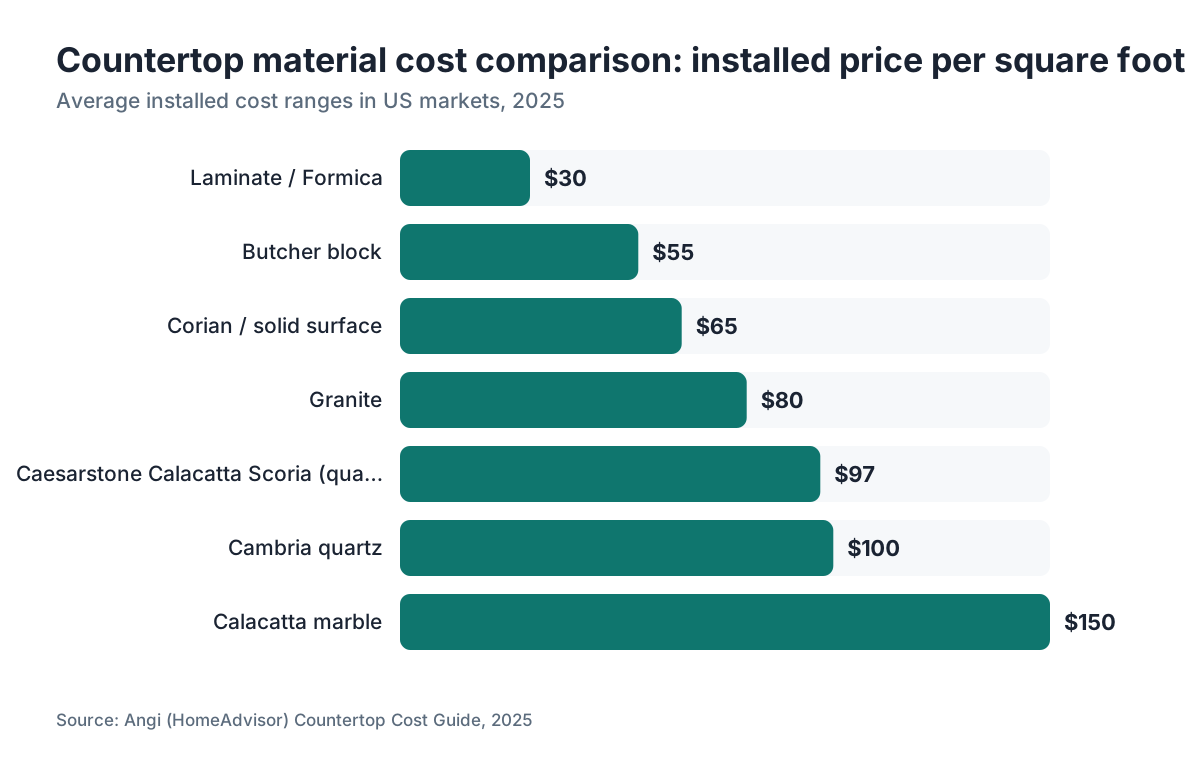
Installed cost for Caesarstone Calacatta Scoria runs about $75 to $120 per square foot in most US markets as of 2025, including material, fabrication, and standard installation [3]. Four things move that range: your region, your edge profile, the number of cutouts, and how complex the layout is.
The slab itself, sold wholesale to fabricators, runs somewhere around $30 to $50 per square foot. Fabrication, which covers cutting, edge polishing, and the sink cutout, adds $25 to $45. Installation plus tearout of the old counter adds another $10 to $20. Stack those and you land in the $75 to $120 range.
Regional swing is real. San Francisco, New York, and Boston tend to run 20 to 30 percent above the national midpoint. Rural Midwest markets can run 10 to 15 percent below.
Edges add money. A standard eased or slightly beveled edge is usually included. A mitered waterfall edge on an island can add $150 to $300 or more in labor per linear foot of the mitered joint. An ogee or dupont edge adds $15 to $25 per linear foot over base.
A typical 40-square-foot kitchen (roughly 25 feet of linear counter at an average 25-inch depth) lands around $3,000 to $4,800 installed for Calacatta Scoria, before any waterfall or specialty work. Want a fast number before you call fabricators? The SlabWise instant quote tool can rough-scope your square footage and hand you a market range without a site visit.
For context, Caesarstone sits mid-to-upper tier. It costs more than laminate countertops or Formica countertops, roughly matches Cambria, and usually beats a slab of genuine Calacatta marble on price.
Is Caesarstone Calacatta Scoria durable enough for a real kitchen?
Quartz is a 7 on the Mohs hardness scale, so it shrugs off everyday scratching from knives and utensils better than marble, which sits around 3 to 4 [4]. In practice you would have to work at scratching Scoria with normal use. The catch is the polymer resin binder, which is more vulnerable to certain chemicals and heat than the quartz crystals it holds together.
Heat is the thing people underestimate. The resin can discolor or crack from sudden thermal shock. Caesarstone's technical guidance advises against setting hot pots or pans directly on the surface and tells you to always use trivets or hot pads [2]. A cast-iron skillet straight from a 500-degree oven, set right on Calacatta Scoria, can leave a permanent white thermal mark. This is not hypothetical. It happens in real kitchens, and it is not covered by the warranty.
UV exposure yellows the resin slowly over years. Caesarstone recommends keeping the surface out of prolonged direct sun and says plainly it is not for outdoor use [2]. Indoors this rarely becomes a real problem, but a south-facing window with no UV film and hours of direct sun a day is worth flagging.
Chemicals matter too. Strong bleach, oven cleaners, and drain cleaners can etch or discolor the binder. Mild soap and water or a pH-neutral stone cleaner is the right routine. The how to clean stone countertops guide covers the general approach that applies here.
Edge nicks are possible if something heavy drops on a sharp corner. Quartz chips more cleanly than granite but resists it better than marble. The 3 cm thickness takes edge impacts far better than 2 cm.
The honest verdict: for a busy family kitchen, Calacatta Scoria is a more forgiving daily surface than real Calacatta marble. Marble etches from lemon juice and vinegar and scratches from normal use. Scoria does neither. The one place marble wins is heat.
Does Caesarstone Calacatta Scoria need sealing or special maintenance?
No sealing, ever. That is the definitive answer.
Engineered quartz absorbs almost no water, measured below 0.02 percent under ASTM C373 [5]. There is no porosity for a sealer to reach or protect. If a salesperson tells you to seal a quartz surface, treat it as a reason to double-check everything else they say.
Daily upkeep is simple. Wipe spills reasonably soon, especially acidic ones like wine, tomato sauce, or citrus. Not because the surface etches the way marble does, but because dried, sugary spills get harder to clean the longer they bond. Mild dish soap and a damp cloth handle almost everything. For stubborn residue like dried paint or crusted food, a plastic scraper followed by a damp cloth works without scratching.
Skip abrasive scrub pads. The polished finish can dull over time from repeated micro-scratching with steel wool or harsh Scotch-Brite. Use the soft side.
Caesarstone sells its own care products, but you do not need them. A plain pH-neutral cleaner does the same work. What to keep off the stone: full-strength bleach, acetone (nail polish remover), paint stripper, and industrial degreasers. Those can attack the resin and cause permanent discoloration.
Over many years, the polished finish will pick up micro-scratches in the spots where you cut and prep most. That is normal wear, not a defect, and it happens on every quartz brand.
What warranty does Caesarstone offer on Calacatta Scoria?
Caesarstone offers a lifetime limited warranty on residential use for Calacatta Scoria and most of its line [2]. It covers manufacturing defects: delamination, cracking under normal use, or significant color variation from the confirmed sample.
The warranty does not cover heat damage, UV yellowing, chemical misuse, impact chips, or normal wear and surface scratches. It also does not transfer to a second owner if you sell the home, which differs from some competitors. Cambria offers a transferable lifetime warranty, and some buyers count that as a resale point.
To keep coverage valid, you need professional installation (no DIY), and the surface has to be used as intended: indoor, residential, never as a cutting board or hot pad. Save your purchase receipt and any fabricator paperwork. Caesarstone can ask for proof of purchase and installation details if you file a claim.
Caesarstone has Israeli manufacturing roots and runs its US operations out of Atlanta, Georgia. The brand has sold in North America since the early 2000s and has a settled claims process, which counts when you are buying something you plan to keep for 15 to 20 years.
How does Calacatta Scoria look in real kitchens with different cabinet colors?
White cabinets are the most common pairing, and Scoria handles them well, but the exact white matters. Pure bright white doors like Benjamin Moore Chantilly Lace can make Scoria's slightly warm background read a touch yellow side by side in daylight. Off-white cabinets (creams, warm-based whites, greiges) make Scoria look intentional and settled.
Dark navy and forest green have been a favorite pairing since the early 2020s, and Scoria reads well against both. The white background pops over dark lowers, and the warm gold vein picks up wood, brass, or bronze hardware without trying too hard.
Natural wood cabinets in white oak, walnut, or maple pair well because the warm gold undertone in the veining agrees with wood tones instead of fighting them. This is genuinely one of the better quartz choices for mixed-material kitchens.
Grey is trickier. Cool grey doors (blue-grey, slate-grey) can make Scoria's warm vein look muddy. Warm greys work better. If your cabinets are a cool grey and you love the Calacatta look, Nuvo's cooler vein will probably read better in your room.
Flooring matters too. Large-format white or warm grey porcelain extends the airy feel. Lighter European oak anchors the space and makes the warm veining feel deliberate. Dark walnut floors under Scoria can feel heavy, though also very intentional if the rest of the design backs it up.
Here is the honest advice. Bring the physical sample home, tape it to your counter at real counter height, and look at it three times a day: morning, afternoon sun, and under your kitchen lights at night. That beats any rendering.
How do fabricators work with Caesarstone Calacatta Scoria?
For fabricators, Calacatta Scoria is a straightforward engineered quartz. Standard tooling handles cutting and edge profiling. The pattern repeat is a manufacturing constant, so matching seams takes less judgment than matching natural stone, though where you place the seam still matters to the eye.
Caesarstone holds a consistent slab size and thickness, which makes nesting (planning cuts across a slab to cut waste) predictable. For a standard layout, most shops can pull a 40 to 55 square foot kitchen from a single slab with careful planning. Layout software helps: shops running optimization can sometimes save a full slab's worth of material across a batch of projects. If you run a shop and want to see how automated nesting moves your material costs, SlabWise has a demo that walks through real-kitchen scenarios.
Polished edges come out clean with standard quartz polishing sequences. The white background shows edge inconsistency more than dark stone does, so edge work needs clean passes. Waterfall mitered edges on this color, popular given the visual weight of the bold veining, need precise 45-degree cuts and careful adhesive color matching.
Sink cutouts want a jigsaw or CNC router with the right quartz blades. The material does not chip as readily as granite on cutouts, but the white background makes any chip more visible than it would be on darker stone. Most shops add a relief cut before the main cutout to release stress.
For the install, countertop installation best practices for quartz apply: solid cabinet support, a level substrate, and proper silicone at seams. Caesarstone advises against epoxy-only seams, and its technical guidelines spell out the approved adhesive types.
How does Caesarstone Calacatta Scoria compare to natural marble?
This is the comparison most buyers are really making when they order the sample.
Genuine Calacatta marble, quarried in the Apuan Alps of Italy, costs more, varies more, and asks for more upkeep. A mid-grade Calacatta installed can run $100 to $200 per square foot, higher for premium grades. It etches from acidic liquids, scratches more easily, and needs sealing every one to two years [6]. In return you get true natural variation and the prestige of real stone, which matters to some buyers and not at all to others.
Scoria gives you a controlled, consistent version of that look without the upkeep. The trade-off shows up close: the veining repeats, a stone pro can spot it instantly, and under a close look the pattern lacks the organic randomness of quarried marble.
For a kitchen a family uses every day, the quartz case is strong. Lemon juice, vinegar dressings, wine, coffee, all the things that etch marble, do nothing to Calacatta Scoria. With young kids or serious cooking, that matters every week.
For a rarely used entertaining kitchen or a bathroom vanity where looks beat daily function, some buyers genuinely prefer the real stone. That is a fair choice, not a mistake. Just go in knowing the maintenance you are signing up for.
To weigh other natural stone options, the marble countertops guide walks through the maintenance realities in detail.
Where can I buy Caesarstone Calacatta Scoria and how does the ordering process work?
Caesarstone does not sell direct to consumers. You buy through an authorized fabricator or dealer. The path looks like this:
- Order a sample from caesarstone.com or grab one at a showroom.
- Confirm the color works in your space.
- Get quotes from local fabricators. Most source the slab directly from Caesarstone or a regional distributor.
- A templater visits to measure (usually after cabinets are in), with a physical template or digital laser measuring.
- The fabricator cuts and polishes your slabs.
- Installation follows, usually one to two weeks after templating.
Caesarstone's site has a dealer locator at caesarstone.com. Home Depot sells Caesarstone through its countertop installation program in most US markets, a convenient single-vendor option, though fabrication quality varies by local contractor.
Lead time varies. Caesarstone slabs are generally in stock at regional distributors across the US, so material lead time is usually under a week. Shop backlog is the real variable. Busy seasons (spring and fall renovation peaks) can push fabrication out to three to five weeks.
Get at least three quotes. Fabrication pricing on the same slab can swing 20 to 30 percent between shops in one metro, driven by overhead, equipment, and current workload. The lowest quote is not automatically wrong, but ask to see finished Caesarstone work, especially mitered edges and sink cutouts, before you commit.
Frequently asked questions
Can I get a free Caesarstone Calacatta Scoria sample shipped to my home?
Yes. Caesarstone ships free samples through caesarstone.com, up to two per order. The chip is about 4 by 4 inches, enough to check color in your lighting but too small to show the full vein sweep. To see the pattern at scale, ask a local fabricator or stone yard whether they have a display slab or a Scoria remnant you can look at in person.
What is the difference between Caesarstone Calacatta Scoria and Calacatta Nuvo?
Calacatta Nuvo (5131) has cool grey veining and a slightly cooler background. Calacatta Scoria (5141) has warmer grey-gold veining that reads more like antique Calacatta marble. Nuvo is more neutral and easier to match with cool-toned hardware and cabinets. Scoria works better with warm woods, brass or bronze fixtures, and cream or warm-white cabinetry. Sample both. They look quite different in person.
Does Caesarstone Calacatta Scoria need to be sealed?
No. Engineered quartz absorbs below 0.02 percent water and has no open pores for a sealer to reach. Sealing is never needed and does nothing for performance. Clean with mild soap and water or a pH-neutral cleaner. Keep full-strength bleach, acetone, and industrial degreasers off it, since those can damage the polymer resin binder.
What is the installed cost of Caesarstone Calacatta Scoria per square foot?
Expect $75 to $120 per square foot installed, covering material, fabrication, and standard installation in most US markets as of 2025. High-cost metros run higher. Edge upgrades like ogee or waterfall profiles add to the total. A typical 40-square-foot kitchen lands around $3,000 to $4,800 before specialty features.
Can you put hot pots directly on Caesarstone Calacatta Scoria?
You should not. Caesarstone's technical guidance says to always use trivets or hot pads. The polymer resin binder is vulnerable to thermal shock and can develop permanent white marks or micro-cracks from a hot pan set right on the surface. That damage is not covered by the warranty. Marble handles heat somewhat better; quartz does not.
What warranty does Caesarstone offer on Calacatta Scoria for residential use?
Caesarstone offers a lifetime limited warranty for residential installs, covering manufacturing defects like delamination or cracking under normal use. It does not cover heat damage, UV yellowing, chemical damage, impact chips, or normal surface wear. It also does not transfer to a later homeowner if you sell. Keep your purchase receipt and fabricator paperwork in case you file a claim.
How does Calacatta Scoria quartz compare to real Calacatta marble?
Calacatta marble costs more ($100 to $200 or more per square foot installed), etches from acidic liquids, scratches more easily, and needs sealing every one to two years. Scoria is more consistent, resists etching and staining, and needs no sealing. Real marble has genuine natural variation and prestige; Scoria has a repeating engineered pattern. For a daily-use family kitchen, Scoria is more practical.
Is Caesarstone Calacatta Scoria good for a kitchen island?
Yes, and it is one of the more popular uses for this color. The bold veining reads dramatically at island scale. If you add a waterfall edge on the sides, budget extra for the mitered joints and talk adhesive color matching with your fabricator, since the white background makes any seam color mismatch visible. Get at least three quotes if a waterfall is in the plan.
Can Caesarstone Calacatta Scoria be used for a bathroom vanity?
Yes. Caesarstone recommends the surface for bathroom vanities, and the white-veined look moves well from kitchen to bath. Bathroom use is lower stress than kitchen use since heat and heavy cutting are not factors. The same care rules apply: no harsh chemicals, no abrasive scrubbers. For a spa-like white bath, Scoria and Calacatta Nuvo are both common picks.
How long does it take from ordering Caesarstone Calacatta Scoria to installation?
Total timeline is usually three to six weeks from confirmed order. Slab material is generally available at regional distributors within a week. Shop backlog drives the variability; spring and fall are peak seasons with longer waits. After fabrication, scheduling the install and any needed tearout adds a few more days. Template first, then the clock starts on fabrication.
Does Caesarstone Calacatta Scoria yellow over time?
Slow UV yellowing of the resin binder is possible with prolonged direct sun. Caesarstone does not recommend the product outdoors partly for this reason. For a standard indoor kitchen, yellowing rarely becomes a real concern unless you have south-facing windows with hours of direct sun and no UV-filtering film. Low-E window film is worth considering if your sun exposure is heavy.
What edge profiles work well with Caesarstone Calacatta Scoria?
The popular choices are eased (a softened 90-degree), beveled, and mitered waterfall. Eased is the cleanest, most current look and shows off the 3 cm thickness without competing with the veining. Ogee and dupont edges feel more traditional but can look dated. Waterfall edges are stunning on a Scoria island but need precise miter work and add real cost, typically $150 to $300 or more per mitered joint.
Can I install Caesarstone Calacatta Scoria myself to save money?
Technically possible for an experienced DIYer, but Caesarstone's warranty requires professional installation. Quartz slabs are heavy (a 3 cm section runs 12 to 18 pounds per square foot), need precise cutting with the right tooling, and seam work takes experience to do invisibly. A bad cut or a drop means a very expensive replacement. Most fabricators will not sell slabs to homeowners without an install contract. The savings rarely justify the risk.
What cabinet colors pair best with Caesarstone Calacatta Scoria?
Warm white, cream, off-white, natural wood, navy, and forest green all work well. The warm gold vein tone agrees with brass and bronze hardware. It pairs less naturally with cool grey cabinets or stark blue-toned whites, where Calacatta Nuvo's cooler vein usually performs better. Bring a physical sample home and check it against your cabinets under your actual kitchen lighting before committing.
Sources
- Caesarstone, Technical Data Sheet for Engineered Quartz: Caesarstone engineered quartz is composed of approximately 90 percent ground quartz bound with polymer resins and pigments
- Caesarstone, Product Care and Warranty Information: Caesarstone advises always using trivets or hot pads and offers a lifetime limited warranty for residential installations; samples available free through the website
- Angi (formerly HomeAdvisor), Quartz Countertop Cost Guide 2025: Installed cost for premium engineered quartz countertops ranges approximately $75 to $120 per square foot in US markets
- U.S. Geological Survey, National Minerals Information Center: Quartz has a Mohs hardness of 7, making it significantly harder than marble which rates 3 to 4 on the Mohs scale
- ASTM International, Standard Test Method C373: Water Absorption for Dense and Vitrified Products: Engineered quartz surfaces have water absorption rates below 0.02 percent as measured by ASTM C373 standards
- Natural Stone Institute, Marble and Calacatta Care Guide: Calacatta marble requires sealing every one to two years and is vulnerable to etching from acidic liquids and scratching from normal kitchen use
- U.S. Geological Survey, Mineral Commodity Summaries 2024: Quartz is rated 7 on the Mohs hardness scale and is one of the most abundant minerals used in engineered stone products
- Natural Stone Institute, Stone Countertop Installation Guidelines: Professional installation is required to maintain warranty coverage on engineered stone countertops; substrate must be level and adequately supported
- U.S. Environmental Protection Agency, Indoor Air Quality: Engineered stone products and their polymer resin binders are subject to review for VOC emissions under indoor air quality guidelines
- Consumer Reports, Kitchen Countertops Ratings and Buying Guide: Quartz countertops ranked highly for durability and ease of maintenance in consumer testing, outperforming marble and comparable to granite in everyday use
Last updated 2026-07-10