TL;DR
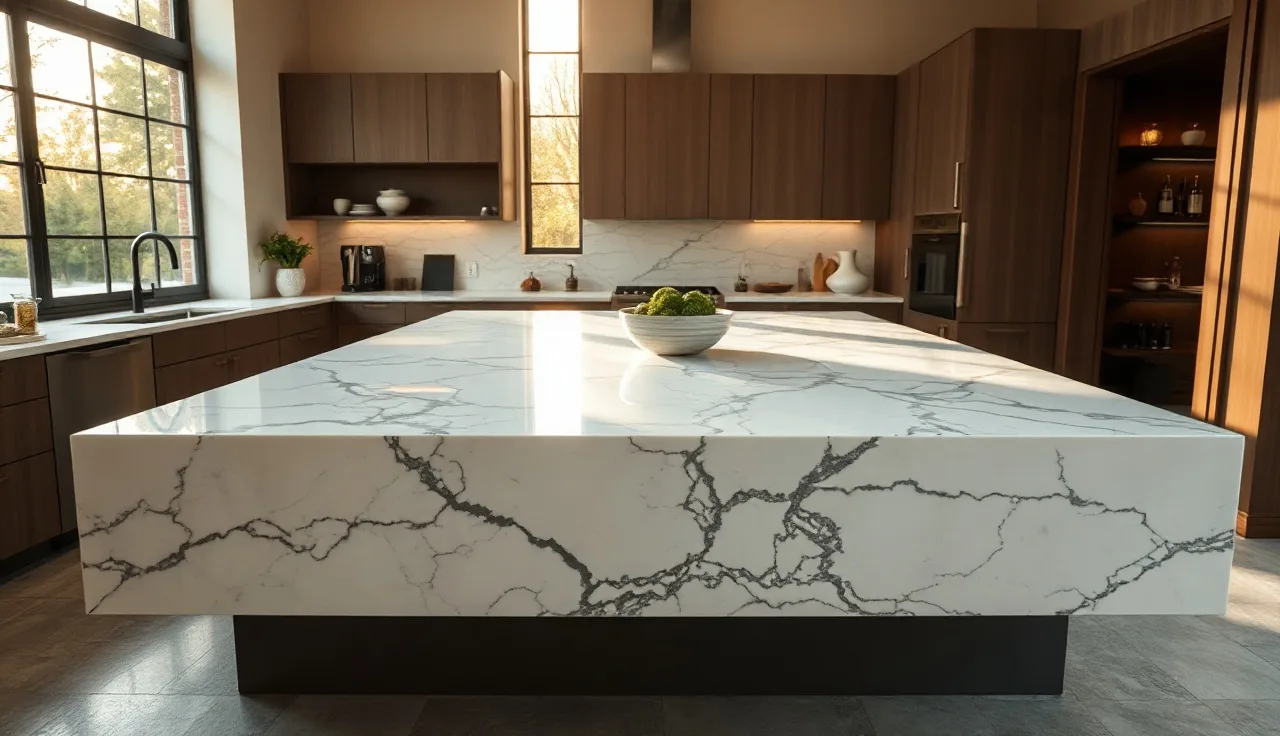
- Caesarstone Statuario Maximus (5031) is a bold white quartz with thick dark grey veining that mimics Statuario marble.
- Free or low-cost samples (typically $0-$10 shipped) show color and texture but not full slab variation.
- Always view a full slab before finalizing your order.
- Installed cost runs $70-$130 per square foot depending on your market and edge profile.
What exactly is Caesarstone Statuario Maximus?
Caesarstone Statuario Maximus, product code 5031, is a white-ground engineered quartz surface with dramatically bold grey veining. Caesarstone markets it as an homage to Statuario marble from the Apuan Alps in Tuscany, and the visual comparison is fair. The veins are thick, high-contrast, and somewhat irregular, which is unusual for quartz, a category where most patterns lean toward the uniform and predictable.
The surface ships in a polished finish as standard. Caesarstone also offers a soft Honed finish on this color, though availability depends on your distributor and region. The slab dimensions are 130 × 63 inches (around 56 square feet per slab) in a 3 cm thickness. A 2 cm option exists in some markets but most kitchen installations use 3 cm.[1]
This is engineered quartz, meaning it is roughly 93% ground quartz bound with polymer resins and pigments. Unlike natural marble countertops, it does not need sealing, does not etch from acidic foods, and has consistent hardness across the surface. The tradeoff is that you cannot replicate the true translucency of natural stone, and you cannot re-hone or re-polish it at home the way you can with some softer stones.
The color sits in Caesarstone's Premium tier, which affects price. Caesarstone divides its catalog into Design, Premium, and Supernatural collections, with Supernatural commanding the highest fabricated prices. Statuario Maximus is Premium, so expect it to cost $10-$25 per square foot more than an entry-level Caesarstone color like Osprey or Frosty Carrina at your local fabricator.[1]
How do you order a Caesarstone Statuario Maximus sample?
Caesarstone offers samples through three channels: their own website, authorized dealers and kitchen showrooms, and fabricator sample boards. The process is straightforward but each channel has different limits.
From Caesarstone's website (caesarstone.com), you can order up to three samples per order. As of mid-2025, samples are listed at no charge, though a small handling fee sometimes appears at checkout depending on promotion timing. The sample tile is roughly 4 × 4 inches. That is small enough to fit in a pocket but large enough to compare against cabinet doors and wall paint.[1]
Authorized kitchen and bath showrooms often stock a larger sample board, typically 6 × 6 inches or 12 × 12 inches. These are usually free to borrow and return. Some showrooms charge a small deposit, around $5-$25, refundable when you bring the sample back. This larger tile is genuinely more useful because you can see how the veining scale reads against your actual cabinet hardware.
Your fabricator is the third option and often the best one. Fabricators who stock Caesarstone will have remnant pieces from previous jobs. A piece 6-12 inches square from a real production slab is more informative than any sample tile because it comes off an actual slab your fabricator has handled. Ask specifically for a remnant of Statuario Maximus 5031 rather than the sample board insert.
One thing nobody tells you up front: sample tiles are cut from a designated sample batch, not from the specific production lot your fabricator will order. Quartz is more consistent than natural stone, but the grey veining placement and density in Statuario Maximus varies enough from slab to slab that your sample may look noticeably different from what arrives at the shop. This is covered more below.
What does the sample actually show you, and what does it miss?
A 4 × 4 inch sample tile from Caesarstone's website tells you three reliable things: the base ground color (white with a slight warm or cool undertone depending on your light source), the general veining color (medium to dark grey, sometimes with a subtle taupe cast), and the surface texture and sheen of the polished finish.
What it cannot show you is slab-level variation. Statuario Maximus has a large repeat in its veining pattern. One area of a slab might be heavily veined; another area might be nearly white. A small tile captures a tiny slice of that range. You could receive a kitchen's worth of countertops that look substantially different from your sample, and technically Caesarstone is not out of spec.
The sample also cannot show you how the veining will run across a long run of countertop. Fabricators can orient slabs with veining running horizontally (the most common), vertically, or at a diagonal. That orientation decision changes the whole look of the kitchen. Ask your fabricator to pull the actual slab and photograph it flat before they template your job. Most will do this at no charge, especially for Premium-tier material.
The sample also will not replicate how the surface looks wet, which matters near a sink. Polished quartz looks nearly the same wet and dry, but it is worth knowing that wet granite and wet quartz behave differently. If you are comparing Caesarstone against a natural stone like quartzite, our guide on how to clean quartzite countertops covers the maintenance differences.
Bring the sample home and look at it in your actual kitchen light, morning and evening. Bright north light will pull the grey cooler; warm incandescent or LED light will warm up the white ground. A sample that looks crisp white in a showroom can read creamy under warm kitchen pendants.
How much does Caesarstone Statuario Maximus cost installed?
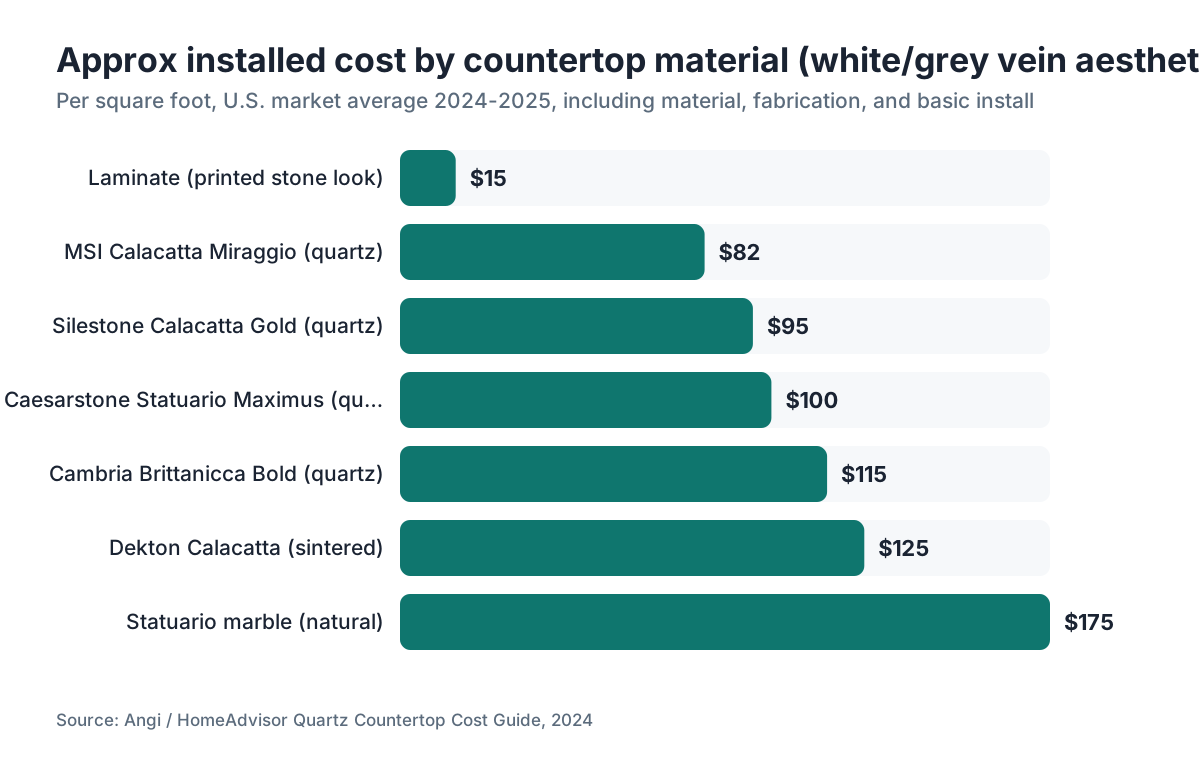
Installed cost for Caesarstone Statuario Maximus runs $70-$130 per square foot in most U.S. markets as of 2025, including material, fabrication, and basic installation. That range is wide because fabrication labor costs vary significantly by region. A shop in rural Tennessee quotes differently than a shop in San Francisco.
Here is a rough breakdown of what drives cost:
| Cost component | Typical range |
|---|---|
| Caesarstone 5031 slab (material only, wholesale) | $22-$38 / sq ft |
| Fabrication labor (cut, polish, template) | $25-$45 / sq ft |
| Standard installation (drop-in or undermount) | $10-$20 / sq ft |
| Edge profile upgrade (waterfall, ogee, etc.) | $15-$45 / linear ft |
| Undermount sink cutout | $150-$300 flat |
For a typical kitchen with 50 square feet of countertop and one undermount sink cutout, you are looking at $3,500-$6,500 total, before any edge profile upgrades.[2]
Premium-tier Caesarstone costs more than Design-tier colors but less than Supernatural colors. If your fabricator has a published price sheet, Statuario Maximus usually falls one or two price tiers above workhorse colors. Get at least three written quotes. Fabricators buy slabs at different prices from their distributors, and the markup varies considerably.
If budget is a real constraint, compare the installed price of Statuario Maximus against competing quartz brands in the same aesthetic, like Silestone Calacatta Gold or MSI Calacatta Miraggio. You can also look at Cambria countertops in a white-vein pattern for a domestic-made alternative. None of those are identical, but they cover similar visual ground at sometimes lower fabricated prices.
How does Statuario Maximus compare to the marble it imitates?
Statuario marble from Carrara, Italy is one of the most copied looks in countertop history, and Caesarstone Statuario Maximus is a direct reference to it. The comparison is worth being honest about.
Real Statuario marble has veining that is genuinely random, sometimes hairline-thin, sometimes broad and sweeping. The white ground has a translucency that engineered quartz cannot replicate because quartz is opaque by its manufacturing nature. Under raking light, marble reads as slightly alive; quartz reads as flat. Most homeowners accept this tradeoff because the maintenance differences are enormous.
Natural Statuario marble etches from lemon juice, wine, coffee, and even some cleaning products. It stains if unsealed and still can absorb some liquids even when sealed. It needs re-sealing every 1-3 years depending on use and the sealer applied.[3] Caesarstone quartz does not etch and does not need sealing. For a household with kids, a heavy cooking schedule, or anyone who finds maintenance genuinely annoying, that is a real practical advantage.
Hardness is another dimension. Marble rates 3-4 on the Mohs scale; engineered quartz typically rates around 7. This means quartz resists scratching from everyday kitchen tools much better than marble. Quartz is not scratch-proof, though. Dragging cast iron or using it as a cutting board will mark it.
Heat resistance is where quartz loses ground to marble. Marble handles brief heat contact reasonably well. Engineered quartz, because it contains polymer resins, can discolor or crack from sudden high heat. The polymer can separate from the quartz filler if a hot pan sits directly on the surface. Always use trivets.[4]
If you want the look but are still weighing natural stone, the marble countertops guide covers what that commitment really involves day to day.
Is the polished or honed finish better for a kitchen?
Caesarstone Statuario Maximus is available in Polished and Honed. Polished is the standard and what most samples represent. Honed is a matte, low-sheen finish that reads closer to raw marble.
Polished hides water spots better and cleans up with a quick wipe. Fingerprints and smudges show on both finishes but tend to be more visible on polished surfaces near a sink where hands are constantly wet. Honed hides fingerprints and small scratches better but can absorb pigmented spills (coffee, red wine, turmeric) more readily than polished, because the micro-texture of a honed surface gives liquids slightly more time before they can be wiped away.
For a working kitchen with heavy daily use, polished is the more forgiving choice in practice. Honed looks stunning in photos and in showrooms but demands slightly more attentive wiping. Neither finish needs sealing; that is true for both.
One fabricator preference: if you are going honed on quartz, ask your fabricator about their process. Some shops finish honed quartz in-house on a CNC polishing head. Others rely on the factory hone that comes on the slab. In-house finishing can be done inconsistently, so verify that your fabricator has done honed Caesarstone before.
For day-to-day care guidance that applies to engineered stone and natural stone alike, the how to clean stone countertops guide is worth bookmarking.
What should you check when viewing a full Caesarstone slab at the yard?
Visiting a stone yard or distributor to view full slabs is one of the most skipped steps in the countertop buying process and one of the most valuable. For a high-variation quartz like Statuario Maximus, it can genuinely prevent regret.
When you go, ask the yard staff to stand the slab upright or lay it on a viewing table. Look at the full slab from about six feet back, which is roughly how far you stand from your countertops while using the kitchen. This is the viewing distance that matters, not close-up inspection.
Check these things specifically:
-
Vein distribution. Is the bold veining concentrated in one corner or spread across the full slab? Your fabricator needs enough vein-free white space for your sink run and enough vein coverage for your island if you want them to match.
-
Color consistency. Hold your sample tile against the slab. Some production lots run slightly cooler or warmer than the sample. A slight difference is normal. A large difference (noticeably yellower or greyer) is worth flagging before you commit.
-
Surface defects. Engineered quartz very rarely has surface voids or inclusions the way natural stone does, but small pits or contamination marks can occur. Run your hand flat across the surface in a raking light to feel anything the eye might miss.
-
Lot number. If your job requires more than one slab, verify that both slabs come from the same production lot. Lot-to-lot variation exists in quartz, though it is smaller than in natural stone. Caesarstone's slabs have a lot code on the back edge label.[1]
Fabricators using modern quoting software, like the nesting tools in SlabWise, can map your job layout against the slab digitally before cutting to minimize waste and place the veining where you want it. If your fabricator does this, ask to see the layout before they commit to the cut.
How does Caesarstone Statuario Maximus hold up over time?
Engineered quartz is one of the more durable countertop materials in the kitchen category. Caesarstone backs Statuario Maximus with a lifetime limited residential warranty, which covers manufacturing defects but not chips, cracks from impact, heat damage, or improper care.[1]
Scratch resistance is solid. Quartz at approximately Mohs 7 handles everyday kitchen tasks without marking. You should still avoid using knives directly on the surface, and not because the counter will suffer much, but because your knife edges will. The surface is hard enough to ruin knife sharpness quickly.
Heat damage is the most common long-term complaint about quartz in kitchens. The resins that bind engineered quartz can discolor or delaminate from sudden thermal shock. Setting a 450°F cast iron skillet directly on the surface is a real risk.[4] The damage is usually permanent and not covered by warranty. Use trivets. This is the one maintenance habit that actually matters.
Stain resistance is excellent for a non-porous surface. Caesarstone quartz does not absorb liquids the way granite or marble does. Wipe spills promptly and you will not stain the surface. Dried-on turmeric paste can leave a very faint temporary tint on lighter quartz surfaces if left overnight, though it typically cleans up with a non-abrasive cleaner.
Long-term appearance: polished quartz holds its sheen without any additional treatment. Unlike granite countertops, which benefit from periodic re-sealing, quartz needs none. The surface you install is the surface you keep, barring physical damage.
For comparison with other material categories on durability and maintenance, kitchen countertops covers the full landscape.
How do you use the sample to plan vein orientation and layout?
This is the step most homeowners skip and most fabricators appreciate when a customer has done it. Vein orientation in a large-pattern quartz like Statuario Maximus is a real design decision.
Vertical veining (running up the wall on backsplash pieces or along the length of the counter) creates a waterfall effect and feels formal and tall. Horizontal veining (running parallel to the counter edge) reads as calm and wide. Diagonal veining is less common and more dynamic but can look restless in small kitchens.
Hold your sample tile in both orientations against your cabinet face and photograph it. The difference is real. For an island with a waterfall edge, you will want to discuss with your fabricator how the slab's veining continues across the mitered corner. Getting continuous veining at a waterfall mitre requires precise bookmatching or at least a coordinated cut, which costs more in labor and potentially more material.
Sketch your kitchen footprint roughly to scale before you meet your fabricator. Mark the island, sink run, and cooking area separately. The bold veining in Statuario Maximus may look overwhelming if it runs directly behind a cooktop, or perfect if that is the statement you want. You cannot fully judge this from a 4-inch tile.
For templating, fabricators measure your cabinets precisely, usually with digital templating tools. The template determines exactly how the slab will be cut. If you have preferences about where the heaviest veining falls (or does not fall), communicate this before templating, not after. Once the template is locked, vein placement decisions are mostly fixed.
What are the real alternatives to Caesarstone Statuario Maximus?
If you are not committed to Caesarstone specifically but want the white-and-bold-grey-vein aesthetic, several alternatives are worth putting on the sample board:
| Product | Brand | Type | Approx installed $/sq ft |
|---|---|---|---|
| Statuario Maximus 5031 | Caesarstone | Engineered quartz | $70-$130 |
| Calacatta Gold | Silestone | Engineered quartz | $65-$125 |
| Calacatta Miraggio Gold | MSI Quartz | Engineered quartz | $55-$110 |
| Brittanicca Bold | Cambria | Engineered quartz | $80-$150 |
| Calacatta Classique | Dekton | Ultra-compact sintered | $90-$160 |
| Statuario marble (natural) | Various | Natural stone | $100-$250+ |
Price ranges are rough 2024-2025 U.S. market estimates based on fabricator pricing surveys; exact numbers vary by market and distributor.[2]
Cambria, a U.S.-made brand, appeals to buyers who want domestic manufacturing. Their Brittanicca Bold is visually comparable and carries a strong lifetime warranty.[5] See the Cambria countertops article for the full breakdown.
Dekton is a different product category entirely. Sintered compact surfaces are harder than quartz, completely non-porous, and genuinely heat resistant. They are also harder to fabricate (more brittle, requires diamond tooling, longer shop time) and more expensive. For a kitchen that sees serious cooking, some buyers find it worth the price premium.
If the real Statuario marble look matters more than the maintenance tradeoff, know that natural Statuario from Italy is one of the pricier marbles on the market. Budget at least $150/sq ft installed in most U.S. markets, often more. The marble countertops guide covers what that premium buys you.
How to find a qualified fabricator for Caesarstone Statuario Maximus
Caesarstone sells through a network of authorized dealers and fabricators. The caesarstone.com website has a dealer locator where you can search by ZIP code. Authorized fabricators have gone through Caesarstone's training program and are required to follow their installation guidelines, which matters for warranty coverage.
That said, authorization is a floor, not a ceiling. A certified fabricator who does mostly laminate and tile work with occasional quartz jobs is not the same as a shop that fabricates quartz daily. Ask each shop you contact what percentage of their volume is quartz, how many Caesarstone jobs they do per month, and whether they have done Statuario Maximus specifically. Shops with experience on bold-vein quartz know where the vein placement decisions are and will raise them with you before you have to ask.
When getting quotes, provide every fabricator with the same information: square footage by zone (island, perimeter, bar), sink type and location, edge profile preference, and any cutouts (cooktop, prep sink). Quotes that are not based on identical scope are not comparable.
Fabricators who use digital quoting tools, including platforms like SlabWise, can provide itemized quotes faster and with fewer surprises at invoice time. If a fabricator's quote is a single line with a total, ask for the breakdown. You want to see material cost, fabrication labor, and installation as separate line items.
For the installation process itself, the countertop installation guide walks through what to expect from template day through final install.
Frequently asked questions
Is Caesarstone Statuario Maximus discontinued?
As of mid-2025 Caesarstone Statuario Maximus (5031) remains an active product in Caesarstone's Premium collection in the U.S. market. Caesarstone does discontinue colors periodically, so if you are planning a future phase or remodel, verify current availability directly with a local authorized dealer before committing to the design. The company posts its active color catalog at caesarstone.com.
Can I get a free sample of Caesarstone Statuario Maximus?
Caesarstone typically offers samples at no charge through its website, up to three per order, though a handling fee sometimes applies depending on current promotions. Authorized kitchen showrooms usually let you borrow a larger sample board for free or a small refundable deposit. Your local fabricator is also a good source for remnant pieces, which are more representative of full slab variation than the small sample tile.
How thick is a Caesarstone Statuario Maximus slab?
The standard thickness is 3 cm (roughly 1.25 inches), which is the thickness used for most kitchen countertop installations in the U.S. A 2 cm option exists in some markets, typically used for vertical applications or furniture. Caesarstone also offers a 1.2 cm option for specific applications, but 3 cm is the right spec for kitchen counters and is what most fabricators quote by default.
Does Caesarstone Statuario Maximus need to be sealed?
No. Engineered quartz is non-porous and does not require sealing, ever. This is one of the main practical advantages over natural stone like marble or granite. You do not need to apply sealer on installation day or at any point during the life of the surface. The manufacturer warranty does not require sealing, and applying sealers designed for natural stone to quartz provides no benefit and can leave a residue.
Can you put hot pans on Caesarstone Statuario Maximus?
No. Engineered quartz contains polymer resins that can discolor, crack, or delaminate from sudden heat. Caesarstone's own care guidelines advise against placing hot pots, pans, or electric griddles directly on the surface. This applies to every quartz brand, more than Caesarstone. Always use a trivet or heat pad. Heat damage is not covered under Caesarstone's warranty and is usually permanent.
What edge profiles are available for Caesarstone Statuario Maximus?
Edge profile options depend on your fabricator, not on Caesarstone directly. Standard profiles (eased, beveled, bullnose) are typically included in the base fabrication price. Upgraded profiles (ogee, waterfall, dupont, triple pencil) carry additional per-linear-foot charges, often $15-$45 depending on complexity and your market. For a bold-veined white quartz, a mitered waterfall edge is a popular choice that carries the veining down the side of an island.
How does Caesarstone Statuario Maximus compare to Silestone Calacatta Gold?
Both target the white quartz with grey veining market. Caesarstone 5031 tends to have bolder, thicker veins with higher contrast. Silestone Calacatta Gold is slightly softer in its vein pattern and includes Silestone's N-Boost surface technology, which the brand says enhances color depth. Silestone also uses an antimicrobial additive in its binder. Pricing at fabricators is similar. Order samples of both and compare them in your actual kitchen lighting before deciding.
What is the slab size for Caesarstone Statuario Maximus?
Standard slab dimensions are 130 × 63 inches in 3 cm thickness, equating to approximately 56.88 square feet of gross surface area per slab. After fabrication waste (cuts, cutouts, unusable edges), usable yield per slab is typically 45-52 square feet depending on your kitchen layout. Your fabricator can calculate exact slab count from your template dimensions. Some distributors stock jumbo slabs; confirm availability with your local dealer.
Is Caesarstone Statuario Maximus good for a bathroom vanity?
Yes, it works well for bathroom vanities. The non-porous surface resists toothpaste, soap residue, and makeup. The bold veining can look striking even in the smaller square footage of a vanity. The same heat and scratch guidelines apply. For a vessel sink setup or wall-to-wall countertop look, the large vein pattern in Statuario Maximus can be dramatic in a small bathroom, so view a full slab before committing to a tight bathroom space.
How long does it take to get Caesarstone Statuario Maximus installed after ordering?
The typical timeline from signed contract to installation is 2-5 weeks at a busy fabricator. Template is usually done 1-2 days after cabinet installation is complete. Fabrication takes 1-2 weeks after template. If your local distributor has the slab in stock, the timeline is at the shorter end. If the slab needs to be ordered from a regional warehouse, add 1-2 weeks. Ask your fabricator to confirm slab availability before you sign.
Can Caesarstone Statuario Maximus be used on an outdoor kitchen?
Caesarstone does not recommend its quartz products for outdoor applications. UV exposure causes quartz polymer resins to yellow or fade over time, and thermal cycling between outdoor temperature extremes stresses the material. For outdoor kitchens, look at porcelain slabs, Dekton, or natural granite, all of which handle UV and temperature fluctuation better. Caesarstone's warranty explicitly excludes outdoor installations.
How do you clean Caesarstone Statuario Maximus day to day?
Mild dish soap and warm water handles almost everything. Wipe up spills promptly and dry with a soft cloth. For stubborn dried residue, a non-abrasive cleaner or a plastic scraper works without scratching. Avoid bleach-based cleaners used daily, though occasional diluted bleach for disinfecting is acceptable per Caesarstone's care guide. Do not use steel wool, abrasive pads, or products containing trichlorethane or methylene chloride.
Sources
- Caesarstone USA, Product & Care Documentation: Statuario Maximus 5031 slab dimensions (130x63 in, 3cm), Premium collection tier, polished and honed finish availability, lifetime limited residential warranty terms, and outdoor use exclusion.
- HomeAdvisor / Angi, Quartz Countertop Cost Guide 2024: Installed quartz countertop costs range $55-$155 per sq ft depending on brand tier, region, and edge profile; typical kitchen project total $1,500-$8,000.
- Marble Institute of America, Natural Stone Care and Maintenance: Natural marble requires re-sealing every 1-3 years depending on use and sealer type; marble rates 3-4 on the Mohs hardness scale and etches from acidic substances.
- NSF International, ANSI/NSF 51 Food Equipment Materials Standard: Engineered quartz surfaces containing polymer resins can degrade under sustained high heat; manufacturer thermal warnings are consistent with polymer resin heat deflection limits.
- Cambria Company, Warranty and Product Information: Cambria offers a full lifetime warranty on its quartz surfaces and manufactures in the United States; Brittanicca Bold is an active product in its bold-vein collection.
- U.S. Geological Survey, Mineral Resources Program: Industrial Minerals: Engineered quartz countertop surfaces are composed of approximately 90-94% ground quartz filler bound with polymer resins and pigments; quartz rates approximately 7 on the Mohs hardness scale.
- Marble Institute of America, Dimension Stone Design Manual: Statuario marble originates from the Apuan Alps quarries in Tuscany, Italy, and is classified among the highest-value white marbles for architectural and countertop applications.
- Kitchen & Bath Business, Annual Countertop Market Report 2023: Quartz accounts for the largest share of kitchen countertop material sales in the U.S. residential market; white and grey color families represent the top-selling segment within quartz.
Last updated 2026-07-09