TL;DR
- Black kitchen countertops run from about $15/sq ft for laminate to $200/sq ft for exotic black quartzite.
- The three most popular picks are black granite, black quartz, and soapstone.
- They differ on fingerprint visibility, heat resistance, and sealing.
- This guide gives honest pricing, care realities, and the finish that hides daily wear best (leathered).
Why are black countertops so popular in kitchens right now?
Black countertops are popular because kitchens got bright, and bright rooms need an anchor. White cabinets and light wood floors have run the show since the early 2010s, so a dark counter became the obvious contrast move. It grounds a room that would otherwise float.
There's a practical pull too. Dark surfaces hide coffee drips, crumb shadows, and soap haze better than white or beige. If you cook a lot and hate wiping every hour, black is genuinely easier to live with for a certain kind of mess.
The tradeoff is fingerprints and water spots, which jump out on polished black. That one fact drives almost every decision in this guide: which material, which finish, and how much upkeep you're signing up for.
Natural stone does most of the heavy lifting in black installs. The Natural Stone Institute reports that granite and quartzite together make up more than half of natural stone countertop shipments in the U.S. [1] Black versions of both sit in nearly every slab yard in the country.
What materials come in black and how do they compare?
Black is available in almost every countertop category. The material differences matter far more than the color, so here's the honest landscape in one table.
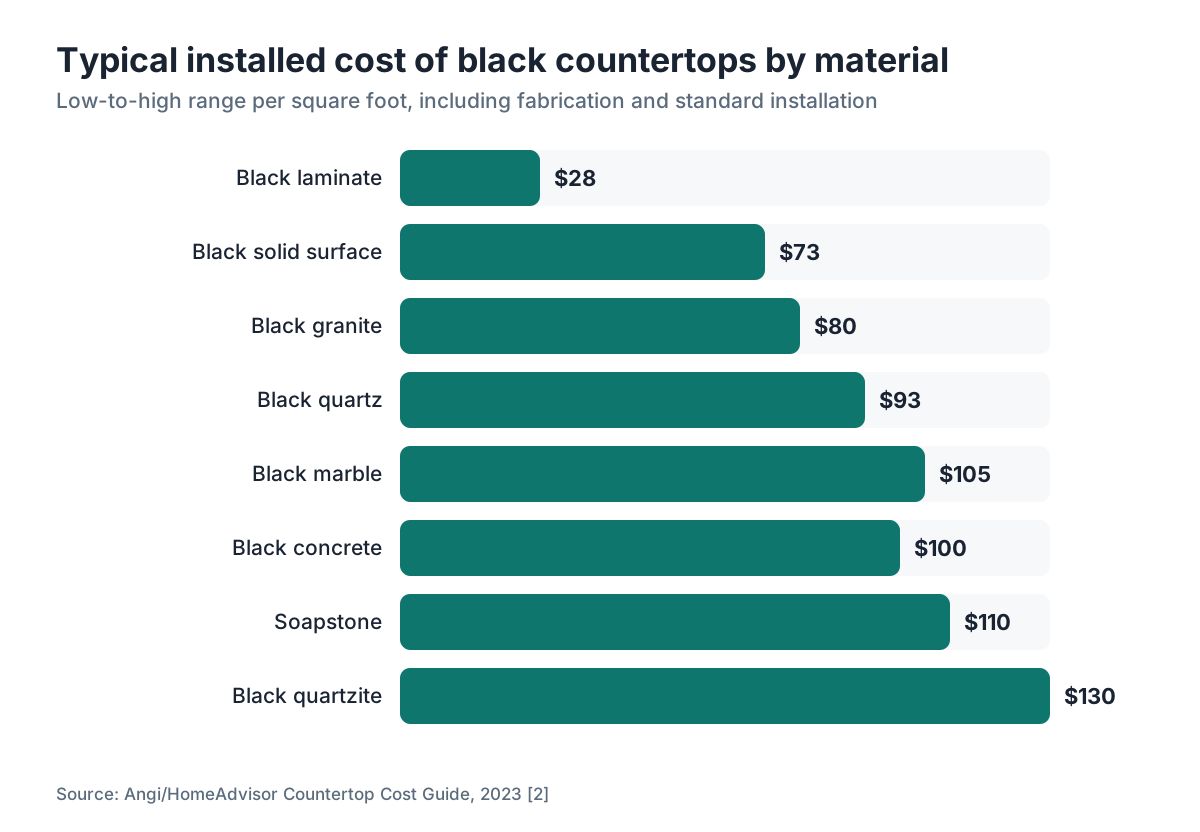
| Material | Typical installed cost ($/sq ft) | Heat resistant | Needs sealing | Fingerprint visibility |
|---|---|---|---|---|
| Black granite | $40, $120 | Yes | Yes (1 to 2x/year) | Medium |
| Black quartz (engineered) | $55, $130 | Partial (up to ~150°F) | No | Medium-high |
| Soapstone | $70, $150 | Yes | No (oil instead) | Low |
| Black quartzite | $60, $200 | Yes | Yes (1 to 2x/year) | Medium |
| Black marble | $60, $150 | Yes | Yes (frequent) | Medium |
| Black laminate | $15, $40 | No | No | Low |
| Black concrete | $65, $135 | Yes | Yes (frequent) | Low-medium |
| Black solid surface (Corian-type) | $45, $100 | No | No | Low |
Costs reflect national averages from contractor pricing data and include fabrication plus basic installation. They do not include sink cutouts, edge profiles, or demolition [2].
Two materials dominate residential black kitchens: black granite and black engineered quartz. Granite gives you natural variation and true heat resistance. Quartz gives you a uniform look and zero sealing, which more homeowners value than expect to. See the full granite countertops and marble countertops guides for the detail beyond color.
Soapstone is the underrated pick. It's naturally black or dark gray, shrugs off pot heat, and builds a patina over the years that most owners grow to love. No sealant needed. You rub in mineral oil now and then to deepen the color. The how to clean soapstone countertops guide walks through that process.
How much do black kitchen countertops actually cost?
The range is wide, and material is only part of it. Fabrication labor, edge profile complexity, seam count, and local rates all move the final number a lot.
For a typical kitchen with 40 square feet of counter (a common modest U-shaped or L-shaped layout), here's a realistic installed budget:
- Black laminate: $600, $1,600
- Black solid surface: $1,800, $4,000
- Black granite (standard): $1,600, $4,800
- Black quartz: $2,200, $5,200
- Soapstone: $2,800, $6,000
- Black quartzite or exotic granite: $2,400, $8,000+
Those are installed estimates. The slab itself is usually 40 to 60% of the total. The rest is cutting, polishing edges, templating, and install labor [2].
Edge profiles cost real money. A simple eased edge is usually in the base price. A waterfall edge, where the slab runs vertically down the cabinet side, adds $300, $1,200 depending on slab height and material. Waterfall black counters are having a moment, and fabricators price them accordingly because they eat more slab and demand tighter seaming.
One honest note on quoting: black slabs vary in price even inside the same category. Generic Absolute Black granite (Nero Assoluto) runs far cheaper than a rare leathered black quartzite. Get quotes with the specific slab name, more than "black granite," or you'll get surprised by an upgrade charge later. Shops running software like SlabWise can produce itemized quotes that name the slab and lot number, which protects you as the buyer.
For laminate countertops and Formica countertops in black, costs drop hard and the DIY route becomes realistic.
Which black countertop finish is best: polished, honed, or leathered?
Finish decides how the counter looks every single day, which matters more than how it looks under showroom lighting. Leathered hides the most wear. Polished shows the most. Honed sits in between. Pick based on how much wiping you'll actually do.
Polished black is the most reflective. It shows depth and makes color look richest. It also shows every fingerprint, water spot, and smudge within about 30 minutes of install. In a working kitchen with kids or heavy cooking, polished black granite or quartz needs a daily wipe to stay sharp.
Honed black is flat and matte. Less drama, far more forgiving. Fingerprints still land, but they're softer-edged and easier to ignore. Honed scratches show slightly more than on polished, and honed natural stone is a touch more porous.
Leathered sits between the two. The surface has a light texture, gentle peaks and valleys across the stone. It hides fingerprints better than polished or honed because the texture breaks up reflections. Deep cleaning is harder since crumbs and oils settle into the grain, but for daily appearance it's the lowest-maintenance of the three. Leathered black granite has gotten genuinely popular over the last five to seven years.
Soapstone deserves another mention. Its natural surface is smooth but not glassy. It doesn't broadcast fingerprints like polished granite, and it looks better as it ages and drinks in mineral oil. If fingerprint anxiety is your main worry, soapstone or leathered granite are the honest answers.
How hard is it to maintain black countertops?
Maintenance swings a lot by material, but two things hold true for every black surface: water spots show, and your cleaning cloth matters. Microfiber wins. Paper towels leave lint.
Sealed natural stone (granite, quartzite, marble) needs resealing once or twice a year with a penetrating stone sealer. The Natural Stone Institute recommends a water test: leave a few drops on the surface for 10 to 15 minutes, and if the stone darkens, it's time to reseal [1]. Black stone makes that test hard to read, so set a calendar reminder and reseal on schedule instead.
Engineered quartz needs no sealing. But quartz is not fully heat resistant. Quartz makers warn that thermal shock from a hot pot can damage the resin binders in the slab [3]. Use trivets. Treat that as a rule, not a suggestion.
Daily on any black surface: microfiber for wiping, no abrasive cleaners, and dry the surface afterward or spots form as water evaporates. Hard water makes this worse.
Soapstone needs no sealing, but most owners rub in mineral oil every few months, heavily in the first year, to even out color and blend scratches. The oil darkens a scratch so it disappears into the stone instead of glaring as a light mark. See the how to clean stone countertops guide for method specifics.
Laminate and solid surface are the easiest black counters to own. No sealing, no oiling, just a damp cloth. The catch is that deep scratches or burns can't be sanded away invisibly the way they can on some stone.
Concrete in black or charcoal needs frequent sealing, sometimes two to four times a year depending on the sealer and how hard you use it. Beautiful, high-commitment.
Does a black countertop make a kitchen look smaller or darker?
It depends on everything else in the room. Black counters can weigh a space down or ground it, and the difference is cabinet color, backsplash tone, and light.
Black countertops in a room with dark cabinets and little natural light will feel heavy. That's just how contrast and light absorption work. Pair black counters with white or light gray cabinets, good under-cabinet lighting, and a light backsplash, and they read as anchoring instead of oppressive.
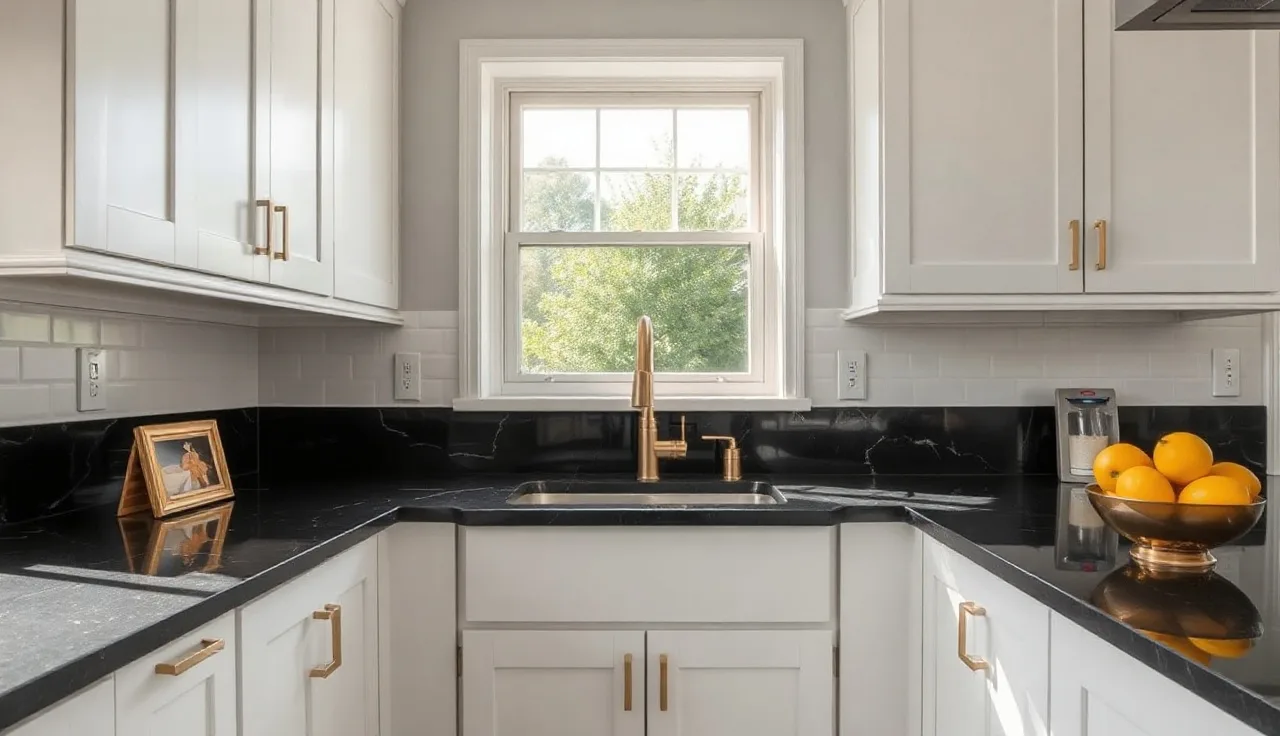
The most common winning pairing is white shaker cabinets with black granite or quartz. Some designers call it played out, but it works because the contrast is clean and the kitchen photographs and lives well.
In a small kitchen, a honed or leathered finish absorbs less light than polished. The matte surface skips the visual depth of a glossy slab, which nudges the room a little lighter. Not dramatically, but you'll notice.
Under-cabinet lighting does more work here than the counter itself. LED strips under the uppers bounce light off the surface and cut the shadowing that makes dark counters feel heavy. If you're going black, budget for that lighting at the same time.
One data point worth knowing: Houzz's kitchen trends studies show black and dark countertops turning up most often in larger kitchens (over 200 sq ft) rather than small ones, which suggests homeowners lean black when they have the room to carry it [4].
What cabinet colors go best with black countertops?
The countertop is a big visual element, but cabinets cover more surface area, so cabinet color is the bigger call. White cabinets are the most forgiving and most popular pairing. Any black finish works with them.
White cabinets keep the contrast strong and the room from going monochrome. That's why they're the default.
Light gray cabinets give you a softer version of the black-and-white kitchen. Lower contrast, which some people prefer. Works especially well with leathered or honed black.
Dark cabinets (navy, forest green, charcoal) can work with black counters, but only with enough light and contrast elsewhere: light floor, light backsplash, real windows. An all-dark kitchen with no light elements reads as a cave. Navy cabinets, black granite, brass hardware, and a cream backsplash is one specific combination that lands well.
Natural wood cabinets are underused. Light oak or maple with black counters gives warmth from the wood and contrast from the stone, without the sterility of all-white. This one ages better than pure white-and-black because the wood mellows in a way that looks intentional.
Black-on-black takes care. You need different sheens or textures so the two surfaces read as distinct. Matte black cabinets with polished black granite, for example, makes a monochrome that works in the right space.
What backsplash works with a black kitchen countertop?
The backsplash either extends the drama or gives the eye relief. Both work. The choice comes down to whether you want the counter to dominate or share the visual weight.
White subway tile is the safe, effective pick. It brightens the room, lets the black counter be the star, and it's cheap to swap if your taste shifts.
A natural stone mosaic or a slab backsplash in a lighter stone builds a layered look. White or light gray marble behind black counters reads rich and cohesive. With black granite below, a marble backsplash gives you two stones in complementary tones.
Black tile behind black counters needs strong texture or material contrast to work. Zellige tile (handmade Moroccan tile with slight surface variation) in black or deep charcoal works because each tile catches light a bit differently and breaks up the uniformity.
Mirror or glass tile bounces light back off the dark counter and makes a small kitchen feel bigger. Functionally fine, stylistically specific.
Brass or unlacquered brass fixtures and hardware pair well with black counters. The warm metal reads clean against the dark surface and adds the warmth black can lack on its own.
Are black countertops a good idea for resale value?
Honest answer: nobody has clean data on countertop color in isolation. Resale research measures renovation categories, not paint chips or slab colors.
The National Association of Realtors' 2023 Remodeling Impact Report found a full kitchen remodel recovered roughly 67 cents on the dollar at resale, while a minor kitchen upgrade recovered about 85 cents [5]. Those figures cover the renovation category, not the countertop color.
What agents generally say is that neutral choices hold better than polarizing ones. Black counters aren't universally polarizing, but they aren't universally loved either. A buyer who wants an all-light kitchen sees black as something to rip out. A buyer who likes the look sees it as a feature.
The riskier moves are unusual black materials like concrete or soapstone, which carry maintenance needs buyers may not understand and may price in as a negative. Black granite or black quartz in good shape usually reads neutral to positive.
For a resale-focused job, the classic guidance holds: mid-range materials in good condition beat expensive or unusual materials that shrink your buyer pool. A well-installed black quartz counter is probably a smarter resale bet than an exotic black quartzite at three times the price, even if the quartzite is objectively prettier.
What are the most common mistakes people make with black countertops?
These come up over and over in fabrication shops and on design forums. Most are avoidable with one showroom visit and a few pointed questions.
Choosing polished when leathered would suit them better. Polished black stuns in the showroom. Two weeks into real cooking and family life, plenty of owners wish they'd gone matte. Ask your fabricator for samples in all three finishes in your exact material, and study them under your kitchen's actual light.
Not specifying the exact slab. Asking for "black granite" gets you whatever's in stock. Nero Assoluto, Black Galaxy, Ubatuba, Absolute Black, and Fantasy Brown (which carries some black movement) are all different slabs with different prices and looks. Go to the yard, pick the slab, confirm that's the one going into your kitchen.
Skipping under-cabinet lighting. In a small or window-poor kitchen, adding black counters without adding light makes the room noticeably darker. Budget the lighting first.
Underestimating water spots. The zone around the faucet gets splashed constantly. On polished black, spots appear in minutes. You can live with it if you wipe often, but the frequency surprises a lot of people. Leathered or honed finishes are much kinder here.
Not asking about minimum slab purchase. Many distributors sell in full or half increments only. If your kitchen needs 38 square feet, you might pay for 55+ depending on how the pieces nest. A good fabricator optimizes the layout to cut waste, but ask about the purchase unit upfront. Countertop installation processes, including slab yield, are covered in that guide.
How do I get an accurate quote for a black countertop kitchen?
Quoting countertops involves more variables than most homeowners expect, and black adds one wrinkle: slab-to-slab color consistency matters more, because any mismatch reads loud on a dark surface. Start with three quotes, each naming the exact slab and finish.
Measure your current counter footprint in square feet, overhangs included. Add 10 to 15% for waste. Complex layouts with many cutouts or angles push that higher.
Get at least three quotes from local fabricators. Make each one spell out: exact material name and finish, edge profile, whether the sink cutout is included, how many seams and where, and the install timeline.
Ask directly: "Which slab lot will my countertops come from?" For black spanning multiple pieces (island plus perimeter), you want every piece from the same slab, or at least the same quarry lot. Different lots of the same-named black granite can carry different base tones or vein patterns.
Fabricators using digital quoting tools (such as SlabWise, built for countertop shops) can show a nesting diagram of how your pieces cut from the slab. That's useful for reading seam placement and confirming yield before you commit.
With quotes in hand, compare line by line, more than totals. A lower total that drops the sink cutout or swaps in a different material than you specified isn't the better deal.
Frequently asked questions
Do black countertops show scratches?
Polished black shows fine scratches because any break in the reflective surface is visible. Honed and leathered finishes hide them much better. Granite and quartzite are hard enough (Mohs 6 to 7) that everyday utensil scratching is rare. Soapstone is soft (Mohs 1 to 2) and scratches easily, but those scratches blend in with oiling and turn into the patina most owners come to like.
Are black countertops hard to keep clean?
Harder for some messes, easier for others. Black hides food residue and crumbs better than white, but fingerprints, water spots, and soap film show clearly on polished black. Leathered and honed finishes are far more forgiving. Microfiber cloths beat paper towels. Drying after every wipe stops water spots from building up, especially near the sink.
What is the cheapest black countertop option?
Black laminate or Formica is cheapest at $15, $40 per square foot installed. For a 40-square-foot kitchen, that's $600, $1,600 total. It looks convincing in matte or textured finishes and handles daily use fine. It can't be sanded or repaired if cut or burned, but as a budget choice it's genuinely functional and the quality has improved a lot over the past decade.
Does black granite need to be sealed?
Yes, most black granite needs sealing once or twice a year with a penetrating stone sealer. The exception is very dense varieties like Absolute Black (Nero Assoluto), sometimes described as needing less frequent sealing thanks to low porosity. Test annually by leaving water drops on the surface for 10 to 15 minutes. If the stone darkens, seal it. When in doubt, seal on schedule anyway.
Is black quartz better than black granite for a kitchen?
Depends what you prioritize. Black quartz needs no sealing and has consistent color with no natural variation. Black granite handles heat better, has natural movement many people prefer, and often costs less. Quartz makers warn against setting hot pots directly on the surface because of the resin content. If you cook heavily with cast iron and skip trivets, granite is the more forgiving material.
What is the most heat-resistant black countertop?
Natural stone (granite, quartzite, soapstone) handles heat best because it's essentially solid mineral with no resin binders. Soapstone especially has been used for woodstove surrounds and lab counters for a long time. Engineered quartz, solid surface, and laminate are all vulnerable to heat and need trivets or hot pads. Concrete can take heat but thermal shock can crack it depending on the mix and thickness.
How do I remove water spots from black countertops?
For sealed natural stone: wipe with a damp microfiber cloth, then dry right away. For stubborn mineral deposits, use a cleaner with a mild acid (many stone-safe cleaners contain dilute citric acid). Never put vinegar directly on unsealed stone. For engineered quartz, a 50-50 water and isopropyl alcohol solution clears most haze. Prevention beats removal: dry the surface after every use near the sink.
Can I use a black countertop with white oak cabinets?
Yes, this is one of the better-looking combinations out there. White oak's warm, low-contrast grain adds warmth that balances the weight of black stone. Leathered or honed black tends to look better with natural wood than polished, because the matte texture echoes the grain instead of fighting it. Brass or matte black hardware finishes the combination well.
What is the most durable black countertop material?
Black quartzite is arguably the most durable natural option, with Mohs hardness around 7 and good resistance to the etching that hits marble. Black granite is close behind and more widely available. Both need sealing. Among engineered materials, quartz rates very high for surface hardness and stain resistance, with the caveat that heat can damage the resin. Soapstone is softer but resists staining and etching exceptionally well.
Is soapstone a good black countertop choice?
Soapstone is an excellent pick for anyone who wants a naturally dark, heat-resistant surface with low maintenance. It needs no sealing. It scratches fairly easily, but scratches fill in with mineral oil. The color deepens and evens out over time. It's softer than granite or quartzite, so cutting directly on it will mark it. For a working kitchen with high heat use, soapstone is genuinely hard to beat.
How do I choose between a matte and polished black countertop?
Ask how much wiping you'll actually do each day. Polished black looks spectacular and shows everything. Matte (honed or leathered) hides fingerprints and water spots far better. In a kitchen used by several people daily, most owners end up happier with leathered or honed. Take home samples from your fabricator and study them under your kitchen's real lighting for a full day before deciding.
Do black countertops go out of style quickly?
Dark countertops have shown up across kitchen design cycles for the past 50 years and have never fully fallen out of use. A specific combination (black counters with white cabinets, say) may read dated in a decade, but the material itself is unlikely to look out of place. Unusual materials like concrete or soapstone read more niche and polarize buyers more than a neutral black granite or quartz.
Can I install a black countertop myself?
Laminate and some solid surface products are DIY-installable with the right tools and patience. Natural stone and engineered quartz are not practical DIY jobs. The slabs are extremely heavy (granite runs 18 to 20 lbs per square foot at 3/4-inch thickness), they need diamond-blade wet saws for cutting, and seam or cutout mistakes are expensive to fix. Professional fabrication and installation is strongly recommended for any stone or quartz counter.
What edge profile looks best on black countertops?
Mitered or waterfall edges emphasize slab thickness and look striking. Simple eased or straight edges read clean and modern. Beveled edges add a subtle detail that catches light differently on black stone. Ogee and bullnose profiles feel more traditional. For most contemporary black-counter kitchens, a simple eased or 1/4-inch beveled edge is the most common and cost-effective choice. Complex profiles add fabrication cost without necessarily improving the result.
Sources
- Natural Stone Institute (formerly Marble Institute of America), Natural Stone Care Guide: Water test for sealing: if water left on stone for 10 to 15 minutes causes darkening, the stone needs sealing. Granite and quartzite together represent over half of natural stone countertop shipments.
- Angi (formerly HomeAdvisor), Countertop Installation Cost Guide: National average installed countertop costs by material, including fabrication and standard installation labor.
- Cambria, Countertop Care and Warranty Information: Cambria (quartz manufacturer) specifies that thermal shock from hot pots can damage engineered quartz surfaces; trivets are required.
- Houzz, U.S. Houzz Kitchen Trends Study: Black and dark countertops appear most frequently in larger kitchens (over 200 sq ft) in Houzz survey data.
- National Association of Realtors, 2023 Remodeling Impact Report: Full kitchen remodel recoups approximately 67 cents on the dollar at resale; minor kitchen upgrade recoups approximately 85 cents on the dollar.
- USGS National Minerals Information Center, Minerals Yearbook: Stone (Dimension): U.S. dimension stone shipment data including granite and other countertop stones.
- Natural Stone Institute, Soapstone Technical Data: Soapstone Mohs hardness ranges from 1 to 2; the material does not require sealing and has been used in laboratory and stove applications due to heat resistance.
- Natural Stone Institute, ANSI/NSI Standards for Natural Stone: Granite Mohs hardness is approximately 6 to 7; quartzite is approximately 7. Standards for fabrication and installation of dimension stone.
- Consumer Reports, Kitchen Countertops Buying Guide: Comparison of countertop material durability, maintenance requirements, and price ranges for consumer decision-making.
- U.S. Census Bureau, American Housing Survey: Kitchen renovation frequency and countertop replacement data in U.S. residential housing stock.
Last updated 2026-07-09