TL;DR
- The cheapest installed kitchen countertops are laminate ($15-40/sq ft), ceramic tile ($20-35/sq ft), and butcher block ($30-60/sq ft).
- Concrete, vinyl sheet, and basic solid surface fill out the budget tier.
- Stone options like granite start around $50/sq ft installed.
- This guide ranks every major material by real installed cost and explains what drives the price up or down.
What is the cheapest kitchen countertop including installation?
Laminate is the cheapest installed kitchen countertop you can buy. Full stop. Depending on the edge profile and brand, laminate runs $15 to $40 per square foot installed, including demolition of the old surface, adhesive, and finishing the edges. That number comes from contractor pricing surveys and holds across most U.S. markets, though rural areas and high-cost cities like San Francisco or New York can push it 20-30% outside that range in either direction.[1]
Ceramic tile comes in second at roughly $20 to $35 per square foot installed. The material itself is cheap, sometimes under $2 per square foot for basic tiles, but labor is significant because each tile has to be set, grouted, and sealed individually. Grout lines also collect bacteria and grime, which is a real practical downside worth knowing before you choose it.
Butcher block, often overlooked as a budget option, typically lands at $30 to $60 per square foot installed. IKEA's butcher block countertops (the BADELUNDA and KARLBY lines) are a legitimate way to hit the low end of that range if you're willing to do some of the installation yourself or pay a handyman instead of a stone shop.[2]
Solid surface materials like Corian start around $45 to $65 per square foot installed. That's more than laminate, but solid surface can be repaired by sanding out scratches, which stretches its usable life. For a kitchen that gets hard daily use, the math over 10 years sometimes favors solid surface over laminate even though the upfront cost is higher.
Everything below $50 per square foot installed is what fabricators and designers call the "budget tier." Above that, you're into entry-level quartz and granite, which are different conversations entirely.
How much does each countertop material cost per square foot installed?
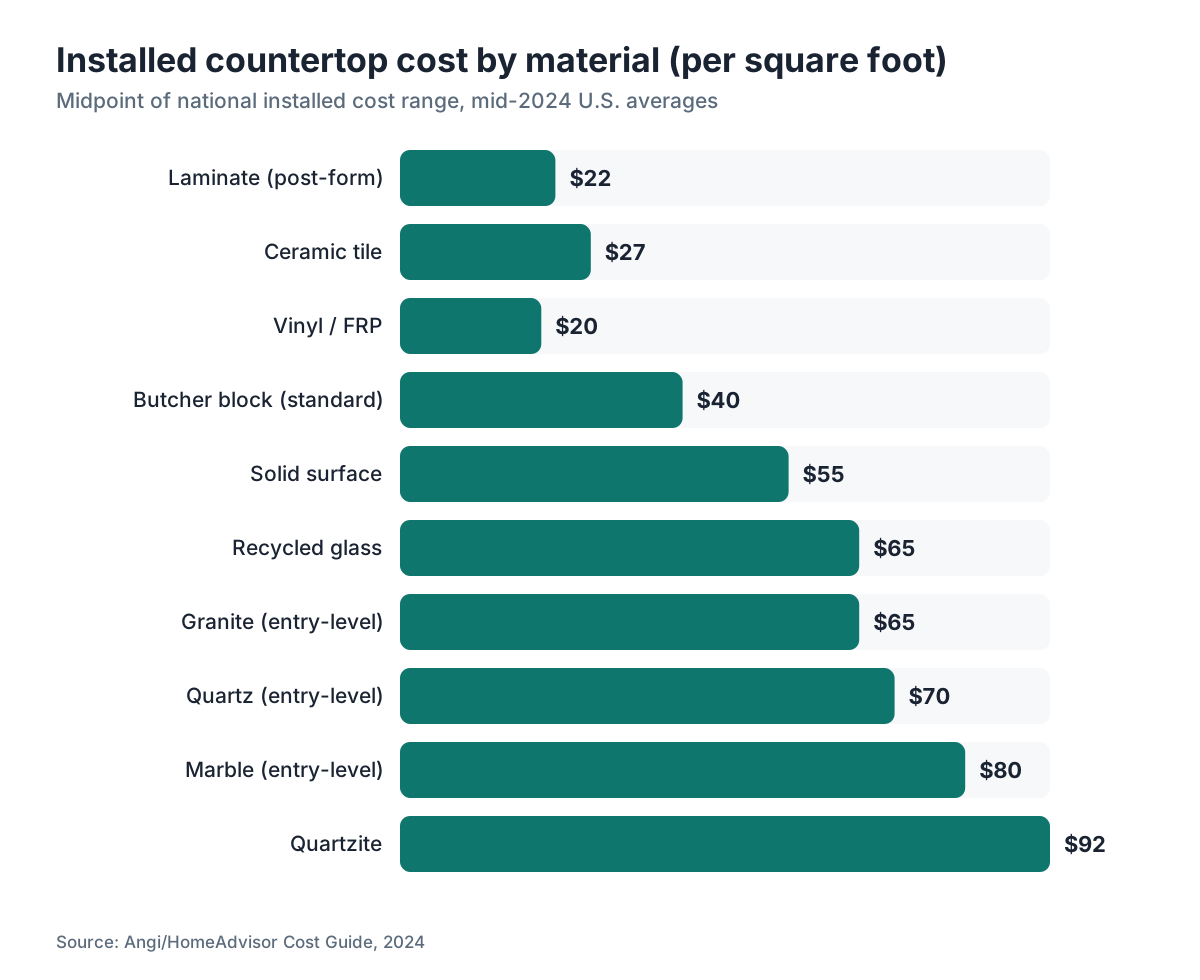
Here is a real cost table ranked from cheapest to most expensive on a fully installed basis. These figures reflect mid-2024 U.S. national averages and include material, fabrication or cutting, adhesive or mortar, and basic installation labor. They do not include plumbing disconnection and reconnection, which typically adds $150-300 if a sink is involved.[1][3]
| Material | Installed Cost (per sq ft) | Notes |
|---|---|---|
| Laminate (post-form) | $15 - $30 | Basic post-form; includes standard edge |
| Laminate (custom) | $25 - $40 | Mitered or waterfall edges cost more |
| Ceramic tile | $20 - $35 | Labor-intensive; grout lines are a con |
| Vinyl sheet / FRP | $15 - $25 | Rare in kitchens; mostly commercial |
| Butcher block (standard) | $30 - $50 | Pine or acacia; DIY-friendly |
| Butcher block (walnut/maple) | $45 - $65 | Higher-grade species |
| Solid surface (Corian-style) | $45 - $65 | Seams can be hidden; repairable |
| Recycled glass | $50 - $80 | Depends heavily on manufacturer |
| Granite (entry-level) | $50 - $80 | "Level 1" slabs from stock |
| Quartz (entry-level) | $55 - $85 | Standard colors; 1.25" thickness |
| Marble (entry-level) | $60 - $100 | Carrara; requires sealing and care |
| Quartzite | $65 - $120 | Varies widely by quarry and color |
| Soapstone | $70 - $120 | Niche; limited fabricator availability |
| Ultra-compact (Dekton/Neolith) | $80 - $150 | Requires experienced fabricator |
A typical U.S. kitchen has between 30 and 50 square feet of countertop surface. The National Kitchen and Bath Association puts the median new-construction kitchen at roughly 314 square feet of floor space, which usually maps to 40-55 square feet of counter.[4] At those square footages, the difference between laminate and entry-level granite is $1,400 to $2,500 in real money. That's meaningful but not enormous if you're already spending $20,000 or more on a full remodel.
For a closer look at laminate specifically, see our laminate countertops guide, which covers brands, finishes, and edge profiles in depth.
What drives the installed price up beyond just material cost?
Material is often the smaller part of the bill. Labor, cutouts, and job-site conditions add up fast.
Edge profiles are one of the biggest upsells. A standard eased edge (barely rounded) is usually included in any quote. A bullnose, ogee, or beveled edge adds $10 to $25 per linear foot depending on material and complexity. On a kitchen with 20 linear feet of exposed edge, that's $200 to $500 added to the quote for a purely cosmetic choice.
Sink cutouts cost $100 to $250 each. Cooktop cutouts are similar. If you're doing an undermount sink with a stone or solid surface countertop, you also need the sink polished on the inside of the cutout, which adds another $50-100. These are not optional if you have a sink.
Demolition of existing countertops is sometimes included and sometimes not. Ask specifically. Most contractors charge $100 to $300 to remove and haul away old laminate or tile countertops. Stone removal costs more because it's heavy.
Stair carries and difficult access add a premium in apartment buildings or houses without good truck access. A shop sending two guys to carry slabs up three flights of a narrow stairwell will charge more than a ground-floor suburban installation.
Seaming matters most with stone and solid surface. Quartz and granite slabs typically come in widths up to about 63 inches (around 5 feet). If your countertop run is longer than that, you'll need a seam, and a well-done seam costs labor time. Laminate has seam issues too, but they're less noticeable and cheaper to execute.
Local labor rates vary enormously. The Bureau of Labor Statistics reports that construction and extraction worker wages range from roughly $19/hour in Mississippi to over $40/hour in Hawaii and Alaska as of 2023.[5] That wage difference flows straight into your installed countertop price.
Is laminate worth it, or does it fall apart quickly?
Laminate gets a bad reputation it doesn't fully deserve. Modern laminate is a high-density particleboard or MDF core with a photographic layer under a tough resin surface. Brands like Wilsonart and Formica now offer textures that genuinely mimic stone, and the surface hardness ratings have improved a lot since the 1980s versions people remember from their parents' kitchens.
The real weaknesses are heat and moisture at the edges. Set a hot pan directly on laminate and you can bubble the surface permanently. Water that gets into an unsealed edge seam will swell the particleboard core and cause visible warping. Both failure modes are avoidable with normal care, but they're unforgiving if you forget.
Lifespan is honestly 10 to 20 years with good care. That's real, not marketing. A solid surface or stone countertop can last 30 years or more if maintained, so over a 30-year window you might replace laminate once or twice. Whether that matters depends on whether you expect to live in the house that long.
For renters or homeowners doing a quick flip, laminate is genuinely smart. You get a clean, updated look for the least possible money, and it goes in fast. For a long-term family home where you cook constantly, I'd spend the extra money on solid surface or entry-level granite instead.
Our full breakdown of Formica countertops covers the specific product lines, thickness options, and where to buy if you want the details.
How does butcher block compare to laminate on total cost?
Butcher block costs more upfront than laminate, usually $30 to $65 per square foot installed versus $15 to $40 for laminate. But it carries maintenance costs laminate doesn't: you need to oil it two to four times a year with food-safe mineral oil or a board cream, and you have to watch standing water near seams and around the sink.
The appeal is real. Butcher block is warm, repairable (sand out knife marks), and genuinely beautiful in a farmhouse or Shaker kitchen. It's also a legitimate DIY option in a way that stone is not. IKEA sells its Karlby countertop in oak or walnut veneer for around $150 to $300 per section, and a competent homeowner with a circular saw and some clamps can install it in a weekend. That drops the total installed cost hard if your time is cheap.
The sink area is where butcher block fails people. You cannot have an undermount sink with standard butcher block without extensive sealing and careful maintenance. Almost every butcher block horror story involves a leaky dish soap bottle left sitting near the sink. Use a separate material at the sink run and butcher block everywhere else if you love the look but want longevity.
See our dedicated butcher block countertops guide for oiling schedules, species comparisons, and installation tips.
What is the cheapest stone countertop option?
Entry-level granite is the cheapest natural stone at $50 to $80 per square foot installed. The trade calls these "Level 1" slabs. They're typically solid colors with minimal veining, often sourced from Brazil or China, and held in large quantities at distributors to keep the cost down. Colors like Uba Tuba (dark green-black), Tan Brown, and Santa Cecilia are classic Level 1 options you'll find at almost any stone yard.
Granite is genuinely durable. It resists heat, scratches, and most chemicals if sealed once a year. The annual sealing costs about $30 in materials if you do it yourself (one bottle of penetrating sealer covers a typical kitchen), or $100 to $200 if you hire it out. That maintenance cost is real but not burdensome.
Quartz starts slightly higher than entry-level granite at around $55 to $85 per square foot installed, but it doesn't require sealing and the surface consistency is more predictable because it's engineered. For most homeowners comparing budget stone options, the honest answer is simple: granite if you love natural stone variation, quartz if you want low maintenance and consistency.
For more detail on granite pricing by level and color, see our granite countertops guide.
Marble is the trap at the bottom of the stone market. You can find entry-level Carrara marble at $60 to $100 per square foot installed, which sounds competitive. But marble etches from acids (lemon juice, vinegar, even hard water) and stains easily. For a kitchen that sees real cooking, marble demands constant vigilance. It's a beautiful material in the right hands, but calling it a "budget stone" for a busy kitchen would be dishonest.
How do I get an accurate quote for budget countertops?
Measure your own kitchen before calling anyone. Fabricators quote by the square foot, but they also charge for linear footage of edges, number of cutouts, and sometimes a minimum job fee. If you walk in knowing your dimensions, you can compare quotes accurately instead of trusting whatever number a salesperson gives you.
To measure: sketch the countertop layout, measure each section's length and depth (standard depth is 25.5 inches for kitchens), multiply to get square footage, and add up the sections. Don't forget the island if you have one. Most people underestimate total square footage by 15-20% because they forget about the return behind the stove or the section next to the refrigerator.
Get at least three quotes for any job over 20 square feet. Prices on identical material can vary 25-40% between shops in the same city, based on their overhead, equipment efficiency, and how busy they are. A shop with efficient digital quoting and nesting software (the kind that optimizes how slabs get cut to reduce waste) often passes some of that savings into competitive quotes. SlabWise is one tool fabricators use for this kind of optimization, which is why some shops can quote faster and tighter than others.
Ask each shop explicitly what is included: material, templating, fabrication, delivery, installation, sink cutout, edge profile, and haul-away of old countertops. The lowest headline number often leaves out things the higher quote includes.
For laminate specifically, big-box stores like Home Depot and Lowe's sell post-form laminate countertops as stock pieces in standard lengths, which can cut cost sharply on simple layouts. A 10-foot section of post-form runs $100 to $250 at retail. Add $200 to $400 for basic installation labor and you're looking at total costs well under $20 per square foot for a simple kitchen.
Our countertop installation guide covers what to expect on installation day, including how to verify a fabricator's template is accurate.
What are the hidden costs that blow up a budget countertop project?
Plumbing. If you're replacing countertops with a sink, a plumber has to disconnect the supply lines, P-trap, and garbage disposal, then reconnect everything after installation. Plumbers typically charge $150 to $350 for this, and fabricators won't do it. Budget for it.
Cabinet leveling is another surprise. Countertops need a level substrate to sit flat. If your cabinets are out of level by more than 1/4 inch over 8 feet (common in older homes), the fabricator may charge extra time to shim, or the countertop may rock and crack over time. A good fabricator catches this during templating; a bad one installs on unlevel cabinets and leaves you with a problem six months later.
Permit requirements vary by jurisdiction. Most countertop replacements don't need a permit because you're replacing like-for-like and not moving plumbing. But if you're reconfiguring the kitchen layout, adding an island, or your local code is aggressive, a permit may be required. Check with your local building department. The International Residential Code sets baseline guidance, but each municipality adopts and amends it independently.[6]
Backsplash replacement often rides along with a new countertop. If the existing tile backsplash was set on top of the old countertop rather than behind it (common in older kitchens), removing the countertop destroys the bottom row of tile. Budget $5 to $20 per square foot for new tile, or plan to repaint the wall if you don't want to retile.
The total cost of a budget countertop project for an average kitchen, once you add plumbing disconnect and reconnect, sink cutout, haul-away, and a modest backsplash repair, typically runs $500 to $1,500 more than the countertop quote alone. That's not a reason to skip the project. It's just the honest number to plan around.
Can I install cheap countertops myself to save money?
Laminate post-form is the most DIY-friendly countertop on the market. Home Depot and Lowe's sell pre-cut sections in standard sizes, and installation needs only basic tools: a jigsaw, drill, sander, and caulk gun. YouTube tutorials from licensed contractors cover the process in detail. The main risks are making a bad cut on the sink opening (you get one shot at the material you bought) and getting the scribing wrong where the counter meets a wall.
Butcher block is the second-easiest DIY option, especially IKEA's products, which are built to be consumer-installed. You need a circular saw with a fine-tooth blade, sandpaper to clean up cut edges, and a food-safe finish. The biggest mistake DIYers make is not letting the wood acclimate to the kitchen for 48-72 hours before installation, which causes warping after the fact.
Ceramic tile is technically DIY-able, but the result quality swings wildly. Uneven grout lines look bad and are hard to fix without tearing everything out. If you're not already comfortable with tile work from bathroom projects, this is a harder DIY than laminate or butcher block.
Stone and quartz are not DIY materials. Full slabs weigh 15-20 pounds per square foot. A standard 10-foot kitchen slab can weigh 400-600 pounds. It takes a vacuum lifting system and two or more trained people to handle safely. The cuts need a wet saw with diamond blades and real fabrication experience. Trying to DIY stone countertops without that gear and training is how people get seriously hurt and end up with an expensive broken slab.
Solid surface (Corian-style) is a middle case. The material cuts with standard woodworking tools, but joining two pieces into one invisible surface takes practice. Most solid surface manufacturers train certified installers, and a bad installation voids the warranty.
What cheap countertop materials hold up best long-term?
Durability isn't just about surface hardness. It's about how a material responds to the specific abuse your kitchen dishes out.
If you run a busy household with kids, heat exposure is the main enemy. Laminate fails with heat. Butcher block survives light heat but not a cast iron pan straight from the oven. Tile, granite, and solid surface handle heat better. Quartz technically has a heat threshold (Cambria, for example, warns against direct heat contact because the resin binder can discolor above around 300 degrees F), so stone is genuinely better for people who cook hard.[7]
For scratch resistance, ceramic tile and granite top the budget list. The Mohs hardness of granite is typically 6 to 7, meaning most knives (steel hardness around 5.5-6.5) won't scratch it.[8] Laminate scratches more easily and shows it. Butcher block scratches constantly, but that's kind of the point: you sand and re-oil it.
For stain resistance, solid surface and laminate are non-porous by default and shrug off stains well unless the surface is physically damaged. Granite and stone need annual sealing to stay stain-resistant. A simple water-bead test tells you whether granite needs resealing: drip water on the surface, and if it soaks in instead of beading up, seal it.[9]
For moisture resistance in high-humidity kitchens, tile is the top performer among budget options because the tile itself is inert. The grout lines, though, need annual sealing or they'll harbor mold and discolor.
Plain answer: for a long-term working kitchen on a tight budget, entry-level granite gives you the best mix of durability and simple maintenance. For a short-term or rental situation, laminate makes more financial sense.
What do fabricators see as the most underrated budget countertop?
Solid surface. It gets shortchanged in budget conversations because it sits at the upper end of the budget tier ($45-65/sq ft installed), but it does things cheaper materials can't.
The big one is repairability. A scratch or burn in a solid surface countertop sands out with 120-grit paper and the surface looks factory-new afterward. Scratches in laminate are permanent. Chips in tile mean replacing individual tiles and matching grout, which is nearly impossible after a few years of color change. Solid surface joints can be chemically bonded and polished so they disappear to the naked eye.
Solid surface also allows integrated sinks: the sink and countertop are one continuous molded piece, killing the seam where water collects and bacteria grows. An integrated sink solid surface countertop costs more (the sink itself adds $200-600), but it's a genuinely better hygiene solution than an undermount stone sink.
The material is also lighter than stone, easier to transport, and doesn't demand the same heavy-duty cabinet support. That matters in older homes where cabinets weren't built to carry 400-pound slabs.
Corian is the original brand name; Wilsonart Solid Surface, LG Hi-Macs, and Staron are competitors in a similar price range. They all work the same way and are all worth considering. Our Corian countertops guide covers the specifics of that brand if you want a starting point.
Fabricators who've been in the business a long time often prefer installing solid surface over laminate because the job quality is easier to hold and callbacks are rare. That's a meaningful endorsement from people who've watched thousands of countertops fail and succeed over the years.
How does location affect the installed cost of budget countertops?
Location is one of the biggest pricing variables that never shows up in national averages. A laminate countertop that costs $22 per square foot installed in Phoenix might cost $35 in Seattle and $40 in the Boston metro because of local labor rates, permit costs, and shop overhead.
The Bureau of Labor Statistics Occupational Employment and Wage Statistics (OEWS) data shows construction trades wages vary by a factor of roughly 2x between the lowest-wage and highest-wage states.[5] That difference flows straight into installed countertop pricing.
Rural areas sometimes have cheaper labor but limited fabricator options. If there's only one stone shop within 50 miles, they don't need to compete on price. Urban areas have more competition but higher overhead. The result is that rural and urban costs both often run above the national average, for different reasons.
California adds its own complexity because of Title 24 energy code requirements and stricter VOC regulations that affect adhesives and finishes, which tack small but real costs onto any interior construction project.[10]
The best way to calibrate local pricing is to get three quotes from local shops and compare them to the national ranges in this article. If all three local quotes come in 30% above national average, that's your market rate, and the national number is irrelevant to your decision.
Frequently asked questions
What is the absolute cheapest countertop I can put in a kitchen?
Vinyl sheet or FRP panel runs $15 to $25 per square foot installed, but it's mainly used in commercial kitchens and looks institutional. For a real residential kitchen, post-form laminate at $15 to $30 per square foot installed is the practical cheapest option. It's available at every big-box store, can be DIY-installed, and looks decent in modern finishes.
How much does it cost to replace countertops in an average kitchen?
An average U.S. kitchen has 30 to 50 square feet of counter surface. At laminate prices ($15-30/sq ft installed), total replacement runs $450 to $1,500. At entry-level granite ($50-80/sq ft), it's $1,500 to $4,000. Add $150 to $500 for plumbing disconnection, sink cutout, and haul-away. Most budget kitchen countertop replacements land between $800 and $3,000 all-in.
Is it cheaper to do countertops yourself?
For laminate post-form, yes. Material-only cost at big-box stores is $100 to $250 for a 10-foot section. Add basic tools and hardware and you might do a simple kitchen for $400 to $700 total, versus $800 to $1,500 for professional installation. Butcher block is also DIY-friendly. Stone is not: the weight, tooling, and risk of breaking a slab make DIY stone almost never worthwhile.
How long does laminate countertop last?
With normal care, 10 to 20 years is realistic. The main failure modes are heat damage (hot pans bubble the surface), edge swelling from water infiltration, and deep scratches that can't be repaired. Modern laminates from brands like Wilsonart and Formica are meaningfully more durable than older versions, but they still can't match stone or solid surface for longevity in a heavily used kitchen.
What cheap countertop looks most like stone?
Modern laminate in stone-look prints from Wilsonart or Formica has gotten genuinely convincing, especially at cabinet height where texture differences are less obvious. Luxury vinyl tile made for countertops is another option but less common. For a realistic stone appearance at budget cost, high-resolution laminate in a quartz or marble pattern is the most widely available choice in the $15-35/sq ft installed range.
Are granite countertops actually cheaper than quartz?
At the entry level, yes, slightly. Level 1 granite runs $50 to $80 per square foot installed; entry-level quartz runs $55 to $85. The gap is not huge. Granite requires annual sealing ($30-200/year); quartz does not. Over 10 years, the maintenance cost difference is real but modest. Choose granite for natural stone variation; choose quartz if you want consistency and zero sealing obligation.
What is the cheapest countertop that doesn't look cheap?
Entry-level quartz or Level 1 granite, both starting around $50 to $55 per square foot installed, give you a surface that reads as genuinely upscale to most visitors. Within the sub-$40 category, butcher block in a well-maintained kitchen looks intentionally designed rather than cheap. High-quality laminate in a matte stone finish also holds up better aesthetically than most people expect.
Does tile make a good cheap kitchen countertop?
The material cost is extremely low, sometimes under $2 per square foot. Installed cost lands at $20 to $35 per square foot once you include setting mortar, grout, and labor. The real problem is grout lines: they collect bacteria, stain over time, and are tedious to keep clean. Tile is also hard and unforgiving if you drop glassware. Most fabricators and designers recommend laminate over tile for budget kitchens specifically because of the maintenance issue.
How do I get the best price from a countertop fabricator?
Measure accurately before calling (saves templating time), get at least three quotes, ask what is explicitly included in each, and consider off-peak timing (winter is slower for most shops and some offer discounts). Being flexible on edge profile and choosing stock colors rather than special-order material also saves meaningful money. Shops that use digital quoting and nesting software can often price more competitively because they waste less slab material per job.
What countertop can I install over existing countertops to save money?
Tile can go over solid existing laminate if the substrate is flat and secure. Some solid surface products and thin quartz overlays (around 3/8 inch thick) are also made to be glued over existing countertops. This skips demolition cost ($100-300) but adds risk: the overlay is only as good as the substrate underneath, and water trapped between layers speeds up deterioration. It's a shortcut worth considering in rental or short-term situations.
What is the cheapest countertop for an outdoor kitchen?
Concrete and tile are the most common budget choices for outdoor kitchens because they handle UV exposure, temperature swings, and moisture better than laminate, wood, or most solid surface products. Concrete poured in place runs $65 to $135 per square foot installed but can be done cheaper with precast forms. Porcelain tile made for exterior use is another solid budget option at $25 to $50 per square foot installed.
How much does butcher block countertop installation cost?
Professional installation of butcher block runs $30 to $65 per square foot all-in for mid-grade species like acacia or hard maple. Walnut species push toward the top of that range or beyond. IKEA butcher block countertops in oak or bamboo can be DIY-installed for a total cost of $15 to $30 per square foot if you do the work yourself, making it one of the more accessible budget options for kitchens with simple layouts.
Do cheap countertops hurt home resale value?
The data is mixed. Remodeling Magazine's Cost vs. Value report consistently shows kitchen remodels recover roughly 60-80% of cost at resale, and countertop material is only one factor buyers weigh.[3] Laminate in good condition in an otherwise updated kitchen is far less damaging to resale value than cracked tile or water-damaged wood. Clean and functional matters more than expensive material at most price points below luxury homes.
What is solid surface countertop and is it really a budget option?
Solid surface is a man-made material made from acrylic or polyester resins with mineral fillers. Corian (by DuPont/SSMC) is the best-known brand. At $45 to $65 per square foot installed, it sits at the top of the budget tier. The key advantages are repairability (scratches sand out), invisible seaming, integrated sink options, and no sealing required. It costs more than laminate but less than stone, and outlasts laminate with proper care.
Sources
- HomeAdvisor (Angi) - Countertop Installation Cost Guide: National average installed countertop costs by material, including laminate at $15-40/sq ft and granite at $50-80/sq ft
- IKEA USA - KARLBY Countertop product page: IKEA butcher block countertop sections available for consumer purchase in oak and walnut veneer at accessible retail prices
- Remodeling Magazine - Cost vs. Value Report 2023: Kitchen remodels recover approximately 60-80% of cost at resale; countertop material is one component of overall kitchen valuation
- National Kitchen and Bath Association - Kitchen Design Guidelines: Median new-construction kitchen floor area and countertop surface area planning guidelines
- U.S. Bureau of Labor Statistics - Occupational Employment and Wage Statistics (OEWS): Construction and extraction worker wages range from approximately $19/hour in lowest-wage states to over $40/hour in Hawaii and Alaska as of 2023
- International Code Council - International Residential Code: The International Residential Code provides baseline guidance for residential construction; each municipality adopts and amends it independently
- Cambria - Quartz Care and Maintenance Guidance: Cambria cautions against placing hot items directly on quartz surfaces because the resin binder can discolor with direct high heat
- U.S. Geological Survey - Mohs Hardness Scale: Granite has a Mohs hardness of 6 to 7; standard steel knife blades have hardness around 5.5-6.5 Mohs
- Marble Institute of America (Natural Stone Institute) - Stone Maintenance Guidelines: Water-bead test recommended for determining whether granite countertops need resealing; if water soaks in rather than beading, resealing is indicated
- California Energy Commission - Title 24 Building Standards: California Title 24 and VOC regulations affect adhesives and finishes used in interior construction projects, adding compliance costs
- U.S. Environmental Protection Agency - Indoor Air Quality: Volatile Organic Compounds: VOC content in adhesives, sealers, and finishes used in countertop installation is regulated at federal and state levels for indoor air quality
Last updated 2026-07-10