TL;DR
- Granite countertops cost $40 to $200 per square foot installed, depending on grade and region.
- Granite is quarried natural stone.
- It needs resealing every 1 to 3 years, and it cleans up with mild dish soap and water.
- Acids and abrasive pads damage it.
- This guide covers pricing, fabrication, daily care, sealing, and buffing.
What are granite countertops and how are they made?
Granite is an igneous rock that forms when magma cools slowly deep underground. That slow cooling gives mineral crystals, mostly quartz, feldspar, and mica, room to grow large enough to see, which is what makes granite look speckled or veined. No two slabs match. That's a feature or a liability, depending on how picky you are.
The trip from mountainside to your kitchen goes like this. Quarry crews cut large blocks from the deposit with wire saws and diamond-tipped cables. Those blocks travel to a processing plant, where gang saws slice them into slabs roughly 3/4 inch to 1-1/4 inches thick. Then the slabs run under a series of polishing heads that step the surface from rough to mirror. Most of what you see at a slab yard is already polished, but you can order honed (matte) or leathered finishes if you ask.
Fabricators buy those slabs and cut them to your countertop layout using CNC waterjet machines or bridge saws guided by a digital template. The template gets taken two ways: manually with measuring sticks and adhesive strips, or digitally with a laser device. Precision is the whole game here. A slab cut 1/8 inch too short doesn't stretch. Edge profiles get shaped and polished after the main cuts, and then the pieces ship to your house for install.
The United States imports most of its dimension granite from Brazil, India, China, and Italy [5]. For how granite stacks up against other stone and manufactured options, the kitchen countertops guide covers the full material comparison.
How much does it cost to add granite countertops?
Installed granite runs roughly $40 to $200 per square foot for most residential jobs, and exotic slabs or complex edges push past that [1]. That price includes the slab, fabrication labor, and installation. It does not include demo of your old counters, plumbing reconnection, or backsplash work.
The spread really is that wide. Here's what moves the number:
| Cost factor | Lower end | Higher end |
|---|---|---|
| Slab grade | Builder-grade granite, $10 to $20/sq ft at the yard | Exotic or rare origin, $60 to $100+/sq ft at the yard |
| Edge profile | Eased or beveled (minimal extra) | Waterfall, ogee, or multi-step profiles ($15 to $30/linear ft extra) |
| Fabrication complexity | Simple L-shape, few cutouts | Islands with multiple cutouts, curved sections |
| Region | Midwest/Southeast average lower | Northeast/West Coast 20 to 40% higher |
| Thickness | 3/4" (20mm) standard | 1-1/4" (30mm) or mitered to look thick |
A typical 40-square-foot kitchen (a modest galley layout) in mid-grade granite comes out around $2,500 to $4,500 installed. Larger kitchens with islands regularly hit $8,000 to $12,000 [1]. If a quote lands way below that, ask whether it includes removal, sink cutout, and sealer. Those three are where the surprise charges hide.
Fabricators, accurate job costing starts with knowing your slab yield after nesting, which is exactly where quoting software pays for itself. SlabWise's quoting tool handles slab layout and material waste so you can see where your margin actually goes.
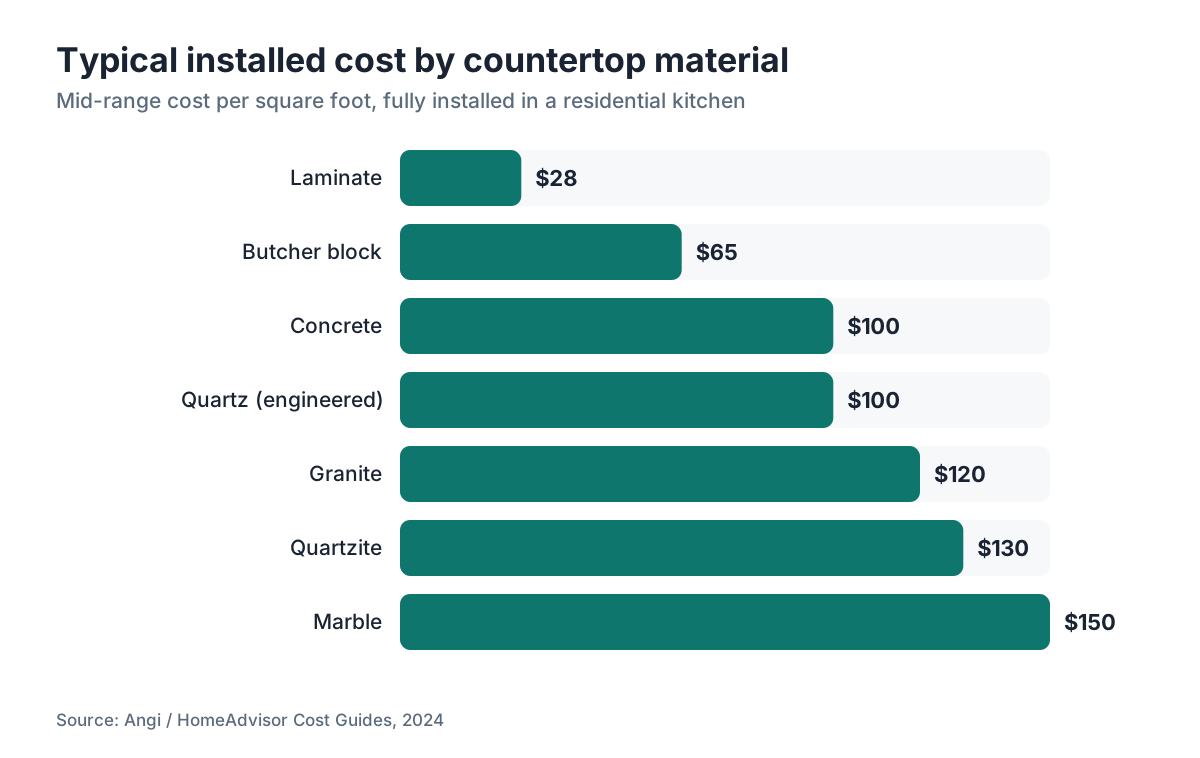
For comparison, quartz countertops land in a similar range but price more predictably, because the material comes off a line at consistent dimensions. Laminate countertops and formica countertops cost far less, usually $15 to $40 installed, if budget is driving the decision.
How do you clean granite countertops day to day?
Warm water and a few drops of dish soap, wiped with a soft cloth or microfiber, then dried. That handles almost every mess [2]. You don't need a special product for daily cleaning.
Granite is porous to varying degrees depending on the stone, so the real concern is letting acidic or harshly alkaline liquids sit. Coffee, lemon juice, wine, and vinegar can etch the surface or eat the sealer over time if they pool. Wipe spills soon after they happen. No need to panic, but don't leave a cut lemon face-down on unsealed granite for an hour either.
Here's what actually matters day to day:
- Use pH-neutral dish soap like Dawn or a granite-specific spray. Both work.
- Microfiber cloths clean without scratching. Paper towels are fine too. Keep steel wool and scrubby pads away from the stone.
- Dry the surface after cleaning. Standing water won't etch granite the way it does marble, but it leaves mineral spots and slowly breaks down a wax-based sealer.
- Skip the vinegar-water sprays that live forever on cleaning blogs. Vinegar sits around pH 2 to 3 and will dull a polished finish over time [2].
- Skip bleach too. It won't destroy granite on contact, but repeated use degrades sealers and can react with minerals in some stones.
For baked-on grease, a paste of baking soda and water left a few minutes lifts it without scratching. For sticky residue, reach for a plastic scraper, never a metal one.
More on cleaning every stone surface, including how quartzite care differs, sits in the how to clean stone countertops guide.
What to clean granite countertops with: safe products vs. things that cause damage
Store shelves are full of products labeled "stone cleaner" that swing wildly in quality and pH. The EPA's Safer Choice program flags pH-neutral surfactant cleaners as low-risk for hard surfaces, which is a decent shorthand for what's safe on granite [8]. Here's how the categories break down.
Safe for regular use:
- Mild dish soap (any brand, just don't use concentrated degreasers undiluted)
- Granite-specific pH-neutral sprays (Method Stone Cleaner, Weiman Granite Cleaner, and StoneTech Revitalizer are commonly stocked at hardware stores)
- Isopropyl alcohol diluted to 70% in water, for disinfecting without acid or bleach [2]
Use rarely or carefully:
- Ammonia-based glass cleaners. One wipe won't ruin anything, but ammonia degrades sealers with repeated use.
- Hydrogen peroxide at 3% for stain poultices. Fine once in a while, not as a daily cleaner.
Avoid entirely:
- Vinegar, lemon juice, or any citrus-based cleaner
- Bleach as a routine cleaner
- Abrasive powders (Comet, or Bar Keepers Friend in powder form)
- Anything labeled "disinfecting spray" with acidic compounds, so read the label
The logic is simple. Granite's polished surface etches from acids, and its sealer, the thing keeping stains out, breaks down from alkalis and solvents. Protecting the sealer costs a lot less than replacing it.
For a specific stain, oil-based stains respond to a baking soda poultice, water-based stains to a hydrogen peroxide poultice. Both need time under plastic wrap (12 to 24 hours) to pull the stain out instead of just smearing it around [3].
How to buff granite countertops back to a shine
Before you treat a dull spot, figure out what caused it. Three different problems look nearly identical, and each needs a different fix:
- Surface haze from cleaner residue or hard water film. Common, and easy to fix.
- Sealer film that built up unevenly. Also easy to fix.
- Real etching or micro-scratching of the stone itself. This one needs a pro.
For haze and residue, a granite polish or spray wax buffed with a clean microfiber cloth in circles usually brings the shine back in a few minutes. Granite Gold Polish and StoneTech Bullet Shield both do this. Apply a little, work it in, buff dry. Don't overdo it. Excess polish leaves its own film, so less really is more.
For sealer buildup, strip it with a stone-safe cleaner per the product directions, let it dry all the way (usually 24 to 48 hours), then reseal fresh.
Real etching shows up as dull spots with a slightly different texture than the stone around them. That's mechanical damage to the granite. A stone restoration contractor re-polishes those areas with diamond pads in finer and finer grits, finishing at 1500 to 3000 grit for a mirror. Don't DIY this unless you own the gear and have practiced on scrap. Renting a random-orbit polisher and grabbing the wrong diamond pads is a fast way to make the damage worse.
Buffing after a fresh seal is a separate question. Most penetrating sealers need no buffing. Some topical (film-forming) sealers do. Read whatever you used. Pros generally prefer impregnating sealers because they soak in and leave the surface looking the same [3].
How often does granite need to be sealed?
Most granite needs resealing every one to three years, and porosity drives the range [3]. Dark, dense granites like Absolute Black barely need it, and some skip sealing entirely. Lighter granites, and stones sold as "granite" that are actually quartzite or gabbro, tend to be more porous and can want annual sealing.
The water test is the standard check. Pour a few tablespoons of water on the surface and watch it for 10 to 15 minutes. If the water beads, the sealer is working. If it darkens the stone (soaks in), reseal [9]. The Natural Stone Institute calls this the standard field method for judging whether a sealer still performs.
Sealing is a reasonable DIY job. Clean the surface well, let it dry for several hours, apply sealer with a clean cloth or applicator, respect the dwell time on the label (usually 5 to 20 minutes), then wipe the excess before it hazes. Penetrating sealers from StoneTech, Tenax, or Miracle Sealants are all safe for homeowners to apply [3].
Professionally applied sealer isn't dramatically better for most kitchens, though fabricators usually seal as part of the install.
What is the Xactimate code for cleaning granite countertops?
Xactimate is the estimating platform insurance adjusters use to price restoration work, and it carries line items for granite countertop cleaning after water damage, fire, or other covered losses. The relevant items sit in the countertop cleaning category.
The code you'll most often use is CTR CT CLN (countertop cleaning, stone) in Xactimate's price list, though the exact notation shifts by Xactimate version and regional price list. Some adjusters pull codes from the "Contents" or "Flooring" categories depending on scope.
A few practical notes for contractors writing granite cleaning scopes:
- Line item prices update quarterly by region and reflect the local labor rate, not a fixed national number [6]. Always pull the current regional price list instead of trusting a figure from a job two years back.
- Sealing after cleaning is usually a separate line item. Include it in the scope if the damage event compromised the existing sealer.
- If the scope needs a stone restoration pro (etching, polishing, stain removal beyond surface cleaning), document that separately, because it falls outside the standard CTR codes.
For current codes and pricing, go through your Xactimate subscription or Verisk customer support directly. Codes change, and third-party lists go stale fast.
How does granite compare to other countertop materials?
Granite sits in the premium tier of natural stone alongside marble and quartzite. Here's how it lines up on the things that actually matter in a kitchen:
| Material | Typical installed cost | Heat resistance | Stain resistance | Maintenance |
|---|---|---|---|---|
| Granite | $40 to $200/sq ft | Excellent | Good (sealed) | Seal 1 to 3 yrs |
| Quartz (engineered) | $50 to $150/sq ft | Moderate (resin can scorch) | Very good | Minimal |
| Marble | $50 to $250/sq ft | Good | Poor (etches easily) | Seal often, accepts etching |
| Quartzite | $60 to $200/sq ft | Excellent | Good (sealed) | Similar to granite |
| Butcher block | $30 to $100/sq ft | Poor (chars) | Poor (oils and stains) | Oil regularly |
| Laminate | $15 to $40/sq ft | Poor (melts) | Good | Minimal |
| Concrete | $65 to $135/sq ft | Excellent | Moderate (sealed) | Seal annually |
Granite's spot in that table is strong for kitchen use. It takes heat better than engineered quartz (which has a polymer resin binder that discolors under sustained heat), it's harder than marble, and it shrugs off acid better than marble countertops do. Its main downside next to engineered quartz is variability. Break a corner and you'll find that matching natural stone is close to impossible.
If you're weighing quartzite (which showrooms constantly confuse with quartz), the how to clean quartzite countertops guide explains how its care differs from granite. For dark, heat-tolerant stone that needs no sealing, how to clean soapstone countertops is worth a read.
Butcher block countertops and concrete countertops chase different looks and carry their own maintenance trade-offs.
What should homeowners ask fabricators before buying granite?
Most granite regret traces back to a conversation that never happened before the slab got cut. Ask these questions first.
What's the actual square footage, and how is overage handled? Fabricators usually charge for the full slab area they need, including the sink and cooktop cutouts they keep. Ask how usable remnants get priced.
Can I see the actual slab? With natural stone you're buying that specific slab, not a generic product. Go to the yard and chalk-mark the slabs you want. A phone photo flattens the movement in the veining.
What sealer do you apply, and how do I maintain it? A good fabricator names the product so you can buy the same thing later. If they say "we sealed it, you're set forever," that's not true.
Is this actually granite? Plenty of stones sold as granite are technically quartzite, gabbro, or something else. Not worse, necessarily, but it changes the care instructions. Ask if you're unsure.
What's your warranty on fabrication defects? Chipped edges, bad seam placement, and cutouts that miss the sink are fabrication problems, not material problems. Know what's covered.
How is the seam going to look? On long runs, seams are unavoidable. Ask to see their seam work and talk placement before templating. A seam at a sink or cooktop hides better than one in the middle of a run.
For fabricators juggling multiple jobs who need accurate quotes without burning an hour on each, the SlabWise platform handles slab inventory, remnant tracking, and quote generation, which cuts the manual math errors that quietly eat margin.
How long do granite countertops last, and what can damage them?
The rock itself lasts essentially forever. Granite formations run hundreds of millions of years old. A countertop is not going to wear out from cooking dinner inside any human lifetime.
Here's what actually fails over time:
- Sealer. It degrades and needs replacing. Skip it and stains start to penetrate.
- Joints and caulk. The caulk at the wall-to-countertop joint and around the sink dries out and cracks, usually within 5 to 10 years, and then water sneaks under the stone or into the substrate.
- Chips. Granite is hard but brittle at thin edges. Drop a heavy cast iron pan on a thin eased edge and it chips. The chip won't spread, but it won't heal either.
- Thermal shock. Rare with granite (far rarer than with engineered quartz), but slamming a screaming-hot pan straight from a high oven onto the same spot over and over is a bad habit. Use a trivet.
The honest word on staining: sealed granite resists stains well, but it isn't bulletproof. Leave a bottle of olive oil sitting on light-colored granite overnight and you can end up with an oil stain that needs a poultice to pull out. The sealer buys you time, not immunity.
One more thing that matters at the shop, not the kitchen: OSHA regulates crystalline silica dust during stone fabrication under 29 CFR 1910.1053, and cutting natural granite still requires dust controls even though engineered stone carries higher risk [10].
For kitchens specifically, the granite kitchen countertops guide goes deeper on layout for high-use cooking spaces.
Frequently asked questions
How do I clean granite countertops every day?
Warm water and a drop of dish soap on a soft cloth covers almost every daily need. Wipe the surface, rinse with a damp cloth, and dry it. That's genuinely all most counters need. Skip vinegar, citrus sprays, and bleach cleaners, since they degrade the sealer over time. For disinfecting, 70% isopropyl alcohol in a spray bottle is safe and effective.
What is the best thing to clean granite countertops with?
A pH-neutral dish soap and water combo is hard to beat for daily use. For a spray, granite-specific products from Weiman, StoneTech, or Granite Gold are made to be sealer-safe. To disinfect without a dedicated stone cleaner, 70% isopropyl alcohol works without the acidity that damages granite. Avoid anything with vinegar, bleach, or citrus.
How do you clean granite countertops that have stains?
For oil stains, mix a poultice of baking soda and water to a peanut-butter consistency, spread it on the stain, cover with plastic wrap, and leave it 12 to 24 hours. For water-based or organic stains, use 3% hydrogen peroxide as the poultice liquid instead of water. Rinse well and reseal that spot once the stain is gone. Repeat if the stain runs deep.
How much does it cost to add granite countertops to a kitchen?
Expect $40 to $200 per square foot installed, with most mid-grade residential projects between $60 and $100 per square foot. A standard 40-square-foot kitchen runs roughly $2,500 to $4,500. Larger kitchens with islands can reach $8,000 to $12,000. The variables are slab grade, edge profile complexity, number of cutouts, and your region.
How are granite countertops made?
Granite gets quarried as large blocks, then sliced into slabs with diamond-wire gang saws. The slabs are polished at the processing plant, then bought by fabricators who cut them to your kitchen using CNC saws guided by a precise template. Edges are profiled and polished after cutting. The finished pieces install with adhesive, and epoxy holds the seams together.
How do you buff granite countertops to restore shine?
First identify the cause. Cleaner haze or hard water film responds to a granite polish (Granite Gold, StoneTech) buffed with a microfiber cloth. Sealer buildup needs stripping and reapplication. Actual surface etching or scratch marks require professional diamond polishing in finer and finer grits, which is not a DIY job without the right equipment. Don't treat a dull spot as if it's just dirty.
What is the Xactimate code for cleaning granite countertops?
The standard Xactimate line item for granite countertop cleaning falls under the CTR CT CLN category (stone countertop cleaning) in most regional price lists. Exact codes vary by Xactimate version and price list update. Sealing after cleaning is a separate line item. Always pull the current regional price list through your active Xactimate subscription rather than a cached number, since pricing updates quarterly.
Can you use vinegar to clean granite countertops?
No. Vinegar runs around pH 2 to 3, and it will gradually etch the polished surface and degrade the sealer with repeated use. This is one of the most common mistakes homeowners make, often because vinegar gets pushed as a universal natural cleaner. Stick to pH-neutral soap and water or a granite-specific spray. If someone cleaned your granite with vinegar once, it's likely fine, but don't make it a habit.
How often should granite countertops be sealed?
Most granite needs sealing every one to three years, but porosity varies by stone. Test by leaving a few tablespoons of water on the surface for 10 to 15 minutes: if it beads, the sealer is fine; if it darkens the stone, reseal. Dark, dense granites may need sealing rarely. Lighter or more porous stones may want it annually. Sealing yourself with a penetrating impregnating sealer is a reasonable DIY task.
Is granite better than quartz for kitchens?
It depends on your priorities. Granite takes heat better than engineered quartz, since quartz contains a polymer resin that can scorch under sustained heat. Quartz is more consistent in appearance and needs almost no upkeep. Granite is unique, natural, and generally reads as more distinctive. If predictability and low maintenance matter most, quartz is easier to live with. If you want natural stone character, granite is the more durable natural option compared to marble.
Can granite countertops crack?
Yes, though it's uncommon under normal use. Granite can crack from extreme point loads (a very heavy object dropped on an unsupported span near a seam or cutout), from poor installation that leaves sections unsupported, or from thermal shock in rare cases. Hair-thin lines visible only in certain light are usually fissures, natural to the stone and not structural. A real crack with movement or depth is a fabrication or installation issue to address.
What edge profiles are available for granite countertops?
Common options include eased (a slightly softened square edge, the cheapest), beveled, bullnose (fully rounded), half-bullnose, ogee (an S-curve that reads formal), and waterfall (a 90-degree mitered drop to the floor, popular on islands). More complex profiles add $10 to $30 per linear foot. On a budget, eased or beveled edges look clean and cost little extra. Ogee can look dated, so consider how long you plan to stay.
Does granite increase home value?
Real estate pros consistently say buyers notice granite, but pinning down the return is genuinely hard. Remodeling Magazine's Cost vs. Value Report estimates minor kitchen remodels recoup roughly 70 to 80 percent of cost, though that covers the whole project, not granite alone. Granite may help a home sell faster in certain price brackets rather than adding dollar-for-dollar value. It's a reasonable investment if you'll enjoy it for years, less obvious if you're selling in six months.
How do I get rid of water spots on granite countertops?
Hard water spots are mineral deposits left behind when water evaporates. A damp cloth with a little dish soap and some light scrubbing lifts most of them. For stubborn buildup, a granite-safe polish or a paste of baking soda and water works. Don't use lime remover or calcium/rust cleaners, since those are typically acidic and will damage the surface. Prevention is easy: dry the surface after cleaning instead of letting it air dry.
Sources
- HomeAdvisor (Angi), Granite Countertop Cost Guide: Installed granite countertops typically cost $40 to $200 per square foot; average kitchen projects range from $2,500 to $4,500 for smaller kitchens and $8,000 to $12,000 for larger ones with islands.
- Natural Stone Institute, Care and Cleaning for Natural Stone: Mild dish soap and water is safe for daily granite cleaning; acidic cleaners like vinegar and citrus damage both the stone surface and sealer. Diluted isopropyl alcohol is an effective disinfectant that does not harm stone.
- Natural Stone Institute, Sealing and Stain Removal Guidance: Penetrating impregnating sealers are preferred by professionals; granite typically needs resealing every one to three years depending on porosity; poultice treatments using baking soda or hydrogen peroxide remove oil and water-based stains.
- USGS National Minerals Information Center, Stone, Dimension (Granite): The United States imports significant quantities of dimension granite from Brazil, India, China, and Italy for use as building and countertop material.
- Verisk / Xactimate, Line Item Price List Documentation: Xactimate's regional price lists are updated quarterly and include specific line items for countertop cleaning (stone) and sealing as separate billable scope items.
- Remodeling Magazine, Cost vs. Value Report: Minor kitchen remodels recoup approximately 70 to 80 percent of cost at resale, though specific material upgrades like granite countertops are not isolated as individual ROI line items.
- EPA, Safer Choice Program: The EPA Safer Choice program evaluates cleaning product ingredients for surface and health safety; pH-neutral surfactant-based cleaners are broadly recognized as low-risk for hard surfaces.
- Natural Stone Institute, Consumer Care Guide for Granite: The water bead test is the standard field method for assessing whether a granite sealer is still performing; water that absorbs into the stone within 10 to 15 minutes indicates resealing is needed.
- Occupational Safety and Health Administration (OSHA), Crystalline Silica Standard: OSHA regulates crystalline silica exposure in stone fabrication under 29 CFR 1910.1053; engineered stone poses a higher risk than natural granite, but natural stone cutting also requires dust controls.
Last updated 2026-07-09