TL;DR
- Granite kitchen countertops run $40 to $200 per square foot installed, depending on grade and complexity.
- They're harder than most stones, resist heat well, and last decades with annual sealing.
- White granite pairs well with both white and dark cabinets.
- Black granite reads bold but needs thoughtful backsplash choices to avoid a cave-like kitchen.
What does granite actually cost for kitchen countertops?
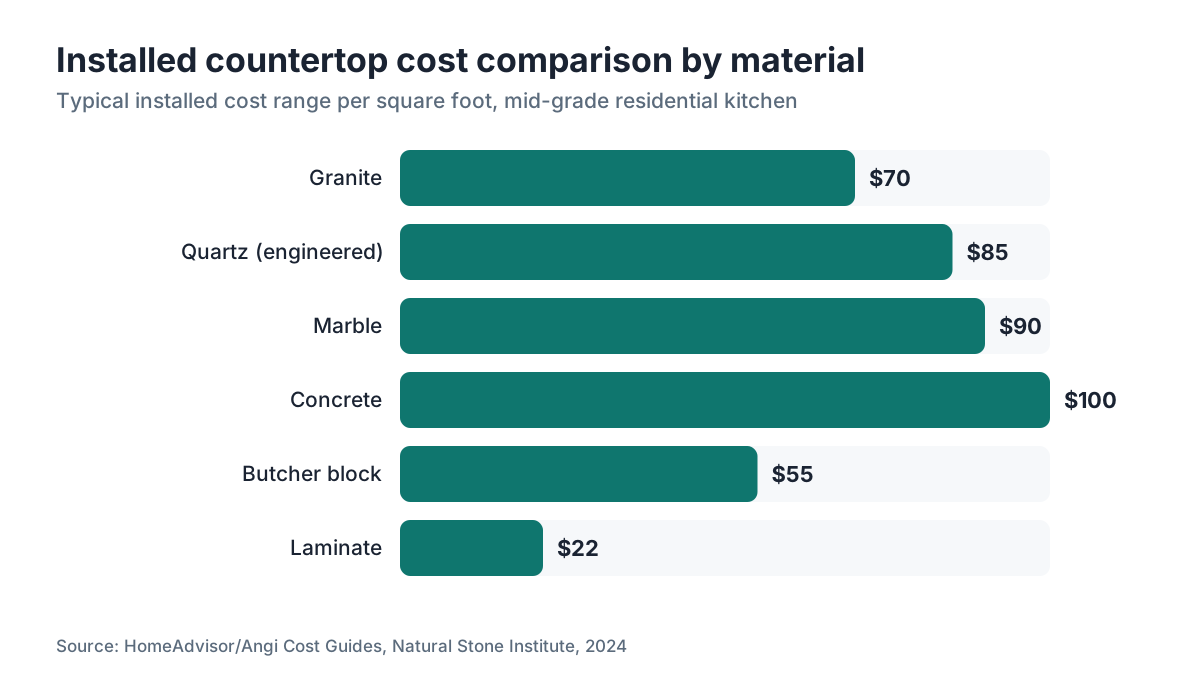
Installed granite kitchen countertops typically run $40 to $200 per square foot, with the national average landing around $60 to $100 per square foot for mid-grade material [1]. That range is wide because granite is a natural stone, and the quarry source, rarity of the color, slab thickness (2 cm vs. 3 cm), edge profile, cutouts for sinks and cooktops, and the market your shop operates in all pull the number in different directions.
Entry-level granite, sometimes called Level 1 or builder-grade, sits closer to $40 to $50 installed. You're looking at common colors like Ubatuba, Uba Tuba, or standard Santa Cecilia in 2 cm thickness with a simple eased edge. The stone is real granite, it performs the same, it just lacks the drama that commands a premium. Mid-grade material (Level 2 to 3) runs $55 to $100 installed and covers the bulk of what kitchen designers specify. Exotic or imported slabs, thick 3 cm material, and highly veined patterns climb to $120 to $200 per square foot.
Labor varies by region. According to HomeAdvisor's cost data, the typical American kitchen of 30 to 40 square feet of countertop lands between $2,000 and $4,500 all-in for a mid-grade granite install [1]. Fabrication and installation usually account for 30 to 50 percent of that total, more than the stone.
Things that push costs up fast: waterfall edges, mitered profiles, a large island with seams you want hidden, undermount sink cutouts (each adds $100 to $300), and cooktop cutouts. Things that don't move the needle much: adding a standard eased or beveled edge versus an ogee or bullnose costs an extra $10 to $30 per linear foot, which sounds small until you have 25 feet of edge.
Compared to quartz countertops, granite comes in slightly cheaper on material but can cost more in ongoing maintenance (sealing). Compared to laminate countertops or formica countertops, granite is much more expensive upfront but resists heat and scratching in ways those surfaces don't.
How does granite compare to other countertop materials?
Granite sits near the top of the durability ladder for kitchen surfaces. Its Mohs hardness is typically 6 to 7, meaning most knives (Mohs 5.5 to 6.5) won't scratch it, though you can still dull a good chef's knife by cutting directly on the stone. Glass and hardened steel will scratch it eventually. In normal kitchen use, surface scratches are rarely the complaint.
Heat resistance is real. Granite handles temperatures up to roughly 480°F (250°C) without cracking or discoloring under normal conditions, though thermal shock from placing a very hot pan on a cold spot can cause stress fractures in rare cases [2]. Most fabricators will tell you a hot pan is fine on granite. Use a trivet anyway. The risk isn't zero and the stone is expensive.
The comparison that matters most for most buyers is granite vs. quartz engineered stone. Quartz scores higher on consistency, lower maintenance (no sealing needed), and resistance to staining. Granite scores higher on heat tolerance, unique natural patterning, and generally lower cost for equivalent visual drama. Neither is objectively better. It's a tradeoff between natural variation you love (or hate) and manufactured predictability.
| Material | Installed cost/sq ft | Hardness (Mohs) | Needs sealing | Heat resistant |
|---|---|---|---|---|
| Granite | $40, $200 | 6 to 7 | Yes, annually | Yes (up to ~480°F) |
| Quartz (engineered) | $50, $150 | ~7 | No | Moderate (avoid direct heat) |
| Marble | $50, $150 | 3 to 4 | Yes, frequently | Moderate |
| Butcher block | $30, $100 | N/A | Oil regularly | No |
| Laminate | $10, $40 | N/A | No | No |
| Concrete | $65, $135 | ~5 | Yes | Yes |
For more detail on how marble countertops and butcher block countertops hold up in kitchens, the comparisons get nuanced fast, especially around staining and how often you have to maintain them.
What are the most popular granite colors for kitchens?
Granite comes in genuinely thousands of colors and patterns because it forms from cooled magma, and mineral composition varies by quarry location [11]. In kitchen applications, a handful of families dominate sales year after year.
White and light gray granites are the biggest sellers in the current market. Bianco Romano, White Ice, White Fantasy, and Alaska White all deliver that clean, bright look that reads well with both white and painted cabinets. White granite kitchen countertops specifically have driven the bulk of the market's growth over the past decade as the all-white or white-and-wood kitchen aesthetic took hold. These stones tend to have subtle movement, gray veining, or flecks of black and cream that keep them from looking flat.
Black and dark granites, including Absolute Black, Black Galaxy, and Ubatuba, project a more dramatic kitchen. Black granite countertops with white cabinets is one of the most searched kitchen design combinations because the contrast is sharp and has aged better than many trends. The weakness of dark granite in kitchens is that water spots, fingerprints, and light-colored crumbs show constantly on polished surfaces. Honed or leathered finishes help.
Brown and gold tones, Santa Cecilia, Venetian Gold, and Giallo Ornamental, were the dominant choices in the early 2000s. They've faded in popularity but haven't disappeared. They pair well with warm-toned wood cabinets and antique-style hardware.
Blue and green granites, Blue Pearl, Emerald Pearl, Volga Blue, are genuinely unique and command a premium. They're polarizing: some buyers love them, others find them hard to design around.
Movement matters more than color in many cases. A heavily veined granite requires careful slab layout to avoid awkward seams. A more uniform stone like Absolute Black is much easier to match across a large kitchen island.
Do granite countertops really need to be sealed?
Yes, but the answer has nuance. Granite is a porous stone. Liquids, particularly oils and acidic liquids like wine, juice, and coffee, can penetrate unsealed granite and leave stains that are difficult to remove [3]. Sealing fills those pores temporarily and buys you time to wipe spills before they soak in.
The Natural Stone Institute's guidance says most kitchen granite should be sealed at installation and re-sealed every one to three years depending on the stone's porosity and use level [4]. A simple test: put a few drops of water on the surface. If the stone darkens within a few minutes, it's time to seal. If water beads, you're still protected.
Not all granite is equally porous. Black granites and many darker stones are very dense and may not need frequent sealing. Some light or heavily mineral-varied granites are more porous and absorb liquids faster. Your fabricator should test the specific slab rather than quote a generic schedule.
The sealing process itself is straightforward. A penetrating impregnator sealer (brands like Tenax, Tilelab, or Aquamix work well) gets wiped on with a cloth, left to penetrate for the manufacturer's recommended dwell time (usually 10 to 30 minutes), then buffed off. A good bottle costs $15 to $50 and covers several hundred square feet. Hiring it done runs $60 to $150 per service. There's no reason to hire this out except time.
Skipping sealing doesn't mean immediate disaster. Unsealed granite can survive years without obvious staining in low-use kitchens. In an active cooking household with olive oil, red wine, and acidic marinades near the stone, you'll eventually see the difference.
What cabinets go best with granite countertops?
This is one of the most-asked design questions, and honestly, granite is more forgiving than most people expect. The stone already contains multiple colors. A slab of Bianco Romano might carry white, gray, cream, and black flecks. Any of those tones can anchor a cabinet color choice.
White kitchen cabinets with granite countertops is the dominant pairing in the market right now. It works because white cabinets don't compete with the stone's pattern. The granite becomes the visual feature. For white granite kitchen countertops specifically, the effect is bright and airy, though the kitchen can look cold without warm accents in the flooring, hardware, or lighting. A white kitchen with white granite countertops pulls off a coherent monochrome look when the granite has enough movement to keep it from being flat.
Gray cabinets pair especially well with stones that have strong gray veining, like Alaska White or Silver Cloud. The risk is sameness: if the cabinet gray and the granite gray are too similar in value, everything flattens out. Contrast within the stone itself (dark flecks against a light field) saves the design.
Dark cabinets, navy, hunter green, charcoal, pair beautifully with lighter granites because the contrast carries the room. Black granite countertops with white cabinets creates the inverse: a sharp, modern look that shows up in a lot of contemporary and transitional kitchens.
Warm-toned wood cabinets (maple, cherry, hickory) pair best with brown, gold, or cream granites. Trying to match warm wood to cool gray granite usually produces a muddy, unresolved look.
Choosing granite before cabinets? Bring the slab sample to the cabinet showroom. Choosing cabinets first? Take a door sample to the stone yard and hold it against actual slabs in daylight, not the fluorescent slab-yard lighting that distorts everything.
What backsplash works with white cabinets and granite countertops?
Backsplash choices depend heavily on how much visual activity is already in the granite. Heavy-movement granite demands a quieter backsplash. A more uniform or subtle granite can absorb a bolder tile choice.
For backsplash ideas with white cabinets and granite countertops, a few approaches never let you down.
Subway tile in white or cream with a tight grout joint reads clean and lets the granite star. Simple, never wrong, cheap to install. The downside is that it reads generic in 2025, and resale value on a white-subway-plus-white-cabinet kitchen is competitive but not distinctive.
Small mosaic or hexagon tiles in neutral tones add texture without color competition. These work especially well with stones that have strong patterns because the tile stays visually secondary.
Large-format porcelain slab backsplashes, 24x48 or larger, create a continuous, high-end look. If you use a porcelain that picks up a color from the granite, the whole wall reads as intentional.
Natural stone mosaic that matches the granite (buying off-cuts from the same slab) is a fabricator trick that ties the room together. It costs more because you're buying an extra piece of stone, but the effect is polished.
For backsplash for black granite countertops and white cabinets, the contrast is already maxed out. A white or light gray subway tile keeps it clean without adding a third competing element. Metallics (brushed brass, stainless) are a popular choice here because they warm up what can otherwise be a very stark look. Avoid busy pattern tiles behind already-busy granite.
Grout color matters more than most people realize. Dark grout with dark granite makes the seams disappear. Light grout with busy granite splits your eye between the tile grid and the stone pattern. When in doubt, match the grout to the lighter tone in the granite.
How long do granite kitchen countertops last?
Granite is a geological material. The stone itself is tens of millions to hundreds of millions of years old. In a kitchen, a properly installed and maintained granite countertop lasts, for practical purposes, indefinitely. The failure modes aren't in the stone.
What actually ends a granite countertop's life in a kitchen: chips from heavy impacts at edges (especially on thin 2 cm slabs without plywood backing), cracks from poor installation or improper support across cabinet gaps, staining from years of neglected sealing, or the owner remodeling and wanting something different. The stone itself doesn't wear out.
Edge profiles matter for durability. A sharp eased or mitered edge chips more easily than a rounded bullnose or half-bullnose. If you have kids or a busy kitchen, an ogee or rounded profile holds up better to the inevitable dropped cast iron pan.
Thickness is a real durability variable. Three-centimeter granite (about 1.25 inches) is much stronger and less prone to cracking during installation and use than 2 cm (about 0.75 inches). Most residential fabricators in the U.S. now default to 3 cm for kitchens [10]. If you're being quoted 2 cm, ask why.
Stone suppliers and fabricators in the industry commonly cite a properly maintained granite countertop lasting 50 to 100 years without needing replacement [4]. Compare that to laminate, which typically shows wear in 10 to 15 years, or even quartz, where the resins in the binder can yellow or discolor under prolonged UV exposure.
Is granite safe for food prep? What about radon?
Granite is safe for food contact. The surface is hard, non-reactive, and doesn't harbor bacteria in any unique way compared to other non-porous surfaces. A sealed granite countertop behaves similarly to tile or solid surface for food safety purposes. The U.S. Food and Drug Administration considers properly sealed stone surfaces acceptable for food contact [5].
The radon question comes up repeatedly and deserves a straight answer. Granite does contain trace amounts of naturally occurring uranium, thorium, and radium, which decay and produce radon gas. The question is whether the amounts in a kitchen countertop are meaningful.
The EPA's position, backed by research including work at Lawrence Berkeley National Laboratory, is that granite countertops are generally not a significant source of radon exposure in homes [6][8]. The EPA states that "it is possible for any granite sample to contain varying concentrations of uranium and other naturally occurring radioactive elements," but that most countertops contribute far less to indoor radon than soil gas entering through the foundation [6]. That soil gas is the dominant residential radon source.
Worried about it? Test your home's radon level with an EPA-recommended test kit (available at hardware stores for $15 to $30) and address the building's overall radon management instead of skipping granite countertops [6]. Radon testing is the same process regardless of your countertop material.
There's also a radiation concern that gets raised. LBNL research found that granite countertops contribute negligible radiation exposure compared to normal background levels from cosmic rays and building materials [8]. The agency has no recommendation to avoid granite countertops for radiation reasons.
What's the right way to clean and maintain granite countertops?
Daily cleaning is simple. Warm water, a few drops of dish soap, a soft cloth. That handles 95 percent of kitchen messes. Dry the surface after cleaning to prevent water spots, which are especially visible on polished dark granite.
Things to avoid: acidic cleaners (vinegar, citrus-based cleaners, many commercial bathroom cleaners), bleach at full strength, and abrasive scrubbing pads. Acids break down the sealant and eventually the stone surface itself. You won't see damage immediately, but over months of regular acid exposure, a polished granite surface can lose its sheen in spots.
For a deeper look at stone cleaning protocols for natural surfaces, how to clean stone countertops covers the chemistry and products in more detail.
Oil stains: if you catch them fast, dish soap and warm water usually work. If the oil has penetrated, a poultice of baking soda and a few drops of dish soap mixed to a paste, applied to the stain, covered in plastic wrap, and left overnight can draw the oil out. Repeat if needed.
Organized fabricators track sealing intervals for their clients. If you're running a shop and want to stay in contact with customers post-install, tools like SlabWise can attach maintenance notes and reminders to specific jobs, so customers come back to you for re-sealing and future projects rather than calling a competitor.
Stain removal for tough cases: the Natural Stone Institute publishes a stain-identification guide that pairs stain type to removal method [4]. Worth bookmarking, because the right solution depends on whether you're dealing with oil, organic material, rust, or water deposits, and each needs a different treatment.
How is granite fabricated and installed?
The fabrication process starts with templating. A templator visits your kitchen, measures the cabinets precisely (with a digital laser system or a physical template), and produces a cut map that shows exactly how slabs will be positioned and where seams will fall. Seam placement is what separates good fabricators from lazy ones: a good one minimizes visible seams and avoids placing them at stress points like cooktop cutouts.
Slabs are then cut on a CNC waterjet or bridge saw. Edge profiles are shaped on edge polishing machines. Cutouts for sinks and cooktops are made with core drill bits and jigsaws or on the CNC. The whole fabrication process for a typical kitchen takes one to three days in a well-equipped shop.
Installation day usually takes three to six hours for a full kitchen. The installer sets cabinets level, dry-fits the stone pieces, applies epoxy adhesive, positions the slabs, and fills seams with color-matched epoxy. A good seam in granite is nearly invisible: less than 1/32 inch with matched epoxy is achievable with experienced hands and careful slab layout.
The single biggest determinant of a great install is the template. If the template is off, nothing downstream fixes it. Comparing fabricators? Ask how they template. Digital templating (Proliner, Alpha Cam, similar systems) is more accurate than hand templating in most cases, though an experienced hand templator can match it.
Weight is a structural concern. Three-centimeter granite weighs roughly 18 to 20 pounds per square foot. A 40-square-foot kitchen countertop is 720 to 800 pounds of stone sitting on your cabinets. Standard frameless and face-frame cabinet construction handles this load without issue. Custom cabinetry that uses non-standard construction or thin materials should be inspected first.
For homeowners comparing granite to kitchen countertops broadly, the installation process for granite is more involved than laminate (which often laminates onto existing substrate) but comparable to quartz.
What are the downsides of granite kitchen countertops?
Granite gets positioned as the gold standard, and it earns that reputation for durability. But it has real weaknesses worth naming.
Variation you can't preview. You buy a granite color name. What you get is the specific slab from the specific quarry lot your supplier has in stock. Two slabs called 'White Ice' can look meaningfully different. Always view and approve the actual slab before fabrication, not a sample chip.
Seams show on large kitchens. Granite slabs are typically 9 to 10 feet long and 5 to 6 feet wide. A kitchen island 8 feet long probably needs a seam. A skilled fabricator minimizes visibility, but a seam through granite is never as invisible as it can be with solid surface materials like Corian countertops.
Maintenance is real. Annual sealing is not a dealbreaker, but it's a task that many homeowners ignore and eventually regret. Unsealed granite that's been neglected for years can stain deeply, and those stains may be permanent.
Weight limits flexibility. Once the stone is installed, you can't easily remove it without risking breakage. Kitchen remodels that involve moving a cooktop or sink location often require scrapping the existing granite, which hurts both financially and ecologically.
Unusual colors go out of style. Brown and gold granites from the early 2000s read as dated to many buyers today. If resale value is a primary concern, sticking with classic white, gray, or black granite lowers the risk of the kitchen feeling dated in 10 years.
Pricing opacity is a real issue. Stone pricing varies enormously between shops, and most homeowners have no frame of reference. Getting three quotes is essential. If you want to understand how fabricators build their prices, SlabWise has a quote calculator at slabwise.com that breaks down how square footage, edge profiles, and cutouts combine into a final number.
How do I choose and buy the right granite slab?
Go to a stone yard, not a showroom. Showrooms display samples. Stone yards have the actual slabs, and you need to see the full slab to understand the movement, color variation, and potential seam locations. Most fabricators work with one or more distributors. Ask yours to take you to the yard or to hold specific slabs for you to view.
View slabs in person in daylight or with a color-accurate light. Slab yard fluorescent lighting flattens everything. Bring a cabinet door sample or paint chip.
Look at the whole slab surface, more than the nice section. Where are the natural fissures (visible lines in the stone that are part of the crystal structure, not cracks)? A fissure that runs across where your cooktop cutout will be is a potential crack location under stress. A skilled fabricator will see this and adjust the layout. A careless one may not.
Check for pitting on the surface. Some granites have natural voids or soft mineral pockets. Fabricators fill these during fabrication, but heavy pitting can affect sealing performance and long-term appearance.
Ask about the slab's country of origin. Brazil is the largest granite exporter to the U.S., followed by India and China [7]. European quarries (Italy, Norway) produce premium materials at premium prices. Country of origin affects neither quality nor safety. It affects cost and the range of colors available.
Buy enough stone. A common mistake is ordering exactly the square footage needed with no margin. Granite is a natural material with a non-repeatable lot. If a piece breaks during fabrication or you add a shelf or windowsill later, matching the original slab is often impossible. A 10 to 15 percent overage is standard practice.
Frequently asked questions
How much does a granite kitchen countertop cost per square foot installed?
Installed granite kitchen countertops cost $40 to $200 per square foot, with most homeowners paying $60 to $100 for mid-grade material. A typical 30 to 40 square foot kitchen comes out to $2,000 to $4,500 all-in. Entry-level builder granite starts near $40; exotic imported slabs with waterfall edges can exceed $200. Labor and fabrication usually account for 30 to 50 percent of the total.
What is the best granite color for a kitchen?
There's no universally best color, but white and light gray granites like White Ice, Bianco Romano, and Alaska White are the most popular right now because they pair with nearly any cabinet color. Black granite like Absolute Black or Black Galaxy creates strong contrast and ages well stylistically. Brown and gold tones like Santa Cecilia remain solid choices for warm-toned wood cabinet kitchens. Choose based on your cabinet color and lighting.
Do granite countertops need to be sealed every year?
Most kitchen granite should be sealed at installation and re-sealed every one to three years, depending on porosity and use. The Natural Stone Institute recommends a simple water test: drop water on the surface. If it darkens within a few minutes, seal it. If it beads, you're still protected. Denser dark granites may only need sealing every two to three years; more porous light granites may need annual attention.
What backsplash goes with white cabinets and black granite countertops?
White or light gray subway tile is the safest choice behind black granite countertops and white cabinets because it keeps the contrast clean without adding a third competing element. Metallic tiles in brushed brass or stainless warm up the stark black-and-white palette. Avoid busy patterned tiles; the granite itself provides more than enough visual activity. A large-format white porcelain slab backsplash is a cleaner, more contemporary option.
Can you set hot pans on granite countertops?
Granite handles heat better than most countertop materials and can tolerate temperatures up to around 480°F without cracking under normal conditions. Thermal shock from placing a very hot pan on a cold spot carries a small but non-zero risk of stress fracturing. Most fabricators say hot pans are fine in practice, but using a trivet costs nothing and eliminates all risk. Quartz is more heat-sensitive, so this matters more there.
Is white granite a good choice for a kitchen with white cabinets?
White granite with white cabinets works well because the stone's natural movement, gray veining, and mineral flecks provide visual texture the cabinets don't. The result is bright and airy. The risk is coldness: without warm accents in flooring, hardware, or lighting, an all-white kitchen can feel sterile. Choose a white granite with enough movement or warm undertones to keep it from looking flat.
How long does granite countertop installation take?
A typical kitchen granite installation takes three to six hours on the install day. Before that, templating takes one to two hours, and fabrication takes one to three days in a well-equipped shop. So from template appointment to installed countertops, expect one to two weeks total in normal scheduling. Busy shops during peak remodel season (spring and fall) may take three to four weeks from template to install.
What is the difference between granite and quartz countertops?
Granite is a natural stone cut from quarried slabs. Quartz countertops are engineered from 90 to 95 percent crushed stone bound with polymer resins. Quartz is more consistent in appearance, doesn't need sealing, and resists stains better. Granite is harder to replicate consistently but offers unique natural patterns, handles heat better, and typically costs less for equivalent visual impact. Neither is objectively better; it depends on your priorities.
Does granite increase home resale value?
Granite is widely considered a value-adding kitchen feature by real estate professionals, but hard return-on-investment data is limited. Remodeling Magazine's Cost vs. Value Report consistently shows minor kitchen upgrades (including countertop replacements) returning 80 to 90 percent of cost at resale. Granite reads as a premium material to buyers and can help a kitchen compete in the market, but it won't fully recoup installation cost in most resale scenarios.
How do I clean granite countertops without damaging them?
Use warm water and a small amount of mild dish soap on a soft cloth for daily cleaning. Dry the surface afterward to prevent water spots. Never use vinegar, citrus cleaners, bleach, or abrasive scrubbing pads. Acids break down sealant and can etch the stone surface over time. For oil stains that have soaked in, a poultice of baking soda and dish soap left overnight under plastic wrap can draw the stain out.
Is granite safe for food prep?
Yes. A properly sealed granite surface is safe for direct food contact. It's hard, non-reactive, and doesn't harbor bacteria in any unusual way. The FDA considers properly sealed stone surfaces acceptable for food contact. The radon question that sometimes comes up with granite is not a practical concern for countertops: EPA and LBNL research found granite contributes negligible radon compared to soil gas, which is the dominant residential radon source.
What thickness of granite is best for kitchen countertops?
Three-centimeter granite (about 1.25 inches thick) is the standard recommendation for kitchens. It's much stronger than 2 cm (about 0.75 inches), less prone to cracking during fabrication and under kitchen use, and doesn't require a plywood substrate for support. Two-centimeter granite costs slightly less but introduces more risk. Most U.S. residential fabricators now default to 3 cm; if you're quoted 2 cm, ask specifically about the tradeoffs.
How do I find visible seams in a granite countertop?
Seams in granite are almost always visible on close inspection because the stone's natural pattern breaks across the joint. A skilled fabricator matches the slab layout to minimize how noticeable the break looks and fills the seam with color-matched epoxy. Seams are less noticeable on more uniform granites (like Absolute Black) and more obvious on heavily veined material. Ask your fabricator to show you the slab layout and seam locations before they cut.
Can granite countertops crack?
Yes, though it's uncommon with proper installation. Cracks typically result from poor support across a cabinet gap, heavy impact at an edge or sink cutout, or thermal shock. Three-centimeter granite cracks far less often than 2 cm. Edges and corners are the most vulnerable points; a chip from a dropped cast iron pan at an edge is more common than a full crack across the field of the stone.
Sources
- HomeAdvisor (Angi), Granite Countertops Cost Guide: Installed granite countertops average $40 to $200 per square foot; a typical 30-40 sq ft kitchen runs $2,000 to $4,500 all-in
- Penn State Extension, Stone Countertop Care and Maintenance: Granite handles temperatures up to approximately 480°F without cracking under normal conditions; thermal shock from rapid temperature change is a low but non-zero risk
- University of Minnesota Extension, Kitchen Countertop Materials: Granite is porous and can absorb oils and acidic liquids if unsealed, leading to stains that are difficult to remove
- Natural Stone Institute (formerly Marble Institute of America), Care and Cleaning for Natural Stone: Most kitchen granite should be sealed at installation and re-sealed every one to three years; stone suppliers and fabricators cite a properly maintained granite countertop lasting 50 to 100 years
- U.S. Food and Drug Administration, Food Contact Surfaces: The FDA considers properly sealed stone surfaces acceptable for food contact in commercial and residential settings
- U.S. Environmental Protection Agency, Radiation and Radon: The EPA states that granite countertops are generally not a significant source of radon exposure; soil gas entering through the foundation is the dominant residential radon source
- U.S. Geological Survey, National Minerals Information Center: Stone (Dimension): Brazil is the world's largest granite exporter to the United States, followed by India and China
- Lawrence Berkeley National Laboratory, Radon and Radiation Sources in Buildings: LBNL research found that granite countertops contribute negligible radon and radiation compared to background levels from soil and building materials
- Remodeling Magazine, Cost vs. Value Report: Minor kitchen remodels including countertop replacement return 80 to 90 percent of cost at resale on average nationally
- Natural Stone Institute, Dimensional Stone Design Manual: Three-centimeter granite (1.25 inches) is the recommended thickness for residential kitchen countertops; 2 cm slabs require plywood substrate backing for adequate support
- U.S. Geological Survey, Rock Types and Geology: Granite forms from cooled magma and has a Mohs hardness of 6 to 7; mineral composition varies by quarry location producing thousands of distinct color patterns
Last updated 2026-07-09