TL;DR
- World Stone Fabricators Inc is a natural and engineered stone fabrication company.
- Before you hire any stone fabricator, verify licensing, insurance, slab sourcing, and warranty terms.
- Installed granite runs $40 to $100 per square foot, depending on stone grade and region.
- This guide covers what separates a shop you can trust from one that will cost you.
What is World Stone Fabricators Inc and what do they do?
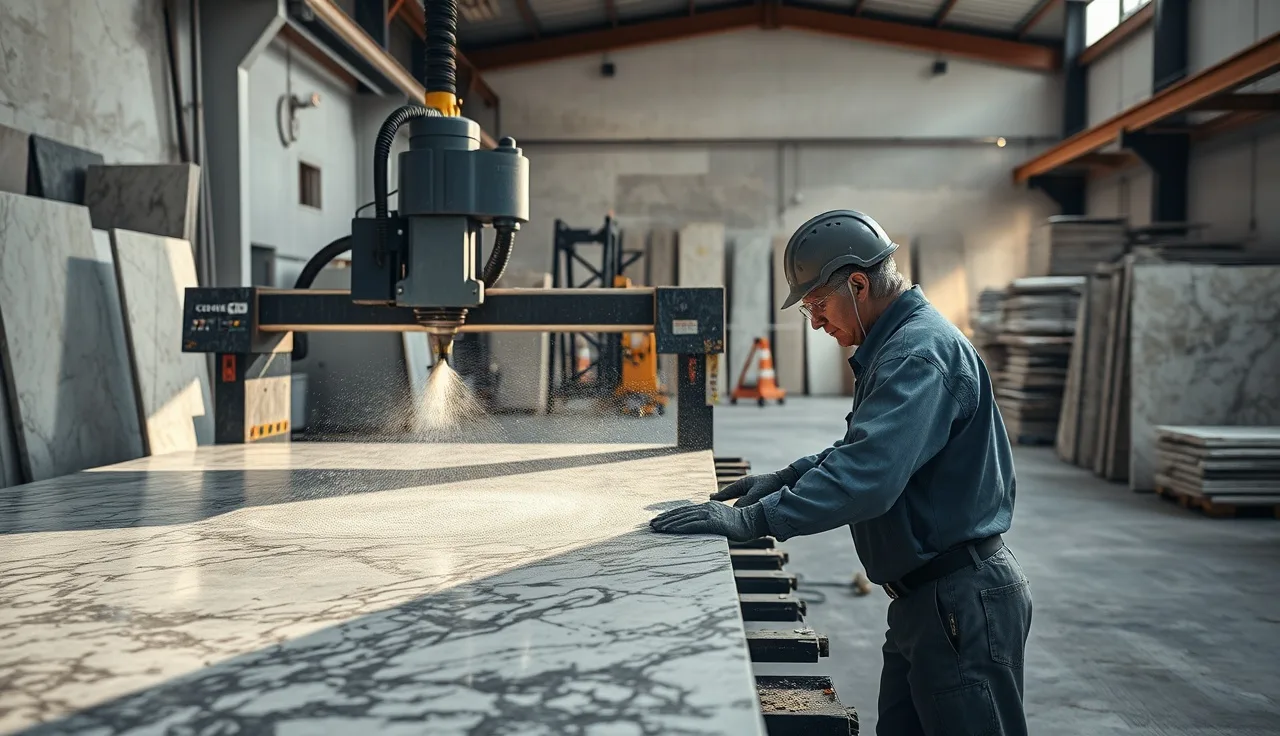
World Stone Fabricators Inc is a stone fabrication company working in countertops and architectural stone. The core job is what every fabricator does: buy raw slabs, cut them to a customer template, finish the edges, and install the finished pieces in homes or commercial spaces.
The word "fabricator" gets used loosely, so let's be precise. A fabricator is not a stone dealer. Dealers sell slabs. Fabricators take those slabs and turn them into countertops, vanities, shower walls, and flooring. Some shops do both, buying direct from quarries or importers and handling the full process in-house. Others job out steps like CNC cutting or edge polishing to partner shops. The model a company uses changes your lead time, your price, and who is actually on the hook when something goes wrong.
World Stone Fabricators works with granite, marble, quartzite, and engineered quartz. What a shop handles well depends on its equipment, its templating crew, and how many years it has run that gear. A shop that cuts granite all day may not be your best pick for a delicate book-matched marble install. That distinction is worth asking about before you commit.
How does stone fabrication actually work from slab to countertop?
Most homeowners picture fabrication as one smooth step. It's really five or six separate ones, and your countertop is only as good as the weakest one.
First comes templating. A technician comes to your home or jobsite and either laser-measures the space or builds a physical template from thin strips of material. This measurement is the foundation of everything. An error here means a slab that doesn't fit, and at $60 to $200 per square foot for premium stone, a mistake is expensive. Laser templating (using tools like a Proliner from Prodim) is the standard at better shops now.
Next, the template data drives the CNC saw and waterjet in the shop. The slab gets cut to shape, then the edges are profiled with a CNC edge machine or by hand depending on the edge style you chose. Common profiles include eased, beveled, bullnose, and ogee. Fancier profiles cost more, sometimes $15 to $25 extra per linear foot for a full bullnose or ogee over a standard eased edge.
After cutting and edging, natural stone gets sealed (if the material calls for it) and the pieces load up for delivery and install. Installation means setting the sections with adhesive, making seams where sections join, and caulking the perimeter. A good seam on dark granite should be nearly invisible. On white marble a seam shows more, because the material is more translucent and you can see the epoxy line. That's physics, not sloppy work, though how well the epoxy is color-matched still matters.
Start to finish, template to install usually takes one to three weeks at a busy shop. Longer in peak remodeling season, which is spring and fall.
What does it cost to have stone countertops fabricated and installed?
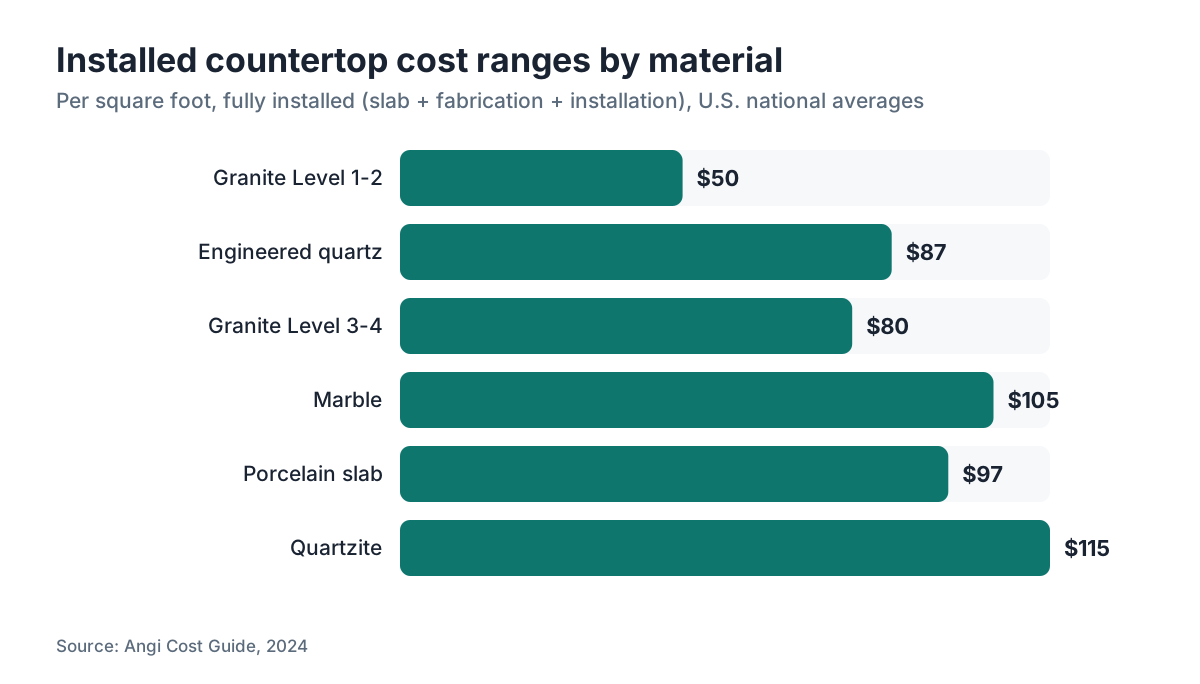
Cost depends on material, edge profile, cutouts, thickness, and your region. Here are real ranges for installed countertops, meaning slab, fabrication, and installation bundled together:
| Material | Low (per sq ft) | High (per sq ft) | Notes |
|---|---|---|---|
| Granite (Level 1-2) | $40 | $60 | Builder grade, limited colors |
| Granite (Level 3-4) | $60 | $100 | Exotic colors, more movement |
| Marble | $60 | $150 | Varies wildly by origin |
| Quartzite | $70 | $160 | Often mislabeled in the trade |
| Engineered quartz | $55 | $120 | Consistent color, no sealing needed |
| Porcelain slabs | $65 | $130 | Lightweight, heat resistant |
These ranges come from contractor cost databases and real quotes across U.S. markets [2]. They aren't guarantees. A rural shop in the midwest may quote 20 percent below a coastal metro shop for the exact same material.
Cutouts add cost. Each sink cutout usually runs $150 to $300. A cooktop cutout is $100 to $200. Faucet holes are $50 to $100 each. Undermount sinks add cost because the edge of the cutout has to be polished, which takes extra time.
Thickness matters too. Standard countertop thickness is 3/4 inch (20mm) or 1.25 inches (30mm). Most natural stone countertops in the U.S. sell as 3cm (about 1.18 inches). Thicker stone costs more per square foot and weighs a lot more, which matters for cabinet support.
The biggest price variable most homeowners miss is slab waste. Slabs don't come pre-cut to the size of your kitchen. You buy part of a slab (or sometimes the whole thing), and the leftover pieces don't come back to you. A layout with many small sections and lots of cutouts wastes more stone and raises your real cost per usable square foot. A good fabricator will show you the cut layout (called a nest) before cutting, so you can see exactly how the slab is being used.
How do you verify a stone fabricator is licensed and insured?
This is where a lot of homeowners skip steps and regret it. Licensing rules for stone fabricators vary by state and sometimes by county. There is no single national license for countertop fabrication. In California, contractors who install countertops must hold a C-54 (Tile and Marble) or C-61/D-41 (limited specialty) license from the California Contractors State License Board [3]. In Florida, stone installation falls under the general contractor or specialty contractor framework run by the Department of Business and Professional Regulation [4]. Other states have their own categories, and some have almost no requirements at all.
The safest move: ask for the fabricator's contractor license number, then verify it yourself on your state's licensing lookup database. Don't take their word for it. If they lack a license in a state that requires one, that's a real red flag.
Insurance is non-negotiable. You want a certificate of insurance showing general liability coverage (at least $1 million per occurrence) and workers' compensation for their employees [10]. Ask to be named as an additional insured on the general liability policy for the length of your project. A legitimate shop provides this without blinking. One that pushes back or says it isn't necessary is one to walk away from.
Bonding is a third layer. A surety bond means that if the contractor fails to finish the work, there's a financial backstop. It's less common to require this for countertop work specifically, but on large commercial projects it's worth asking about.
What questions should you ask a stone fabricator before hiring?
You can learn most of what you need from about eight direct questions. Any shop worth hiring will answer all of them without hesitation.
-
Where do your slabs come from? Do you have a slab yard I can visit, or do you work with a distributor? Ideally you pick your actual slab in person, not from a photo on a screen. Every slab is one of a kind.
-
What equipment do you use for templating and cutting? Laser templating and CNC cutting are the current standard. Hand-cutting isn't inherently bad, but it takes a very skilled saw operator.
-
Do you install in-house or subcontract? If they sub out installation, find out who actually shows up at your house and whether that crew is covered under the fabricator's insurance.
-
What is your lead time right now? Not the ideal lead time, the current one. Shops booked six to eight weeks out are usually that busy because they're good. Shops that can start tomorrow may be slow for a reason.
-
What does your warranty cover? A reasonable warranty covers fabrication defects (cracks from poor handling, seam failures, edge chips caused during install) but not damage you cause after install. Get the terms in writing.
-
Can I see recent project photos or customer references? You want more than a curated gallery. Ask if you can contact two or three recent customers directly.
-
What is your process for handling a problem? Chips, seam issues, and color mismatches happen sometimes. How a shop responds to a problem tells you far more than how they act during the sale.
-
What's included in the quote? Make sure fabrication, delivery, installation, cutouts, edge profile, and any support brackets are itemized. Surprises on invoice day are common with less reputable shops.
How do stone fabricators price their work, and where is the markup?
Knowing the fabricator's cost structure helps you negotiate and helps you spot quotes that are either too good to be true or wildly inflated.
A fabricator's cost on a natural stone job usually breaks down something like this: slab cost (30 to 45 percent of the job), labor for cutting and edging (20 to 30 percent), installation labor (15 to 20 percent), and overhead plus margin (20 to 35 percent). These are rough industry estimates. There's no published standard, because shops don't share this data publicly. Engineered quartz tends to carry higher margins because the product is more consistent and faster to cut.
The slab is one area where markup swings hard. If a shop has its own yard, it may have bought a container of stone direct from a quarry in Brazil or Italy and is selling it to you at a markup over landed cost. If it works through a distributor like MSI or Arizona Tile, its cost is the distributor's wholesale price. Either model is fine. Just know that the stone listed at a 3,000-square-foot distributor showroom is frequently the exact same material a smaller shop can order for you.
Edge profiles are another margin area. A simple eased or pencil edge adds almost no labor time. An ogee or waterfall edge can eat a lot more machine time, especially on a CNC that needs custom tooling. But some shops charge $40 per linear foot extra for work that takes them five extra minutes per foot. Worth asking what the real labor difference is.
For fabricators running their own shops, software that handles quoting and material nesting changes how accurately they price jobs. Tools like SlabWise help shops see exactly how much stone a job will use before the first cut, which means tighter quotes and less wasted material. Quote by gut feel and one miscalculated nest can erase your margin on a job.
Seams are a cost-plus item at some shops. If your layout needs more seams than usual, you may pay $100 to $200 per seam for the extra material, labor, and epoxy matching.
What materials do stone fabricators like World Stone Fabricators typically work with?
Most full-service stone fabricators handle natural stone and engineered surfaces. Natural stone includes granite, marble, quartzite, limestone, travertine, soapstone, and onyx. Engineered options include quartz (brands like Cambria, Silestone, and Caesarstone), sintered porcelain slabs (Dekton, Neolith), and ultra-compact surfaces.
Granite is still the most commonly fabricated natural stone in U.S. residential projects, mostly because of its durability and wide price range [5]. Marble has surged with the white kitchen trend but needs more client education about etching and maintenance. Quartzite gets mislabeled in the trade all the time, with some dealers calling soft marbles "quartzite" because it sounds tougher. Real quartzite (a metamorphic rock from sandstone) is harder than marble and more acid-resistant, though still not as stain-proof as granite [9].
For more on specific materials, see our guides to granite countertops, marble countertops, and kitchen countertops for a side-by-side of the main options. If you're eyeing lower-cost alternatives, laminate countertops and formica countertops hit far lower price points with no fabrication complexity.
For engineered options, Cambria countertops and Corian countertops are worth reading before you decide.
One category worth flagging is butcher block. Most stone fabricators don't cut butcher block in-house, because it's a different material with different tools and skills. If you want butcher block countertops in a mixed-material kitchen, you'll often deal with a separate vendor for that section.
What are the most common problems with stone countertop fabrication jobs?
Problems fall into a few predictable buckets. Knowing them ahead of time helps you catch them before they become your problem.
Templating errors are the most expensive failure. If the template is wrong, the cut stone won't fit. This almost never happens with digital laser templating, but hand templates built from poorly measured strips can carry cumulative errors that add up to a gap you can see. The fix is remaking the piece, which costs the fabricator a slab and real labor.
Seam placement and appearance is the most common complaint. Homeowners sometimes okay a seam location during templating without picturing what it'll look like. If your kitchen has a peninsula or island, there's almost certainly at least one seam. Ask to see the proposed seam layout before any cutting happens. Moving a seam after cutting means wasting stone.
Edge chipping during delivery and install happens more than fabricators like to admit. Stone is brittle at thin profiles. A bullnose or mitered edge on a thin piece can chip if a corner hits something in transport. Inspect every piece before the installers leave. A chip found after they're gone means a service call and maybe a repair, and the repair (epoxy fill and color-matching) is visible on close inspection, though usually acceptable.
Quartzite cracking is a growing complaint as the material has gotten popular. Some quartzite varieties have natural fissures that aren't structural failures but look like cracks. Others are genuinely fragile and shouldn't be cantilevered more than eight to ten inches without support. A good fabricator knows the traits of specific quartzite varieties and will tell you.
Installation damage to cabinets or floors happens when a crew rushes. Stone is heavy (a 3cm granite slab weighs roughly 20 pounds per square foot), and setting it without scratching finished cabinet faces takes care. Lay down protection before they start, and walk the finished space before you sign off.
How do you compare quotes from multiple stone fabricators?
This is where a lot of people go wrong. They compare bottom-line numbers without checking whether the quotes cover the same scope of work.
Start by building a standard scope document. Write down your exact square footage (measure twice), the edge profile you want, how many sink and cooktop cutouts you need, how many faucet holes, whether you need a backsplash, and the material and grade you're comparing. Send this same document to every shop.
When quotes come back, check: Is demolition of the old countertop included? Some shops include it, others charge $50 to $150 extra. Is delivery included? Is a second trip for install included if the first trip has a problem? Is sealing (if the material needs it) done at the shop or at install, and is it included?
Price per square foot is a useful shortcut but it can mislead you. A shop quoting $65 per square foot with cutouts and delivery included may beat one quoting $55 per square foot that adds $300 in cutout fees and $150 for delivery.
Lead time is a real quality signal. If a shop's quote is 15 percent lower and they can start next week in busy season, ask why they have availability. Sometimes it's because they're new and building a client base, which is fine. Sometimes it's because experienced shops have stopped referring them work.
Read reviews for whole-project stories, more than "beautiful countertops." You want customers who describe the process, including what happened when something went wrong and how the shop handled it. Read the one and two-star reviews carefully. Patterns matter more than any single complaint [11].
How should you care for stone countertops after installation?
The fabrication job ends at install. Your life with the countertop lasts decades. Care requirements vary a lot by material.
Granite needs sealing at install and resealing every one to three years depending on the stone's porosity. A simple water bead test tells you when: pour a tablespoon of water on the counter. Beads up, the seal is good. Soaks in within a few minutes, reseal. Use a penetrating impregnator sealer, not a topical coating.
Marble is sensitive to acids. Lemon juice, vinegar, wine, and many cleaning products etch the surface, leaving dull spots that look like water stains but are actually microscopic surface damage. That's a chemical reaction, not a sealing failure. Etching can be polished out by a stone restoration pro, but it'll happen again if you keep using the same products. For detailed cleaning guidance, see our guide on how to clean stone countertops.
Quartzite care is similar to marble for most varieties, though true hard quartzites resist etching better. The catch: you often can't be 100 percent sure which variety you have without a lab test. When in doubt, treat it like marble. Our how to clean quartzite countertops guide covers the specifics.
Engineered quartz needs the least maintenance. No sealing. Wipe clean with mild soap and water. The main limit is heat: quartz resin can discolor or crack under sustained heat above about 150 degrees F, so always use trivets.
Soapstone is one of the easiest natural stones to live with. It's non-porous, so sealing is optional. Some homeowners rub in mineral oil now and then to deepen the color and even out the patina. See our how to clean soapstone countertops guide for more.
For countertop installation itself, see our step-by-step breakdown of what install day actually looks like.
What should you look for in a stone fabrication contract?
A contract protects both sides. If a fabricator doesn't offer one, write a simple letter of agreement yourself and ask them to sign it.
At minimum, the contract should spell out: the exact material (stone type, color name, slab number if you've already picked), the square footage being fabricated, the edge profile, all cutouts and their locations, the total price broken out by line item, the payment schedule (typically 50 percent deposit, balance at installation), the projected timeline, who removes the old countertop, and the warranty terms.
Payment schedule matters. Never pay 100 percent upfront. A 40 to 50 percent deposit to reserve your slab and schedule your template is industry standard [12]. Some shops take a second payment at template (another 25 percent) and the balance at installation. This structure protects you if the shop goes dark mid-project.
The warranty section should state exactly what's covered and for how long. A legitimate fabrication warranty covers workmanship defects, including seam failures, edge chips that happen during installation, and cuts that don't match the template. It will not cover damage you cause to the stone after it's installed.
Change orders are a fact of life in kitchen remodels. Get any scope changes (adding a backsplash, changing an edge profile, adding a cutout) confirmed in writing with a price before the work happens. Verbal agreements are hard to enforce and easy to misremember.
Confirm what happens if the stone gets damaged during fabrication or transport. Slabs crack. A reputable shop replaces the piece at their cost and sources a matching slab. Ask it flat out: "If my slab cracks in your shop, what is your process?" The answer tells you a lot about how they run the business.
Frequently asked questions
Is World Stone Fabricators Inc the same as World Stone Fabricators in my area?
"World Stone Fabricators" appears as a registered business name in more than one state, so the company in your local search results may or may not be the same entity as a business using a similar name elsewhere. Always verify the specific legal entity, address, license number, and insurance status of any shop you're considering, regardless of the name. Business names can be similar without being the same company.
How long does it take a stone fabricator to complete a countertop job?
From template day to installed countertops usually runs one to three weeks at most shops. Template day is usually a standalone appointment. The shop then cuts and finishes the stone, which takes one to three days for a standard kitchen. Install is scheduled after that, often one to two weeks out depending on backlog. Spring and fall are peak remodeling seasons, so expect longer lead times then.
What is the difference between a stone fabricator and a stone dealer?
A stone dealer sells raw slabs. A fabricator cuts, finishes, and installs them. Some businesses do both. If you buy from a dealer and want countertops, you'll need a fabricator too. If you hire a full-service fabricator, they source the slab and handle everything. Full-service is simpler for residential projects. Going slab-dealer-plus-separate-fabricator can sometimes save money but adds coordination work.
How do I know if a stone fabricator is reputable?
Check their contractor license on your state's licensing board website. Ask for a certificate of general liability insurance naming you as additionally insured. Read Google and Yelp reviews for patterns, more than star ratings. Ask for two or three recent customer references and actually call them. A shop with nothing to hide hands you all of this without hesitation. Any pushback on insurance or references is a warning sign.
Can I use my own slab at a stone fabricator?
Most fabricators will work with a customer-supplied slab, but ask first and understand the terms. If the slab cracks during cutting, the fabricator is not liable for the material cost when it's your slab. You'll also need to arrange slab transport to their shop, which requires a stone-rated flatbed or delivery service. The fabricator's labor and overhead charges are the same regardless of who supplied the stone.
What is a slab remnant and can I buy one?
A remnant is the leftover piece after a larger slab is cut for a project. Many fabricators sell remnants at big discounts, sometimes 50 to 70 percent below full-slab pricing. Remnants work well for bathroom vanities, small laundry rooms, bar areas, or any space where a single piece under roughly 30 square feet is enough. Ask the shop if they have a remnant yard or remnant inventory.
Do stone fabricators do the tearout of old countertops?
Some do, some don't, and some charge extra for it. Tearout means removing the existing countertop, which on older kitchens may include tile set in a mortar bed, glued-down laminate, or solid-surface material. It's messy and slow. Confirm in writing whether tearout is in scope and what the charge is before your template appointment, not the morning of installation.
What is a seam in stone countertops and how do you minimize them?
A seam is a joint where two pieces of stone meet, needed when your countertop run is longer than one slab or wider than one piece. Slab widths typically max out around 55 to 65 inches. Seams are unavoidable on large kitchens or L-shapes. To reduce their look, ask for seam placement in low-traffic areas, make sure the fabricator color-matches the epoxy, and pick stone with random pattern movement rather than straight veining.
Is natural stone or engineered quartz a better choice for kitchen countertops?
It depends on your priorities. Engineered quartz is more consistent, needs no sealing, and resists stains well. Natural stone is unique, has higher resale appeal in many markets, and certain varieties like granite are extremely durable. Marble and quartzite need more maintenance. Neither is universally better. The right answer depends on how you use your kitchen, your aesthetic preference, and your tolerance for upkeep.
Can stone fabricators do outdoor countertops or only interior?
Many fabricators do outdoor kitchens, but material choice matters a lot. Granite, quartzite, and porcelain slab handle outdoor conditions well. Marble and limestone are poor choices outside because rain and humidity cause etching and faster weathering. Engineered quartz is not recommended outdoors; UV exposure causes resin discoloration over time. Ask your fabricator what they specifically recommend for outdoor exposure in your climate.
What should I do if my countertop is damaged after installation?
Contact the fabricator first, ideally in writing, with photos. If the damage looks like a fabrication or installation defect (a crack at a seam, an edge chip that showed up in the first few weeks), most reputable shops assess it at no charge and repair or replace under warranty. If the damage happened during normal use, repairs are available from stone restoration pros. Small chips and cracks can often be filled with color-matched epoxy.
How do I find a stone fabricator near me and what should I search for?
Search "stone countertop fabricator" plus your city rather than "countertop installer." Fabricator searches pull up shops that actually cut stone in-house, while installer searches may surface remodeling contractors who subcontract the work. Check the National Kitchen and Bath Association member directory, local Better Business Bureau listings, and ask for referrals from your kitchen designer or general contractor, who knows from experience which local shops perform consistently.
What thickness of stone slab is standard for kitchen countertops?
The U.S. standard is 3cm (about 1.18 inches). That's thick enough to be structurally sound without added support for overhangs up to about 10 to 12 inches. The older 2cm (about 0.75 inches) thickness is still available and costs less, but needs a plywood substrate underneath for support. Most fabricators default to 3cm for kitchen work and may use 2cm for certain vertical applications or if budget is tight.
Sources
- HomeAdvisor / Angi, Countertop Installation Cost Guide: Installed granite countertop costs range from $40 to $100 per square foot depending on stone grade and region; engineered quartz runs $55 to $120 per square foot installed.
- California Contractors State License Board, License Classifications: In California, contractors installing stone countertops must hold a C-54 (Tile and Marble) or relevant C-61/D-41 specialty license issued by the CSLB.
- Florida Department of Business and Professional Regulation, Construction Licensing: In Florida, stone installation and countertop contracting falls under state contractor licensing administered by the Department of Business and Professional Regulation.
- Natural Stone Institute (formerly Marble Institute of America), Natural Stone Reference Manual: Granite remains the most commonly fabricated natural stone in U.S. residential countertop projects due to its durability and wide price range.
- Occupational Safety and Health Administration (OSHA), Silica in the Workplace: Stone fabrication generates respirable crystalline silica dust; OSHA enforces exposure limits of 50 micrograms per cubic meter as an eight-hour time-weighted average for general industry.
- U.S. Geological Survey, Dimension Stone Statistics and Information: The USGS tracks domestic production and import data for dimension stone including granite, marble, and quartzite used in countertop fabrication.
- National Kitchen and Bath Association (NKBA), Kitchen and Bath Market Index: The NKBA member directory includes vetted kitchen and bath contractors and is a reliable starting point for finding reputable local fabricators.
- Natural Stone Institute, Quartzite Technical Bulletin: True quartzite (a metamorphic rock derived from sandstone) is harder and more acid-resistant than marble, though it is frequently mislabeled in the trade.
- U.S. Small Business Administration, Contractor Bonding and Insurance Overview: General liability insurance of at least $1 million per occurrence and workers compensation coverage are standard requirements for licensed contractors.
- Better Business Bureau, Contractor Verification Resources: The BBB recommends verifying contractor license numbers directly on state licensing board websites rather than relying solely on contractor-provided documentation.
- Consumer Financial Protection Bureau, Contractor Payment and Contract Guidance: Consumer protection guidance recommends never paying 100 percent of a contractor's fee upfront; a 40 to 50 percent deposit is industry standard for home improvement projects.
Last updated 2026-07-09