TL;DR
- Barra & Trumbore is a New Jersey stone fabricator and installer with decades of work in granite, marble, quartzite, and other natural surfaces.
- They handle residential and commercial jobs across the Delaware Valley.
- This guide covers what they do, how fabrication works step by step, real pricing context, and the questions that separate a good shop from a bad one before you sign.
Who are Barra & Trumbore and what do they do?
Barra & Trumbore is a stone fabrication and installation company based in Thorofare, New Jersey. They've worked the greater Philadelphia and South Jersey market for several decades, focused on natural stone countertops, tile, and custom stone for kitchens, bathrooms, and commercial spaces.
The company runs the full fabrication chain in-house: selecting slabs from distributors, templating the job site, cutting and finishing stone in their own shop, and installing the finished pieces. That vertical integration matters. Every handoff between a separate supplier, fabricator, and installer is a spot where things break, pricing gets murky, and nobody wants to own the mistake.
They work with granite, marble, quartzite, limestone, soapstone, travertine, and engineered quartz. The portfolio leans toward natural stone, which tracks with a shop old enough to build its name before engineered quartz took over the market. Want a dramatic Calacatta marble island or a soapstone farmhouse sink surround? That's the kind of work a shop like this has done a thousand times.
They are not a national chain. You can't order online and expect a crew in Ohio. Their footprint is the Delaware Valley. If you're outside that area, this article still matters, because the process, the questions, and the pricing math apply to any regional stone fabricator you're weighing.
What materials does a shop like Barra & Trumbore typically fabricate?
Most established regional stone shops work the same core material list. Here's what you'll see and what each one means for your project.
Granite has been the workhorse of stone fabrication for thirty-plus years. It's hard, heat-resistant, and seals easily. Slab prices swing hard by origin and movement, from roughly $40 per square foot installed for basic colors up to $150 or more for premium imports. [1]
Marble countertops are softer and more porous than granite. They etch from acids, period. Any fabricator who doesn't tell you that upfront isn't being straight with you. Marble is beautiful and a real choice for bakers and people who don't mind the patina, but you go in with open eyes.
Quartzite gets confused with quartz constantly, by homeowners and even some showrooms. Quartzite is natural metamorphic stone, harder than marble, and needs sealing like granite. Engineered quartz is a manufactured product bound with resin. They behave nothing alike in use or in fabrication. If you're buying quartzite, ask the shop for the mineral hardness data or at least a Mohs rating on the specific slab. [2]
Soapstone is a niche material a shop like Barra & Trumbore is set up for, because it takes specific fabrication experience. It's soft, non-porous, and darkens over time with mineral oil. See how to clean soapstone countertops if you're seriously considering it.
Engineered quartz brands like Cambria and Silestone run strict fabricator certification programs. A shop that handles these brands has passed the manufacturer's training, which matters for warranty. Cambria countertops in particular require certified fabricators or the warranty is void. [3]
Limestone and travertine are softer than granite and marble and need filling, honing, or sealing depending on the finish you want. They're less common in kitchens and more common in bathrooms and flooring, but they show up in custom countertop work too.
How does the stone fabrication process actually work, step by step?
Most homeowners picture fabrication as cutting stone and nothing else. There are six or seven distinct steps, and a problem at any one of them shows up in your finished kitchen.
Step one is slab selection. You go to a slab yard (sometimes the fabricator has their own, sometimes they pull from a regional distributor) and pick your specific slab. Natural stone isn't carpet, where you choose a color and any bolt looks the same. Every slab has unique veining. Big island? You may need book-matched slabs (two slabs cut from the same block and mirrored) for visual continuity.
Step two is templating. Someone from the shop comes to your home and takes precise measurements of your cabinets, walls, and any appliances that affect the layout. Older shops use physical cardboard templates. Modern operations use digital laser templating that captures room geometry straight into CAD, which cuts human measurement error.
Step three is layout. Back at the shop, the fabricator overlays your template on the actual slab to decide where each piece comes from. This is where the skill lives. The person doing layout positions the veining, places the seams, and minimizes waste. Bad layout costs you money and looks wrong.
Step four is cutting. A computer-guided waterjet or bridge saw cuts the rough shapes. Then edges get profiled on a CNC router or by hand, depending on the edge style you chose.
Step five is finishing: polishing, honing, or leathering the surface. Some shops do custom finishes (brushed, sandblasted), but most residential work is polished or honed.
Step six is sealing. Natural stone leaves the shop sealed. Granite and quartzite need re-sealing every one to three years depending on use. If your fabricator doesn't mention this, ask.
Step seven is installation. The crew brings the finished stone to your home, sets it on the cabinets, makes field cuts for plumbing and appliances, and adheres everything down. Seams get epoxy-matched to the stone color. A good crew spends as much time on seam work as on setting the stone.
For a closer look at what happens on install day, see countertop installation.
What does stone fabrication cost, and how does Barra & Trumbore pricing compare?
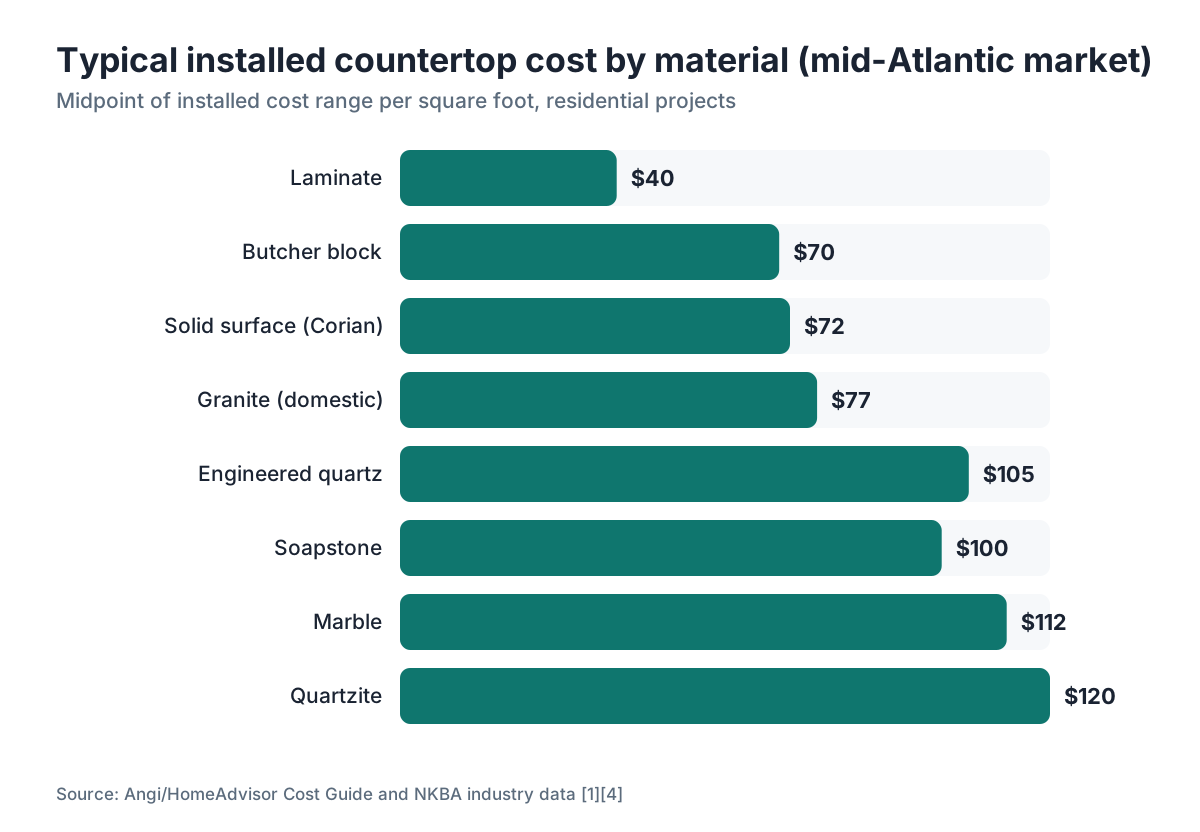
Stone fabrication in the mid-Atlantic runs from roughly $55 per square foot installed on the low end for simple granite up to $250 or more per square foot for exotic imported stone with heavy custom work. [1]
That range is wide because it holds three separate cost buckets: the stone, the fabrication labor, and the installation. A basic domestic granite slab might cost $18 to $30 per square foot as raw stone. Fabrication and installation add another $40 to $80 per square foot in most regional markets. Add edge profiles, sink cutouts, and sealer, and you're tacking on $200 to $600 in line items before any special requests. [4]
Barra & Trumbore, like most established regional fabricators, doesn't publish a price list. Quotes are job-specific. That's not evasive. It's how stone fabrication works: cost depends on the slab you choose, the square footage, the edge profile, the number of cutouts, and how far the crew has to drive.
| Material | Typical installed range ($/sq ft) | Typical sealing frequency |
|---|---|---|
| Granite (domestic) | $55 - $100 | Every 1-3 years |
| Granite (imported/exotic) | $90 - $160+ | Every 1-3 years |
| Marble | $75 - $150 | Every 6-12 months |
| Quartzite | $80 - $160 | Every 1-2 years |
| Engineered quartz | $70 - $140 | None required |
| Soapstone | $70 - $130 | None (oil instead) |
| Limestone/travertine | $60 - $120 | Annually |
These ranges reflect the broader mid-Atlantic and Northeast market from published homeowner data and industry cost surveys, not one shop's price list. [1][4] Your actual number depends on scope.
Want to get ahead of it? The fastest way to understand your project cost before calling any shop is to run your own square footage estimate. SlabWise's free instant quote tool lets homeowners input dimensions and material type and get a realistic cost range before walking into a showroom, which puts you in a much stronger spot for the conversation.
How do you evaluate any stone fabricator, more than this one?
The hard part of hiring a stone fabricator is that the quality isn't visible until the work is sitting in your kitchen, and by then fighting for a redo is slow and expensive. Here's what to actually look at before you sign.
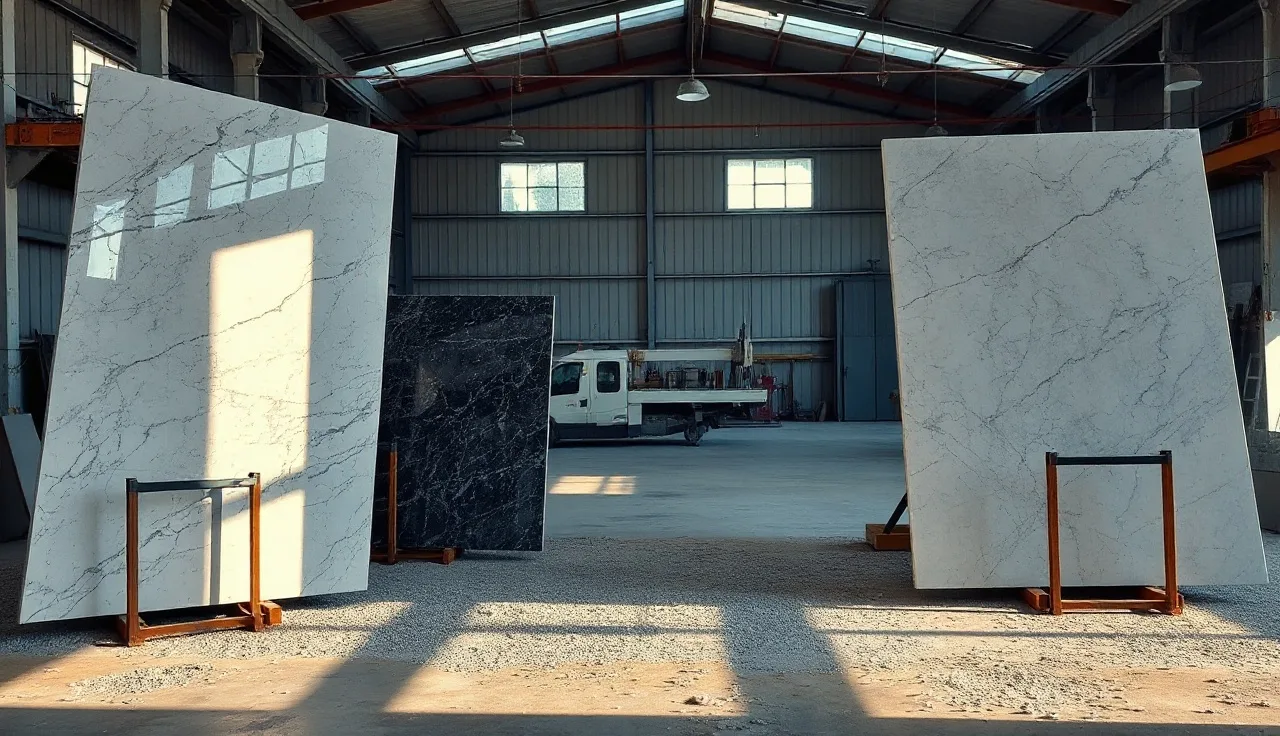
Shop tour. Any fabricator worth hiring will let you walk their shop floor. You want to see how tidy it is, how stone is stored (upright in A-frames is correct; flat stacking damages stone), and whether they run CNC equipment or rely entirely on hand tools. Hand tools aren't bad, but you should know what you're getting.
Templating method. Digital laser templating cuts error, especially on complex layouts with multiple cutouts. Ask what they use. If they still use cardboard, that's fine for simple jobs, but probe the process.
Seam samples. Ask to see seam work on a piece of scrap stone that matches your material. Seams in polished granite or marble should be nearly invisible from standing height. If the sample looks rough, walk out.
References on similar material. A shop that's excellent at granite may be mediocre at soapstone. Ask for references from jobs that used your exact material type.
Warranty language. What do they warrant? For how long? Is it a warranty on the stone itself (not their call) or on the fabrication and installation? Get it in writing and read it.
Timeline. Fabrication plus installation usually runs two to four weeks after templating for most residential jobs in normal conditions. Busy seasons (spring kitchen remodels) push that out. A shop quoting six weeks isn't a red flag. Sometimes it means they're the good shop everyone wants.
Insurance. They should carry general liability and workers' comp. Ask for a certificate of insurance. A stone slab falling during installation can do serious structural and bodily harm. This is not a paperwork formality.
What questions should you ask Barra & Trumbore (or any fabricator) before signing?
Here's a list that separates shops that know what they're doing from shops that don't. Use these.
-
Who physically does the templating, and do you use digital or manual templates? The answer tells you how much they've invested in precision.
-
Who does the installation? Some shops sub out installation to independent crews. Not automatically a problem, but you want to know who's accountable when something goes wrong.
-
Can I come to the shop to watch layout on my slab? Good fabricators say yes. Layout decides where your veining lands and where seams go. You should see it before cutting starts.
-
How do you match seam epoxy? The answer should involve color-testing against your specific slab, not a generic beige.
-
What edge profiles do you have CNC programs for, and what needs hand work? Some profiles look identical in a showroom sample but take three times as long when hand-routed at scale.
-
What sealer do you apply, and what's the re-seal interval for my material? They should name a specific product and a maintenance schedule.
-
Do you give a written quote that breaks out stone cost, fabrication, and installation separately? This protects you if scope changes and makes comparison shopping honest.
-
What happens if the slab cracks during fabrication? Natural stone breaks. It happens even in good shops. You want the policy before it happens to your $4,000 piece of Calacatta marble.
What are common complaints about stone fabricators, and how do you avoid them?
Consumer complaint patterns from the Better Business Bureau and Angi review data give a clear picture of where these jobs go wrong. [5][6]
Bad seams top the list. Seams that are wide, poorly colored, or sitting at mismatched heights are visible every single day. They're also brutal to fix after installation, because reworking a seam means pulling the stone. Prevention: inspect a seam sample before you commit, and write seam location into your contract so you approve the layout before cutting.
Delayed installations run close behind, especially with smaller shops on lean crews. A three-week job becomes six weeks because someone got sick or a slab arrived cracked from the distributor. Prevention: get the timeline in writing and ask what happens if they miss it.
Slab damage during fabrication is rarer but brutal when it hits. The shop should carry its own insurance to cover material replacement. Get the certificate of insurance, then confirm it's current by calling the insurer.
Edge profile miscommunication happens when homeowners pick from a 6-inch sample card without picturing 10 feet of continuous run. An ogee edge that looks elegant on a card can read as ornate and busy on a 12-foot island. Ask to see installed photos of the profile you're considering.
Sealing disputes come up when customers expect sealed stone to repel everything, then learn that sealers are not waterproofing. They just slow penetration. Sealed granite still stains if red wine sits an hour. For keeping natural stone clean in real use, see how to clean stone countertops. [7]
How does stone fabrication compare to other countertop materials?
Stone fabrication is more labor-intensive and more expensive than most alternatives, so it's worth knowing what you're paying for versus what you could have spent elsewhere.
Laminate countertops (including Formica countertops) run $20 to $60 per square foot installed, need no sealing, and can be cut and installed by a skilled carpenter without a stone shop. They've gotten dramatically better looking over the past decade. Renovating a rental or a secondary kitchen? Laminate is the honest choice.
Butcher block countertops cost $40 to $100 per square foot installed. They're warm, repairable by sanding, and genuinely beautiful in the right kitchen. They need regular oiling and can't take standing water at seams. Bad pick for a natural-wood sink surround.
Corian countertops and similar solid surface materials run $45 to $100 per square foot installed. Seams are nearly invisible, they repair well, and they don't need sealing. What they lack is the visual drama of a natural stone slab.
Natural stone from a shop like Barra & Trumbore costs more than all of these. What you're buying is durability (granite and quartzite last the life of the building), visual uniqueness (no two slabs match), and heat resistance no engineered material fully matches. Whether that premium is worth it depends on the kitchen, the budget, and how long you're staying in the house.
For the full picture across kitchen countertops and every material type, that's the right place to start if you haven't settled on stone yet.
What should fabricators know about quoting and shop efficiency?
This section is for shop owners and fabricators, not homeowners.
The biggest margin leak in most stone shops isn't stone waste. It's quoting time and unbilled scope creep. A job quoted in 45 minutes that takes four callbacks before the contract is signed has already eaten into profit before a single blade touches stone.
Digital quoting software has gotten good enough that no shop of any size has an excuse for running countertop quotes on Excel or paper. Generating a quote from a floor plan, attaching a slab photo, and sending a professional PDF in one workflow is what customers under 50 expect when they're also getting quotes from two other shops. Shops using software like SlabWise report faster quoting cycles and fewer revision requests because the quote is visual and the customer sees exactly what they're getting. Want to see how it fits your operation? The demo is worth 20 minutes.
Nesting is the other operational area where software pays for itself fast. The gap between 78% and 85% slab utilization across a year of jobs is real money in material savings. Manual nesting on a paper sketch is fine for simple jobs, but complex multi-piece layouts with bookmatch requirements and remnant tracking are genuinely hard to optimize by eye.
For smaller shops, the hidden cost is templates that don't translate cleanly to the shop floor. Digital templating ties directly into CNC programs and kills the transcription error that shows up when a field measurement gets written down wrong on a paper form.
Is Barra & Trumbore the right fabricator for your project?
That depends on where you live, what material you want, and what kind of relationship you want with your fabricator.
If you're in the Delaware Valley (South Jersey, Philadelphia suburbs, parts of Delaware), they're a credible option with long local tenure. That matters, because a shop in the same market for decades has real reputation at stake. You can actually find former customers, local contractors who've worked with them, and kitchen designers who'll give you an honest read.
If you're outside that region, use this article as a template for sizing up your local fabricator. The questions are the same everywhere. The process is the same everywhere. The material behavior is the same everywhere. What changes is which specific shop has done the most work with the specific stone you want.
The one thing I'd tell any homeowner before hiring any stone fabricator: go see the shop before you sign. Not the showroom. The shop. The showroom is built to sell you. The shop shows you how they actually work.
Still researching materials before you've picked a fabricator? Granite countertops and marble countertops are the two most common starting points for people new to natural stone. How to clean quartzite countertops is worth a read if quartzite is on your shortlist, because the maintenance reality surprises a lot of buyers.
Frequently asked questions
Where is Barra & Trumbore located?
Barra & Trumbore is based in Thorofare, New Jersey, in the South Jersey and greater Philadelphia metro area. They serve residential and commercial clients across the Delaware Valley. If you're outside that area, they aren't set up to serve you, and you'll need to find a regional fabricator in your own market.
What materials does Barra & Trumbore work with?
The shop works with granite, marble, quartzite, limestone, soapstone, travertine, and engineered quartz. Their background is natural stone, with fabrication experience across many imported and domestic slabs. Ask specifically about any exotic material you're considering to confirm they have direct experience with it.
How long does stone fabrication and installation take?
Most residential stone countertop jobs take two to four weeks from templating to installed stone, assuming the slab is in stock at the distributor. Complex jobs, large projects, or special-order slabs can take six weeks or longer. Busy seasons, especially spring kitchen remodels, push timelines out. Get the expected timeline in your written contract.
How much does a stone countertop cost in the South Jersey or Philadelphia area?
Installed natural stone countertops in the mid-Atlantic run roughly $55 to $160 or more per square foot depending on material, slab origin, edge profile, and number of cutouts. Simpler granite costs less; exotic quartzite or bookmatched marble with custom edges costs substantially more. Get a line-item quote that breaks out stone, fabrication, and installation separately.
Does Barra & Trumbore do commercial work?
Yes. Like most established regional stone fabricators, they work with commercial clients including contractors, developers, and commercial kitchen and bathroom projects, alongside residential homeowners. Commercial projects usually involve larger volume, tighter timelines, and more coordination with general contractors.
What is the difference between quartzite and quartz countertops?
Quartzite is a natural metamorphic rock formed from sandstone under heat and pressure. It needs sealing and behaves like granite in fabrication. Engineered quartz is a manufactured product made from ground quartz bound with polyester resin. It needs no sealing but can discolor under prolonged UV exposure. They look similar in some cases but are completely different materials with different care requirements.
What edge profiles are available for stone countertops?
Common profiles include eased (a simple slightly rounded edge), beveled, bullnose, ogee, dupont, and waterfall. Profiles are cut by CNC router for consistency or by hand for custom work. Simpler profiles cost less. More complex profiles like ogee or stacked details add $15 to $30 per linear foot in most markets. Ask to see installed photos of your chosen profile, more than a 6-inch sample.
How often does natural stone need to be sealed?
Granite and quartzite typically need sealing every one to three years depending on usage and the stone's porosity. Marble is more porous and may benefit from sealing every six to twelve months. Soapstone needs no chemical sealer but takes mineral oil to darken and protect the surface. Engineered quartz needs no sealing. Your fabricator should tell you the re-seal interval for your specific slab.
Can I visit the fabrication shop before my job is cut?
You should ask to. Reputable stone fabricators will let you come in during the layout stage, before cutting starts, so you can approve slab placement, seam locations, and veining orientation. This matters most for bookmatched slabs or distinctive veining where the exact position drives the look. If a fabricator refuses, that's a red flag.
What warranty does a stone fabricator typically provide?
Most fabricators warrant their labor, meaning the installation, seam work, and cutouts, for one year. They do not warrant the stone itself against natural variation, cracking under abuse, or staining. Some engineered quartz brands provide a separate manufacturer warranty (Cambria offers a lifetime warranty) that requires a certified fabricator to be valid. Always get the warranty in writing and clarify exactly what it covers.
What happens if my slab cracks during fabrication?
Natural stone cracks during fabrication more often than shops advertise. A reputable shop carries insurance to cover material replacement and will source a replacement slab or equivalent. Ask about this policy before signing. You should also ask whether they do a dry run (dry-fitting the cut pieces on your cabinets before final adhesion) so problems surface before the stone is permanently set.
Is it better to go directly to a fabricator or through a kitchen designer?
Going directly to a fabricator cuts out one layer of markup and gives you more control over slab selection and layout. A kitchen designer can be worth it if you're doing a full renovation and need someone coordinating cabinets, fixtures, and stone together. For countertop-only projects, going direct to a regional fabricator like Barra & Trumbore is usually faster and cheaper.
What should I bring to my first meeting with a stone fabricator?
Bring rough measurements of your countertop area (length times depth for each run), photos of your cabinets and backsplash if installed, your sink model or cutout spec sheet, and any photos of stone styles you like. If you have a floor plan or cabinet drawing, bring that too. The more context you give, the faster the shop can produce an accurate quote.
Sources
- HomeAdvisor (Angi), Granite Countertops Cost Guide: Installed granite countertop costs range from roughly $40 to $160 per square foot depending on material grade and region, based on aggregated homeowner project data.
- USGS, Minerals Information: Natural Stone: Quartzite is a metamorphic rock formed from sandstone, composed primarily of quartz grains, and is distinct from manufactured engineered quartz products.
- Cambria, Fabricator Certification Program: Cambria's lifetime warranty is contingent on fabrication and installation by a Cambria-certified fabricator.
- National Kitchen and Bath Association (NKBA), Cost vs. Value and Industry Pricing Data: Fabrication and installation labor for stone countertops typically adds $40 to $80 per square foot to raw slab cost in the U.S. market.
- Better Business Bureau, Home Improvement Contractor Complaint Categories: Seam quality, delayed installation, and scope creep are among the most frequently cited complaints in stone countertop installation reviews and BBB reports.
- Angi, Stone Countertop Installer Reviews and Consumer Reports Data: Homeowner reviews on Angi consistently cite seam visibility and installation delays as the top two dissatisfiers in stone countertop projects.
- Marble Institute of America (MIA+BSI), Care and Maintenance of Natural Stone: Stone sealers slow liquid penetration but do not make stone stain-proof; spills must still be wiped promptly to prevent staining of porous natural stone surfaces.
- Remodeling Magazine, Cost vs. Value Report (most recent year available): Major kitchen remodels including stone countertop upgrades recoup roughly 54 to 72 percent of cost at resale depending on region and project scope.
- OSHA, General Industry Standards for Stone Processing Operations: Stone fabrication operations involving silica dust from cutting granite and engineered quartz are regulated under OSHA's silica standard (29 CFR 1910.1053), requiring exposure controls and medical surveillance.
- U.S. Geological Survey (USGS), Dimension Stone Statistics and Information: The U.S. consumed roughly 1.4 million metric tons of dimension stone in recent years, with granite, limestone, and marble accounting for the majority of countertop applications.
Last updated 2026-07-09