TL;DR
- A custom stone fabricator buys raw slabs, templates your space, cuts and edges the stone on a bridge saw or CNC, and installs the finished countertops.
- A typical kitchen runs $1,500 to $8,000 installed depending on material and complexity.
- The process takes 1 to 3 weeks from template to install.
- Picking the right shop matters more than picking the right stone.
What does a custom stone fabricator actually do?
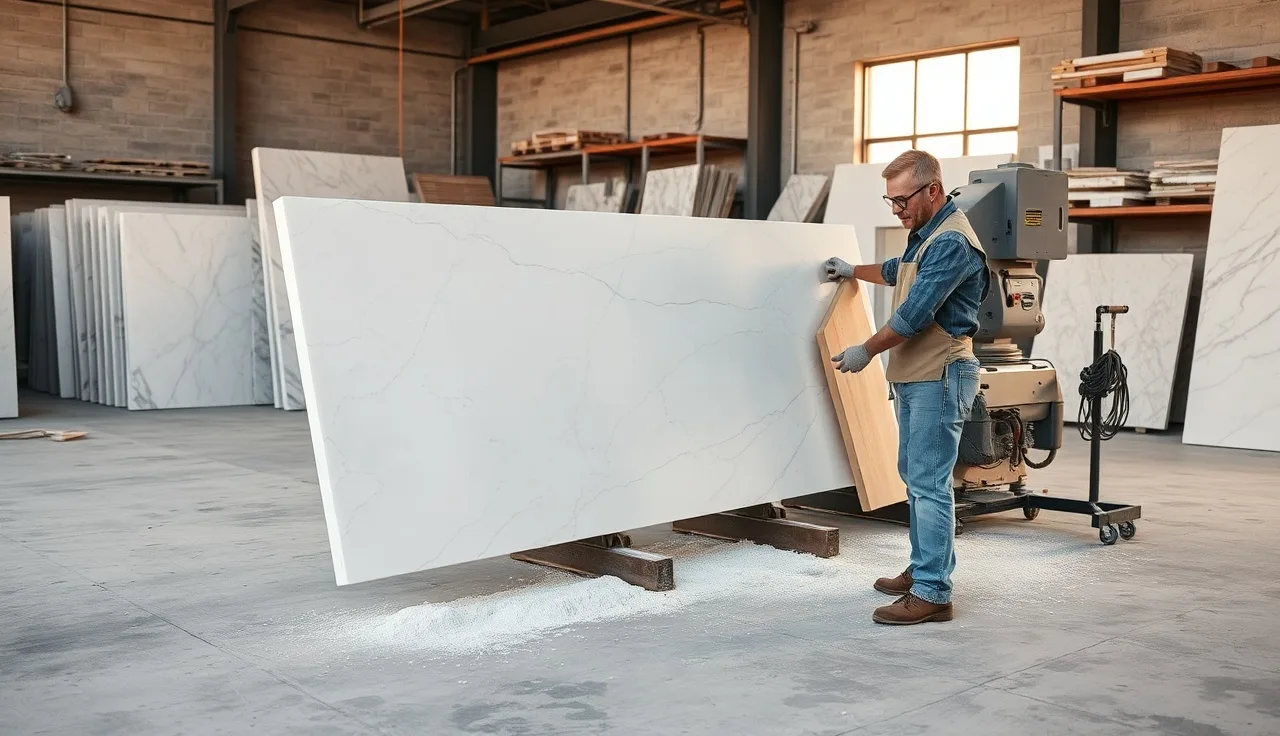
A custom stone fabricator takes a raw slab from a warehouse and turns it into a finished, installed countertop. That's the short version. They are not the same as a stone supplier or a big-box retailer. Suppliers sell slabs. Fabricators cut them, shape them, polish the edges, drill the sink cutouts, and set everything in your kitchen.
The full scope usually runs like this: measure your existing counters or new cabinet boxes, produce a physical or digital template of the space, program the cuts on a CNC machine or bridge saw, polish the edges to whatever profile you pick, dry-fit in the shop when the job warrants it, haul the stone to your house, and install with silicone and mechanical fasteners. Some shops set the sink and disconnect plumbing. Most won't touch the plumbing itself.
Fabrication is a skilled trade, and the skill is easy to underrate until you watch it. The person running a bridge saw reads a kitchen's real geometry, manages a brittle material that can crack mid-cut, and decides where a slab's veining lands. One bad seam or a miscalculated overhang can send a $3,000 piece of stone to the dumpster. That risk is baked into what you pay.
Most shops work in granite, quartzite, marble, and engineered quartz. Some specialize in one material. A shop that cuts a lot of marble countertops has different tooling and instincts than one focused on granite countertops. Worth asking before you hand anyone a deposit.
How much does custom stone fabrication cost?
It varies a lot, and anyone quoting you one number is either giving you a starting point or making it up. Here's what actually drives the price.
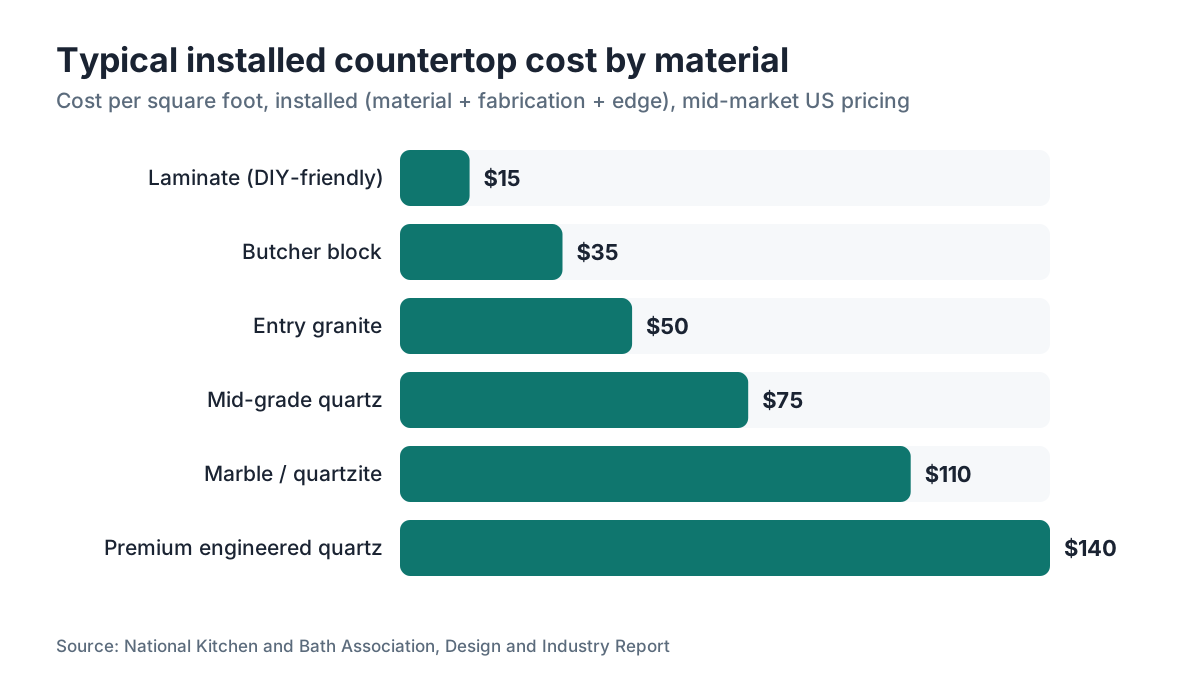
Material is the biggest variable. Engineered quartz (Silestone, Cambria, MSI) runs $50 to $120 per square foot installed, with premium lines going higher. Cambria countertops sit at the top of that band. Granite runs $45 to $100 per square foot installed for mid-grade slabs. Quartzite and marble for kitchen use tend to run $65 to $150 and up, because the raw stone costs more at the yard and it's often harder to cut clean.
Fabrication labor adds roughly $20 to $50 per square foot on top of material, though most shops fold this into one installed number rather than breaking it out. Edge profiles cost extra. A basic eased edge is usually included. A waterfall or ogee can add $10 to $20 per linear foot or more.
A typical kitchen with 40 square feet of surface lands between $1,800 and $5,000 for granite or quartz, and $2,500 to $8,000 for premium natural stone. Bathrooms are smaller but carry a higher cost per square foot, because setup costs the shop the same whether the job is big or small. Many shops set a minimum project fee of $600 to $1,200.
These ranges line up with pricing data the National Kitchen and Bath Association tracks and with home improvement spending in the Bureau of Labor Statistics Consumer Expenditure Survey. [1][2] Quotes in expensive markets like the San Francisco Bay Area or New York City run 20 to 40 percent above these numbers.
What is the fabrication process from start to finish?
Knowing the steps tells you where the delays hide and what you're paying for at each stage.
Step 1: Template. A fabricator comes to your home and either hand-templates with strips of Lauan or cardboard, or uses a digital measuring device (a laser system from a brand like Proliner or Laser Products). Digital templates are faster and more accurate and have become standard for shops doing volume. The template captures exact dimensions, sink cutouts, cooktop locations, and every out-of-square wall your builder left you.
Step 2: Slab selection. You pick your slab at a stone yard or distributor. Some fabricators keep their own inventory. Others order for each job from local wholesalers. For natural stone, see and approve the exact slab that gets cut, not a sample. Two slabs of the same material can look like different rocks.
Step 3: Programming and cutting. The template data loads into CAD/CAM software. The shop's programmer lays out the pieces on a digital slab, working to cut waste and to put seams where you agreed they go. A bridge saw or CNC waterjet makes the cuts. A good shop watches yield closely, because wasted stone is money lost.
Step 4: Edge profiling and polishing. A CNC router or handheld tooling grinds and polishes the exposed edges to your profile. Common ones are eased (a softened square), beveled, bullnose, and ogee. Each takes a different amount of machine time.
Step 5: Installation. The pieces travel on padded A-frames. The crew sets them on the cabinets with silicone and shims, aligns the seams, and secures everything. A standard kitchen install takes two to five hours. You can use the counters lightly that day. Silicone cures fully in about 24 hours.
Total elapsed time from template to install usually runs 5 to 15 business days. A backordered slab or a slammed shop can push that to 3 or 4 weeks. Ask for a specific install date before you sign, not a vague range of weeks.
How do fabricators price a job and generate quotes?
Quoting is one of the messier back-office problems in this trade, and it's where money quietly leaks out or gets given away.
A proper quote starts with the square footage, but that number isn't as simple as it sounds. Some fabricators measure the full slab area needed including waste. Others measure net countertop surface and apply a waste factor on the back end. The two methods can produce different prices for the same job if nobody states the waste factor. Ask which one your quote uses.
Edge linear footage, cutout count, seam count, and special work (waterfall edges, book-matching, mitered thick edges) all push the price up. A single sink cutout on a straight run is a different animal from an island with an undermount sink, a cooktop, and a mitered waterfall on two sides.
Plenty of small shops still quote in a spreadsheet or by feel, which leads to inconsistent numbers and missed line items. Shops running purpose-built quoting and nesting software (like SlabWise) can calculate slab yield, apply edge pricing automatically, and send a clean PDF quote in a fraction of the time. As a homeowner, what you want regardless of the software is a clearly itemized written quote.
Get at least three quotes on any job over $3,000. Compare them line by line, more than on the total. A lower total can hide a lower-grade slab, a thinner slab (2cm vs 3cm), fewer edge inches, or a shop planning a single piece where a competitor would add a seam.
What certifications and training do stone fabricators have?
There's no single mandatory license for countertop fabrication at the federal level in the United States. Most states don't require a specialty license for it either, though some require a general contractor or home improvement contractor registration to collect money for residential work. [3]
The main voluntary certification comes from the Marble Institute of America, now operating as the Natural Stone Institute after merging with the Building Stone Institute. Its Accredited Natural Stone Fabricator program evaluates a shop's equipment, processes, and quality standards. [4] Accreditation means something, but it isn't universal. Plenty of excellent shops skip it, and the badge alone doesn't guarantee a good install.
There are also manufacturer certification programs. Cosentino, Cambria, and others certify installers for their warranty terms. If you're buying an engineered quartz product with a manufacturer warranty, ask whether the fabricator is a certified installer for that brand. Cambria states in its warranty that installation by a non-certified fabricator can affect coverage. [5]
One thing no certificate captures is dust control. Dry-cutting engineered stone throws off crystalline silica, and OSHA's silica standard (29 CFR 1926.1153) sets a permissible exposure limit of 50 micrograms per cubic meter of air over an 8-hour shift. [6] NIOSH has documented silicosis cases among engineered-stone fabrication workers. [7] A shop that wet-cuts and runs proper ventilation is protecting its people, and that tells you something about how it's run.
For homeowners, the most reliable quality signals are plain: how long the shop has been in business, whether it has verifiable Google or Houzz reviews (look for at least 30), whether it will give references from projects finished in the last six months, and whether you can walk the shop floor. A real fabrication shop has a bridge saw, a CNC machine or edge polisher, and staff who know the equipment. A broker who subcontracts all the cutting is a different animal.
How do I choose a stone fabricator?
This is the most consequential decision in your countertop project, more than the stone itself. Here's what actually matters.
Visit the shop. Serious fabricators have one. The floor should be organized. Stone dust is normal; chaos is not. Ask to see a job in progress. A shop that lets you look around is confident in its work.
Understand the templating method. Digital templating (Proliner, Laser Products, or similar) beats hand templating on complex jobs. Hand templating is fine for simple straight runs. Either way, the fabricator should do the template, not a sales rep with a tape measure.
Ask about seam placement. Seams are unavoidable on most counters wider than 26 inches, because slab widths top out around 65 to 70 inches. A good fabricator tells you exactly where seams fall before cutting. Ask for a scaled drawing or a digital layout.
Ask about slab yield. Some shops book-match slabs for visual continuity. Some optimize for minimal waste. Those goals fight each other, and knowing which one a shop favors tells you how it operates.
Check the warranty and service policy. What happens if a seam opens six months after install? What if a chip appears during the install itself? Get it in writing. A one-year labor warranty is a fair baseline.
Price belongs at the end of your checklist, not the front. A $500 gap on a $4,000 job isn't worth going with a shop you doubt. Stone counters are permanent in the practical sense. You don't easily undo a bad install.
What stone materials can fabricators work with?
Most full-service shops cut granite, marble, quartzite, engineered quartz, soapstone, and sometimes travertine or limestone. Some also fabricate porcelain slabs, which need different tooling and keep gaining fans for their heat and scratch resistance.
Granite is the most commonly fabricated natural stone in the US. It's hard, forgiving to cut, and the material cost is predictable. Granite countertops are still a big share of what most shops produce.
Marble is soft and etches when it meets acid, which shapes both the fabrication and the long-term care. Shops that work a lot of marble use different polishing sequences and charge for the trouble. If you want marble in a kitchen, your countertop installation will come with a longer conversation about sealing and daily habits.
Quartzite (not engineered quartz, despite the name) is a natural metamorphic stone with dramatic white and gray patterns. It's very hard and chips if handled wrong. Make sure your fabricator has real quartzite experience. Some shops have cut a lot of it. Some haven't cut any.
Engineered quartz (Silestone, Caesarstone, Cambria, and others) is consistent in density and flatness, which makes fabrication predictable. Fabricators often prefer it because the slab holds fewer surprises. Porcelain is the newest common material. It's brittle in its own way and needs specialized blades and careful handling.
Not every shop does every material. Want soapstone, the soft matte stone that builds a patina over time? Ask specifically, because many shops have never cut it. Same for reclaimed or unusual stone. And some surfaces, like butcher block countertops or laminate countertops, come from entirely different trades, not stone fabricators.
How do I care for stone countertops after installation?
Care depends on the material, but a few rules hold across most natural stone: keep acidic liquids (lemon juice, vinegar, tomato sauce) from sitting on the surface, use trivets under hot pans instead of setting them straight on the stone, and clean with a pH-neutral soap or a stone-specific cleaner.
Sealing is the maintenance task that matters most for porous natural stone. Granite and quartzite do well with an annual sealer. Marble needs it more often, sometimes every three to six months depending on how hard you use the kitchen. Engineered quartz is non-porous and needs no sealing at all.
The Natural Stone Institute publishes care recommendations that fabricators often hand out at install. [4] For material-specific guidance, see how to clean stone countertops, how to clean quartzite countertops, and how to clean soapstone countertops.
Here's one thing your fabricator should tell you and many won't: the exact sealer used on your counter at install. Write it down. Matching that product for future reapplication gives you steadier results than grabbing whatever's on sale at the hardware store.
Edges chip more often than flat tops. A chipped bullnose or ogee is usually fixable by a fabricator with a hand polisher, but it costs money. Undermount sinks are the other common failure point. If the silicone bead between the stone and the sink rim breaks down, water sneaks under the stone and rots the cabinet below. Check that bead once a year and reseal it if you spot a gap.
What is the difference between a fabricator and a stone supplier?
This one trips up a lot of homeowners. A stone supplier (also called a slab yard or distributor) sells stone by the slab. It's the warehouse between the quarry and the fabricator. You can usually walk the showroom, see full slabs backlit, and pick the exact piece for your job.
A fabricator buys slabs from suppliers, adds an inventory markup, and does the cutting and installation. Some fabricators keep their own slab inventory. Many don't and order per job.
A countertop retailer or home center (Home Depot or Lowe's countertop programs) usually acts as a middleman that hires a local fabricator as a subcontractor. You pay the retailer, the retailer pays the fab shop, the fab shop does the work. That markup is real, and you also lose direct accountability, because the person you call when something goes wrong is not the person who cut the stone.
The setup I'd steer most people toward is working straight with a fabricator who has solid slab-yard relationships and lets you visit the yard to pick your own stone. You get direct accountability, better pricing, and a person who owns the outcome. The tradeoff is more homework upfront to find a shop worth trusting.
How are stone fabricators different from big-box countertop programs?
Home Depot and Lowe's both run installed countertop programs, mostly engineered quartz and occasionally granite. The process is streamlined. You pick a material and color from a limited display, a subcontracted installer comes to measure, and a few weeks later a crew shows up to install. Pricing usually lands as an all-in per-square-foot number.
For standard layouts in popular materials, big-box programs work fine and price competitively. The trouble shows up on complex jobs. The installers are subcontractors who may not carry the same equipment or experience as a dedicated shop. Your ability to shape seam placement, negotiate a custom edge, or reach someone by phone when something goes sideways is limited.
Independent fabricators are often competitive on mid-grade materials and beat the big-box programs on custom work, unusual stone, and finish quality. A shop running a Donatoni or Park Industries CNC produces a different edge than one using older, lighter equipment, and you can see the difference in the light.
The real question is how complex your project is and how much the details matter to you. Simple galley kitchen with a stock quartz color? Big-box might be all you need. Large island with dramatic natural stone, specific veining, and a waterfall edge? Get a real fabrication shop and a direct line to the people cutting your stone.
What questions should I ask before hiring a stone fabricator?
This list covers the things that actually matter and that most homeowners don't think to ask until something has already gone wrong.
-
Can I visit your shop and see work in progress? A serious fabricator says yes.
-
Do you do your own templating, or subcontract it? In-house templating means accountability.
-
What templating technology do you use? Digital or hand template?
-
Where will my seams be, and can I see the layout before cutting? This is non-negotiable.
-
What slab are you using for my job, and can I approve it before you cut? For natural stone, absolutely required.
-
What edge profiles are included in the price, and what costs extra?
-
How long have you been in business, and can you give two or three references from the past six months?
-
What's your labor warranty? What happens if a seam opens or a chip appears during install?
-
Are you certified for the specific engineered quartz brand I'm buying? (Relevant for Cambria, Silestone, and other branded products.)
-
What's the timeline from template to install, and can you give me a specific date?
If a fabricator balks at any of these or gets defensive, that's information. Good shops answer them every day without blinking.
How do fabricators handle seams and why do they matter?
Seams are one of the most visible quality tells in a finished countertop. A well-made seam in granite or quartz should be tight (under 1/16 inch), color-matched with pigmented epoxy, and placed where it's least visible and least stressed by daily use.
Guidance from the Natural Stone Institute has historically allowed seams up to 1/8 inch wide, though most quality shops aim tighter. [10] Location matters as much as width. Seams directly under a cooktop or crossing a sink cutout are stress points, and a good fabricator dodges those spots when the slab layout allows.
For engineered quartz, seams are often less obvious because the pattern repeats consistently. For dramatic natural stone with heavy veining (Calacatta marble, bold white quartzite), seams show more, and book-matching the veining across the seam marks a skilled shop.
The seam-filling step, mixing epoxy with pigment to match the stone as closely as possible, separates a clean finish from a mediocre one. Ask to see photos of seam work in the fabricator's portfolio, specifically on material like what you're buying. A seam you can't find is the goal.
If you're weighing kitchen countertops options and wondering where the seams will land, your fabricator can hand you a preliminary layout before you commit. Ask for it.
Frequently asked questions
How long does it take a stone fabricator to complete a countertop project?
Most residential projects run 7 to 15 business days from the template appointment to install day. Busy season (spring and fall) can stretch that to 3 or 4 weeks. Material availability is the most common delay. If a specific slab has to move from another warehouse or quarry, add a week or more. Ask for a firm install date, more than an estimate.
Do I need to be home for the stone fabricator's template appointment?
Yes. The template appointment needs someone with decision-making authority present. The fabricator confirms seam placement, overhangs, sink and faucet hole locations, edge profiles, and any odd conditions in the space. Decisions made at the template drive the cut pieces. Getting these right during templating is far cheaper than fixing them after the stone is cut.
What is a reasonable price per square foot for custom stone fabrication?
Installed prices (material plus labor plus edge work) typically run $45 to $100 per square foot for granite and mid-grade quartz, $65 to $150 for marble and quartzite, and $80 to $200 for premium engineered quartz brands. These reflect mid-tier markets in the continental US. High cost-of-living metros run 20 to 40 percent higher. Anything below $40 installed should prompt hard questions about slab quality and shop experience.
Can a stone fabricator match veining across a seam?
Yes, it's called book-matching. The fabricator flips adjacent pieces from the same slab so the veining mirrors across the seam like an open book. It takes careful layout and more waste. Not every shop does it or offers it at the base price. If it matters to you, ask specifically and expect to pay a premium. Best results come from slabs with strong, readable veining like Calacatta or dramatic quartzite.
What is the difference between 2cm and 3cm stone thickness?
2 centimeter stone (about 3/4 inch) is thinner and cheaper. It usually needs a plywood substrate for support, especially on spans over 24 inches with no cabinet below. 3 centimeter stone (about 1.25 inches) is self-supporting for most countertop spans, looks more substantial, and is the current US standard for kitchens. Most fabricators quote 3cm by default. 2cm still shows up in bathrooms and some vertical work.
How do I know if a stone fabricator is reputable?
Look for a shop in business at least five years, with 30 or more Google or Houzz reviews averaging above 4.3 stars, that lets you walk the shop floor and hands over verifiable references from recent projects. Accreditation through the Natural Stone Institute is a good signal but not required. Any shop demanding full payment before templating is a red flag. A 50 percent deposit with the balance on install day is the normal structure.
Does a stone fabricator also remove old countertops?
Most fabricators offer demo and removal as an add-on, usually $150 to $400 for a standard kitchen depending on what's coming out. Some shops require you to remove the old counters yourself before they template. A few won't do demo at all. Settle this at the quoting stage, not the day before install. Cast-iron undermount sinks and tile backsplashes that run behind the countertop often complicate removal.
Can a stone fabricator repair a cracked or chipped countertop?
Yes, most offer repair. A chip on an edge can usually be filled with color-matched epoxy and polished smooth. A crack through the surface is more serious. It can be repaired with epoxy injection and grinding, but a faint line often remains. Chip repairs typically run $100 to $300. A crack in a high-stress area like a cooktop cutout can mean the piece needs replacement, not repair.
What edge profiles are available and what do they cost extra?
Common profiles from cheapest to priciest: eased (slightly rounded square), beveled, bullnose (fully rounded), dupont, ogee, and mitered. Most shops include an eased or basic bevel in the base price. Ogee and dupont profiles add $10 to $25 per linear foot. A mitered waterfall edge, where a full piece of stone turns vertical at the end of an island, can add $500 to $2,000 or more depending on complexity and material.
Do stone fabricators install undermount sinks?
Yes, sink cutouts and undermount sink drops are standard fabrication work. The fabricator cuts and polishes the cutout, sets the stone, and mounts the sink with silicone and mechanical clips. Plumbing connections are not included; you need a licensed plumber for that. Plan to disconnect your plumbing before install day and have a plumber lined up for the day after. Most fabricators will say so, but confirm it upfront.
Is engineered quartz or natural stone easier for a fabricator to work with?
Engineered quartz (Silestone, Caesarstone, Cambria) is dimensionally consistent and predictable to cut, which makes fabrication more straightforward. Natural stone varies in density and hides fissures, which demands more judgment. Neither is inherently better. They're different skill sets. What matters is that the fabricator has real experience with the specific material you chose, more than with stone in general.
Can stone fabricators work with unusual or salvaged stone?
Some can, not all. Reclaimed stone, slabs with natural fissures, or odd formats take experience and a willingness to accept some risk on the material. If you bring your own slab, most fabricators charge a fabrication-only fee instead of material-plus-fabrication. Clarify upfront whether they guarantee their work if the material has pre-existing fissures that spread during cutting. Liability for customer-supplied stone is a common point of disagreement.
What should I do to prepare my kitchen for countertop installation day?
Clear everything off the existing counters and out of the cabinets below. If the fabricator handles demo, confirm whether you need to disconnect the sink plumbing first (most require it). Move small appliances out of the work zone. Give the crew clear access and a parking spot for their vehicle and A-frames. Have a plan for kids and pets. The crew needs a few hours of unobstructed space.
How does the quoting process work at a stone fabrication shop?
A quote starts with your measurements or the fabricator's site visit. The shop calculates square footage, adds edge linear footage, counts cutouts, and applies pricing by material. Some shops quote in a spreadsheet; others use dedicated software that automates slab yield and edge pricing. You should get an itemized written quote before any work begins. If a quote is a single total with no line items, ask for the breakdown.
Sources
- National Kitchen and Bath Association, Design and Industry Report: Average countertop project costs for kitchen remodels in the NKBA's annual industry survey, used to benchmark fabrication pricing ranges.
- U.S. Bureau of Labor Statistics, Consumer Expenditure Survey: Home improvement spending categories including floor and surface installation used to contextualize countertop investment ranges.
- U.S. Small Business Administration, Apply for Licenses and Permits: No federal mandatory license exists specifically for countertop fabrication; state contractor registration varies by jurisdiction.
- Natural Stone Institute, Accredited Fabricator Program: Accredited Natural Stone Fabricator program criteria and Natural Stone Institute care recommendations for installers.
- Cambria, Product Warranty Documentation: Cambria warranty terms state that installation by a non-certified fabricator can affect warranty coverage.
- Occupational Safety and Health Administration (OSHA), Crystalline Silica Rule: OSHA's respirable crystalline silica standard (29 CFR 1926.1153) sets a permissible exposure limit of 50 micrograms per cubic meter of air over an 8-hour shift for construction and stone fabrication work.
- National Institute for Occupational Safety and Health (NIOSH), Silica and Stone Fabrication: NIOSH has documented silicosis cases and silica dust exposure risks among engineered stone fabrication workers.
- University of Florida IFAS Extension (EDIS), Consumer Guide to Stone Countertops: Extension service guidance on stone material properties, maintenance, and what to expect from professional installation.
- U.S. Environmental Protection Agency, Indoor Air Quality: EPA indoor air quality guidance relevant to silicone adhesives and epoxy sealants used during countertop installation.
- Natural Stone Institute, Dimensional Stone Design Manual: Industry standard seam width tolerances (historically up to 1/8 inch) and installation best practices for fabricated stone countertops.
Last updated 2026-07-09