TL;DR
- Bluffton, SC has roughly a dozen active stone fabrication shops serving the Lowcountry.
- Granite and quartz countertops run $55 to $120 per square foot installed here.
- Vetting a fabricator comes down to three things: seeing their actual slab inventory, checking their template-to-install timeline, and reading reviews that mention post-install service.
- Get three itemized quotes before you sign anything.
What do stone fabricators in Bluffton actually do?
A stone fabricator buys raw slabs, cuts them to the dimensions your kitchen or bath requires, edges and polishes them, and installs the finished pieces on your cabinets. They are not a store that sells pre-made countertops. They are a manufacturing operation that makes yours from scratch.
The work chain looks like this. A template technician comes to your home after your cabinets are set, measures every run of countertop with a digital laser or physical template, and passes those dimensions to the shop. The shop programs a CNC waterjet or bridge saw to make the cuts, then a fabricator hand-finishes the edges and seams. Installation usually follows one to two weeks after templating for most Bluffton shops.
Bluffton sits in Beaufort County, just inland from Hilton Head Island, and the local construction market is brisk. The area has seen steady residential growth, with Beaufort County permit activity running well above South Carolina's statewide average for new single-family homes. [1] That pace keeps local fabricators busy, which matters to you: lead times at a shop running near capacity can stretch to three or four weeks.
Most Bluffton fabricators work with granite countertops, quartz engineered stone, quartzite, marble, and occasionally soapstone or porcelain slabs. A few also offer marble countertops fabrication, though natural marble is less common in coastal homes because of humidity and sealing concerns.
How much do stone countertops cost from a Bluffton fabricator?
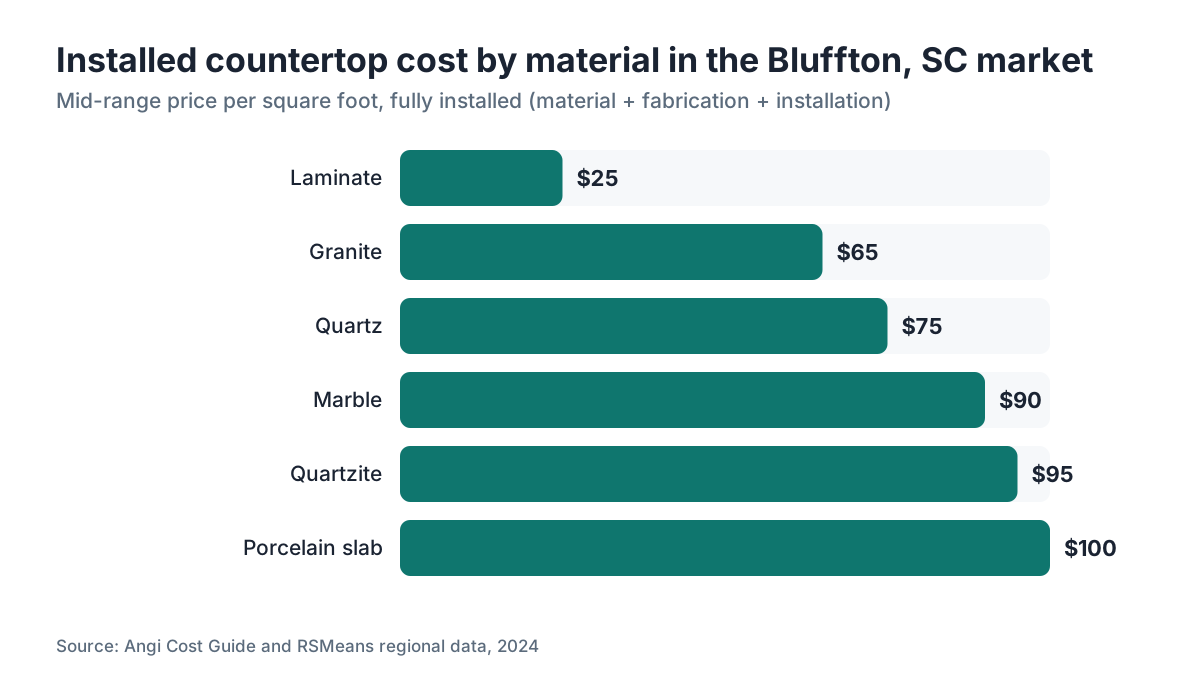
Pricing varies by material, edge profile, sink cutouts, and the shop's overhead. Here is a realistic price range based on typical market data for the Lowcountry. These are fully installed prices, meaning material, fabrication labor, and installation are all included. [2]
| Material | Low (per sq ft) | Mid (per sq ft) | High (per sq ft) |
|---|---|---|---|
| Laminate / post-form | $15 | $25 | $40 |
| Granite (builder-grade slab) | $45 | $65 | $85 |
| Quartz (engineered) | $55 | $75 | $110 |
| Quartzite (natural stone) | $70 | $95 | $145 |
| Marble (natural) | $65 | $90 | $160 |
| Porcelain slab | $70 | $100 | $150 |
A typical Bluffton kitchen has roughly 40 to 55 square feet of countertop surface. At mid-range quartz pricing, that works out to $3,000 to $4,125 for material and installation. Add a farmhouse sink cutout ($100 to $250), a decorative edge profile ($10 to $20 per linear foot above a standard eased edge), and a stone backsplash if you want one, and the total climbs fast.
Where do these numbers come from? The most consistent public benchmark is the Remodeling Cost vs. Value report, which tracks average project costs by region every year. The 2024 South Atlantic region data puts a mid-range minor kitchen remodel (which includes countertop replacement) at roughly $27,000 total project cost. [3] The countertop portion alone accounts for a meaningful share of that. Estimating databases like RSMeans publish more granular fabrication and installation labor costs by ZIP code, which most professional estimators use. [4]
One honest caveat. Bluffton-specific prices are hard to pin down because fabricators rarely publish their rates. The table above reflects Lowcountry market conditions and conversations within the industry, not a formal survey. Prices shift with slab import costs, fuel surcharges, and shop capacity.
If you want a fast ballpark before calling shops, kitchen countertops pricing guides help you build a rough budget.
What stone fabrication shops are in or near Bluffton, SC?
Bluffton's commercial corridor along US-278 and May River Road has several fabrication operations, and neighboring Hilton Head Island and Savannah, Georgia add more options within reasonable delivery range. Here is what you'll find.
Local Bluffton-area shops tend to be mid-size operations, anywhere from three to twelve employees, running one or two CNC saws. They serve both residential remodels and new construction builders. Because new construction volume in Okatie and Sun City Hilton Head is high, some shops prioritize builder accounts, which can mean longer waits for one-off homeowner jobs.
Savannah fabricators, roughly 25 miles away, widen your options a lot. Larger shops in the Savannah market carry bigger slab inventories and may turn around popular quartz lines faster because they stock them in higher volume. The trade-off is a longer drive for slab selection.
Hilton Head Island shops are geographically close but operationally different. Island logistics, including the bridge crossing and limited shop space, affect both pricing and scheduling.
Rather than name specific shops (business details change fast), the better move is to search Google Maps for "countertop fabricator Bluffton SC" and filter for businesses with more than 30 reviews. Shops with fewer than 10 reviews may be perfectly legitimate, but you have less signal to work with. Check the South Carolina Secretary of State's business search to confirm a shop is an active registered business before you put down a deposit. [5]
How do you vet a stone fabricator before signing a contract?
Most homeowners pick a fabricator on price alone, then discover the real differentiators after the install goes sideways. Here is the vetting process that actually works.
First, visit the shop in person. A real fabrication operation has a shop floor with a saw, a polishing setup, and slabs on the ground or in an A-frame rack. If a company operates entirely from a website with no physical location, they are a broker, not a fabricator. Brokers can be fine, but you're paying a middleman and losing control over who actually cuts your stone.
Second, look at finished seams on a display piece. Seams in stone should be tight, level, and color-matched as well as the material allows. A seam you can feel with your fingernail is a seam you'll notice every time you wipe the counter.
Third, ask specifically about their template method. Digital laser templating (sometimes called LT-55 or Proliner systems) is more accurate than hand templates for complex layouts like kitchen islands with multiple angles. Either method works in skilled hands, but digital templating cuts the chance of a mis-cut slab that has to be redone.
Fourth, ask who does the installation. Some fabricators use their own crews; others subcontract to independent installers. Either is fine, but you want the same entity responsible for fabrication and installation so accountability doesn't get diffused. countertop installation quality depends heavily on level cabinets and correct shimming, more than the quality of the stone.
Fifth, check the contract for a seam location clause. On a large kitchen, the fabricator has to seam two pieces together somewhere. You should have input on where that seam lands. If the contract doesn't address seam placement, ask for a templating diagram before signing.
Finally, ask about their warranty on fabrication defects. Most reputable shops cover fabrication errors (mis-cuts, damaged edges from their tools) but not damage from homeowner use. A written warranty, even a short one, tells you the shop stands behind its work.
How long does the full fabrication and installation process take in Bluffton?
The standard timeline from signed contract to installed countertop runs 10 to 21 days for most Bluffton-area fabricators under normal conditions. Here is how those days break down.
Days 1 to 3 are slab selection and deposit. You visit the shop or slab yard, pick your material, sign the contract, and put down a deposit (typically 50% of the total). Some shops let you view their slab inventory on-site; others work through a distributor's yard.
Days 3 to 7 are template scheduling. The fabricator schedules a template appointment at your home. Templating takes 30 minutes to two hours depending on kitchen complexity. This step cannot happen until your cabinets are installed and fully secured, no exceptions. Trying to template over temporary or unlevel cabinets is one of the most common sources of expensive remakes.
Days 7 to 14 are fabrication. The CNC saw cuts the stone, the fabricator finishes edges and polishes, and the pieces get staged for delivery. Rush fabrication is possible at some shops for an upcharge.
Days 14 to 21 are installation and sealing. Installation takes two to four hours for a typical kitchen. Most natural stones need a penetrating sealer applied within 24 to 48 hours of installation. Some quartz products are advertised as maintenance-free, but a sealer check on the grout lines around undermount sinks is still worth doing.
Delays happen. Material back-orders, busy shop schedules around holidays, and permit-related cabinet delays on new builds can push timelines past three weeks easily. If your project has a hard deadline (appliance delivery, a holiday gathering), build in at least a week of buffer and confirm the fabricator's current queue length before signing.
What materials do Bluffton fabricators carry and which is the best choice for the Lowcountry?
Coastal South Carolina's climate adds considerations that most countertop guides ignore. High humidity, salt air near the water, and heavy seasonal use from vacation traffic all matter.
Granite is the traditional choice here and still the most common material in resale homes. It handles humidity well and, when properly sealed, resists staining from food and drink. The main knock on granite is that sealers need renewal every one to three years depending on traffic, and some homeowners forget. [6] For a detailed look at what you're buying, the granite countertops guide covers porosity, sealing schedules, and finish options.
Quartz (engineered stone) dominates new construction in Bluffton right now. It's non-porous, needs no sealing, and comes in consistent color runs that help builders match finishes across dozens of homes. The downside is UV sensitivity. Prolonged direct sunlight can discolor some quartz products over time, which matters in sun-drenched Lowcountry kitchens with south-facing windows. Check the specific product's warranty for UV language before buying. [11]
Quartzite, a natural metamorphic stone (not to be confused with quartz engineered stone), is gaining ground in higher-end Bluffton homes. It's harder than granite and takes a beautiful polish. It's also more expensive and needs careful sealing because it can be more porous than its hardness suggests. how to clean quartzite countertops has the specifics on daily care.
Marble is gorgeous, and coastal homeowners buy it for bathrooms and bar areas despite the maintenance reality. Etching from acidic foods and drinks is a real ongoing issue, not a rare one. If you use your kitchen counter hard, marble is a difficult choice for the main cooking surface. It works beautifully in low-traffic spots.
Soapstone is rare in Bluffton shops but worth knowing about. It needs no sealing, handles heat well, and its patina deepens over time. A few specialty fabricators in the Savannah area carry it. how to clean soapstone countertops explains what ownership actually looks like.
Porcelain slab is the newest material in the market. Slabs run up to 126 inches long, with extremely low porosity and lighter weight than stone. The fabrication catch is that it's brittle and chips during cutting if the shop doesn't have experience with it. Ask specifically how many porcelain jobs the shop has done before committing.
For most Bluffton homeowners doing a primary kitchen, quartz or granite is the practical choice. Quartz if you want zero maintenance, granite if you want natural stone character and don't mind the occasional sealing.
What questions should you ask a Bluffton fabricator before getting a quote?
A good quote conversation takes fifteen minutes and tells you most of what you need to know about a shop's professionalism.
Ask: Do you fabricate in your own shop or do you outsource cutting? You want to know who actually touches your stone.
Ask: What CNC equipment do you run and how old is it? Older saws can still produce quality work, but worn tooling shows up in edge finish quality.
Ask: Can I see the slab I'm buying, more than a sample chip? For natural stone especially, the slab you're looking at is the slab you get. A chip tells you nothing about veining, movement, or color variation across the full 9-by-5-foot piece.
Ask: What is your current lead time from signed contract to installation? A shop that says "one week" when they're clearly slammed is telling you what you want to hear.
Ask: How do you handle a mis-cut or a slab that cracks during fabrication? The answer tells you about their process discipline and whether they carry replacement inventory.
Ask: Who removes my existing countertops and what does that cost? Countertop demo and disposal is sometimes included, sometimes billed separately at $150 to $400 for a typical kitchen.
Ask: Do you carry current liability insurance and are your installers covered by workers' compensation? Any legitimate shop answers yes immediately and can provide a certificate. Hesitation here is a serious flag. South Carolina requires most employers with four or more employees to carry workers' compensation. [7]
How does stone fabrication quoting actually work, and how do you avoid being overcharged?
Fabricators quote by the square foot, but what counts as a square foot varies by shop. Some shops use the "slab area" method, counting every square foot of raw slab allocated to your job including cutouts. Others use the "finished surface" method, counting only the countertop area you actually end up with. The difference on a job with multiple sink cutouts can be 10 to 15%.
Sink cutouts, faucet holes, cooktop cutouts, seams, and edge profiles are all line items in a real quote, not part of the base per-square-foot rate. Get an itemized quote, not a single lump sum, so you can compare shops apples to apples.
Template and installation fees show up as separate line items at some shops and bundled at others. Ask which method a shop uses so you're comparing correctly.
Stone fabrication has no single accrediting body, but the Natural Stone Institute publishes standards and fabrication guidelines that professional shops generally follow. [8] If a fabricator cites Natural Stone Institute training or certification, that's a real positive signal.
Shops running dedicated quoting and job management software, like SlabWise, can usually produce itemized quotes faster and with less math error than shops working from spreadsheets. For fabricators, that kind of systematic quoting also cuts the chance of underquoting a job and eating margin on the back end. If your fabricator hands you a detailed written quote with line items, that's a good operational signal regardless of what software they run.
For homeowners, the clearest protection is to get three quotes and ask each shop to explain any item you don't recognize. Lowball quotes almost always hide something: thinner material, a cheaper edge profile than you discussed, or planned use of a remnant slab rather than a full book-matched slab.
What are the most common problems with stone countertop installs and how do you avoid them?
The complaints that show up over and over in reviews and contractor forums fall into a predictable set.
Seam quality is the top complaint. A visible, uneven seam is almost always a fabrication problem, not a material problem. Seams in high-movement stones like Calacatta marble or some quartzites will never be invisible, but they should be level and tight. Fixing a seam almost always means the fabricator comes back, which is why their warranty and responsiveness matter before you hire them.
Overhang cracking is the second most common issue. Stone countertops more than 10 to 12 inches past a cabinet edge need support, usually corbels or steel brackets. Some fabricators put this recommendation in their scope; others leave it to the homeowner to figure out. The Natural Stone Institute's installation guidelines spell out support requirements by material and thickness. [8]
Lippage at seams, where one slab sits slightly higher than the piece next to it, becomes a daily irritant when you wipe the counter. It happens when one cabinet run is not level and the installer doesn't shim correctly.
Damage at undermount sink clips is another frequent issue. The clips that support undermount sinks from below put stress on the stone edge. If the cutout radius is too tight or the clips are over-torqued, edge chips or cracks develop over months. This is a fabrication and installation issue, not a homeowner one.
Wrong slab delivery happens more than shops like to admit. You select a specific slab, and a different slab with similar but not identical veining gets cut. The prevention is simple. Mark your chosen slab with a tag that has your name and date, and photograph it on your phone before you leave the yard.
How does Bluffton's growth affect fabricator capacity and pricing?
Beaufort County, which includes Bluffton and Hilton Head, is one of the faster-growing counties in South Carolina by population. The U.S. Census Bureau estimated Beaufort County's population at roughly 204,000 in 2023, up from around 186,000 in 2020. [9] That growth drives heavy residential construction volume.
For homeowners, the practical effect is that good fabricators are booked out. Shops serving both new construction builders and homeowner remodels prioritize builders during active construction phases because the volume is predictable. So if you want a specific top-rated shop, you may need to get on their schedule four to six weeks out, especially in spring and fall when remodel season peaks.
Pricing in growth markets tends to run modestly above comparable inland South Carolina markets. One rough benchmark: comparable granite installation in Columbia, SC (a larger but less growth-pressured market) runs about $10 to $15 per square foot less than Bluffton and Hilton Head area pricing, based on general contractor estimating data. The premium reflects tighter labor supply, higher real estate overhead for shop space, and the travel cost of island and waterfront deliveries.
The upside of a competitive market is that multiple shops want your business. Getting three quotes is completely normal, and no reputable fabricator will decline to quote because you're comparison shopping. The shops that push back on competing quotes, claiming their work is uniquely superior, are worth being skeptical of.
Are there alternatives to full stone fabrication that Bluffton homeowners should consider?
Stone is not the only reasonable answer for every kitchen or budget. A few alternatives worth knowing about.
Laminate countertops (and specifically Formica countertops) have gotten a lot better in the last decade. High-resolution print technology produces laminate surfaces that convincingly mimic stone at $15 to $40 per square foot installed. They don't hold up to heat as well and can delaminate at the sink edge if water gets in, but for rental properties, secondary kitchens, or tight budgets, they're a reasonable choice.
Corian countertops and other solid surface products are still in the market and have real advantages: continuous runs with no visible seams, easy scratch repair, and integral sink options. They're less common in new Bluffton construction than stone or quartz, but for a bathroom vanity or laundry room, worth pricing.
Butcher block countertops work in specific Bluffton applications, usually a kitchen island or a prep area, but humidity is a genuine concern. Wood countertops in humid coastal air need more maintenance than they do in drier climates. Consistent oiling matters more here than in Atlanta or Charlotte.
Cambria countertops are a branded quartz product with a strong warranty and U.S.-based manufacturing. Some Bluffton fabricators are authorized Cambria dealers; others are not. If you want Cambria specifically, confirm a shop is an authorized fabricator before committing, because Cambria's warranty requires authorized installation.
For most primary Bluffton kitchens in the $400,000-plus home price range that defines much of the local market, natural stone or quartz fabrication is the standard expectation. But alternatives are not a downgrade. They're a prioritization choice.
What should the contract with a Bluffton stone fabricator include?
A contract that protects you has specific items. Missing items are negotiable before signing, not after.
The contract should name the exact material by slab lot number or bundle number for natural stone, more than "Calacatta Gold marble" as a generic description. Generic material descriptions let a fabricator substitute a different slab.
It should state the edge profile by name, the thickness (2 cm or 3 cm is standard, with 3 cm more common for residential kitchens here), and the finish (polished, honed, leathered).
It should list all cutouts and their locations: undermount sink model number, cooktop model number, faucet hole count.
It should include a payment schedule. Most shops take 50% at signing and 50% at installation. Be cautious about any shop asking for more than 50% upfront.
It should state the estimated template date, fabrication timeline, and installation date, even as approximate ranges.
It should include a cancellation and refund policy. Once a slab is cut, it's cut for your job. Most shops will not refund material costs after cutting begins, which is fair, but that should be written down.
South Carolina does not have a specific contractor licensing category for stone fabricators (they are not classified as specialty contractors under the SC Contractor's Licensing Law the way HVAC or plumbing contractors are), so there's no license number to require. [10] What you can require is proof of general liability insurance, which any legitimate business carries.
For fabricators looking to tighten up their own quoting and contract workflow, software built for stone shops like SlabWise can cut the chance of missing line items or material specification errors that lead to contract disputes.
Frequently asked questions
How much does a stone countertop cost from a Bluffton, SC fabricator?
Expect $55 to $110 per square foot fully installed for quartz or granite in the Bluffton area, depending on the material tier and edge complexity. A 45-square-foot kitchen comes to roughly $2,500 to $5,000 for most homeowners. Quartzite and marble run higher, starting around $70 and going past $150 per square foot for premium material and profiles.
How long does countertop fabrication and installation take in Bluffton?
Most Bluffton shops run a 10- to 21-day cycle from signed contract to installed countertop. Templating happens after cabinets are set, fabrication follows within a week or so, and installation takes a half-day for most kitchens. Busy seasons, back-ordered materials, or a full shop schedule can push this to three to four weeks. Ask for a current lead time estimate before signing.
What is the difference between a stone fabricator and a stone supplier?
A stone supplier imports and sells slabs. A fabricator cuts, finishes, and installs them. Some operations do both under one roof; others are separate businesses. When you hire a fabricator, you're paying for the slab material plus the labor to turn it into a finished countertop. Buying a slab from a supplier and then hiring a separate fabricator is possible but adds coordination complexity.
Do I need a permit to replace countertops in Bluffton, SC?
No. Countertop replacement in Bluffton (Beaufort County) is cosmetic work and does not require a building permit. Permits are required for structural changes, electrical work at the countertop level (new circuits or receptacle additions), or plumbing modifications. A straight swap of old countertops for new ones on existing cabinets with the same sink and faucet configuration needs no permit.
What is the best countertop material for a coastal Lowcountry kitchen?
Quartz engineered stone is the most practical choice in coastal South Carolina's humid climate because it's non-porous and never needs sealing. Granite is the traditional choice and works well with consistent sealing. Avoid marble for high-use kitchen surfaces unless you're ready for etching and patina. Porcelain slab is an emerging option that handles humidity well but requires experienced fabricators.
Can Bluffton fabricators do Hilton Head Island installs?
Yes, most Bluffton shops serve Hilton Head Island regularly, but there is sometimes a travel or delivery surcharge for island deliveries. Ask about it upfront. Savannah-based fabricators also serve Hilton Head, and a few shops keep relationships with island-based general contractors. If your project is complex or the timeline is tight, confirm the shop's experience with island logistics specifically.
How do I select a specific granite slab rather than a generic lot?
Visit the slab yard in person, more than a sample room. Natural stone slabs vary dramatically within the same material name. Once you find a slab you like, photograph it end to end, note the lot and bundle number on the tag, and ask the fabricator to include that bundle number in your contract. Mark the slab physically with a tag, and confirm at template time that your named slab is still reserved.
What edge profiles do Bluffton fabricators typically offer?
Standard options include eased (a simple flat edge with a slight bevel), beveled, bullnose, ogee, and dupont. Most fabricators include an eased or slight bevel in the base price; decorative profiles like ogee add $10 to $20 per linear foot. Waterfall edges that wrap down the side of an island are fabricated separately and priced as additional pieces. Ask to see physical samples of each profile, more than photos.
Is 2 cm or 3 cm stone better for kitchen countertops?
3 cm (about 1.25 inches thick) is the current standard for residential kitchen countertops in the U.S. market. It's strong enough to span the space between cabinet runs without a plywood sublayer, and it looks more substantial. 2 cm slabs can be used but typically need a built-up laminated edge or a plywood substrate for support. Most Bluffton fabricators quote 3 cm as the default.
How do I find out if a Bluffton stone fabricator is a legitimate registered business?
Search the South Carolina Secretary of State's online business name database at search.sc.gov. Any legitimate stone shop operating under a business name should appear there as an active entity. Also ask for their general liability insurance certificate before signing a contract. South Carolina has no state license specifically for stone fabricators, so registration and insurance are the practical checks available to homeowners.
What happens if a slab cracks during fabrication?
A reputable fabricator replaces the material at no charge to you if the crack happened because of their handling or cutting. This is covered under any reasonable fabrication warranty. The gray area is when the crack sits in a natural fissure that was hidden in the slab before cutting. Ask upfront how the shop handles natural-fissure discoveries and whether they keep reserve inventory of similar lots to source replacements quickly.
How much does countertop removal and disposal cost in Bluffton?
Removing old countertops before installation runs $150 to $400 for a typical kitchen in the Lowcountry market. Some fabricators include it in their installation quote; others list it separately. Ask specifically. Tile backsplash behind existing countertops often has to come off too if the new countertop height or depth changes, which adds time and cost. Confirm what the demo scope covers before finalizing the quote.
Do Bluffton fabricators work on bathroom vanities as well as kitchens?
Yes. Most stone fabricators handle both kitchen countertops and bathroom vanity tops. Vanity tops are smaller, simpler jobs, so some shops set a minimum order or a project minimum charge. A small single-sink vanity top might cost $400 to $900 depending on material and edge. Combining a kitchen and bath project in one contract often gets you better pricing and scheduling than ordering them separately.
Sources
- South Carolina Revenue and Fiscal Affairs Office, Building Permit Activity: Beaufort County residential construction permit volume consistently runs above South Carolina's statewide per-capita average for new single-family homes
- HomeAdvisor / Angi, Countertop Installation Cost Guide: Granite countertops install for roughly $40 to $60 per square foot on the low end; quartz runs $55 to $75 mid-range; quartzite and marble can exceed $100 per square foot installed
- Remodeling Magazine, 2024 Cost vs. Value Report, South Atlantic Region: A mid-range minor kitchen remodel in the South Atlantic region averages approximately $27,000 in total project cost in 2024
- RSMeans Data from Gordian, Construction Cost Data: RSMeans publishes ZIP-code-adjusted fabrication and installation labor costs that estimators use to benchmark regional countertop pricing
- Natural Stone Institute, Care and Maintenance Guidelines: Granite countertops should be resealed every one to three years depending on use intensity, per Natural Stone Institute care guidelines
- South Carolina Workers' Compensation Commission, Employer Coverage Requirements: South Carolina requires employers with four or more employees to carry workers' compensation insurance
- Natural Stone Institute, Dimensional Stone Design Manual and Installation Standards: The Natural Stone Institute specifies support requirements for overhanging stone countertop sections, including corbel and bracket requirements by thickness and material
- U.S. Census Bureau, Beaufort County South Carolina Population Estimates 2023: Beaufort County, SC population was estimated at approximately 204,000 in 2023, up from roughly 186,000 in the 2020 Census
- South Carolina Contractor's Licensing Board, License Classifications: Stone countertop fabricators are not classified as specialty contractors under South Carolina's Contractor's Licensing Law, meaning no state license is specifically required for stone fabrication work
- Natural Stone Institute, Quartz Surface Fabrication Standards: Engineered quartz surfaces are non-porous and do not require sealing, but UV exposure from direct sunlight can cause discoloration in some products over time
Last updated 2026-07-10