TL;DR
- Chicago Metropolitan Stone Fabricators Inc is one of the region's established stone fabrication shops serving the greater Chicago area.
- Before you hire any Chicago fabricator, know three things: installed countertops run $40 to $200+ per square foot depending on material, a quality shop templates before it quotes a final price, and a real contract lists your slab, your seams, and your cutouts in writing.
What is Chicago Metropolitan Stone Fabricators Inc and what do they do?
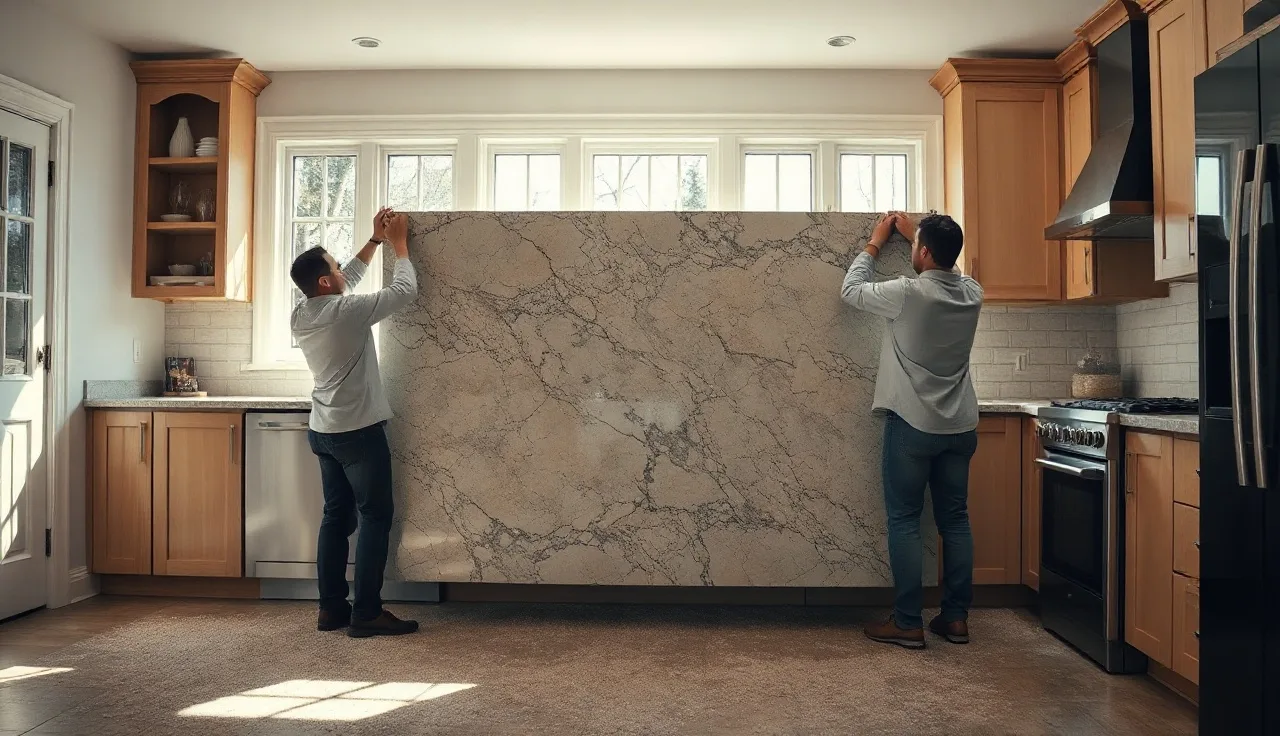
Chicago Metropolitan Stone Fabricators Inc is a stone fabrication and installation company serving the Chicago metropolitan area, which includes Cook, DuPage, Lake, Will, Kane, and McHenry counties. Like most regional fabricators, their core work is cutting, edging, polishing, and installing natural and engineered stone countertops for kitchens, bathrooms, and commercial spaces.
Fabricators sit in the middle of the supply chain. A quarry pulls the stone from the ground, a distributor or slab yard imports and warehouses it, and the fabricator buys raw slabs, cuts them to your template dimensions, and installs the finished pieces. That distinction matters when you price a job. The fabricator's quote usually covers fabrication labor, edge profiles, cutouts for sinks and cooktops, and installation, but you may pay the slab yard separately for the material itself.
Chicago has a crowded stone fabrication market. The city and its suburbs support dozens of shops, from one-person operations working out of a garage to mid-size facilities running CNC bridge saws and waterjet cutters across 10,000-square-foot floors. A named, established company like Chicago Metropolitan Stone Fabricators sits in the mid-to-large tier. That usually means commercial liability insurance, permits pulled where required, and enough crew to run several jobs at once.
If you're a homeowner, the practical question is whether they serve your zip code and what materials they stock or can source. If you're a competing fabricator or a contractor, they're a benchmark for regional pricing and shop practices.
What materials does a Chicago stone fabricator typically work with?
Most Chicago-area fabricators, including larger shops like Chicago Metropolitan Stone Fabricators, work across the full spectrum of stone and engineered surfaces. Here's what you'll actually run into.
Natural stone. Granite countertops are still the volume leader in the Midwest. They're durable, come in hundreds of color families, and fabricate without much drama. Marble countertops carry more cachet but softer hardness (Mohs 3 to 4 versus granite's 6 to 7), so they scratch and etch from acid contact. Quartzite gets confused with quartz constantly, and they're different things: quartzite is metamorphic stone, quartz is an engineered product. Quartzite needs sealing like other natural stones. Soapstone and limestone round out the natural options.
Engineered quartz. Brands like Cambria, Silestone, Caesarstone, and MSI Q bring consistency that natural stone can't match. Cambria countertops are manufactured in Minnesota, so they're a domestic product with a short supply chain to Illinois. Engineered quartz runs 7 on the Mohs scale, resists staining without sealing, and holds tight dimensional tolerances that make templating easier.
Other surfaces. Some shops also cut and install porcelain slabs, sintered stone (brands like Dekton and Neolith), and occasionally solid surface materials like Corian countertops. Porcelain and sintered stone are harder to cut cleanly. They demand diamond blades and experienced operators, so not every shop offers them.
What a shop won't fabricate matters as much as what it will. If you want butcher block countertops or laminate countertops, a stone-focused shop usually sends you elsewhere. That's a good sign. It means you're getting a specialist, not a generalist.
What does stone countertop fabrication cost in Chicago?
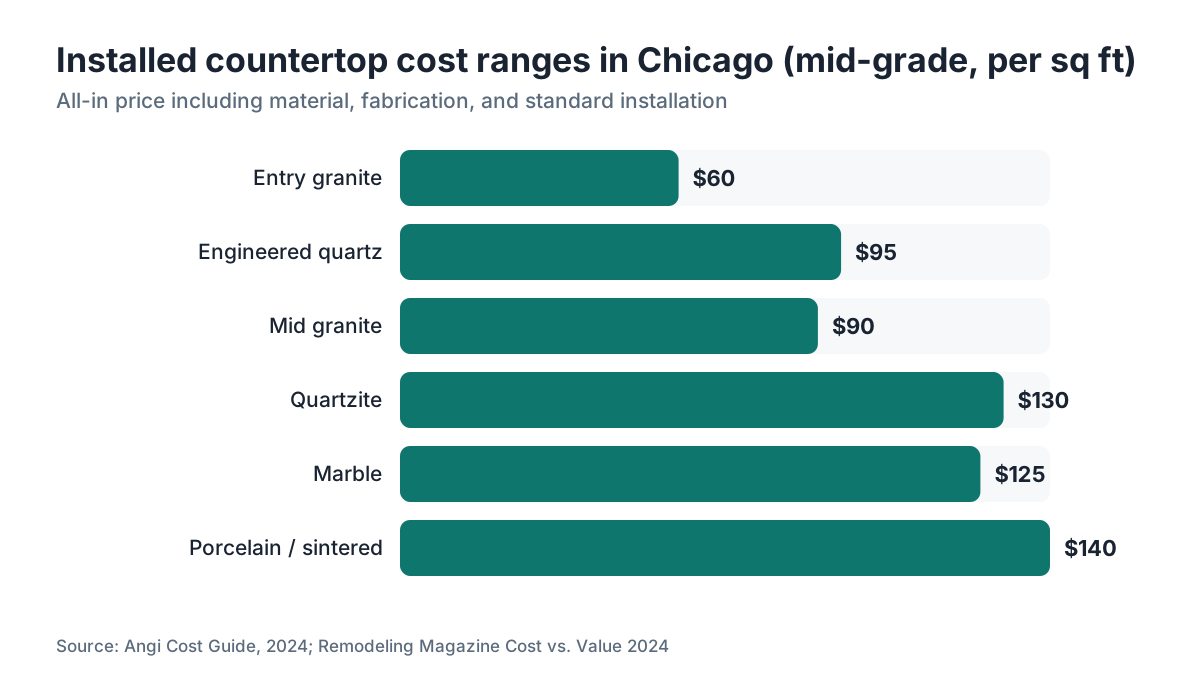
Installed countertop pricing in Chicago tracks national ranges but sits at the higher end. Illinois labor costs, Cook County commercial property overhead, and the hassle of dense urban and suburban job sites all push numbers up. Here are realistic all-in ranges for 2024 to 2025 (material plus fabrication plus installation) [1][2]:
| Material | Low ($/sq ft installed) | Mid ($/sq ft installed) | High ($/sq ft installed) |
|---|---|---|---|
| Entry granite (Level 1-2) | $40 | $60 | $80 |
| Mid-grade granite | $65 | $90 | $120 |
| Engineered quartz | $70 | $95 | $130 |
| Quartzite | $90 | $130 | $180 |
| Marble | $85 | $125 | $200+ |
| Porcelain / sintered stone | $100 | $140 | $220+ |
A typical Chicagoland kitchen has 35 to 55 square feet of countertop. At mid-grade granite pricing, that's $3,150 to $4,950 installed. At mid-grade quartzite, it's $4,550 to $7,150. These assume a reasonably straightforward layout. Complex island shapes, tight radius curves, and unusual edge profiles all add cost.
The extras that catch homeowners off guard: sink cutouts run $100 to $250 each, cooktop cutouts $75 to $200, edge profiles beyond a standard eased edge add $10 to $40 per linear foot, and seam location fees sometimes appear on natural stone jobs where the fabricator has to match book-matched veining [3].
Fabricators rarely budge much on labor. Material pricing has more give. If you're flexible on slab selection and willing to look at remnant inventory (leftover pieces from bigger jobs), you can save 20 to 40 percent on smaller sections like bathroom vanities.
How does the stone fabrication process work from template to install?
Understanding the workflow helps you manage your own timeline and catch problems before they turn permanent.
Step 1: Template. After your cabinets are in and level, the fabricator sends a templater to measure your countertop layout. Modern shops use digital templating (laser or photogrammetry tools) that captures exact dimensions and feeds them straight into CNC cutting files. Smaller shops still use physical templating with thin strips of luan or cardboard. Both work. Digital is faster and cuts out human transcription error.
Step 2: Slab selection. You'll visit the slab yard (often a distributor like MS International, Arizona Tile, or a regional importer) to pick your specific slabs. Always pick in person for natural stone. Photos lie. The slab you select is the slab you get, and veining can vary hard within a single material.
Step 3: CNC cutting and edging. Back at the shop, your template file drives a bridge saw or CNC router that cuts the slab into the pieces your kitchen needs. Edge profiles get ground and polished by CNC or by hand depending on complexity. A standard eased edge or flat polish is machine work. A hand-chiseled or leathered finish is skilled manual labor.
Step 4: Quality check. A good shop checks dimensions against the template file before pieces leave the building. Cracks, fissures (natural in stone, different from damage), and polish inconsistencies should get caught here, not at your house.
Step 5: Installation. Countertop installation usually takes two to four hours for a standard kitchen. Installers set pieces on the cabinets, secure them with adhesive or mechanical fasteners where required, caulk the seams and perimeter, and mount undermount sinks if included [4]. They typically won't reconnect plumbing. That's your plumber's job.
Total timeline from signed contract to installed countertop: two to four weeks for in-stock material, four to eight weeks if you've ordered a specialty slab that has to be imported.
How do you find and vet stone fabricators in Chicago?
The Chicago metro has enough shops that you can and should get three quotes. Here's how to sort the good from the bad.
Check licensing and insurance first. Illinois requires contractors to register with the state and carry general liability insurance. Ask any fabricator for a current certificate of insurance (COI) before they set foot in your house. Minimum coverage should be $1 million per occurrence and $2 million aggregate for a residential job [5]. Some metro municipalities also require a separate business license or home improvement registration on top of state registration.
Look at their shop, more than their website. A legitimate fabricator will let you see the shop floor. Stone dust management (wet cutting, HEPA filtration, or both) matters for worker safety and for product quality. OSHA's silica dust standard, 29 CFR 1926.1153, requires engineering controls for stone cutting and sets a permissible exposure limit of 50 micrograms per cubic meter as an 8-hour time-weighted average [6]. A shop that ignores silica safety is probably cutting corners everywhere else too.
Read the contract carefully. A quality contract spells out exact square footage being fabricated, slab origin (lot number if natural stone), edge profile by name, sink and cooktop cutout count, seam locations drawn on a layout diagram, payment schedule, and what happens if a slab cracks during fabrication. Verbal promises don't survive disputes.
Ask about seams. Most kitchens need at least one. Where that seam lands, how it's colored to match the stone, and how it's structurally bonded matters more than most homeowners realize. Ask to see seam samples from past jobs. A bad seam on dark granite is obvious from six feet away.
For more on what install looks like from the homeowner's side, the countertop installation guide covers what to expect on the day.
What questions should you ask a Chicago stone fabricator before signing?
These are the questions that separate informed buyers from people who end up with regrets:
-
Do you handle your own templating and installation, or do you subcontract? Subcontracting isn't automatically bad, but you want to know who's responsible if something goes wrong.
-
Where do you source your slabs? Some fabricators have exclusive distributor relationships that limit your material choices. Others will work with slabs you buy independently, which opens up your options.
-
What's your turnaround right now? During spring and fall remodeling rushes, even well-staffed Chicago shops run four to six week backlogs.
-
How do you handle a crack or damage during fabrication? Natural stone can crack during cutting, especially along existing fissures. A reputable shop re-fabricates from a new slab at no extra cost to you. Get it in writing.
-
What does your warranty cover and for how long? One-year labor warranties are common. Some shops offer two. Material warranties depend heavily on whether the stone was in good condition at installation.
-
Can I see the slab before you cut? Most shops will do a pre-cut review if you ask. This is your last chance to confirm you're getting the exact slab you selected, not a lookalike.
-
Who pulls permits? Some Cook and DuPage county municipalities require a building permit for countertop replacement if plumbing is involved. Their answer tells you a lot about how they handle compliance in general.
How do Chicago stone fabricators quote a job, and what makes a quote accurate?
A countertop quote is only as good as the template behind it. Fabricators who quote from photos or rough measurements are guessing, and that guess becomes your problem if the real square footage comes in higher.
The usual sequence goes like this. A sales rep visits for a preliminary measure and gives a range, you sign a proposal and pay a deposit (typically 50 percent), then a templater does the precision measure before fabrication starts. Final price adjusts to actual square footage. Reputable shops cap that adjustment. Shady ones use it to tack on 10 to 15 percent at the last minute.
Digital quoting has made this more honest. Shops running modern fabrication software can generate itemized quotes that break out per-square-foot material cost, fabrication labor, edge profile charges, cutouts, and installation separately. That itemization lets you compare apples to apples across three quotes. When one shop's number comes in way low, the line-by-line breakdown usually shows why: a lower-grade slab, no sealer, or delivery left out.
Shops running software like SlabWise can also show you nesting layouts, meaning how your pieces get cut from the slab. That affects how much of the slab you pay for and how the veining flows through your kitchen. Genuinely useful information on natural stone jobs, and a sign of a shop that cares about doing it right [7].
For context, the National Kitchen and Bath Association reports that kitchen countertops average 7.2 percent of a kitchen remodel's total budget [8]. In Chicago, where full kitchen remodels range from $40,000 to well over $100,000 per Remodeling Magazine's Cost vs. Value Report, that puts countertop spend around $2,880 to $7,200 at the median, which matches the square footage estimates above [9].
What are the most common problems with stone fabrication jobs, and how do you avoid them?
In rough order of how often they happen:
Seams in bad locations. A seam across your primary prep area, or placed to show maximum vein mismatch, is a planning failure. Ask to see the seam layout diagram before fabrication starts and object if you don't like where seams land. Good fabricators accommodate reasonable requests.
Template errors. Cabinets that aren't level or square create cascading measurement problems. A thorough templater notes cabinet issues and tells you to fix them before fabrication. Skip that step and you may end up with gaps or overhangs that miss your design intent.
Slab substitution. You picked slab 4B in the yard. The shop installs slab 6A because 4B cracked in transit. It happens. Prevent it by photographing your selected slab's lot tag and confirming in writing that your specific slab is the one getting cut.
Underestimating sealer maintenance. Natural stone needs periodic sealing. Most granite wants it every one to three years. Marble and quartzite can need it every six to twelve months depending on use [10]. A fabricator who never mentions this is either uninformed or not thinking about your long-term satisfaction. For care after install, the guides on how to clean stone countertops and how to clean quartzite countertops are solid references.
Rushed installation. An installer who rushes the sink cutout alignment or doesn't let adhesive cure before leaving creates problems that surface weeks later. Don't let anyone pressure you through the final walkthrough. You have the right to inspect every inch before you sign off.
How does Chicago's market compare to national stone fabrication trends?
The U.S. stone countertop market has grown steadily. The USGS Mineral Resources Program tracks dimension stone production and import data every year. In 2022, the U.S. imported roughly 4.5 billion dollars worth of stone products, with granite and marble taking the largest shares [11]. Illinois ranks among the top ten states for stone product consumption, driven by the Chicago metro's construction and remodeling volume.
Nationally, engineered quartz has pulled significant market share from granite over the past decade, mostly on lower maintenance and consistent appearance. Chicago follows that trend, though the Midwest holds a stronger granite preference than coastal markets. Midwestern buyers tend to weight durability and value over design-forward looks.
Labor costs are the biggest gap between Chicago pricing and national averages. Illinois minimum wage hit $15 per hour in January 2025, and skilled stone fabrication labor (CNC operators, hand polishers, experienced installers) earns well above that, typically $22 to $45 per hour depending on role and experience [12]. Shops in lower-wage states carry a structural cost advantage that Chicago fabricators can't match without giving up workforce quality.
One trend worth watching: thinner slabs (3/4 inch versus the standard 1.25 inch or 1.5 inch) are showing up more, especially for waterfall edges and furniture-style islands. Thinner stone is more fragile during fabrication and needs more support structure, so shops that aren't tooled for it will push back or upcharge hard.
Should homeowners consider alternatives to full stone fabrication?
Honestly, sometimes yes. Full slab stone isn't always the right answer.
For rental properties or tight budgets, laminate countertops have improved a lot. Modern high-pressure laminate from brands like Formica mimics stone convincingly at $20 to $40 per square foot installed, roughly a third of entry-level granite. It won't fool anyone up close, but for a rental kitchen the math is hard to argue with.
For people who love the warmth of wood, butcher block countertops are a legitimate choice for kitchens that don't leave dishwater standing on the surface. The maintenance commitment is real (oiling every few months, refinishing when scratched), but the upfront cost is lower and a skilled woodworker can produce stunning results.
For homeowners chasing the no-maintenance promise, engineered quartz (Cambria, Silestone, Caesarstone) is the strongest all-around bet for kitchen countertops. It costs slightly more than entry granite but well under premium natural stone, and it never needs sealing.
When is natural stone fabrication worth every dollar? High-use kitchens where owners want heirloom permanence. Bathrooms where stone builds a spa feel that genuinely changes daily life. Commercial spaces where stone signals quality to clients. For everyone else, match the material to the real use case and the real budget.
How do fabricators and shop owners run a competitive stone business in Chicago?
This section is for fabricators and shop owners thinking about what separates shops that grow from shops that plateau.
The two biggest operational levers in a stone shop are material yield and labor efficiency. A shop cutting 88 percent yield from its slabs versus one cutting 80 percent is pulling more revenue from the same material cost. At Chicago slab prices ($300 to $800 per slab for mid-grade granite, $600 to $2,000+ for premium natural stone), that difference compounds fast across a month of jobs.
Digital templating and CNC integration have basically become table stakes for shops doing more than 15 to 20 jobs a month. Shops still leaning on hand templating can stay competitive on low volume or highly custom work, but at scale the error rate and re-work cost get punishing.
Customer acquisition in Chicago runs mostly on referrals at the residential level and contractor relationships at the commercial level. A fabricator who builds a reputation with two or three high-volume kitchen and bath remodelers in the north or northwest suburbs can carry a shop on those relationships alone. The shops that struggle are the ones trying to win on price. There's always a newer shop willing to cut margins to buy market share.
On quoting, shops that turn around fast, itemized, professional quotes close more jobs than shops that make customers wait three days for a PDF. Quote software that ties into slab inventory and auto-calculates edge profiles, cutouts, and material waste makes a real operational difference. SlabWise is built for countertop fabricators who want that speed and accuracy without hand-building a spreadsheet system [7].
The OSHA silica rule from earlier is a business issue as much as a safety one. Shops that aren't compliant face fines up to $15,625 per violation under OSHA's current penalty schedule [6].
Frequently asked questions
Is Chicago Metropolitan Stone Fabricators Inc a licensed and insured contractor?
Any legitimate stone fabricator operating in Illinois should carry general liability insurance and meet state and local business registration requirements. Before hiring any fabricator, request a current certificate of insurance showing at least $1 million per occurrence in coverage. You can also verify business registration through the Illinois Secretary of State's office at ilsos.gov. Don't skip this step no matter how established a company looks.
What is the average cost of granite countertops installed in Chicago?
Entry-level granite installed in Chicago runs $40 to $80 per square foot. Mid-grade granite runs $65 to $120 per square foot installed. A typical 40-square-foot kitchen at the mid range costs $2,600 to $4,800. Costs run higher than the national average because of Illinois labor rates and Chicago metro overhead. Sink cutouts, edge profiles beyond a basic eased edge, and complex layouts all add to the total.
How long does stone countertop fabrication and installation take in the Chicago area?
From signed contract to installed countertop, expect two to four weeks for in-stock material. Template day usually falls within a week of signing, fabrication takes three to seven business days after template, and installation follows. If you've chosen a specialty slab that has to be imported or ordered from a distributor, add two to four weeks. Busy remodeling seasons (spring and fall) stretch lead times further.
What is the difference between a stone distributor and a stone fabricator?
A distributor imports and warehouses raw slabs, selling them to fabricators or sometimes directly to consumers. A fabricator buys slabs from distributors, cuts them to your specifications using bridge saws and CNC equipment, and installs the finished pieces in your home. Some shops are vertically integrated and do both. Most Chicago fabricators source material from regional distributors like MS International or Arizona Tile.
Can I supply my own slab to a Chicago stone fabricator?
Many fabricators will cut and install a slab you buy independently, though some charge a handling or liability surcharge because they can't warranty material they didn't source. If you find a slab at a discount or want a specific stone a shop doesn't normally stock, it's worth asking. Get clarity in writing on who bears responsibility if the slab cracks during fabrication.
What edge profiles are available and how much do they cost?
Common profiles include eased (flat, slightly softened), beveled, bullnose (fully rounded), ogee (S-curve), and waterfall. A standard eased edge is usually included in the base fabrication price. Upgraded profiles add $10 to $40 per linear foot depending on complexity. Hand-carved or custom profiles on hard stone like quartzite or sintered porcelain can run $50 to $80 per linear foot because of the labor involved.
Does stone countertop fabrication require a permit in Chicago or its suburbs?
Generally, a simple countertop swap does not require a permit in most Chicago-area municipalities. But if the project moves plumbing, changes structural elements, or is part of a larger remodel that already requires a permit, the countertop work gets included. Requirements vary by municipality: Cook County, DuPage, Lake, and Will counties each have their own jurisdictions. Ask your fabricator and call your local building department if you're unsure.
How do I maintain natural stone countertops after installation?
Most natural stone, including granite, marble, and quartzite, should be sealed at installation and re-sealed every one to three years depending on porosity and use. Use a pH-neutral cleaner for daily cleaning and avoid acidic products like vinegar or citrus-based sprays, which etch marble and softer stones. For specifics by material, the guides on how to clean stone countertops and how to clean quartzite countertops cover the details well.
What is silica dust and why does it matter when hiring a stone fabricator?
Silica dust is released when stone is cut, ground, or polished. Prolonged exposure causes silicosis, an irreversible lung disease. OSHA's rule 29 CFR 1926.1153 requires stone fabricators to use engineering controls (wet cutting, local exhaust ventilation, HEPA vacuums) and limits worker exposure to 50 micrograms per cubic meter as an 8-hour time-weighted average. A shop cutting stone dry without ventilation is both a worker safety violation and a sign of poor operational standards.
Are there remnant slabs available at Chicago stone fabricators, and how do I buy them?
Most fabricators keep remnant pieces left from larger jobs. These are typically priced 30 to 50 percent below full slab cost and work well for bathroom vanities, small kitchen sections, or laundry room counters. Call or visit the shop and ask to see their remnant yard. Selection changes constantly. Remnants sell as-is, so inspect them for cracks or finish inconsistencies before you commit.
What should a stone fabrication contract include?
A complete contract should include exact square footage, slab lot numbers for natural stone, edge profile specified by name, number and type of sink and cooktop cutouts, a seam location diagram, payment schedule with amounts and milestones, warranty terms, and a clause covering what happens if a slab cracks during fabrication. If any of these are missing, ask for them before signing. Verbal agreements don't hold up when disputes arise.
How many quotes should I get for stone countertops in Chicago?
Three is the right number. One quote gives you no reference point. Two create a binary choice that's hard to evaluate. Three show you the market rate, reveal outliers on both ends, and give you enough to ask informed questions. Make sure all three are based on the same square footage, same edge profile, and same material so you're comparing equivalent scope.
What is the OSHA silica rule and does it apply to Chicago stone fabricators?
Yes. OSHA's rule 29 CFR 1926.1153, finalized in 2016, applies to all construction and stone fabrication operations in the United States, Illinois included. It sets a permissible exposure limit of 50 micrograms per cubic meter for crystalline silica and requires employers to implement engineering controls, provide respiratory protection where controls aren't enough, and offer medical surveillance for workers with significant exposure. Non-compliance carries fines up to $15,625 per violation.
Sources
- HomeAdvisor (Angi) - Countertop Installation Cost Guide: Installed stone countertop prices range from roughly $40 to $200+ per square foot depending on material and region
- Remodeling Magazine - Cost vs. Value Report 2024: Kitchen remodel costs in the Chicago metro area ranging from roughly $40,000 to over $100,000
- National Association of Home Builders - Remodeling Market Index: Common countertop add-on charges including sink cutouts, edge profiles, and seam work
- National Kitchen and Bath Association - Kitchen and Bath Market Index: Countertops average approximately 7.2 percent of a kitchen remodel's total budget
- Illinois Department of Financial and Professional Regulation: Illinois contractor licensing and insurance requirements for home improvement contractors
- OSHA - Respirable Crystalline Silica Standard for Construction, 29 CFR 1926.1153: OSHA sets a permissible exposure limit of 50 micrograms per cubic meter for crystalline silica and requires engineering controls in stone cutting operations; non-compliance penalties up to $15,625 per violation
- SlabWise - Countertop Fabrication Software: Quoting and nesting software used by stone fabricators to generate itemized quotes and optimize slab yield
- National Kitchen and Bath Association - Design and Industry Research: Kitchen countertops average 7.2 percent of total kitchen remodel budget according to NKBA industry data
- Remodeling Magazine - 2024 Cost vs. Value Report, Chicago metro: Full kitchen remodel costs in Chicago range from $40,000 to well over $100,000 at the median
- Natural Stone Institute - Stone Care and Maintenance: Natural stone sealing frequency recommendations: granite every one to three years, marble and quartzite every six to twelve months depending on use
- U.S. Geological Survey - Mineral Commodity Summaries, Dimension Stone: U.S. stone product imports in 2022 totaled roughly 4.5 billion dollars, with granite and marble the largest shares
- U.S. Bureau of Labor Statistics - Occupational Employment and Wage Statistics, Stone Cutters and Carvers: Skilled stone fabrication labor wages ranging from $22 to $45 per hour depending on role and experience
Last updated 2026-07-09