TL;DR
- Stone fabricators cut, edge, and install countertops from raw slabs.
- Companies like Atlas Stone Fabricators and SoCal Stone Fabricators handle the whole chain from templating to final install.
- Expect to pay $40 to $200 per square foot installed depending on material, edge profile, and cutouts.
- Lead times usually run two to four weeks from template to install.
What does a stone fabricator actually do?
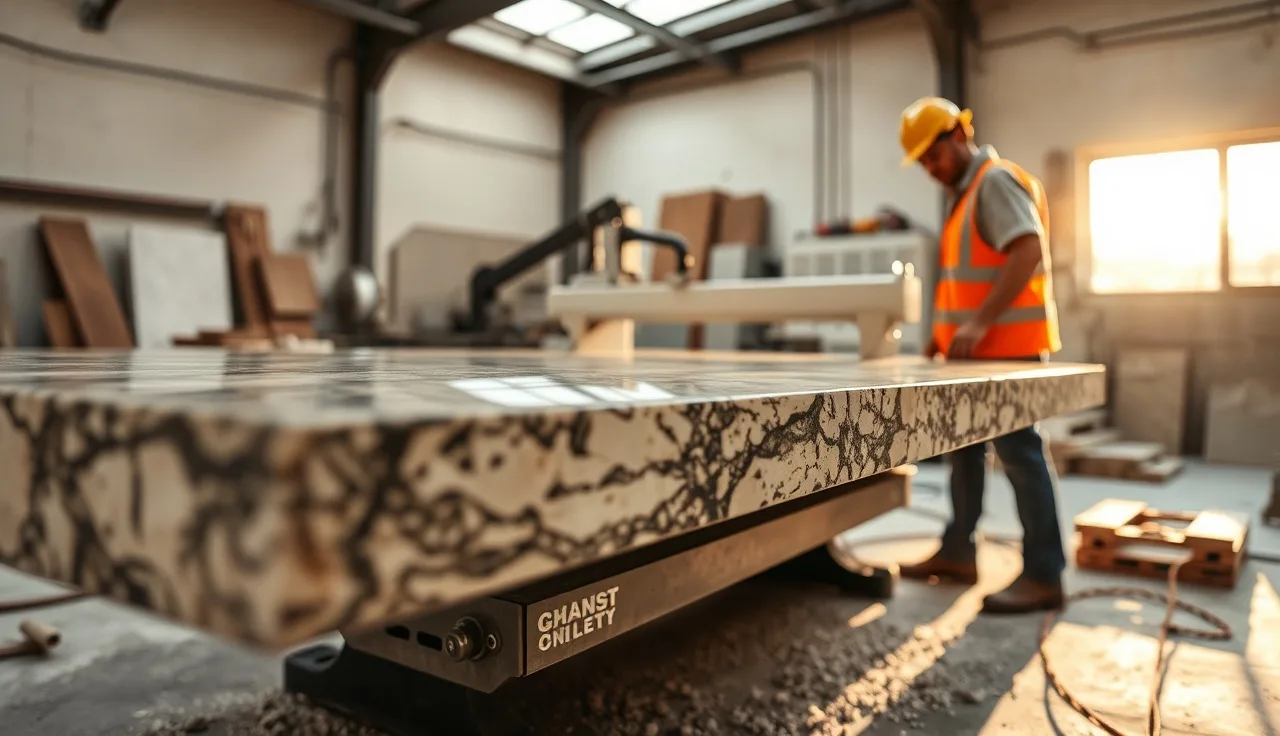
A stone fabricator is the shop that turns a raw slab of granite, quartz, marble, or quartzite into finished countertops on your kitchen or bathroom cabinets. They buy slabs from importers or distributors, template your space, cut the stone to your exact measurements on a CNC bridge saw or waterjet, profile the edges, polish the surface, and send an install crew to set everything in place.
The fabrication side is where the real skill and cost live. Cutting a 3 cm granite slab cleanly around a sink cutout, mitering two pieces on a kitchen island, or grinding a waterfall edge without chipping the face takes trained labor, expensive machinery, and hard-won experience with how stone behaves. One bad cut scraps a slab worth hundreds of dollars.
Templating comes first. A tech visits your home with either a laser measuring device or physical template strips and captures every wall angle, corner, and appliance position. No two kitchens are square. That template drives the cutting file, so any error there shows up permanently in the stone.
Then install. The crew carries slabs that often weigh 800 to 1,200 pounds into your home, sets them on the cabinets, glues seams, and in some cases connects plumbing stub-outs. The whole process from signed contract to finished kitchen usually runs two to four weeks, though busy shops in high-growth markets can stretch to six or eight. [1]
Who are Atlas Stone Fabricators and what do they specialize in?
Atlas Stone Fabricators is a stone fabrication and installation company working in the residential and commercial countertop market. The name shows up across several independently owned regional shops, which is common in this trade. Stone fabrication is intensely local. A shop in Phoenix serves Phoenix, period, because shipping finished countertops across state lines destroys both the margin and the slabs.
Atlas Stone Fabricators Inc is one of the more recognized names in the space, working with natural stone, engineered quartz, and porcelain slab countertops. Their service model bundles template, fabrication, and installation, which is the standard approach for any full-service shop. Most customers reach them through a kitchen designer, a home improvement retailer, or a direct referral.
Shopping Atlas for a project? Get these in writing before you sign anything: the specific slab you are buying (name, lot number, thickness), the edge profile and its price per linear foot, the number of seams and where they land, the lead time from template to install, and the workmanship warranty. A reputable shop hands over these details without flinching.
What about SoCal Stone Fabricators and regional stone shops?
SoCal Stone Fabricators Inc is a Southern California stone fabrication company serving residential remodel and new construction across Los Angeles and the broader region. Southern California has one of the densest concentrations of stone fabricators in the country. Part of that is the volume of new construction and high-end remodel work. Part of it is that major slab importers cluster around the ports in Long Beach and Los Angeles, and that supply chain proximity keeps material costs competitive.
Regional fabricators like SoCal Stone Fabricators compete on speed, on relationships with local designers and contractors, and on material access. A shop with long-standing ties at a slab yard can sometimes get you into a remnant or a rare lot of book-matched marble that a big-box referral program simply cannot touch.
Working with a regional fabricator instead of a national chain program means you deal with the shop doing the actual work, not a middleman. You can visit the facility, watch your stone get cut, and talk to the people who will be in your house. That transparency matters when you are spending $4,000 to $15,000 on a kitchen. [2]
How much do stone fabricators charge per square foot?
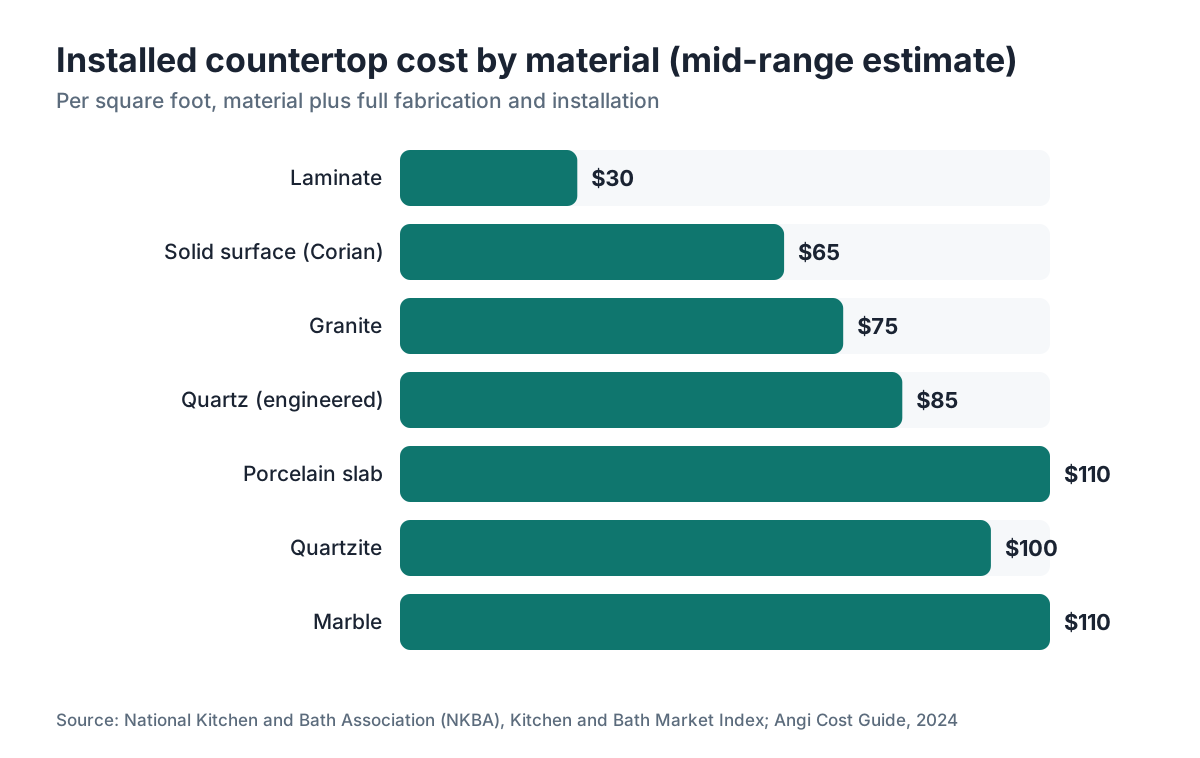
Fabrication pricing has two parts most customers never separate: material and fabrication labor. Material cost is what the shop paid for the slab plus their markup. Fabrication cost covers templating, cutting, edging, and install. Most shops bundle these into one per-square-foot price, but understanding the split helps you read a quote.
Here is a realistic price range by material as of 2025, covering material plus full fabrication and install:
| Material | Low ($/sq ft) | Mid ($/sq ft) | High ($/sq ft) |
|---|---|---|---|
| Laminate | $15 | $30 | $50 |
| Tile | $20 | $35 | $60 |
| Solid surface (Corian) | $40 | $65 | $90 |
| Granite | $40 | $75 | $150 |
| Quartz (engineered) | $55 | $85 | $150 |
| Quartzite | $60 | $100 | $200 |
| Marble | $60 | $110 | $200 |
| Porcelain slab | $65 | $110 | $180 |
These numbers line up with the National Kitchen and Bath Association's residential remodel data. [3] The spread inside each category is wide because it reflects slab rarity, thickness (2 cm vs. 3 cm), edge complexity, and local labor rates. A basic eased edge costs almost nothing. A full bullnose, ogee, or mitered waterfall edge can add $15 to $40 per linear foot.
Cutouts get priced separately. Expect $150 to $250 for a sink cutout, $50 to $100 for a cooktop cutout, and $30 to $60 for each faucet hole, though these move around by shop. [4]
A typical 40-square-foot kitchen with one undermount sink and a standard edge runs roughly $3,000 to $6,000 installed in granite. Marble and quartzite in the same kitchen run $4,000 to $8,000. Those are ballparks. Your real quote turns on your specific slab and the shop's current labor rate.
What materials do stone fabricators work with?
Full-service stone fabricators work with granite, marble, quartzite, soapstone, engineered quartz, porcelain slab, and sometimes limestone and travertine. Some shops also do solid surface like Corian, though that material cuts and finishes differently from natural stone and not every stone-focused shop wants the work.
Granite is still the most commonly fabricated natural stone in the U.S. residential market by volume. [3] It is hard, forgiving on installation, and available in hundreds of colors and movement patterns at reachable prices. Granite countertops run from commodity black or white at $40 per square foot installed up to exotic Brazilian granites at $150 or more.
Marble countertops ask more of both the fabricator and the homeowner. Marble is softer, more porous, and prone to etching from acids. A good fabricator seals marble before install and walks you through maintenance. If they never mention sealing, ask.
Engineered quartz (brands like Caesarstone, Silestone, and Cambria countertops) is uniform in composition and predictable to fabricate, which is why many shops prefer it. No veining to match across a seam. No void to fill. No surprise porosity. For fabricators, quartz is reliable volume work.
Quartzite and soapstone are genuinely different materials that take different tooling and technique. Quartzite can be brutally hard and dulls blades fast. Soapstone is soft enough that a careless cut turns into a problem. Choosing one of these? Ask the fabricator how many slabs of that specific material they cut in the last year. Experience with the material matters more than experience with stone in general.
For maintenance by material type, see how to clean stone countertops and how to clean quartzite countertops.
How does the stone fabrication process work from start to finish?
The process runs in a predictable order, and knowing it helps you dodge the mistakes that cause delays or disappointment.
First, you select your slab. This happens at the fabricator's showroom or at a slab yard they work with. Pick the specific slab, more than the material and color. For natural stone, every slab is one of a kind. That batch of Calacatta marble on a sample board will look nothing like the slab that shows up if you never go mark it at the yard. Go to the yard.
Second, you sign a contract and pay a deposit, usually 50 percent. The shop reserves your slab and schedules your template date. Template happens after your cabinets are in place and plumbing rough-in is done. If your cabinets are not level, the fabricator notes it and either shims on install or tells you to fix the cabinets first.
Third, templating happens on-site. It takes 30 minutes to two hours depending on complexity. Some shops use laser templating systems (Proliner or LT-55 devices), others use physical strips. Both work. Laser is faster and slightly more precise on complex layouts.
Fourth, the shop programs the CNC and cuts your pieces. Quality control here varies enormously between shops. A serious shop dry-fits pieces on a flat table before polishing to catch seam alignment problems while the stone can still be adjusted.
Fifth, install. Usually a two-person crew for a standard kitchen. They set the pieces, run color-matched epoxy on the seams, clamp and let it cure, then clean up. The install itself runs two to four hours for a standard kitchen. Do not use the countertops for 24 hours after install, so the adhesive fully cures.
Shops that run quoting and job tracking on dedicated fabrication software, like what SlabWise offers for job costing and slab nesting, tend to have shorter turnaround and fewer measurement errors, because every step from quote to cut file lives in one system instead of bouncing between spreadsheets and hand-written notes. [5]
How do you evaluate a stone fabricator's quality?
The easiest proxy for quality is seam work. Ask to see finished projects in person, or at least ask for close-up seam photos on projects using the same material you are considering. On a good seam, the gap is 1/16 inch or less, the color-matched filler is nearly invisible, and there is no lip between the two pieces. A bad seam jumps out at you and cannot be fixed without cutting the stone again.
Second, ask about their CNC and templating equipment. A shop running a 5-axis CNC bridge saw and a laser templating system is investing in precision. A shop doing everything by hand with an angle grinder can produce beautiful work, but the margin for error is higher and output is limited.
Third, check the warranty terms in writing. A standard workmanship warranty in this trade covers fabrication defects, cracking at seams, and installation errors for one year. [6] Material warranties vary, because a crack in natural stone is sometimes the slab's fault and sometimes the installer's. Get clarity on what they cover before you sign.
Fourth, ask who does the install. Some fabricators subcontract it. That is not automatically bad, but you want to know, so you understand who is accountable if something goes wrong.
Finally, visit the shop if you can. Labeled slabs, organized racks, machinery that looks maintained: good signs. A chaotic yard buried in stone dust with no apparent system: not.
What questions should you ask a stone fabricator before signing?
Before you commit, run through this list.
Can I come to the slab yard to personally pick and mark my slab? For natural stone, the answer should be yes. If they say it is not necessary, push back.
Where will the seams be and why? Seam placement is a fabrication decision, and you should be part of the conversation instead of handed the result.
What is the exact edge profile and how is it priced? Get it in writing. Edge upsells are where a quote can jump 15 to 20 percent after the fact.
What is the lead time from template to install, and what most often makes it slip? An honest shop will tell you if they are booked out and what causes delays (back-ordered material, a jammed install schedule).
Do you handle the plumbing reconnect or do I need a separate plumber? Most fabricators do not reconnect plumbing. Know this in advance so you can schedule around it.
What is included in the workmanship warranty, and how do I file a claim? Get the answer in writing.
Is my slab stored indoors? Slabs left outside in extreme heat or freeze-thaw cycles can develop micro-cracks. A shop that keeps slabs under cover and off the ground is taking proper care of your material.
For the broader install process, see countertop installation for a walkthrough of what to expect on install day.
How do stone fabricators handle remnants and smaller projects?
Remnants are leftover pieces from previous slab cuts, and they are genuinely useful for small projects: bathroom vanities, laundry room tops, bar tops, fireplace surrounds. A remnant that covers a 15-square-foot vanity might cost $150 to $400, against $600 to $1,000 for a full slab cut. Most shops sell remnants at a discount and are glad to move them.
If you are doing a small bathroom remodel on a tight budget, walking a fabricator's remnant pile before you commit to a full slab is worth an hour of your time. Material that would be an odd-lot scrap for a kitchen is often exactly the right size for a single-sink vanity.
Small projects also cover fireplace hearths, window sills, outdoor kitchen tops (use granite or quartzite, not marble, outdoors), and island tops added to an existing kitchen. Fabricators price these the same way: square footage plus edge linear footage plus cutouts. The minimum job charge at most shops runs $300 to $600 no matter the square footage, so a tiny project costs more per square foot than a full kitchen purely because of setup time.
For materials where remnant sourcing does not apply, butcher block countertops, laminate countertops, and Formica countertops run on a different supply chain entirely and usually come through lumber yards or home improvement stores rather than stone fabricators.
How do fabricators calculate waste and slab yield?
Slab yield is one of the most misunderstood parts of a stone purchase. A full granite slab usually gives you 45 to 65 square feet of usable surface. Jumbo slabs run 75 to 90. But cutting wastes material at saw kerfs, edge strips, and odd-shaped offcuts. The industry standard is to add 15 to 20 percent to your actual countertop square footage to estimate slab consumption. [7]
A kitchen with 40 square feet of counter surface likely eats 46 to 48 square feet of slab after waste. That may fit on one slab or force a second, depending on slab size and how the pieces nest. Nesting is the process of laying out all your pieces on the slab to minimize waste, and it is where a skilled fabricator or good software earns its keep. Poor nesting burns expensive material and creates seam placement problems.
Fabrication software that automates slab nesting, like what SlabWise provides, can cut material waste measurably by finding the most efficient layout before any blade touches stone. [5] For a shop running 20 or 30 kitchens a month, that margin on material adds up fast.
For homeowners, the takeaway is simple. If a quote looks low, ask whether it assumes one slab or two. A quote built on one slab that actually needs two will read very differently at final invoice.
What are the most common complaints about stone fabricators and how do you avoid them?
Homeowner complaints fall into a predictable set: seams that are visible or raised, slabs that arrived cracked during install, delays that blew past move-in dates, and mix-ups over edge profiles or sink cutout types.
Seam complaints are usually a fabrication quality issue tangled up with a communication problem. The homeowner did not know the seam would be visible from a certain angle, or the fabricator did not pull a tight enough joint. Asking to see seam photos before you hire, and writing the seam location into your contract, heads off most of it.
Cracked slabs on install are often pre-existing micro-fractures that get stressed during transport or the set itself. Some natural stones, certain quartzites and thinner marbles especially, are more prone to it. A reputable fabricator inspects slabs for cracks before cutting and either rejects the slab or points out the flaw so you can decide with eyes open. Ask them about their slab inspection process.
Delays trace back to one of three sources: material back-ordered at the distributor, the shop's install crew overbooked, or the homeowner's cabinets not ready on the template date. The cabinet delay is the most common and completely avoidable. Do not schedule templating until your cabinets are fully installed and level.
Spec mix-ups almost always come down to a thin contract. Every detail that matters to you belongs in writing: slab name and lot number, edge profile name and price, seam locations, cutout type (undermount vs. drop-in), number of faucet holes, and install date. Verbal agreements are how you end up with the wrong edge.
Are stone fabricators licensed or regulated?
Licensing for stone fabricators varies by state and sometimes by county. In most states, if the fabricator performs structural installation or connects plumbing, the person doing that work needs a general contractor or specialty contractor license. The fabrication work itself, cutting and finishing stone, generally does not require a specific stone fabrication license. [8]
California, where SoCal Stone Fabricators and other Southern California shops operate, requires contractors doing home improvement work above $500 to hold a valid California Contractor's License (a C-10, C-36, or general B license depending on scope). The California Contractors State License Board (CSLB) runs a public license lookup where you can verify any contractor's status before you sign. [9]
In practice, many small stone shops work as unlicensed subcontractors under a general contractor's license. That can be legal if it is structured correctly, but it complicates things when a workmanship dispute lands. If you are hiring a fabricator directly (not through a GC or designer), confirm they hold a valid license for your state.
Silica dust is a serious occupational health hazard in stone fabrication. OSHA's final rule, 29 CFR 1910.1053, sets the permissible exposure limit for respirable crystalline silica at, in the rule's words, "50 micrograms of respirable crystalline silica per cubic meter of air (50 g/m3) as an 8-hour time-weighted average." [10] A responsible fabricator runs wet cutting, uses dust collection, and gives workers proper respiratory protection. That protects the crew. It also tells you the shop operates like professionals.
Frequently asked questions
What is Atlas Stone Fabricators Inc and where do they operate?
Atlas Stone Fabricators Inc is a stone countertop fabrication and installation company. The name exists across multiple independently owned regional shops, which is typical in stone since fabrication is inherently local. They generally offer full-service work: slab selection help, templating, CNC fabrication, and installation. To confirm service area and current availability, contact the specific shop directly.
How do I find a reputable stone fabricator near me?
Ask local kitchen designers and cabinet shops who they use, since they see fabricator work constantly and know which shops are reliable. Check the National Kitchen and Bath Association member directory and the Natural Stone Institute member list. Visit the shop in person if you can. Ask for references on projects using the same material you are considering, and look hard at seam quality in any photos they show you.
How long does stone countertop fabrication take from template to install?
Most shops run two to four weeks from template date to installation. That window covers template scheduling, CNC programming, cutting, polishing, and install crew scheduling. Busy shops in high-demand markets, Southern California especially, can run four to eight weeks during peak spring and fall remodel seasons. Ask for a specific install date in writing, not a vague range, before you sign.
What is the difference between a slab yard and a fabricator?
A slab yard imports and distributes raw stone slabs. A fabricator buys slabs from the yard and cuts them into finished countertops. Some fabricators own their own slab inventory. Others work closely with nearby yards and take customers there to select stone. You can visit a slab yard on your own, but you cannot buy fabrication services there. Most homeowners work with a fabricator who has slab relationships.
Do I need to be home for the stone countertop installation?
Yes. Someone needs to be present to give access, approve the placement before adhesive sets, and sign off on the finished work. Do not leave the install crew unsupervised if you have specific concerns about seam placement or any agreement that never made it into the contract. Walk the job before the crew leaves and note any issues in writing on the install receipt.
What is the difference between granite and quartz for fabricators?
For fabricators, engineered quartz is more predictable to cut and finish because the material is uniform. Natural granite varies in hardness, porosity, and grain by slab, which takes experienced judgment on blade choice and cutting speed. For homeowners, the practical difference is that granite needs periodic sealing, quartz generally does not, and granite shows natural variation across a seam that quartz largely erases.
Can a stone fabricator fix a cracked countertop?
Sometimes. Small hairline cracks that do not run through the full thickness can be filled with color-matched epoxy and polished down. A crack that fully separates a piece, or one near a sink cutout that compromises structure, usually means replacing that section of stone. If the crack happened during install, the fabricator's workmanship warranty should cover the repair or replacement. Document the damage with photos immediately.
What edge profiles do stone fabricators offer and how much do they cost?
Common profiles include eased, beveled, bullnose, ogee, mitered waterfall, and dupont. Eased and beveled are usually included in the base price or carry a small upcharge. Ogee and full bullnose typically add $10 to $20 per linear foot. A mitered waterfall edge, which wraps stone down the side of an island, can add $30 to $60 per linear foot plus heavy labor. Prices vary by shop and region.
How do stone fabricators price sink cutouts?
Most fabricators charge $150 to $250 for an undermount sink cutout, which is cut with a CNC or router and needs clean, smooth edges since the sink clips pull against the underside. Drop-in cutouts are less critical and sometimes cheaper. Faucet holes run $30 to $60 each. If you are buying an undermount sink, confirm with the fabricator that your sink model's dimensions match their template before they cut.
What is silica dust and why should I care about my stone fabricator's practices?
Silica dust is released when stone containing crystalline silica, including granite, quartz, and sandstone, is cut or ground dry. Prolonged exposure causes silicosis, an irreversible lung disease. OSHA's 2016 silica rule set a permissible exposure limit of 50 micrograms per cubic meter for fabrication workers. A shop that uses wet cutting and proper dust collection is protecting its employees, which also signals it runs a professional operation.
Do stone fabricators offer warranties on their work?
Most reputable fabricators offer a one-year workmanship warranty covering fabrication defects, installation errors, and seam failures. Material warranties are separate and depend on the slab supplier. Engineered quartz makers like Caesarstone and Cambria offer their own warranties, typically 10 years or lifetime, that transfer to the homeowner. Get any warranty terms in writing, including the claims process, before signing a fabrication contract.
Is it cheaper to buy stone through a fabricator or through a big-box store?
Neither is categorically cheaper. Big-box stores like Home Depot and Lowe's use third-party fabricator networks, and their pricing can be competitive on entry-level material, but selection is limited to what their network carries. An independent fabricator often gives you more slab options, the chance to hand-pick your stone, and more flexibility on edge profiles and layout. For unusual materials or higher-end projects, a direct fabricator relationship usually wins on selection and service.
What should I look for in a stone fabricator's contract?
The contract should specify the exact slab (name, lot number, thickness), edge profile and its price, seam locations, all cutout types and counts, template date, install date, deposit amount and payment schedule, workmanship warranty terms, and what happens if the slab is damaged during fabrication or install. If any of those are missing, add them before signing. A fabricator who resists putting details in writing is worth avoiding.
Sources
- National Association of the Remodeling Industry (NARI), Remodeling Cost vs. Value data: Stone countertop lead times from template to install typically run two to four weeks, extending to six to eight weeks in high-demand markets
- U.S. Census Bureau, County Business Patterns (NAICS 327991, cut stone and stone product manufacturing): Stone fabrication is geographically concentrated near major import ports, including the Los Angeles and Long Beach area in Southern California
- National Kitchen and Bath Association (NKBA), Kitchen and Bath Market Index: Granite is the most commonly specified natural stone countertop material in U.S. residential remodels; installed countertop prices range $40 to $200 per square foot depending on material
- Angi (formerly HomeAdvisor), Countertop Installation Cost Guide: Sink cutouts are typically priced at $150 to $250 each; faucet holes run $30 to $60 each at most fabricators
- SlabWise, Slab Nesting and Job Costing Software: Fabrication software that automates slab nesting reduces material waste and shortens turnaround times by keeping quote-to-cut-file workflow in one system
- Natural Stone Institute, Natural Stone Industry Standards: Industry standard workmanship warranty for stone countertop fabrication covers fabrication defects and installation errors for a minimum of one year
- Natural Stone Institute, Dimension Stone Design Manual: The stone fabrication industry standard is to add 15 to 20 percent to actual countertop square footage to account for saw kerf waste and cutting inefficiency
- California Contractors State License Board (CSLB), Licensing Requirements: California requires contractors performing home improvement work valued above $500 to hold a valid CSLB contractor's license; homeowners can verify license status through the CSLB online lookup
- California Contractors State License Board (CSLB), License Check Tool: The CSLB maintains a public online tool to verify any California contractor's license status, expiration date, and any disciplinary actions
- U.S. Occupational Safety and Health Administration (OSHA), Occupational Exposure to Respirable Crystalline Silica, Final Rule 29 CFR 1910.1053: OSHA's 2016 final rule sets the permissible exposure limit for respirable crystalline silica at 50 micrograms per cubic meter of air as an 8-hour time-weighted average for general industry, including stone fabrication
- Remodeling Magazine, Cost vs. Value Report 2024: Average installed kitchen countertop costs in the U.S. range from roughly $3,000 to $8,000 for a standard kitchen depending on material and region
Last updated 2026-07-09