TL;DR
- Wholesale granite slabs cost $10, $40 per square foot at the distributor or importer level.
- A finished countertop runs $40, $100 per square foot installed at retail.
- Trade accounts usually need a business license and resale certificate, but homeowners can sometimes buy directly from a stone yard or grab a remnant.
- The savings are real.
- You still pay for fabrication and installation on top of the raw slab.
What does wholesale granite actually mean?
Wholesale means buying slabs straight from an importer or large regional distributor before any fabrication touches the stone. You get rough-cut slabs, usually 2 cm or 3 cm thick, bundled in a lot that came off a container ship from Brazil, India, China, Italy, or Norway. That's the real definition. The word gets thrown around loosely in the stone trade, so it helps to be precise.
Retail is what a homeowner pays after a fabricator buys those same slabs, cuts them to a kitchen template, edges the profiles, polishes the cutouts, and installs the finished counter. Every step adds labor, overhead, and margin. That's a real service, not padding.
The price gap is big. A slab a distributor sells to a fabricator for $200, $600 can cost a homeowner $1,500, $3,000 once it's a finished countertop. The markup reflects roughly 6 to 12 hours of skilled fabrication labor plus shop overhead, delivery, and installation.
So when someone advertises "wholesale granite countertops," they mean one of three things: a fabricator selling direct to homeowners without a showroom middleman, a stone yard that lets the public browse and buy slabs, or an actual importer whose minimum order and buyer requirements keep pricing to trade buyers only. Knowing which one you're dealing with changes what you should expect to pay and what you're on the hook for afterward.
Who is actually allowed to buy granite at wholesale prices?
Most granite importers and large distributors in the U.S. want a business license, a resale certificate (sometimes called a seller's permit), and a physical shop address before they open a trade account. Part of it is minimum order size. Part is tax exemption on materials that get resold. Part is liability. A homeowner buying a raw slab has no crew to move it, no saw to cut it, and no polish to finish it.
The rules vary by supplier. Some stone yards run as hybrids: they wholesale to fabricators five days a week and open to the public on weekends. Others run a cash-and-carry program where anyone can buy a remnant or even a full slab if they can haul it. Granite liquidators and overstock dealers often sell direct to homeowners at prices close to true wholesale.
For a homeowner, the most realistic path to wholesale-adjacent pricing is buying from a fabricator who does direct sales, catching a local stone yard during a public sale, or finding a remnant that's already been cut down. A remnant from a fabricator's offcut bin can run $10, $25 per square foot for a piece big enough to do a bathroom vanity or small island. That's genuinely close to wholesale [1].
Getting a trade account with a major importer like MSI, Bedrosians, or Arizona Tile takes basic paperwork: a business license, a tax ID, and sometimes a minimum first order in the $2,000, $5,000 range. The application is usually simple. The price difference versus buying through a smaller local distributor can be 20 to 35% on popular colors.
What are the real price tiers from quarry to countertop?
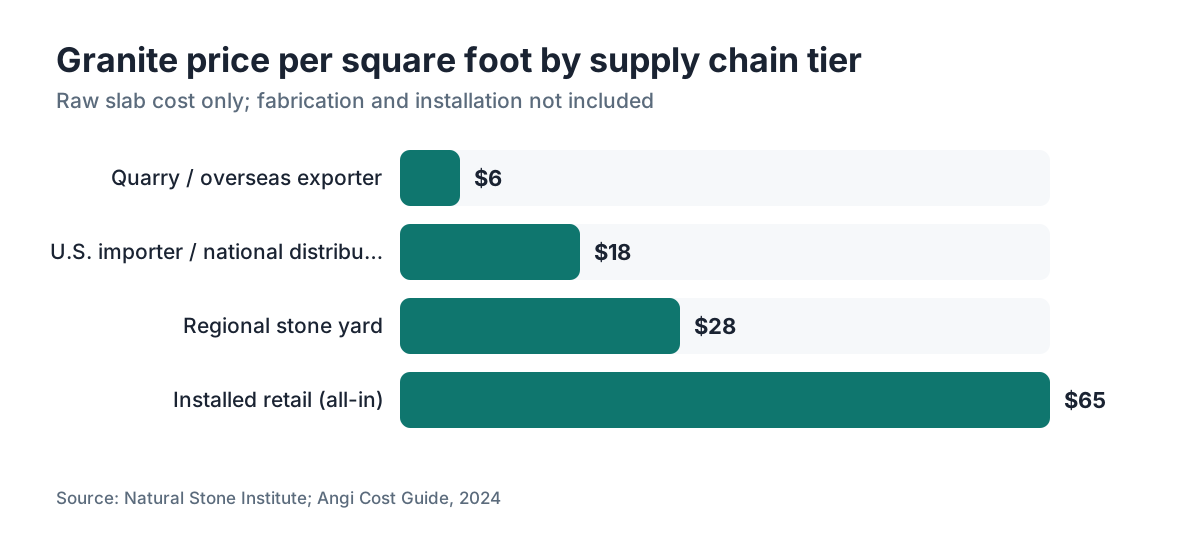
The granite supply chain has at least four price layers. Understanding them explains why "wholesale" means different things to different buyers.
| Tier | Who buys here | Typical slab cost per sq ft |
|---|---|---|
| Quarry / exporter (overseas) | Large importers, container buyers | $3, $10 |
| Importer / national distributor | Fabricators, large tile dealers | $10, $25 |
| Regional stone yard or sub-distributor | Small fabricators, tile shops, some homeowners | $18, $40 |
| Fabricated and installed (retail) | Homeowners | $40, $100+ |
These ranges come from industry pricing guides and distributor public price sheets [1][9]. Exotic or rare stones, like Blue Bahia, Azul Aran, or high-movement Fantasy Brown, push importer pricing to $35, $60 per square foot. That translates to installed retail of $120, $200 per square foot or more.
The quarry-level cost looks tiny, but no homeowner realistically touches that tier. A container of granite slabs from Brazil weighs roughly 20 to 25 metric tons and needs a freight forwarder, a customs broker, drayage to a warehouse, and a facility with a gantry crane or overhead lift to unload it safely [3]. The minimum practical order at the importer level is usually a full bundle (8 to 12 slabs) or a full lot.
The regional stone yard is where most small fabricators actually shop. It's also the tier most accessible to homeowners who want to self-source. Prices here swing hard on location, current inventory, and color demand. A basic colonial white or Santa Cecilia might sit at $18, $22 per square foot wholesale at a regional yard. A trendy leathered quartzite in a gray-gold pattern might sit at $38, $45 per square foot for that same buyer.
How do fabricators find and vet granite wholesale suppliers?
The most direct path for a fabricator is a trade account with one of the major national importers. MSI International, Arizona Tile, and Bedrosians each run regional distribution centers across the U.S. and publish trade pricing to approved accounts [4][5]. Dal-Tile and Emser Tile also carry natural stone, though their core business is ceramic and porcelain. For shops in coastal markets, direct importers with warehouses near major ports (Los Angeles, Houston, Miami, Newark) often have the best selection and the lowest prices on container-fresh material.
Beyond the national players is a long tail of regional importers worth knowing. Many specialize in particular origins: Brazilian stones, Indian granite, or Chinese granite for lower-cost projects. Visiting a stone yard in person matters more than browsing a website, because natural stone varies wildly within a single color name. Two slabs labeled "Uba Tuba" from the same distributor can look noticeably different.
Vetting a new supplier comes down to a handful of questions. Do they provide a certificate of origin or documentation of the stone's source? What are their return and damage policies on slabs that arrive with cracks or voids? Do they let you book specific slabs from a bundle, or do you get whatever they pull? What's their minimum order for trade pricing, and do they offer net-30 terms once a relationship is established?
As volume grows, software that tracks material cost per slab and per job makes it easier to compare supplier pricing over time. Tools like SlabWise connect slab costs to job quoting, so you can see in real time whether a cheaper supplier actually delivers better margin after waste.
Trade shows are a legitimate sourcing channel too. TISE (The International Surface Event) in Las Vegas typically runs in January and puts importers, fabricators, and equipment vendors in one hall [6]. Walking the floor lets you build direct relationships with importers you'd never find through a web search.
Can homeowners buy granite wholesale directly, and is it worth it?
Homeowners can sometimes buy slabs at or near wholesale, but the math only works in specific situations. The slab is one piece of the total. Fabrication (cutting, edging, polishing) runs $25, $50 per square foot on its own, and installation adds another $10, $20 per square foot depending on complexity [2]. Buy a slab at a stone yard for $22 per square foot but still pay full retail fabrication, and your total savings might be $5, $10 per square foot versus letting the fabricator source the material.
The math gets better on a large project, when you find a truly exceptional stone the fabricator doesn't carry, or when you buy a remnant a fabricator already has on hand. Remnants are the real play for small projects. A fabricator's offcut bin often holds pieces of 10 to 25 square feet, plenty for a bathroom vanity or a small laundry counter, and those go for $10, $30 per square foot at most shops.
The risk of buying raw slabs is real. A full granite slab weighs 500 to 1,000 pounds depending on thickness and size [3]. Moving it takes specialized equipment. A slab that cracks during transport or handling is your loss, not the supplier's, once it leaves the yard. And not every fabricator will work on a homeowner-supplied slab. Some refuse it because they can't warranty a finished product when they didn't control the material.
Want to use wholesale pricing to your advantage? The smarter move is usually to visit a stone yard, pick your specific slabs in person, then bring the fabricator to see them or send photos and measurements. Some fabricators will let you direct-source if you accept that material issues aren't on them. Ask before you assume.
What granite colors and types are available at wholesale, and what affects pricing?
At the importer level, the range is huge: hundreds of named colors from quarries in Brazil, India, Norway, Italy, South Africa, and China. The cheapest wholesale colors tend to be high-production stones from India and Brazil. Absolute Black, Uba Tuba, Santa Cecilia, Venetian Gold, Kashmir White, and Bianco Romano are staples at most distributors and rarely command premium pricing.
Prices climb with stones quarried in limited quantities, stones from a single origin with high extraction costs, or stones that just became fashionable. Blue Bahia comes only from the state of Bahia in Brazil and has real geological rarity. At the importer level it can run $50, $80 per square foot, which means installed retail of $150, $250 per square foot in a major market isn't unusual.
Surface finish shifts wholesale pricing too. Polished is the baseline. A leathered or honed finish takes extra processing time and costs $3, $8 per square foot more even at the wholesale tier. Thickness matters as well: 3 cm slabs price higher than 2 cm by $5, $12 per square foot at the distributor level. For most kitchen work fabricators still prefer 3 cm because it skips the laminated edge build-up.
When you're quoting a granite countertop job, the stone's origin, rarity, and finish drive material cost. Exotic stones that look similar in a photo can carry very different prices, and a quote that treats all granite as interchangeable loses money on the premium jobs.
Here's the thing nobody warns you about: color names aren't standardized in the granite industry. "Bianco Romano" from one distributor might be a completely different stone than "Bianco Romano" from another. Look at the actual slabs, not the name.
How does wholesale granite compare to other countertop materials on cost?
Granite's wholesale pricing edge only means something next to the alternatives at a similar quality level. Here's a rough comparison of wholesale or fabricator-cost ranges for common countertop materials, drawn from available industry data [1][9]:
| Material | Fabricator/wholesale cost per sq ft | Typical installed retail |
|---|---|---|
| Granite (standard) | $18, $35 | $45, $80 |
| Granite (exotic) | $35, $80 | $90, $200+ |
| Quartz (engineered) | $28, $55 | $60, $120 |
| Quartzite (natural) | $30, $70 | $70, $180 |
| Marble | $25, $60 | $60, $150 |
| Butcher block | $15, $30 | $30, $60 |
| Laminate | $5, $15 | $15, $40 |
Granite sits in a strong middle spot. It beats engineered quartz at the fabricator tier for most standard colors, it's a natural stone with unique character, and it's been a known quantity in the trade for decades. Fabricators move fast with it because they've cut thousands of jobs in it.
Comparing granite to marble countertops or cambria countertops, the practical difference is mostly maintenance and surface hardness. Granite is harder than marble and shrugs off acid etching better. It needs periodic sealing (once a year or every few years depending on the stone's porosity), but it forgives a working kitchen far better than most marbles.
On a tight budget, laminate countertops or formica countertops are still a legitimate call. They skip sealing, they install fast, and the material cost is a fraction of even the cheapest wholesale granite. Anyone who tells you they're inferior in every situation is selling stone.
What should fabricators know about buying granite wholesale by the container?
Buying a full container of granite is a different business than buying slabs from a local distributor, and it only pays off at a certain volume. A 20-foot container holds roughly 180 to 250 square meters of slabs depending on thickness and packing. A 40-foot container roughly doubles that. At $3, $8 per square foot at the quarry price, the stone alone runs $5,000, $20,000, plus freight, customs, insurance, and warehouse costs that add another $2,000, $6,000 depending on origin and destination [3].
The customs process for natural stone imports runs through Harmonized Tariff Schedule (HTS) code 6802.93 for granite, which sets the duty rate. Under current U.S. tariff schedules, granite from most countries enters at 0 to 3.7% depending on origin and product form. According to the U.S. International Trade Commission's Harmonized Tariff Schedule, subheading 6802.93 covers "Granite" among worked monumental or building stone. Tariff situations shift with trade policy, so verify with a customs broker before you commit to a container [7].
Container buying makes sense for a fabricator running 2 to 4 crews full-time who can turn a container in 60 to 90 days. The price advantage is real: typically 30 to 50% below regional distributor pricing on the same stone. The catch is you can't inspect individual slabs before purchase, you need warehouse space and handling equipment, and you carry inventory risk if demand for that color softens.
Many mid-size shops solve this by splitting a container with one or two other shops. You divide the slabs, share the freight, and each gets material at near-importer pricing without the full inventory burden. It's common in regional markets and works well when you have a clear agreement on how lot variation gets distributed.
Accurate cost tracking across both channels, container and individual slab, separates profitable shops from busy-but-broke ones. The per-square-foot cost of container granite looks great until you count the slow-moving slabs sitting in the yard for eight months.
What are the hidden costs that eat into wholesale granite savings?
The gap between the wholesale slab price and what a finished countertop actually costs a fabricator is bigger than most homeowners (and some newer fabricators) expect. Here are the real cost layers between "$20/sq ft wholesale" and the final invoice.
Fabrication waste is first. A typical kitchen job loses 15 to 25% to cutouts, edge offcuts, and template constraints [2]. Pay $20 per square foot for stone and you're actually paying for more square footage than lands on the counter. On a 40 sq ft kitchen, you might buy 50 sq ft of stone. That changes your effective cost per installed square foot.
Shop labor to cut, edge, polish, and install runs $25, $50 per square foot of finished countertop in most U.S. markets, though it varies a lot by region and shop efficiency. Equipment overhead (bridge saws, CNC machines, polishers, trucks) adds another $5, $15 per square foot when amortized across jobs. Consumables like blades, polishing pads, and adhesives add $2, $5 more.
Delivery and installation labor is often billed separately and adds $150, $400 per trip depending on job complexity, stairs, and distance from the shop.
Here's the number that surprises homeowners who plan to self-source: after paying fabrication, installation, and delivery, the savings on a typical 40 sq ft kitchen might be $200, $600 versus using a full-service fabricator who sources their own material. Real money, sure. Not the 50% discount "wholesale pricing" implies. The fabricator's material markup is usually 15 to 35%, not 100%.
Read the countertop installation guide before you assume your kitchen is a simple job. Complex layouts, high-end edge profiles, multiple sink cutouts, and cooktop cutouts all add labor time that has nothing to do with material cost.
How to spot a legitimate wholesale granite deal versus misleading marketing
The phrase "wholesale granite" runs constantly in retail advertising because it performs well in search. Plenty of companies advertising wholesale pricing are just fabricators with a direct-to-consumer model. That's fine, often genuinely good value, but it isn't buying at the importer tier.
Legitimate wholesale pricing has a few consistent traits. The price is per slab or per square foot of raw stone, not per square foot of installed countertop. The quote breaks out material, fabrication, and installation as separate line items. The company either has visible slab inventory you can visit and select from, or documented accounts with named national importers. They can tell you the stone's country of origin and quarry region.
Red flags: all-in "wholesale" prices suspiciously close to market retail (say, $45/sq ft installed for a basic color), vague "direct from the quarry" language that can't be verified, no chance to see or select the actual slabs, and pressure to commit to a price before you see the material.
For kitchen countertops, a genuinely good price from a reputable direct fabricator on standard granite (polished, basic color, straight edge) in most U.S. markets is $45, $65 per square foot installed. Anything below $40 installed for real granite (not laminate or low-grade cultured stone) deserves hard scrutiny. Stone, labor, overhead, and delivery don't compress much below that.
Get at least three quotes from different fabricators. It's still the single best thing a homeowner can do to calibrate pricing in their market. Prices vary 30 to 50% between high-overhead showroom operations and lean direct fabricators, and that spread has nothing to do with stone quality.
What do fabricators need to run a profitable wholesale granite operation?
Running a shop that sources granite wholesale and fabricates it profitably means getting several things right at once: supplier relationships, accurate material costing, efficient job quoting, and waste control.
Supplier relationships take time. The best pricing from a national distributor usually shows up after 12 to 24 months of steady buying history. Many distributors tier their pricing: a shop buying $5,000/month gets a different price sheet than one buying $50,000/month. Building volume with two or three primary suppliers, rather than spreading purchases thin across ten, gets you better pricing faster.
Accurate material costing is where a lot of shops quietly bleed money. Quote jobs off a rough per-square-foot material cost without accounting for job-specific waste, edge lengths, and cutout counts, and you'll profit on simple jobs and lose on complex ones. The margin on a multi-piece island with a waterfall edge and an undermount sink behaves nothing like a straight galley kitchen.
Quoting software that ties wholesale slab costs to individual job estimates kills most of that error. SlabWise is built for this workflow: enter your actual slab cost, the software calculates material usage and waste from the job layout, and the quote reflects real economics instead of averages.
Waste control ties straight to profit. A well-nested job (efficient piece layout on the slab) can cut waste from 25% down to 12 to 15% on a complex kitchen. Over a year of production, that recaptures a meaningful amount of material cost. Shops that track waste per job and review it regularly beat shops that don't.
And for the how to clean stone countertops questions customers always ask, hand them a simple care sheet at installation. It builds trust and cuts callbacks. Small thing. It matters.
Frequently asked questions
What is the cheapest way to get granite countertops?
Buying a fabricator's remnant is usually the lowest per-square-foot cost a homeowner can find, often $10, $25 per square foot for the stone itself. For a full kitchen, getting quotes directly from fabricators who source wholesale (rather than through a showroom) and picking a high-volume standard color like Uba Tuba or Santa Cecilia saves 20 to 40% versus a premium showroom.
Can I buy granite slabs directly from a wholesaler as a homeowner?
Sometimes, yes. Some stone yards and regional distributors have public sale days or allow walk-in purchases. Others require a business license and resale certificate. The more common path for homeowners is buying from a fabricator's remnant bin or from a stone yard that operates as a hybrid retailer. You'll still arrange fabrication and installation separately.
How much does a full granite slab cost wholesale?
At a regional distributor, a full granite slab (roughly 45 to 60 square feet) for a standard color runs $800, $1,500 per slab. Exotic or rare colors can hit $3,000, $5,000 per slab at the same tier. At the importer level, the same standard slab might cost $450, $900, but minimum order requirements and account prerequisites usually apply.
What is the difference between a granite slab and a granite tile for countertops?
A slab is a single continuous piece, typically 2 or 3 cm thick and 45 to 65 square feet in area, cut from a quarry block. Tiles are smaller cut pieces, usually 12x12 or 18x18 inches, set with grout joints. Slabs are standard for countertops because there are no grout lines to harbor bacteria or stain. Tiles are much cheaper at wholesale but rarely used for countertops in new installations.
Do I need a contractor's license to buy wholesale granite?
A contractor's license isn't universally required, but most genuine wholesale accounts need a business license and a state resale certificate (seller's permit) so the distributor can sell to you tax-exempt. Exact requirements vary by state and by distributor. Some stone yards have no requirements at all for cash sales.
How do I know if a granite wholesale price is actually good?
Compare the price to published distributor price sheets from major importers like MSI or Arizona Tile, which trade buyers can access. For a standard polished granite like Absolute Black or Santa Cecilia, a genuine wholesale price at a regional distributor should be $18, $30 per square foot of raw slab. If an all-in installed price is advertised as wholesale, you're looking at retail with a marketing label.
What granite colors are cheapest at wholesale?
High-production stones from India and Brazil consistently carry the lowest wholesale prices: Absolute Black, Uba Tuba, Santa Cecilia, Venetian Gold, Bianco Romano, and Kashmir White are examples. These colors are quarried in large volumes and widely stocked at distributors, which keeps prices competitive. Expect $18, $28 per square foot at a regional stone yard for these colors.
Is 2 cm or 3 cm granite better to buy wholesale for countertops?
For kitchen countertops, 3 cm is the U.S. fabrication standard because it drops the need for a plywood substrate and gives a thicker finished edge without laminating. It costs $5, $12 more per square foot at wholesale but saves labor time in fabrication. For bathroom vanities where weight matters, 2 cm is still commonly used.
How do granite importers handle damaged slabs?
Policies vary, but most reputable importers replace or credit slabs that arrive cracked if the damage is documented at delivery before the freight driver leaves. Damage found after the driver departs is harder to claim. Fabricators buying in volume should inspect all slabs on arrival and note any damage on the bill of lading. Small natural fissures present before shipping are generally not covered.
What trade shows help fabricators find new granite wholesale suppliers?
The International Surface Event (TISE) in Las Vegas, typically held in January, is the largest U.S. gathering of stone importers, fabricators, and equipment suppliers. Coverings, held in spring, focuses more on tile but includes stone importers. Marmomacc in Verona, Italy is the global benchmark for natural stone sourcing and draws serious U.S. importers building direct quarry relationships.
Can I mix slabs from different suppliers on a single countertop job?
Technically yes, but color and movement variation between slabs from different lots or suppliers is a real risk. Even within the same color name, natural stone varies quarry-to-quarry and lot-to-lot. On a large kitchen that needs more than one slab, most fabricators want all slabs from the same bundle or at least the same supplier lot. Mixing sources raises the chance of a visible seam color mismatch.
What happens to wholesale granite remnants and can I buy them cheaply?
After fabricating a countertop job, a fabricator usually has offcut pieces ranging from a few square feet to 15 to 25 square feet. These remnants sell off at deep discounts, sometimes $10, $25 per square foot, because they take up yard space. Remnant bins are worth checking for bathroom vanities, small islands, or accent pieces. Most shops update remnant inventory infrequently, so call ahead.
Is wholesale granite the same quality as what I see in showrooms?
The stone is the same product. What changes is the selection process. Showrooms often curate their display slabs for visual appeal, while a wholesale yard shows the full range including slabs with more variation, fissures, or movement. Lower wholesale prices sometimes reflect slower-moving colors or stones with more natural variation, not lower material grade. Always inspect the actual slabs you're buying.
How do tariffs affect the price of imported wholesale granite?
Granite falls under HTS code 6802.93 in the U.S. Harmonized Tariff Schedule. Most-favored-nation (MFN) duty rates for this category have historically run 0 to 3.7% depending on origin and form. Trade policy changes, including Section 301 tariffs on Chinese goods and shifting trade agreements, can affect prices from specific origins. Fabricators buying container loads should confirm current duties with a licensed customs broker before committing.
Sources
- Angi, Granite Countertops Cost Guide: Granite countertops typically cost $40, $100 per square foot installed at retail; remnants and direct-from-fabricator pricing can be significantly lower
- U.S. Bureau of Labor Statistics, Producer Price Index for cut stone and stone products: Fabrication and installation labor costs for stone countertops; material waste percentages in countertop fabrication
- USGS National Minerals Information Center, Stone (Dimension) statistics: Weight and volume data for dimension granite slabs; container import volumes for natural stone
- MSI International, Trade account and product information: MSI operates regional distribution centers and offers trade pricing to approved fabricator accounts
- Arizona Tile, Trade program information: Arizona Tile offers wholesale trade accounts to fabricators with business licenses and resale certificates
- TISE, The International Surface Event, official show information: TISE is held annually in Las Vegas and is the largest U.S. trade event for stone importers and fabricators
- U.S. International Trade Commission, Harmonized Tariff Schedule: HTS subheading 6802.93 covers worked monumental or building stone (granite); MFN duty rates run 0 to 3.7% depending on origin
- U.S. Census Bureau, Foreign Trade, stone imports data: Import volumes and country-of-origin data for dimension granite entering the U.S.
- Natural Stone Institute, Natural stone industry statistics and standards: Industry data on granite slab pricing tiers, fabricator margins, and standard slab dimensions
- Natural Stone Institute, Fabrication standards and specifications: Industry standards for granite slab thickness (2 cm and 3 cm), edge profiles, and fabrication tolerances
- Marmomac International Exhibition, Official show information: Marmomac in Verona is the global reference trade show for natural stone importers and quarry operators
Last updated 2026-07-09