TL;DR
- Quartzite is a natural metamorphic rock quarried from the earth, typically harder than granite and requiring sealing.
- Quartz countertops are engineered: roughly 90 to 95% crushed stone bound with polymer resin, never needing sealer.
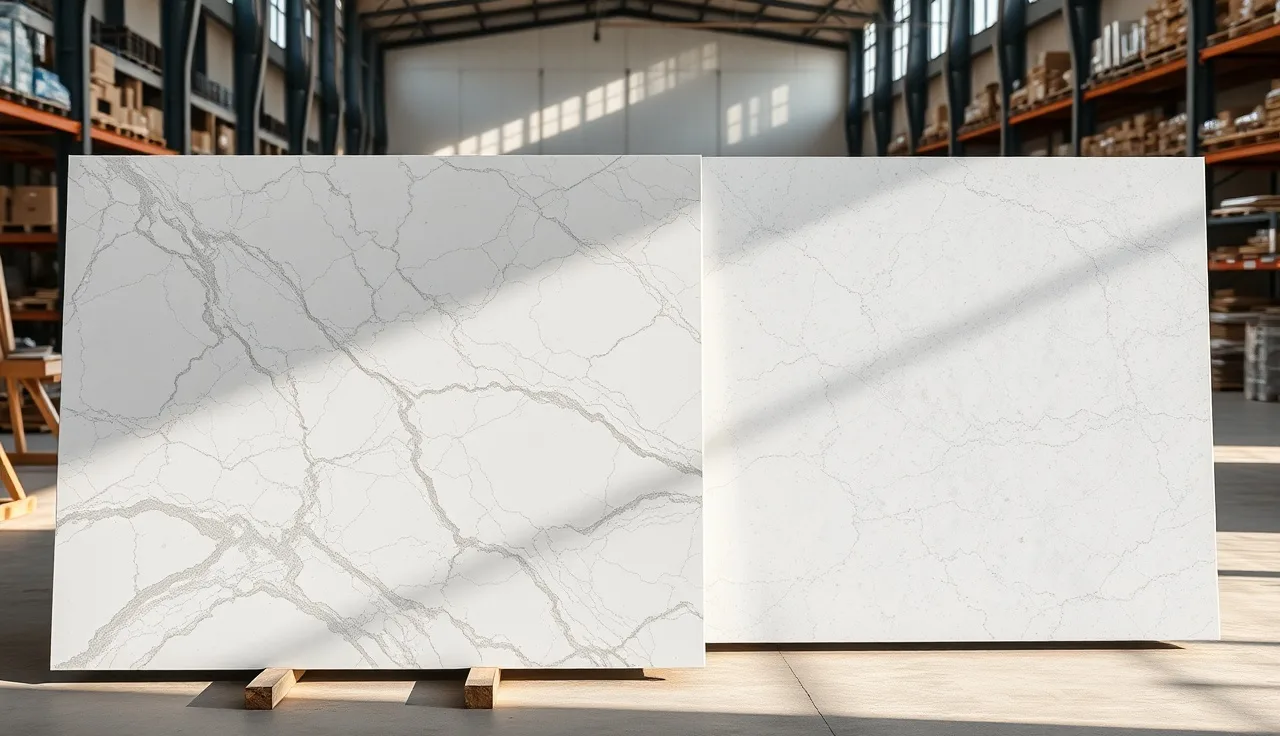
- Both can look like marble.
- They differ in hardness, heat resistance, maintenance, and price.
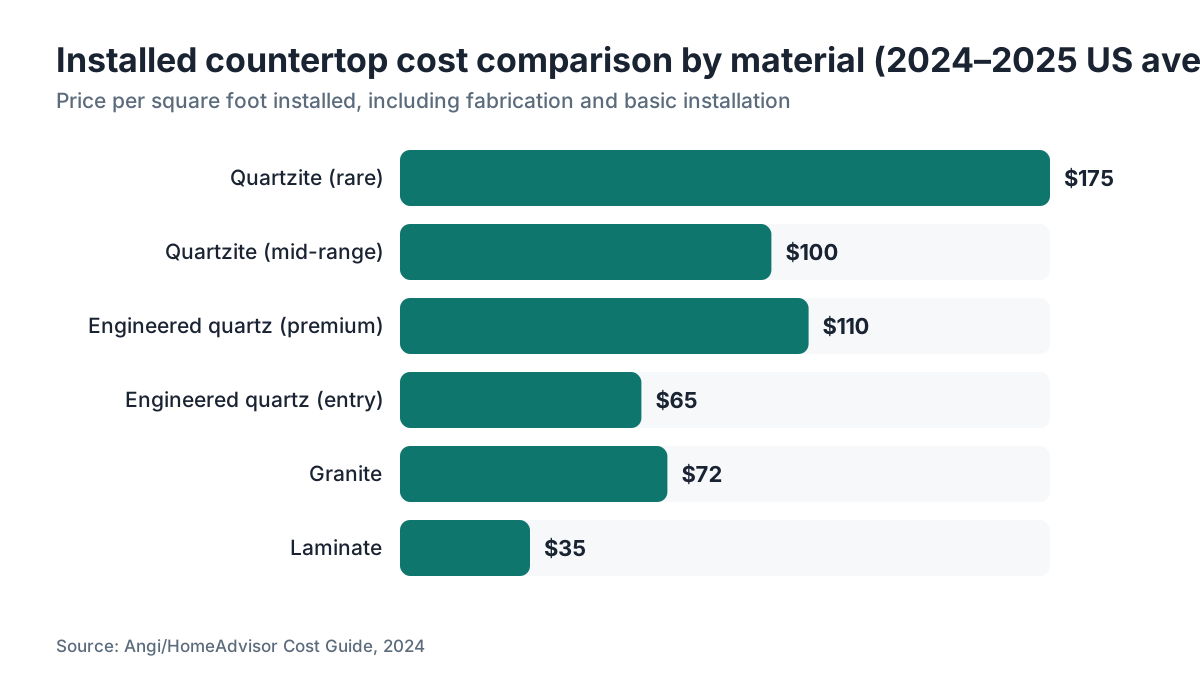
- Quartzite runs $60, $150 per square foot installed; quartz runs $50, $120.
Why do people confuse quartzite and quartz?
The names share nine letters. That's basically the whole reason.
Both materials often get sold with pale, veined slabs that mimic Carrara marble. Both show up in high-end kitchen showrooms sitting side by side. And the terms get muddled in marketing: some fabricators have been caught labeling soft quartzite as engineered quartz, and some slabs sold as "quartzite" are actually marble or dolomite. The confusion is real enough that the Natural Stone Institute has issued guidance warning buyers to ask for documentation on any slab called quartzite [1].
The underlying materials could not be more different, though. One is a natural rock that formed underground under extreme heat and pressure. The other is a manufactured composite built in a factory. Once you understand that split, everything else, including why they behave so differently in a kitchen, makes sense.
What is quartzite, exactly?
Quartzite is a metamorphic rock. It starts as sandstone, mostly quartz sand grains, and gets buried deep enough that heat and pressure recrystallize those grains into a dense, interlocking mosaic of quartz crystals [2]. The result is one of the hardest natural stones used in countertops, typically rating 7 on the Mohs hardness scale. Granite usually lands between 6 and 6.5. Marble is closer to 3 to 4.
Because quartzite is natural, every slab is unique. Colors run from white and gray to gold, pink, and blue-green depending on mineral impurities present during formation. Well-known varieties include White Macaubas (bright white with faint veining), Sea Pearl (silvery with movement), and Taj Mahal (warm cream, very marble-like).
Quartzite is porous. It needs sealing, typically once a year or every couple of years depending on the stone's density and the sealer used [3]. Left unsealed, it can absorb liquids, stain, and in some cases etch. That last point is worth a pause: true quartzite should not etch from acids because it's quartz-dominant, not calcite-dominant. If your "quartzite" etches from lemon juice, you might have marble or dolomite. Ask the supplier for a scratch test with a steel knife (quartzite will win; marble will scratch) before you buy.
For more on keeping natural stone clean without damaging it, see our guide to how to clean stone countertops.
What is quartz (engineered stone), exactly?
Engineered quartz countertops are a manufactured product. The standard composition is approximately 90 to 95% ground quartz aggregate mixed with 5 to 10% polymer resins, pigments, and sometimes recycled glass or mirror chips [4]. Manufacturers compress and cure the mixture under vacuum to eliminate voids, which is why the finished slab is essentially nonporous.
Big brand names you'll see: Caesarstone, Cambria, Silestone, MSI Q Premium Natural Quartz. Cambria is notable for being the only major brand that manufactures entirely in the US (in Le Sueur, Minnesota). Caesarstone is Israeli-owned with US manufacturing. Silestone is a Cosentino brand out of Spain.
Because the pattern is set in a factory, slabs within the same product line are consistent, which matters if you need to match countertops across a large kitchen or replace a section years later. Natural stone slabs from the same quarry lot can still vary in veining and color.
The resin binder is also quartz's Achilles heel for heat. Most manufacturers publish warnings against sustained direct heat: Caesarstone's care guide, for example, advises always using trivets and hot pads and warns that thermal shock or extreme heat can damage the surface [5]. The resin can discolor or crack if a screaming-hot cast iron pan sits on it.
How do quartzite and quartz compare on hardness and durability?
Hardness is where quartzite wins cleanly. At Mohs 7, true quartzite resists scratching from most kitchen tools. A steel knife blade is Mohs 5.5 to 6.5, so it won't scratch quartzite in normal use. Engineered quartz also does well, around Mohs 7 for the quartz aggregate, but the resin binder between grains is softer and can be gouged if you drag something sharp with real force.
For heat, the comparison flips. Natural quartzite is stone; it can handle a hot pan without a structural problem. Engineered quartz cannot, because the polymer resin degrades under sustained heat above roughly 150°C (300°F) [4]. In practice, most cooks should use trivets on both surfaces to be safe, but quartzite has more forgiveness.
Impact resistance is roughly equal in daily use. Quartzite can chip at edges if struck hard, just as engineered quartz can. Thicker slabs (3 cm versus 2 cm) reduce chip risk on both.
For everyday durability, engineered quartz is actually harder to damage in typical kitchen use because it's nonporous. You don't have to seal it, you don't have to worry about a wet cutting board sitting overnight, and coffee or wine won't stain it if you wipe it up reasonably soon. Quartzite, if properly sealed, is close, but it takes more active management.
Which one needs more maintenance?
Engineered quartz wins this comparison by a lot. No sealing, ever. Clean it with mild soap and water or a stone-safe cleaner. Avoid prolonged contact with very harsh chemicals (bleach, acetone) because they can degrade the resin over time, but normal kitchen cleaning is no issue.
Quartzite needs sealing on a schedule. The frequency depends on the specific stone's porosity and the sealer you use. A dense quartzite sealed with a penetrating fluoropolymer sealer might only need re-sealing every two to three years. A more porous variety might need it annually. The Marble Institute of America (now the Natural Stone Institute) recommends the water-drop test: drop water on the surface; if it soaks in within 5 minutes rather than beading up, it's time to reseal [3].
Quartzite is also more finicky around acidic foods than most homeowners expect. True quartzite shouldn't etch, but many slabs sold as quartzite are actually softer calcite-bearing stones that will etch. Until you're certain of your slab's identity, treat it like you'd treat marble around lemon juice and vinegar. Our guide on how to clean quartzite countertops walks through safe daily cleaning in detail.
What does each one cost?
Prices vary a lot by region, slab rarity, and shop markup, so treat these as realistic ballpark ranges rather than hard quotes.
Engineered quartz typically runs $50, $120 per square foot installed in the US as of 2024 to 2025 [6]. Entry-level solid colors (think builder-grade white) sit at the low end. Designer or patterned slabs with lots of movement from brands like Cambria can push toward the top of that range or beyond.
Natural quartzite typically runs $60, $150 per square foot installed [6]. Common varieties like White Macaubas sit mid-range. Rarer stones like Azul Macaubas (vivid blue) or Van Gogh quartzite can exceed $200 per square foot installed when you factor in the slab cost and fabrication complexity.
Fabrication labor is similar for both materials, though quartzite's hardness means tool wear is higher, and some shops charge more to cut it. A full kitchen (35 to 40 square feet of countertop) in mid-range engineered quartz might run $2,000, $4,500 installed. The same square footage in a popular quartzite might run $2,500, $5,500, with rare stones going higher.
If you're a homeowner trying to get a fast read on your project, the SlabWise instant quote tool lets you plug in your measurements and material choice to get a realistic number in minutes.
For comparison across more materials, see our broader guide on kitchen countertops.
Does either one look better, or is that just opinion?
Mostly opinion, but with some facts underneath.
Engineered quartz has improved dramatically since its introduction in the 1980s by Breton S.p.A., the Italian company that patented the Bretonstone process [7]. Modern slabs can fool most people in a showroom photo. But if you put a slab of Taj Mahal quartzite next to its closest engineered imitation, the natural stone has depth, translucency, and movement that manufactured slabs still don't fully replicate. The veining in engineered quartz is applied at the surface; in quartzite, it runs through the full thickness of the slab.
Engineered quartz is better at consistent pattern matching. If you have an L-shaped kitchen with three seams, quartzite slabs from the same lot will still vary. Engineered quartz from the same product run will be nearly identical, which makes seam placement more predictable.
For people who want the look of marble with less maintenance anxiety, both materials compete directly. Quartzite's Taj Mahal or White Macaubas gets closest to actual marble appearance. Engineered quartz's Calacatta or Statuario lines are also convincing and far easier to live with. Actual marble countertops are softer (Mohs 3 to 4) and etch readily, so both quartzite and quartz are more durable marble alternatives.
Which is better for resale value?
Neither material has well-controlled resale value data specific to countertop type. The National Association of Realtors and Remodeling Magazine's annual Cost vs. Value report tracks kitchen remodels broadly but doesn't break out quartzite versus quartz [8]. Real estate agents generally say that stone countertops of any kind outperform laminate or tile in buyer perception, but the premium between quartzite and quartz is not well-documented.
What's documented: the 2024 Cost vs. Value Report found that a minor kitchen remodel (which includes countertop replacement) returned roughly 96.1% of its cost at resale on average nationally [8]. A major upscale kitchen remodel, which would include high-end stone, returned about 38.7%. The lesson: going upscale does not pay back dollar-for-dollar. Spend on natural quartzite because you want it, not because you expect to recoup it.
For buyers who want a stone look at lower cost, laminate countertops including Formica now have convincing stone prints and run $20, $50 per square foot installed, though they don't appraise or hold up the same way.
How can you tell quartzite from quartz (or marble) in a showroom?
A few practical tests help.
The scratch test: drag a steel key across an inconspicuous spot. True quartzite at Mohs 7 will not scratch. Marble or dolomite at Mohs 3 to 4 will scratch visibly. Engineered quartz resists scratching similarly to quartzite in this test.
The acid test: put a drop of muriatic acid or even lemon juice on the surface. Calcite-bearing stones (marble, dolomite, limestone) will fizz and etch. True quartzite and engineered quartz will not. If a slab sold as quartzite fizzes, it's not quartzite.
Ask for the material's geological report or quarry documentation. Reputable importers provide this. The Natural Stone Institute's Accredited Natural Stone Companies program verifies member claims about stone identity [1].
Look at the back of the slab. Engineered quartz slabs have a factory-finished, uniform back. Natural quartzite has a rougher, clearly natural cleft or saw-cut back with no uniform resin layer.
Edge profiles can also give clues: in a polished edge on quartzite, you can see that the veining runs through the full thickness of the stone. In engineered quartz, the interior is more uniform, and the surface pattern doesn't always continue consistently through the edge.
Are there environmental differences between quartzite and quartz?
Quartzite is mined from the earth. Mining has environmental costs: land disturbance, water use, diesel for equipment, and transport (much quartzite comes from Brazil, India, or Norway). The stone itself is inert and lasts indefinitely with no off-gassing.
Engineered quartz contains polymer resins, typically polyester or epoxy-based, which are petrochemical products. Manufacturing requires energy-intensive vacuum compression and curing. However, some manufacturers have introduced recycled content (recycled glass, post-industrial quartz waste) and some hold certifications like GREENGUARD Gold for indoor air quality [9]. GREENGUARD Gold certification means the product meets strict chemical emission limits suitable for schools and healthcare settings, which is a useful benchmark for kitchens.
The honest answer is that neither material is clean from a lifecycle standpoint. Quartzite's footprint is heavily weighted toward extraction and shipping. Engineered quartz's footprint includes those same transport costs plus resin manufacturing. If sustainability is a priority, look for domestically quarried stone or GREENGUARD-certified engineered products, and consider that either surface, if it lasts 30 years, has a much better per-year footprint than a surface replaced every 10 years.
For a very different environmental profile, butcher block countertops made from FSC-certified wood are a renewable option, though they require their own maintenance regimen.
What do fabricators need to know about cutting and handling each material?
If you're running a shop, quartzite and engineered quartz both cut with diamond tooling, but they behave differently at the saw and CNC.
True quartzite at Mohs 7 eats blades faster than granite. Budget for shorter blade life. The stone's hardness also means it can chip more aggressively at interior corners and cutouts if feed rate is too fast. Slow, steady passes with good water cooling are non-negotiable.
Engineered quartz is more uniform, which makes CNC programming predictable, but the resin content can cause smearing and gumming on blades if water cooling is inadequate. Some fabricators report that cheap engineered quartz cuts gummy; premium brands cut cleaner. Edge polishing on engineered quartz goes faster than on quartzite because the material is more consistent.
Seam placement matters more on quartzite because the natural pattern won't repeat. Book-matching (mirroring adjacent slabs from the same block) is possible and gorgeous on quartzite; it requires buying matched slabs upfront. Engineered quartz patterns repeat on a fixed tile, so seams on busy patterns need careful placement to avoid the repeat looking mechanical.
Fabrication software that handles slab nesting, remnant tracking, and job costing saves real money on both materials, particularly when slab costs are high. The SlabWise platform is built specifically for this workflow.
Which should you actually choose?
Here's the honest opinion: for most busy households, engineered quartz is the better countertop. It's nonporous, needs no sealing, handles acidic foods without complaint, and costs less at the entry and mid-range. If you have kids, if you cook a lot, if you dislike maintenance tasks, quartz is just easier.
Choose quartzite if you want a one-of-a-kind natural stone surface, you're willing to seal it and treat it with care, you love the specific look of a stone like Taj Mahal or Azul Macaubas that engineered products can't fully imitate, and you have the budget for it. Quartzite in a well-run kitchen can outlast any manufactured product. Natural stone is also harder to damage in ways that look cheap: a deep chip in quartzite can sometimes be honed; a crack in engineered quartz is harder to hide because the resin color doesn't match.
If your real concern is budget, compare both against granite countertops, which often run $45, $100 per square foot installed and are extremely durable, or even Corian solid surface at $40, $80, which repairs almost invisibly in ways stone can't match.
For help planning your countertop installation budget and process, see our countertop installation guide.
Frequently asked questions
Is quartzite harder than quartz countertops?
True quartzite rates about Mohs 7, similar to engineered quartz's aggregate. But the polymer resin binding engineered quartz is softer than the stone itself, so in real-world scratch resistance the two are close. Quartzite has the edge in heat resistance because it has no resin to degrade. For scratch resistance in normal kitchen use, both perform well.
Does quartzite need to be sealed?
Yes. Quartzite is porous and needs a penetrating sealer applied periodically. How often depends on the stone's density and the sealer used; a dense quartzite with a quality fluoropolymer sealer might only need re-sealing every two to three years. The simple test: drop water on the surface. If it absorbs within five minutes instead of beading up, it's time to reseal.
Does engineered quartz need to be sealed?
No. Engineered quartz is nonporous by design. The polymer resin fills all voids during manufacturing, so liquid cannot penetrate the surface. No sealer is needed, ever. This is one of its biggest practical advantages over natural stone surfaces including quartzite, granite, and marble, all of which require periodic sealing to prevent staining.
Can you put hot pans on quartzite or quartz countertops?
Quartzite, being natural stone, handles heat better. Engineered quartz countertops contain polymer resin that can discolor or crack under sustained direct heat above roughly 300°F (150°C). Most manufacturers explicitly warn against placing hot pans directly on quartz surfaces. Use trivets on both materials to be safe, but quartzite has significantly more heat tolerance than engineered quartz.
How do I know if a slab sold as quartzite is actually quartzite?
Ask for quarry documentation. Scratch it with a steel key: true quartzite at Mohs 7 won't scratch. Drop a little lemon juice on it: quartzite won't fizz or etch, but marble and dolomite (often mislabeled as quartzite) will. Look at the slab back: natural stone has a clearly natural, non-uniform back. Reputable importers provide geological provenance documentation on request.
Which is more expensive, quartzite or quartz countertops?
Quartzite typically costs slightly more. Installed prices run roughly $60, $150 per square foot for quartzite versus $50, $120 for engineered quartz, based on current US market ranges. Rare quartzite varieties like Azul Macaubas can exceed $200 installed. Entry-level engineered quartz in solid colors sits at the low end of its range. Fabrication labor is similar for both.
Which looks more like marble, quartzite or engineered quartz?
Both can look very close to marble. Quartzite varieties like Taj Mahal and White Macaubas are often nearly indistinguishable from high-end marble in appearance, with veining running through the full slab thickness. Engineered quartz Calacatta and Statuario patterns are also convincing but the pattern is surface-applied and repeats on a fixed tile. Most designers give quartzite a slight edge in natural depth and translucency.
Are quartzite countertops worth the extra cost?
For the right buyer, yes. If you want a truly unique natural stone surface with better heat resistance than engineered quartz, and you're committed to proper sealing maintenance, quartzite delivers something manufactured products can't fully replicate. If you dislike maintenance or want consistency across a large kitchen, engineered quartz is the better value. The premium is real; whether it's worth it depends entirely on your priorities.
Can quartzite countertops etch from acidic foods like lemon juice?
True quartzite should not etch because it's composed of quartz crystals, not calcite. Calcite is what reacts with acid in marble and limestone. However, many slabs sold as quartzite are actually dolomite, marble, or a mixed stone that contains calcite and will etch. The acid test (a drop of lemon juice) is a reliable field check: fizzing or dull spots mean the stone contains calcite and is not true quartzite.
Which countertop is better for kitchen resale value?
There's no reliable data separating quartzite from quartz specifically for resale value. Remodeling Magazine's 2024 Cost vs. Value Report found minor kitchen remodels return about 96% of cost on average, while major upscale remodels return around 39%. Stone countertops generally help with buyer perception versus laminate or tile, but spending more on rare quartzite is unlikely to return dollar-for-dollar. Choose for the material you want to live with.
Is engineered quartz safe to use indoors? Does it off-gas?
Engineered quartz products certified to GREENGUARD Gold standard meet strict indoor air quality limits for chemical emissions and are considered safe for residential use. The resin content means newly installed slabs may have a faint odor that dissipates quickly. Once cured and installed, off-gassing from quality engineered quartz products is minimal and within established safety thresholds.
How thick should quartzite or quartz countertops be?
The two standard thicknesses are 2 cm (about 3/4 inch) and 3 cm (about 1-1/4 inch). Most residential countertop installations use 3 cm because it's stronger, chips less at edges, and doesn't need a plywood substrate built up underneath. Two-cm slabs cost less and are lighter but require more support. Quartzite at 3 cm is heavy; verify your cabinet structure can support it before ordering.
Can you repair chips or cracks in quartzite or quartz?
Both can be repaired, with different results. Quartzite chips can sometimes be filled with a color-matched epoxy or, for edge chips, ground and re-polished by a skilled fabricator. The natural variation in the stone helps hide repairs. Engineered quartz repairs are trickier because the pigmented resin color must match exactly and cured filler often looks different from the surrounding material. Neither material repairs as cleanly as solid surface like Corian.
Sources
- Natural Stone Institute: The Natural Stone Institute has issued guidance warning buyers to verify stone identity documentation when purchasing slabs labeled as quartzite.
- U.S. Geological Survey, National Minerals Information Center: Quartzite is a metamorphic rock formed when sandstone is subjected to heat and pressure, recrystallizing quartz grains into a dense interlocking structure.
- Natural Stone Institute, Care and Cleaning Guide: The water-drop test is recommended to determine when natural stone needs resealing: if water absorbs within 5 minutes rather than beading, it is time to reseal.
- Caesarstone, Technical Data and Product Care: Engineered quartz countertops are composed of approximately 90-95% ground quartz with 5-10% polymer resins; the resin binder can be damaged by sustained direct heat above 150°C.
- Caesarstone, Care and Maintenance Guide: Caesarstone's published care guide advises always using trivets and hot pads and warns that thermal shock or extreme heat can damage the quartz surface.
- HomeAdvisor (Angi), Countertop Installation Cost Guide 2024: Engineered quartz countertops typically cost $50-$120 per square foot installed; natural quartzite typically costs $60-$150 per square foot installed in the US as of 2024-2025.
- Breton S.p.A. company history: Breton S.p.A. of Italy developed and patented the Bretonstone process for engineered quartz stone in the 1980s.
- Remodeling Magazine, 2024 Cost vs. Value Report: The 2024 Cost vs. Value Report found minor kitchen remodels returned roughly 96.1% of cost at resale nationally; upscale major kitchen remodels returned about 38.7%.
- UL GREENGUARD Certification Program: GREENGUARD Gold certification means a product meets strict chemical emission limits for indoor air quality, suitable for use in schools and healthcare settings.
- Cambria, About Cambria Manufacturing: Cambria is the only major engineered quartz brand that manufactures entirely in the United States, at its facility in Le Sueur, Minnesota.
Last updated 2026-07-10