TL;DR
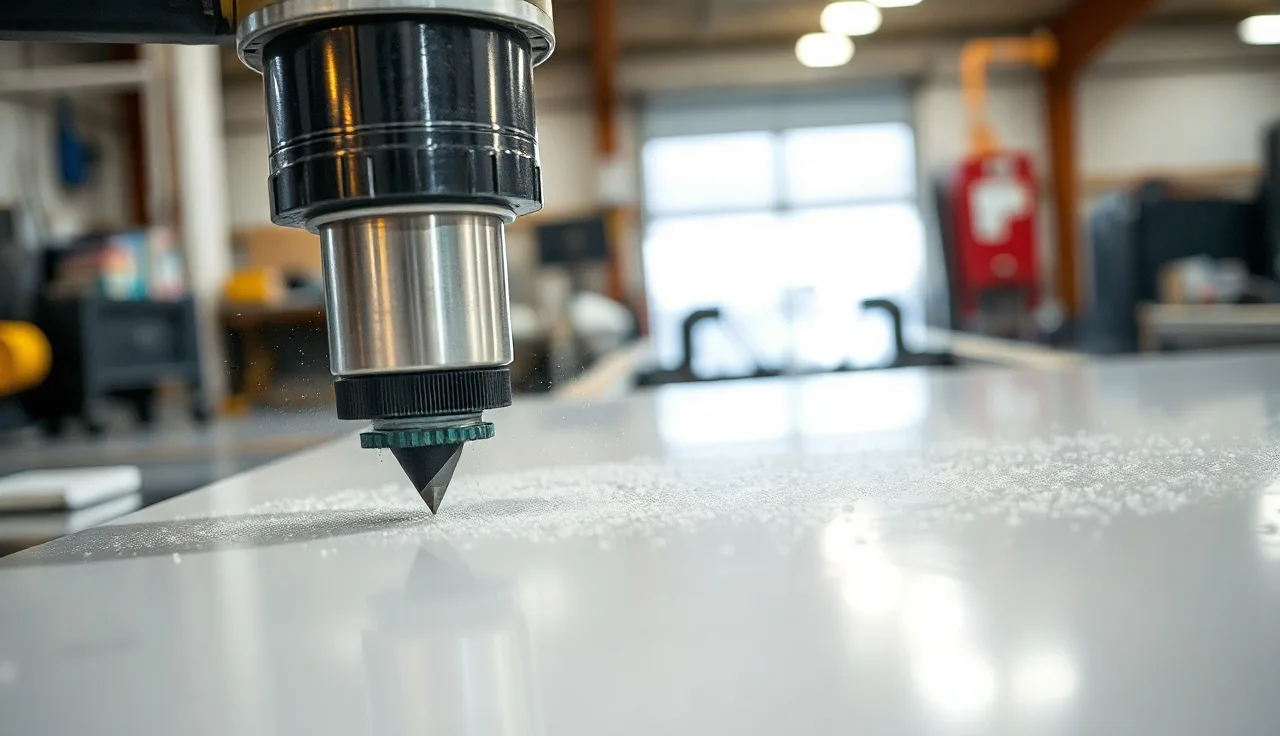
- CNC router bit burn on quartz happens when friction heat passes roughly 300°F at the cutting edge and chars the resin binder holding the quartz crystals together.
- Four causes drive it: feed rate too slow, spindle RPM too high, dull or wrong-geometry bits, and weak water cooling.
- Fix the feed-rate-to-RPM ratio first.
- Slow and careful is the trap that burns slabs.
What is bit burn on quartz and why does it matter?
Bit burn is the dark, sometimes glassy discoloration that shows up on a routed or profiled quartz edge right after the bit passes through. It looks like a scorch mark because it is one. The resin binder in engineered quartz, which makes up roughly 7 to 10 percent of the slab by weight [1], softens and chars at sustained temperatures above about 300°F (149°C). Once the binder burns, the surface chemistry in that spot changes for good. You cannot sand it back to factory condition the way you might buff out a scratch.
Homeowners usually meet burn as a nasty surprise during countertop installation, when a sink cutout arrives with brown or black edges. Fabricators know it as a job-quality failure that can mean a full slab replacement out of pocket. Knowing exactly why burn happens lets you stop it before it starts, not after a $200-per-square-foot slab is ruined.
Quartz behaves nothing like granite under a router bit. Natural stone is mostly mineral crystals with almost no organic binder, so it soaks up more heat before visible damage shows. Engineered quartz is a composite, and that polymer resin is the thermal weak link. Treat it more like a high-filled polymer than like stone.
What are the main causes of CNC router bit burn on quartz?
There are four root causes, and they almost always overlap on a burned cut.
1. Feed rate too slow relative to RPM
This is the most common culprit, and it runs against instinct. Slower feed means each cutting edge spends more time touching the material, which means more friction, which means more heat. The bit rubs instead of cutting. A quartz profiling bit at 18,000 RPM and 150 inches per minute (IPM) generates far less localized heat than the same bit at 18,000 RPM and 80 IPM, even though the slower pass feels safer [2].
2. Spindle RPM too high for the bit diameter
Chip load (the thickness of material each tooth removes per revolution) drops as RPM climbs without a matching feed increase. Lower chip load means more rubbing, less cutting. For a 2-flute, 3/4-inch router bit, a starting RPM of 12,000 to 16,000 is common on quartz. Push to 24,000 without touching feed and you build the rubbing condition [2].
3. Dull or wrong-geometry bits
A dull diamond-tipped bit has a rounded cutting edge instead of a sharp one. Rounded edges push material instead of shearing it, dumping nearly all the mechanical energy into heat. Polycrystalline diamond (PCD) bits built for engineered stone have rake angles tuned for composites. Run a solid-surface bit on quartz and you often get burn even at correct feed rates.
4. Weak or interrupted water cooling
Most CNC stone routers aim water or water-coolant mist at the cut zone. If flow is low, clogged, or pointed wrong, heat has nowhere to go. A perfectly tuned feed-rate-to-RPM ratio still burns quartz if cooling fails mid-pass. Dry-cut situations, like a portable router doing field modifications, have no cooling at all and demand very aggressive feed rates plus frequent bit lifts to manage heat.
How does feed rate affect heat buildup in quartz routing?
Feed rate and heat move in opposite directions during routing: slower feed, hotter cut. That surprises a lot of operators who assume slow and careful always wins.
The physics is simple. Heat at the cutting interface tracks friction force times sliding distance. At low feed rates, each tooth makes repeated small passes over the same resin-filled zone, and heat piles up faster than coolant can carry it away. At higher feed rates, each tooth takes a bigger chip and moves on before conduction pushes heat back into the part [3].
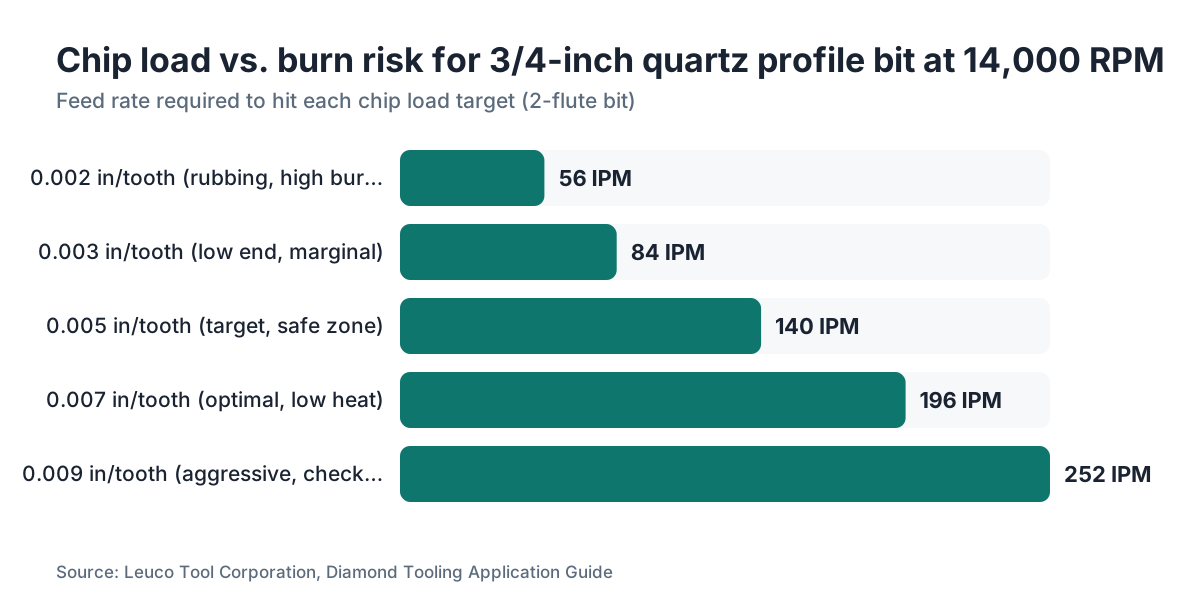
For quartz, fabricators usually target a chip load of 0.003 to 0.008 inches per tooth per revolution, depending on bit diameter and profile. A 2-flute bit at 14,000 RPM chasing a 0.005-inch chip load needs 140 IPM (14,000 x 2 x 0.005 = 140). Drop to 70 IPM and chip load falls to 0.0025, which is rubbing territory for most bit geometries.
The fix is not to slow down. Find the minimum feed rate that keeps chip load in range, then never go below it on a production pass. Test cuts on offcuts, with a thermocouple or thermal camera on the edge, are the fastest way to validate settings for a new profile or a new batch of slabs. Different quartz brands carry slightly different resin content and cure hardness, and those differences shift the safe window.
Does a dull bit always cause burn, or can a new bit burn too?
A new bit absolutely can burn quartz. Bit condition is one variable, not the whole story.
A fresh PCD bit with wrong RPM and feed still burns. A well-maintained bit with a clogged coolant nozzle still burns. Wear does tighten the safe window, though. As diamond segments wear, cutting edges round over, chip load drops for any given feed rate, and you have to push feed higher and higher just to stay in the non-burn zone. Eventually the bit is so dull it cannot cut cleanly at any feed rate the machine can safely reach.
Diamond-tipped router bits on quartz generally last 300 to 600 linear feet of profiling before they need redressing or replacement, though that range swings widely with quartz hardness, silica content, and whether the shop runs steady coolant [4]. Tracking linear footage per bit is basic shop discipline. Skip it and you are guessing.
Wrong geometry matters as much as wear. Bits made for granite have different helix angles and flute layouts than bits tuned for engineered quartz. A granite-spec bit on quartz can burn at feed rates that would be perfectly safe on the material it was built for. Match the bit spec sheet to the material category, every time.
What role does water cooling play in preventing bit burn?
Water cooling is not optional on a CNC router cutting quartz at production feed rates. It is the main way heat leaves the cut zone before it climbs high enough to char resin.
Fabrication CNC machines usually deliver coolant at 0.5 to 2 gallons per minute straight at the bit-material interface. The water pulls heat away by convection and carries it off as hot runoff. Cut that flow and, at aggressive feed rates, cut-zone temperature can jump hundreds of degrees in seconds. At lower feed rates, weak cooling is even more dangerous, because the bit dwells longer per inch of cut [3]. Water cooling does double duty here: OSHA regulates silica dust from cutting engineered stone, and wet methods suppress that dust while they carry heat away [11].
The cooling problems that cause burn:
- Clogged coolant ports (slurry buildup is the usual suspect)
- Kinked or pinched coolant lines
- Nozzle aimed at the bit body instead of the cut interface
- Operator throttling coolant to keep the shop cleaner
- Field or portable work with no coolant system at all
For field modifications, some fabricators clamp a wet sponge near the cut zone or hit it with a spray bottle every few inches. Neither matches a pressurized system, but both beat dry cutting by a mile. If you must cut dry, feed fast and lift the bit every 2 to 3 inches to let the surface cool.
Which quartz brands or formulations are most prone to burn?
No manufacturer publishes exact resin chemistry, so brand-to-brand comparisons stay fuzzy. What we do know: polymer content varies, and higher-resin formulations tend to be more heat-sensitive.
Natural quartz crystal (SiO2) melts near 3,110°F, so the mineral filler is not the problem. The polyester or epoxy resin binder starts softening around 250 to 350°F depending on chemistry [1]. Slabs with heavier resin loading for flexibility or particular looks (some white and light colors use more resin for opacity) show burn sooner than darker, higher-quartz-content slabs.
Cambria countertops markets its products as 93 percent natural quartz [10], near the high end of the mineral-to-resin ratio. Brands lower on mineral content, sometimes 85 to 90 percent, tend to need more conservative parameters.
Color and pigment loads matter too. Heavily pigmented whites and solid colors sometimes carry extra resin to hold pigment in suspension, and the pigment itself can char visibly at lower temperatures than clear resin would. Cutting an unfamiliar brand? Run test profiles on offcuts before you commit to production settings.
What are the right RPM and feed rate settings for routing quartz?
There is no single universal setting, but there are well-worn ranges experienced fabricators start from.
| Operation | Bit Diameter | RPM Range | Feed Rate (IPM) | Chip Load Target |
|---|---|---|---|---|
| Profile routing | 3/4 in (19mm) | 12,000 to 16,000 | 120 to 200 | 0.004 to 0.007 in/tooth |
| Sink cutout | 3/4 in (19mm) | 10,000 to 14,000 | 80 to 140 | 0.004 to 0.006 in/tooth |
| Straight edging | 1 in (25mm) | 10,000 to 14,000 | 150 to 250 | 0.005 to 0.008 in/tooth |
| Freehand portable | varies | 10,000 to 16,000 | operator-paced | lift every 2-3 in |
These ranges come from tooling manufacturer guidance [2][4]. They assume a sharp PCD bit, steady coolant, and a machine with good spindle runout. Any of those off-spec shifts the safe range.
The chip load formula: Feed Rate (IPM) = RPM x Number of Flutes x Chip Load. Work backward from your target chip load and RPM to find the minimum feed rate, then build in a 10 to 20 percent buffer above it. Never program a pass below that minimum. Some shops lock out feed rates below a floor value in the CNC controller so operators cannot dial down mid-cut.
Shops running Intermac, Brembana, or similar CNC stone machining centers often have manufacturer parameter sheets for common materials. Those sheets beat generic web advice, including these numbers, because they account for the specific machine's spindle characteristics [5].
Can a burned quartz edge be repaired, or does the slab need replacement?
Honest answer: true burn damage is almost never fully repairable to factory standard, and a bad repair often looks worse than the burn.
Light surface discoloration that sits only on the top of the resin layer can sometimes be reduced by hand polishing with diamond pads, working from 400 grit up through 3,000 grit. That removes a thin layer of damaged material and softens the look of the scorch. But if the burn went deeper than a few thousandths of an inch, the edge resin is compromised and no amount of polishing brings it back.
For structural burn (charred black area, pitting, crumbling at the edge), the options are:
- Re-route the edge deeper to cut past the burned zone, if geometry allows
- Apply a color-matched epoxy fill (rarely matches well enough for a homeowner)
- Replace the section or the full slab
The business reality: burn on a visible edge almost always ends in a slab replacement at the fabricator's cost if it turns up during installation. That is why catching parameter problems early matters so much. One ruined slab at $150 to $200 per square foot [6] on a typical 30-square-foot kitchen run is a $4,500 to $6,000 loss before labor.
Shops with tight quality control catch burn on the first test profile. Shops without it discover it on the customer's finished piece.
How do fabricators diagnose the actual cause of burn on a specific job?
Start with three questions. Was the feed rate at or above the chip-load minimum? Was coolant flowing and aimed correctly? Was the bit within its service life?
Answer yes to all three with confidence and the problem is probably bit geometry or slab-specific resin content. Pull the bit and inspect the cutting edges under magnification. A worn PCD bit shows rounding, chipping, or glazing on the diamond face. A new but wrong-spec bit can look fine and still cut badly for the material.
Thermal cameras are cheap enough now (some FLIR handheld units run under $500 [7]) that sharp shops use them during test cuts to see where heat gathers on the slab surface. A hot spot that lingers more than 2 to 3 seconds after the bit passes means heat is stacking up above the safe threshold.
For shops juggling many jobs, toolpath software and machine logs expose patterns. If burn shows up at corners (where the bit decelerates), the fix is the CNC controller's corner-deceleration setting, not the bit or feed rate. Most modern controllers let you set a minimum feed through corners so the machine never drops below the burn threshold even in tight geometry.
SlabWise and similar fabrication software can flag jobs that historically caused parameter trouble by material and profile type, so operators spot high-risk combinations before they reach the machine.
A consistent log of bit footage, coolant checks, and parameter settings per profile is the line between guessing and knowing.
Does the type of quartz countertop profile affect burn risk?
Yes, a lot. Profile complexity changes the effective feed rate the bit sees even when the programmed feed stays constant.
A straight edge is continuous linear contact. The bit runs at the programmed IPM for the full length of the cut. A bullnose or ogee profile involves curved toolpaths, and at tight inside curves the CNC's motion planner slows the axis drives to hold positional accuracy through the arc. That drops the actual feed rate below the programmed value, which drops chip load, which raises burn risk.
A 1/4-inch inside radius on an eased edge carries much more burn risk than a 3/4-inch radius bullnose, because the machine decelerates harder through the tighter curve. Waterfall edges or stacked mitered profiles that need multiple passes stack repeated heat exposure in the same zone.
For complex profiles, experienced operators do two things. They bump the programmed feed rate above what they would use on a straight edge to offset the deceleration through curves. And they check the controller's look-ahead and corner-smoothing settings so the machine holds closer to target speed through the curved sections. Some high-end stone CNC controllers run a dedicated high-speed machining mode that handles this on its own [5].
Profile complexity is also worth flagging during quoting and job planning. High-burn-risk profiles should trigger a parameter check before the cut, not after.
How is quartz routing different from routing granite or marble?
The differences are big enough to change your whole parameter strategy, more than nudge a setting.
Granite is almost entirely crystalline mineral with little or no organic binder. It is abrasive, which wears bits fast, but it does not burn the same way because there is no resin to char. Heat damage on granite shows up as micro-cracking or thermal-shock fracture at high temperatures, not surface discoloration from combustion. Shops routing granite countertops run coolant for bit life, not for resin protection.
Marble countertops are calcium carbonate, softer than quartz, and cut more freely. Heat is less of a problem for marble than for quartz, though marble's softness means it chips and scratches more easily from other causes.
Engineered quartz sits in between: harder than marble thanks to the mineral content, but with a thermal weak point that neither granite nor marble has. The right mental model treats quartz routing as a hybrid of stone cutting and high-filled polymer machining. The tooling and coolant come from stone. The thermal-sensitivity parameters come from polymer composites.
So "what works on granite" is not a safe template for quartz. Shops that cut both on the same CNC need separate parameter sets stored in the controller and a clear setup protocol so operators load the right one for each material.
What can homeowners do if their fabricator delivers burned quartz edges?
Document it before installation goes any further. Take close-up photos of the burned edges in good light before the countertop is set in place. It gets much harder to photograph and argue a claim once the slab is installed and the sink is dropped in.
The legal framework is straightforward. Most fabrication contracts carry workmanship warranty language, and burn is a fabrication defect, not a material defect. The manufacturer's slab warranty does not cover fabrication errors. That is the fabricator's responsibility. Caesarstone's residential warranty, for one, excludes damage caused during fabrication, including cutting and routing errors [8].
A calm, direct conversation with the shop owner usually settles it faster than an adversarial one. Show the photos. Ask specifically whether the edge can be re-profiled to remove the burn or whether a replacement section is needed. Get the proposed remedy in writing before you agree to it.
If the shop disputes the claim, call the quartz manufacturer's customer service line. Brands like Silestone, Caesarstone, and Cambria run dealer relations teams that sometimes mediate disputes with their authorized fabricators, though they will not cover fabrication damage directly [9].
As a last resort, a state contractor licensing board complaint is on the table if the fabricator refuses any remedy and the damage is significant. Most states require licensed contractors to correct defective workmanship, and the Federal Trade Commission publishes consumer guidance on home-improvement disputes and warranty rights that homeowners can lean on [12].
For homeowners comparing shops, ask directly: "How do you prevent bit burn on quartz edges?" A fabricator who can talk specifically about feed rates, chip load, and coolant management understands the process. A fabricator who looks confused by the question may not.
Frequently asked questions
Can I prevent bit burn on quartz by just slowing the router down?
No. Slowing RPM without cutting feed rate proportionally raises chip load, which brings its own problems. Slowing feed without cutting RPM makes burn worse by dropping chip load and stretching dwell time. The correct move keeps feed rate and RPM in a ratio that holds chip load in the 0.003 to 0.008 inch per tooth range. Slow and careful is not safer with quartz routing.
How do I know if my router bit is too dull to use on quartz?
Inspect the cutting edges under magnification, ideally 10x or more. A dull PCD bit shows rounded or chipped diamond faces instead of sharp, flat edges. Practically, most shops track linear footage and replace or redress bits at 300 to 600 linear feet on quartz. If burn starts appearing at parameters that were safe last week, that is the most reliable field sign the bit is past its service life.
Does bit burn on quartz affect structural integrity or just appearance?
Both, depending on depth. Surface discoloration on the top layer of resin is mostly cosmetic. Deeper burn that chars through the resin creates a weak zone where the binder no longer holds the quartz crystals properly, which can lead to chipping or edge cracking under normal use. Any burned area that shows pitting, crumbling, or a powdery texture should be treated as structural, not cosmetic.
What temperature actually burns quartz countertop resin?
The polyester or epoxy resin binders in engineered quartz begin to soften and degrade around 250 to 350°F (121 to 177°C), depending on the polymer chemistry. Sustained temperatures above 300°F at the cutting interface are generally the threshold for visible burn. The quartz crystals themselves stay stable at these temperatures. The resin fails first.
Is bit burn covered under the quartz manufacturer's warranty?
No. Quartz manufacturer warranties cover defects in the slab material, not damage from fabrication. Brands including Silestone, Caesarstone, and Cambria explicitly exclude damage caused by cutting, routing, or fabrication errors from their residential warranties. Burn is the fabricating shop's liability, covered or not under their workmanship warranty, not the material brand's warranty.
Can bit burn be fixed with polishing or resurfacing?
Light surface discoloration can sometimes be reduced by hand polishing with diamond pads from 400 up to 3,000 grit, removing a thin layer of damaged resin. Deep burn that has charred or pitted the edge cannot be polished out. Re-routing the edge slightly deeper to cut below the burned zone is sometimes possible if the profile geometry allows. Full slab replacement is the only reliable fix for severe burn on a visible edge.
Does the color of quartz affect how easily it burns?
Indirectly, yes. White and very light quartz colors sometimes carry higher resin loading for opacity and pigment suspension, which makes them marginally more heat-sensitive than darker colors with higher mineral content. There is no public comparative data by brand or color, so run test profiles on offcuts of unfamiliar white or solid colors before committing to production parameters.
What is chip load and why does it matter for quartz routing?
Chip load is the thickness of material each cutting tooth removes per revolution, calculated as feed rate divided by (RPM times number of flutes). Higher chip load means each tooth takes a bigger bite, which is efficient and generates less heat per inch of cut. Too low a chip load puts the bit in a rubbing condition that produces heat fast. For quartz, a chip load of 0.003 to 0.008 inches per tooth is the typical target range.
Why does burn happen more often at corners and tight curves on quartz profiles?
CNC controllers slow the axis drives through tight curves and corners to hold positional accuracy. That drops the actual feed rate below the programmed value, cutting chip load and stretching dwell time exactly where the bit is making repeated passes through the same material. Fabricators compensate by programming a higher feed rate for complex profiles, or by adjusting the controller's corner-deceleration and look-ahead settings to hold speed closer to target through curves.
How is routing quartz different from routing granite in terms of burn risk?
Granite has almost no organic binder, so it does not burn the way quartz does. Heat damage to granite shows up as micro-cracking from thermal shock at extreme temperatures, not surface charring. Quartz holds 7 to 10 percent polymer resin that burns at relatively low temperatures around 300°F. So quartz demands stricter feed-rate-to-RPM discipline and reliable water cooling, while granite routing focuses more on bit wear than on thermal damage.
What coolant flow rate is needed to prevent burn when routing quartz?
Most production CNC stone routers deliver 0.5 to 2 gallons per minute of water coolant at the bit-material interface. Exact volume matters less than making sure the flow is continuous, aimed at the cut zone rather than the bit body, and not interrupted. Clogged nozzles, kinked lines, and operators throttling flow to keep the work area dry are the most common coolant failures behind burn.
Can a portable angle grinder or router burn quartz the same way a CNC does?
Yes, and more easily, because portable tools lack the coolant systems and steady feed of a CNC. Field modifications with a handheld router or angle grinder carry high burn risk on quartz. Best practices for dry portable work: feed aggressively (never linger in one spot), lift the bit every 2 to 3 inches to let the surface cool, and use a water spray bottle or wet sponge near the cut zone as a rough cooling measure.
How long do diamond bits last on quartz before burn risk increases?
PCD diamond router bits on engineered quartz typically last 300 to 600 linear feet of profiling before the cutting edges degrade enough to raise burn risk. That range shifts with quartz hardness and silica content, coolant consistency, and how hard the shop pushes parameters. Tracking linear footage per bit and replacing or redressing at the lower end of that range is the most reliable way to prevent wear-related burn.
Sources
- MDPI Materials Journal, 'Thermal and Mechanical Properties of Engineered Stone Composites' (2021): Engineered quartz contains approximately 7 to 10 percent polymer resin binder by weight, with the resin beginning to degrade thermally at roughly 250 to 350°F depending on chemistry.
- Leuco Tool Corporation, CNC Router Bit Application Guide for Stone and Composites: Recommended chip load of 0.003 to 0.008 inches per tooth and RPM range of 12,000 to 16,000 for 3/4-inch profile bits on engineered stone; low feed rate relative to RPM increases heat generation.
- National Institute of Standards and Technology (NIST), research on thermal aspects of machining polymer matrix composites: Heat generated per unit area at the cutting interface is inversely related to feed rate; slower feed increases heat accumulation when coolant removal rate is constant.
- Tenax USA, Diamond Tooling Maintenance Guide for Natural and Engineered Stone: PCD diamond bits used on engineered quartz typically last 300 to 600 linear feet before redressing or replacement is needed.
- Intermac CNC Stone Machining Centers, Operator and Programming Manual Series: Modern stone CNC controllers include look-ahead and corner-smoothing settings that maintain feed rate through curved toolpaths to prevent dwell-related heat buildup.
- Angi, Quartz Countertop Cost Guide (2024): Typical installed quartz countertop cost ranges from $150 to $200 per square foot for mid-range residential projects as of 2024.
- FLIR (Teledyne FLIR), Thermal Imaging Camera Product Line Overview: Entry-level FLIR handheld thermal cameras are available for under $500 and are used in fabrication settings for diagnostic heat mapping during test cuts.
- Caesarstone USA, Residential Warranty Terms and Conditions: Caesarstone's residential warranty explicitly excludes damage caused during fabrication, including cutting and routing errors.
- Silestone by Cosentino, Warranty and Fabrication Guidelines: Silestone's warranty terms exclude fabrication damage and require authorized fabricators to follow the brand's published cutting and routing specifications.
- Cambria, Product Care and Warranty Information: Cambria states its products contain 93 percent natural quartz and that warranty coverage excludes damage from fabrication processes.
- U.S. Occupational Safety and Health Administration (OSHA), Silica standard and guidance: OSHA regulates silica dust exposure from cutting engineered stone; water cooling during routing serves both thermal and dust suppression functions under these standards.
- U.S. Federal Trade Commission (FTC), Consumer Advice on home improvement and warranty rights: The FTC publishes consumer guidance on home-improvement contracts, workmanship disputes, and warranty rights that homeowners can reference when a fabricator delivers defective work.
Last updated 2026-07-10