TL;DR
- A brushed finish on quartzite countertops is made by abrading a polished slab with wire or diamond brushes, leaving a low-sheen, lightly textured face.
- It hides fingerprints and minor scratches better than a mirror polish, costs roughly $10 to $25 per square foot more than a standard polish, and still needs sealing because the surface stays porous.
What exactly is a brushed finish on quartzite?
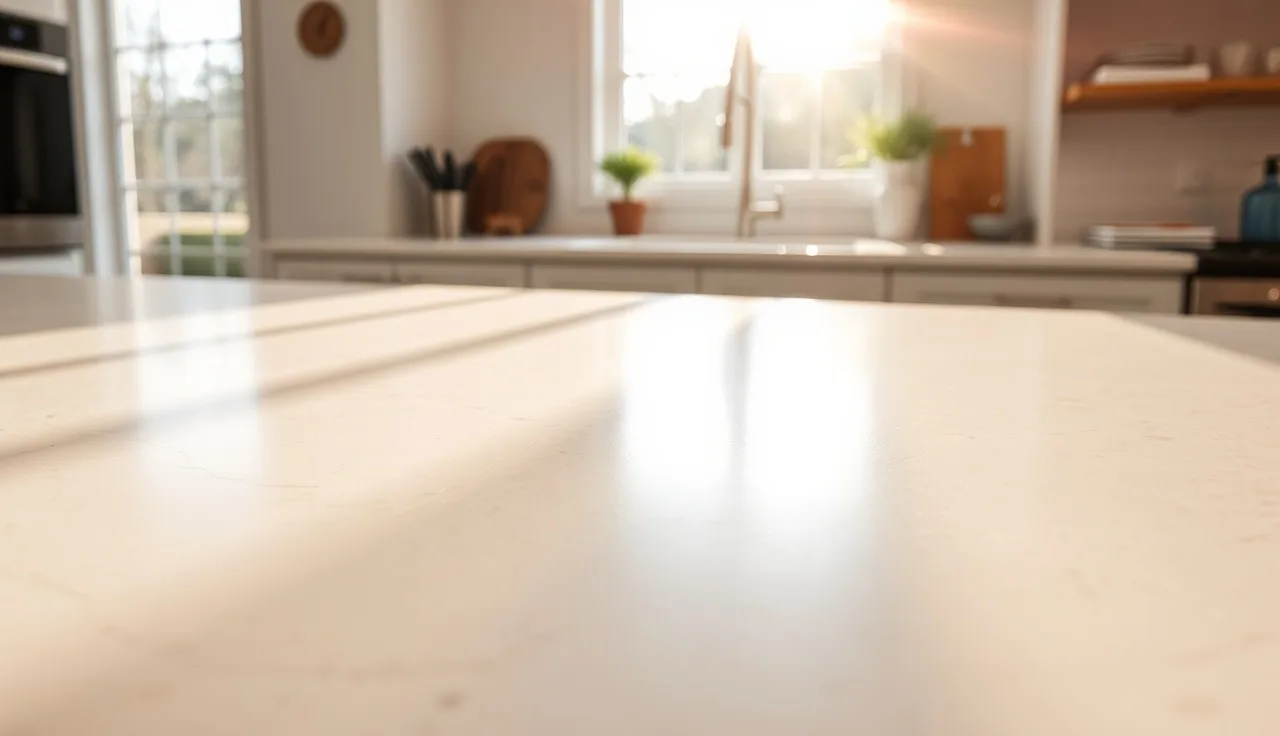
A brushed finish starts as a fully polished slab. Then it gets worked with rotating wire or diamond-tipped brushes that scuff the surface just enough to break the gloss without removing much material. You end up with a matte or satin sheen, a faint micro-texture you can feel when you drag a fingertip across it, and a face that scatters light instead of throwing back a sharp reflection.
Quartzite is a metamorphic rock formed when sandstone gets compressed and recrystallized under heat and pressure, which makes it harder than marble (typically 7 on the Mohs hardness scale versus marble's 3 to 4) [1]. That hardness is why brushing works on quartzite. The stone takes the abrasion without crumbling or losing structural integrity the way a softer stone might.
The look gets called "leathered" in the industry, though fabricators will argue about the difference. Technically, a leathered finish uses diamond-tip brushes on a honed (not polished) surface, while a brushed finish usually starts from polish. In practice many shops swap the terms freely, and the visual result is close enough that homeowners rarely need to care about the distinction. Ask your fabricator which process they actually run and whether the starting surface is honed or polished, because that changes the final sheen level.
The texture depth is subtle, maybe 0.5 to 1.5 mm of surface relief. This is not a rough or rustic surface. It reads refined but lived-in, which is why designers reach for it in kitchens that need to feel warm instead of clinical.
How is a brushed finish made in a fabrication shop?
The work happens on a CNC bridge saw or an automatic polishing line fitted with brush-head attachments. Wire brushes, abrasive nylon brushes, or diamond-impregnated resin brushes spin against the slab at controlled pressure and speed. The fabricator usually makes multiple passes, starting with a coarser brush and finishing with a finer one to even out the texture [2].
Hand-brushing works too, mostly for edges or small repairs. A technician runs a handheld angle grinder with a diamond brush pad in overlapping strokes. It takes longer and the texture comes out slightly less uniform, but for an edge profile or a sink cutout perimeter it's the practical move.
Water or coolant flows the whole time during machine brushing to control heat and carry away stone dust. Dry brushing burns the resin in diamond pads and can micro-crack the surface on some stones, so any shop doing this right keeps everything wet.
Quartzite's hardness means the process takes longer than brushing marble or limestone. Expect a quartzite slab to spend 20 to 40 percent more time under the brushes than a softer stone would. That is one reason the upcharge exists. The labor cost is real, not a markup fiction.
After brushing, the slab gets washed, dried, and inspected under a raking light so the fabricator can catch uneven texture patches before the stone ships to the job site.
How does a brushed finish compare to polished, honed, and leathered?
Here is a straight comparison of the four common quartzite surface finishes:
| Finish | Sheen level | Surface texture | Fingerprint visibility | Relative cost vs. polished |
|---|---|---|---|---|
| Polished | High gloss | Smooth | High | Baseline |
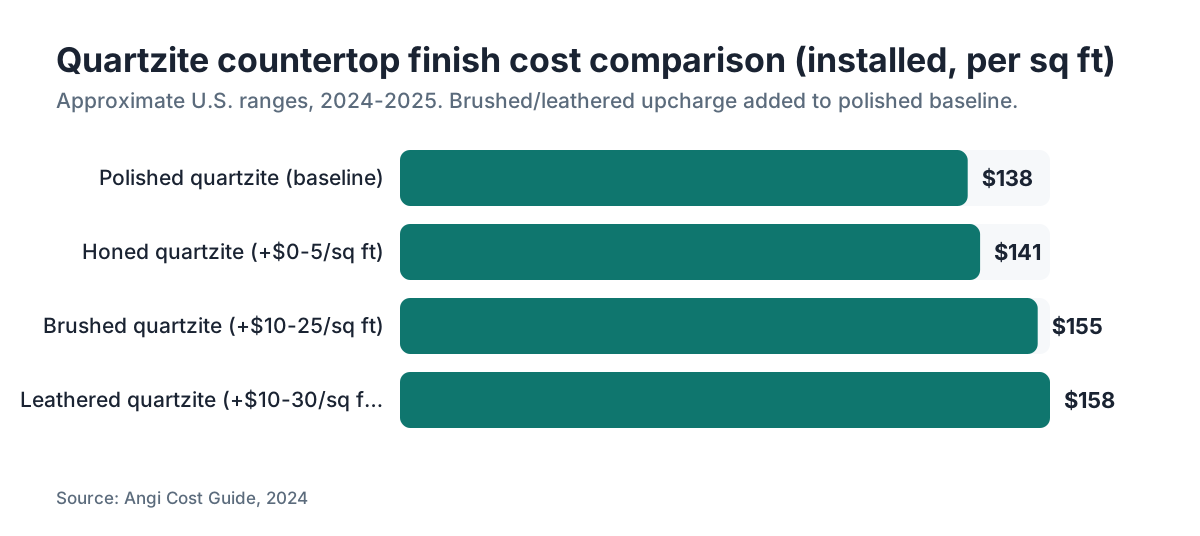
| Honed | Matte, flat | Smooth | Moderate | +$0-$5/sq ft |
| Brushed | Matte to satin | Light micro-texture | Low | +$10-$25/sq ft |
| Leathered | Low satin | Moderate texture, pits follow crystal structure | Low | +$10-$30/sq ft |
Polished quartzite shows the color depth and movement better than any other finish, because the flat reflective surface acts almost like a mirror behind the crystal structure. If you chose quartzite for dramatic veining, polished lets you see the most of it.
Honed is polished quartzite sanded back to a flat, non-reflective matte. Almost no texture, just less gloss. It's the easiest finish for fabricators to produce and the cheapest non-polished option.
Brushed sits between honed and leathered. More texture than honed, slightly less than a full leather. The satin sheen forgives more than a mirror polish but stays brighter than a dead-flat hone.
Leathered follows the natural crystal grain of the quartzite, so pits and undulations track the actual mineralogy of the slab. On a stone with large crystals like some Brazilian quartzites, leathered can feel pronounced. On a fine-grained quartzite it's barely distinguishable from brushed.
For a busy family kitchen, brushed or leathered beats polished on a practical level every single day.
Does a brushed finish affect quartzite's durability or stain resistance?
Brushing opens the micro-pores at the surface slightly more than polishing does. Polishing closes and compresses the surface layer. Brushing reopens it. That makes a brushed quartzite a bit more porous at the surface than a polished one, which matters for sealing [3].
The good news: quartzite is already one of the denser natural stones. Its porosity runs much lower than marble or travertine to begin with. Seal a brushed quartzite with a quality penetrating sealer (siloxane or fluorocarbon-based), and you fill those micro-pores and get stain resistance on par with polished stone. You just have to seal it, and reseal it on a consistent schedule.
A simple water-drop test tells you when to reseal. Put a tablespoon of water on the surface and wait 5 to 10 minutes. If the stone darkens where the water sits, it's time to seal. If the water beads and sits on top, you're still protected [4].
For scratch resistance, brushed quartzite is excellent. Quartzite's hardness of around 7 Mohs means ordinary kitchen tools, ceramic knives included, can't scratch it under normal use [1]. The micro-texture of a brushed finish also makes any fine scratches that do occur essentially invisible, because the surface already carries variation. A polished quartzite shows a scratch immediately because it breaks the mirror. Brushed does not.
Heat resistance is the same regardless of finish. Quartzite tolerates heat reasonably well, but setting a 500-degree pan directly on any stone countertop is a bad habit. The thermal shock risk is real even if the stone itself doesn't burn.
How much does a brushed quartzite countertop cost?
Quartzite countertop pricing swings widely by slab origin, color rarity, and regional labor rates. Here are the general ranges you can expect in the U.S. as of 2024 to 2025.
Polished quartzite installed typically runs $75 to $200 per square foot for material and fabrication combined, with entry-level slabs (like a plain white quartzite) at the low end and exotic Brazilian pieces at the high end [5].
The brushed finish upcharge runs $10 to $25 per square foot on top of base polished pricing at most shops. On a typical 50-square-foot kitchen countertop, that is $500 to $1,250 extra just for the finish. It's a real difference, and it's smart to ask for it as a line item on any quote so you can see exactly what you're paying.
Some high-end shops or designers bundle the finish cost into a "per-slab" price instead of quoting per square foot, which makes comparison harder. Push for square-foot breakdowns on every quote.
For fabricators pricing jobs, the brushed finish burns more machine time and eats brush consumables faster on quartzite than on softer stones. Factor in 20 to 40 percent additional processing time versus a standard polish. If your shop uses SlabWise quoting software, you can add a finish-specific line item so the upcharge always gets captured and never slips through on a busy job.
Edge profiles on brushed slabs add complexity. An ogee or dupont edge needs hand-brushing to match the face finish, and that labor is separate from the face-brushing cost. Simple eased or beveled edges are easier to match and keep total cost down.
Is a brushed finish harder to clean than polished quartzite?
Not harder, just slightly different. The micro-texture means particles can settle into the low spots rather than sitting on a perfectly flat plane. In practice: wipe with a damp cloth and mild dish soap, and the surface comes clean just fine. The texture is shallow enough that a normal cloth reaches it without any special tool [6].
What you want to avoid is abrasive cleaners or scrubbing pads. Those gradually smooth out the brushed texture over years of use, and you end up with an uneven surface that's part brushed and part polished-looking. Stick to soft cloths or microfiber.
Acidic cleaners (vinegar, lemon juice, most bathroom tile cleaners) are a risk on any natural stone, quartzite included. True quartzite with high silica content resists acid better than marble does, but some stones sold as quartzite are actually soft marble or dolomite in disguise. If your stone etches from a drop of lemon juice, you don't have true quartzite [7]. More on that in the next section.
For daily cleaning of quartzite countertops, warm water and a few drops of pH-neutral dish soap on a microfiber cloth is all you need. Dry the surface after cleaning rather than letting water air-dry, because hard-water mineral deposits show more on the low-sheen brushed finish than on polished stone.
For stubborn spots, a poultice made from baking soda and water (paste consistency, applied, covered with plastic wrap, and left overnight) pulls most organic stains out of the micro-pores without hurting the finish.
How do you tell real quartzite from marble or dolomite being sold as quartzite?
This is one of the most common problems in the countertop industry, and it directly affects whether a brushed finish is a good choice for your slab.
True quartzite is more than 90 percent quartz grains recrystallized under metamorphic heat and pressure, giving it a Mohs hardness of about 7 [1]. It resists acid because quartz (silicon dioxide) doesn't react with household acids the way calcite (calcium carbonate, the mineral in marble) does.
Dolomite is a carbonate rock that looks a lot like quartzite and marble. It's softer (Mohs 3.5 to 4) and etches readily. Many slabs sold under fantasy trade names are actually dolomite or dolomitic marble, not quartzite [7].
A simple field test: put a drop of white vinegar or lemon juice on an inconspicuous spot and wait 30 seconds. If the stone fizzes or leaves a dull etch mark, it holds calcite or dolomite and it's not true quartzite. If nothing happens, you're likely dealing with true quartzite.
A brushed finish on true quartzite is a durable, sensible choice. A brushed finish on a soft dolomite sold as quartzite is a problem waiting to happen, because the texture holds acid from food longer than a smooth surface would, which speeds up etching.
If you want certainty, ask the supplier for the quartzite's geological source and request any available hardness or mineralogy documentation. Some suppliers (particularly those sourcing directly from Brazilian quarries) can provide it. Most box-store slabs cannot.
What does a brushed quartzite countertop look like in a real kitchen?
Brushed quartzite reads completely different from the high-gloss kitchen look that dominated the 2010s. It's quieter and more natural. The surface absorbs light instead of reflecting it, which makes the stone feel softer even though the material is harder than ever.
On a white or light quartzite like Super White or White Macaubus, a brushed finish gets close to the look of raw linen, pale with just enough variation to keep it from feeling sterile. On a darker or heavily veined stone like Taj Mahal or Fantasy Brown, the brushed finish makes the veining recede slightly compared to polished but keeps the color depth intact.
Designers often pair brushed quartzite with matte-finish cabinetry, because the two low-sheen surfaces read as one deliberate choice. Polished countertops on matte cabinets can feel discordant. Brushed countertops on matte cabinets feel intentional.
On island countertops that see heavy use, a brushed finish hides watermarks, children's handprints, and the general grime of kitchen life far better than polished. That's not an aesthetic opinion, it's physics. A rough surface scatters light in multiple directions and breaks up the visual continuity of a smudge.
Photographs of brushed quartzite on design sites like Houzz or Architectural Digest consistently show it styled with natural wood, aged brass, or unlacquered bronze hardware. That's no coincidence. The finish has an organic quality that reads well next to warm metals and real wood. See kitchen countertops for more on how different stone finishes work in full kitchen contexts.
Does a brushed finish need to be sealed, and how often?
Yes. Sealing is not optional on brushed quartzite. The brushing process opens micro-pores that a penetrating sealer needs to fill.
For a true quartzite (high silica, low porosity), a quality impregnating sealer applied after installation and then every one to three years depending on use is the standard approach. High-traffic kitchens with frequent cooking and wet surfaces need annual sealing. A low-use surface (a butler's pantry, a bathroom vanity) might go two to three years between applications [4].
On sealers, silane-siloxane or fluoropolymer-based penetrating sealers outperform surface-coating sealers on brushed stone. A surface coating sits on top and can peel or wear unevenly on a textured surface. A penetrating sealer soaks into the pores and bonds from the inside, so there's nothing on the surface to chip or flake.
Application on a brushed surface takes slightly more sealer than on a polished one, because the textured face has more actual surface area. Figure 10 to 15 percent more product per square foot than the label's polished-stone estimate.
The water-drop test from earlier is the simplest reseal reminder. When water no longer beads and instead soaks in within 5 to 10 minutes, seal the stone. You don't need a calendar reminder. Just check it now and then.
For broader care protocols that apply to sealed natural stone surfaces generally, how to clean stone countertops covers the full picture across stone types.
What are the main pros and cons of choosing a brushed finish?
Pros:
Fingerprints, water spots, and light scratches show much less than on polished stone. For a kitchen with children or heavy daily cooking, this matters a lot.
The matte texture gives you grip. A smooth polished countertop can feel slippery when wet. The micro-texture of a brushed finish adds just enough friction that items sit more securely.
The surface hides minor sealer wear better than polished. When a polished quartzite's sealer degrades, you often see dull patches. On a brushed surface, the baseline lack of gloss makes uneven sealer wear nearly invisible.
It ages gracefully. A polished countertop can look tired as it collects micro-scratches that dull the mirror finish over years. A brushed finish already lacks that mirror quality, so use doesn't visibly degrade its appearance.
Cons:
The upcharge is real, $500 to $1,250 on a typical kitchen job, and not every budget has room for it.
Grout-line cleaning is slightly more work, because the texture can trap fine particles at the grout or caulk joint near sinks. Not a major issue, but worth knowing.
If you later want to change the finish, you can polish a brushed slab back to a high shine only by running it through a full polishing sequence, which means removing the countertop, hauling it back to the shop, and refinishing it. That's a significant job. Choose your finish with some permanence in mind.
Color and veining read slightly less dramatically than on polished stone. If you're paying for an exotic quartzite specifically for its visual impact, a polished finish shows it better.
How should fabricators price and communicate brushed finish jobs?
The biggest mistake fabricators make on brushed-finish jobs is treating the upcharge as an afterthought instead of a clearly quoted line item. Homeowners who didn't understand they were paying more for the finish are the ones who dispute invoices.
Build the finish upcharge into your quoting template as a discrete line: "Brushed finish (per sq ft), $X." Show it separately from base fabrication and material. That transparency builds trust rather than eroding it.
Quote processing time accurately. Quartzite brushing on a CNC line takes longer than marble brushing. If your shop bills time on the machine, track the actual averages for your specific quartzite varieties and update your rate table quarterly. Exotics with large crystal structure often run longer than fine-grained quartzites.
Edge profiles deserve their own conversation. Tell the customer upfront that a complex edge profile (ogee, double-ogee, waterfall mitered edge) on a brushed countertop needs hand work to match the face finish, and that work costs more. A simple eased or micro-beveled edge matched to a brushed face costs almost nothing extra. A full ogee matched to a brushed face is a significant labor addition.
For shops tracking job costs across multiple finish types, software that lets you record finish type per slab and pull reports by finish is worth having. SlabWise lets you attach finish type to individual slabs in a job so labor and material costs stay tied to the correct surface.
For any fabricator quoting brushed quartzite regularly, run a time study on your own equipment with your actual brush consumables to build a real cost number rather than estimating from industry averages. Local labor rates and machine depreciation vary enough that generic estimates can leave money on the table.
Frequently asked questions
Is brushed quartzite the same as leathered quartzite?
Close but not identical. Leathered quartzite typically starts from a honed surface and uses diamond brushes to create a texture that follows the stone's natural crystal structure, often leaving visible pits. Brushed quartzite usually starts from a polished surface. The practical visual difference is subtle, and many fabricators use both terms for the same process. Ask your fabricator which specific process and starting surface they use.
Will a brushed finish on quartzite etch if I spill lemon juice or vinegar on it?
True quartzite (over 90 percent silica by composition) resists acid and will not etch. If your slab etches from acidic spills, it is likely dolomite or marble sold under a quartzite trade name, not real quartzite. The brushed texture holds liquid slightly longer than a smooth polished surface, so wipe acidic spills quickly regardless. Do a vinegar spot test before purchase to confirm you have true quartzite.
Can you change a brushed quartzite countertop to polished later?
Yes, but it requires removing the countertop and running it through a full polishing sequence at a fabrication shop. This is a major job, not a DIY project. Polishing compounds and hand polishers sold at home improvement stores cannot restore a full mirror polish on quartzite. If there's any chance you'll want a polished surface later, start with polished and save yourself the cost and hassle.
Does a brushed finish cost more than polished quartzite?
Yes. The brushed finish upcharge runs roughly $10 to $25 per square foot at most U.S. fabrication shops as of 2024 to 2025. On a 50-square-foot kitchen job that adds $500 to $1,250 to the total. The extra cost reflects real additional machine time and brush consumables, more than a design premium. Always ask for the upcharge as a separate line item on your quote.
How do I clean a brushed quartzite countertop without damaging the texture?
Use warm water and a few drops of pH-neutral dish soap on a soft microfiber cloth. Avoid abrasive scrubbing pads, which gradually smooth the texture over time. Rinse and dry the surface after cleaning to prevent hard-water mineral deposits. For stubborn stains, an overnight baking-soda poultice works without scratching. Avoid vinegar, bleach, or acidic tile cleaners.
Does a brushed quartzite countertop still need to be sealed?
Yes. Brushing opens micro-pores in the surface more than polishing does, so sealing is essential. Use a penetrating silane-siloxane or fluoropolymer sealer, not a surface coating. Apply at installation and reseal every one to three years depending on use, or whenever the water-drop test shows absorption within five to ten minutes. A brushed surface uses about 10 to 15 percent more sealer per square foot than polished stone.
Is brushed quartzite good for bathrooms as well as kitchens?
Brushed quartzite works very well in bathrooms. The texture cuts the slipperiness of a wet surface, the low sheen hides water spots and toothpaste marks better than polished stone, and the material's hardness makes it durable in humid environments. Seal it properly and it performs as well as in a kitchen. Because bathroom countertops see less heavy use, the sealer typically lasts two to three years between applications.
What quartzite colors or varieties look best with a brushed finish?
Quartzites with visible crystal structure and variation, such as Taj Mahal, Calacatta Macaubus, or Fantasy Brown, show their natural texture through a brushed finish in a way flat polished surfaces can't. Heavily veined slabs still show their movement. Solid-color quartzites with little variation can look slightly flat with a brushed finish, where polished might serve better. View actual brushed samples, not polished ones, when deciding.
Can a brushed quartzite countertop be repaired if it chips?
Small chips and cracks can be filled with color-matched epoxy by a professional stone restorer, the same way polished countertops are repaired. Blending the repair into a brushed texture is actually easier than matching a mirror polish, because the texture hides the repair boundary more naturally. Large structural cracks need professional assessment. Don't attempt epoxy chip repair yourself on a brushed surface if you've never done it, because color-matching is a skill.
How thick should brushed quartzite countertops be?
The standard slab thickness for countertops is 3 cm (about 1.25 inches), and this is the right choice for quartzite regardless of finish. Some designers specify 2 cm for furniture-style applications with a laminated apron edge, but for kitchen countertops the structural support and impact resistance of 3 cm makes a meaningful difference. The brushed finish does not change the thickness recommendation.
Does a brushed finish make quartzite countertops harder to quote and fabricate?
The fabrication process is straightforward for any shop with CNC brush-head attachments, but the added machine time and consumable wear are real costs that need to land in the quote. The main operational issue is edge work: complex edge profiles require hand-brushing to match the face texture, which is labor-intensive. Simple eased edges on a brushed face add minimal cost. Quote finish type and edge complexity as separate line items.
How does brushed quartzite compare to other matte countertop options like soapstone or honed marble?
Brushed quartzite is harder and more scratch-resistant than soapstone (Mohs 1 to 2) and far more resistant to etching than honed marble. Soapstone has a naturally soft, oily feel brushed quartzite doesn't replicate. Honed marble has a similar low-sheen look but etches easily from acids. If you want a matte surface that holds up to kitchen use, brushed quartzite or brushed granite outperforms both marble and soapstone on durability.
Is quartzite a good countertop material aside from the finish question?
Quartzite is one of the strongest natural stone options for countertops. Its hardness around 7 Mohs makes it very scratch-resistant, it handles heat better than engineered quartz, and it looks like marble without marble's fragility. The main caveats are cost (higher than granite or engineered quartz) and the prevalence of mislabeled slabs sold as quartzite that are actually softer stones. Verify hardness before buying.
Sources
- U.S. Geological Survey, Mineral Resources Program, Quartzite: Quartzite is a metamorphic rock composed predominantly of quartz with a Mohs hardness of approximately 7
- Natural Stone Institute, Fabrication and Installation Technical Manual: Brushed and leathered finishes are produced by diamond-tipped or wire brushes on CNC machines, typically with multiple passes and continuous water cooling
- Natural Stone Institute, Specification Guide for Natural Stone: Polishing reduces surface porosity by compressing and smoothing the surface layer; brushing and honing leave the surface more open and porous
- Natural Stone Institute, Care and Maintenance of Stone Surfaces: The water-drop test (absorption within 5-10 minutes indicates need to reseal) is the standard field test for determining sealer reapplication timing
- HomeAdvisor (Angi), Quartzite Countertop Cost Guide 2024: Quartzite countertop installed costs range from approximately $75 to $200 per square foot in the U.S. depending on slab variety and region
- Natural Stone Institute, Residential Applications Guide: Textured stone finishes including leathered and brushed can be cleaned with pH-neutral soap and a soft cloth; abrasive pads will alter the texture over time
- Natural Stone Institute, Understanding Your Natural Stone, Consumer Guide: Many slabs marketed as quartzite are actually dolomite or marble; a vinegar or acid spot test that causes fizzing or etching indicates calcite or dolomite content, not true quartzite
- U.S. Geological Survey, 2023 Minerals Yearbook, Stone, Dimension: Dimension stone, including quartzite, is categorized and tracked by mineral type and hardness characteristics in annual USGS production summaries
- ASTM International, Standard C503, Standard Specification for Marble Dimension Stone: ASTM standards for dimension stone classify stone by mineralogy and abrasion resistance, relevant to distinguishing true quartzite from carbonate stones sold under quartzite trade names
- University of Minnesota Extension, Building Materials and Stone Properties: Metamorphic quartzite formed from sandstone recrystallization has consistently higher silica content and hardness than carbonate rocks such as marble and dolomite
- Marble Institute of America (now Natural Stone Institute), Dimension Stone Design Manual: Quartzite countertop finishes including polished, honed, and brushed are defined by surface abrasion level and sheen measurement in the standard dimension stone design manual
Last updated 2026-07-11