TL;DR
- In 2025 to 2026, granite countertops typically cost $40, $100 per square foot installed, while quartz runs $50, $120 per square foot installed.
- Quartz almost always costs more, mainly because of manufacturing overhead and brand premiums.
- The gap is roughly $10, $30 per square foot on mid-range slabs, though entry-level granite and entry-level quartz can land at nearly the same price.
What does granite countertop installation actually cost in 2025?
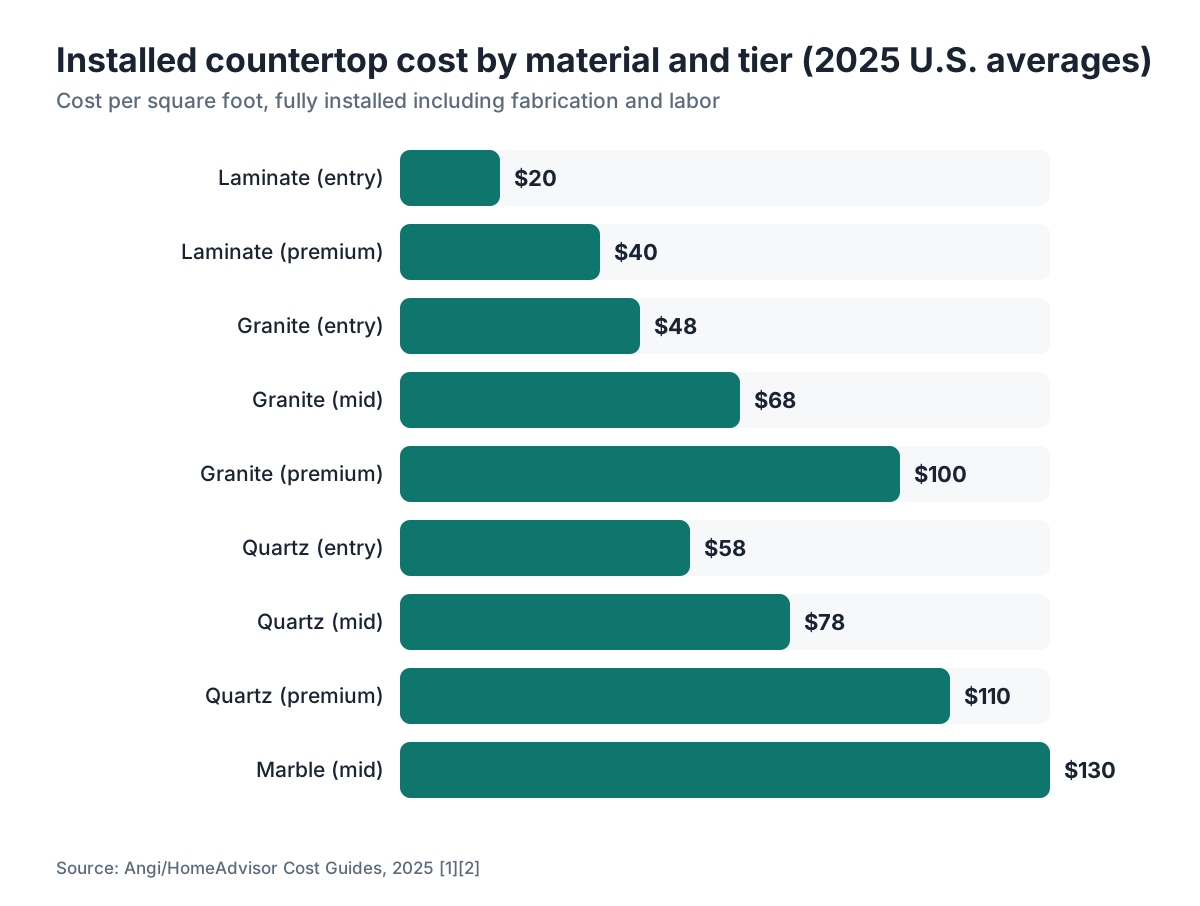
Granite countertops in 2025 run roughly $40 to $100 per square foot installed, including material, fabrication, and basic installation. That range sounds wide, but it makes sense once you break it down. Entry-level granite, often called Level 1 or builder-grade, sits at $40, $55 per square foot installed. These are consistent colors, simple patterns, and thick commercial inventory, so fabricators can quote them fast and cut them efficiently. Mid-range granite, Level 2 and Level 3, lands at $55, $80 installed. Exotic or rare slabs, think quartzite-adjacent granites or slabs with dramatic movement, push past $80 and can reach $100 or more before you add edge profiles.
The average kitchen has 30 to 45 square feet of countertop surface, not counting the island. A 40-square-foot kitchen at $65 per square foot installed comes out to $2,600. Add a 15-square-foot island and you're at $3,575. Those are real-world numbers for a mid-range granite job in a mid-cost U.S. market in 2025. [1]
Labor is a real variable here. Urban markets, especially the Northeast and West Coast, run 20 to 35% higher on labor than the national median. The material itself is globally traded stone, so slab prices stay more consistent across regions than labor rates do. If you're in Nashville or Phoenix, your installed cost will probably land lower than the same job in Boston or San Francisco.
What does quartz countertop installation cost in 2025 and 2026?
Quartz countertops in 2025 run $50 to $120 per square foot installed, with most homeowners landing between $60 and $90 for a mid-range product from a known brand. Entry-level quartz, usually house-brand or lesser-known manufacturers, starts around $50, $60 installed. Mid-range products from brands like Silestone, Caesarstone, or MSI Q Premium sit at $65, $90 installed. Premium engineered products, including Cambria's thicker slabs and some Calacatta-look designs, run $90, $120 or higher. [2]
The cambria countertops line is a useful anchor for understanding the top end of quartz pricing. Cambria is manufactured in the U.S. and sold factory-direct to fabricators, which cuts out one distributor margin, but the product itself commands a premium because of slab thickness, consistency, and warranty coverage. Expect $90, $130 installed depending on the design.
For 2026, the dominant cost pressure on quartz is energy cost at manufacturing plants and resin supply. Quartz slabs are roughly 90 to 93% crushed natural quartz bound with polymer resins, usually polyester or epoxy. Resin prices track petrochemical markets, so any sustained energy spike hits quartz harder than it hits granite. Most industry observers expect 2026 quartz prices to hold roughly flat or rise 3 to 6% from 2025 levels, barring a major supply disruption. [3]
A 40-square-foot kitchen in quartz at $75 per square foot installed costs $3,000. That same kitchen in entry granite at $55 would be $2,200. The $800 difference on a single kitchen is real money, and it compounds on larger projects.
What is the actual cost difference between granite and quartz countertops?
The short answer: quartz costs about $10, $30 more per square foot installed than comparable granite in most U.S. markets. On a typical 50-square-foot kitchen project, that's a $500, $1,500 premium for quartz over granite.
But comparable is the key word. If you're comparing entry granite to entry quartz, the gap is often only $5, $15 per square foot. If you're comparing a rare granite slab to a commodity quartz, granite can actually cost more. The cost difference between quartz and granite countertops shrinks or reverses at the extremes, which is worth knowing before you assume one material always beats the other on price.
| Material | Entry Level (installed $/sq ft) | Mid-Range (installed $/sq ft) | Premium (installed $/sq ft) |
|---|---|---|---|
| Granite | $40, $55 | $55, $80 | $80, $120+ |
| Quartz | $50, $65 | $65, $90 | $90, $130+ |
| Difference | ~$10 | ~$10, $15 | variable |
The gap exists for a couple of structural reasons. Granite is a natural stone quarried, cut into slabs, and sold with relatively low processing overhead. Quartz requires a full manufacturing operation: crushing, mixing, pressing, curing, then finishing. That plant overhead and the resin raw material add cost that quarried stone doesn't carry. Brand marketing also inflates quartz prices at the top end. A Calacatta Gold quartz from a major brand includes significant marketing spend that a genuine Calacatta marble slab from Italy does not charge for separately.
Fabrication labor is roughly the same for both materials. Both cut on the same CNC equipment. Both polish with the same tooling. Quartz is marginally harder on tooling, but that's a small cost in a well-run shop. The material cost difference between granite and quartz is almost entirely about the supply chain, not the fabrication.
Why does quartz usually cost more than granite?
Three reasons drive most of the price gap.
First, manufacturing overhead. Every quartz slab goes through a factory. You're paying for that factory whether you know it or not, including the equipment, the energy to cure the slabs, the quality control, and the workforce. Natural granite just gets quarried, gang-sawed into slabs, and polished. The processing chain is shorter.
Second, resin cost. Quartz slabs are approximately 7 to 10% polymer resin by weight. Polyester resin prices in 2024 averaged around $0.80, $1.20 per pound depending on grade and contract volume, according to the ICIS Chemical Business market data. [4] That's a raw material cost baked into every slab that granite simply doesn't have.
Third, brand premiums. The major quartz brands spend heavily on showroom presence, warranty programs, and marketing. Silestone, Caesarstone, Cambria, and MSI all run serious installer certification programs, and their material warranties often stretch 10 to 25 years. Those programs have real value, but they cost money that shows up in the slab price.
Natural granite, by contrast, is more of a commodity at the lower end. The same generic gray or black granite slab gets imported and sold by dozens of distributors competing on price. There's no brand to charge for. Once you move into rare granites with unique origins, the price difference from comparable quartz narrows or disappears.
One underappreciated factor: quartz slab sizes. Premium quartz often comes in larger format slabs, sometimes 130 inches by 65 inches or bigger, which cuts down on seams on large islands. That size advantage has real design value, but it also adds handling cost and breakage risk during fabrication, both of which feed back into price.
Which material costs less to maintain over time?
Granite needs sealing. Most granite should be sealed on installation and resealed every 1 to 3 years depending on porosity and use. A professional sealing runs $50, $150 for a standard kitchen. DIY sealer products cost $15, $40 per application. Over 10 years, you might spend $100, $400 on sealing materials and time, more if you hire it out each time. [5]
Quartz doesn't need sealing. The resin binder makes it non-porous by design. That's a real maintenance advantage. No periodic cost, no risk of staining if you forget to reseal.
Repair costs are more even. Both materials chip at the edges occasionally, especially on aggressive overhangs. Professional chip repair on granite or quartz typically runs $100, $300 per chip depending on size and location, with color-matching difficulty driving the high end. Quartz is arguably harder to match precisely because the manufacturing process creates very consistent patterns that are difficult to replicate with filler.
Heat is where quartz costs you long-term. Hot pots placed directly on quartz can scorch or discolor the resin. Granite handles heat better. A $200, $500 repair or a ruined slab surface is a real risk on quartz if you cook without trivets. Granite's heat resistance is genuinely better, more than marginally.
Bottom line: over a 10-year period, granite adds roughly $100, $400 in sealing costs. Quartz adds near zero in regular maintenance but has higher risk of heat damage. If you're comparing total cost of ownership and you cook heavily, that heat risk should influence your math.
Does granite or quartz add more resale value to a home?
Neither material has a definitively proven resale premium over the other in current data. The National Association of Realtors produces a Cost vs. Value report annually (via Remodeling Magazine's joint publication), and countertops don't appear as a standalone line item. [6] Kitchen remodels as a category recover roughly 30 to 86% of cost depending on scope, market, and whether the job was a minor or major remodel. The specific countertop material is hard to isolate.
Real estate agents generally say both granite and quartz signal quality to buyers compared to laminate or tile. The difference between granite and quartz in a buyer's perception is minimal in most markets. What buyers notice is whether it looks good, whether it's consistent, and whether it matches the kitchen. A $55-per-square-foot granite that photographs beautifully can do more for a listing than a $90-per-square-foot quartz in a color that clashes with the cabinets.
For resale purposes, the material decision that matters most is avoiding the extremes. An unusual or bold granite pattern can actually hurt resale because it polarizes buyers. Neutral tones in either material tend to serve the broadest buyer pool. That's the practical guidance, not a guarantee.
If you're renovating specifically to sell, spending the extra $10, $20 per square foot for quartz over mid-range granite is unlikely to recover in the sale price. Spend the money on the kitchen as a whole. Lighting, hardware, and cabinet condition matter more than granite versus quartz at the margin.
How do edge profiles and add-ons affect the total cost?
Edge profiles add $5, $30 per linear foot to both granite and quartz jobs. An eased edge (simple flat bevel) is often included at no charge. An ogee or dupont profile on a 30-linear-foot kitchen perimeter adds $150, $900 to the job. Fabricators charge roughly the same rates for granite and quartz edge work because the tooling is similar.
Sink cutouts add $100, $250 per cutout. Cooktop cutouts are similar. Backsplash material from the same slab runs $15, $40 per linear foot if you want it cut from matching stone. Full-height backsplash in either material adds significantly, often $500, $1,500 depending on linear footage and tile-setter labor.
Built-up edges, where fabricators laminate an extra strip of stone to the front edge to create a 1.5-inch or thicker appearance, add $8, $15 per linear foot in labor plus material waste. This is more common on quartz projects where thick slabs command a design premium.
Mitered edges on waterfall islands are labor-intensive. A waterfall island where the stone wraps down the sides with a mitered corner adds $300, $800 in fabrication labor for the miter work alone, on top of the additional material for the side panels.
For fabricators running a quoting operation, capturing these line items accurately is where margin lives. Tools like SlabWise are built to itemize edge profiles, cutouts, and add-ons in the quote rather than burying them in a lump sum, which reduces disputes and helps close jobs faster.
Stone thickness matters too. Standard 3/4-inch (2 cm) slabs cost less than 1.25-inch (3 cm) slabs, both in material and in the substrate or support work required. Most U.S. fabricators default to 3 cm for residential granite and quartz because it eliminates the need for a plywood buildup, reducing installation time.
What factors make granite or quartz more expensive on a specific job?
Several job-specific factors push costs up or down regardless of which material you choose.
Slab movement and seams. Complex L-shaped or U-shaped kitchens require more seams. Each seam adds $75, $150 in labor and slightly increases material waste. Tight layouts with many angles waste stone and drive up effective cost per usable square foot.
Demolition of the existing countertop. If you're replacing counters, demo and haul-away adds $100, $300 to most jobs. Some fabricators include this; others quote it separately. Always ask.
Cabinet levelness. Out-of-level cabinets require shimming during installation, which adds labor. On a badly unlevel run of cabinets, this can add $150, $400 to installation time.
Access and logistics. Second-floor kitchens, narrow stairways, or difficult parking at the job site add cost. Slabs weigh 400 to 700 pounds each. Getting them up a tight staircase requires extra crew.
Local permit requirements. Most jurisdictions don't require permits for countertop replacement, but some do require permits for plumbing reconnection if the sink is being moved. Check your local building department. [7]
For kitchen countertops projects specifically, the combination of a complex layout plus premium edge profiles plus a waterfall island can easily push total installed cost to $8,000, $15,000 even at mid-range material prices. Know your layout before you start comparing per-square-foot prices.
How does granite compare to other countertop alternatives on price?
Granite and quartz both sit in the mid-to-upper tier of countertop pricing. Here's how they compare to alternatives that homeowners frequently consider.
Laminate countertops run $15, $40 per square foot installed. That's the budget option. Modern laminate has improved dramatically, and premium Formica countertops can look convincingly stone-like, but the material still scratches and can't be refinished.
Marble countertops run $75, $250 per square foot installed for genuine marble. You pay more than quartz and get a material that etches from acidic foods (lemon juice, wine, vinegar) and stains if not sealed obsessively. Beautiful, but high-maintenance.
Butcher block countertops run $40, $100 per square foot installed. Similar price to granite at the mid-range, warmer look, requires oiling and can warp near sinks if not properly finished.
Corian countertops and other solid surface products run $50, $100 installed. They join without visible seams and repair easily, but they're softer than stone and show scratches over time.
| Material | Installed cost range ($/sq ft) | Sealing needed | Heat resistant |
|---|---|---|---|
| Laminate | $15, $40 | No | No |
| Butcher block | $40, $100 | Yes (oil) | No |
| Granite | $40, $120 | Yes | Yes |
| Quartz | $50, $130 | No | Partial |
| Marble | $75, $250 | Yes | Yes |
| Solid surface | $50, $100 | No | No |
Granite and quartz occupy overlapping price bands, which is exactly why the comparison gets so much attention. The decision is rarely purely about price.
How can homeowners get an accurate quote and avoid overpaying?
Get at least three quotes. The range between the highest and lowest quote on the same job often spans 20 to 35%, which is real money on a $3,000, $6,000 project. The cheapest quote isn't always wrong, but if one quote is dramatically lower, ask what it excludes.
Know your square footage before you call. Measure your countertops: length times width for each section, add 10% for waste. Having your own number lets you check whether a fabricator's estimate matches reality. If their square footage is significantly higher than yours, ask them to walk you through the calculation.
Ask for itemized quotes. A lump-sum quote hides whether you're paying a fair price for edge work, cutouts, and installation. An itemized quote lets you compare apples to apples across shops.
Understand the slab level system. Most fabricators use a Level 1/2/3 or Tier A/B/C system. Ask which level is being quoted and whether you can see the actual slab in person before you approve the job. Photos on a screen are not a substitute for seeing natural stone in person.
The countertop installation process typically takes 1 to 3 days from template to install. Template day (measuring your exact cabinets with a digital template or hard template) usually happens 1 to 3 days after you select your slab. Fabrication takes 3 to 7 business days. Installation is a half-day to full-day job.
For fabricators generating quotes, the accuracy of your square-footage calculation and your line-item add-ons determines margin. Quoting software built for the stone industry captures material waste, slab yield, and edge linear footage automatically. SlabWise was built specifically for this, letting shops produce detailed quotes in minutes rather than manually calculating yield on each job. If you're running a shop on spreadsheets, that's where margin disappears.
Is granite or quartz a better choice for a bathroom countertop?
Bathroom countertops are smaller, usually 5 to 20 square feet, so the cost difference between granite and quartz on a single bathroom vanity is $50, $300. That's a meaningful percentage of a small-bathroom budget but not necessarily a deciding factor.
For bathrooms, the practical differences matter more. Quartz's non-porous surface resists moisture better than granite, which is relevant in a high-humidity environment. Granite in a bathroom should absolutely be sealed on install and checked annually. A forgotten sealing cycle in a constantly wet environment can lead to staining around sink drips.
Both materials work well in bathrooms and hold up for decades with reasonable care. If the bathroom sees heavy use, especially a shared family bathroom with kids, quartz's forgiveness on maintenance edges out granite slightly. For a master bath that gets lighter use, granite's natural look and slightly lower cost make it a reasonable pick.
For ideas on material care, how to clean stone countertops covers the right products for both granite and quartz surfaces without voiding manufacturer warranties.
Frequently asked questions
How much cheaper is granite than quartz per square foot?
On average, granite runs $10, $30 per square foot less than quartz when comparing similar quality levels. Entry-level granite starts around $40, $55 installed versus $50, $65 for entry quartz. At the mid-range, expect granite at $55, $80 and quartz at $65, $90. At the premium end the gap narrows or reverses: exotic granites can exceed premium quartz prices.
What is the total installed cost for granite countertops in a typical kitchen?
A typical kitchen with 40 to 50 square feet of counter space at mid-range granite pricing ($60, $75 per square foot installed) comes out to $2,400, $3,750. Add an island, complex edges, or a difficult layout and you can hit $5,000, $7,000. These are 2025 mid-market U.S. estimates and vary 20 to 35% by region.
Does quartz or granite hold up better in a kitchen?
Both hold up well for decades. Quartz resists staining better because it's non-porous and doesn't need sealing. Granite handles heat better, surviving hot pans without scorching. Quartz can discolor or crack from direct heat. For a busy kitchen with heavy cooking, granite's heat tolerance is a real practical advantage worth considering.
Which countertop is easier to install, granite or quartz?
Installation is nearly identical for both. Both need digital or hard templates, CNC or bridge-saw cuts, and a two-person crew for carrying slabs. Quartz slabs can be slightly heavier per square foot due to density. Neither is DIY-friendly at full-slab scale; professional installation is strongly recommended for both. Allow 3 to 7 business days for fabrication after templating.
Do quartz countertop prices vary by brand?
Yes, significantly. Entry quartz from lesser-known brands runs $50, $65 installed. Silestone and Caesarstone mid-range products land at $65, $90. Cambria and top-tier designs from any brand reach $90, $130 or more. The brand premium reflects warranty length, slab consistency, and thickness rather than just aesthetics. For budget projects, house-brand quartz from large distributors is worth pricing.
Is it worth paying more for quartz over granite?
It depends on how you cook and how much maintenance you want to do. If you want zero sealing obligation and a very consistent pattern, quartz is worth the premium. If you want better heat resistance, lower material cost, and a one-of-a-kind natural look, granite wins. The price difference on a typical kitchen is $500, $1,500. Neither choice is obviously wrong.
Does granite or quartz cost more to repair?
Chip and crack repair is roughly comparable, running $100, $300 per repair area for either material. Color-matching quartz can be harder because manufactured patterns are uniform and precise, making filler repairs more visible. Granite's natural variation can actually camouflage small repairs better. Full slab replacement is expensive for both, in the $1,500, $4,000+ range for a single countertop section.
Can I get granite or quartz installed under $1,500 for a small kitchen?
Possibly, for a very small kitchen or single bathroom vanity. A 25-square-foot layout at $55 per square foot installed comes to $1,375 in entry granite. Getting under $1,500 for a full-sized kitchen of 40+ square feet is unlikely in most 2025 markets. Be cautious of unusually low quotes; they often exclude demo, cutouts, or haul-away.
How do tariffs and supply chain issues affect granite and quartz prices in 2025?
Both materials have global supply chains subject to tariff exposure. A significant portion of U.S. granite slabs come from Brazil, India, and China. Quartz slabs are dominated by Chinese and Spanish manufacturers. U.S. tariff actions in 2025 have added cost pressure to imports from certain origins. Expect 5 to 15% upward pressure on affected slab types. Domestically manufactured quartz (like Cambria) is insulated from import tariffs.
What should I ask a fabricator before getting a countertop quote?
Ask for an itemized quote that separates material cost, fabrication labor, edge profile charges, sink and cooktop cutouts, installation labor, and haul-away. Ask which slab level is being quoted. Ask whether the price locks in or floats with material cost at time of fabrication. Ask how seams are handled on your specific layout. These questions separate professional shops from those that will surprise you with add-on charges.
Are there ways to reduce the cost of granite or quartz countertops?
Yes. Choose Level 1 or entry-tier material. Use an eased or beveled edge instead of a decorative profile. Reduce the number of cutouts by keeping your original sink location. Avoid waterfall islands, which consume significant extra material. Get multiple quotes. Buying remnant slabs from a fabricator's yard works well for small bathrooms or laundry rooms where a full slab isn't needed.
How does quartz compare to quartzite in cost?
Quartzite (a natural metamorphic stone, not to be confused with engineered quartz) typically runs $70, $200 per square foot installed, more expensive than most quartz products. Quartzite requires sealing like granite and is harder to fabricate, which drives up labor cost. It's prized for its natural beauty and heat resistance. For maintenance information, see how to clean quartzite countertops.
Does quartz add more value to a home than granite when selling?
No clear evidence supports one material adding measurably more resale value than the other. Both granite and quartz signal quality to buyers versus laminate or tile. Real estate agents generally report that buyers perceive both as upgrades. Kitchen remodels recover roughly 30 to 86% of cost depending on scope and market, per the Remodeling Magazine Cost vs. Value report. The specific stone type is rarely the deciding factor for buyers.
Sources
- HomeAdvisor (Angi), Granite Countertops Cost Guide, 2025: Granite countertop installation averages $40, $100 per square foot installed including material, fabrication, and installation labor in U.S. markets.
- HomeAdvisor (Angi), Quartz Countertops Cost Guide, 2025: Quartz countertop installation averages $50, $120 per square foot installed depending on brand and slab quality.
- U.S. Bureau of Labor Statistics, Producer Price Index for Stone Product Manufacturing, 2024 to 2025: Producer price index for stone product manufacturing shows 3 to 6% annual cost increase trend for engineered stone products.
- ICIS Chemical Business, Polyester Resin Market Report, 2024: Polyester resin prices averaged approximately $0.80, $1.20 per pound depending on grade and contract volume in 2024.
- Marble Institute of America (Natural Stone Institute), Care and Maintenance of Natural Stone Surfaces: Most granite countertops should be sealed at installation and resealed every 1 to 3 years depending on porosity; professional sealing runs $50, $150.
- Remodeling Magazine, Cost vs. Value Report 2024 to 2025: Kitchen remodels recover approximately 30 to 86% of cost at resale depending on scope and market; countertop material is not isolated as a standalone variable.
- U.S. Census Bureau, American Housing Survey, 2023: Most jurisdictions do not require building permits for countertop replacement alone; permits may be required if plumbing is relocated.
- U.S. International Trade Commission, Stone Products Import Data, 2024: Significant portions of U.S. granite slab imports originate from Brazil, India, and China; engineered quartz slabs are primarily imported from China and Spain.
- National Kitchen and Bath Association (NKBA), Kitchen and Bath Market Index, 2024: Quartz is the most specified countertop material in new U.S. kitchen installations as of 2024, surpassing granite in market share.
- Natural Stone Institute, Dimension Stone Design Manual, 8th Edition: Standard granite slab sizes in the U.S. residential market are typically 110 to 130 inches by 55 to 65 inches; 3 cm (1.25 inch) thickness is standard for residential countertop applications.
- U.S. Bureau of Labor Statistics, Occupational Employment and Wage Statistics for Terrazzo Workers and Finishers, 2024: Labor costs for stone fabrication and installation workers vary 20 to 35% between lower-cost and higher-cost metropolitan areas in the U.S.
Last updated 2026-07-09