TL;DR
- For quartz countertops, run a 50 to 80 grit (mesh) continuous-rim or turbo diamond blade for rough cuts and a 120 to 140 grit blade for finished edges where chipping ruins the piece.
- Most fabricators keep a 60-grit continuous-rim blade as the everyday workhorse.
- Wet cutting is non-negotiable.
- The resin binder in quartz clogs dry blades fast and throws off dangerous silica dust.
What does 'diamond blade grit' actually mean?
Diamond blades don't have grit the way sandpaper does. The number you see is the mesh size of the diamond particles bonded into the blade's segments or rim. A lower mesh number means larger, coarser diamond crystals. A higher number means finer ones. A 30-mesh blade cuts fast and rough. A 200-mesh blade cuts slow and smooth.
The bond matrix matters just as much as diamond size. The bond holds the diamonds in place, and it has to wear away at the right rate to keep exposing fresh crystals. If the bond is too hard for the material, the diamonds glaze over. Too soft, and the diamonds fall out before they've done their work. Engineered quartz, which is roughly 90 to 94% crushed quartz bound in polymer resin [1], sits in a weird middle ground. It's harder than most ceramic tile, but the resin makes it somewhat self-lubricating, which glazes a bond faster than you'd expect.
When people in the trade say "blade grit" loosely, they usually mean the overall aggressiveness of the blade. That's a combination of mesh size, bond hardness, and segment geometry. All three interact, and you can't tune one without thinking about the other two.
What grit diamond blade should I use for quartz countertops?
Use a 60-grit (or 50 to 80 grit range) continuous-rim or turbo-rim diamond blade for field cuts, and a 120 to 140 grit blade for final finish passes or sink cutouts where chipping means a ruined slab. That's the answer fabricators reach for daily.
Here's the logic. Engineered quartz like Silestone, Caesarstone, or Cambria uses aggregate rated around 7 on the Mohs scale [2], but the resin binder softens the composite to roughly 5 to 6 in real cutting behavior. A coarse blade (30 to 40 grit) cuts fast and leaves a chipped edge that needs heavy grinding. A very fine blade (180+ grit) barely chips at all, but it cuts so slowly that it generates more heat, which can delaminate the resin and warp thin sections.
The 60-grit range hits the balance point. Fast enough to stay cool, fine enough to leave an edge that needs one pass of polishing and no more. Most shops running a CNC bridge saw or a track-mounted circular saw default to a 60-grit sintered continuous-rim blade in the 14-inch range for slabs [3].
Doing a one-time cut with an angle grinder or a circular saw and a blade guide? A 4.5-inch or 7-inch turbo diamond blade in the 60 to 80 grit range is the practical pick. Those are everywhere, forgiving of uneven cutting pressure, and cheap enough that burning one up on a single job doesn't sting.
Continuous rim vs. segmented vs. turbo: which blade type works on quartz?
Blade type and grit work together. You can't pick a grit and ignore the rim style.
Continuous rim blades have no gaps in the diamond edge. They produce the smoothest cuts and the least chipping, which is why they're the default for tile and stone finish work. For quartz, a continuous-rim blade in the 60 to 100 grit range is what most fabricators run on a bridge saw with water. The tradeoff is that continuous rims lean hard on water to flush swarf (the slurry of cut material) and hold temperature down. Run one dry for more than a few seconds and it's dead.
Segmented blades have gullets, the gaps cut into the rim between segments. Those gullets clear debris faster and keep the blade cooler with less water. They're common in masonry and concrete work. On quartz, they chip the edge noticeably more than continuous rims. If the cut edge will be seen and finished, a segmented blade adds real polishing time or forces you to route a profile that hides the damage. They're fine for hidden cuts, like a sink apron edge against a wall.
Turbo blades have a serrated, wave-cut rim. They're faster than continuous rims and smoother than segmented. For a homeowner doing a single DIY cut on an angle grinder, a 4.5-inch turbo diamond blade is a reasonable compromise. They also work well on a circular saw for rough-cutting quartz close to final dimensions before a cleaner finish pass.
The short version: continuous-rim wet blade, 60 grit, for any cut where the edge shows. Turbo for rough work or when you're stuck dry-cutting.
Does grit selection change for different quartz brands?
Mostly no. But there are real differences between brands worth knowing before you load a blade.
Most engineered quartz sold in North America, including Silestone, Caesarstone, Cambria, and MSI Q Premium, is 90 to 94% quartz aggregate by weight in polymer resin [1]. The mechanical properties are close enough that a 60-grit continuous-rim blade works on all of them with no special adjustment.
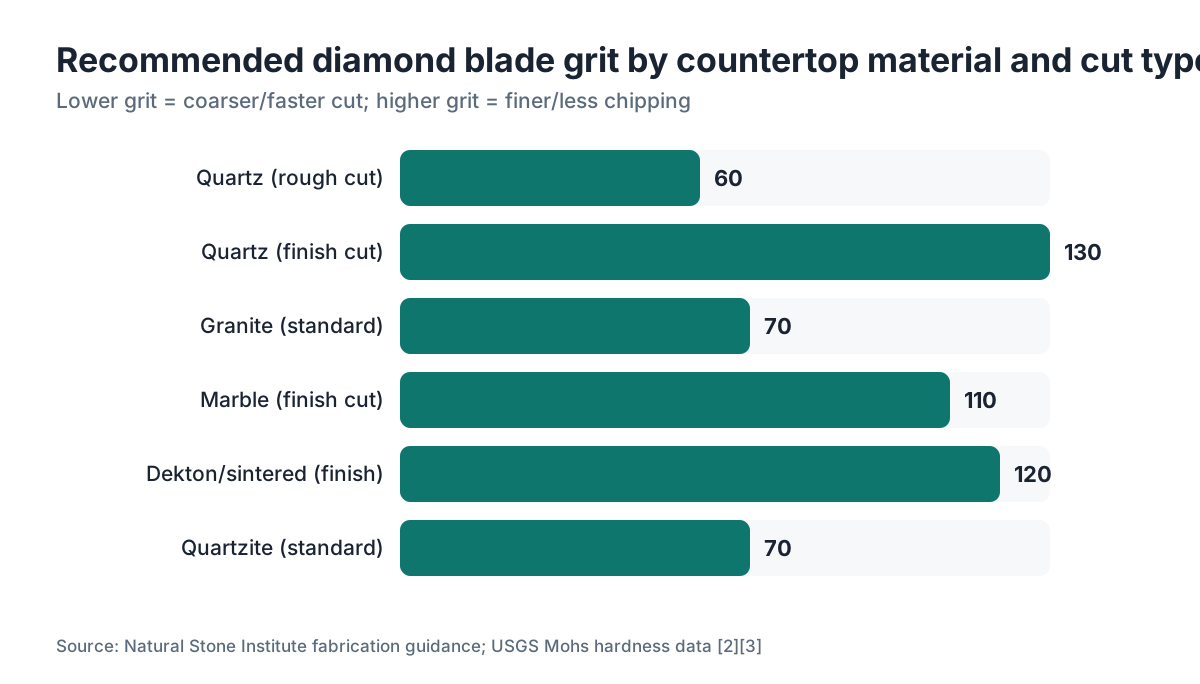
Some ultra-compact surfaces branded as porcelain or sintered stone, like Dekton or Lapitec, get confused with quartz but are entirely different materials. Dekton is a sintered surface with no resin, fired at extreme temperatures, and it's significantly harder and more brittle than standard engineered quartz [4]. On Dekton or similar sintered surfaces, move to a finer blade (100 to 120 grit) and slow your feed rate a lot to avoid cracking the material from thermal shock.
Actual quartzite is a natural metamorphic stone, different from both engineered quartz and Dekton. If you're working with quartzite countertops, the approach is closer to granite: a 60 to 80 grit segmented or continuous rim blade, wet, but with more attention to feed rate because natural quartzite has directional cleavage planes that engineered quartz lacks.
For standard engineered quartz brands, don't overthink it. A quality 60-grit continuous-rim wet blade handles every one of them.
Why does wet cutting matter more than grit when cutting quartz?
Grit selection matters. Wet cutting matters more. If you can only get one thing right, get the water.
Cutting quartz generates respirable crystalline silica dust, a known occupational carcinogen. OSHA's permissible exposure limit for respirable crystalline silica is 50 micrograms per cubic meter of air as an 8-hour time-weighted average [5]. Dry cutting a quartz countertop with an angle grinder can push silica concentrations many times past that limit within seconds. OSHA's construction silica rule (29 CFR 1926.1153) requires wet methods or integrated water delivery when cutting stone like quartz [5].
Water also keeps the blade cool. Diamond blades have a maximum RPM and a maximum operating temperature. Exceed the temperature and the bond matrix delaminates, shedding diamond segments. A continuous-rim blade that runs dry for 20 seconds on quartz can lose enough bond integrity to go dangerously out of round. It can also crack the quartz from thermal shock, and in a finished countertop that crack can travel well past the cut line.
A workable setup for a shop or a careful DIY job: a recirculating water pump feeding a blade guard water attachment, or a wet-cutting angle grinder with a shroud and water feed. Some fabricators run a garden hose through a valve at low flow as a bare minimum. Not ideal, but it beats dry cutting.
A blade two grit numbers off from ideal but run wet will beat the perfect grit run dry, every single time.
What RPM and feed rate should I use with a diamond blade on quartz?
Match RPM and feed rate to the blade's rating and the material, not to a fixed number. Diamond blade makers publish a maximum surface feet per minute (SFPM), which matters more than RPM alone because rim cutting speed depends on both RPM and blade diameter. For most 14-inch bridge saw blades in countertop work, the operating range is 5,500 to 7,000 SFPM [3]. Check the blade's label or spec sheet. Running above the rated SFPM voids the warranty and is genuinely dangerous.
For angle grinders with 4.5-inch blades, most small diamond blades are rated up to 13,300 RPM. A standard 4.5-inch grinder at 11,000 RPM sits inside that range for most blades, but confirm the blade's rating matches your tool.
Feed rate, meaning how fast you push the blade through the material, ties directly to grit. A coarser blade tolerates a faster feed because larger crystals take bigger bites. A finer blade needs a slower, steadier feed. For quartz on a bridge saw, start around 100 to 150 mm per minute (roughly 4 to 6 inches per minute) at full depth on a 20mm slab, then adjust by how the blade sounds and how the swarf looks. When the swarf turns from a white milky slurry to brownish sludge, you're going too fast or losing water flow.
For hand-tool cuts the rule is simpler. Let the blade do the work, apply light forward pressure, and don't force it. Push hard and let the blade bind, and the quartz cracks.
Can I cut quartz countertops with a regular circular saw blade?
No. A standard carbide-tipped wood-cutting blade will wreck itself and probably crack the quartz. Quartz at 7 Mohs is far harder than any wood-cutting carbide tooth can handle. Even masonry blades built for brick won't cut it cleanly.
You need a diamond blade made for stone. That distinction matters, because abrasive masonry cutoff wheels (the disposable discs used on angle grinders for concrete) are not the same as a sintered diamond blade. Abrasive wheels wear down extremely fast on quartz and throw off even more heat and dust than a diamond blade.
A homeowner making a countertop cutout, say for an undermount sink on a quartz counter, needs at minimum a 4-inch or 4.5-inch continuous-rim or turbo diamond blade rated for stone, mounted in an angle grinder with a water attachment or a tile saw with a recirculating tray. A 7.25-inch circular saw with a diamond blade and a water-drip attachment also works and gives better control on straight cuts.
The costs are real but not scary. A quality 4.5-inch diamond blade for stone from a reputable brand runs about $15 to $40 retail. A 14-inch professional continuous-rim blade for a bridge saw runs $80 to $300 depending on diamond quality and bond type [6]. One slab ruined by a botched dry cut costs more than the whole proper setup.
How do I know when a diamond blade is worn out and needs replacing?
Worn diamond blades don't slow down dramatically at first. They glaze over. The bond matrix hardens relative to what the material can expose, so the diamonds stop protruding to cut. The blade still spins and still looks intact, but it drags and builds heat fast.
Signs a blade is glazed or spent: the cut takes noticeably longer than usual, the saw motor bogs down, the swarf turns from white slurry to a paste that won't clear, or you start seeing micro-checks (stress cracks) in the quartz next to the cut line. A quick reset for mild glazing is a few passes through a softer abrasive material like a cinder block or a dressing stick made for diamond blades. That re-exposes fresh diamond.
On segmented blades, watch segment height. Most start with 10 to 12mm of segment above the core. When you're down to 2 to 3mm, the blade is done. Running a blade with underheight segments risks a segment debonding entirely, and that's a projectile.
On continuous-rim blades, watch rim height. Original rim is typically 5 to 8mm. Below 2mm, replace it.
Production shops log blade use by linear feet cut. If you're running quoting and shop management through something like SlabWise, you can tie blade replacement intervals to job output tracking, so you swap blades on a schedule instead of guessing.
What safety gear do I need when cutting quartz?
At minimum: a half-face respirator with P100 cartridges, eye protection, hearing protection, and cut-resistant gloves, on top of wet cutting. OSHA's 29 CFR 1926.1153 lists stone cutting, engineered quartz included, as a high-exposure task for respirable crystalline silica [5]. The rule requires employers to use engineering controls (wet cutting, vacuum shrouds) and, where those don't drop exposure below the action level of 25 micrograms per cubic meter, to provide respiratory protection.
A paper dust mask doesn't count. It doesn't filter particles small enough to matter here. Use a half-face respirator with P100 or combination P100/OV cartridges, safety glasses or a face shield, hearing protection rated for your tool's dB output, and cut-resistant gloves.
Wet cutting cuts airborne silica dramatically because water captures the fine particles into slurry before they go airborne. But wet cutting still throws off mist that can carry fine silica, so wear the respirator even with water running.
California has gone further than federal OSHA on engineered stone specifically. In 2024, Cal/OSHA adopted an emergency regulation effectively banning dry grinding and dry cutting of engineered stone countertops containing 40% or more crystalline silica, with added medical surveillance for fabricators [7]. That move reflects occupational health data linking engineered stone fabrication to accelerated silicosis, including cases in workers under 30 [8].
For a homeowner doing a one-time cut: wet cut, wear the respirator, work outside or with strong cross-ventilation. This is one area where skimping has documented health consequences.
How does cutting quartz compare to cutting granite or marble?
Engineered quartz sits between granite and marble in how it cuts. Granite has higher compressive strength than most quartz, but it cuts more predictably because it has no resin binder. On granite countertops, a 60-grit segmented or continuous-rim blade is standard. You can often use less water pressure than on quartz because the dry swarf clears more easily, though wet cutting is still preferred for silica control.
Marble countertops are softer, around 3 to 4 on the Mohs scale, so marble cuts faster and wears the blade less. The danger with marble is the reverse of quartz: too coarse a blade chips the polished surface visibly. Many fabricators run a 100 to 120 grit continuous-rim blade on marble to protect the face polish, and feed rate can be faster than quartz at the same grit.
Quartz needs marble's careful chip control (hence the preference for continuous-rim blades) but has hardness closer to granite, so you can't run as fine a blade as on marble without overheating.
Materials like laminate countertops or butcher block countertops use entirely different cutting strategies. Laminate cuts best with a fine-tooth carbide blade run from the finish face down (or scored first). Butcher block is wood, so standard woodworking blades apply. Diamond blades are wrong for both.
The table below lays out the grit comparison across common countertop materials.
What blade diameter is standard for countertop fabrication shops?
Fourteen inches is the industry standard for bridge saw countertop work. The right diameter depends almost entirely on the equipment you're running.
Bridge saws, the large fixed-bed wet saws used in professional stone shops, typically run 14-inch blades. That diameter gives enough depth to go through a 20mm (roughly 3/4-inch) or 30mm (roughly 1.25-inch) slab in a single pass. Some heavy-duty bridge saws run 16-inch or 18-inch blades for thicker material or gang cutting, but 14-inch is the standard for countertop work [3].
Portable track saws and rail systems, used for on-site cuts or shops without a full bridge saw, typically use 7-inch or 9-inch blades. Those handle a full 20mm countertop depth with the right blade exposure.
Angle grinders for cutouts, inside corners, or curves use 4-inch, 4.5-inch, or 5-inch blades. The 4.5-inch size is the most common in shops because it fits the widest range of corded grinders.
Diameter doesn't change the core grit advice. Whatever size you run, 60-grit continuous-rim for finish-quality cuts and 40 to 80 grit for roughing applies across the board. A larger blade at the same grit lasts longer because it has more diamond matrix to wear through before the segment runs out.
Is there anything special about cutting quartz for sink or cooktop cutouts?
Sink and cooktop cutouts are the highest-risk cuts on any countertop job. The slab is already installed, which limits water cooling. The cutout leaves an unsupported section that can crack as the cut finishes. And inside corners concentrate stress right where a spinning blade wants to turn.
The standard professional approach for quartz cutouts: drill the corner relief holes first with a diamond core bit (typically 1-inch diameter), then run the straight cuts with an angle grinder or a jigsaw with a diamond blade attachment. Corner holes stop the crack that happens when you try to pivot a spinning blade in a tight radius.
Grit for cutout work: a 60 to 80 grit turbo or continuous-rim blade on the grinder. You're not chasing a polished edge because the sink rim or cooktop frame covers it. Smooth enough not to stress-crack, and that's all you need.
Support the cutout section from below before the last cut. Set a piece of wood or foam under the opening. When the final cut releases the cutout piece, an unsupported drop sends a stress wave back into the slab and can crack it, sometimes 12 inches or more from the cutout. This isn't rare. It shows up in most professional fabrication training material.
For countertop installation with a new sink, coordinate the cutout before the slab is set if you possibly can. Cutting on the bench with a bridge saw is far safer and cleaner than cutting in place.
Frequently asked questions
Can I use a dry diamond blade on quartz countertops?
Some diamond blades are rated for limited dry use, but on quartz it's a bad idea on two counts. The resin binder transfers heat quickly, which glazes dry blades fast and can thermally crack the slab. More seriously, dry cutting quartz generates dangerous levels of respirable crystalline silica dust. OSHA requires wet cutting methods for engineered stone. If wet cutting isn't possible, use a vacuum shroud with HEPA filtration and a respirator.
What's the difference between sintered diamond blades and electroplated diamond blades for quartz?
Sintered (metal-bond) blades have diamonds embedded throughout the segment matrix. As the outer layer wears, fresh diamonds expose, so the blade stays sharp across its full life. Electroplated blades have a single layer of diamonds bonded to the surface. They cut fast and smooth when new, but once that layer wears, the blade is finished. For quartz slab cutting where you need consistent performance across many linear feet, sintered continuous-rim blades are the professional standard.
How many linear feet can I expect from a diamond blade cutting quartz?
Blade life varies enormously with blade quality, water cooling, feed rate, and slab thickness. A mid-grade 14-inch sintered continuous-rim blade cutting 20mm engineered quartz wet might last 200 to 500 linear feet before it needs dressing or replacement. Premium blades from specialized stone tooling suppliers can run 800+ linear feet. Running too fast or with too little water slashes those numbers. Track linear feet per blade to catch declining performance before it costs you a slab.
Will a higher grit blade prevent chipping on quartz edges?
Yes, to a point. Moving from a 60-grit to a 120-grit blade cuts chip size noticeably, which matters for edges that get polished or left as eased edges. But above about 140 grit, the drop in chipping is marginal while heat buildup and cut time climb. The smarter path for a high-gloss edge is a 60 to 80 grit cut followed by a polish progression using resin-bond diamond pads starting at 50 or 100 grit and working up to 3,000 or 6,000.
What blade should I buy for a one-time DIY quartz sink cutout?
A 4.5-inch turbo diamond blade rated for stone in the 60 to 80 grit range, run on an angle grinder with a water-feed shroud attachment. Drill the corners first with a 1-inch diamond core bit. Don't skip the water. A reasonable blade for a single DIY job costs $15 to $40 at most home improvement stores. Add a P100 respirator if you don't have one. The respirator matters more than which exact blade you buy.
Does blade diameter affect cut quality on quartz?
Larger blades run at lower RPM to hit the same surface feet per minute, so each point on the rim takes slightly longer cuts through the material. In practice, a 14-inch bridge saw blade at the right SFPM produces a cleaner, cooler cut than a 4.5-inch angle grinder blade at the same grit, because the larger blade has more mass, better heat dissipation, and steadier cutting geometry. Diameter is mostly a function of your equipment; grit selection applies similarly across sizes.
Can I cut quartz with a wet tile saw from a rental center?
Yes, a rental tile saw with a continuous-rim diamond blade and a water tray handles engineered quartz for straight cuts. Confirm the blade is rated for stone, more than ceramic tile. Many rental saws ship with a general-purpose diamond blade in the 60 to 80 grit range that works fine. The limits: most rental tile saws have a small cutting capacity (usually 12 to 18 inches), shallow depth, and underpowered motors. Good for small cuts or scribes, not for full 4x8-foot slabs.
What causes a diamond blade to crack or shatter when cutting quartz?
The usual causes are running above the blade's rated RPM, thermal shock from cutting dry or losing water mid-cut, side loading (twisting the blade in the cut), and using a worn or underheight blade past its safe life. Quartz is especially prone to causing thermal shock cracking in blades because the resin binder conducts heat back into the blade core faster than natural stone does. Always verify RPM compatibility between your tool and your blade before cutting.
Is there a grit recommendation for polishing quartz edges after cutting?
After a 60-grit blade cut, edge polishing on quartz typically starts with a 50 or 100 grit resin-bond diamond hand pad or cup wheel, then works through 200, 400, 800, 1,500, and 3,000 grit. Some fabricators add a 6,000 or buffing step for a mirror edge. Engineered quartz polishes a little differently than natural stone because the resin responds to frictional heat differently. Keep pads wet and don't skip steps; jumping from 100 to 800 grit leaves visible scratches.
How do I store diamond blades to prevent them from warping or losing their edge?
Store blades flat or hung on a peg through the arbor hole, never stacked face-down on the segment. Keep them dry; moisture corrodes the steel core over time, which leads to out-of-round running. Avoid storing blades near solvents or strong chemicals that could degrade the bond resin in the segments. Label used blades so you know their service history. A blade that's been dropped on a hard floor should be inspected carefully for core cracks before reuse.
Do quartz countertop warranties cover cracks from improper cutting?
No. Every major engineered quartz manufacturer, including Caesarstone, Silestone, and Cambria, limits their warranty to defects in the material and excludes damage caused during fabrication or installation, cutting errors included. Cracking a slab with the wrong blade or poor technique is the fabricator's financial loss. That's one reason professional shops invest in quality blades and proper bridge saw setups: the cost of a ruined slab far exceeds the cost of the right tooling.
Are there OSHA rules specific to cutting engineered quartz countertops?
Yes. OSHA's silica standard for construction, 29 CFR 1926.1153, applies directly to cutting engineered stone countertops. It requires employers to use wet cutting methods or vacuum shrouds with HEPA filtration, provide appropriate respirators when engineering controls alone don't meet the exposure action level, conduct exposure assessments, and offer medical surveillance for workers with significant exposure. California added stricter rules in 2024 effectively banning dry grinding of high-silica engineered stone entirely.
Sources
- Caesarstone, Product Technical Data: Engineered quartz countertops are approximately 90 to 94% crushed quartz aggregate bound in polymer resin
- USGS, Mineral Resources Program, Quartz: Quartz mineral hardness is 7 on the Mohs scale
- Natural Stone Institute, Dimension Stone Design Manual and fabrication technical guidance: 14-inch blades are the professional standard for bridge saw countertop fabrication; operating range approximately 5,500 to 7,000 SFPM
- Cosentino, Dekton Technical Product Guide: Dekton is a sintered surface with no polymer resin, significantly harder and more brittle than standard engineered quartz
- OSHA, Occupational Exposure to Respirable Crystalline Silica (29 CFR 1926.1153): OSHA PEL for respirable crystalline silica is 50 micrograms per cubic meter as an 8-hour TWA; construction standard requires wet cutting methods for stone
- Braxton-Bragg, Diamond Blade Product Catalog: Professional-grade 14-inch continuous-rim diamond blades for bridge saws retail for approximately $80, $300 depending on diamond quality
- California Department of Industrial Relations, Cal/OSHA engineered stone emergency regulation (2024): Cal/OSHA adopted emergency regulation in 2024 effectively prohibiting dry grinding and dry cutting of engineered stone countertops containing 40% or more crystalline silica
- CDC/NIOSH, Occupational silica exposure during countertop manufacturing and fabrication: Silica exposure during engineered stone fabrication linked to accelerated silicosis including cases in workers under 30
- Silestone by Cosentino, Technical Specifications: Silestone engineered quartz composition is approximately 94% natural quartz
- OSHA, Table 1 controls, Construction Standard 29 CFR 1926.1153: Table 1 specifies engineering and work practice controls for specific tasks, including cutting stone with wet methods as a required control for masonry and stone fabrication
Last updated 2026-07-10