TL;DR
- A color-enhancing sealer is an impregnating stone sealer that soaks into granite and deepens its natural color, giving it a wet or freshly rained-on look while staying dry to the touch.
- It seals against staining at the same time.
- Not every granite needs one, and the color shift is largely permanent, so test a hidden area first.
What does a color-enhancing sealer actually do?
A color-enhancing sealer soaks into the pores of the stone instead of forming a film on top. That makes it an impregnating sealer. Most are silicone- or silane/siloxane-based, and they work by filling the microscopic voids inside the granite with a resin that has a higher refractive index than air. Light that used to scatter dully through air-filled pores now bounces off the resin, so the crystal structure pops and the color looks richer and darker.
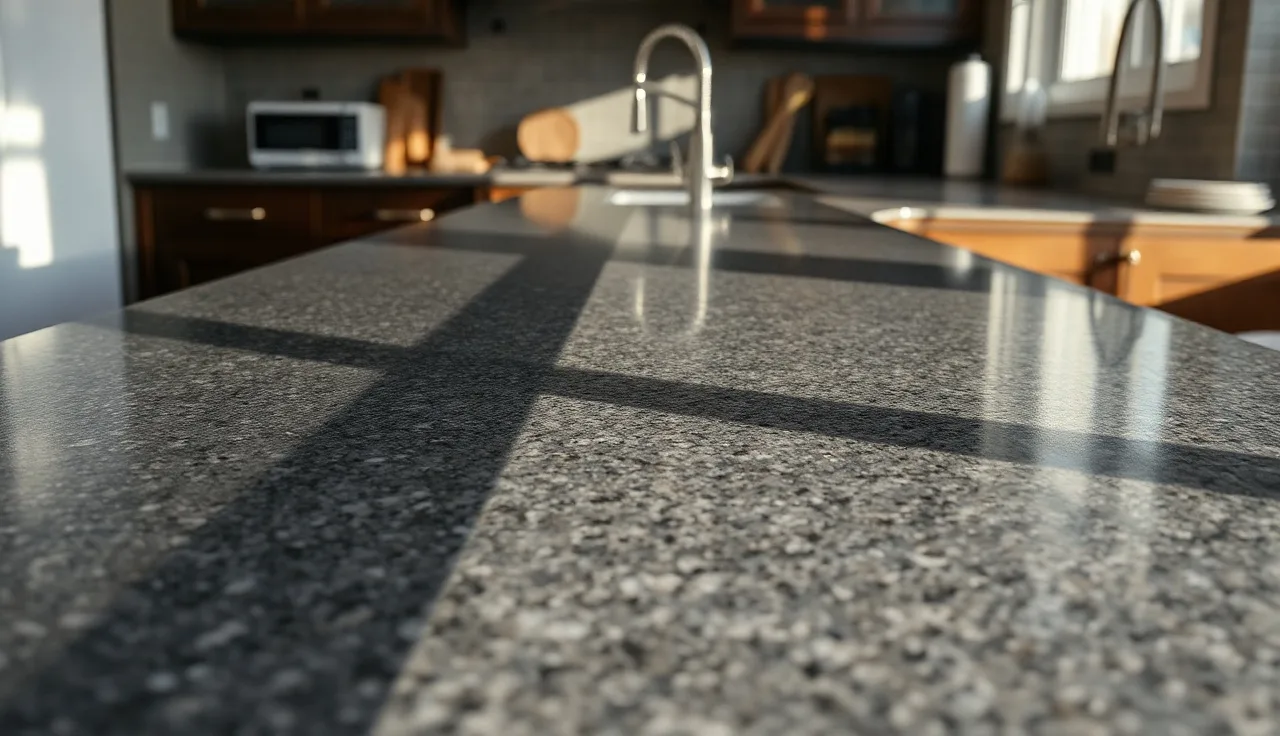
The result looks a lot like wetting the surface with water. Fabricators call it the "wet look." The stone looks like it just got rained on, but the surface stays completely dry under your hand.
The sealer also does what any impregnating sealer does. It slows liquid from soaking in and buys you time to wipe up spills before they stain. Two benefits, one product. The color is the reason people buy it, but the protection is real too.
Not every granite needs this treatment. Very dense, dark granites like Absolute Black may show almost no color change because they have next to no porosity to begin with. Very light granites like White Ice can turn muddy or yellowish, which most homeowners hate. The sweet spot is mid-tone granites with visible grain and crystal structure, where the deepening reads as natural and dramatic instead of fake.
How is color-enhancing sealer different from a regular granite sealer?
Standard impregnating sealers are built to disappear. Their job is to fill pores and repel liquids without changing how the stone looks at all. A good one is basically undetectable after it cures.
A color-enhancing sealer uses the same chemistry (usually silane or siloxane carriers) but the resins have a higher refractive index, or the carrier solvents are chosen to leave a saturating deposit in the pores. The result is a controlled, permanent darkening of the stone's tone.
Some products claim to do both jobs equally well: maximum protection and maximum color. In practice there's usually a tradeoff. Products that deliver a strong color shift tend to use heavier resin loads, which can slightly cut breathability. On a kitchen counter that tradeoff is minor. On a porous outdoor stone it matters more.
Topical coatings like wax, lacquer, or acrylic floor finish can also make granite look wet, but they sit on top of the stone rather than inside it. They wear off, they scratch, and they change the texture under your hand. A true impregnating color enhancer never films over and won't alter the feel of the stone. That distinction matters a lot on a surface you touch every day.
The comparison table below lays out the main sealer types side by side.
What do the main sealer types look like side by side?
| Sealer type | Location in stone | Color shift | Needs reapplication | Alters feel |
|---|---|---|---|---|
| Standard impregnator (silane/siloxane) | Below surface, in pores | None | Every 1 to 5 years [1] | No |
| Color-enhancing impregnator | Below surface, in pores | Moderate to strong wet look | Every 3 to 5 years or as needed | No |
| Topical wax / acrylic coating | On surface | Mild sheen | Every 3 to 12 months | Yes (smoother, can feel filmy) |
| Penetrating oil (for softer stones) | Below surface | Warm darkening | Every 1 to 3 years | No |
The right choice comes down to what you want the stone to look like for the long haul. Love how your granite looks now and just want protection? Use a standard impregnator. If your granite looks dull, pale, or flat and you wish it looked more like the polished slab you fell for at the stone yard, a color enhancer is worth testing.
Cleaning and maintenance also differ across stone types, and that affects sealer choice. The how to clean quartzite countertops and how to clean soapstone countertops guides cover those differences.
Which granites benefit most from color-enhancing sealer?
The granites that respond best share two traits: moderate to high porosity, and a structure where deeper color looks natural. Leathered or honed finishes benefit more than polished ones, because honing opens the surface and leaves the stone looking flat. A color enhancer on a honed slab restores much of the depth the polish used to provide.
Granites with strong pattern movement, visible mica flakes, or colorful mineral inclusions look dramatic after enhancement. Think Blue Pearl, Tan Brown, Typhoon Bordeaux, and most darker Brazilian granites. The crystals literally glitter more once the pores fill with resin.
Very light granites, especially white or cream-toned slabs, are risky. The color shift on a light stone can read as yellowing or graying rather than deepening, especially if the granite holds iron-bearing minerals that oxidize slightly against solvent-based sealers. Always run a test patch on a hidden area and let it cure a full 24 hours before you commit.
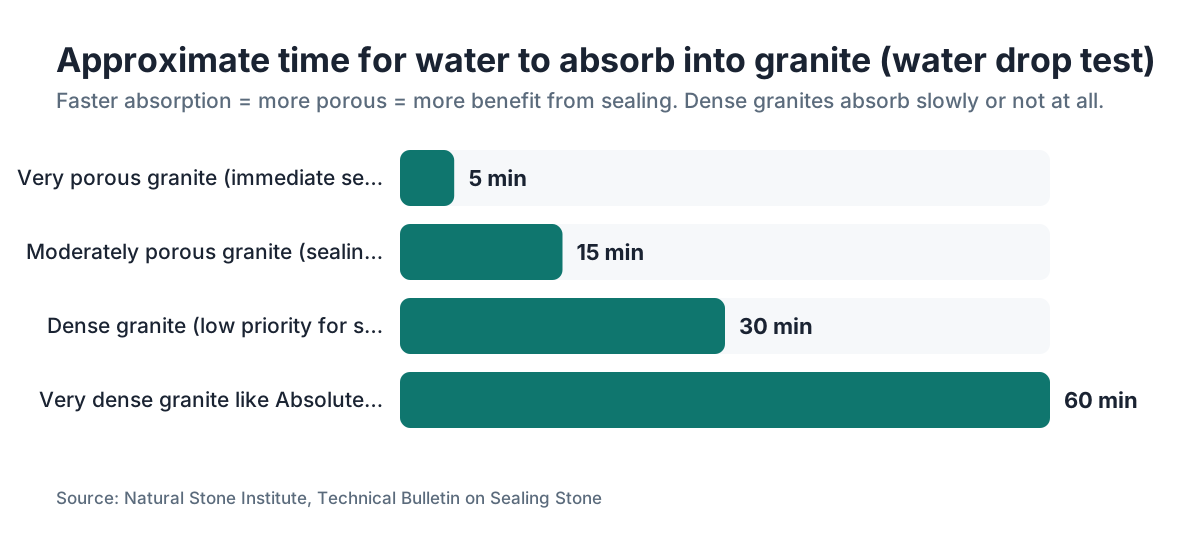
Absolute Black and other very dense, tight granites often absorb almost nothing. You can apply a color enhancer and see essentially no difference. Porosity ranges from under 1% for dense granites like Absolute Black to 2 to 3% for more porous varieties, and that gap drives the whole result [5]. Check porosity first with the water drop test: put a few drops of water on the surface and time how long it takes to absorb. If the water beads for 30 minutes or more, the stone is already dense and neither sealer type will do much [1].
Is the color change from a color-enhancing sealer permanent?
Largely, yes. This is the part that surprises homeowners most. The product penetrates the stone and the resins bond inside the pores, so the initial color shift is essentially permanent. You can't easily take it back. The sealer does deplete over years of use and cleaning, and as it goes the color may drift back toward the original look, but you won't wake up one morning and find your granite reset to how it was.
That's exactly why the test patch is not optional. Do it on the underside of the slab, on a cutout, or on a hidden spot like under the lip of an overhang. Mix a small amount, apply it by the directions, and wait the full cure time (usually 24 to 72 hours) before you judge it. Love it? Proceed. If the test area looks too dark, muddy, or uneven, don't put that product on the field.
Permanence also means you should think about how the stone relates to everything else in the room. Granite chosen to match cabinetry, backsplash tile, or flooring at a certain lightness can look mismatched after a strong color treatment. That's not a dealbreaker, but factor it in before you start.
How do you apply a color-enhancing sealer to granite countertops?
The process isn't complicated, but execution matters. A rushed or uneven application leaves blotches that are very hard to fix.
Start with a completely clean, dry surface. Grease, soap film, or moisture will block penetration. Use a dedicated stone cleaner or a small amount of dish soap heavily diluted in water, rinse well, and let the stone dry at least an hour, longer in humid weather.
Apply the sealer in sections. Work it in with a foam applicator, soft cloth, or the applicator that came with the product. Cover one 2-to-3-square-foot section at a time so you can keep the surface wet with sealer before it starts absorbing unevenly. Let it dwell for the time on the label, usually 3 to 10 minutes. Then buff off all the excess with a clean dry cloth before it hazes.
This last step is the one people blow. Any sealer left on the surface past the dwell time cures into a hazy residue that takes solvent to remove. More sealer does not mean more color. The enhancement comes from what absorbs, not from what sits on top.
Apply a second coat if the instructions call for it, using the same method. Let the final coat cure fully (24 to 72 hours for most products) before the counter goes back to normal use. Keep it dry during the cure window.
For fabricators tracking material and labor on jobs that include sealing, good quote data pays off. SlabWise's quoting tools let you build sealer application into job pricing so it's never forgotten or given away for free.
What does color-enhancing sealer cost, and how long does it last?
Products sold for residential DIY use run $15 to $60 for a quart or pint, enough for 50 to 200 square feet depending on the product and the stone's porosity [2]. Professional-grade products from suppliers like StoneTech, Aqua Mix (a Custom Building Products brand), or Tenax run $25 to $80 for larger containers, covering 100 to 400 square feet per quart.
How long the color lasts depends on the resin load, how porous the stone is, and how hard the surface gets used. Most manufacturers claim 3 to 5 years [6]. Heavy daily use with acidic cleaners burns through a sealer faster. Reapply when the water-bead test shows the stone drinking water quickly again, and for a color enhancer also watch for the color starting to look duller or lighter than it did right after application.
Having a fabricator apply the sealer at installation is an option worth considering. Fabricators often charge $50 to $150 to seal a standard kitchen's worth of countertops, depending on region and square footage. For a color enhancer, where the result is permanent, letting someone experienced handle the first application is a reasonable call.
Are there any risks or downsides to using a color-enhancing sealer?
The biggest risk is the one already covered: the color change isn't easily reversible. An unwanted result means living with it while it slowly fades, and that can take years.
The second risk is trapping moisture. If you seal stone that hasn't fully dried, or a slab that was just installed and still holds moisture from the install process or a recent deep cleaning, you can trap that water and create a milky or whitish haze under the sealed surface. Let new countertops dry at least 24 hours after installation before sealing. If the stone was just cleaned, give it at least a few hours.
Some color-enhancing sealers are solvent-based rather than water-based. Solvent-based products tend to produce a stronger color shift and penetrate harder, but the fumes are stronger too. Work with good ventilation and follow the product's safety data sheet. The California Air Resources Board regulates VOC content in stone sealer products sold in California, with limits that shape how these products are formulated [3].
One more thing: color-enhancing sealers don't make granite bulletproof. They slow staining but don't stop it. Sealed granite still needs wine, oil, or acidic spills wiped up fast. And no sealer protects against etching from acids, though granite etches far less readily than marble or limestone. For broader stone care, the how to clean stone countertops guide covers maintenance across stone types.
How can you test whether your granite needs a sealer at all?
The water drop test is the standard field check fabricators and installers use. Place a quarter-sized drop of water on the granite. If it beads and stays beaded past 30 minutes without soaking in, the stone is dense enough that sealing is low priority. If it absorbs in 5 to 15 minutes and leaves a dark wet spot, the stone is porous and will benefit from sealing. Absorption in under 5 minutes means the stone is quite porous and sealing is a good idea [1].
For color enhancement specifically, run a quick preview right on the counter: pour a small puddle of water on the surface and look at it from an angle. The area under the water shows you roughly what a color enhancer would do. Like how it looks wet and want that for keeps? A color-enhancing sealer gets you close. If the wet look doesn't do it for you or makes the stone look muddy, stick with a standard sealer or skip sealing altogether.
The Marble Institute of America (now part of the Natural Stone Institute) has long recommended the water test as the baseline diagnostic before any sealing decision [4]. It takes 30 seconds and costs nothing.
What are the best color-enhancing sealer products on the market?
A few brands come up again and again in fabricator shops and among stone care pros. These aren't ranked, and none of them paid for this mention.
StoneTech BulletProof Sealer and its color-enhancing variant are easy to find at tile and stone suppliers. Aqua Mix Sealer's Choice Gold (water-based) and Enrich N Seal (solvent-based, for a stronger color effect) are popular with installers and come from Custom Building Products, a large established manufacturer [10]. Tenax Ager is a solvent-based product from an Italian manufacturer, well-regarded for strong color enhancement on dense dark stones [7]. Black Diamond Stoneworks Natural Stone Sealer is a consumer-accessible option sold online and at home improvement stores.
For a honed granite that needs the most dramatic wet-look restoration, solvent-based products generally beat water-based ones. For polished granite where you just want a moderate color boost plus good protection, water-based options are easier to apply and smell far less.
Buy from a stone supply distributor or a manufacturer's direct channel rather than a random third-party reseller, and confirm the product is a true impregnating sealer before you apply it. Some products labeled as stone sealers are actually topical coatings with misleading labels.
Does a color-enhancing sealer work on other stone types besides granite?
Yes. The same products work on quartzite, slate, travertine, sandstone, limestone, and most other porous natural stone. Marble is a special case. Marble etches easily from acid exposure, and a sealer (color-enhancing or not) won't stop etching, so set expectations correctly. A color enhancer on marble gives a wet look and slows staining, but the surface still etches from lemon juice or vinegar.
Engineered stone (quartz countertops like Cambria) is not porous and doesn't absorb sealer at all. Applying a color-enhancing sealer to Cambria countertops or other quartz surfaces is wasted product. The sealer has nowhere to go and just sits on top and hazes.
Natural quartzite gets confused with engineered quartz, but quartzite is a metamorphic rock and is genuinely porous. Plenty of quartzite slabs benefit from color-enhancing sealer the same way granite does, though testing matters even more because quartzite varies widely in density and mineral makeup.
For homeowners weighing marble countertops or granite countertops as part of a bigger decision, knowing how sealer behaves on each stone type sets realistic maintenance expectations before you pick a material.
Can a fabricator or professional apply this better than a DIY job?
Honestly, the application isn't technically demanding. Most homeowners who read the instructions and work carefully get good results. The common DIY mistakes are applying too much product, not buffing off the excess before it hazes, or not letting the stone dry thoroughly first. All three are avoidable with a little attention.
That said, a fabricator sealing at installation has one real edge: they can do a controlled application in ideal conditions (clean stone, known dry time, no household traffic to dodge). For a color-enhancing sealer, where the result is permanent, having the first application done professionally takes some risk off the table.
If you're getting new kitchen countertops installed, ask the fabricator whether they seal as part of the package and whether their standard product is a color enhancer or a neutral impregnator. Many fabricators apply a neutral sealer by default and will upgrade to a color enhancer for a small upcharge, or free if you ask. Fabricators running job management and quoting software like SlabWise can track which sealer went on which job, so you have a record for future reapplications.
For the bigger picture on install day, including surface prep and sealing timing, see the countertop installation guide.
Frequently asked questions
Will a color-enhancing sealer make my granite look fake or plastic?
If applied correctly to the right stone, no. A proper impregnating color enhancer deepens the stone's natural tones rather than adding an artificial sheen. The surface should feel exactly the same as unsealed stone. The wet-look effect only reads as fake when it's applied to a stone that doesn't suit it, like a very pale granite, or when a topical coating is used instead of a true impregnator.
Can I reverse a color-enhancing sealer if I don't like the result?
Not easily. Impregnating sealers bond inside the stone's pores, and there's no reliable DIY way to extract them. Professional stone restorers sometimes use heavy solvent treatments or poulticing to partially reduce the effect, but full reversal is unlikely. This is why testing on a hidden area before doing the full surface is strongly recommended. The test patch is not optional.
How do I know if my granite has already been sealed with a color enhancer?
If the stone looks darker or richer than other slabs of the same material you've seen, it may have been treated. The water drop test won't tell you whether a color enhancer was used, only whether the stone is still sealed. If you weren't told at installation and have no product record, assume you don't know and do a small test patch with any new product before applying it to the full surface.
Does color-enhancing sealer protect against granite staining?
Yes, it provides real stain protection on top of the color effect. Like any impregnating sealer, it slows liquid penetration and gives you time to wipe up spills before they work into the stone. It doesn't make granite completely stain-proof, especially against oils left to sit for hours. You still need to wipe spills promptly.
How often do I need to reapply color-enhancing sealer on granite?
Most products are rated for 3 to 5 years under normal use. The practical trigger for reapplication is when the water-bead test shows the stone absorbing water quickly again and the color looks noticeably lighter or duller than it did after the original application. Harsh cleaning products and daily heavy use will shorten that window.
Is a color-enhancing sealer safe for a kitchen food-prep surface?
Most products are considered safe for incidental food contact after the cure period, typically 24 to 72 hours. Check the specific product's safety data sheet to confirm. During the cure window, keep the surface dry and avoid using it for food prep. Once cured, the sealer is inert and inside the stone's pores, not on the surface where it would contact food.
What's the difference between a wet-look sealer and a color-enhancing sealer?
They're effectively the same thing marketed under different names. Both deepen the stone's color by filling pores with a resin that raises the refractive index of the stone's interior. Some products lean on the aesthetic language (wet look) and others on the protective language (color-enhancing sealer with stain protection). Check the actual chemistry and whether it's an impregnator or topical coating.
Can I use color-enhancing sealer on honed granite specifically?
Honed granite is actually the best use case for a color enhancer. Honing removes the mirror polish and makes granite look flat and lighter than polished. A color-enhancing sealer restores much of that depth and makes the stone look rich again without a re-polish. The effect is typically more dramatic on honed surfaces than on polished ones.
Do I need to strip the old sealer before applying a color-enhancing sealer?
If the stone was previously sealed with a neutral impregnator and that sealer is depleted (the water-bead test shows quick absorption), you generally don't need to strip anything. The old sealer is already gone from the pores. If the stone has a topical coating like wax or acrylic on it, that needs to be stripped with the right remover before any impregnating sealer will work.
Will color-enhancing sealer work on outdoor granite?
Yes, though outdoor applications are harder on sealers because UV exposure, temperature cycling, and rain speed up depletion. Reapplication frequency outdoors may be every 1 to 2 years rather than 3 to 5. Use a product rated for exterior use and check whether solvent-based or water-based performs better in your climate. The test-patch step matters even more outdoors where stone conditions vary.
Is there a color-enhancing sealer that works on engineered quartz?
No. Engineered quartz like Caesarstone, Silestone, or Cambria is non-porous by design. Impregnating sealers need pores to penetrate, and quartz doesn't have them. Any product applied to quartz just sits on the surface and needs to be wiped off. Quartz countertops don't need sealing at all, which is one of the main reasons homeowners choose them.
How do I prep granite before applying a color-enhancing sealer?
Clean with a dedicated stone cleaner or heavily diluted dish soap, rinse thoroughly, and let the surface dry completely. At least one hour of dry time is the minimum; longer in humid weather. The surface must be free of grease, soap film, polish, and moisture. Any contamination in the pores will block penetration and can cause an uneven or blotchy color result that's very hard to correct.
Does color-enhancing sealer affect the shine or gloss level of polished granite?
A true impregnating color enhancer should not change the surface's gloss level. The polish comes from the surface texture, not from what's in the pores. If you notice a slight sheen increase after sealing a polished granite, it may be from sealer residue left on the surface that wasn't fully buffed off. Buff it thoroughly with a clean dry cloth and the effect should normalize.
Sources
- Natural Stone Institute, Technical Bulletin on Sealing Stone: Water drop absorption test as the standard diagnostic for whether granite needs sealing: bead for 30+ minutes means dense/no sealing needed, absorbs in under 5 minutes means porous and sealing recommended
- Custom Building Products, Aqua Mix product data sheets: Coverage rates and pricing for consumer and professional impregnating stone sealers in the $15-$80 range per quart, covering 50-400 sq ft depending on porosity
- California Air Resources Board, Consumer Products VOC regulations: CARB regulates VOC content in stone sealer products sold in California, affecting solvent-based product formulations
- Natural Stone Institute, Care and Maintenance of Natural Stone: Marble Institute of America (now Natural Stone Institute) has long recommended the water test as the baseline diagnostic before any sealing decision
- USGS, National Minerals Information Center: Dimension Stone: Granite porosity typically ranges from under 1% for dense granites like Absolute Black to 2-3% for more porous varieties, affecting sealer penetration and color-enhancement results
- StoneTech Professional, BulletProof Sealer Technical Data Sheet: Solvent-based impregnating stone sealers with color-enhancement formulation rated for 3-5 year service life under normal interior use
- Tenax USA, Ager Color Enhancing Sealer Product Information: Tenax Ager is a solvent-based color-enhancing impregnator particularly effective on dense dark stones, widely used by fabricators for wet-look results
- U.S. Environmental Protection Agency, Safer Choice: Stone and Tile Care Products: EPA Safer Choice program includes stone care product category; product safety data sheets required for food-contact surface suitability claims
- Natural Stone Institute, Understanding Stone Sealers (Technical Bulletin 7): Distinction between impregnating (below-surface) sealers and topical coatings, and recommendation that impregnating sealers are preferred for kitchen countertop applications
- Custom Building Products, Aqua Mix Enrich N Seal Technical Data: Solvent-based color-enhancing impregnators deliver stronger color shift than water-based equivalents due to deeper penetration and higher-refractive-index resin deposit
Last updated 2026-07-10