TL;DR
- Black granite countertops cost $40 to $200 per square foot installed, depending on the stone type, finish, and your region.
- Absolute Black is the most popular option and the easiest to maintain.
- Most black granites need sealing once a year.
- They hide crumbs well but show dust and water spots more than lighter stones.
What exactly is black granite, and is it really granite?
Here's where things get murky right away. The stone industry uses "granite" loosely. True granite, in the geological sense, is a coarse-grained igneous rock made mostly of quartz, feldspar, and mica. A stone sold as "Absolute Black granite" is almost always a gabbro or diabase, not granite at all [1]. It has a different mineral makeup, a finer grain, and almost no quartz, which is part of why it's so uniformly dark.
That distinction matters practically. Gabbro and diabase are denser and less porous than true granite, so Absolute Black often needs less frequent sealing than a typical speckled granite [2]. It also machines differently on a CNC bridge saw, which some fabricators account for in their pricing.
Black stones labeled "Black Galaxy," "Black Pearl," and "Nero Impala" are usually true granites with dark backgrounds and flecks of gold, silver, or white. Those do qualify as granite under the geological definition. So when you're shopping for black granite countertops for your kitchen, you may be comparing a gabbro (Absolute Black) to a true granite (Black Pearl) to a quartzite (Black Fantasy) and all three will be called granite at the stone yard.
The shorthand isn't going away, and for most homeowners it doesn't need to. What matters is hardness, porosity, and how the stone behaves in your kitchen. Ask your fabricator for the material's water absorption test result or check if it has been tested to ASTM C97, the standard method for measuring absorption in dimension stone [3].
How much do black granite countertops cost?
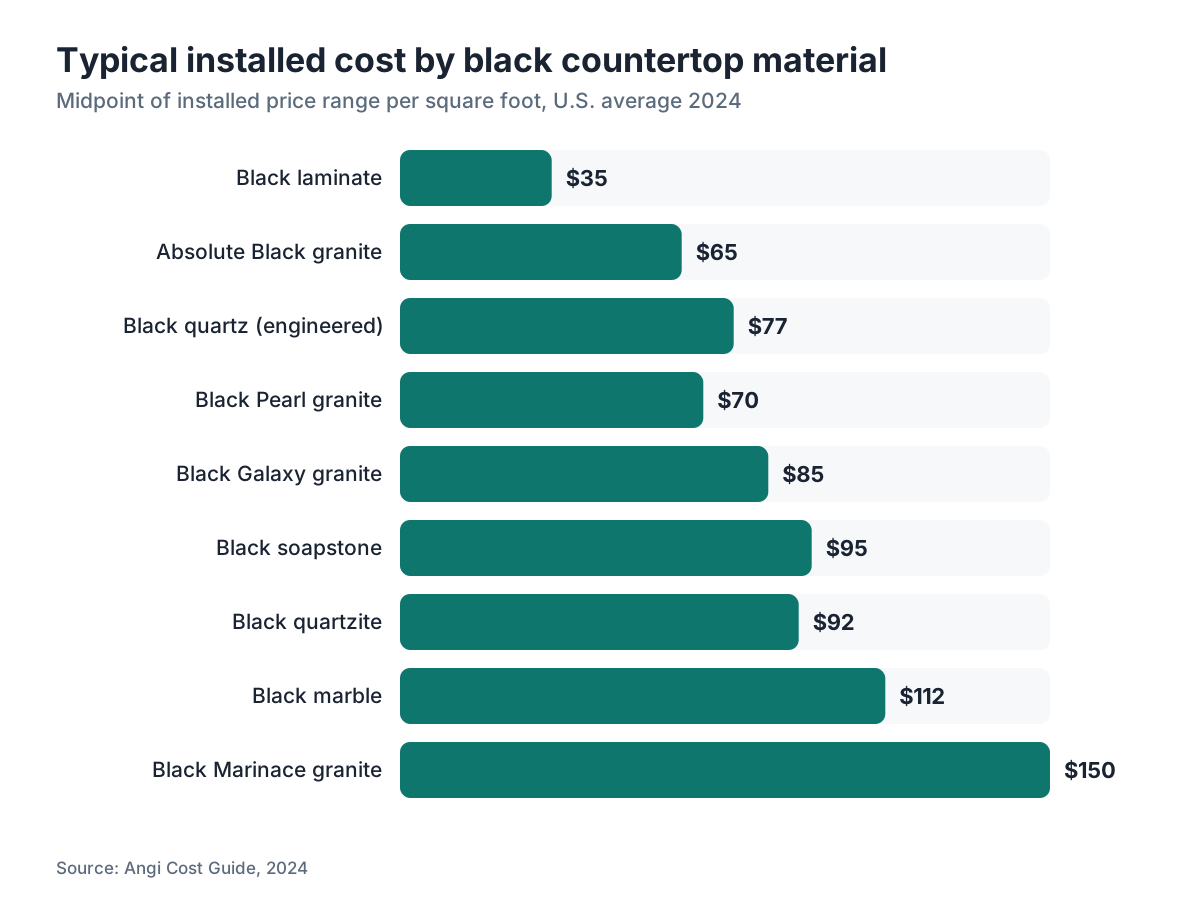
Installed prices for black granite countertops generally run $40 to $200 per square foot, with the wide spread driven by stone rarity, slab thickness, edge profile, and your region's labor rates [4].
Absolute Black sits in the lower to middle range, typically $50 to $80 per square foot installed for a standard 3 cm slab with a simple eased or beveled edge. It's widely available, quarried in large volumes in India and South Africa, and fabricators know how to work it efficiently.
Black Galaxy (also called Star Galaxy) runs a bit higher, $60 to $110 installed, because the golden fleck pattern requires more careful slab selection to match seams. Nero Absolute and Nero Impala sit in a similar band.
Exotic blacks like Black Marinace (a conglomerate with quartz pebbles) or Cosmic Black can reach $150 to $200 installed because the material itself costs more at the slab yard and seam placement requires more skill.
| Stone Name | Typical Installed Cost (per sq ft) | Notes |
|---|---|---|
| Absolute Black (gabbro) | $50, $80 | Most uniform; widely available |
| Black Pearl granite | $55, $85 | Silver/charcoal flecks; moderate variation |
| Black Galaxy granite | $60, $110 | Gold flecks; seam-matching adds labor |
| Nero Impala granite | $65, $100 | Slight gray grain; South Africa |
| Black Marinace granite | $120, $180 | Conglomerate; high visual impact |
| Leathered Absolute Black | $70, $100 | Add $10, $20/sq ft for leathered finish |
Strip out installation, and raw fabrication (cutting, edging, polishing) for a mid-range black granite runs $30 to $60 per square foot. Material at the slab yard adds $10 to $40 per square foot depending on origin and thickness.
For comparison, see our full breakdown of kitchen countertops and granite countertops pricing across all stone types.
The biggest surprise in most quotes is the cutout and edge-profile charges. A single undermount sink cutout typically adds $100 to $200. An ogee or dupont edge can add $15 to $30 per linear foot over a basic eased edge. Those line items shock homeowners who budgeted off a per-square-foot number alone [4].
Which black granite is best for a kitchen?
For most kitchens, Absolute Black is the right call. It's the most uniform-looking stone on the market, it's dense enough that routine sealing is easy to maintain, and fabricators cut it cleanly. If you want a countertop that reads as solid black from across the room, this is it.
Want some movement or sparkle? Black Galaxy delivers that without getting too busy. The gold and bronze mineral flecks catch light in a way that keeps the surface from looking flat or heavy.
Black Pearl is a good middle ground. It has enough grain variation to hide minor scratches and scuffs better than Absolute Black, but it still reads dark and dramatic.
For kitchen islands or statement surfaces, leathered black granite has become genuinely popular over the last decade. The leathered finish (sometimes called brushed or honed-brushed) leaves a slightly textured matte surface that hides fingerprints and water spots better than a high-gloss polish. You give up some of the mirror-like shine, but in a busy kitchen that's usually a good trade.
A word on pairings. Black granite countertops go well with white or light gray cabinetry because the contrast is clean and doesn't fight. They work with warm wood tones too, though the pairing can feel heavy if the space is small or has low ceilings. In a well-lit kitchen, black granite reads sophisticated. In a dim one, it can feel like a cave.
Do black granite countertops show fingerprints and water spots?
Yes. That's the most honest thing anyone can tell you about polished black granite countertops. The high-gloss surface acts like a mirror, and water minerals, skin oils, and soap residue all show up clearly against that dark background.
Polished Absolute Black is the worst offender because there's no grain to break up the visual field. You'll see every water drop from the faucet and every hand print at the edge of the sink.
You have two ways to manage this. Go with a leathered or honed finish, which diffuses light and makes the surface far more forgiving day to day. Or keep a microfiber cloth under the sink and wipe the countertop down regularly. Most homeowners with polished black granite say they wipe it once a day without thinking about it.
Dust shows clearly too, especially light-colored dust like drywall dust during renovation or flour when baking. White pet hair is extremely visible. These aren't dealbreakers, but they're real, and anyone who's spent time with these countertops will tell you the cleaning frequency runs higher than with a white or gray speckled stone.
How do you seal and maintain black granite countertops?
Sealing is straightforward. For Absolute Black (gabbro), the stone's low porosity means you may need to seal less often than a typical granite. Do the water test: pour a few tablespoons of water on the surface and wait 15 minutes. If the stone darkens and the water soaks in, it needs sealing. If the water beads or evaporates without darkening the stone, you can wait [2].
For Black Pearl and other true black granites, annual sealing is a reasonable default. Use a penetrating (impregnating) sealer, not a topical coating. Topical sealers build up a film on the surface, peel over time, and make refinishing a headache. Penetrating sealers soak into the stone's pores and protect from within without changing the surface appearance.
Application is simple. Clean the surface thoroughly, apply the sealer with a soft cloth or foam pad, let it dwell for the time on the label (usually 10 to 15 minutes), and buff off the excess before it hazes. The whole job takes about 30 minutes for a typical kitchen.
For daily care, pH-neutral stone cleaner or a few drops of dish soap in warm water is enough. Avoid anything acidic: vinegar, lemon juice, and citrus-based cleaners etch stone surfaces and strip sealers over time [5]. The Natural Stone Institute's care guidance is blunt about it, warning homeowners to "never use products that contain lemon, vinegar, or other acids on marble or limestone," and the same caution applies to sealed granite [5].
For more on cleaning natural stone surfaces, see our guide on how to clean stone countertops.
Scratching is a real but uncommon concern. Granite rates 6 to 7 on the Mohs hardness scale, which means a knife won't scratch it but a diamond or tungsten carbide will [6]. Don't cut directly on the stone anyway, not because of the granite but because it will ruin your knife edge fast.
What finishes are available for black granite countertops?
Four finishes dominate the market.
Polished is the default. A mirror-like surface that pulls out the visual depth and shine of the stone. It shows water spots and fingerprints most readily, and it's what most people picture when they think of a black granite kitchen countertop.
Honed removes the reflective layer and leaves a flat, matte surface. Honed Absolute Black looks more like a chalkboard than a mirror. It's less likely to show water spots, but it's more porous at the surface level and may need more frequent sealing depending on the stone.
Leathered (or brushed) is the fastest-growing finish right now. A diamond-tipped brush runs over the surface to create a slight texture, like very fine orange peel. It hides fingerprints and water spots much better than polished, adds a tactile quality to the stone, and keeps more color depth than honed. Fabricators typically charge $10 to $20 per square foot more for a leathered finish because it takes extra machine time.
Flamed is a rough, outdoor-grade texture created by high-heat torching. It's rare on kitchen countertops but shows up occasionally for rustic or outdoor kitchen applications.
How does Absolute Black granite compare to black quartz countertops?
This is the comparison most homeowners land on, and it's genuinely close depending on your priorities.
Black quartz countertops (engineered stone like Silestone Charcoal Soapstone or Caesarstone Jet Black) are manufactured from ground quartz and pigment binders. They're non-porous, never need sealing, and hold consistent color throughout the slab [7]. For homeowners who don't want to think about maintenance, engineered black quartz is a real answer.
Absolute Black granite is a natural stone, so each slab is unique even when the variation is minimal. It's harder than most quartz products, though the difference is marginal for kitchen use. Granite also handles heat better than quartz, which can discolor or crack under sustained direct heat from pots and pans. The resin binders in quartz are the vulnerability there, not the quartz crystals themselves [7].
Price is close. Entry-level black quartz runs $55 to $90 per square foot installed. Premium large-format slabs of black quartz push $100 to $150. So Absolute Black granite is often cheaper or equal once you account for the full installed cost.
Here's the aesthetic difference: natural stone has depth. Even Absolute Black, which looks uniform, has a three-dimensional quality under directional light that engineered quartz doesn't replicate. If that matters to you, granite wins. If consistent color and zero maintenance are your priorities, quartz wins.
For a fuller comparison on the quartz side, see our guide to quartz countertops.
What do fabricators need to know about cutting and fabricating black granite?
This section is for shop owners and fabricators. Homeowners can skip it, though understanding what goes into fabrication explains why quotes vary.
Absolute Black (gabbro/diabase) cuts differently than true granites. It's denser, which means blade wear runs higher. Budget for more frequent blade changes, or use a premium blade rated for hard dense material. Feed rates on a bridge saw should be slower than you'd run for a typical speckled granite. Push too fast and you get micro-fracturing at the cut edge that shows up as chipping on the finished polished edge [8].
The uniformity of Absolute Black is both a help and a trap. Seam placement looks cleaner because there's no grain to match, but any small chip or machining mark is far more visible against the solid black surface than it would be on a patterned stone. Surface prep and edge finishing have to be tight.
For leathered finishes, the diamond brush attachment needs the right pressure. Too light and you get inconsistent texture. Too heavy and you create uneven patches that show up under raking light. Run samples on offcuts before committing the tool path on a full slab.
Water quality in the shop matters more with dark stones. Hard water deposits on the polished surface during fabrication can leave faint white marks that are very obvious on black. Use deionized or softened water for final polishing passes if your shop water is hard.
If you're quoting black granite jobs and want to cut the back-and-forth on pricing, SlabWise handles edge-profile pricing, cutout charges, and finish upcharges as line items in the quote rather than rolling them into a single number. That makes it easier to explain the breakdown to a homeowner who's only seen a per-square-foot figure online.
Does black granite work in small kitchens or dark rooms?
Small kitchens with black granite countertops can work beautifully, but you need to balance the dark mass somewhere else in the design. White upper cabinets are the classic fix. A white subway tile backsplash, light-colored flooring, or strong overhead lighting all help the black surface read as a deliberate choice rather than a dim afterthought.
Dark cabinets plus black granite in a small space with limited natural light is genuinely hard to make feel good. The countertop disappears into the cabinetry and the room reads as one dark mass. If that's your situation, either pick a black granite with high contrast (like Black Galaxy with its gold flecks, which catch light) or go with a leathered finish that adds surface texture and a visual break.
In large kitchens with good natural light and an open floor plan, black granite countertops are one of the more forgiving choices. The stone anchors the room without demanding too much attention.
How long do black granite countertops last, and do they add resale value?
Granite countertops, maintained properly, last the life of the house. There's no replacement timeline. You're dealing with stone that formed over millions of years; a few decades of kitchen use isn't a challenge [6].
The practical risks are chips at corners and edges (granite is hard but not flexible, so impact at a thin edge can chip), and etching if the sealer breaks down and acidic liquids sit on the surface. Both are preventable with basic care and occasional resealing.
On resale value, the research is messier than the countertop industry would like you to believe. A 2019 Zillow analysis found that homes listing luxury features in their descriptions, including stone countertops, sold for 4.1% more than expected [9]. Stone countertops were mentioned as a feature, but the data doesn't isolate black granite specifically or control cleanly for house quality. Take resale claims with appropriate skepticism; the stone you like living with is probably the right choice.
What realtors consistently say, and this matches common sense, is that granite countertops are a neutral positive. They don't hurt resale value and they read as a premium material to most buyers. Black specifically can divide buyers who have strong preferences for light countertops, so if resale is your top concern, a light-to-medium granite is a safer bet for broad appeal.
How does black granite compare to other dark countertop materials?
Black granite sits in a category with several competitors worth considering.
Soapstone is naturally dark gray to black, non-porous, acid-resistant (a real advantage over granite), and has a softer, more organic look. It scratches more easily than granite, but those scratches can be sanded out. See our guide on how to clean soapstone countertops for more on its maintenance.
Black quartzite (like Black Fantasy or Nero Santiago) sometimes gets confused with black granite at the stone yard. True quartzite is harder than granite and very durable, but it's porous and needs sealing. The care routine is similar to granite, but the material origin and mineral composition are different. Our how to clean quartzite countertops guide covers the specifics.
Black marble, like Marquina or Nero Portoro, is strikingly beautiful but practically challenging. Marble is calcite-based and reacts with any acid, meaning lemon juice, wine, and even some cleaning products will etch the surface. For a kitchen with heavy daily use, black marble is a maintenance commitment most homeowners underestimate. Read our marble countertops article before committing.
Concrete countertops can be cast in any dark color and have a distinctly industrial quality. They need sealing, can crack over time, and are heavy. For some kitchens they're exactly right. See concrete countertops for the trade-offs.
Black laminate countertops, including Formica countertops and other laminate countertops, cost $20 to $50 per square foot installed and are a reasonable budget option. They won't have the visual depth or heat resistance of stone, but for a rental or a budget renovation they do the job.
| Material | Installed Cost (sq ft) | Sealing Needed | Acid Resistance | Heat Resistance |
|---|---|---|---|---|
| Absolute Black granite | $50, $80 | Occasionally | Good | Good |
| Black quartz (engineered) | $55, $100 | Never | Good | Moderate |
| Black soapstone | $70, $120 | Optional (oil) | Excellent | Good |
| Black quartzite | $65, $120 | Yes (annual) | Good | Good |
| Black marble | $75, $150 | Yes (frequent) | Poor | Good |
| Black concrete | $65, $135 | Yes (frequent) | Moderate | Good |
| Black laminate | $20, $50 | No | Good | Poor |
What should you ask a fabricator before buying black granite countertops?
Most homeowners walk into a fabricator armed with a style photo and a rough square footage number. That's enough to start, but not enough to dodge surprises on the final bill.
Ask these questions specifically.
What is the material? Absolute Black labeled as granite may actually be gabbro; ask what the stone variety is and where it was quarried. This affects porosity and sealing frequency.
What thickness slab are you quoting? The industry standard for residential countertops is 3 cm (about 1.25 inches). Some fabricators quote 2 cm and add a laminated edge to fake the 3 cm look. That's a legitimate choice, but you should know you're getting it.
What edge profile is in the base price? Many quotes include only an eased or straight edge. Ogee, waterfall, or dupont profiles add cost per linear foot.
How many seams will there be, and where? Black granite's uniformity means seams are less visible than on a patterned stone, but they're still there. Ask to see where they land relative to your sink and cooktop.
Do you have multiple slabs of this material in stock, or will you need to order? If your kitchen needs more than one slab, book-matching or at minimum pulling from the same lot matters for a consistent look.
What's the warranty on fabrication and installation? Norms vary, but most reputable shops cover defects in their work for at least one year.
If you're a fabricator reading this and you're still quoting black granite jobs by hand or with spreadsheets, look at software built for stone shops. SlabWise handles the line-item detail, finish upcharges, and edge-profile pricing that trips up manual quotes.
Frequently asked questions
Is Absolute Black granite actually granite?
No, not in the geological sense. Absolute Black is almost always gabbro or diabase, a different igneous rock with finer grain and very little quartz. The stone industry uses "granite" broadly for commercial marketing. Gabbro is denser and less porous than most true granites, which is actually a practical benefit: it typically needs less frequent sealing.
How often do black granite countertops need to be sealed?
It depends on the specific stone. Absolute Black (gabbro) is dense enough that some slabs pass the water absorption test and need sealing only every two to three years. True black granites like Black Pearl or Black Galaxy typically need sealing once a year. Do the water test: if water darkens the stone in 15 minutes, it's time to seal. If the water beads, you have time.
Do black granite countertops scratch easily?
No. Granite ranks 6 to 7 on the Mohs scale, so everyday kitchen use won't scratch the surface. Knives, pots, and ceramic dishes can't mark it. What can scratch it: other stones (like a granite mortar and pestle dragged across the surface), diamond, or tungsten carbide. Don't cut directly on it regardless; the stone will destroy your knife edge faster than the knife affects the stone.
Will black granite countertops make my kitchen look smaller?
They can if your kitchen is already small and dark. Black granite absorbs light rather than reflecting it. In a small kitchen, pair it with white or light cabinetry, good overhead lighting, and a light floor. In a well-lit kitchen with high ceilings and open space, black granite reads sophisticated without making the room feel smaller.
What's the difference between polished and leathered black granite?
Polished has a mirror-like reflective surface that pulls out the stone's depth and shine, but shows water spots and fingerprints clearly. Leathered (or brushed) uses a diamond brush to create a slight matte texture that hides fingerprints and water marks much better in daily use. Leathered finishes typically add $10 to $20 per square foot to fabrication cost, but most homeowners with busy kitchens find them easier to live with.
Can I use vinegar to clean black granite countertops?
No. Vinegar is acidic and will etch granite surfaces and strip the sealer over time. Same goes for lemon juice, lime-based cleaners, and citrus-heavy products. Use a pH-neutral stone cleaner or mild dish soap in warm water for daily cleaning. For anything stubborn, isopropyl alcohol diluted with water is safe and effective without damaging the sealer.
How much does a black granite countertop cost for an average kitchen?
An average U.S. kitchen has roughly 30 to 40 square feet of countertop. At $50 to $80 per square foot installed for Absolute Black, you're looking at $1,500 to $3,200 for a typical kitchen, before add-ons. Sink cutouts ($100 to $200 each), specialty edge profiles ($15 to $30 per linear foot upgrade), and complex layouts with many seams can push the total significantly higher.
Does black granite stain?
It can, but it's one of the more stain-resistant natural stones because of its low porosity, especially Absolute Black (gabbro). Oil-based stains are the main risk if the sealer has worn through. Acidic liquids like wine or tomato sauce won't stain quickly but will etch an unsealed surface over time. Keep the sealer current and wipe spills promptly and staining is rarely an issue in practice.
Is black granite good for outdoor kitchens?
Yes, with some caveats. Granite handles freeze-thaw cycles poorly if water infiltrates through the sealer and freezes in the pores, causing spalling. In climates with hard freezes, use a high-quality penetrating sealer rated for exterior use and reseal annually. Flamed black granite is sometimes used outdoors because the rough texture is non-slip and less finicky about surface water. Avoid polished finishes outdoors; they get slippery when wet.
How do you repair a chip in a black granite countertop?
Small chips at corners or edges can be filled with a color-matched epoxy or acrylic repair kit. Black is actually easier to match than variegated stones. Clean the chip thoroughly, apply the filler, let it cure, and sand flush. On polished surfaces, the repair may have a slightly different sheen than the surrounding stone; a fabricator can sometimes re-polish a small area to blend it. Major cracks or breaks usually need professional repair or slab replacement.
How does black granite compare to black quartz for a kitchen?
Black quartz (engineered stone) is non-porous, never needs sealing, and stays more consistent in color. It's the lower-maintenance choice. Black granite is a natural stone with more visual depth, handles heat better than quartz (resin binders in quartz can discolor under sustained heat), and is often cheaper at the entry level. If you don't want to think about maintenance, quartz wins. If you want the natural stone look and better heat resistance, granite is the better fit.
What cabinets go best with black granite countertops?
White and off-white cabinets are the most reliable pairing, giving maximum contrast and keeping the kitchen feeling bright. Light gray, cream, and sage green cabinets also work well. Natural wood tones (maple, oak, walnut) create a warm, grounded look but can feel heavy in small spaces. Dark cabinets with black granite need strong lighting and careful design to avoid the whole kitchen reading as one dark mass.
Can black granite countertops be installed over existing countertops?
Technically possible but not recommended. Granite slabs are heavy, typically 18 to 25 pounds per square foot for 3 cm material. Installing over an existing laminate or tile countertop adds structural load to your cabinets and leaves height and overhang inconsistencies. Standard practice is to remove the existing countertop before installation. Most reputable fabricators include demolition and haul-away in their quote or offer it as a line item add-on.
Are there health or radon concerns with black granite countertops?
Radon from granite countertops has been studied, and the consensus from the U.S. Environmental Protection Agency is that the contribution from granite countertops to indoor radon levels is typically small compared to radon entering from soil and building materials [10]. The EPA states that granite used in countertops is unlikely to be a significant source of radon in homes. If you have concerns, test your home's air with a standard radon test kit.
Sources
- U.S. Geological Survey, Mineral Resources Program (igneous rock classification): Absolute Black granite is geologically a gabbro or diabase, not true granite, due to its mineral composition lacking significant quartz and feldspar.
- Natural Stone Institute, Stone Maintenance Guidelines: Dense, low-porosity stones like gabbro (sold as Absolute Black) require less frequent sealing than higher-porosity granites; the water absorption test is the standard homeowner check.
- ASTM International, ASTM C97 Standard Test Methods for Absorption and Bulk Specific Gravity of Dimension Stone: ASTM C97 is the standard method for measuring water absorption in dimension stone, which determines sealing frequency needs for countertop materials.
- Angi, Granite Countertops Cost Guide 2024: Installed granite countertop prices range $40 to $200 per square foot; cutouts add $100 to $200 each and upgraded edge profiles add $15 to $30 per linear foot.
- Natural Stone Institute, Care and Maintenance for Natural Stone: The Natural Stone Institute advises against acidic cleaners, vinegar, and citrus-based products on stone surfaces, as they etch stone and strip sealers.
- U.S. Geological Survey, Mohs Hardness Scale (Mineral Resources): Granite rates 6 to 7 on the Mohs hardness scale, so common kitchen tools like knives cannot scratch it; only diamond or tungsten carbide will.
- Natural Stone Institute, Engineered/Quartz Surfaces Guidance: Engineered quartz countertops are non-porous and never require sealing; resin binders can discolor under sustained high heat, unlike natural stone.
- Natural Stone Institute, Dimension Stone Fabrication Guidance: Dense gabbro/diabase (Absolute Black) requires slower feed rates on bridge saws than standard granites to avoid micro-fracturing at the cut edge.
- Zillow Research, Features That Can Help Homes Sell for More (2019): Zillow's 2019 analysis found homes listing luxury features including stone countertops in descriptions sold for approximately 4.1% more than expected.
- U.S. Environmental Protection Agency, Radon (indoor air quality): The EPA states granite countertops are unlikely to be a significant source of indoor radon compared with radon entering from soil and building materials.
- National Kitchen and Bath Association (NKBA), Design and Cost Reports: Stone countertops remain among the most specified kitchen surfaces in NKBA design surveys, with granite consistently in the top materials by volume.
Last updated 2026-07-09