TL;DR
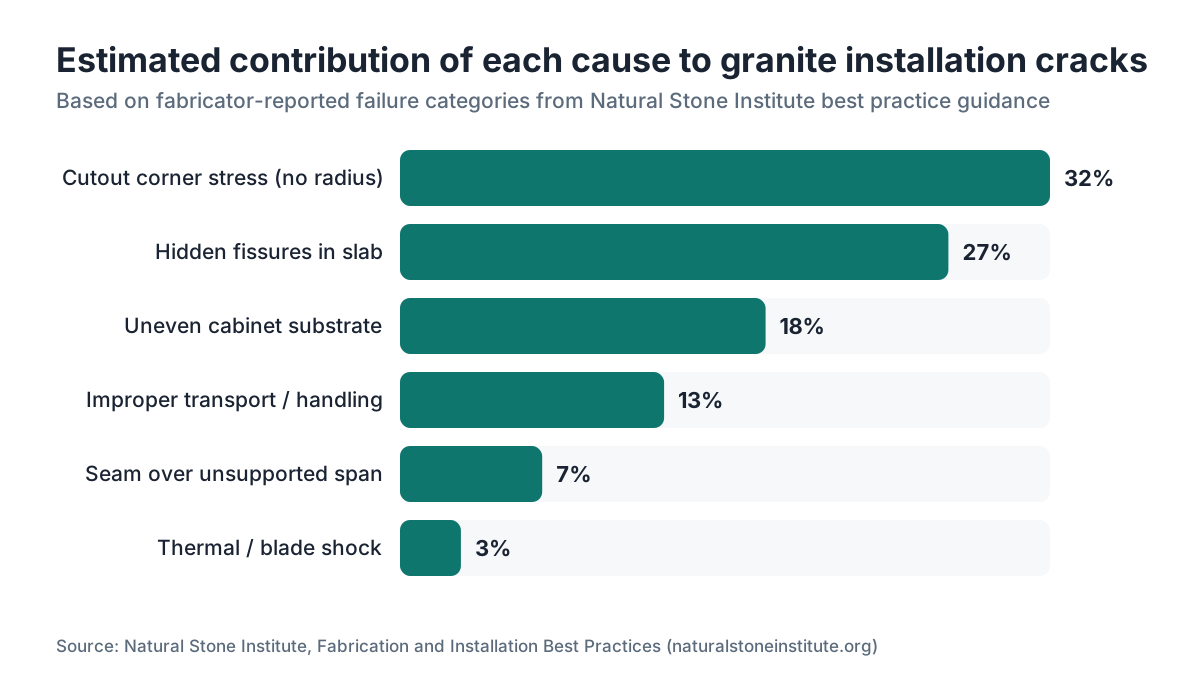
- Granite cracks during installation for six reasons: hidden natural fissures, poor slab support during transport, square cutout corners near sinks, uneven cabinet tops, thermal shock from a dry blade, and seams placed over unsupported spans.
- Almost all of it is preventable with careful templating, radiused corners, and substrate prep.
- A crack that shows up during install is rarely random.
Why does granite crack at all? Understanding the stone first
Granite is an igneous rock that formed under heavy pressure over millions of years. It rates 6 to 7 on the Mohs scale, so it scratches almost nothing [1]. But hard is not the same as tough. Toughness describes resistance to fracture, and granite is more brittle than most people expect. A thin slab with a long unsupported span or a big cutout behaves closer to a sheet of tempered glass than a solid block of rock.
The stone also arrives with built-in weak spots. Natural fissures are hairline separations that formed as the rock cooled, and they run through almost every slab. They are not cracks. Fissures are part of the stone's character, and most stay stable for decades. But put a fissure under load, vibration, or handling stress and it can open into a full crack in seconds. A fabricator who templates carefully spots them. One who doesn't finds out at the worst possible moment.
Thickness matters too. A residential slab is usually 3/4 inch (2 cm) or 1.25 inches (3 cm) [2]. The thinner 2 cm material cracks far more easily during handling than 3 cm. Most experienced shops either skip it for long spans or laminate a build-up strip underneath for rigidity before the piece ever moves.
What are the most common causes of granite cracking during installation?
Six causes come up again and again on job sites. They are not equally common, and they are not equally preventable.
1. Hidden fissures in the slab itself A fissure that ran quietly through a slab for years can open during cutting, routing, or even a careless carry. Fabricators should inspect every slab with raking light (one strong light held at a low angle across the surface) before cutting. Wetting the surface makes fissures easier to see. If a fissure runs through a planned cutout zone, the fabricator should shift the layout or reinforce that zone with a fiberglass rod epoxied into a channel on the underside [3].
2. Sink and cooktop cutouts This is the single most common crack location. Any cutout removes material and leaves stress concentration points at the corners. A square inside corner is a crack waiting to happen. The fix is cheap: every inside corner needs a radius, at least 1/4 inch, ground at the end of each cut. Shops round these with a router or grinder before the piece leaves. Cutouts done on-site with a hand-held circular saw and square corners are a frequent cause of field cracks [3].
3. Poor slab support during transport and handling Slabs should travel and be carried on edge, not flat. Lay a slab flat across two narrow supports with nothing in the middle and it acts like a beam. The bending stress at the center can pass what the stone handles. Carrying a finished section horizontally, two people at the short ends and nothing under the middle, is a classic way to snap it in half on the way through the door. The Marble Institute of America (now part of the Natural Stone Institute) long recommended full-length support for cut pieces in transport [4].
4. Uneven or unlevel cabinet substrate If a cabinet run is not flat and level, the granite rests on the high spots and spans the low ones. That creates a three-point loading problem. Any downward pressure on a spanning section (someone sitting on the counter, say) can crack it. Before install, check the cabinets with a long straightedge and shim the low spots. Variations greater than about 1/8 inch over a 10-foot run are worth fixing [5].
5. Seam placement errors Never put a seam over a span between cabinets, over a dishwasher, or across a sink cutout. Those spots put the seam under the worst bending stress. A seam should land over a cabinet wall or solid substrate. Obvious, and still skipped when a fabricator chases yield and drops the seam wherever the slab happens to run out.
6. Thermal or mechanical shock during cutting Wet-saw blades run cool because water carries the heat away. Let a blade run dry even briefly and the sudden heat at the cut line can start a micro-crack that spreads later. Blade quality counts too. A worn or wrong-grit blade drags and vibrates instead of cutting clean, and that vibration pushes stress through the whole slab [6].
Does the type of granite matter? Are some slabs more crack-prone?
Yes, and it matters a lot. Granite is a broad category of igneous rock, and mineral makeup shifts by quarry and even by block within one quarry. Some varieties have fine, even grain and almost no natural fissures. Others carry large mineral crystals that create zones of different hardness, which makes clean cutting harder. Heavily veined exotics (Blue Bahia, Fusion White) are often not granite at all. They are quartzite or gneiss sold loosely as granite, and they can carry a lot more fissure risk [7].
Rift direction matters too. Natural stone has a preferred cleavage direction, and a good fabricator orients the slab so long cuts run with the rift instead of across it. Cutting against the rift takes more blade force and raises crack risk.
Origin plays into slab consistency as well. Brazilian and Indian slabs have a reputation, fair or not, for more thickness variation and more pre-existing fissures than Italian or Spanish material. That varies wildly by specific quarry and lot. The honest answer is to inspect every slab on its own. Origin is a starting point, not a promise [7].
How does sink cutout placement cause cracks, and how do fabricators prevent it?
A sink cutout pulls a large chunk of material out of the front-to-back span, leaving two narrow strips of stone on either side of the opening. Add a nearby cooktop, or an undermount sink close to the front edge, and those strips can drop under 2 inches wide. Under the slab's own weight plus water, dishes, or someone leaning in, those strips are the most likely place for a crack to start.
Fabricators prevent this three ways. Radius every inside corner, never square. Reinforce the underside of the strips beside the cutout with a fiberglass rod epoxied into a routed channel, which works like rebar and handles tension the stone alone cannot. And support the slab fully before, during, and right after the cutout is made. Cutting a sink hole while the slab hangs off the edge of a table is a short road to a cracked piece [3].
Getting cutout geometry right is the most important single technical call a fabricator makes on any given countertop installation.
Can thermal shock crack granite during installation?
It can, though it shows up less than the mechanical causes. Granite expands and contracts with temperature. The coefficient of thermal expansion sits around 4 to 8 microstrains per degree Celsius, depending on mineral content [8]. That is tiny, and for normal household temperature swings it does nothing. But during fabrication a wet saw running dry can push the cut line above 200 degrees C within seconds. The hot cut zone wants to grow while the cooler slab body holds still, and that difference creates tension. Usually it shows as a micro-crack right at the cut that nobody notices until it spreads later under handling.
Thermal shock during the install itself, as opposed to fabrication, is rare. A cold slab set on warm cabinets does not crack. But a fabricator who runs a dry blade, especially for finish grinding, is inviting trouble. Keep blades sharp and water flowing. That is the whole answer [6].
What role does cabinet prep play in preventing cracks?
Cabinets that are not flat and level are a big, underrated source of installation cracks. Granite cannot conform to a wavy substrate the way laminate can. If the run has a high spot in the middle, the stone rests on that spot and the two ends hang. Any load on those ends bends the slab. It fails at the high spot, or at a nearby cutout or seam where stress piles up.
The fix is short and cheap. Check the cabinets with a 4- to 6-foot level or straightedge before the countertop arrives. Shim low areas with composite shims or dabs of construction adhesive. If a cabinet wall sits too high, a belt sander or hand plane brings it down. Fifteen to thirty minutes of work prevents a problem that costs thousands to fix later [12].
The rule for any kitchen countertops job: the substrate has to be as flat as the material you set on it is rigid. Granite is very rigid. So the substrate has to be flat.
One note on plywood. A 3/4-inch plywood underlayment under granite is common in older installs and gives a stable, leveled base. Many frameless cabinet installs skip it and set the stone right on the cabinet tops. That works fine if the cabinets are plumb and level. If they are not, plywood is cheap insurance.
How do fabricators inspect slabs before cutting to avoid cracking?
Good inspection happens at three points: at the yard when the slab is picked, when it lands at the shop, and again right before the blade drops.
At the yard, pull the slab upright in good natural or raking light. Run your hand across the face and feel for any line that sits slightly raised or sunken. Spray the surface with water. Fissures often show as a different sheen. Any fissure running perpendicular to the long dimension of the planned pieces deserves a hard look.
In the shop, some fabricators use a rubber mallet. They tap the slab and listen. A section with a hidden crack or heavy fissure returns a duller sound than solid stone. It takes experience to read, but it is real and widely used.
Layout, whether digital or on paper templates, should account for fissures. Move a seam to land on a fissure, where a seam is going anyway, rather than run a seam line right beside it. This is where digital templating earns its keep. You can mark the fissure on the slab image and route around it during layout, before any material gets committed [9].
Once cutting starts, the posture is simple. Keep the slab fully supported on the table, watch the cut line, and stop the second the blade stutters or the stone sounds off.
What happens if granite cracks during installation? Who is responsible?
This starts more arguments between homeowners and fabricators than almost anything else. The honest answer: it depends on when and why.
If a crack happens at the shop during fabrication, the fabricator owns it. The slab was in their hands, under their tools and their process. A reputable shop sources a replacement section, often at their own cost if the slab was new material. Many carry contractor liability insurance that covers exactly this [10].
If a crack happens during delivery or on-site handling, it is usually still on the fabricator, since safe transport and installation are their job.
After installation, the picture gets murkier. A crack that shows up within a few days almost certainly started during the install, from a seam under stress, an unlevel cabinet, or a fissure that was already near failure. A crack that appears months later with no clear cause may be a natural fissure that finally let go, or it may be a new load (a heavier appliance, water damage to the cabinet). Some fabricators offer a limited workmanship warranty, usually 1 year, but there is no standard warranty required by law and terms vary widely [10].
Photograph the slab at the yard, again when it arrives at the shop, and again during install. Documentation matters if a dispute lands in small claims court or an insurance claim.
Can a cracked granite countertop be repaired, or does it need full replacement?
Plenty of cracks can be repaired, and the repair can come out invisible or close to it with the right technique. The standard method uses a two-part color-matched epoxy, injected into the crack, cured fully, then ground and polished flush. For a hairline crack with no displacement, where both sides sit perfectly flush, a skilled fabricator can make it nearly impossible to find.
Cracks with vertical displacement are harder. If one side has shifted up or down relative to the other, the polish lines will not line up across the gap. Some fabricators fill, grind, and touch up the polish. Others use a tinted epoxy meant to read as a feature instead of a hidden repair.
A crack that runs clean through the slab, especially near a cutout, is a real structural problem. Even filled, that area stays vulnerable to re-cracking under the same conditions that caused the first one. Fix the root cause (unlevel cabinet, unsupported seam, unreinforced fissure) before any repair makes sense.
Engineered stones like Cambria countertops and other quartz surfaces are more uniform and less prone to these installation cracks, partly because they have no natural fissures. Granite needs more care precisely because it varies.
A cosmetic, non-structural repair usually runs $200 to $500 depending on length and complexity. A new slab section runs $600 to $1,700 for material plus install, before removal cost [11].
What should homeowners look for when hiring a fabricator to reduce crack risk?
The fabricator is the single biggest variable in whether your granite arrives crack-free. Here is what to actually check.
Ask whether they use digital templating. A shop that still works only with cardboard is not automatically bad, but digital templating that records fissure locations and optimizes layout cuts error substantially. It also gives you a record of the slab's condition before fabrication.
Ask how they handle sink cutout corners. The right answer is a radius on every inside corner, with a rod reinforcing the underside of the adjacent strips. A blank stare is also an answer.
Ask about slab thickness. For a large run with a big sink cutout, 3 cm material resists installation cracking meaningfully better than 2 cm [2].
Ask about transport. Slabs should ride on edge on an A-frame rack, not flat. Cut pieces should travel fully supported.
Ask about the warranty. A fabricator who offers no workmanship warranty at all is telling you how confident they are in their own work.
If you're weighing alternatives to natural stone, marble countertops carry similar fissure risks, while laminate countertops and formica countertops have essentially no installation crack risk. The trade-off is durability and looks. The risk profile of natural stone is the price of its character.
Shops that run fabrication software like SlabWise for templating, layout, and quoting tend to document slab conditions more systematically, which means fewer surprises on the job site and cleaner accountability when something does go wrong.
How can homeowners spot a fissure vs. a crack in their installed granite?
This is a genuinely useful distinction, and most homeowners never learn it until they are standing over a line in the counter wondering what it means.
A fissure is a natural feature. It was there when the slab was quarried. It runs in a consistent direction that matches the mineral grain. Under raking light it usually looks like a subtle change in surface texture or a faint shadow. Drag a fingernail across it and it sits flush. It does not catch.
A crack is a fracture. It may be hairline-thin, but it catches a fingernail. Under raking light it throws a tiny shadow that deepens as you swing the light angle. It may have a slight ridge or dip on one side. It often starts at an inside corner (sink, cooktop) or at a seam and runs out in a direction that ignores the stone's grain.
Flush and following the grain? Probably a fissure that was always there. Watch it, seal the stone once a year, and don't lose sleep. Catches your fingernail, ignores the grain, or starts at a cutout corner? That is a crack, and it earns a call to your fabricator.
For sealing and cleaning basics that also help you catch new cracks early, see our guide on how to clean stone countertops.
Frequently asked questions
How common is it for granite countertops to crack during installation?
There is no industry-wide statistic, and fabricators rarely publish failure rates. Anecdotally, experienced shops report crack incidents on roughly 1 to 3 percent of jobs, almost always tracing to a fissured slab, a cutout with square corners, or a transport handling error. With proper inspection, layout, and substrate prep, installation cracks are preventable in the large majority of cases.
Does dropping granite always cause it to crack?
Not always, but the risk is high. Granite takes impact better on its face than on an edge. A slab dropped flat onto a carpeted floor from a few inches may survive. The same slab dropped edge-first onto concrete almost certainly cracks. Any significant impact during handling should trigger a careful re-inspection with raking light before the piece goes in, because impact can open a previously stable fissure without leaving a visible crack.
Will granite crack if I put hot pots on it?
This is about normal use, not installation, and the answer is: probably not from one event, but repeated thermal cycling can stress the stone over time. Granite's thermal expansion runs roughly 4 to 8 microstrains per degree Celsius. A spot shock from a 500-degree pan on cold stone has caused cracks in some cases, usually near an existing fissure. A trivet costs nothing and removes the risk entirely.
Does sealing granite prevent cracks?
No. Sealer fills the pores and blocks stains. It adds no structural strength. A sealed slab cracks just as easily as an unsealed one under mechanical stress. Sealing matters for stain prevention, especially on porous varieties, but don't confuse it with structural protection. Crack prevention happens during design, templating, and installation, not in a bottle of sealer.
Why did my granite crack near the sink a year after installation?
A crack showing up a year later usually means one of two things: an installation stress that was already near failure finally let go, or a new load appeared (a heavier garbage disposal, cabinet damage from a water leak, or someone sitting on the counter repeatedly). Check whether the cabinet directly under that area is still solid and level. A water-damaged cabinet can shift and pull support out from under a previously stable span.
Can cold weather cause granite to crack during installation?
Cold temperatures alone are not a direct crack risk for granite installed indoors. But a slab stored outdoors in freezing weather and brought straight into a warm space expands fast on the surface while the interior stays cold, creating differential stress. The fix is to let the slab acclimate to indoor temperature for a few hours before cutting or installation, especially in winter when the swings are large.
Is 3 cm granite stronger than 2 cm for installation purposes?
Yes, meaningfully. A 3 cm (about 1.25-inch) slab has roughly twice the section modulus of a 2 cm (about 3/4-inch) slab, so it resists bending far better during handling, transport, and long spans. For any countertop with a sink cutout, a large span, or a long L-shape, 3 cm is the right choice. The cost difference is real but modest against the total project.
What is the correct way to carry a granite countertop section to avoid cracking it?
Carry it on edge, not flat. Two people hold the piece vertically, each at one end, with the bottom edge resting against their legs for stability. For pieces longer than about 5 feet, add a third person in the middle. Carrying flat and horizontal is the most reliable way to snap a long piece in transit. If it must go horizontal through a door, support it every 24 to 30 inches along its length.
Should I be present during my granite countertop installation to watch for problems?
Yes. Being there lets you see whether the crew checks the cabinets for level before the stone goes down, whether they shim, and how they handle the pieces around the sink. You are not policing their technique, but you can document conditions with photos and ask questions. If something looks off during install, it is far easier to address before the countertop is set than after the adhesive cures.
Can an unlevel floor cause granite countertops to crack over time?
An unlevel floor rarely causes granite cracks directly, because cabinets are usually shimmed plumb and level to the floor before the countertop goes on. What matters is the flatness of the cabinet tops, not the floor. But if the cabinets were installed without leveling on a very uneven floor, the cabinet tops themselves may not be flat, and that does create crack risk in the granite above.
How do I know if my granite slab has pre-existing fissures before it is fabricated?
Visit the yard and inspect the slab yourself before purchase. Ask them to pull it from the bundle and lean it upright. Use a flashlight held at a very low, raking angle across the surface, or do it in direct sunlight. Wet the surface with a spray bottle and look for lines that show differently. Then ask the fabricator to photograph and document any fissures on the digital template or shop traveler before cutting begins.
Are there granite colors or patterns that crack more easily than others?
Generally yes, with caveats. Heavily veined stones and materials sold as granite but geologically quartzite, gneiss, or schist tend to have more natural fissures and more directional cleavage planes. Fine-grained, uniform granites like Absolute Black or Steel Grey are typically more homogeneous and easier to cut without cracking. That said, individual slab inspection beats color selection: a veined slab with no fissures is safer than a plain slab full of them.
What warranty should a homeowner expect from a fabricator if granite cracks during installation?
There is no legally mandated standard. Most reputable fabricators offer at least a 1-year workmanship warranty covering defects from their fabrication and installation. Get it in writing before the job starts. It should state clearly what it covers (workmanship, not acts of God or homeowner misuse) and what the remedy is (repair or replacement of the affected section). A fabricator who refuses to put any warranty in writing is a red flag.
Sources
- USGS Mineral Resources Program, Hardness of Rocks and Minerals: Granite rates 6 to 7 on the Mohs hardness scale; hardness differs from fracture toughness
- Natural Stone Institute, Dimensional Stone Design Manual: Residential granite countertops are typically fabricated in 2 cm (3/4 inch) or 3 cm (1.25 inch) thicknesses
- Natural Stone Institute, Fabrication and Installation Best Practices: Inside corners of sink and cooktop cutouts require a radius; fiberglass rod reinforcement is standard practice for narrow strips adjacent to cutouts
- Natural Stone Institute (formerly Marble Institute of America), Stone Handling and Transport Guidelines: Natural stone slabs and cut pieces should be transported vertically on A-frame racks with full-length support
- National Kitchen and Bath Association (NKBA), Kitchen Planning Guidelines: Cabinet tops should be flat and level within approximately 1/8 inch over a 10-foot run before countertop installation
- Occupational Safety and Health Administration (OSHA), Silica in Construction: Wet Methods and Tool Controls: Wet cutting of stone is required to control silica dust; dry blade operation also causes localized heat buildup that can damage material
- USGS Open-File Report 2005-1051, Natural Stone Resources of the United States: Many stones commercially sold as granite are geologically quartzite, gneiss, or schist with different fissure characteristics and cleavage planes
- Engineering Toolbox, Thermal Expansion Coefficients of Building Materials: Granite has a coefficient of thermal expansion of approximately 4 to 8 microstrains per degree Celsius depending on mineral composition
- SlabWise, Digital Templating and Slab Layout Overview: Digital templating software allows fissure locations to be marked on the slab image and routed around during layout before cutting begins
- Insurance Information Institute, Contractor Liability Insurance Overview: Contractors including stone fabricators can carry liability insurance covering property damage during installation; warranty terms vary by contractor and are not legally standardized
- HomeAdvisor (Angi), Countertop Repair Cost Guide: Granite crack repair typically costs $200 to $500; a new slab section plus installation runs $600 to $1,700 depending on material and region
- Portland Cement Association, Substrate Flatness Requirements for Hard Surface Installations: Hard surface materials including stone require a flat substrate because they cannot conform to surface irregularities the way flexible materials can
Last updated 2026-07-09