TL;DR
- Granite works outdoors because it resists UV fading, shrugs off grill heat, and sheds water once sealed.
- Budget $60 to $150 per square foot installed.
- The catch: seal it every one to two years outside, versus every three to five years inside.
- Darker granites run hot in the sun, and low-porosity varieties survive freeze-thaw climates best.
Why do people use granite outdoors in the first place?
Outdoor kitchens went from a rich-person indulgence to a normal renovation line item over the past twenty years. The National Kitchen and Bath Association tracks outdoor living as one of the categories that grew fastest after 2020, with homeowners putting real money into permanent cooking and entertaining structures instead of a grill on wheels [1]. Once you build something permanent, the countertop stops being an afterthought.
Granite shows up outside for the same reason it took over indoor kitchens. It is igneous rock, formed under heat and pressure that would vaporize anything softer, so weather that destroys other surfaces barely registers. A laminate countertop blisters and swells in sun and rain. Butcher block countertops rot outdoors unless you baby them. Granite does neither.
So the question is never whether granite can go outside. It can. The question is which granite, what finish, and how much maintenance you will actually keep up with, because outdoors is harder on stone than indoors and pretending otherwise gets people in trouble.
How does outdoor exposure actually affect granite?
Granite is one of the most UV-stable stones you can buy. Its color comes from minerals, not pigments, so sunlight does not bleach it the way it fades dyed concrete or engineered stone. Over many years, strong UV can slowly dull a mirror polish, which is worth knowing if you fall for a high-gloss slab.
Heat is where granite earns its keep. Surface temperatures right under a gas flame can hit 300 to 400 degrees F, and granite takes it without cracking or scorching. This is one of the few countertop materials where setting a hot pan straight down is genuinely fine. A thick slab has enough thermal mass to spread the heat instead of concentrating it.
The real enemy outdoors is freeze-thaw. Water works into micro-pores, freezes, expands, and over enough winters it spalls or fractures the surface. Porosity varies a lot by quarry: some granites drink almost nothing, others measurably more. The U.S. Geological Survey puts granite porosity at roughly 0 to 1 percent [2], and that small range decides a lot outdoors. A thirsty granite in a cold climate, sealed poorly, can fail in ways the same slab would never fail in a kitchen.
Rain on sealed granite is a non-issue. UV is a non-issue. Bugs and mold cannot penetrate the stone, though organic gunk left sitting on an under-sealed slab will stain it. The outdoor math is simple: seal more often, clean more often, and pick your slab with porosity in mind.
What does outdoor granite countertop installation cost?
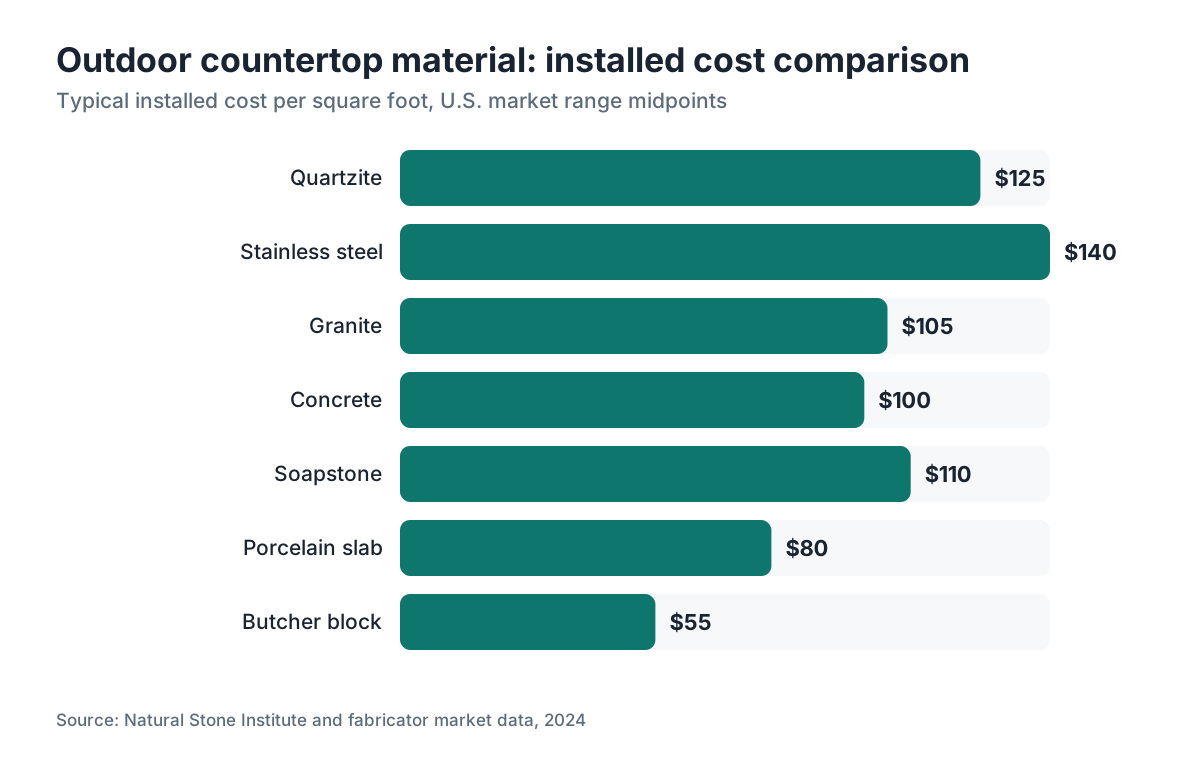
Outdoor granite runs $60 to $150 per square foot installed, and it swings wider than buyers expect because outdoor jobs carry structural work indoor jobs skip.
| Cost component | Typical range (per sq ft) |
|---|---|
| Granite slab material | $15-$60 |
| Fabrication (cutting, edging, polishing) | $20-$50 |
| Installation labor | $10-$30 |
| Outdoor-rated substrate/support | $5-$20 |
| Sealing (initial) | $1-$3 |
| Total installed | $60-$150 |
Those ranges come from fabrication shops and contractor bids around the country, and regional labor moves the number hard. In San Francisco or New York, plan on the top of the range or past it. In the Southeast or Midwest, the middle is normal.
Substrate is the part homeowners forget. Outdoor kitchen frames get built from steel studs, concrete block, or pressure-treated lumber. Granite is heavy, about 18 to 22 pounds per square foot at 3/4 inch, so whatever sits under it has to be stiff enough that the slab never flexes. A fabricator who does outdoor work checks your substrate before templating. One who never asks is a red flag.
Fabrication itself is not much pricier than an indoor job. The difference is cutouts. Outdoor counters get carved up for grills, side burners, sinks, and ice bins, and every cutout adds time and waste. A drop-in grill cutout usually runs $75 to $200 depending on complexity and edge finishing.
For the indoor picture, granite countertops run $50 to $120 installed, so going outside adds roughly $10 to $30 per square foot for structure and extra sealing.
Which granite colors and finishes work best outside?
Color matters more outdoors than inside, for two reasons: heat and stain visibility.
Black and very dark granites soak up far more solar heat than light ones. On a summer afternoon a polished black slab in full sun can hit 140 to 160 degrees F, hot enough to burn a forearm and cook anything heat-sensitive you set on it. Gray, cream, and white granites stay cooler. Same physics as roofing: Lawrence Berkeley National Laboratory has measured 50 to 60 degrees F of surface temperature difference between dark and light materials in direct sun [3].
On finish, honed and leathered beat polished outside. A mirror polish shows watermarks and wear fast, and weather speeds that up. A honed surface already looks matte, so the gradual dulling hides. A leathered or brushed finish goes further and grips better when wet, which counts near a pool or wet bar.
For freeze-thaw country, harder low-porosity granites are the smart pick. Black Galaxy from India runs very low porosity with a long outdoor track record. Absolute Black holds up well. Ask your fabricator or supplier for the water absorption rate on any slab you are eyeing, since most quarries ship a technical data sheet that lists it.
Skip granites with straight-line veining or heavy biotite content. Those can hide internal planes of weakness that freeze-thaw exploits over the years.
How often do you need to seal outdoor granite?
Seal outdoor granite every one to two years, and once a year in harsh climates or heavy-use kitchens. Indoors the interval stretches to three to five years. Outdoors you tighten it because sun, rain, and freeze-thaw chew through sealer faster.
Don't guess by the calendar, test it. Put a tablespoon of water on the surface and watch. Beads that hold for four minutes mean the seal is fine. Water that soaks in within a minute or two means reseal now. The Marble Institute of America, now the Natural Stone Institute, publishes care guidance that matches this test [4].
Use a penetrating impregnating sealer outdoors, never a topical one. Topical sealers sit on top, look great for a season, then peel or haze under UV and thermal cycling. Penetrating sealers soak into the pores and leave no film to fail. Tenax, StoneTech, and Miracle Sealants all have good reputations in the trade, and honestly your application technique matters as much as which bottle you buy.
Seal when the stone is clean, dry, and above 50 degrees F. Then leave it alone for the full cure the manufacturer lists, usually 24 to 72 hours, before it gets wet.
For the cleaning side of this, our how to clean stone countertops guide walks through technique in detail.
How does granite compare to other outdoor countertop materials?
Sit with this comparison before you commit, because granite is not automatically the right call for every outdoor setup.
| Material | UV stability | Heat resistance | Freeze-thaw | Maintenance | Installed cost |
|---|---|---|---|---|---|
| Granite | Excellent | Excellent | Good (varies by slab) | Medium (seal 1-2yr) | $60-$150/sq ft |
| Quartzite | Excellent | Excellent | Excellent | Medium (seal 1-2yr) | $70-$180/sq ft |
| Porcelain tile/slab | Excellent | Good | Excellent | Low | $40-$120/sq ft |
| Concrete | Good | Good | Fair | High (seal 2x/yr) | $65-$140/sq ft |
| Soapstone | Excellent | Excellent | Good | Low (oil only) | $70-$150/sq ft |
| Stainless steel | Excellent | Excellent | Excellent | Low | $80-$200/sq ft |
| Butcher block | Poor | Poor | Poor | Very high | $35-$75/sq ft |
Porcelain large-format slabs turned into a real granite competitor over the past five years. They are basically impervious to water, frost, and UV because they get vitrified at high temperature. The trade-offs: porcelain chips at edges more easily than granite, and it lacks the depth of real stone. Plenty of outdoor kitchen designers now spec porcelain for the fully exposed zones and granite or quartzite for covered bar and prep areas.
Quartzite (not quartz engineered stone, which is not outdoor-rated because of its resin) is arguably the best natural stone outside: harder than granite on average, extremely low porosity in good specimens, and gorgeous. It costs more.
Engineered quartz, including Cambria countertops, is explicitly off-limits outdoors per the makers. The resin binder degrades under UV, then discolors and cracks. This is a common, expensive mistake.
Marble countertops are also a weak outdoor choice because marble is soft, acid-sensitive, and porous next to granite. Rain alone is mildly acidic, around pH 5.6 in normal conditions and lower where the air is polluted [5], enough to etch marble over time.
What should you know before templating and installing outdoor granite?
Templating outdoors differs from an indoor kitchen in a few ways that matter.
The substrate has to be finished and cured before the templater shows up. If you poured a concrete frame, it needs the full cure for design strength, which ACI guidance puts at 28 days [6]. Steel or block needs to be built and leveled. Fabricators cannot template an accurate slab on a structure that is still moving, and outdoor builds tend to run into more sequencing snags than indoor ones.
The slab also has to physically reach the kitchen. Think about gate widths, path clearances, and grade changes. A full granite slab on a cart is heavy and clumsy. If your access is tight, the fabricator may bring the top in sections and join them with a color-matched epoxy seam. That is not a compromise; a good outdoor seam is invisible and structurally sound.
Overhangs need more support outside because people lean on bar edges and sometimes sit on the counter. The general fabrication rule is that granite overhangs past 8 to 10 inches need help, and outdoors you push toward the tighter end. Natural Stone Institute guidance calls for corbel or rod support on anything beyond 8 inches of unsupported overhang on a 3/4-inch slab [7].
Shops running digital templating and CNC production (the kind that use dedicated quoting and nesting software like SlabWise to plan cuts) tend to hit fewer yield surprises on outdoor jobs with odd grill cutout geometry. Granite slabs are unique pieces, and a miscut costs the same money whether it happens outside or in.
For the whole sequence, the countertop installation guide covers it start to finish.
Can granite withstand a grill or fire feature nearby?
Yes, with a couple of caveats. Granite handles radiant heat from a gas or charcoal grill without melting, warping, or cracking at normal grill temperatures.
What it dislikes is extreme direct flame contact, like a burner cranked to max output inches from the stone edge with no pot in between. That kind of localized, sustained heat can shock the stone, especially at edges and cutouts. Real outdoor cooking almost never creates that scenario, but it is worth knowing where the limit sits.
For fire pits and fire tables, granite next to open flame is common and holds up well. The bigger issue is soot and combustion residue settling on the surface. That stuff is acidic and will etch an unsealed slab over time. Keep fire features sealed and wiped down.
A side burner or outdoor range is a different animal than grill radiant heat. Burner grates sitting straight on granite are not ideal. A metal trivet or grate stand that lifts the heat source a little is a cheap precaution at cutout edges.
Granite's thermal expansion coefficient runs about 7 to 8 microstrain per degree Celsius, low enough that the swing from a cold night to a hot afternoon does nothing [8]. Trouble comes from rapid, localized change: a block of dry ice on a sun-baked slab, for example. Nobody does that on purpose, but it shows the physics.
How do you clean and maintain outdoor granite day to day?
The daily routine is easier than the sealing talk makes it sound. Wipe food and grease promptly and you have done most of the work.
Outdoors you fight more organic material than inside: bird droppings, pollen, mold from moisture, and grease that bakes on in the sun. None of it penetrates sealed granite quickly, but anything acidic like citrus or tomato will stain if it sits.
For routine cleaning, warm water with a pH-neutral stone cleaner or a little dish soap does the job. Skip anything acidic (vinegar, lemon cleaners) and skip bleach as a habit. Bleach works as a one-time disinfectant but repeated use degrades the sealer. Natural Stone Institute care guidance lines up with this [11].
Pressure washing is where people argue. A light hose rinse is fine. A high-psi washer aimed straight at granite can drive water under the sealer and into joints, and a close tip can chip edges. If you are blasting the surrounding patio and the spray catches the counter in passing, no crisis. Using a pressure washer as your main countertop cleaning method is something I would not do.
Cover the counter if you get hard winters and you shut the kitchen down for months. A fitted cover keeps debris off, cuts the freeze-thaw beating on the sealer, and stretches the sealing interval. It is the simplest step and the one people skip most.
For related stones, how to clean quartzite countertops and how to clean soapstone countertops use the same core principles as granite.
Are there building code or permit considerations for outdoor granite countertops?
The granite itself is not regulated, but the outdoor kitchen holding it up almost certainly is. Check with your local building department before you order a slab.
Most jurisdictions require a permit for a permanent outdoor kitchen, especially with gas lines, electrical, or a roof or pergola. The International Residential Code, adopted with local amendments across most of the U.S., governs residential construction including accessory structures [9]. Your building department is the last word on what triggers a permit where you live.
Gas line work for an outdoor grill or burner must go to a licensed plumber or gas fitter in nearly every state. This is not optional and not a place to save money. A gas leak in an outdoor kitchen is a real hazard.
Countertop weight can affect permitting on a deck. At 18 to 22 pounds per square foot across a typical 40 to 80 square foot outdoor kitchen, granite adds 700 to 1,700 pounds. Most well-built decks handle that fine, but an aging or marginal deck may need structural review. The American Wood Council's deck guide, DCA 6, covers load requirements for residential decks [10].
HOAs sometimes regulate outdoor kitchen materials, colors, and structures too. Read your CC&Rs before you commit.
What do fabricators need to know about quoting outdoor granite jobs?
Outdoor granite is not wildly different to fabricate, but it hides a few consistent quoting traps.
Cutout count runs high. A typical outdoor kitchen might carry a grill cutout, one or two burner cutouts, a sink, an ice bin, and a fridge door gap. Each one costs time and burns material. Quote every cutout on its own line, and add an access fee when the shop has to do site work on a tight lot.
Edge profiles carry more weight outside because edges take more abuse. Bullnose and eased edges chip far less than sharp mitered ones. Clients who want a slick mitered edge on their bar should hear, in writing, that chips at the miter line are a real risk and harder to fix than chips on a rounded edge.
Seam placement gets trickier outdoors because grill frames and structural members rarely land where your layout wants them. Good digital nesting, the kind SlabWise helps shops run, keeps you from designing a seam into a stress point like the corner of a cutout.
Outdoor installs often need a second site visit or a longer install window from access constraints, leveling, or substrate that is out of true. Price that into the labor quote up front instead of calling the customer with bad news after.
Frequently asked questions
Does granite crack in cold weather if used outdoors?
Granite resists cold well, but water that gets into unsealed pores can freeze, expand, and spall or fracture the surface over many seasons. The fix is sealing every one to two years and picking a low-porosity variety. In USDA hardiness zones 6 and colder, those two steps are not optional. Covering the counter in winter helps a lot.
Is outdoor granite hotter to the touch than other countertop materials?
Dark granite in full sun gets very hot, potentially 140 to 160 degrees F on a summer afternoon, similar to dark asphalt. Light granite runs cooler by 40 to 60 degrees F in the same conditions. If touch temperature matters, like a bar where people rest their arms, pick a lighter color or a covered spot. Light-colored porcelain handles this better than dark granite.
Can you use engineered quartz like Cambria or Silestone for an outdoor kitchen?
No. Every major engineered quartz maker, Cambria and Silestone included, voids the warranty for outdoor use. The polymer resin binding the quartz particles degrades under UV, which causes discoloration and structural breakdown over time. Natural granite, quartzite, soapstone, or large-format porcelain are the right choices for outdoor countertops in the sun.
How thick should outdoor granite countertops be?
3cm (about 1.25 inches) is the standard for outdoor work and what most fabricators recommend. The thicker slab resists edge chipping, handles unsupported overhangs better, and has more thermal mass to spread heat. Some shops offer 2cm at a lower price, but 3cm earns its premium outside. 4cm and up exists but is rarely needed.
What edge profile works best on outdoor granite?
Bullnose, eased, and beveled edges hold up better outdoors than sharp or mitered profiles, because rounded edges chip less when bumped by cookware, chairs, or general use. Mitered edges look modern, but a chip on a miter line is harder to fix invisibly than one on a bullnose. For a clean contemporary look, a flat polish with a small bevel is a good middle ground.
How long does outdoor granite last?
Properly installed and sealed outdoor granite lasts decades. Ancient granite structures have survived thousands of years of weather. The practical limits in a backyard kitchen are not the stone but the support structure under it, the quality of the original install, and whether you keep up the sealing schedule. With annual sealing and a covered structure, 30-plus years is realistic.
Can outdoor granite be repaired if it chips or cracks?
Small edge chips fill with color-matched epoxy or stone repair kits and often disappear after repair. Cracks through the field are more serious: a hairline crack can sometimes be stabilized with epoxy injection, but a slab with a significant crack usually needs replacement. Outdoor installs take more edge chips than indoor kitchens, so factor repair access into your edge profile and color choices.
Do I need a special sealer for outdoor granite versus indoor granite?
Both want a penetrating impregnating sealer, but outdoors look specifically for products rated for exterior stone or that mention UV and weather resistance. Topical film-forming sealers are wrong outside because UV and thermal cycling make them peel and haze. StoneTech Bulletproof, Tenax Hydrex, and Miracle Sealants 511 all get used in the trade for exterior work.
How much does an outdoor granite countertop cost for a typical outdoor kitchen?
A typical outdoor kitchen counter runs 40 to 80 square feet. At $60 to $150 per square foot installed, that lands the total at $2,400 to $12,000 depending on slab quality, cutout count, access, and regional labor. Budget the high end if your kitchen has multiple appliance cutouts, needs special access, or sits in a high-cost labor market. Material alone runs $15 to $60 per square foot before fabrication.
What causes staining on outdoor granite and how do you remove it?
The common outdoor stains are grease from cooking, organic material like leaves and bird droppings, and iron stains from metal furniture. Grease responds to a poultice of baking soda and acetone or a commercial stone degreaser. Organic stains often bleach out in sunlight or respond to diluted hydrogen peroxide. Iron stains need a specialty iron-removing poultice. Act fast on any stain and re-seal after aggressive treatment.
Is granite a good choice for a pool area countertop?
Yes, with one caveat: pool water sits around pH 7.2 to 7.6, close to neutral, but splash and runoff from heavily chlorinated water degrade sealer faster than plain weather. Bump your sealing to once a year minimum near a pool. Choose a honed or textured finish over polished, since wet polished granite gets slippery. Lighter colors also keep surface heat down near the water.
Can I install outdoor granite countertops myself?
Templating and cutting granite takes diamond tooling, water cooling, and skill that puts it out of DIY range for most people. Setting a finished slab is possible for a handy homeowner if it comes in manageable sections and the substrate is well prepared, but a full slab is a two-person job minimum and mistakes are costly. Budget for professional installation; labor usually runs 15 to 25 percent of the total.
Sources
- National Kitchen and Bath Association (NKBA), Design Trends Report: Outdoor kitchen installations grew as part of a broader outdoor living trend accelerated after 2020, with homeowners increasing spending on permanent outdoor cooking structures.
- U.S. Geological Survey: Granite porosity typically ranges from near 0 percent to about 1 percent, and that range affects freeze-thaw durability outdoors.
- Lawrence Berkeley National Laboratory, Heat Island Group, Cool Roofs: Surface temperature differentials of 50-60 degrees F have been measured between dark and light-colored surfaces in direct sun.
- Natural Stone Institute, Care and Maintenance of Stone: Penetrating sealers are recommended for natural stone; the water bead test is the standard field method to assess when resealing is needed.
- U.S. Environmental Protection Agency, What is Acid Rain?: Normal rain has a pH of about 5.6; acid rain in polluted areas can be significantly lower, both acidic enough to etch calcium-based stones like marble over time.
- American Concrete Institute, ACI 308, Guide to External Curing of Concrete: Concrete reaches full design strength at 28 days of proper curing.
- Marble Institute of America (Natural Stone Institute), Fabrication and Installation Guidelines: Unsupported granite overhangs beyond 8-10 inches on 3/4-inch slabs require corbel or rod support to prevent cracking.
- Engineering Toolbox, Thermal Expansion Coefficients of Materials: Granite's coefficient of thermal expansion is approximately 7-8 microstrain per degree Celsius, low enough that normal outdoor temperature swings do not cause stress fractures.
- International Code Council, International Residential Code (IRC): The IRC governs residential construction including outdoor accessory structures; most U.S. jurisdictions require permits for permanent outdoor kitchen construction involving gas or electrical connections.
- American Wood Council, DCA 6: Prescriptive Residential Wood Deck Construction Guide: DCA 6 addresses load requirements for residential decks; heavy countertop installations adding 700-1,700 pounds to a deck require verification against the deck's structural capacity.
- Marble Institute of America (Natural Stone Institute), Stone Cleaning Guidelines: pH-neutral cleaners are recommended for routine stone maintenance; acidic cleaners like vinegar and bleach degrade sealers and can etch stone surfaces.
Last updated 2026-07-09