TL;DR
- The water drop test is a quick absorption check.
- Pour a small puddle of water on your granite, wait 10 to 15 minutes, then see if it beads or soaks in.
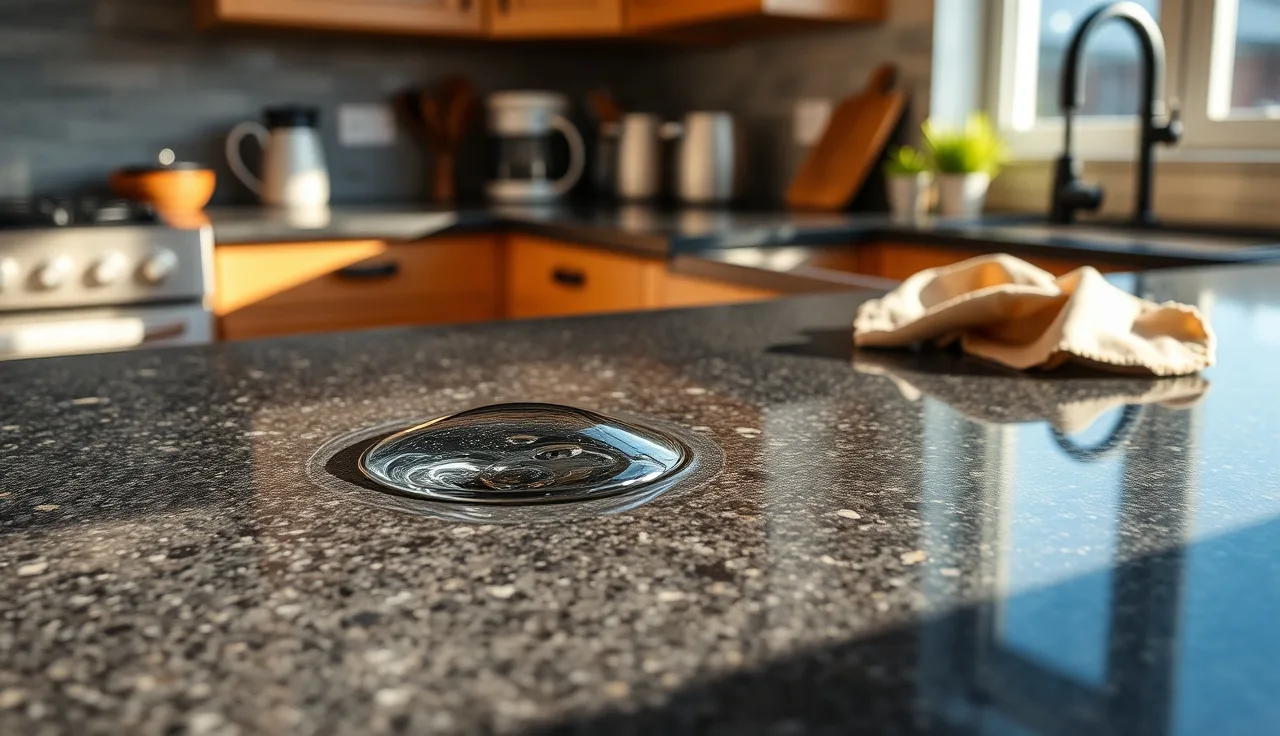
- Water that stays in a rounded dome means the sealer is holding.
- Water that darkens the stone within a few minutes means the sealer has worn through and it's time to reseal.
What exactly is the water drop test for granite?
The water drop test (also called the bead test or absorption test) is the standard field check for whether a penetrating sealer is still doing its job inside a stone's pores. No lab. No moisture meter. A quarter cup of tap water and 15 minutes of patience are all you need.
Here's what happens at a physical level. Granite is a porous igneous rock. Even though it's denser than most sedimentary stones, it still has tiny interconnected voids that pull in liquids. A penetrating impregnator sealer fills those voids with a silicone or fluoropolymer compound and builds a water-repellent barrier [1]. When the barrier is intact, surface tension wins: water molecules are more attracted to each other than to the stone, so the droplet pulls itself into a high, rounded dome and sits on top. When the sealer has broken down or was never applied right, the voids are open and capillary action drags the water in. The stone darkens because water displaces the air inside the pores and changes how light bounces off the surface.
The test is not a verdict on the stone. It's a verdict on the sealer layer. Granite's natural porosity tells you nothing about whether the specific slab on your counter is protected right now.
How do you do the water drop test, step by step?
Start with a clean, dry surface. Any leftover cleaning product, oil, or cooking grease will throw off the result, because surfactants break surface tension and make water spread even on a well-sealed stone. If you just cleaned the counter, wait 30 minutes.
Pick two or three spots, not one. Granite is not uniform. The feldspar-heavy areas, the quartz veins, and the darker biotite patches all have different natural porosity. A spot that drinks water fast doesn't always mean the whole slab is exposed, but it does mean that zone needs attention [2].
Pour about two tablespoons of water onto each test spot. Don't spread it. Let it sit as a puddle, undisturbed, on a flat section of the counter.
Set a timer for 10 minutes. Come back and read the droplet from eye level, not from above. From eye level you can actually see whether it's still domed or has flattened out.
At 10 minutes, blot the water with a paper towel and check for darkening. If the stone matches the dry areas around it, the sealer passed. If there's a darker wet patch, note how dark and how wide. Then wait five more minutes to see whether it dries fast (surface absorption, minor concern) or stays dark (deeper absorption, reseal now).
One more variant is worth running. Put a drop of cooking oil on a different spot and use the same 15-minute timer. Oil is a better stand-in for what actually stains granite in a kitchen. If the oil vanishes as fast as the water, the sealer is losing to the most common real-world threat.
What do the results mean: bead, sheet, or absorb?
Results fall into three rough buckets, and the gaps between them matter.
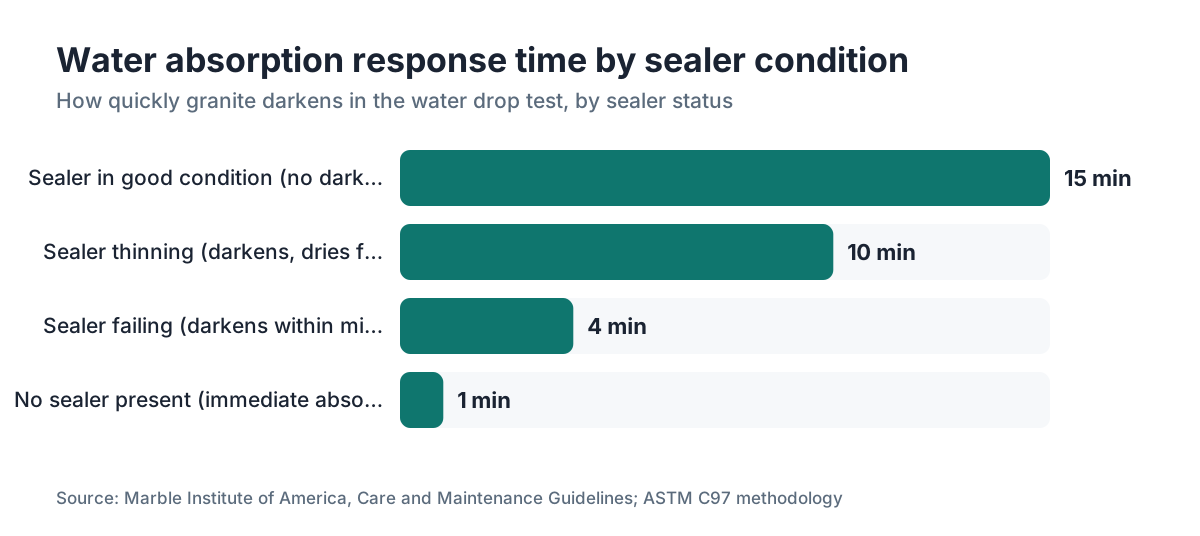
Strong bead, high dome, no color change after 15+ minutes. The sealer is working well. You probably don't need to reseal for at least another year, maybe longer depending on how hard the counter gets used. This is the result you want.
Shallow bead or flat sheet, slight darkening at 10 minutes that dries out within 5. The sealer is thinning but still offering partial protection. This is the gray zone. Reseal now as preventive maintenance, or note the date and retest in three months. Most fabricators and stone care pros seal here rather than wait, because light stains are annoying and deep oil stains are expensive to remove [3].
Rapid absorption, stone darkens within 2 to 4 minutes, color stays dark. The sealer is gone. Reseal as soon as you can. Every day you wait is a day the stone is open to oil, wine, coffee, and acidic cleaners.
The table below sums it up:
| Bead behavior | Time to darken | Sealer status | Action |
|---|---|---|---|
| Tight dome, high contact angle | Never or 15+ min | Good | Retest in 12 months |
| Flat or spreading puddle | 10 to 15 min, dries fast | Thinning | Reseal soon |
| Immediate spread | 2 to 4 min, stays dark | Failed | Reseal now |
Contact angle is the technical term for the angle where a liquid surface meets a solid surface. Silicone-based sealers usually produce contact angles above 90 degrees on granite, which is why the bead sits up high instead of spreading [4]. A failed sealer pushes that angle toward zero, and the water flattens out.
How often should you run the water drop test?
Most stone care guidance sets the minimum retest interval at once a year for kitchen counters. That's a rough default, nothing more. The honest answer is that resealing frequency depends on the stone, the sealer product, and how the surface gets used.
Polished granite that sees daily cooking, acidic cleaners (including plenty of common dish soaps), and heavy traffic near the sink burns through a sealer faster than the same stone in a quiet bathroom. Honed and leathered finishes have more surface area exposed, so they generally need sealing more often than polished ones [5].
Run the test any time the granite stops beading water the way it used to after a normal wipe-down. Kitchen counters in busy households: test every six months and reseal when needed. Bathroom granite with light traffic: once a year is usually plenty. Just moved into a home and don't know when the granite was last sealed? Run the test before you do anything else.
Fabricators usually seal slabs at the shop or on-site before installation. But that first coat is often a production-line pass with a standard product, not the best product for your specific stone. Test a few months after a new countertop goes in to see what you actually have [6].
What factors affect how long granite sealer lasts?
Sealer longevity is genuinely all over the map, and the countertop industry is not honest about it. Manufacturers publish claims like "10-year protection" or "lifetime sealer," but independent testing does not back those claims up for kitchen conditions [3].
Acids are the biggest threat. Lemon juice, vinegar, wine, and many everyday cleaners with a pH below 7 slowly break the fluoropolymer or silicone chains that make up the sealer. Once those chains snap, the water-repellent effect fades. If somebody in your house cleans the granite with a diluted vinegar spray (a popular DIY tip that stone pros hate), expect sealer life to drop from years to months. As the EPA's Safer Choice guidance puts it, pH-neutral cleaners are the recommended choice for these surfaces [11].
Heat doesn't directly break down most impregnating sealers, because they cure inside the pores instead of sitting on the surface. But thermal cycling (hot pan, then cold water) can open micro-fractures in the stone that expose fresh unsealed mineral. The water drop test will catch that.
Wax-based topical sealers behave very differently from penetrating impregnators. They add a sacrificial surface layer that buffs off with use. The water drop test still works on them, but a failing topical often reads differently: the water spreads without the stone darkening, because the topical layer is gone while an older impregnator underneath may still be holding. This is one reason most stone care pros now prefer penetrating impregnators for granite [1].
Does the water drop test work on all natural stone or just granite?
The test works on any porous natural stone sealed with a penetrating impregnator. That includes marble, quartzite, travertine, limestone, and sandstone. The mechanics don't change: sealer in the pores means water beads, open pores mean water soaks in.
For marble countertops, the test matters just as much, because marble is softer and more porous than granite in most cases. Failed sealer on marble opens the door to both staining and acid etching from everyday kitchen acids [5].
For quartzite countertops, the test matters even more, because quartzite gets mislabeled at the retail level constantly. Plenty of slabs sold as quartzite are quartzitic marble or even soft marble, and they absorb faster than true quartzite. Running the water drop test regularly tells you whether your stone actually performs the way it was described.
For engineered quartz (Cambria, Silestone, and the rest), the water drop test is pointless. Engineered quartz uses a polymer resin binder that makes it non-porous by design. It doesn't need sealing and won't absorb water no matter what. Same goes for solid surface products like Corian. If you want a countertop that never needs this kind of upkeep, Cambria countertops or similar engineered options are the practical answer.
Soapstone is also non-porous on its own and usually gets finished with mineral oil rather than a sealer. The water drop test tells you nothing useful about soapstone's protection status [7].
Can the test give false positives or false negatives?
Yes, and knowing the failure modes keeps you from resealing for no reason or missing a real problem.
False positive (stone looks sealed but isn't fully protected): some highly polished granite repels water purely from the mechanical smoothness of the polish, with no sealer at all. The tight crystal structure of very dense granite can produce bead-like behavior on bare stone. That's fine for those slabs, which may genuinely not need sealing, but it means the visual bead test can oversell protection on dense stone. The oil drop variant is more telling here. Cooking oil is heavier and depends less on surface tension than water, so it's a harder stress test for real absorption.
False negative (stone looks like it's absorbing but the sealer is fine): a thin film of dried cleaning product, hard water mineral buildup, or a soapy residue can wreck the beading. The water spreads and flattens not because it's soaking in, but because a surfactant on the surface knocked down its contact angle. Clean the stone with a pH-neutral cleaner and let it dry completely before testing.
Temperature matters too. Cold granite (say, after the air conditioning has run with no direct sun) evaporates the test water slower, which can make a borderline result look like deeper absorption than it really is. Test at normal room temperature for the most readable result.
How do you reseal granite after a failed water drop test?
Resealing isn't complicated, but the order of operations matters.
Clean thoroughly first. Any oil, grease, or residue left on the stone gets sealed in under the new product. Use a stone-safe degreaser or a neutral-pH stone cleaner. Not dish soap. Not vinegar. Then let the surface dry all the way. On a humid day, give it an hour minimum, because the sealer needs to penetrate dry pores, not wet ones [6].
Apply a penetrating impregnator sealer per the product's instructions. The standard approach: pour a thin coat onto the stone, spread it with a clean cloth, let it dwell for the time the manufacturer specifies (usually 5 to 20 minutes), then wipe off all the excess before it hazes. Residue left on the surface hazes over and is a pain to remove.
For very porous granite that failed fast, a second coat 30 to 60 minutes after the first fills the pores the first coat missed. Dense granite that only barely failed usually needs a single coat.
Wait 24 hours before putting the counter back into full use. Some products cure faster, but 24 hours is a safe standard that gives the sealer time to cross-link inside the pores [1].
Then run the water drop test again after that 24-hour window to confirm the new application worked. If water still soaks in, either the product isn't right for that stone (some very porous stones need a sealer rated for high-absorption use) or you applied it too thin. For fabricators running production sealing in the shop, tracking which products work on which stone types is exactly the operational knowledge that separates good shops from great ones. SlabWise's shop operations tools let fabricators log stone-specific notes by job, so you're not relearning sealer preferences from scratch every time a similar slab rolls through.
Is the water drop test the same as what fabricators and inspectors use?
Broadly yes, with a few additions. On the professional side, stone inspectors and conservation specialists sometimes run a more quantitative version: a fixed volume of water applied with a syringe to a marked area, then photographed at intervals and compared against color reference cards for degree of darkening. The Marble Institute of America's care and maintenance guidance points to absorption testing as the baseline check for sealer integrity [8].
On the standards side, ASTM C97 covers absorption and bulk specific gravity testing for dimension stone, but that's a laboratory test run on core samples, not a countertop field check [9]. No ASTM standard governs the informal field water drop test, which means the 10 to 15 minute window you'll see cited all over the internet is professional consensus, not a codified threshold. The consensus is reasonable and it lines up with how impregnating sealers actually behave, but know that it's a guideline, not a specification.
Fabricators who seal stone in the shop sometimes use a production variant. Seal a test coupon of the same stone batch, run the water drop test after cure, and confirm the sealer works before committing the full slab. Good practice, and it catches the cases where a product that shines on one quarry's granite falls flat on a different slab with different porosity.
What are the best sealers to use if your granite fails the test?
Short answer: a penetrating fluoropolymer or silicone impregnator from a brand that publishes its technical data sheet. The specific product matters less than matching the sealer's rated absorption class to your stone's actual porosity.
Fluoropolymer sealers (often labeled fluorocarbon sealers) repel both water and oil, which is what a kitchen counter needs. Pure silicone impregnators repel water well but do less against oil-based stains. For a kitchen, spend on the fluoropolymer or a silicone-plus-fluorocarbon blend [3].
Concentration matters. Some consumer products are diluted versions of the same chemistry sold in professional-strength formulas. If your granite is very porous and failed the water drop test fast, the professional-concentration product does more in one coat than a diluted consumer spray does in three.
When you buy, read the technical data sheet (TDS), not the marketing label. The TDS gives you the coverage rate (usually 150 to 300 square feet per liter depending on porosity), the dwell time, and the rated contact angle after cure. A product with a stated post-cure contact angle above 100 degrees is doing its job [4].
For granite countertops specifically, confirm the product is labeled safe for food-contact surfaces after cure. Most penetrating sealers are food-safe once fully cured and off-gassed, but check the TDS instead of assuming.
How does the water drop test relate to granite stain resistance and long-term care?
The water drop test is the most accessible proxy for stain resistance. It doesn't test every threat, but it tests the most common one, and a stone that beads water reliably almost always resists the everyday kitchen stains that matter most.
The bigger picture: granite countertops are genuinely low-maintenance next to many alternatives, but they're not no-maintenance. A quick water drop test twice a year takes two minutes. Resealing when needed takes maybe an hour. That routine protects a surface that runs anywhere from $40 to $200 per square foot installed, and it costs far less than professional stain removal or, worst case, a slab replacement.
The same habits that stretch sealer life also protect the stone itself: pH-neutral cleaners only, no abrasive pads, and immediate blotting of acidic spills. Blot, don't wipe. Wiping drags the acid sideways across a wider stretch of pore surface. Our how to clean stone countertops guide walks through the full routine.
If you're weighing granite against materials that need none of this, laminate countertops and solid surfaces like Corian countertops have no sealing requirements at all. That's a real maintenance advantage if low upkeep is your priority. The tradeoff is that natural stone's look and feel is its own thing, and a well-kept granite surface outlasts most other countertop materials. The water drop test is how you make sure "well-kept" actually means something.
Frequently asked questions
How long should water bead on granite for the sealer to be considered good?
Water should bead and stay domed for at least 10 to 15 minutes without darkening the stone beneath it. At the 15-minute mark, blot the water and check for a color change. If the stone looks the same wet or dry, the sealer is working. If there's a darker patch, even a faint one, the sealer is thinning and you should plan to reseal soon.
Can I use the water drop test on a newly installed granite countertop?
Yes, and it's a good idea. Most fabricators seal slabs before or during installation, but application quality varies. Running the test two to four weeks after installation confirms the sealer cured properly and is actually protecting the stone. If it fails quickly on a new countertop, contact your fabricator. The stone should have been sealed properly as part of the job.
What if the water drop test passes in one spot but fails in another on the same counter?
That's common. Granite is not uniform, and different mineral zones have different porosity. A darker area rich in biotite or other mafic minerals often absorbs faster than a quartz-heavy zone. Spot-reseal the failing areas rather than doing the whole counter if the rest passed. Pay special attention to areas near the sink and stove where exposure to water and heat runs highest.
Is there a difference between the water drop test and the lemon juice test?
Yes. The water drop test checks sealer integrity and absorption. The lemon juice test checks for acid sensitivity and etching, which is a separate problem. Granite doesn't usually etch visibly the way marble does, but marble and softer stones can show permanent dull spots from acid contact even through a sealer. Use water for the sealer check and only reach for acid tests if you suspect an etching problem.
Does granite always need to be sealed, or are some slabs naturally non-porous enough to skip it?
Some very dense granites, particularly Absolute Black, have low enough porosity that sealing is arguably unnecessary. The water drop test will tell you: if untreated stone beads water for 15 minutes without darkening, it doesn't need sealing. That's a rare result for kitchen-grade granite in daily use, but it happens. When in doubt, seal anyway. The cost is low and the downside of skipping it is not.
How soon after cleaning granite should I do the water drop test?
Wait at least 30 minutes after cleaning with a standard stone cleaner, and at least an hour after any product with surfactants or degreasers. Surfactant residue lowers water's surface tension and makes water spread even on well-sealed stone, which produces a false fail. If you cleaned with vinegar or anything acidic, wait longer and rinse the surface with plain water first.
Will the water drop test detect if my granite sealer was applied incorrectly?
Mostly yes. The most common mistake is not removing excess sealer before it hazes, which leaves a topical film instead of a penetrating seal. That film might pass the water test at first but wears off quickly, so a test three to four weeks after application tells you more than one run immediately after. A sealer applied too thin on porous stone will fail the water test within days.
Can I do the water drop test on granite tiles, more than slabs?
Yes. The test works identically on granite tile. The one extra consideration with tile is the grout. Grout is often far more porous than the tile itself and needs its own sealer. Check both the tile surface and the grout lines separately. A tile that beads water can still let staining through the grout, so treat them as two systems that both need periodic maintenance.
Does the water drop test work for outdoor granite, like on a kitchen island or patio?
Yes, but outdoor stone needs more frequent testing. UV exposure, freeze-thaw cycles, and outdoor cooking grease speed up sealer breakdown. Test outdoor granite every three to six months. Many interior sealers aren't rated for UV exposure and degrade faster outdoors, so look for a sealer specifically labeled for exterior use if your granite sees direct sun.
What should I do if I reseal and the water drop test still fails after 24 hours?
First, check whether the stone was fully dry when you applied the sealer. Moisture in the pores blocks penetration. Let the stone dry for 48 hours, clean it again with a stone-safe degreaser, and apply a second coat. If it still fails, the stone may be too porous for a standard-concentration product and you need a high-absorption-rated sealer, or there may be old oil or cleaning product contamination in the pores that needs a deep-clean treatment first.
How does sealer effectiveness compare across different granite colors?
Color is a rough proxy for mineral composition and porosity. Light-colored granites (white, beige, light gray) tend to carry more feldspar and more porosity, so they absorb faster and need sealing more often. Dark granites, especially true black, are often denser and more resistant. This is a generalization, not a rule. Let the water drop test on your specific slab guide you rather than assuming based on color.
Can the water drop test help me figure out if a used home's granite was ever sealed?
It's the first thing to do when you move into a home with existing granite and no maintenance records. If the test fails quickly, the stone may never have been sealed or was last sealed years ago. Reseal it, wait 24 hours, and test again to confirm. From there you have a known baseline and can run the test annually to stay ahead of any degradation.
Sources
- Marble Institute of America, Care and Maintenance Guidelines: Penetrating impregnator sealers fill stone pores with silicone or fluoropolymer compounds, creating a hydrophobic barrier; they cure inside the stone rather than forming a topical film
- University of Florida IFAS Extension, Natural Stone Countertop Selection and Care: Different mineral zones in granite have different natural porosity, so testing multiple spots gives a more accurate picture of overall sealer condition
- Tile Council of North America, Stone and Tile Installation Standards Handbook: Fluoropolymer sealers repel both water and oil; manufacturer claims of 10-year sealer life are not consistently supported in kitchen environments with acidic exposure
- Journal of Cultural Heritage, Contact angle measurement for stone consolidant and water repellent evaluation (2008): Silicone-based impregnating sealers typically produce contact angles above 90 degrees on stone surfaces; a contact angle near zero indicates failed or absent sealer
- National Park Service Preservation Brief 45, Removing Stains and Cleaning Stone Masonry: Honed and textured stone finishes have greater surface area exposed and absorb sealers and contaminants faster than polished finishes; marble is more porous and acid-sensitive than granite
- Vermont Quarries / Polycor, Soapstone Product Care Guide: Soapstone is naturally non-porous and is finished with mineral oil rather than a penetrating sealer; the water drop absorption test is not applicable to soapstone
- Marble Institute of America, Dimension Stone Design Manual: Absorption testing is the baseline field check for sealer integrity referenced in MIA care and maintenance guidance for natural stone
- ASTM International, ASTM C97: Standard Test Methods for Absorption and Bulk Specific Gravity of Dimension Stone: ASTM C97 governs laboratory absorption and bulk specific gravity testing for dimension stone core samples; it is a lab test, not a countertop field test, and no ASTM standard codifies the informal field water drop test
- U.S. Geological Survey, Mineral Resources Program: Granite and Dimension Stone: Granite is an igneous rock with interconnected pore voids that allow liquid absorption; porosity varies significantly by quarry origin and mineral composition
- EPA, Safer Choice Program: Cleaning Products Ingredient Safety: pH-neutral cleaners are recommended for stone surfaces; acidic cleaners below pH 7 can degrade fluoropolymer and silicone sealer chemistry over repeated use
Last updated 2026-07-10