TL;DR
- Most fabricators include one simple edge (eased, pencil, or a small bevel) in the base square-foot price.
- Decorative profiles cost more: full bullnose adds $5 to $15 per linear foot, ogee and dupont run $10 to $25, and mitered waterfall or built-up laminated edges hit $20 to $60.
- On a 30-foot kitchen, that upgrade adds roughly $150 to $1,500.
What edge profile is included in a standard granite quote?
Almost every fabricator includes one basic edge in the square-foot price. The common included option is an eased edge: a 90-degree corner with a tiny break on the top so it doesn't chip. Some shops include a beveled edge instead, which has a flat 45-degree cut along the top corner, or a pencil edge, which rounds the top corner into a soft curve.
That's the whole deal. One profile, no extra charge. Want anything more decorative and you're paying an upgrade.
The reason is labor, not stone. A simple edge takes one or two passes with a router or edge polisher. Complex profiles need multiple tool changes, careful repositioning, and a lot more polishing time. Labor drives edge pricing. The material barely moves the number.
A few high-volume shops bundle a modest upgrade like a full bullnose into their base price as a hook. Don't count on it. Read the quote. If the edge type isn't named on the line item, ask before you sign, because "standard edge" means whatever that particular shop decides it means.
Which edge profiles cost extra, and how much do they add per linear foot?
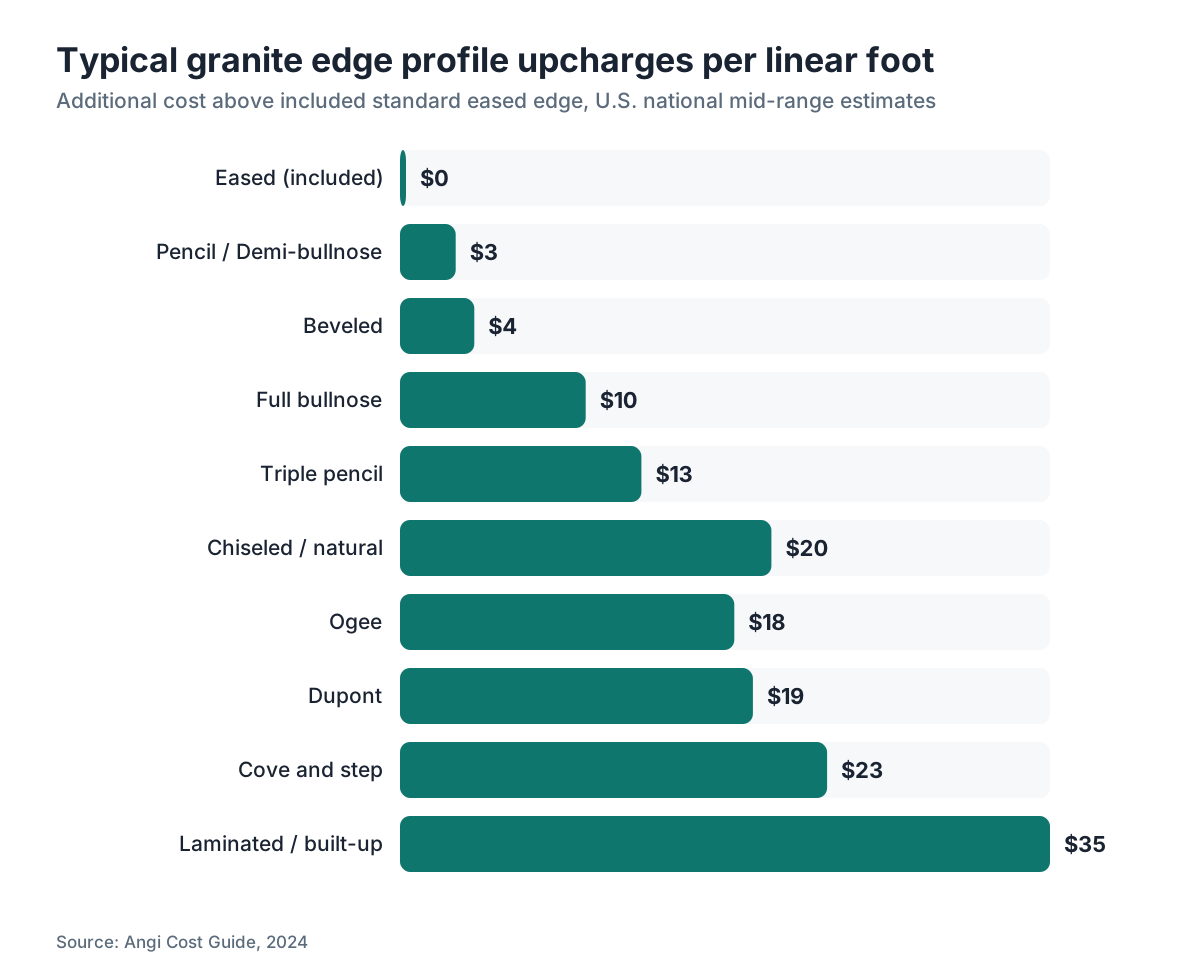
Pricing shifts by shop, region, and stone thickness, but the ranges below match what most U.S. fabricators charged in 2024 and 2025. Thicker material (3cm vs 2cm) nudges edge costs up because there's more face to finish. Labor complexity is the real number to watch.
| Edge Profile | Typical Upcharge (per linear foot) | Complexity |
|---|---|---|
| Eased | Included | Simple |
| Beveled (standard) | Included or $2, $5 | Simple |
| Pencil / Demi-bullnose | Included or $2, $5 | Simple |
| Full bullnose | $5, $15 | Moderate |
| Ogee | $10, $25 | Complex |
| Dupont (chiseled ogee) | $12, $25 | Complex |
| Waterfall (mitered) | $25, $60+ | Very complex |
| Stacked / laminated (built-up) | $20, $50 | Very complex |
| Chiseled / rough (natural) | $10, $30 | Moderate |
| Triple pencil | $8, $18 | Moderate |
| Cove and step | $15, $30 | Complex |
The waterfall and laminated numbers surprise people. A waterfall edge isn't really a profile. It's a mitered joint where the slab wraps vertically down the cabinet side, giving you one continuous run of stone. That means precise miter cuts, careful glue-up, and often more material. On an island with two exposed ends, you're looking at 12 to 18 linear feet of miter work, which can add $400 to $900 fast [1].
A laminated (or built-up) edge glues a strip of matching granite under the slab edge to fake a thicker counter. You end up with what looks like a 2-inch top even though you're running standard 3cm (about 1.25-inch) material. It looks great. It also costs more in stone, adhesive, clamping time, and finishing.
Ogee and dupont are the classic decorative picks. An ogee has an S-curve: a raised upper bump above a concave lower sweep. A dupont is close, but it ends in a flat shelf instead of curling all the way under. Both need multiple router passes and patient polishing into the curve, which is where the money goes.
Does stone thickness change what edge profiles cost?
Yes, and enough to matter. Most residential granite today is 3cm (about 1.25 inches) thick. Older jobs and budget installs use 2cm backed with plywood. A thicker slab has more edge face, so a complex profile takes more work.
For a full bullnose, the gap between 2cm and 3cm is small, maybe $2 to $5 per linear foot. For an ogee or dupont on 3cm stone, expect $3 to $8 more per foot than the same profile on 2cm, because the tool cuts and polishes nearly double the face height.
A laminated edge to fake thickness starts with 3cm material and adds another layer underneath. The visible edge face can hit 2.5 to 3 inches, and polishing all of that to one consistent shine takes real time.
Every fabricator sets their own schedule. Ask the exact question: "What is the per-linear-foot upcharge for this profile on 3cm granite?" Get it in writing. A verbal "oh, it's not much" has burned a lot of homeowners at final invoice.
How do edge profiles affect the total countertop price in a real kitchen?
Take a mid-size kitchen with about 30 linear feet of counter. That fits a layout with roughly 25 to 35 square feet of surface plus an island [9]. Your fabricator includes an eased edge in the base price.
You want an ogee at $15 per linear foot. That's $450 added. It doesn't sound brutal until you stack it with the rest: a nicer slab, a farmhouse sink cutout, thicker backsplash returns. Now the quote is $800 over the number you started budgeting from.
Here's what I'd actually do. Put the edge money on the island only. The island edge is what people see and touch all day. The perimeter runs against walls and under upper cabinets, where an eased edge is perfectly fine and nobody notices. You get the look on maybe 10 to 14 linear feet instead of 30, and the upcharge drops from $450 to somewhere around $150 to $210.
For fabricators writing quotes: edge profiles are one of the cleaner upsells in a granite job because the cost is tangible and easy to explain. Hand the customer a physical edge sample board with the per-foot number next to each option and let them choose. Shops running software like SlabWise can attach per-profile pricing to line items so the quote updates live as the customer toggles options, which kills the "I didn't realize that was extra" conversation at delivery [2].
What is a waterfall edge and why is it so expensive?
A waterfall edge (also called a waterfall island or mitered waterfall) is when the slab keeps going vertically down the side of the cabinet to the floor in one unbroken plane of stone. Picture the top falling like a curtain off the end of the island.
It takes a 45-degree miter cut along the underside of the horizontal counter and the top of the vertical panel, glued and clamped so the grain reads as continuous. If the stone has dramatic veining, the fabricator has to align the cuts so the pattern flows around the corner. That alone wastes material.
The cost lands in four places: extra slab for the vertical panels (often one to two more slabs), precise miter cutting, a strong clamped adhesive joint, and more polishing on the exposed vertical face. Total for a single island with two waterfall ends runs $800 to $2,500 depending on shop, region, and material [1].
Love the look? It's worth it. But this is not a $50 upgrade. Some shops price it as a flat fee per waterfall end instead of per linear foot. Get that number before you fall for it on Instagram.
Are there edge profiles that can actually save money compared to the standard?
Not really. You can't go below free. The included eased or pencil edge is already the cheapest option, so picking something simpler than the included profile won't get you a discount.
The only way to spend less than your original plan is to choose a simpler profile, or to shrink the linear footage of decorative edge by keeping the fancy profile on visible runs (the island) and using the included edge everywhere else.
A chiseled or natural edge is the interesting exception. It sounds fancy, but some fabricators price it below a polished ogee because it skips precision router work. The edge gets split or hand-textured to look rough. The labor is different, not automatically more. Pricing swings hard by shop on this one, so ask for the specific per-foot number.
How do granite edge profiles compare to quartz and marble edge pricing?
The same logic carries across stone. Quartz edge pricing follows the same structure: one simple profile included, upgrades for complex work. Brands like Caesarstone and Cambria publish edge schedules through authorized fabricators, and the numbers track granite closely: $0 for standard edges, $10 to $30 for complex ones [3].
Marble works the same way mechanically. The difference is that some profiles chip more easily on softer marble during fabrication, so a careful shop may add a few dollars per foot on complex marble edges to cover the extra care.
Laminate and solid-surface counters handle edges in a completely different way. Laminate countertops use post-formed edges rolled from the sheet or applied PVC edge banding, and the cost structure doesn't translate. Corian countertops can be thermoformed, which lets them do waterfall profiles without mitering, often cheaper.
Comparing total cost across materials? Edge profiles matter, but they rarely decide it. The slab price per square foot is almost always the bigger number.
Do edge profiles affect durability or maintenance?
Yes, in a way most showrooms skip over. Sharp or thin edges chip more easily than rounded ones.
A knife-edge profile (very thin edge, popular for dramatic modern looks) is beautiful and fragile. A full bullnose is the most durable option because it exposes no sharp corners at all. Eased edges sit in the middle: the tiny break cuts chip risk while keeping a clean modern line.
Ogee and dupont profiles have a concave section that collects crumbs and grime. Not a dealbreaker, but you'll want a small brush to clean the groove. A flat eased or beveled edge wipes down in one pass.
For general stone care, the how to clean stone countertops guide covers the sealers and cleaners that apply no matter which edge you pick.
Rough or chiseled edges are the hardest to clean because the texture traps debris. Cook heavily or have young kids? Weigh that before you commit to the rustic look.
Fabricators, edge choice also drives repair cost. A bullnose or eased edge is easy to re-polish in the field after a chip. Complex profiles like ogee need more tooling to match the original finish, which pushes repair prices up.
How should you read an edge profile line item on a granite quote?
Most quotes show the edge one of two ways: an inclusion note ("includes standard eased edge") or a line item with a unit price per linear foot and a total linear footage count. Check both.
The linear footage number is what trips people up. It's not the perimeter of your kitchen. It counts only the exposed edges: countertop fronts, island sides, and any peninsula overhang. Edges against walls or inside corners don't count because you can't see them. A kitchen with 30 linear feet of total counter perimeter might have only 20 linear feet of exposed edge. An island open on four sides with a seating overhang can add 14 or more linear feet by itself [8].
Ask the fabricator to break out three things: (1) which profile is included, (2) the per-linear-foot upcharge for the profile you want, and (3) how many linear feet of exposed edge they're counting. With those three numbers you can check the math yourself.
For countertop installation jobs with odd layouts, peninsulas open on three sides, or L-shaped islands, the linear footage runs high. Know that number before you choose your edge.
What edge profiles do designers and fabricators actually recommend?
This is opinion, and anyone who tells you there's one right answer is selling something. Here are the patterns I see in real installs.
Modern kitchens with flat-panel cabinets: eased edge or a thin 1/4-inch bevel. Clean, cheap, correct. An ogee on a hard modern kitchen looks like a mistake.
Transitional kitchens: a full bullnose or pencil edge reads finished without getting fussy. Safe pick for most buyers.
Traditional kitchens with raised-panel cabinets and detailing: ogee or dupont is the call. The profile echoes the cabinet work and looks intentional. The upcharge earns its keep here.
Any island with seating: think about the underside of the overhang. A sharp eased edge at knee height is uncomfortable. A full bullnose or dupont with a softer lower return is much nicer to sit against.
Farmhouse and rustic spaces: chiseled or leathered edges can be spectacular, but only from a fabricator who does them well. Look at past work before you commit.
For granite countertops with a lot of movement, keep the edge simple and let the stone lead. A busy ogee on a busy slab just makes visual noise.
Can you change the edge profile after installation?
Technically yes. It's expensive and usually not worth it. A fabricator can re-profile an installed edge in place, but that means bringing a wet polisher into your kitchen, taping off everything nearby, and grinding the old profile away before routing the new one. The mess and labor make it a real job.
Re-profiling in place works okay going from a complex profile to a simpler one. Going the other way, from a simple eased edge to an ogee, is much harder in the field because the ogee cuts deeper into the face and precise routing in a fixed position is tough.
Honest answer: get the edge right before installation. It's cheap to change on paper and expensive to change in stone. Spend time with physical samples at the shop. Look at polished and matte finishes. Touch the profiles. Notice how they feel against your palm and picture leaning into the island making coffee every morning.
Comparison shopping across materials like marble countertops or engineered stone like Cambria countertops? The same upcharge structure applies, so nailing down the edge before fabrication holds true everywhere.
Frequently asked questions
What is the cheapest granite edge profile?
An eased edge is almost always included in the base price at no extra charge. It's a clean 90-degree corner with a slight break on top to prevent chipping. Some fabricators also include a pencil edge or small bevel for free. These profiles work well in modern kitchens, and choosing one over a decorative upgrade saves roughly $150 to $400 on a full kitchen.
How much does an ogee edge cost on granite countertops?
An ogee edge typically adds $10 to $25 per linear foot over the base price. For a kitchen with 25 linear feet of exposed edge, that's $250 to $625 added. The range reflects regional labor and slab thickness. On 3cm granite the upper end is more common because there's more surface area to route and polish into the curve.
Is a bullnose edge more expensive than an eased edge?
Yes. A full bullnose, where the entire edge curves top to bottom in a half-circle, usually adds $5 to $15 per linear foot over an included eased edge. It takes more router passes and more polishing than a flat eased profile. The visual difference is modest in modern kitchens, so many homeowners skip it unless they specifically want the softer look.
How much does a waterfall granite edge cost?
A waterfall (mitered) edge runs $25 to $60 or more per linear foot for the miter work, plus the cost of additional slab material for the vertical panel. On a typical island with two waterfall ends, total added cost commonly lands between $800 and $2,500. Some fabricators charge a flat per-end fee instead of a per-foot rate. Get it itemized in writing before you commit.
What edge profile is most durable on granite?
A full bullnose has no exposed sharp corners and is the most chip-resistant option. An eased edge is a close second. Profiles with a pronounced top corner, like knife-edge or certain cove designs, are more vulnerable to chipping from pots, pans, or impacts. For kitchens with heavy use or small children, a bullnose or demi-bullnose reduces corner damage over time.
Do all granite fabricators charge the same for edge profiles?
No. Each shop sets its own edge pricing, and it varies by region, labor market, and equipment. A fabricator with CNC water-jet gear may charge less for complex profiles than a shop doing everything by hand. In high-cost metros like New York or San Francisco, the top of the range is common. In cheaper markets the same ogee might run $8 per foot instead of $22.
Can you mix edge profiles on different parts of the same kitchen?
Yes, and it's often a smart cost move. Use a decorative profile like an ogee only on the island (the most visible surface) and a simple eased edge on wall counters. That cuts your total linear footage of expensive edge work. The visual payoff is nearly identical since the island is what people see and touch. Most fabricators have no problem quoting mixed profiles.
Does a beveled edge cost more than an eased edge?
A standard bevel (a flat 45-degree cut on the top corner) is usually included or costs just $2 to $5 per linear foot extra. A more dramatic pencil bevel or double bevel adds a little more. Bevels are among the least expensive upgrades and look intentional and clean in contemporary kitchens, without the fussiness of an ogee or dupont.
How do I count linear feet of edge for my kitchen?
Measure only the exposed counter edges: the front of all base-cabinet counters, every open side of an island or peninsula (not against a wall), and any seating overhangs. Skip edges that sit flush against a wall. An island measuring 4 feet by 8 feet open on all four sides has 24 linear feet of edge. Add that to your perimeter counters for the total.
Is a chiseled or rough edge cheaper than a polished profile?
Sometimes, not always. A chiseled edge skips precision router work but needs skilled hand tooling. Some fabricators price it below an ogee, some the same. It depends entirely on the shop. Ask for the per-foot price specifically. If you like the rustic look it can be a reasonable alternative to complex polished profiles, but ask to see the shop's past chiseled work first.
What edge profile looks best on a kitchen island?
It depends on the kitchen style. For modern kitchens, a sharp eased edge or thin bevel reads clean and intentional. For transitional spaces, a full bullnose or pencil edge is a safe, timeless pick. For traditional kitchens, an ogee or dupont echoes cabinet detailing well. For islands with seating, any profile with a softer lower return is more comfortable at knee height than a sharp corner.
Does the edge profile choice affect resale value?
There's no solid research tying specific edge profiles to resale premiums. Granite counters themselves tend to help home value. A highly personal choice, like a very ornate triple-ogee on modern cabinets, can read as dated to buyers. A simple, clean profile is unlikely to hurt resale. Spending big on a complex edge is mostly for your own enjoyment, not a documented return.
Do laminate or buildup edges add to the square footage charge?
No, but they add material cost. A built-up or laminated edge glues a strip of matching granite under the slab edge to fake a thicker counter. That strip costs stone, adhesive, and labor. Fabricators usually price it as a per-linear-foot add-on, not a square-footage charge. Expect $20 to $50 per linear foot for the full build-up, depending on shop and region.
Sources
- HomeAdvisor (Angi) - Granite Countertops Cost Guide: Waterfall and mitered edge costs can add $800 to $2,500 to an island installation; complex edge profiles add $5, $50 per linear foot over base pricing
- SlabWise - Countertop Fabrication Quoting Software: Fabrication quoting software can attach per-profile pricing to line items so quotes update live as customers select edge options
- Caesarstone USA - Product and Fabrication Information: Engineered quartz brands publish edge pricing through authorized fabricators; standard edges included, complex profiles $10 to $30 per linear foot
- Marble Institute of America (MIA+BSI) - Dimensional Stone Design Manual: Edge profile complexity and labor intensity are the primary drivers of edge upcharge in stone fabrication, not material cost
- Natural Stone Institute - Fabrication Standards: Standard residential granite is fabricated at 3cm thickness; edge finishing time and tool passes increase with slab thickness and profile complexity
- U.S. Bureau of Labor Statistics - Occupational Employment and Wage Statistics: Labor cost is the primary variable in stone fabrication pricing, which is why complex profiles command higher per-foot rates than simple ones
- Remodeling Magazine - Cost vs. Value Report: Kitchen remodels including stone countertop upgrades show positive but variable resale impact depending on market and design choices
- National Kitchen and Bath Association (NKBA): Island seating overhangs and exposed edge runs are primary cost drivers in countertop edge pricing; NKBA guidelines inform standard overhang depths
- HomeAdvisor (Angi) - Countertop Installation Cost: Average residential kitchen has 25 to 35 square feet of countertop surface; exposed edge linear footage typically runs 20 to 30 linear feet in a standard layout
Last updated 2026-07-09