TL;DR
- Granite pitting comes from three sources: natural voids left by softer minerals during formation, acid damage that erodes feldspar crystals at the surface, and rough fabrication that opens subsurface pores.
- Most pitting you see under raking light is normal geology.
- Deep pits, new pits, or clusters that show up after installation usually mean sealer failure or acid exposure, and you fix those with epoxy filler or a professional re-polish.
What exactly is pitting in granite, and how does it look?
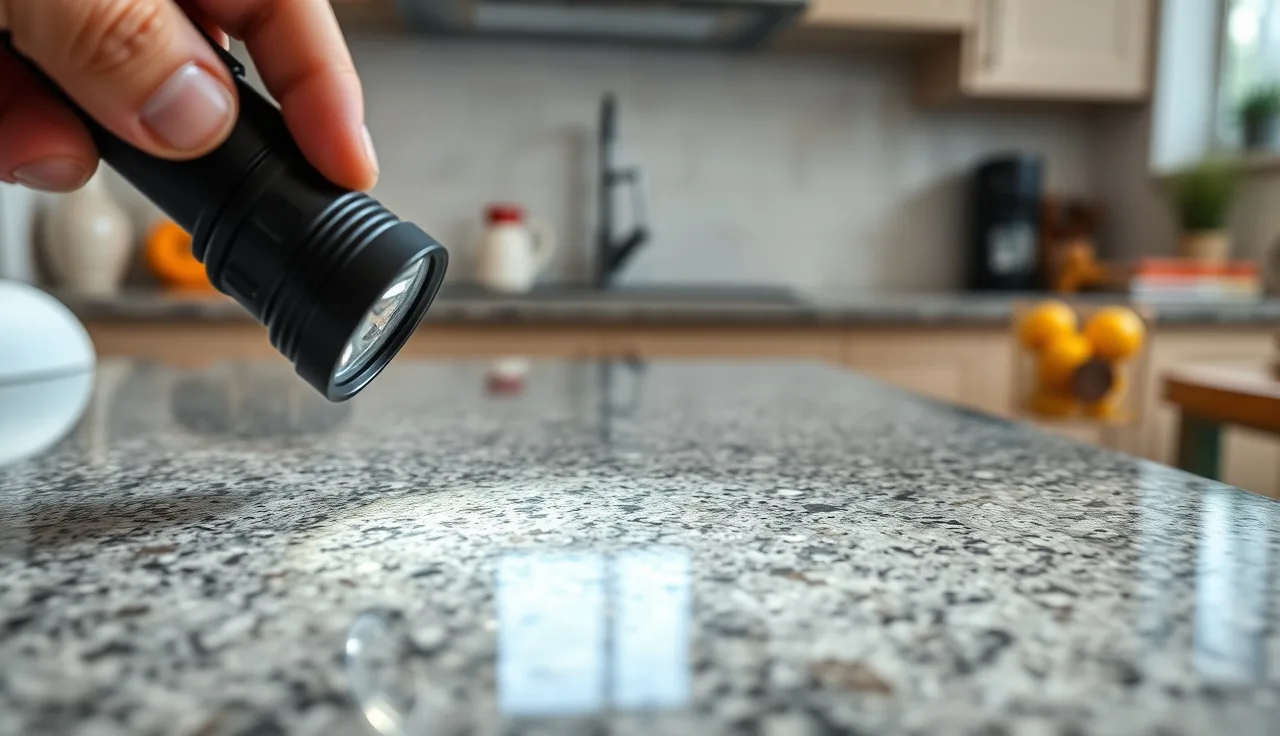
Pitting in granite is small surface voids, anywhere from a pinhole to a couple of millimeters across, that you can feel with a fingertip or see clearly when you shine a flashlight at a low angle across the slab. They are not scratches. They are not stains. They are holes in the stone itself.
Granite is an igneous rock made of interlocking crystals, mostly quartz, feldspar, and mica, that cooled slowly deep in the earth over millions of years. Those crystals vary in hardness and in how tightly they pack together. Where a softer mineral sat, or where two crystals met at an odd angle, there is often a tiny void once the slab is cut and polished. That is pitting in its most basic form.
The look tells you a lot. Pits that read as dull craters scattered at random across the stone are almost always natural. Pits that line up along a vein, pits with a chalky white edge, or pits that showed up after you left lemon juice on the counter overnight are a different animal entirely.
One fast test. Run your fingernail across the surface. If the pit catches your nail, it is a true void. If it looks dark but your nail slides right over it, you are probably looking at a deep stain or a shadow in the crystal pattern, not a physical hole.
What are the main causes of pitting in granite countertops?
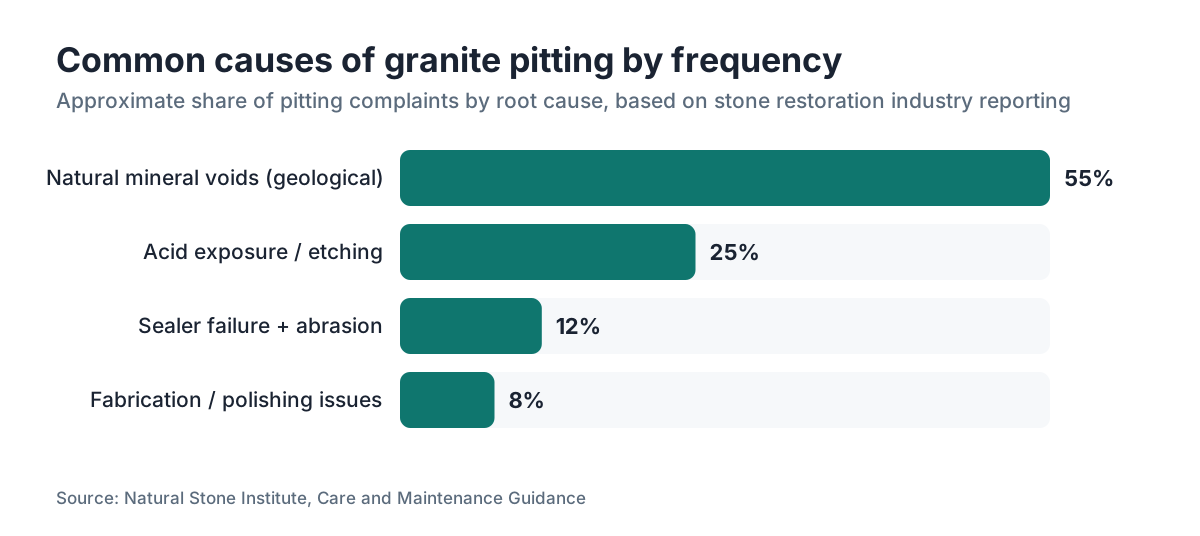
Four real causes exist, and they are nowhere near equally common.
1. Natural mineral voids (the most common cause by far)
Granite forms under enormous heat and pressure, and not every crystal grows to fill its space perfectly. When a slab gets cut and ground to a polished finish, the saw and abrasive wheels expose whatever is there. Softer minerals like biotite mica or calcite inclusions sometimes get partially pulled out during polishing, leaving a pit. The Marble Institute of America (now part of the Natural Stone Institute) lists natural voids and fissures as an expected characteristic of granite and other natural stones, not a manufacturing defect [1].
2. Acid etching
Feldspar, one of granite's main minerals, is vulnerable to mild acids. Citrus juice, vinegar, some cleaning products, and even certain hard water deposits dissolve feldspar crystals slowly. The result looks like a cluster of new, slightly shiny pits that weren't there before, often right where you set a lemon or a bottle of vinegar-based cleaner. This is the cause most homeowners create themselves without realizing it.
3. Fabrication issues
A poorly calibrated polishing line, grinding wheels too aggressive for the specific stone, or thin water cooling during fabrication can open subsurface pores that would otherwise stay hidden. This tends to produce uniform pitting across a large area, not random scatter. It is rare with professional shops. It happens with low-bid work.
4. Sealer failure plus cleaning abrasion
A sealer does not fill pits, but it does protect the stone's surface minerals from the friction of daily cleaning. Once a sealer wears off, repeated scrubbing with abrasive pads dislodges weakly attached crystals at the surface, making existing micro-voids larger and more visible. This is slow, usually years, and it explains why a countertop that looked fine at five years starts showing more texture at ten.
Is granite pitting normal, or does it mean the stone is defective?
Mostly normal. The Natural Stone Institute's standards describe natural pitting as an inherent characteristic of the material, not a quality failure [1]. Look at a polished granite slab under a raking light before you buy, and you will almost always see some pitting. Slabs with zero pitting exist, typically very dense, fine-grained granites like Absolute Black (a gabbro, technically), but they are the exception.
The threshold where pitting crosses from expected to defective is genuinely fuzzy, and nobody has written a clean standard that covers every case. The closest guidance comes from the Natural Stone Institute's ANSI/NSI 373 specification for natural granite tile and slab, which treats surface characteristics including pits as normal for the material class [10].
Here is the rough rule fabricators and designers actually use: if the pitting was visible at the time of sale and the customer approved the slab, it is not a defect. If pitting appears after installation in areas that were smooth at delivery, that warrants a conversation with your fabricator. Document the slab at template time and at installation. Photos with a flashlight held at a low angle are the best evidence either party can have.
Deep pitting bunched near the sink, around the cooktop, or along the perimeter where cleaning products get used most is almost always a maintenance or acid problem, not a stone defect.
Which types of granite are most prone to pitting?
Coarse-grained granites pit more readily than fine-grained ones. The bigger the crystals, the bigger the potential void when one gets dislodged or fails to form completely. A few specific patterns to know:
| Granite type / characteristic | Pitting risk | Notes |
|---|---|---|
| Coarse-grained (e.g., Blue Pearl, Ubatuba) | Higher | Large crystal boundaries create more void opportunity |
| Fine-grained (e.g., Absolute Black, Kashmir White) | Lower | Tightly packed crystals leave little room for voids |
| Stones with significant mica content | Higher | Mica flakes can be partially pulled during polishing |
| Stones with visible veining or calcite inclusions | Higher | Calcite dissolves in acid, leaving pits behind |
| Leathered or honed finishes | Appears higher | Surface texture makes pits more visible, not more actual voids |
Leathered and honed finishes deserve a note. The pitting you see in a leathered granite is no worse than in a polished slab, it is just more obvious because the brushed surface amplifies every texture. Choose leathered granite and you should expect visible pitting. That is part of the aesthetic.
Granites marketed as exotic or sourced from Brazil often have more dramatic veining and more varied mineral content, which generally means more natural pitting than a uniform gray or black granite from India.
Can acid damage cause new pits to form after installation?
Yes, and this is the most preventable cause. Feldspar makes up roughly 50 to 60 percent of most granite by volume [2]. It has a Mohs hardness around 6 to 6.5, which sounds tough, but feldspar reacts chemically with acids even at low concentrations. A pH of 3 to 4, normal for lemon juice or white vinegar, is enough to slowly dissolve feldspar crystal faces and edges [3].
The pattern of acid pitting usually gives it away. You get a cluster of new, slightly bright pits in one spot: right where a citrus half sat, along the sink edge where dish soap or descaler dripped, or in a rectangle that matches the bottom of a spray bottle left on the counter. The surrounding stone looks fine.
The fix takes two steps. First, neutralize any leftover acid residue with a baking-soda-and-water paste, rinse well, and let the stone dry completely. Then fill the pits and reseal. The deeper problem, the dissolved feldspar, cannot be reversed. You can only stop the damage and fill what is there.
Some fabricators and stone care people will tell you granite is acid resistant. That is true next to marble, which etches almost instantly. It is not true in an absolute sense. Given enough time and concentration, acids will damage granite. Unsealed granite is more vulnerable than sealed stone, but even a good sealer will not stop a long acid soak.
Does sealing prevent pitting, and how often should you seal granite?
Sealing does not fill pits that already exist, and it does not stop pitting from natural mineral voids. It does two things. It slows liquid absorption into the stone's pores, which cuts stain risk, and it creates a thin sacrificial layer that protects the outermost crystal edges from abrasion and mild chemical exposure.
For acid-caused pitting, a good impregnating sealer buys you time. The sealer sits below the surface in the stone's pore network and slows how fast acidic liquid reaches the feldspar crystals. It is not a permanent shield. A prolonged acid spill will eventually get through.
The standard recommendation from the Natural Stone Institute is to test your granite's absorption by leaving a few tablespoons of water on the surface for 10 to 15 minutes [4]. If the stone darkens where the water sat, it is time to reseal. For most kitchens that means resealing every one to three years depending on use and stone density [9]. Busy kitchens with frequent cleaning or acidic cooking should lean toward annual sealing.
The actual sealer matters. Penetrating (impregnating) sealers, the kind that soak into the pores rather than sitting on top, are the standard of care for granite countertops. Surface-coating sealers are generally a bad idea. They peel and they trap moisture.
Want to check your current seal without waiting for a water test to fail? Pour about a teaspoon of water and a teaspoon of vegetable oil in separate spots and watch for 10 minutes. Neither should soak in. If the water darkens the stone, the sealer is largely gone [9].
How do you repair pitted granite countertops?
The repair depends on how big and how deep the pits are.
For pinholes and small pits under 1mm, a color-matched epoxy or polyester resin filler works well. Stone repair kits from companies like Tenax and Akemi are what professional restorers reach for. The basic process: clean and dry the area thoroughly, mix the resin to match the stone's color, press it into the void with a putty knife or applicator, let it cure fully, then sand and polish flush. Getting the color match right takes practice. On complex patterns, a professional stone restorer will beat most DIYers.
For larger pits or clusters across a wide area, professional re-surfacing is the realistic move. A stone fabricator or restoration contractor runs a sequence of diamond abrasive pads to grind the surface back to a fresh layer of stone, then re-polishes to the original finish. This removes a small amount of material, usually under 1mm, but it takes the surface back to essentially factory condition. Cost varies a lot by region and area, but a full countertop re-polish from a professional contractor typically runs $200 to $600 for an average kitchen, based on fabricator and restoration pricing common in the industry.
Do not use caulk, silicone, or white grout for pits in granite. They do not stick well to polished stone, they look wrong, and they collect dirt.
If you run a shop and track repair jobs and material costs across projects, software like SlabWise can log stone-specific defect patterns by slab lot. That is useful when a vendor problem, like a bad batch of stone with structural voids, turns up across several installs.
After any repair, reseal the entire surface. The repair area and the surrounding stone should be protected the same.
Is granite pitting a health or food-safety concern?
Pitting itself is not a food-safety hazard, but unsealed pitting can harbor bacteria if the surface is not cleaned properly. That is the short version.
The question of granite and bacteria has been studied. Research on kitchen surface hygiene reported in Applied and Environmental Microbiology found that smooth, non-porous surfaces like glass and high-density plastic were easiest to sanitize, while rougher, more textured surfaces held onto bacteria more readily [5]. Granite lands in the middle. Dense, polished granite cleans up easily. Heavily pitted or unsealed granite can trap food particles and moisture in the voids.
The practical answer for homeowners: keeping granite sealed lowers the effective porosity of the surface, and cleaning with hot soapy water after food contact is enough for normal cooking. Granite countertops sit in commercial kitchens that pass health department inspections all the time. The USDA's food safety guidance focuses on how often and how well you clean and sanitize, not on banning specific counter materials [6].
Pits large enough to trap visible food debris, which would be unusually large for natural granite, should be filled as described above. Normal pinhole pitting on a sealed, cleaned granite surface is not a meaningful food-safety issue.
What should you look for when buying granite to avoid pitting problems?
Inspect the slab in person. Seriously. Photos on a vendor's website get shot under controlled lighting built to hide surface texture. The only way to see pitting accurately is to stand next to the slab with a flashlight held at a low angle, nearly parallel to the surface.
Ask to see the back of the slab. The back has not been polished, so it shows the natural texture of the stone. Heavy pitting on the back often predicts more pitting risk once the polished face takes wear. Not a guarantee, but a reasonable proxy.
For kitchens that get hammered, choose denser, finer-grained stones. A tight-grained Kashmir White or similar fine-grained granite shows far less pitting over time than an open-grained exotic slab from Brazil. That coarse exotic might look spectacular in the showroom and show a lot more texture after two years of cooking and cleaning.
Ask your fabricator or supplier about the stone's country of origin and quarry. Some quarries have a reputation for more structural voids than others. A fabricator who does volume work with a particular stone knows which lots to avoid.
For comparison shopping on surface characteristics by material type, the granite countertops guide covers the full range of what to expect from different stone families, including how granite stacks up against marble countertops and engineered options like Cambria countertops that have zero pitting because they are manufactured.
How is granite pitting different from cracks, fissures, or chips?
These get confused constantly, and they matter differently for repair and for your countertop's structure.
A pit is a void that goes down into the surface but does not spread sideways. It has depth but limited width. You can feel it with a fingernail. It does not compromise the slab's structure.
A fissure is a natural separation between two crystal boundaries that follows the stone's internal grain. Fissures are flat and can run for inches or across a large part of the slab. They show at the surface as a thin line, often with a slight color difference. The Natural Stone Institute's Dimension Stone Design Manual separates fissures from cracks by noting that fissures are natural geological features, present in the stone when it was quarried, while cracks are breaks caused by stress, impact, or thermal shock after fabrication [7]. Fissures do not affect slab stability in most cases. Cracks can.
A chip is missing material at an edge or corner, usually from an impact. Chips sit almost always at the slab perimeter, at cutouts (sink, cooktop), or at the very edge of a seam.
For homeowners trying to figure out what they have: if the void is interior to the surface, circular or irregular, and less than a few millimeters across, it is probably a pit. If it is a thin line, it is a fissure. If it is at an edge and looks like a piece broke off, it is a chip. All three have different repairs. All three have different warranty implications.
For a broader look at caring for stone surfaces, the how to clean stone countertops guide covers cleaning routines that hold down all three kinds of surface damage over time.
When should you call a professional versus doing a DIY repair?
DIY is reasonable for isolated pits under about 2mm, when the color pattern is simple enough to match the filler, and when the pitting sits in a low-visibility spot like the back edge near the wall. Stone repair epoxy kits from Tenax, Akemi, or similar professional suppliers are sold online and at stone supply houses. Budget $30 to $80 for a quality kit.
Call a professional when the pitting is widespread, when the stone has a complex color pattern that would be hard to match, when the pitting sits near a seam or cutout where structural integrity matters more, or when you want a finish that looks factory-new instead of repaired. A stone restoration contractor matches color under real lighting, blends the repair into the pattern, and re-polishes the whole surface to one consistent sheen.
Call a professional too if you are not sure what you are looking at. Getting the diagnosis wrong, treating acid damage like natural pitting, or filling an active fissure with epoxy, can make the problem worse and cost more to fix later.
Fabricators are often the right first call after installation, especially if the pitting showed up fast or is concentrated in one area. They can tell you whether the stone had that characteristic before installation (this is exactly why slab photos at template time are worth taking) and whether it looks like a vendor stone issue versus a maintenance one.
Frequently asked questions
Is it normal for granite countertops to have pits in them?
Yes, entirely normal. Granite is a natural stone with crystals of varying hardness and density. Small pits, especially visible under raking light, are an expected characteristic acknowledged by the Natural Stone Institute's standards. The only situation where pitting is abnormal is when new pits appear after installation in areas that were smooth at delivery, which typically signals acid damage or abrasion from improper cleaning.
Can I fill granite pits myself, and what material should I use?
You can fill small pits yourself using a color-matched stone epoxy or polyester resin from brands like Tenax or Akemi. Clean and dry the area fully, apply filler, let it cure, then sand and polish flush. The hardest part is color matching on patterned stone. For pits larger than 2 to 3mm or on complex-patterned stone, a professional stone restorer will get a better result than most DIY attempts.
What household products cause pitting in granite?
Acidic products are the main culprits: lemon juice, lime juice, vinegar, citrus-based cleaners, some bathroom descalers, and certain multi-surface sprays with low pH. Even tomato juice left to sit can slowly etch feldspar crystals over time. Highly alkaline products can also degrade sealers and some minerals. The safest cleaners for granite are pH-neutral stone-specific soaps or plain warm water with dish soap.
Does sealing granite prevent pitting?
Sealing prevents staining and slows acid penetration, but it does not stop natural mineral voids or fill existing pits. A good impregnating sealer creates a barrier in the stone's pore network that slows acid exposure to the feldspar crystals, which reduces acid-caused pitting over time. Reseal every one to three years depending on use, or whenever a water-drop test shows absorption within 10 to 15 minutes.
Why does my granite have more pitting near the sink?
The area near the sink gets the most water, soap, cleaning-product splatter, and mechanical scrubbing of any surface in the kitchen. Soap scum removers and descalers are often acidic. Dish soap residue is slightly alkaline. Repeated wetting and drying cycles stress the sealer. All of it concentrates wear at the edge of the sink cutout. More pitting there than elsewhere is common and almost always a maintenance issue rather than a stone defect.
How do I know if my granite pitting is getting worse over time?
Take a photo under raking light (flashlight held parallel to the surface) on the day of installation and repeat it every year in the same spot. That gives you actual visual evidence. If the pits look the same size and distribution, you have normal natural pitting. If new pits appear or existing ones look larger, you have an active cause: acid exposure, sealer failure, or abrasive cleaning. Stop the cause before repairing.
What is the difference between pitting and etching in granite?
Etching is surface damage to the polish, leaving a dull spot or slightly rough texture without necessarily creating a physical void. Pitting creates an actual hole in the surface you can feel with a fingernail. Acid causes both: it dissolves feldspar crystals, which first dulls the polish (etching) and with continued exposure removes enough material to leave a pit. Light etching can sometimes be polished out. Pitting requires filling.
Can pitted granite harbor bacteria or be unsafe for food prep?
Normal granite pitting on a sealed, regularly cleaned countertop is not a meaningful food-safety concern. Research on kitchen surface hygiene confirms that standard cleaning with hot soapy water removes pathogenic bacteria adequately from stone surfaces. Granite countertops pass health department inspections in commercial kitchens regularly. Very large unfilled pits that trap visible food debris should be filled as a hygiene measure, but typical pinhole pitting on a clean, sealed surface is not hazardous.
Is leathered granite more prone to pitting than polished granite?
Leathered granite is not more structurally vulnerable to pitting, but the textured surface makes existing pits far more visible than on a polished slab. The leathering process (brushing with diamond-tipped tools) opens up the stone's natural texture on purpose. Anyone choosing a leathered finish should inspect the slab carefully beforehand and accept that pitting will be a visible part of the surface character. It is an aesthetic choice, not a defect.
What types of granite have the least pitting?
Fine-grained, dense granites have the least natural pitting. Absolute Black (technically a gabbro), Kashmir White, and similar tight-grained stones show very little pitting because crystal boundaries are small and tightly interlocked. Coarse-grained exotics from Brazil or stones with significant mica or calcite content show more. If pitting worries you, choose a denser stone and look at the slab under raking light before you buy.
Will my granite warranty cover pitting that appears after installation?
Natural stone does not carry the same warranty as engineered or manufactured countertops. Most fabricator warranties cover workmanship defects for one to two years after installation but explicitly exclude natural stone characteristics, which typically include inherent voids and pitting. If pitting appeared in an area that was smooth at delivery, document it with photos and contact your fabricator promptly. New pitting from acid exposure or abrasion is almost never covered under any warranty.
How much does it cost to repair pitted granite professionally?
Professional stone repair costs vary by region, extent of damage, and pattern complexity. Isolated pit filling by a stone restoration contractor typically runs $150 to $300 for a service call. A full countertop re-grind and re-polish for a standard kitchen, which takes the surface back to factory condition, typically runs $200 to $600 depending on square footage and the number of edges. DIY epoxy kits cost $30 to $80 and work well for small, simple repairs.
Does honing granite reduce or increase visible pitting?
Honing, grinding the surface to a matte finish rather than a high gloss, does not create more pits structurally, but it can make existing pitting more apparent because there is less reflected light to distract the eye. A polished surface reflects light uniformly, which minimizes the visual impact of small voids. A honed surface has a diffuse finish that makes surface texture more visible. Like leathered stone, honed granite is an aesthetic choice that comes with more visible natural character.
Sources
- Natural Stone Institute, Natural Stone Standards and Technical Resources: Natural pitting, voids, and fissures are explicitly listed as inherent characteristics of natural granite and other stone, not manufacturing defects, under NSI standards.
- USGS, National Minerals Information Center: Feldspar: Feldspar makes up approximately 50-60% of the Earth's crust by volume and is a primary constituent mineral in granite.
- USGS, Mineral and Rock Weathering Resources: Feldspar minerals in granite have a Mohs hardness of 6 to 6.5 and are subject to chemical weathering including dissolution by mildly acidic solutions.
- Natural Stone Institute, Care and Maintenance of Natural Stone: The recommended granite absorption test is to leave water on the surface for 10-15 minutes; darkening indicates it is time to reseal.
- Applied and Environmental Microbiology (American Society for Microbiology): Research on kitchen surface hygiene found that rougher, more porous surfaces retain bacteria more readily than smooth non-porous surfaces, with granite rated as intermediate depending on polish and sealing.
- USDA Food Safety and Inspection Service, Kitchen Sanitation and Food Safety Guidance: USDA food safety guidance focuses on cleaning and sanitizing frequency and technique rather than prohibiting specific countertop materials including natural stone.
- Natural Stone Institute, Dimension Stone Design Manual: The Dimension Stone Design Manual distinguishes between fissures as natural geological features present at quarrying and cracks as breaks caused by post-fabrication stress or impact.
- Clemson University Cooperative Extension, Home and Garden Information Center: Granite countertops require sealing to reduce porosity and are susceptible to staining and mild acid etching if not properly maintained; resealing every 1-3 years is typical.
- ANSI/NSI 373 Natural Granite Tile Specification, Natural Stone Institute: ANSI/NSI 373 treats surface characteristics including pits as normal for the natural granite material class and not grounds for rejection under the specification.
Last updated 2026-07-10