TL;DR
- A stress crack in a stone countertop is a fracture caused by uneven mechanical load, thermal shock, or missing support, not by impact.
- Granite, marble, and quartzite crack most often at sink cutouts and thin edges.
- Nearly all of these cracks are preventable with level cabinets, full perimeter support, and a trivet under hot pans.
- Professional repair runs $150 to $450.
What exactly is a stress crack in a stone countertop?
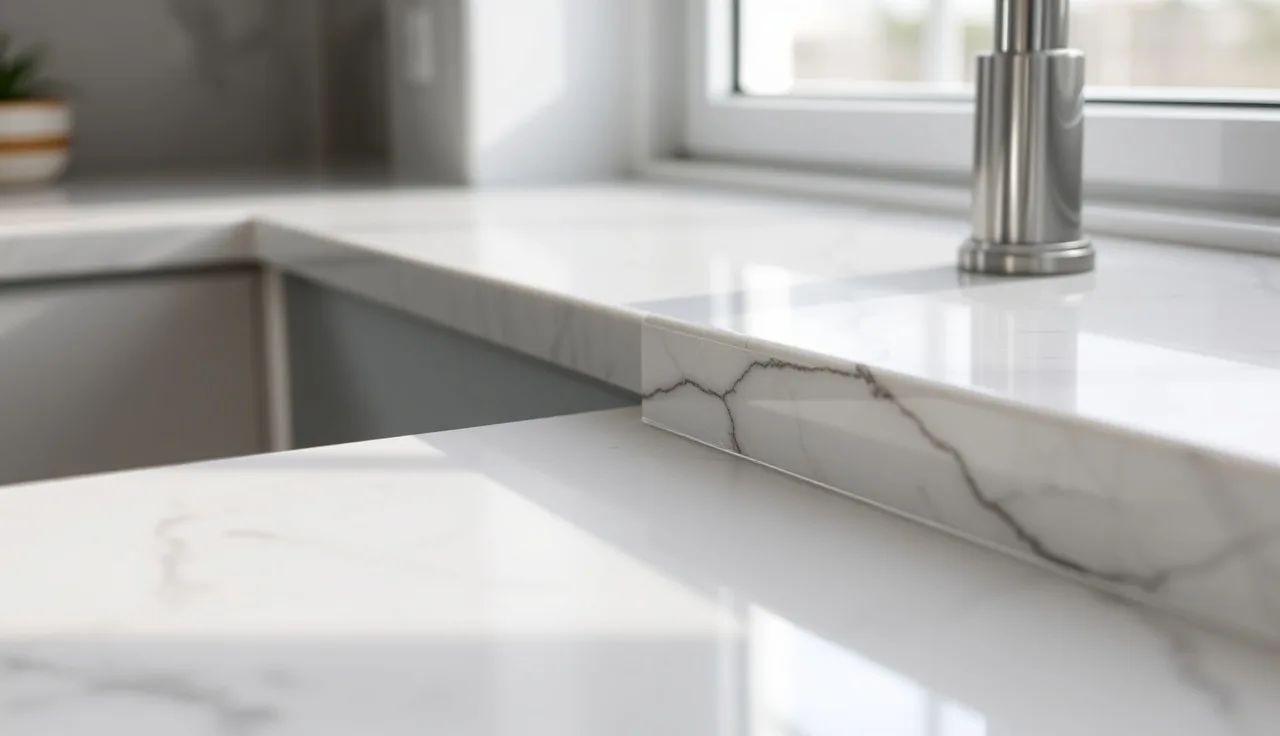
A stress crack is a fracture that forms when tension inside the stone beats the material's tensile strength. The crack runs through the slab itself, not along a seam or a fabrication joint. It almost always starts at a geometric weak point: a sink cutout corner, a cooktop opening, a narrow neck of stone between two appliances, or a fissure that was already sitting in the raw slab.
Stress cracks and impact cracks look different. An impact crack radiates outward from one strike point, like a spider web. A stress crack runs in a mostly straight line, usually starting at a corner and traveling toward the nearest free edge. It can show up gradually over days or weeks, starting as a hairline that slowly opens.
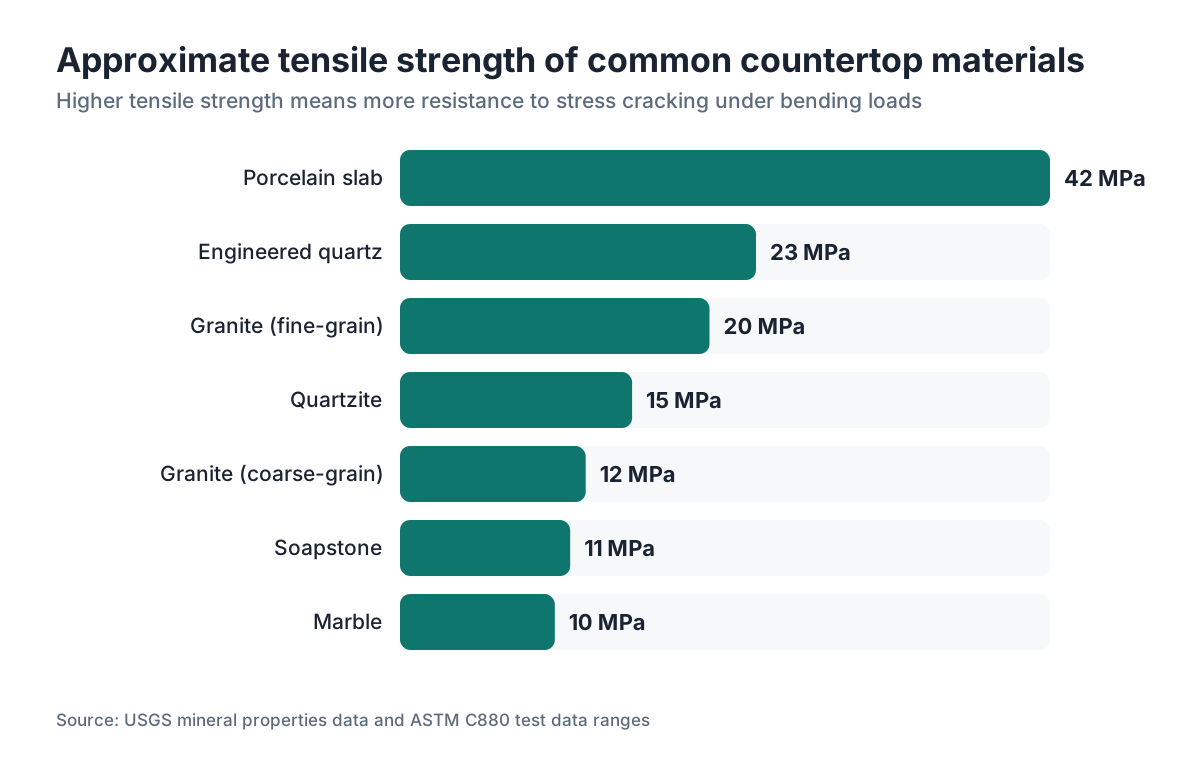
The word "stress" here means the engineering thing: force per unit area on the stone. Stone shrugs off compression but has low tensile strength. Granite's tensile strength runs roughly 7 to 25 MPa depending on variety and grain structure [1]. That sounds like plenty. But concentrated loads from uneven cabinet support, thermal expansion, or someone sitting on an overhanging edge can push localized tensile stress past that number.
Natural fissures muddy the picture. Many slabs, marbles and quartzites especially, carry natural fissures that are not cracks. They are planes of slightly weaker bonding inside the crystal structure. A fabricator can tell you before installation whether a visible line is a fissure or a crack by dragging a fingernail across it: a fissure sits flat with the surface, a crack has an edge you can feel. This matters because a fissure that gets ignored can turn into a full stress crack under the right load.
What causes stress cracks in stone countertops?
Four causes do most of the damage, and they usually gang up rather than act alone.
Uneven cabinet or substrate support. This is the big one. When a cabinet run is not perfectly level, the countertop bridges the low spots. The stone then acts like a beam spanning a gap, and the unsupported section carries bending stress. A drop of even 3/16 of an inch across a 30-inch span can crack stone, especially at a cutout [2]. Plywood substrate spreads load, but it cannot save a cabinet that is badly out of level.
Thermal shock. Stone expands and contracts with temperature. Heat one section fast while the section next to it stays cool, and differential expansion builds tensile stress right at the boundary. Setting a hot pan straight off a burner onto cold granite is the classic case. The surface layer wants to grow, the cooler stone underneath fights back. Thin countertops (under 3/4 inch finished thickness) take the worst of it. Engineered quartz is more uniform in its thermal behavior than natural stone, but it is not bulletproof.
Cutout geometry. Every cutout, sink or cooktop, pulls out material and concentrates stress at the corners. Fabricators round those corners to spread stress over a curve instead of a sharp point. Radius matters: 3/16 inch at a sink corner is the minimum the Marble Institute recommends, with 1/4 inch or larger preferred [3]. A squared-off or under-radiused corner is a crack waiting for a reason.
Overloading and point loads. A countertop is not a step stool. Sitting on an unsupported overhang, climbing up to reach a high cabinet, or dropping a heavy appliance on a narrow peninsula all create point loads that blow past safe design stress. Granite countertops get designed for distributed loads, not concentrated ones out at the edge.
Which stone types are most prone to stress cracking?
Countertop materials do not crack the same way, and the gaps between them are wide enough to shape your material choice.
| Material | Tensile Strength (approx.) | Relative Crack Risk | Notes |
|---|---|---|---|
| Marble | 6-15 MPa | High | Low tensile strength, veining creates natural weak planes [1] |
| Quartzite | 10-20 MPa | Medium-High | Varies widely by quarry; some quartzites behave more like marble |
| Granite | 7-25 MPa | Medium | Mineral grain size affects performance; finer grain = stronger |
| Engineered Quartz | 18-28 MPa | Low-Medium | Polymer binder improves tensile strength vs natural stone [4] |
| Soapstone | 8-15 MPa | Medium | Dense and flexible for a stone, but thin slabs still crack |
| Porcelain Slab | 30-55 MPa | Low (until edge chip) | Strong in tension but brittle at edges and corners |
Marble earns extra attention. Its crystal structure means veining is real planes of relative weakness. A vein running toward a sink corner is a fabricator's warning sign. The good shops orient the slab so veins run parallel to a cutout corner, not into it. If you are shopping marble countertops, ask exactly how the fabricator handles vein orientation at cutouts.
Engineered quartz (Cambria, Silestone, and the rest) has a polymer resin binder that gives it more tensile give than natural stone. Even so, Cambria countertops and other engineered products are not crack-proof. Thermal shock and unsupported overhangs still get them. The failure mode just shifts: quartz tends to delaminate at the surface rather than split clean through the way granite does.
Granite countertops get talked about most for stress cracking, mostly because granite is the most common premium countertop out there. Coarse-grained granites like Ubatuba or Blue Bahia carry more inter-crystal variation and slightly lower average tensile strength than fine-grained types.
How is a stress crack different from a natural fissure?
This is the question that starts the most fights between homeowners and installers, and the answer has real money attached.
A natural fissure is a geological feature that was in the slab when it left the quarry. It forms as magma cools and crystallizes (in igneous rock like granite) or under metamorphic pressure (in marble and quartzite). Fissures lie flat within the plane of the stone. They usually do not run all the way through the slab. Under magnification, the crystal structure on each side of a fissure stays continuous, just slightly parted.
A stress crack cuts across crystal boundaries instead. It tends to work through the full thickness of the slab over time if the load causing it never gets relieved. Drag a fingernail across the line: fissure, smooth crossing; crack, you feel the step.
Why the fuss? A fissure disclosed before installation is the homeowner's informed purchase. A stress crack that shows up after installation because of weak support or bad fabrication is a warranty or liability question. Some fabricators seal fissures with epoxy resin before installation for exactly this reason, to stop them from growing into true cracks under service loads.
The Marble Institute addresses this in its installation guidelines, and its Dimension Stone Design Manual treats natural fissures as normal characteristics of the material rather than defects caused by installation error [3]. That line is what claims get argued over.
Can thermal shock actually crack a granite countertop?
Yes, but it takes rougher conditions than most kitchens dish out. The mechanism is real and documented. Thermal shock cracking happens when the temperature difference across a section builds thermal stress past the tensile strength. In granite, the critical gradient depends on mineral makeup and grain structure, but laboratory work has found that rapid surface temperature swings of 50 to 100 degrees Celsius can start microcracking in granite specimens [5].
The kitchen version: you pull a cast iron pan out of a 500 degree oven and set it straight on cold stone. The pan face is maybe 450 degrees F (232 C), the countertop is 70 degrees F (21 C). That gap sits well inside the range that damages stone, especially if the pan keeps landing in the same spot.
The risk climbs in winter when countertop temperatures drop, and it climbs on thinner stone (3/4 inch versus 1.25 inch), because thin stone has less mass to soak up and spread the heat gradient.
Use a trivet. Not because granite cracks the first time you set a hot pan down, but because repeated thermal cycling fatigues the stone. Cracks often surface on the fifth or tenth pan, not the first. By then nobody connects the crack to the habit.
Hot water in a sink is a different story. Dish water at 140 degrees F running into a sink surrounded by stone almost never shocks the countertop itself. The worry there is the undermount sink clips and the adhesive holding the sink up.
How do you prevent stress cracks during and after installation?
Prevention breaks into three phases: fabrication, installation, and daily use. Each one has specific moves that actually change the outcome.
During fabrication:
Round every cutout corner to at least a 3/16-inch radius, 1/4 inch preferred [3]. Some fabricators run a 3/8-inch radius on thick slabs or soft stones. Square corners are not acceptable on any professional job.
For the shakiest layouts, add corbel or bracket support during fabrication, not later. A sink cutout that leaves under 4 inches of material on the back edge needs extra reinforcement.
Check the slab for fissures before cutting. Map them against the planned cutouts. If a fissure runs toward a sink corner, either reorient the slab or reinforce that spot with rod or epoxy before the saw runs.
Back-rod reinforcement, or rodding, means routing a channel in the underside of the slab and epoxying in fiberglass or carbon fiber rods. It adds real tensile resistance across cutouts. Good fabricators rod any sink opening in marble or quartzite as a matter of habit.
During installation:
Level the cabinets first. A 4-foot level is not enough for a long run. Use a 6-foot or 8-foot level and check diagonally across the whole cabinet field. Shim every low spot before the countertop goes down.
Support the full perimeter. Do not leave unsupported spans over 24 inches without substrate or mid-span support [2]. For heavy stones, treat 18 inches as your ceiling.
Use silicone, not rigid adhesive, at the cabinet-to-countertop joint. Rigid adhesives shove racking stress straight into the stone. Silicone flexes and eats minor movement from seasonal wood swelling without passing it up into the slab.
Never force a countertop into place. If it will not sit flat on its own, find out why before you add weight or fasteners.
During daily use:
Use trivets for hot pans and hot appliances, every time. Air fryers, slow cookers, and instant pots humming for hours on stone are the sneaky risks nobody thinks about.
Do not sit or stand on the countertop. The overhang past cabinet support is in pure cantilever bending, and the stress pileup at the support edge can crack even a thick slab.
Keep very heavy concentrated loads off unsupported overhangs. A 100-pound stand mixer belongs over the cabinet below, not out past the edge.
What role does countertop support and overhang play in cracking?
Overhang is the number homeowners underrate as a crack risk. Countertop overhangs are cantilever beams. The physics is plain: the stone at the support edge is in tension on the bottom face and compression on top. Tensile stress at the underside of that edge scales with the load, with the overhang distance squared, and inversely with the slab thickness cubed. Double the overhang and you roughly quadruple the stress.
The Marble Institute's installation guidance calls for corbel or bracket support once granite and marble overhangs pass 6 inches [3]. Plenty of fabricators use 10 to 12 inches as a working maximum for 3/4-inch stone without extra support. A waterfall edge, where stone drops straight to the floor, follows a different load path and needs engineered attachment more than it needs muscle.
Island seating overhangs crack more than anything else in residential kitchens. Homeowners want 12 to 15 inches of knee clearance. That is fine with proper bracket support (steel brackets every 18 to 24 inches along the overhang). But when a builder drops the island top on without brackets, betting the stone is strong enough, cracks at the cabinet-edge line are predictable.
For the full picture on countertop installation and support requirements, the specifics shift by material and layout. The plain rule holds: if you are not sure an overhang needs support, it needs support.
Can a stress crack be repaired, and what does it cost?
Most stress cracks can be repaired cosmetically, and a skilled fabricator can make the fix nearly invisible. "Nearly" is carrying real weight in that sentence. Full invisibility on a dark stone or a stone with tight, uniform pattern is doable. On white marble with a hairline running through a clean field, the repair will catch the light at certain angles.
The standard process: clean the crack with acetone, inject low-viscosity epoxy or UV-cure resin, cure under light or at room temperature, then grind and polish flush. Color-matched pigments go into the resin. A good fabricator matches color closely, but the texture and translucency of the fill will always read a little different from the surrounding stone.
Cost tracks crack length, stone type, and how far the crack has spread. A simple 4-inch crack at a sink corner in granite usually runs $150 to $300. A longer crack that has traveled 12 to 18 inches, or one in white marble that needs exact color matching, can hit $350 to $500. Full slab replacement, when a crack has made the top unsafe, runs $400 to $1,200 or more depending on material and size [6].
One hard caveat: repair does not fix the cause. If the crack came from an unlevel cabinet, or from no bracket under a long overhang, the repair re-cracks. Fix the root cause first, then repair.
Some cracks need replacement, full stop. A crack that runs completely through the slab from front edge to back, especially one with any gap, means the structure is compromised. No amount of epoxy makes that safe for normal use.
Does sealing a stone countertop prevent stress cracks?
No. Sealer stops staining by blocking liquid from soaking into the pores. It does nothing for the mechanical strength of the stone and nothing to prevent stress cracking.
This myth sticks around because fabricators and stone care brands push sealing as general maintenance, and people hear "protect the stone" and assume that means protect it structurally.
Sealing is still worth doing for stain resistance. For how to clean stone countertops and sealing guidance, the routines that matter live apart from crack prevention. The two topics just happen to touch the same slab.
The one spot where sealing brushes against crack resistance is indirect: certain penetrating sealers fill micro-pores near the surface, which can slow a hairline crack slightly by cutting moisture ingress that drives freeze-thaw expansion outdoors. In an indoor kitchen, that effect is close to nothing.
Are some countertop materials immune to stress cracking?
Immune is too strong. But some materials are far more resistant, and if cracking is your main fear, that difference should steer your choice.
Laminate and similar engineered products like laminate countertops and Formica countertops do not stress crack the way stone does. They can delaminate, chip at the edges, or swell from water, but through-cracks from mechanical or thermal stress are not their failure mode.
Butcher block countertops and Corian countertops can crack under impact or extreme overload, but they behave more like ductile materials than stone, so they absorb stress before they fracture.
Porcelain slab, more common every year, has high tensile strength (30 to 55 MPa) and shrugs off thermal shock better than natural stone [4]. Its weak point is edge chipping, not field cracking. But a thin porcelain slab over an uneven substrate still cracks at unsupported spans, because the bending stress can beat even its higher tensile strength.
Soapstone (see how to clean soapstone countertops) is denser and a touch more ductile than most natural stones, which buys it some margin. It still cracks, especially at cutouts.
The only truly crack-immune countertops in practice are the flexible surfaces: stainless steel and high-pressure laminate. Both carry their own trade-offs, but stress cracking is not one of them.
What should you do if you find a crack in your countertop?
Start by figuring out what you are looking at: a stress crack, an impact crack, or a natural fissure. The fingernail test plus location gives you the first read. Near a cutout corner points to a stress crack. A random field spot with a radial pattern points to impact. If you are not sure, get a second opinion from a stone fabricator, not a general handyman.
Second, stop loading the cracked area. Keep heavy items off it. If the crack is at a sink cutout, keep standing water and heavy pots out of the sink until you know how bad it is.
Third, document it with photos. Date-stamped photos tell you whether the crack is growing. Mark each end of the crack with a small piece of tape, note the date, and check it weekly. A growing crack is more urgent than a stable one.
Fourth, find and fix the cause before you repair. Bring in a fabricator to check support conditions. If a cabinet is low, shim it. If an overhang has no brackets, add them. Repairing a crack without fixing the cause burns money.
Fifth, get a professional repair. DIY epoxy kits exist, and some homeowners pull them off on hairline cracks in low-visibility spots. But for structural cracks, for cracks in marble or light-colored stone where color matching is hard, and for any crack past about 6 inches, professional repair is the smarter call.
Fabricators running estimating and job-tracking software like SlabWise can scope and price a repair quickly during a site visit, which cuts out the back-and-forth of phone calls and photo swaps. If your original fabricator is gone, any Natural Stone Institute member shop can assess the situation. The Natural Stone Institute (formerly the Marble Institute of America) keeps a member directory on its website [3].
How do fabricators assess crack risk before installation?
Good fabricators run a crack risk check at templating, not after the crack shows up. Here is what that looks like on the job.
They check cabinet level across the full run and flag any gap over 1/8 inch. They note where planned cutouts land relative to slab fissures. They measure overhang lengths and flag anything past 6 inches without existing or planned bracket support. For tight necks of countertop (under 6 inches of material between two openings), they may call for reinforcement before cutting.
Some fabricators use the template to set slab orientation on purpose, moving fissures away from cutout corners. Digital templating helps here: laying a digital template over a photo of the slab lets the fabricator see where fissures fall against the cut lines before the saw ever touches stone.
If you are having kitchen countertops fabricated and your templater never mentions any of this, ask. Ask where the sink cutout corners will land relative to any visible lines in the slab. Ask whether the cabinets got checked for level. A fabricator who has thought about it will have answers ready. One who has not is your warning sign.
The Occupational Safety and Health Administration publishes material handling and silica safety guidance for fabrication shops [7], but the actual standard of care for installing stone countertops comes from the Natural Stone Institute (formerly the Marble Institute of America, merged with the Building Stone Institute), which publishes specific installation tolerances and support requirements in its Dimension Stone Design Manual [3].
Frequently asked questions
Can a stress crack in a granite countertop spread over time?
Yes, if the cause is not fixed. A stress crack under ongoing load, whether from an unlevel cabinet, a heavy unsupported overhang, or repeated thermal cycling, keeps propagating. The crack relieves local stress for a moment, but the load stays, so the crack front advances. Mark the ends with tape and a date. If it grows within two weeks, treat it as urgent and fix the support condition right away.
Is a hairline crack in my countertop a warranty issue?
It depends on the cause and the contract. If the crack came from weak support at installation, an under-radiused cutout corner, or a fissure the fabricator knew about and hid, most reputable shops repair it under warranty. If it came from homeowner behavior (a dropped heavy object, hot pans landing in the same spot), that is usually not covered. Document the crack with dated photos and contact your fabricator promptly.
What is the maximum safe overhang for a granite countertop without support?
The Marble Institute recommends corbel or bracket support once granite and marble overhangs pass 6 inches. Many fabricators treat 10 to 12 inches as a working ceiling for 3/4-inch stone over a proper substrate, but anything past 6 inches without support adds real risk, especially at seating-height island overhangs where someone will eventually sit or lean on the edge.
Does a crack in my countertop mean the whole slab needs to be replaced?
Not always. A hairline crack that has not run through the full slab thickness can usually be repaired with epoxy injection for $150 to $450 depending on length and stone type. A crack that runs completely through from one edge to another, or that has a visible gap, often means the structure is compromised and replacement is safer. Get a professional assessment before deciding.
Can hot pans really crack a granite or quartz countertop?
Yes, through thermal shock. Setting a pan at 450 degrees F or hotter on cold stone creates a rapid temperature gap that builds tensile stress in the surface layer. One incident may not crack most stones, but repeated cycling fatigues the material. The risk climbs on thinner slabs, in colder kitchens, and near existing fissures or cutout corners. Use a trivet every single time.
How do I tell if a line in my countertop is a crack or a natural fissure?
Run a fingernail across the line at a right angle. A natural fissure lies flat within the surface and your nail glides across it. A crack has a physical step or gap you can feel. Cracks also tend to start at stress points like sink corners or edges, while fissures run through the body of the stone following the mineral veining. When in doubt, a fabricator can confirm it on a site visit.
What type of countertop material is least likely to crack from stress?
Laminate, stainless steel, and solid surface materials like Corian do not stress crack the way natural stone does. Among stone and stone-like products, engineered quartz has better tensile strength than most natural stones thanks to its polymer resin binder. Porcelain slab has high tensile strength but chips at edges. If stress cracking is your main worry, engineered quartz or solid surface is the safer bet.
Does sealing my countertop prevent cracks?
No. Sealers are penetrating liquids that fill pores to block staining agents. They do nothing for the mechanical or tensile strength of the stone. Crack prevention comes from proper installation support, correct cutout geometry, and careful daily habits. Sealing is still worth doing for stain resistance, but do not count on it for any structural protection.
How much does it cost to repair a stress crack in a stone countertop?
Professional repair usually runs $150 to $300 for a short crack (under 6 inches) in granite or similar stone. Longer cracks, cracks in light-colored marble that need precise color matching, or cracks that have run fully through the slab can hit $350 to $500 or more. Full slab replacement, when repair is not viable, ranges from $400 to over $1,200 depending on material and countertop size.
What is rodding and does it really prevent stress cracks at sink cutouts?
Rodding means routing a channel in the underside of the stone and epoxying fiberglass or carbon fiber rods across a cutout opening. The rods add tensile reinforcement in the direction the stone is most likely to crack. It works, especially for marble and quartzite, and good fabricators use it as standard practice on vulnerable layouts. It adds modest cost, usually $50 to $150 per cutout, and earns it back.
Can an unlevel cabinet cause my countertop to crack?
Yes, and this is the most common cause of post-installation stress cracks. When cabinets are not level, the countertop bridges low spots and acts like a beam spanning a gap. The unsupported section carries bending stress that piles up at the weak points, usually cutout corners or thin necks of material. Even a 3/16-inch drop across a 30-inch span can be enough. Leveling cabinets first is non-negotiable.
How long after installation do stress cracks usually appear?
Many stress cracks show up in the first three to six months, as the structure settles and load patterns stabilize. Thermal-shock cracks can appear immediately after a triggering event. Others, especially in marble at fissures that were never reinforced, develop slowly over one to three years as seasonal wood movement in cabinets cycles the stone. A crack appearing more than two years after installation is less likely a fabrication defect and more likely a use or environmental cause.
Do I need a structural engineer to assess a cracked countertop?
In almost all residential cases, no. A qualified stone fabricator with repair experience can judge whether a crack is structural (full-thickness, propagating, affecting safe use) or cosmetic (surface or partial-depth, stable). A structural engineer is rarely needed unless the countertop is in a commercial setting, the crack is unusually severe, or there is a legal dispute over liability. Start with your fabricator or a second-opinion stone shop.
Can I prevent stress cracks by choosing a thicker countertop slab?
Thickness helps. A 1.25-inch (3 cm) slab is much stronger in bending than a 3/4-inch (2 cm) slab, because bending resistance rises with the cube of thickness. All else equal, a 3 cm slab over the same unsupported span carries roughly 2.4 times the bending load before cracking. But thickness alone does not replace level cabinets and a proper cutout corner radius. All three matter, and none substitutes for the others.
Sources
- U.S. Geological Survey, National Minerals Information Center (dimension stone physical properties): Granite tensile strength approximately 7 to 25 MPa; marble tensile strength approximately 6 to 15 MPa depending on variety
- Natural Stone Institute, Dimension Stone Design Manual: Unsupported spans over 24 inches increase bending stress and crack risk; cabinets must be level within accepted tolerances before countertop installation
- Natural Stone Institute (formerly Marble Institute of America), Installation Guidelines for Dimension Stone: Cutout corners should have a minimum 3/16-inch radius; overhangs beyond 6 inches require corbel or bracket support; natural fissures are not installation defects
- NSF International, Standard 51: Food Equipment Materials: Engineered quartz countertops use polymer-bonded composite construction; porcelain slab tensile strength is reported in manufacturer technical data sheets at roughly 30 to 55 MPa
- International Journal of Rock Mechanics and Mining Sciences (thermal cracking of granite): Rapid surface temperature changes of 50 to 100 degrees Celsius can initiate microcracking in granite specimens under laboratory thermal shock conditions
- Angi, Countertop Repair Cost Guide: Professional stress crack repair in stone countertops typically costs $150 to $500 depending on crack length and material; slab replacement ranges from $400 to over $1,200
- U.S. Occupational Safety and Health Administration, Crystalline Silica guidance: OSHA publishes material handling and silica safety guidance relevant to stone fabrication shop practices
- U.S. Geological Survey, National Minerals Information Center (dimension stone statistics): Granite is the most widely used dimension stone for residential countertop applications in the United States
- ASTM International, ASTM C880 Standard Test Method for Flexural Strength of Dimension Stone: ASTM C880 is the standard method used to measure flexural (tensile) strength of dimension stone including granite and marble
- University of Minnesota Extension, wood and moisture movement: Seasonal wood movement in cabinet frames can create cyclical mechanical stress at rigid countertop attachment points
Last updated 2026-07-11