TL;DR
- Quartzite and sintered stone (Dekton, Lapitec) are the hardest countertop materials to cut and polish, both rating 7 or higher on the Mohs scale.
- That hardness burns through diamond tooling faster, forces slower cutting speeds, and pushes fabrication labor 20-40% above granite.
- Quartzite adds a second problem: it can shatter along hidden fissures on any cut.
Why does stone hardness matter so much for cutting and polishing?
Hardness decides how a slab behaves the moment a blade touches it. A harder stone eats diamond blades and polishing pads, forces slower cutting to avoid cracking, and needs more water to keep heat from splitting the material mid-cut. Every one of those adds time. Time is money, whether you are a homeowner paying a fabricator or a shop owner bidding the job.
The standard measure is the Mohs hardness scale, developed by German mineralogist Friedrich Mohs in 1812. It runs from 1 (talc) to 10 (diamond) and rates relative scratch resistance: a higher number scratches anything below it [1]. For fabricators, the practical cliff sits around 7. Below 7, ordinary diamond tooling handles the material without punishing wear. At 7 and above, blade life falls off a ledge and you reach for premium segmented or turbo blades running at lower RPMs.
Mohs is only one variable. Porosity, grain structure, and hidden fissures all shape how a slab reacts under the saw. Quartzite can rate a clean 7 and still shatter if microfractures run through it. That mix of hard and fragile is what makes it the toughest common countertop material to work.
What is the Mohs hardness of common countertop stones?
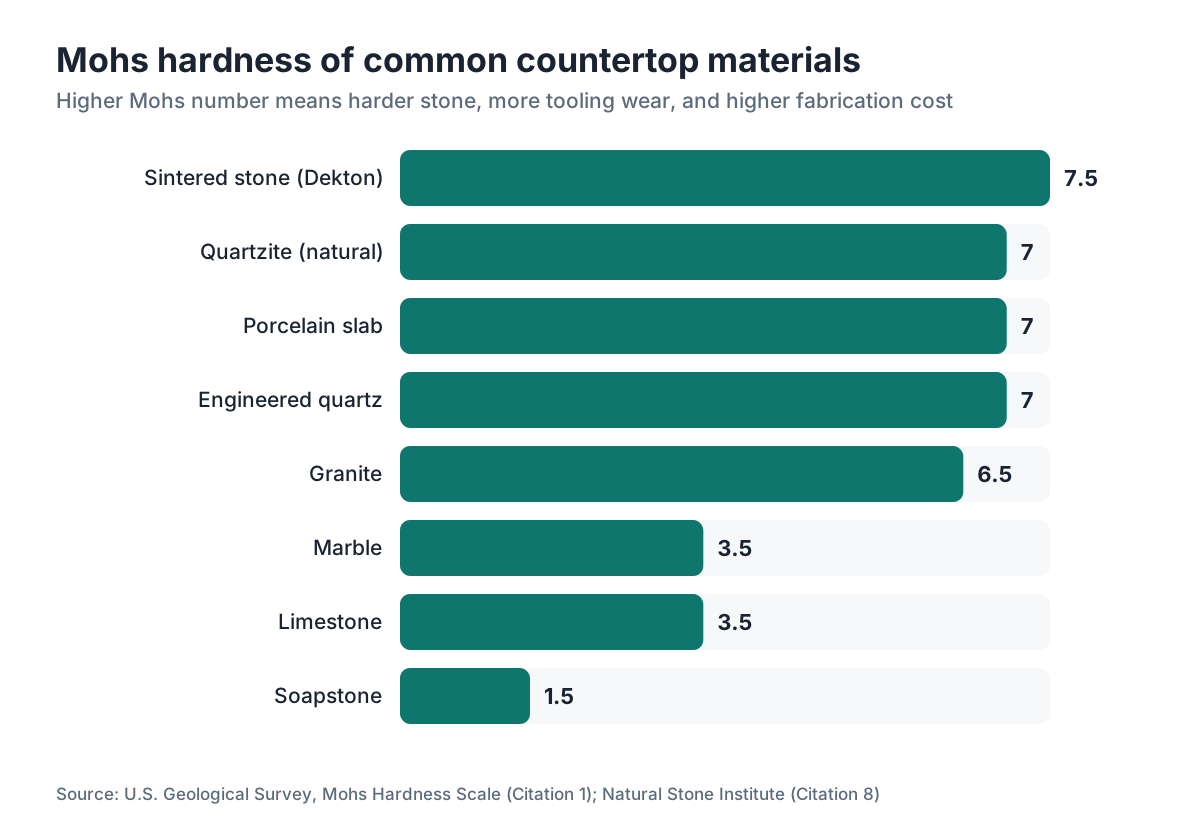
Here is how the common countertop materials line up on Mohs and in real fabrication difficulty. Engineered and sintered products get tested under different standards than natural minerals, so read those numbers as equivalents, not head-to-head comparisons [2].
| Material | Mohs Hardness | Fabrication Difficulty | Key Reason |
|---|---|---|---|
| Quartzite (natural) | 7.0 | Very High | Hard, brittle, fissure-prone |
| Sintered stone (Dekton, Lapitec) | 7.0-8.0 equivalent | Very High | Extreme hardness, chips on edge details |
| Porcelain slab | 7.0-7.5 | High | Brittle, chips on cutouts |
| Granite | 6.0-7.0 | Moderate-High | Hard but predictable grain |
| Quartzite (soft end) | 6.5 | Moderate | Varies by origin |
| Engineered quartz (Silestone, Cambria) | 7.0 | Moderate | Polymer binder softens workability |
| Marble | 3.0-4.0 | Low-Moderate | Soft but fragile; chips at thin edges |
| Soapstone | 1.0-2.0 | Low | Very soft; dulls polish quickly in use |
| Limestone | 3.0-4.0 | Low-Moderate | Soft but abrasive dust |
Engineered quartz (brands like Cambria) reads a 7 on Mohs too, but the polymer resin holding the crystals together softens the material just enough that blades and pads last longer than they do on natural quartzite. That gap is real in a shop even though the numbers match [3].
Sintered products like Dekton register a 7-8 equivalent because they are fired at extreme heat and pressure, which builds a structure closer to fired porcelain than to natural stone. Fabricators who cut a lot of Dekton report burning through blades two to three times faster than on granite [4].
Which specific stone is the absolute hardest to cut and polish?
Among materials you actually see in a showroom, quartzite is the hardest natural stone to fabricate, and sintered stone (Dekton is the common brand) is the hardest engineered option. They fight you in different ways.
Quartzite forms when sandstone gets buried deep enough that heat and pressure fuse the quartz grains into one interlocking mass [9]. That fusion gives it a 7 on Mohs. The catch is that fusion is never perfectly even. Slabs from Brazil, the biggest supplier to the U.S. market, often hide internal fissures you cannot see until a bridge saw blade runs through one [9]. The slab cracks. You lose a $400 to $1,200 piece of stone plus the labor already spent on it. Experienced fabricators build a material contingency into every quartzite quote for exactly this reason.
Sintered stone is uniformly hard all the way through, which is worse for tooling, not better. There are no soft spots to give the blade a break. Edge profiling on Dekton needs special router bits and painfully slow pass speeds, or the edge chips out into a jagged mess no polish can save. Cosentino's own fabrication guide calls for water-cooled CNC routers, diamond-tipped tooling, and feed rates well below granite [4].
For polishing alone, quartzite wins the difficulty crown. A true mirror on quartzite can take 7 to 9 grit stages, starting near 50-grit and climbing to 3,000 or even 8,000. Granite usually needs 5 to 7. Every extra stage adds time and pad cost, and one skipped step leaves scratches that jump out in raking light.
Why does quartzite cost more to fabricate than granite?
The premium is real, and it comes from three costs that stack: tooling wear, slower feed rates, and breakage risk.
Diamond blades for a bridge saw run $150 to $400 each depending on quality and segment style. On granite, a good blade might last 1,000 to 1,500 linear feet. On quartzite, fabricators commonly get 400 to 700 feet before the blade is worn past safe use. That is a 50 to 60% jump in blade cost per square foot, and blades are only one consumable. Diamond polishing pad sets cost $50 to $200 and wear proportionally faster.
Feed rate matters because cutting hard stone too fast builds heat that microcracks the material and shortens blade life fast. A fabricator might push granite through a wet saw at 10 to 14 inches per minute. Quartzite often runs at 6 to 9. Slower rate, longer machine time per job, lower shop throughput, higher effective labor cost per square foot.
Breakage is the cost nobody advertises but everybody prices in quietly. One informal figure from fabricators at trade shows (not a formal study) puts quartzite slab-level breakage at roughly 5 to 10 times the rate of granite during cutting. A single broken slab can erase the profit on a whole job.
For homeowners, that adds up to quartzite fabrication labor running 20 to 40% above granite for the same square footage, before you even count the higher slab price.
Is porcelain or sintered stone harder to cut than natural stone?
Yes. In most real shop scenarios, sintered stone and large-format porcelain slabs are harder to cut cleanly than any natural stone short of quartzite. The trouble is brittleness paired with uniform hardness.
Natural stone has some give. Crystalline grain boundaries in granite and quartzite allow tiny deformation that soaks up cutting stress. Sintered stone has almost no grain boundaries, so stress piles up at edges. That turns sink cutouts, cooktop openings, and inside corners into the high-risk moments of the whole job. A crack that runs through an inside corner on a Dekton slab means fabricating a fresh piece from scratch.
Large-format porcelain (6mm and 12mm slabs from Neolith or Atlas Plan) brings the same challenge and adds thickness. At 6mm the material is thin enough to flex during handling, which can crack it before it ever reaches the saw. Vacuum lifting rigs and full-sheet support during cutting are required, not optional [12].
Plenty of fabricators charge a surcharge of $15 to $30 per square foot just to work with sintered stone or large-format porcelain, on top of normal rates. Some shops refuse these materials outright because the tooling investment and breakage risk do not pencil out at the prices customers will pay.
Pricing a Dekton or Neolith top? Get at least two quotes and make each one spell out breakage liability. It is not a standard clause, and the answer tells you exactly how much experience the shop really has.
Does harder stone mean a more durable countertop in daily use?
Harder usually means more scratch-resistant, yes, but the relationship is not linear and scratch resistance is only one slice of durability.
Quartzite at 7 on Mohs shrugs off a knife (steel knives top out around 6.5) [5]. Granite in the 6 to 7 range does the same. Marble at 3 to 4 scratches from metal utensils and even keys. Soapstone at 1 to 2 dents and scratches from almost anything, though that softness means the marks sand right out, which is an odd advantage.
Here is the honest complication. A stone can be hard enough to resist scratches and still etch from acid. Marble and quartzite both carry calcite in varying amounts. Calcite reacts with acids (lemon juice, vinegar, wine) and leaves a dull spot that is not a scratch but reads like one. True quartzite with high silica and little calcite does not etch. But plenty of stone sold as quartzite in showrooms is actually a softer marble-quartzite hybrid that etches readily, a well-documented problem in the trade [6][10]. Test a sample: a drop of lemon juice with no reaction after 10 minutes means true quartzite; a dull spot means calcite.
For granite countertops and engineered quartz, acid etching is a non-issue. Both are silica-dominant and chemically stable against household acids. For marble countertops, etching is an accepted trade-off, not a defect.
So the honest summary: harder stone costs more to fabricate and resists scratches better, but it may or may not etch depending on mineralogy. Daily durability rides on all three factors at once.
How does stone hardness affect countertop fabrication costs?
Fabrication cost tracks hardness and workability more than raw material price, and most homeowners never learn this until the quote lands.
A basic granite job (cut to size, one edge profile, one sink cutout, install) typically runs $35 to $85 per square foot for labor and fabrication in the U.S. as of 2024, depending on region and shop [7]. Add the slab and you get the total installed price that shows up in cost guides.
For quartzite, fabrication labor alone often adds $10 to $25 per square foot to that baseline. Sintered stone like Dekton adds $15 to $30. Those figures come from informal pricing surveys and quotes collected by countertop retailers, not one authoritative source, so treat them as realistic ranges rather than promises.
The quiet multipliers are edge profiles and cutouts. A waterfall edge on quartzite means mitering a slab at 45 degrees, one of the highest-risk cuts you can make in hard stone. Budget a real premium for it. An undermount sink cutout in Dekton, done by hand or CNC router, takes longer and burns more tooling than the same cut in granite.
Shops running CNC waterjet or CNC bridge saws with automatic tool changers handle hard materials more efficiently than shops on manual or semi-automatic gear. Comparing quotes on quartzite or sintered stone? Ask what equipment the shop runs. It affects both price and finish quality, and it is a fair question.
SlabWise, the fabrication quoting and job management platform, lets shops log material-specific feed rates and tooling costs per job so those real expenses land in the quote instead of vanishing as margin loss. The takeaway for homeowners: a suspiciously low quote on hard stone usually means the shop lowballed tooling cost or plans to rush the feed rate, and both show up in the finished surface.
What tools do fabricators use to cut and polish hard stone?
The core cutting tool is a bridge saw, a big wet saw where a diamond blade rides across a fixed slab on an overhead gantry. Production bridge saws run $15,000 to $80,000 new, and blade choice matters enormously on hard stone. Turbo-rim blades and segmented blades with larger gullets clear swarf better and resist heat buildup. For quartzite and sintered stone, blades with higher diamond concentration and a softer metal bond shed diamonds faster and keep exposing fresh cutting edges [8].
CNC routers handle edge profiling and cutouts. On hard materials, water-cooled spindles are standard and diamond router bits run $80 to $400 each. Feed rates for edge profiling on Dekton or quartzite often sit at 30 to 50% of the granite rate. A complicated ogee or dupont edge that takes 20 minutes on granite can take 35 to 40 on quartzite.
Waterjet cutters show up for inside corners and detailed cutouts because they cut with no mechanical contact, which removes the stress that causes cracking. But waterjet time is expensive and not every shop owns one.
For polishing, diamond pads on a wet grinder or CNC polishing head step through a grit sequence. On quartzite the run typically goes 50, 100, 200, 400, 800, 1500, 3000, and sometimes a final 8000-grit buff. Skip a grit and you leave scratches. Each stage clears the scratch pattern from the last one, which is why a true mirror on quartzite takes longer than on any other common countertop stone.
Some shops use resin-filler compounds between polishing stages to fill microfissures in quartzite before the final polish. That is standard practice, not a shortcut, and reputable fabricators disclose it.
One safety note nobody should skip: cutting and grinding quartz-rich stone throws respirable crystalline silica dust, and OSHA sets a permissible exposure limit of 50 micrograms per cubic meter as an 8-hour average [11]. Wet cutting and proper ventilation are how shops stay under it.
Which countertop materials are easiest to cut, for comparison?
Laminate (Formica) and butcher block countertops are the easiest countertop materials to cut, full stop. Both take standard woodworking tools, no diamond blades. Laminate countertops cut clean with a circular saw and a fine-tooth blade, and the edge is a simple router pass. Total tooling for a laminate job is a fraction of a stone job.
Corian countertops and similar solid-surface materials are also easy. They cut like dense hardwood, route clean, and polish with automotive-style compounds. Low fabrication barriers are why solid surface has long been a good entry point for smaller shops.
Soapstone is soft enough (Mohs 1-2) to cut fast with standard diamond blades, though the talc content throws a slippery ultra-fine slurry that clogs blades differently than quartz-based stone. And polishing soapstone is close to pointless in any permanent sense because the surface rescratches in daily use. Most soapstone gets finished with mineral oil, not a mechanical polish.
Marble lands in the middle. It cuts fairly fast thanks to low hardness, but that softness means chipping at thin edges is common. A good fabricator runs marble at moderate feed rates with sharp, clean blades to get crisp edges. For a homeowner comparing kitchen countertops across the full spectrum, the choice is a genuine trade-off between daily durability, maintenance, and fabrication cost.
How should homeowners factor stone hardness into their buying decision?
Fabrication difficulty is a real cost that lands in your quote, not an abstract shop headache. Drawn to quartzite or sintered stone for the look? Budget for the premium and get quotes from fabricators with proven experience on that exact material. Ask to see examples of their quartzite or Dekton work. A reputable shop has photos.
For most homeowners, granite countertops hit the best balance of hardness, workability, and cost. Granite at 6 to 7 on Mohs is hard enough to resist scratches in daily use, predictable enough for fabricators to price accurately, and available in enough variety that you will not settle. Engineered quartz from Cambria or Silestone runs comparably hard, fabricates more consistently, and stays non-porous without sealing.
Set on quartzite? Hire a fabricator with at least 20 to 30 quartzite jobs behind them, not one treating yours as a lesson. The difference shows in the finished top. And confirm the stone is true quartzite before you buy: ask the supplier for a geology test report, or run the lemon juice test on a sample yourself. A lot of what gets sold as quartzite is really a softer marble hybrid.
For sintered stone or large-format porcelain, the same rule carries even more weight. Ask flat out about the breakage policy. No clear answer means find another shop.
Want a fast read on how material choice moves your total project cost before you call a shop? The SlabWise quote tool takes material type and square footage and shows a realistic fabrication cost range based on current market rates.
The hardness story does not end at fabrication. Hard stones still need the right cleaning products. See our guide on how to clean stone countertops for material-specific advice, and for quartzite owners, how to clean quartzite countertops covers the sealing and maintenance questions that come up most.
Does a harder stone need more sealing or less?
Hardness and porosity are separate properties, and confusing them is one of the most common homeowner mistakes. A stone can be extremely hard and still soak up liquid.
Quartzite, high Mohs number and all, can be moderately porous depending on how fully the original sandstone recrystallized. Some slabs drink water and oil and need annual sealing. Others are dense enough that sealing is optional. Test it with a water drop: a few tablespoons on the surface, wait 10 to 15 minutes, check for darkening. If it darkens, it absorbed water and needs sealing.
Granite ranges widely too. Dark granites with tight grain often go 3 to 5 years between sealings. Lighter, coarser granites can pull liquid in fast and need it yearly.
Engineered quartz and sintered stone are non-porous by design. They do not absorb liquid and do not need sealing. That is a genuine maintenance edge that offsets part of the fabrication premium on sintered products.
Marble needs sealing every 6 to 12 months in a kitchen, though sealing slows staining from oils and colored liquids rather than stopping acid etch. The etch is a chemical reaction on the surface, not absorption, so no sealer stops it [6].
The practical rule: hardness tells you about scratch resistance and fabrication cost. Porosity tells you about sealing and stain resistance. Check both, separately, on any stone you are serious about.
Frequently asked questions
Is quartzite harder to cut than granite?
Yes, consistently. Quartzite typically rates 7.0 on Mohs while granite ranges 6.0 to 7.0, and quartzite's fused grain is more abrasive on diamond tooling. Fabricators report blade life dropping 40 to 60% versus granite, plus a higher risk of cracking along internal fissures during cutting. Expect fabrication labor 15 to 30% above a comparable granite job.
What is the hardest engineered countertop material to fabricate?
Sintered stone, sold as Dekton and Lapitec, is the hardest engineered countertop material to cut and polish. It is made at extreme heat and pressure, producing a uniformly dense material with a hardness equivalent to 7.0 to 8.0 on Mohs. Its brittleness at edges and cutouts makes chip-out risk high, and fabricators often add $15 to $30 per square foot in surcharges to work with it.
Why do fabricators charge more for quartzite countertops?
Three real costs stack up. Diamond blades wear out 40 to 60% faster on quartzite than granite, cutting speed drops to avoid heat cracking (raising machine time per job), and slab breakage during fabrication is far more likely thanks to hidden fissures. A full quartzite fabrication job typically runs 20 to 40% more in labor than the same job in granite.
What is the easiest stone to cut for countertops?
Soapstone (Mohs 1-2) cuts faster than any common countertop stone. Marble (Mohs 3-4) and limestone cut easily too, though marble chips at thin edges. Among non-stone options, laminate and solid surface (like Corian) cut with standard woodworking tools and need no diamond blades. If fabrication cost is your main concern, those materials carry by far the lowest processing expense.
Can quartzite crack during countertop installation?
Yes. Quartzite can crack during fabrication and during installation. Fissures that survived cutting can open up when the slab is moved, set down unevenly, or clamped during seaming. Good installers use full-sheet support during transport, foam padding on all contact points, and caulk rather than rigid adhesive at seams to allow slight flex. A slab that cracks during installation is usually the fabricator's or installer's liability, not yours, but clarify that in the contract before work starts.
How do I know if a stone sold as quartzite is real quartzite?
Do the lemon juice test on a sample: apply a few drops of undiluted lemon juice and wait 10 minutes. True quartzite (high silica, low calcite) shows no reaction. A dull spot or fizzing means calcite is present, which points to a marble-quartzite hybrid or softer dolomitic stone. You can also ask the supplier for a mineral composition report; a true quartzite should show silica content above 90%.
Does a higher Mohs hardness mean my countertop will last longer?
Higher Mohs hardness means better scratch resistance, one dimension of longevity. It does not predict resistance to acid etching, staining, or cracking from impact. Quartzite at 7 resists scratches well but may etch if it holds calcite. Engineered quartz at 7 resists both scratches and acid. The longest-lasting countertop is the one whose properties match your actual usage patterns.
Is Dekton harder to cut than quartzite?
In practice, yes. Dekton's sintered structure is uniformly dense at an equivalent Mohs of 7.0 to 8.0, with no grain boundaries to give cutting tools relief. Quartzite's natural grain variation occasionally offers blades a slightly easier path. More important, Dekton chips at edges and cutouts more reliably than quartzite, demanding slower router speeds and specialized tooling. Most fabricators rate Dekton as more technically demanding than natural quartzite.
How many polishing stages does quartzite require compared to granite?
Quartzite typically takes 7 to 9 diamond pad stages (starting near 50-grit, finishing at 3,000 to 8,000) to reach a mirror polish. Granite usually needs 5 to 7. The extra steps are necessary because quartzite's tight crystalline structure holds scratch patterns from each grit stage and needs more passes to clear them. Skip a stage and you leave visible scratching in raking or direct light.
Do fabricators need special equipment to cut sintered stone?
Yes. Cutting sintered stone like Dekton or Neolith calls for water-cooled CNC routers or bridge saws with premium segmented diamond blades, feed rates well below granite, and in many cases specialized diamond-tipped router bits for edge profiling. Dekton's manufacturer publishes specific fabrication guidelines recommending full CNC water-cooled equipment. Shops on manual or older semi-automatic gear often decline sintered stone for good reason.
What countertop stone is hardest to polish to a mirror finish?
Quartzite is the hardest natural countertop stone to polish to a true mirror. Its tightly fused crystalline structure holds scratch patterns stubbornly, requiring more grit stages and more time per stage than any other common natural stone. A high-gloss result also depends on the specific stone's uniformity; some quartzite slabs polish beautifully while others from the same quarry stall at a satin finish because of internal variation.
Is hard stone better or worse for a busy kitchen?
Hard stone (quartzite, granite, engineered quartz) resists daily scratching better than soft options like marble or soapstone, which matters in a high-use kitchen. But hardness does not stop etching from acids, and it does not stop chips from heavy impacts. Engineered quartz is arguably the best performer for a busy kitchen because it pairs high Mohs hardness with non-porosity and consistent acid resistance, at a fabrication cost below quartzite.
What should I ask a fabricator before ordering quartzite or sintered stone?
Ask: How many quartzite or sintered stone jobs have you done in the last year? What is your policy if the slab cracks during fabrication or installation? Do you have photos of completed jobs with this material? What blade and tooling do you use? Is the quote fixed-price or subject to change if a slab breaks? A fabricator who hesitates on any of those, or cannot show prior work, is a real risk on a high-difficulty material.
Sources
- U.S. Geological Survey, Mohs Hardness Scale: Mohs hardness scale runs from 1 (talc) to 10 (diamond) and measures relative scratch resistance
- ASTM International, standards for surface hardness of dimension stone: Engineered stone and sintered surfaces are tested under different ASTM standards than natural minerals, making direct Mohs comparisons approximate
- Cambria, Technical Fabrication Guide: Polymer resin binder in engineered quartz affects tool wear differently than pure crystalline quartzite despite similar nominal Mohs hardness
- Cosentino, Dekton Fabrication and Installation Guide: Dekton fabrication guidelines recommend water-cooled CNC routers with diamond-tipped tooling and reduced feed rates relative to granite
- U.S. Geological Survey, Mineral Resources Program: Steel knives typically rate around 6.0 to 6.5 on the Mohs scale, meaning stones at 7 or above resist knife scratching
- Natural Stone Institute, Stone Maintenance and Care resources: Acid etching in calcite-bearing stones is a chemical surface reaction not prevented by sealers; stone sold as quartzite may contain calcite and etch similarly to marble
- Angi, Countertop Installation Cost Report 2024: Basic granite countertop fabrication and installation in the U.S. ranges from approximately $35 to $85 per square foot for labor and fabrication as of 2024
- Natural Stone Institute, Fabrication Training and Technical Resources: Diamond blade bond hardness and concentration affect cutting performance on hard stone; softer metal bonds expose fresh diamonds faster and suit abrasive hard materials
- U.S. Geological Survey, National Minerals Information Center: Quartzite forms when sandstone is metamorphosed by heat and pressure, fusing quartz grains into an interlocking mass; Brazil is a major supplier of quartzite slabs to the U.S. market
- Natural Stone Institute, quartzite versus marble identification guidance: Industry professionals note that stones sold as quartzite in showrooms sometimes contain significant calcite and behave more like marble under acid exposure
- Occupational Safety and Health Administration, Crystalline Silica: Cutting and grinding quartz-rich stone generates respirable crystalline silica dust; OSHA enforces a permissible exposure limit of 50 micrograms per cubic meter as an 8-hour TWA
- Tile Council of North America, large format porcelain fabrication guidelines: Large-format porcelain slabs at 6mm thickness require full-sheet support and specialized lifting equipment during handling and cutting to prevent breakage
Last updated 2026-07-10