TL;DR
- A typical granite or quartz countertop section weighs 100 to 300 lbs.
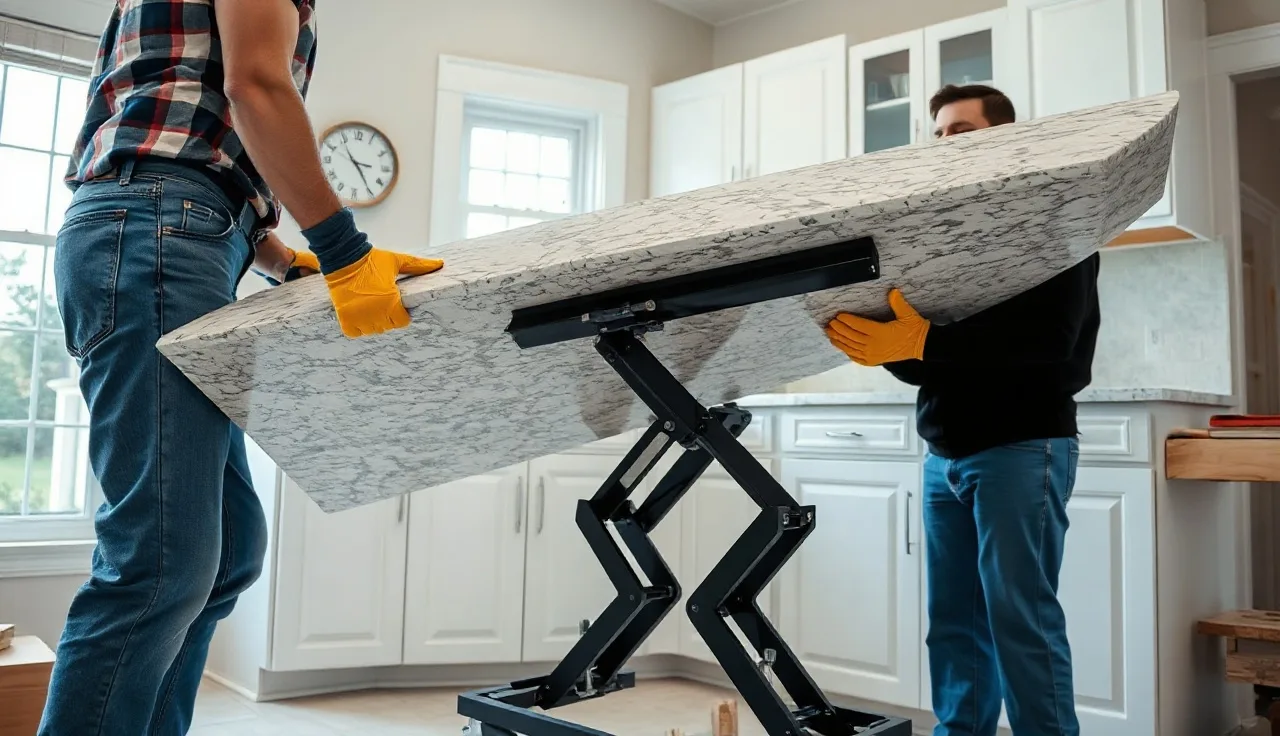
- Professional installers rely on vacuum lifting systems (60 to 800 lb capacity), A-frame slab carts for transport, panel carts or dollies inside the home, and suction cup hand lifters for two-person carries.
- The right tool depends on slab size, job-site access, and whether a crane or boom truck is needed for upper floors.
Why does stone countertop weight matter so much for installation?
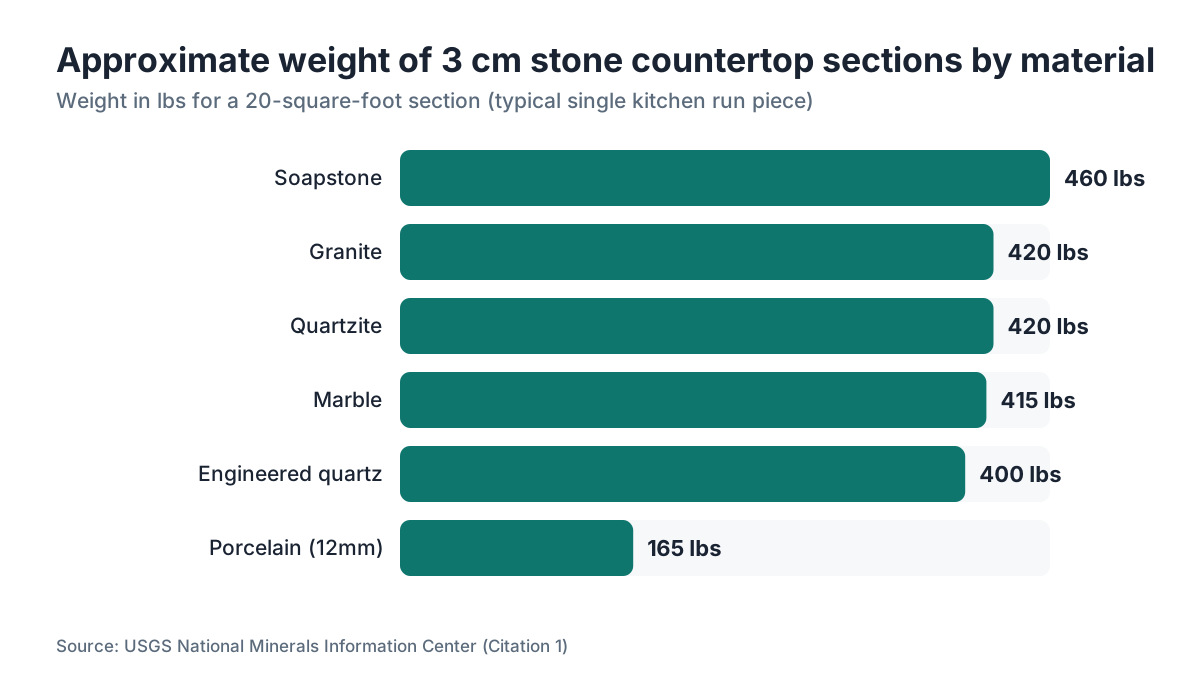
Stone is dense, and that single fact drives every equipment decision on the job. Granite, quartzite, and engineered quartz run roughly 13 to 20 lbs per square foot for a standard 3/4-inch (2 cm) slab, and 19 to 28 lbs per square foot for 1.25-inch (3 cm) material [1]. A single kitchen section covering 25 square feet of 3 cm granite can top 400 lbs before you add the sink cutout or any overhang.
That weight creates two problems that hurt people or wreck stone.
First, a falling slab can kill someone. The Occupational Safety and Health Administration (OSHA) general industry standard 29 CFR 1910.176 covers materials handling and storage and requires that loads be handled safely to prevent injury, which inspectors have applied directly to stone handling incidents [2]. Second, careless handling breaks the slab. Stone has high compressive strength but low tensile strength, so it cracks when flexed far more readily than when crushed. A piece bridged between two people's hands with no support in the middle fractures right through the sink cutout.
Neither problem is theoretical. Slab handling is one of the injury-heavy tasks in the whole trade. Getting the right equipment on site before the truck backs up is not optional for a professional shop.
What are the main categories of stone countertop lift equipment?
There are five broad categories installers work with, and a single job may pull from all five.
Vacuum lifting systems press suction cups against the face of the stone and use a manual hand-pump, battery, or pneumatic vacuum to generate holding force. They range from simple two-cup hand lifters rated at 60 to 150 lbs per cup up to powered gantry-mounted frames rated at 800 lbs or more [3]. The spec that matters is "safe working load" (SWL), which must always exceed the heaviest piece you plan to lift by a real margin. Most manufacturers recommend a 4:1 safety factor on vacuum pads, so a pad rated 200 lbs should not routinely hold more than 50 lbs in sustained overhead use.
A-frame slab carts are the upright steel frames, usually with rubber-padded arms, that hold slabs vertically during transport on the truck and while moving around a shop or driveway. Vertical is the strongest orientation for stone and the least prone to cracking. A loaded A-frame can weigh 500 to 1,200 lbs total and needs a flat, hard surface to roll safely.
Panel carts and dollies are lower-profile wheeled platforms for moving cut sections horizontally once they are inside a home. Rubber-wheeled panel carts protect finished floors and slip through doorways an A-frame never could.
Suction cup hand lifters are the two- or four-handle tools that two installers grip together to carry a section. They are not a substitute for mechanical lifting. Think of them as a last-step positioning tool for sections under about 150 lbs on flat surfaces.
Mechanical advantage equipment covers pry bars, pipe rollers, hydraulic furniture movers, and, for large whole-slab lifts, forklifts, telehandlers, or boom trucks. These show up on commercial jobs and on any job where a slab has to go up stairs or into a space a van cannot reach.
How heavy are granite, quartz, and marble countertops specifically?
Density varies by material, but the practical weight ranges installers plan around hold steady enough to drive equipment choices.
| Material | Density (lbs/ft³) | 2 cm slab (lbs/ft²) | 3 cm slab (lbs/ft²) |
|---|---|---|---|
| Granite | 160 to 175 | ~13 to 14 | ~19 to 21 |
| Engineered quartz | 155 to 165 | ~13 | ~19 to 20 |
| Marble | 155 to 170 | ~13 to 14 | ~19 to 21 |
| Quartzite | 160 to 175 | ~13 to 14 | ~19 to 21 |
| Soapstone | 170 to 185 | ~14 to 15 | ~21 to 23 |
| Porcelain (12mm) | 140 to 155 | ~7 to 8 | N/A |
Here's a real example. A standard 30-inch-deep kitchen run with 20 linear feet of 3 cm granite runs about 50 square feet, which is roughly 975 to 1,050 lbs of stone total. That gets cut into multiple sections for transport and installation (usually 2 to 4 pieces), each landing in the 200 to 400 lb range [1].
Weight per piece is what drives everything. A 150 lb section can be carried by two people with suction cup hand lifters on a flat surface. A 350 lb section needs a vacuum lifting frame or at minimum a mechanical carry board. Anything over 400 lbs as a single piece really wants a powered vacuum system or a forklift [3].
Granite and marble share nearly identical density ranges, so the same equipment plan works for both. See our guides to granite countertops and marble countertops for material-specific detail.
What vacuum lifter should a stone installer buy?
For most residential installers, one battery-powered lifter rated for your heaviest typical section, plus a set of suction cup hand tools for finish positioning, covers about 85% of jobs. The bigger, pricier gear earns its keep on high-volume production or steady commercial work. The market splits into three types, and each has a real use case.
Manual pump vacuum lifters (the "Grabo" style and simple suction cup bars) cost $80 to $600. They work on flat, polished stone up to about 150 lbs and are genuinely handy for the final-positioning step. Their weakness is porous or textured surfaces where they can't hold vacuum, plus operator fatigue on heavy pieces.
Battery-powered vacuum lifters are the current standard for most mid-size shops. Units from Wood's Powr-Grip, Anver, or Böcker run $800 to $3,500 and handle 300 to 600 lb sections reliably [3]. They include a vacuum gauge and an audible alarm that fires if vacuum drops below a safe threshold. That alarm is the single most important safety feature on the tool, and it has prevented a lot of injuries by warning an installer before the piece hits the floor.
Pneumatic vacuum frames connect to a shop compressor and live on fabrication shop cranes and gantries. They handle full slabs (400 to 700 lbs) and cycle fast in production. The catch is the air hose, which turns awkward on a job site.
Vacuum lifting beams are horizontal spreader bars with multiple pads, built so the load spreads across the slab face instead of loading one point. They are the right tool for large unsupported sections or anything with a big cutout (sinks, cooktops) where point-loading could crack the stone.
What equipment do you need to move stone from the truck into the house?
Getting stone from the delivery vehicle to the cabinet is its own logistics chain in three stages: unloading, transit through the home, and final placement. Each stage has its own tool and its own way to go wrong.
Unloading from the truck usually happens with the A-frame cart rolling down a ramp, or off a liftgate. Fabrication vans and flatbeds carry a folding aluminum ramp rated for 1,000 to 1,500 lbs. The slab rides the A-frame cart down the ramp, which two people can manage on a gentle grade. Steep driveways are where people get hurt. A liftgate skips the ramp entirely and is worth renting or requesting on steep sites.
Driveway-to-door transit means the A-frame cart pushed over pavement or compacted gravel. Grass, soft soil, and loose gravel are serious problems for wheeled carts under load. Some installers carry plywood sheets to lay a temporary hard surface. Over longer runs or in tight spots, pipe rollers under a flat carry board work, though slowly.
Through the home is where the A-frame gets parked. It's too tall for most interior doors and too wide for a galley kitchen. Cut sections move inside on a panel cart or in a two- to four-person carry with suction cup hand lifters. Hallways under 36 inches, sharp corners, and stairs are exactly the spots to pre-measure and pre-plan. A section that can't turn a corner flat may need to be tipped to near-vertical with suction cup hand lifters and walked through sideways [4].
For upper floors, some crews use a stair-climbing dolly, which "walks" a wheeled load up steps on rotating treads. It needs two operators and a rated capacity. Others just plan a four-person carry and eat the labor cost.
Do you need a forklift or crane for stone countertop installation?
For standard residential work, no. A forklift or crane is not part of a typical countertop install. The exceptions are worth knowing, though.
Whole-slab deliveries (where the full 400 to 700 lb uncut slab is moving to a shop or job site) typically use a forklift rated for at least 2,000 lbs with a stone-rated attachment, or a dedicated slab crane inside the shop. OSHA 29 CFR 1910.179 governs overhead and gantry cranes in general industry and applies directly to fabrication shop crane systems [10].
For residential installs on upper floors without elevator access, a boom truck or a rented electric material lift (people call them "Genie lifts" or scaffolding lifts) can raise pre-cut sections through a window or over a balcony. This is a specialty operation. The lift has to be rated for the load, the lift point has to be structurally sound, and the slab has to be rigged with straps rated for the weight. A 300 lb slab hanging from one strap with a bad knot is a genuinely dangerous situation.
Commercial work (reception desks, bar tops, full stone wall cladding) brings in scissor lifts, telehandlers, and vacuum-equipped boom attachments. That falls outside a standard residential countertop job, but it's worth knowing if your business does commercial.
What safety gear and PPE goes with stone countertop installation?
The stone is one hazard. Silica dust is the other documented one. OSHA's respirable crystalline silica standard, 29 CFR 1926.1153 for construction and 1910.1053 for general industry, requires engineering controls (wet cutting, local exhaust ventilation) and respiratory protection when exposures pass the action level of 25 micrograms per cubic meter [5]. Dry cutting or grinding stone indoors without controls blows past the permissible exposure limit fast.
For lifting and handling, the kit is short and specific.
Gloves with grip coating (cut-resistant nitrile or leather-palm) protect hands from stone edges sharp enough to lacerate. Plain knit gloves slip on polished stone and are worse than nothing.
Steel-toe boots are the baseline. A dropped section on a soft-shoed foot has a predictable outcome.
Eye protection matters during any dry cutting or grinding, and when setting sections near existing tile or fixtures that can chip.
Knee pads sound minor and aren't. Installers kneel constantly to scribe, shim, and check level, and long install days punish bare knees.
Back support does not replace proper technique or the right tool. If a piece takes two people muscling it into place and either one is straining, the answer is another set of hands or a lifter, not a brace.
The National Institute for Occupational Safety and Health (NIOSH) has published guidance on ergonomic hazards in stone countertop fabrication, naming slab handling among the highest-risk tasks in the industry for musculoskeletal disorders [6].
How do two-person installation crews manage heavy slabs without extra equipment?
Two-person crews clear a lot of residential jobs with a lighter kit than you'd guess, and they lean on technique to make up the difference.
The core move is cutting sections small enough that no single piece beats what two people can carry safely with suction hand lifters. Many experienced installers cap a two-person carry at 150 to 175 lbs, which at 3 cm granite means holding sections to about 8 to 9 square feet. That makes more seams, which some customers dislike. That's the honest tradeoff.
For slightly heavier pieces up to about 250 lbs, a two-person vacuum bar with one lifter on each end of a spreader beam works well. Each installer controls a handle, they move on a count, and the bar keeps the load level.
The move that hurts the most people is the "tip and slide," where one person tips a section off the cart while the other catches the free end. It works right up until a grip fails or the timing slips. A third person or a mechanical lifter is always safer over 150 lbs.
Run a two-person crew at high volume and a small battery vacuum lifter on a job-site stand pays for itself in avoided injuries and faster installs. NIOSH guidance on stone fabrication shops points to mechanizing the heaviest lifts as a way to cut injury rates against manual-only handling [6].
What does lift equipment actually cost, and should homeowners care?
Homeowners don't buy this gear. Fabricators and installers do. But homeowners have two solid reasons to care.
First, if your installer shows up without adequate handling equipment and your slab breaks on the way in, the question of who pays for the replacement (and the labor to redo it) gets messy fast. A cracked countertop on install day is more common than the trade likes to admit, and rough handling is a leading cause.
Second, if your job has access challenges (steep driveway, upper floor, narrow doorways, stairs), knowing what's needed lets you ask the right questions early. "How are you getting the stone to my second-floor kitchen?" is a fair question, and a good installer will have a real answer.
For fabricators pricing equipment, here's the lay of the land.
| Equipment | Typical Cost Range | Notes |
|---|---|---|
| Suction cup hand lifters (pair) | $80 to $300 | Entry level, 150 lb max |
| Battery vacuum lifter, 300 lb | $800 to $1,800 | Mid-range shop standard |
| Battery vacuum lifter, 600 lb | $2,500 to $4,500 | Heavy slab capability |
| Vacuum lifting beam | $1,500 to $6,000 | For large or cutout pieces |
| A-frame slab cart | $300 to $1,200 | Steel, rubber-padded |
| Panel/transport dolly | $200 to $800 | Interior use |
| Stair-climbing dolly | $400 to $1,500 | Specialty, rental available |
| Liftgate truck rental | $100 to $250/day | Eliminates ramp hazards |
Rental is a real option for specialty gear. Forklift rental runs $200 to $450 per day at national equipment rental chains, and plenty of stone shops rent for the occasional boom-truck job rather than buying [7].
What does a standard fabricator's install kit look like?
A well-equipped two- or three-person residential crew carries a predictable set of tools, and you can read a shop's seriousness off it.
The core kit: a battery-powered vacuum lifter (300 to 600 lb rated) as the main mechanical assist. An A-frame cart on the van for transport. Two or three sets of suction cup hand lifters in different configurations (two-cup flat, four-cup adjustable). A panel dolly or low-profile cart for interior moves. Wooden shims, a 4-foot level, and a long straightedge. Silicone guns, color-matched caulk, and 5-minute epoxy for seams. Folding aluminum ramps (typically 8 to 10 feet) for unloading. And a shop vacuum with a HEPA filter for dry dust cleanup, since the silica standard applies even on residential installs.
Past that core, experienced crews add specialty tools for what they see often. Stair jobs get the stair climber. Heavy high-rise condo work might justify a compact gantry or an electric material hoist that fits in an elevator.
Fabricators who quote and track jobs carefully can see which access challenges keep coming up and equip for them. Quoting software like SlabWise lets fabricators flag access conditions during estimating, so the right equipment gets assigned before the crew loads the truck.
For homeowners comparing bids, a fabricator who asks detailed questions about access, stairways, floor protection, and entry width is telling you how seriously they take the install. That attention to logistics is worth real money when a $4,000 slab is riding a cart down your driveway.
Are there weight limits for cabinet support that affect how you install stone?
Yes, and it comes up more on renovations than new construction. Standard base cabinets are typically rated for 100 to 150 lbs per linear foot of total load, but the real structural limit depends on cabinet construction, wall anchoring, and the floor beneath them [8].
Heavy stone on weak or poorly anchored cabinets can sag the whole run or, in bad cases, pull it off the wall. Most contractors and cabinet manufacturers want full-perimeter support for stone over 1.5-inch thickness, and no overhangs longer than 10 to 12 inches without a corbel or bracket underneath.
This ties back to lift equipment because when a section drops onto badly prepped cabinets, nobody may notice a problem until months later, when a seam opens or a cabinet door starts binding. Getting the stone safely to the cabinet is only half the job.
For ultra-heavy work like thick quartzite waterfall islands or extra-thick mitered edges (which roughly double the apparent thickness at the edge), check the cabinet framing and wall anchors before install day. The International Residential Code (IRC) Section R301 covers floor live load requirements, but cabinet-specific loading follows manufacturer specs rather than a single national standard [9].
What should homeowners do to prepare for a heavy stone countertop delivery?
You don't need to own or run any of this equipment. But a few prep steps make the installer's job safer and protect your house.
Clear the path completely. Move furniture out of the route from the entry point to the kitchen. Measure every doorway on the way, interior doors included. Standard interior doors run 30 to 32 inches wide, and countertop sections run 25 to 30 inches deep. A 3 cm section carried flat can just squeeze through a 30-inch door if both people angle it carefully. Find your bottleneck before delivery day, not during it.
Protect the floors. Installers should bring floor protection (cardboard, rosin paper, or plastic), but hard flooring in the path helps. Cart wheels and aluminum ramp feet mark soft wood floors if the crew isn't careful. A runner of rosin paper taped down ahead of time helps a lot.
Disconnect the sink plumbing and pull the old countertop before the crew arrives, or confirm in plain terms that both are in the installer's scope. A surprising share of install-day delay traces to an old countertop that was supposed to be gone.
For countertop installation questions beyond the heavy-lifting mechanics, walk the prep checklist with your fabricator well before the scheduled day.
Frequently asked questions
Can two people carry a granite countertop without mechanical lifters?
Yes, for sections under about 150 lbs on flat surfaces with suction cup hand lifters. At 3 cm thickness that's roughly 7 to 8 square feet of granite. Anything heavier than 150 lbs sharply raises injury risk in a two-person manual carry, especially on stairs or through narrow doorways. Most professional installers switch to a battery vacuum lifter or bring a third person for heavier sections.
What is a vacuum lifter and how does it work for stone?
A vacuum lifter uses suction cups pressed against the polished face of the stone. A pump pulls air from the cups, creating suction that holds the slab. Battery-powered models include a vacuum gauge and an alarm that sounds if suction drops below a safe threshold. They handle 150 to 600 lbs depending on the model and are the standard mechanical lifting tool for stone installation crews.
How do installers get heavy stone countertops to upper floors?
Options include a stair-climbing dolly (a wheeled tool with rotating treads, needs two operators), a four-person manual carry up the stairs, or an electric material lift through a window or balcony opening. For full slabs on commercial jobs, a boom truck with a vacuum lifting attachment is used. Stairs are the most common access challenge on residential work and should be flagged to the installer at quoting time.
Do installers need a forklift to deliver stone countertops?
Not for typical residential jobs. Residential countertop sections are pre-cut at the shop and weigh 100 to 400 lbs each, which a well-equipped two- or three-person crew handles with vacuum lifters and A-frame carts. Forklifts move full, uncut slabs (400 to 700 lbs) in fabrication shops and appear on commercial jobs with large one-piece runs. Residential installs rarely need them.
What is an A-frame slab cart used for?
An A-frame slab cart holds stone slabs vertically (on edge) during truck transport and while rolling them from the vehicle to the home entry. The vertical orientation is the strongest for stone and cuts cracking risk. A loaded A-frame can weigh 500 to 1,200 lbs total. Most fabricators own several, load them directly onto the van or flatbed, then wheel them down an aluminum ramp at the job site.
How do installers protect floors when moving heavy stone inside?
The standard approach is rosin paper or heavy cardboard laid along the travel path and taped at the seams. Low-profile rubber-wheeled panel carts stress floors less than cart wheels running straight on hardwood. For sensitive floors (old hardwood, luxury vinyl plank), some crews carry 1/4-inch plywood sheets to spread the load. Floor protection on hand is part of the standard install kit for professional crews.
What OSHA rules apply to stone countertop lifting?
OSHA 29 CFR 1910.176 covers materials handling and storage in general industry, requiring safe handling of loads. 29 CFR 1910.1053 (and 1926.1153 for construction) governs silica dust exposure during cutting and grinding. Fabrication shop overhead cranes fall under 29 CFR 1910.179. For residential installation, the general duty clause also applies when hazardous conditions are present. Installers who are employees, rather than the business owner, are covered.
How heavy is a full granite or quartz slab before cutting?
A standard full slab (roughly 55 to 65 square feet at 3 cm thickness) of granite weighs 800 to 1,200 lbs depending on density and exact dimensions. Engineered quartz slabs run slightly lighter but sit in the same range. These get handled with forklifts or gantry cranes in fabrication shops. Cut countertop sections delivered to a home are much lighter, typically 100 to 400 lbs each.
What is the safest way to carry a stone countertop through a narrow doorway?
Pre-measure and confirm the section fits with at least 1 to 2 inches of clearance. Sections are often tilted near-vertical and walked through sideways, with suction cup hand lifters giving both carriers a secure grip. A third person guiding the leading edge keeps it off the door casing. A section too wide when flat often clears the opening when stood on edge.
Are there weight limits for cabinets supporting stone countertops?
Standard base cabinets are typically rated for 100 to 150 lbs per linear foot, but real capacity depends on construction quality, wall anchoring, and floor support. Heavy stone like 3 cm granite or quartzite is generally fine on well-anchored stock cabinets for typical runs. Waterfall edges, mitered profiles, and extra-thick slabs add concentrated load that can require added bracket or corbel support, especially at overhangs past 10 to 12 inches.
Should I hire a fabricator who owns vacuum lifting equipment?
Yes, for any section over 150 lbs. A fabricator with only suction cup hand tools either cuts pieces very small (more seams) or takes on real injury and breakage risk on heavy sections. Ask directly what equipment they use for heavy sections and how they plan to reach your specific kitchen. A straightforward, detailed answer is a good sign. Vague reassurance that 'we handle it all the time' is not.
Can porcelain countertops be installed without heavy lift equipment?
Often, yes. Porcelain slabs in 6 to 12mm thickness run 7 to 9 lbs per square foot, roughly half the weight of 3 cm granite. A 25-square-foot section weighs 175 to 225 lbs, still heavy but more manageable. Porcelain also has different handling rules because it is brittle and can crack from point pressure. Vacuum lifters are still strongly recommended, but the load requirements are lower than for natural stone.
What should I tell my stone installer before delivery day?
Give them the exact path from the vehicle to the install location: entry point, every doorway width and height, number of stairs, floor type, and anything unusual like a tight corner or an elevator with a weight limit. Confirm who is removing the old countertop and disconnecting the plumbing. Installers who know the access conditions ahead of time bring the right equipment. Those who find surprises on delivery day improvise, and that's when breakage and injuries happen.
Sources
- USGS National Minerals Information Center, Dimension Stone: Granite density ranges 160 to 175 lbs per cubic foot; engineered quartz 155 to 165 lbs per cubic foot, yielding 19 to 21 lbs per square foot for 3 cm material.
- OSHA, 29 CFR 1910.176 Materials Handling and Storage: OSHA requires safe handling and storage of materials to prevent injury, applied to stone handling in general industry settings.
- Wood's Powr-Grip, Vacuum Lifting Equipment: Powered battery and pneumatic vacuum lifters for stone range from roughly 300 lb capacity up to gantry-mounted frames rated at 800 lbs or more.
- NIOSH, Stone, Sand, and Gravel Mining Safety and Health: Manual and near-vertical handling of large slabs through tight access points is a recognized handling hazard requiring planning and mechanical assist.
- OSHA, 29 CFR 1926.1153 Respirable Crystalline Silica Standard for Construction: The OSHA silica standard sets an action level of 25 micrograms per cubic meter (as an 8-hour TWA) and requires engineering controls and respiratory protection above the PEL of 50 micrograms per cubic meter.
- NIOSH, Silica and the Stone Countertop Fabrication Industry: NIOSH identifies slab handling as among the highest-risk tasks for musculoskeletal disorders in the stone countertop fabrication industry, recommending mechanization of the heaviest lifts.
- United Rentals, Equipment Rental Catalog: Forklift daily rental rates at national equipment rental chains typically run $200, $450 per day.
- Kitchen Cabinet Manufacturers Association (KCMA), ANSI/KCMA A161.1 Performance and Construction Standard: KCMA ANSI/KCMA A161.1 sets cabinet load performance standards; base cabinets are typically rated for 100 to 150 lbs per linear foot under standard construction and anchoring conditions.
- International Code Council, International Residential Code (IRC) Section R301: IRC R301 series governs floor live load requirements for residential construction; cabinet-specific loading is governed by manufacturer specifications rather than a single uniform national standard.
- OSHA, 29 CFR 1910.179 Overhead and Gantry Cranes: OSHA 29 CFR 1910.179 governs overhead and gantry cranes in general industry, directly applicable to fabrication shop slab-handling crane systems.
- OSHA, 29 CFR 1910.1053 Respirable Crystalline Silica Standard for General Industry: The general industry silica standard applies to stone fabrication shops and sets the same PEL and engineering control requirements as the construction standard.
Last updated 2026-07-10