TL;DR
- Most silicone caulk or adhesive used under stone countertops skins over in 30 to 60 minutes and reaches a usable cure in 24 hours, but full mechanical cure takes 24 to 72 hours depending on bead thickness, humidity, and the specific product.
- Don't stress the joint, run water, or put weight on undermount sink clips until the 24-hour mark at the earliest.
What is cure time for silicone, and why does it matter under stone?
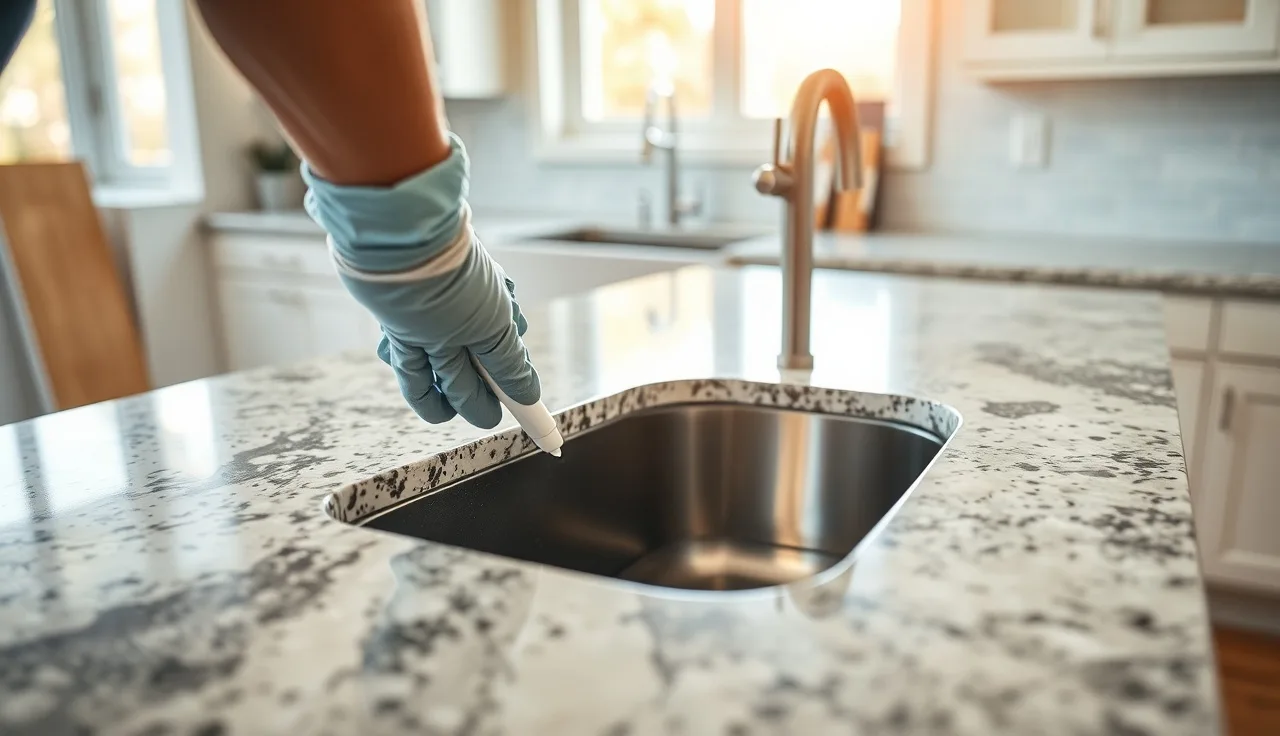
Silicone doesn't dry the way paint does. It cures, meaning atmospheric moisture triggers a chemical crosslinking reaction that turns the uncured gel into a solid elastomer. Under stone countertops that process matters a lot because you're often asking the silicone to do two jobs at once: adhesive and sealant. For undermount sinks especially, the silicone bead is frequently the only thing keeping water from migrating between the sink rim and the underside of the stone, and in some installations it carries a meaningful share of the sink's weight alongside mechanical clips.
Load a joint before the silicone has cured enough and you distort the bead, introduce voids, and build a path for water. That's how undermount sinks cause cabinet rot and eventual countertop failure. The cure timeline is more than a technicality.
Stone countertops, whether granite, marble, or engineered quartz like Cambria, are nonporous or very low porosity on their finished undersides. That actually slows silicone cure a little compared to porous substrates, because moisture can only diffuse in from the open bead face and the edges, not through the stone itself. Thick beads under a flat stone surface can take longer than the product label suggests.
How long does silicone take to cure under a stone countertop?
It depends on the product, bead geometry, and your shop conditions. Here are the real numbers that cover most installations.
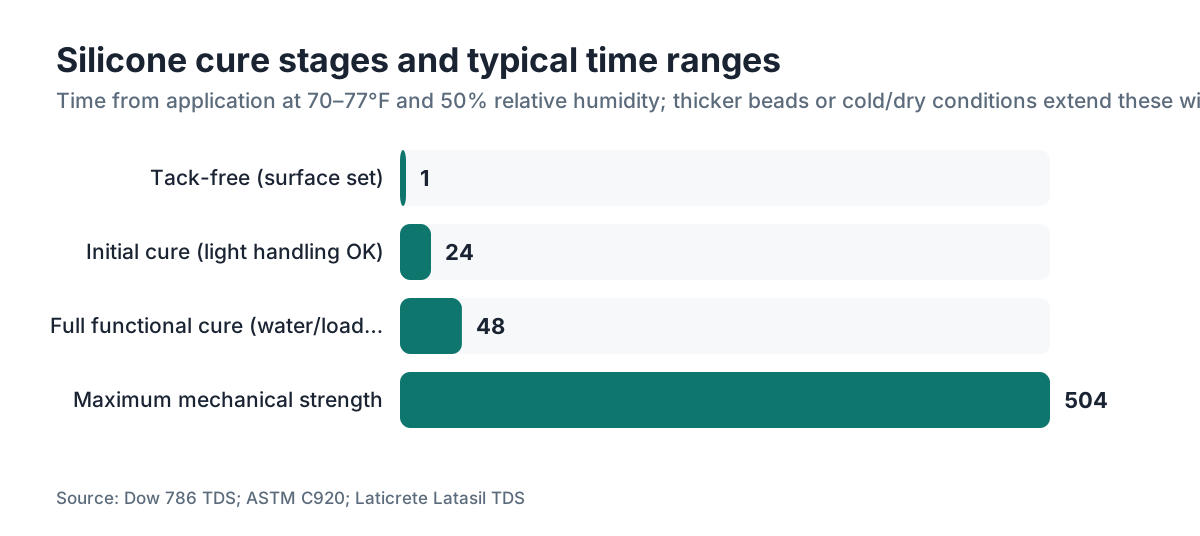
| Stage | Typical time range | What it means |
|---|---|---|
| Skin-over (surface tack-free) | 30 to 60 minutes | Surface is set; don't touch or disturb |
| Initial cure (light handling) | 12 to 24 hours | Can open clips, remove bracing |
| Full functional cure | 24 to 72 hours | Safe for water exposure, full load |
| Complete mechanical cure | Up to 21 days | Maximum bond strength reached |
Dow (formerly Dow Corning) publishes cure data for its 100% silicone product lines. Dow's 786 Silicone, a common choice for undermount sink work, lists a tack-free time of roughly 30 minutes at 77°F and 50% relative humidity, with full cure in 24 hours under those conditions [1]. Momentive's GE Advanced 100% silicone sealants show similar numbers: tack-free in under an hour, functional cure in 24 hours [2].
The 21-day figure for maximum mechanical strength traces back to ASTM C920, the standard specification for elastomeric joint sealants, which governs how silicones are tested and classified in construction applications [3]. Most fabricators and contractors don't wait 21 days, and you don't need to. The 24-hour functional cure is enough for normal kitchen use. Just don't run a full sink of water against that joint the night of installation.
For a countertop installation with an undermount sink, here's what I tell homeowners: don't use the sink for 24 hours, then use it normally. That's not overcautious. It's what the product data supports.
What factors speed up or slow down silicone curing under stone?
Temperature and humidity are the two big levers, and they cut both ways depending on where you start.
Silicone cures faster when there's more moisture in the air and when temperature sits in a moderate range, roughly 60°F to 90°F. Below 40°F, cure essentially stalls. The ASTM C920 standard requires cure testing at 73°F ± 4°F and 50% ± 5% relative humidity [3]. Real shops and real homes deviate from that constantly.
Bead thickness matters more than most people realize. A thin bead, say 3/16 inch, exposed on both sides cures much faster than a thick fill under a flat stone surface where the only moisture access is the perimeter of the bead. If a fabricator lays down a heavy application to bed a sink rail, the center of that bead could still be partially uncured at 24 hours. That's not a failure. It's physics.
Here's what affects cure time in practice:
- Cold weather installs (below 50°F): add 24 to 48 hours minimum, or warm the space before and after
- High humidity (above 70%): modestly faster cure, though too much surface moisture on the stone can reduce adhesion
- Thick beads or full fills: assume 48 to 72 hours for functional cure rather than 24
- Neutral-cure vs. acetoxy silicone: both cure by moisture, similar timelines, but acetoxy products release acetic acid (that vinegar smell) during cure which can slightly etch some stones [4]
- 100% silicone vs. siliconized latex (paintable caulk): don't confuse these. Siliconized latex is not appropriate for stone countertop installation. It doesn't have the same elongation, adhesion, or water resistance [5]
One practical point. If your shop or the customer's house is running air conditioning hard in summer, indoor humidity can drop well below 50%, which slows cure. If it's January and the house is heated to 72°F with no humidifier, same problem. In those conditions I'd plan for 48 hours before recommending water use.
What type of silicone is best for under stone countertops?
Use 100% silicone. Not siliconized acrylic, not latex caulk with silicone in the name. The product label needs to say "100% silicone." This matters for two reasons: adhesion to non-porous stone surfaces and long-term water resistance.
For undermount sinks, neutral-cure silicones are generally preferred over acetoxy-cure products when you're working with natural stone. Acetoxy products release acetic acid during cure. On polished granite or quartzite the effect is usually negligible, but on more reactive stones like marble or limestone there's a real chance of micro-etching if the joint gets filled against a fresh polished edge [4]. Neutral-cure silicones don't have this problem.
Color is a real decision too. Fabricators typically use clear, white, or a color-matched silicone depending on the stone and whether the joint will be visible. For undermount work the joint hides mostly under the sink rim, so clear is common and fine.
A few specific products fabricators actually use (not an exhaustive list, and product lines change, so verify current specs):
- Dow 786 Silicone: widely used in stone fabrication for undermount sinks, neutral-cure, 100% silicone [1]
- GE Supreme or GE Advanced 100% Silicone: widely available retail option, acetoxy cure, adequate for most granite work [2]
- Bostik and Mapei products get used in wet-area applications, but check the spec sheet for stone compatibility
For homeowners doing a small repair or re-caulking a visible joint, GE Supreme clear from a hardware store is perfectly fine. For a new installation with an undermount sink carrying 50-plus pounds of porcelain, let the fabricator spec the product.
When is it safe to use the sink after silicone is applied?
Twenty-four hours is the practical standard that matches most product data. That means no water in or around the sink for a full day after installation.
Specifically, don't:
- Fill the sink with water
- Run the dishwasher if it drains into that sink
- Use the garbage disposal (vibration stresses uncured bonds)
- Set heavy pots on the countertop directly over the adhesive zone
After 24 hours, normal use is fine for most products under normal cure conditions. If your installer applied silicone on a cold day in an unconditioned space, stretch that to 48 hours.
The undermount sink is the higher-stakes case because water intrusion at the sink-to-stone joint is one of the most common causes of cabinet damage in kitchens. Undermount sinks on stone countertops have shown up in insurance claims and product liability cases when the joint fails. The installation method matters. Mechanical clips are not optional on anything but the lightest sinks. Silicone alone is not rated to carry a full undermount sink's weight [6].
One thing worth knowing: the silicone at the sink perimeter does sealing duty forever, far longer than the cure window. Inspect it once a year and re-caulk if you see any separation or cracking. That maintenance conversation is separate from cure time, but they're related, because a joint that got stressed during cure is more likely to fail early.
Does silicone need to be applied differently for undermount vs. drop-in sinks?
Yes, and the cure implications differ too.
For an undermount sink, the silicone bead goes on the underside of the stone around the cutout perimeter, the sink rim seats against it, and mechanical clips pull the sink tight from below. The silicone needs to cure before the clips get over-tightened, and definitely before water is introduced. In this configuration the silicone sits under the stone and is largely inaccessible for inspection later.
For a drop-in (self-rimming) sink, the sink rim sits on top of the countertop. Silicone goes on the underside of the rim, the sink drops in, and a thin bead may run around the rim perimeter afterward. Cure considerations are basically the same, 24 hours before water use, but the geometry means the bead is thin and exposed on both sides, so it cures a bit faster.
For stone-to-cabinet or stone-to-wall applications (backsplash joints, or securing stone to cabinet rails), the silicone does adhesive work but not water-containment work. The same 24-hour minimum applies before putting any stress on the joint, but there's less consequence if the joint is a day slow to cure.
For butcher block countertops or laminate countertops, the substrate is porous or semi-porous, which speeds silicone cure at the interface a touch. The same product data applies, but you may see tack-free times closer to 20 minutes.
Can you speed up silicone cure time under stone countertops?
A little. You can't rush the chemistry dramatically without specialized products, but you can optimize conditions.
Legitimate ways to speed cure:
- Raise room temperature to 75 to 80°F (but don't aim a heat gun directly at the joint)
- Increase ventilation to keep fresh, slightly humid air moving over open bead surfaces
- Run a room humidifier to bring relative humidity to 50 to 60% in dry winter conditions
- Choose a fast-cure silicone product. Some manufacturers offer products rated for cure in 12 to 16 hours under stated conditions. Read the spec sheet, not the marketing language.
Things that don't reliably help:
- Hairdryers or heat lamps aimed at the joint can skin over the surface before the core cures, trapping uncured material inside
- Misting water on the joint can help in very dry conditions but can also introduce too much surface moisture, weakening adhesion at the stone interface
For fabricators running high-volume shops, the cure wait is a scheduling reality. A shop's job flow often accounts for this: undermount sink installs get scheduled so the homeowner has 24-plus hours before they'd want the sink anyway. SlabWise's job scheduling tools let shops flag hold times on installation tickets, which keeps crews from accidentally scheduling a follow-up visit (like a cleanup run) before the silicone is ready to disturb.
There's no honest substitute for time. Fast-cure silicones are real, but they trade some long-term flexibility for speed. For a permanent stone installation, I'd rather wait 24 hours with a standard product than rush with one I trust less.
What happens if silicone under a stone countertop doesn't cure properly?
A few failure modes, from cosmetic to genuinely costly.
If the silicone gets loaded before cure (sink filled with water at hour 4, for example), the bead can deform and pull away from either the stone or the sink rim. Once silicone fully cures in a deformed or gapped position, it stays there. You'd have to cut it out and redo the joint, which on an undermount sink means dropping the sink, cleaning off all the old silicone, and re-setting. That's a significant labor cost.
If the silicone never fully cured, which happens with a contaminated substrate (oil, silicone release, or dust on the stone underside at installation), you get adhesive failure. The bead peels away cleanly rather than tearing. That's a useful diagnostic tell: if old silicone peels off the stone in one piece, the surface probably wasn't clean at application.
Moisture intrusion through a failed undermount joint leads to cabinet swelling, mold, and eventually countertop movement. This is expensive. The National Kitchen and Bath Association's installation and warranty guidance identifies water damage at undermount sink joints as a leading source of warranty claims in the two years following installation [6].
For stone types sensitive to water, like natural stone with visible veining or fissures, an ongoing leak at the sink joint can also cause staining that won't clean off easily. Knowing how to clean stone countertops properly is good background, but it doesn't fix a structural moisture problem.
Does cure time differ for silicone used as a joint sealant vs. a structural adhesive?
The cure chemistry is the same regardless of the application role. But the consequences of early loading differ, which is why fabricators treat them differently in practice.
As a joint sealant (countertop-to-backsplash, countertop-to-wall), the silicone mostly keeps out water and debris. Early disturbance before cure might gap the joint cosmetically, but it rarely causes structural damage. Still, the same 24-hour standard is reasonable and costs you nothing.
As a structural element (undermount sink bond, stone-to-stone seam filler used alongside epoxy), cure time is load-bearing critical. ASTM C920 [3] classifies silicone sealants partly by their capability to handle movement under stress after cure. A silicone at hour 6 has nowhere near the elongation and tensile strength it'll have at 72 hours.
For full stone-to-stone structural seams, fabricators typically use two-part epoxy, not silicone. Silicone doesn't color-match well to polished stone seams, and its flexibility, while great for sink work, is a negative for a seam that should be rigid. Epoxy seams cure much faster (some in 15 to 30 minutes) and are sandable. Silicone has no role in structural seam work on most stone countertop installations.
For how to clean quartzite countertops or soapstone, the routine cleaning questions are separate, but both stone types still use silicone at sink joints, with the same cure times.
How do fabricators handle silicone cure time in their installation workflow?
The practical shop answer: build the wait into the schedule and tell the homeowner clearly before you leave.
Most fabricators set the stone, apply silicone at the sink cutout, install mechanical clips to the specified torque (finger-tight plus a partial turn, not gorilla-tight, since over-torquing a partially cured joint can deform it), then leave written instructions about the 24-hour hold. The verbal instruction almost never sticks. Written is better.
A few workflow specifics experienced shops have settled on:
- Apply the silicone bead, set the sink, let the bead compress to roughly 1/8 to 3/16 inch thickness. Thinner beads cure faster and hold better than oversized applications.
- Don't wipe or tool the bead on the inaccessible underside. A consistent application bead beats a disturbed one.
- If the install is in winter or a new construction space with no climate control, note it on the job ticket and extend the homeowner hold time.
- For kitchen countertops with multiple undermount sinks or complex layouts, the last silicone applied sets the clock for the whole project.
For fabrication shops tracking jobs and communicating cure hold times across multiple crews and customers, building it into the job documentation system makes a real difference. That's the kind of operational detail fabricator-focused software like SlabWise handles in the installation phase, where crews can log actual application time and flag holds. Homeowner guides built around these timelines funnel naturally to getting an accurate quote before the project even starts.
Are there any silicone products specifically rated or tested for stone countertop use?
Yes. A few manufacturers have products positioned or tested for stone countertop and tile installation. The distinction matters mostly for neutral-cure vs. acetoxy-cure and for adhesion to non-porous polished stone.
Dow 786 is the most commonly cited product in fabrication trade circles for undermount work. Mapei and Laticrete both make silicone products tested and marketed for stone and tile applications, with documentation to match. Laticrete's Latasil, for example, is a 100% silicone sealant with published technical data sheets covering temperature range, cure time, and substrate compatibility for natural stone [7].
For retail products, GE's Advanced Silicone 2 line includes formulations with published data on cure rates and a 10-year warranty claim against mold and mildew (a quality signal, though warranty marketing language should always be weighed against the underlying spec sheet). GE Advanced lists tack-free time of 30 minutes and full cure of 24 hours under standard conditions [2].
The key documents to ask for or look up for any product:
- Technical Data Sheet (TDS): gives cure times at specific temperature and humidity
- Safety Data Sheet (SDS): required by OSHA's Hazard Communication Standard (29 CFR 1910.1200) and tells you chemical content and ventilation requirements during application [8]
- ASTM C920 classification: tells you the sealant's movement capability and use classification
For homeowners: if your fabricator is using a product you haven't heard of, ask for the TDS. Any reputable product has one. If they can't produce it, that's worth a conversation.
Frequently asked questions
Can I use the sink the same day the countertop is installed?
No. Wait at least 24 hours after the silicone is applied before using the sink, running water, or using the garbage disposal. Most 100% silicone products reach functional cure in 24 hours at room temperature and moderate humidity. Using the sink earlier risks deforming the bead before it fully crosslinks, which can create gaps that let water into the cabinet below.
How long does silicone take to dry under a countertop?
Silicone doesn't dry, it cures via moisture absorption. The surface becomes tack-free in 30 to 60 minutes. Functional cure, meaning it can handle water and light stress, takes 24 hours under normal conditions (70°F, around 50% humidity). Full mechanical strength develops over 72 hours and keeps improving for up to 21 days, per ASTM C920 testing standards.
Does cold weather affect silicone cure time under stone?
Yes, significantly. Below 50°F, silicone cure slows to a crawl, and below 40°F it essentially stalls. If the installation space is cold, add at least 24 to 48 hours to the normal cure window. Warm the room to 65°F or above before installation if you can, and keep it warm through the first 24 hours. A cold garage or new construction without heat is the most common source of cure failures.
What's the difference between silicone cure time and dry time?
Drying is physical (solvent or water evaporation). Curing is chemical (crosslinking triggered by moisture in the air). Silicone has no solvent to evaporate, so it never dries in that sense. It cures. The surface can feel solid in an hour while the interior bead is still uncured gel. That's why bead thickness matters and why a tack-free surface doesn't mean the joint is ready for stress.
Is one type of silicone faster to cure than another for stone countertops?
Acetoxy-cure and neutral-cure silicones have similar overall cure timelines, typically 24 to 72 hours for functional cure. Some manufacturers offer fast-cure variants that reach functional cure in 12 to 16 hours. These are real products, but read the spec sheet carefully. Speed-optimized formulas sometimes sacrifice long-term flexibility. For permanent stone installations with undermount sinks, long-term durability matters more than saving a few hours.
How thick should the silicone bead be under a stone countertop?
Most fabricators aim for a compressed bead of 1/8 to 3/16 inch after the sink is set and clipped. Thinner beads cure faster and form a better seal than oversized applications. A bead that squeezes to more than 1/4 inch thick in the center takes longer to cure through and is more likely to have uncured gel at the core at the 24-hour mark. Consistency matters more than volume.
Can you apply silicone to wet or damp stone?
No. The stone underside must be clean, dry, and free of oils, old silicone residue, and dust for proper adhesion. A slightly humid room is fine and actually helps cure, but surface moisture on the stone at the bonding interface reduces adhesion. If old silicone was removed, clean the surface with isopropyl alcohol and let it fully evaporate before applying new product.
Why does my silicone smell like vinegar and does that affect cure time?
The vinegar smell is acetic acid, which acetoxy-cure silicones release during curing. This is normal and not a defect. The smell dissipates as cure completes, usually within 24 hours in a ventilated space. It doesn't meaningfully change the cure timeline, but it does mean the cure is still in progress. On reactive stones like marble, avoid acetoxy products near polished edges because the acid can cause slight etching.
How long before I can caulk over or paint over silicone under the countertop?
If you need to apply additional caulk or sealant over a silicone bead (for example, a cosmetic bead at the backsplash joint), wait a full 24 hours. Most latex or acrylic caulks don't adhere well to uncured silicone. Silicone-to-silicone layering is generally not recommended unless the base bead is fully cured. Paint does not adhere to 100% silicone at all, so painting over a silicone joint is never the right approach.
How do I know if the silicone under my countertop has failed?
Visible signs include a gap between the sink rim and the stone underside (look under the countertop with a flashlight), water stains or swelling on the cabinet face below the sink, or a sink that moves slightly when pressed. A failed joint can sometimes be re-caulked from above if there's access, but full repair usually means dropping the sink, cleaning the surfaces, and resetting it with new silicone.
Do I need silicone on every type of stone countertop for undermount sinks?
Yes, regardless of stone type. Granite, marble, quartzite, engineered quartz, soapstone, and every other stone type used for countertops need silicone at the undermount sink joint. The stone type affects which silicone formulation to choose (neutral-cure is safer for reactive stones like marble and limestone) but not whether silicone is needed. Mechanical clips alone are not sufficient; silicone provides the watertight seal and distributes load.
What is ASTM C920 and why does it matter for countertop silicone?
ASTM C920 is the Standard Specification for Elastomeric Joint Sealants published by ASTM International. It classifies sealants by movement capability, substrate compatibility, and use type. A silicone labeled as meeting ASTM C920 has been tested for adhesion, elongation, and durability under controlled conditions. For undermount sink applications it's the relevant quality benchmark, and it's the testing basis for the cure-time data published by major silicone manufacturers.
Can I use silicone caulk from a hardware store or do I need a professional product?
For a simple re-caulk of a visible joint or backsplash, a consumer 100% silicone from a hardware store is fine. GE Supreme or similar products work. For a new undermount sink installation, a fabricator-grade neutral-cure silicone like Dow 786 is a better choice because of its documented adhesion to non-porous stone and neutral cure chemistry. The price difference is small; the performance difference matters more on a permanent installation.
Sources
- Dow Inc., Dow 786 Silicone Technical Data Sheet: Dow 786 Silicone lists tack-free time of approximately 30 minutes at 77°F and 50% relative humidity, with full cure in approximately 24 hours under those conditions
- Momentive (GE Sealants), GE Advanced Silicone 2 product data: GE Advanced Silicone 2 lists tack-free time of 30 minutes and full cure of 24 hours under standard temperature and humidity conditions
- ASTM International, ASTM C920 Standard Specification for Elastomeric Joint Sealants: ASTM C920 requires cure testing at 73°F ± 4°F and 50% ± 5% relative humidity, and governs movement capability and classification of elastomeric sealants including silicone
- Natural Stone Institute (formerly Marble Institute of America), Technical Bulletins on stone installation: Acetoxy-cure silicones release acetic acid during cure, which can cause micro-etching on reactive natural stones such as marble and limestone at polished edges
- Natural Stone Institute, ANSI A108 Tile Installation Standards reference materials: Siliconized latex (paintable caulk) is not suitable for stone countertop installation applications due to inadequate elongation, adhesion, and water resistance compared to 100% silicone
- National Kitchen and Bath Association (NKBA), Installation and warranty practices guidance: Water damage at undermount sink joints is identified as a leading source of warranty claims in kitchen remodels in the two years following installation; mechanical clips are required alongside silicone
- Laticrete International, Latasil 100% Silicone Sealant Technical Data Sheet: Laticrete Latasil is a 100% silicone sealant with published technical data covering cure time, temperature range, and substrate compatibility for natural stone applications
- U.S. Occupational Safety and Health Administration (OSHA), Hazard Communication Standard 29 CFR 1910.1200: OSHA's Hazard Communication Standard (29 CFR 1910.1200) requires Safety Data Sheets for chemical products including silicone sealants, covering chemical content and ventilation requirements
- U.S. Environmental Protection Agency (EPA), Indoor Air Quality: Volatile Organic Compounds: Adequate ventilation is recommended during application of silicone sealants to manage VOC and acetic acid off-gassing in enclosed spaces
- ASTM International, ASTM C1382 Standard Test Method for Determining Tensile Adhesion Properties of Sealants When Used in Exterior Facades: ASTM test methods for sealant adhesion confirm that maximum tensile and adhesion strength in silicone products develops over an extended post-application period, up to 21 days
Last updated 2026-07-10