TL;DR
- A sink reveal is the strip of countertop material left visible between the sink rim and the edge of the cutout.
- Four main styles exist: overmount (positive reveal), undermount (negative reveal), flush, and zero reveal.
- The style itself rarely costs extra, but undermount cutouts, polished edges inside the cutout, and tight tolerances on zero-reveal work add $80, $200 or more to fabrication labor.
What exactly is a sink reveal?
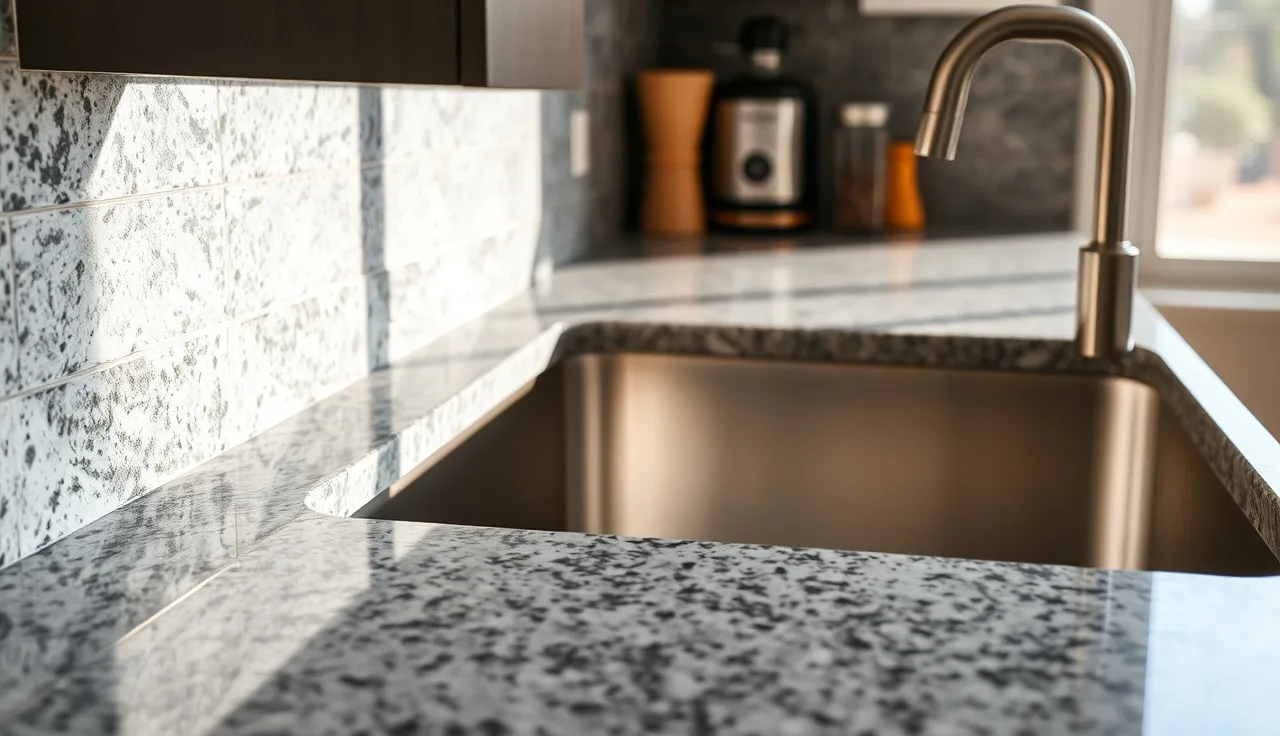
The reveal is the measurement, usually in fractions of an inch, between the inner edge of a sink rim and the edge of the stone cutout. It tells you how much countertop surface is visible around the sink once everything is installed.
Think of it this way. Drop a self-rimming kitchen sink into a hole in a slab and the sink's lip overlaps the stone by about 3/8 inch all the way around. That overlap is a positive reveal. Flip to an undermount configuration and the stone overhangs the sink basin by a similar amount, which is a negative reveal. The number seems trivial, but it controls water drainage, cleaning ease, aesthetics, and, critically for fabricators, how much labor and skill the cutout demands.
Reveal is separate from edge profile. Your edge profile (eased, bullnose, ogee, and so on) describes the vertical shape of the countertop's outer perimeter. Reveal describes what happens at the sink hole. A shop can combine any edge profile with any reveal style, though certain pairings look odd or create weak thin lips in the stone.
Homeowners rarely hear the word until they walk into a showroom or read a fabrication quote. At that point it pays to understand it, because the reveal choice is locked in once the template is drawn and the CNC file is cut. Changing it after fabrication means re-cutting the slab, which almost always means buying new stone.
What are the four main sink reveal types?
Fabricators and designers recognize four configurations. Each has real tradeoffs.
Positive reveal (overmount / drop-in sinks) The sink rim sits on top of the stone and the cutout is slightly smaller than the sink's outer edge. A lip of 1/8 to 3/8 inch of the sink rim overlaps the stone. This is the most forgiving cut because minor imperfections hide under the rim. It's the standard for drop-in stainless sinks and cast-iron farmhouse sinks with a separate apron front. The downside is a ledge where water and crumbs collect.
Negative reveal (undermount sinks) The stone overhangs the sink bowl by 1/8 to 3/16 inch. The cutout is slightly smaller than the sink's outer bowl dimension, leaving a narrow stone ledge visible from above. Counter wiping goes straight into the sink, which is why undermounts dominate in new kitchen remodels. The cutout edge must be polished because it's visible, and the tight tolerance on that overhang dimension is where fabrication skill and time go.
Flush reveal (zero overhang undermount) The stone's inner edge aligns exactly with the sink's inner bowl wall. No ledge in either direction. This requires the most precise templating and is unforgiving. A millimeter off and the joint looks sloppy. Some fabricators call this "zero reveal" though that term is used inconsistently in the industry.
Negative zero reveal The cutout is cut to the exact outer bowl dimension of the sink so the stone edge lines up with or is slightly inside the sink rim. This exposes the full sink opening with no overhang at all. Debris can fall into the gap if silicone fails. It's more common in commercial work than residential kitchens.
A few shops use a fifth category called "reveal reveal," which is just a marketing term for a very exaggerated negative reveal of 3/8 to 1/2 inch, creating a wide visible stone lip around the bowl. That's really just a large negative reveal by another name.
| Style | Stone visible at sink edge | Wipe-in drainage | Cutout edge polished? | Relative cost adder |
|---|---|---|---|---|
| Positive (drop-in) | Sink rim covers edge | No | Usually not | $0 |
| Negative (undermount) | 1/8 to 3/16" stone overhang | Yes | Yes | $80, $150 |
| Flush | None | Yes | Yes | $100, $200 |
| Zero / negative zero | Cutout equals bowl opening | Yes | Yes | $80, $150 |
How does sink reveal type affect countertop cost?
The reveal style itself is a design choice, not a line item. What drives cost is the work attached to that choice.
Positive reveal with a drop-in sink is the least expensive path. The cutout tolerances are loose, the edge inside the hole is hidden under the rim, and no polishing is required there. A basic drop-in cutout on a granite or quartz slab runs roughly $50, $80 at most shops for the cut itself, though that price varies widely by region and material thickness. [1]
Undermount cuts cost more for three reasons. First, the cutout edge is polished and visible, so the fabricator has to finish that inside edge to the same standard as the outer counter edge. On a 3cm granite slab that means running the polishing pads around the entire bowl perimeter, which is 5 to 10 minutes of hand work per sink. Second, the tolerances are tighter. A negative reveal of 3/16 inch requires holding that dimension consistently around a curved opening, which is where CNC templating pays for itself over hand-tracing. Third, undermount sinks make the stone carry the weight of the sink and any attached plumbing, so fabricators sometimes add epoxy reinforcement or a sub-mount bracket, adding materials and time. [2]
Flush reveal is the most labor-intensive option, no contest. The margin for error is essentially zero. Shops that do this well charge a premium, and some smaller shops decline the job or subcontract the template to a digital scanning service.
A realistic cost breakdown for a single undermount sink cutout on a 3cm natural stone slab in 2024 in the US looks like this:
- Basic cutout only: $50, $80
- Polished undermount edge: $40, $80 additional
- Mitered or radius corners (for tight rectangular undermounts): $30, $60 additional
- Total range for a finished undermount cutout: $100, $200+
These are typical shop-floor figures drawn from industry pricing surveys. Your region and shop will vary. [1] The sink cutout often appears as a flat fee on a quote rather than broken into sub-items, so ask your fabricator exactly what is included when you see "undermount cutout" on the estimate.
For homeowners comparing quotes, a lower headline price that doesn't specify undermount cutout finishing is a flag worth chasing down. Get the full scope in writing before you sign. Software like SlabWise builds these cutout specs into the quote template so fabricators itemize them clearly rather than bundling them into a vague "installation" line.
Does the countertop material change how sink reveal is done?
Yes, quite a bit. The material decides how tight a reveal you can safely hold and how much finishing labor the cutout edge demands.
Granite and quartzite are hard and chip-resistant on edges, making them good candidates for tight negative reveals. The inside cutout edge polishes well. Natural variation in grain means minor imperfections read as less obvious than on engineered surfaces. [3]
Quartz (engineered stone) has a consistent, mirror-like surface that shows any deviation in the reveal line immediately. Fabricators working with quartz tend to play it safe on flush reveals for that reason. The material cuts clean on CNC, but hand-finishing the inside edge takes care to avoid color inconsistency where the resin heats during polishing.
Marble and softer stones (like certain limestones) chip more easily on a tight inside corner. A negative reveal on marble with a rectangular sink needs carefully radiused corners, minimum 1/8 to 1/4 inch, to avoid stress cracks. See our guide to marble countertops for more on working with softer stones.
Laminate countertops (Formica and similar) almost always use positive reveals because the substrate exposed on a cutout edge looks bad and absorbs water. Some laminate tops use a PVC trim strip to cover the cutout edge, which mimics a flush look, but it is never as clean as stone. Check the laminate countertops and Formica countertops guides for how those surfaces handle sink cutouts.
Butcher block needs special attention at any cutout because exposed end grain absorbs water and can split over time. Undermount sinks on butcher block countertops require careful silicone sealing and often a slightly larger positive overhang to keep water away from the end grain.
Solid surface materials like Corian can be thermoformed, so they allow integrated sink bowls molded straight into the counter, where the reveal concept doesn't apply in the traditional sense. See Corian countertops for how that works.
What is the standard undermount sink reveal measurement?
The industry standard for undermount sinks is a negative reveal of 1/8 inch (about 3mm), meaning the stone overhangs the sink bowl by that amount all the way around. Some designers prefer 3/16 inch for a slightly more visible ledge. Going beyond 1/4 inch starts to look deliberate and heavy, which is sometimes the goal on thick 3cm mitered edge slabs.
The Kitchen Cabinet Manufacturers Association (KCMA) and the National Kitchen and Bath Association (NKBA) both publish installation guidelines that touch on undermount sink tolerances, though neither mandates a specific reveal dimension. The NKBA's kitchen planning guidelines address clearances and access requirements but leave reveal dimensions to fabricator and designer discretion. [4]
What matters in practice is consistency. A reveal that runs 3/32 inch on one side and 5/32 inch on the other looks like a mistake even though both measurements sit within the 1/8 inch nominal spec. CNC-cut templates hold tighter tolerances than hand-traced cuts, which is why digital templating has become standard in shops that do volume undermount work. [2]
For tight farmhouse sinks with a flat front, the reveal at the apron face is sometimes specified separately. On an apron-front sink the stone typically butts directly to the apron (zero or slightly negative reveal at the front) while the back and sides hold the standard 1/8 inch undermount reveal. This asymmetric setup adds to template complexity.
How does sink reveal affect the template and fabrication process?
The template is where reveal gets locked in. A digital template (laser or structured-light scanner) captures the actual sink dimensions and cabinet opening to about 1/32 inch, then the CAD file carries the specified reveal offset as a constant value around the cutout path. The CNC router cuts that path. What you see in the final slab is exactly what the file said. [2]
Hand-traced templates (the old foam or cardboard method) introduce more variability. A careful templater can hold 1/8 inch reveal consistently, but it takes deliberate scribing technique and good light. Shops doing high volumes of undermounts have largely moved to digital templating for this reason.
For fabricators, the reveal choice also affects how the cutout interacts with the sink clip locations. Undermount clips need the stone to extend past the sink rim by enough to catch the clip mechanism, typically 3/4 to 1 inch from the bowl wall. A very large positive reveal (1/2 inch) on an overmount sink puts the clips further out, which may or may not conflict with cabinet framing. These are the small decisions that show up at installation and bite shops that didn't think through the full chain from reveal to clip to cabinet. The countertop installation process depends on getting these measurements right before fabrication, not after.
Some fabricators build a "reveal check" step into their template workflow: they mark the sink cutout on the template, then hold the actual sink over the mark and measure the reveal at eight or twelve points around the perimeter before sending the file to the saw. This adds ten minutes per sink and prevents remakes.
Can you change the sink reveal after the countertop is installed?
Mostly no. Once the slab is fabricated and installed, the cutout dimension is fixed in stone. Literally.
You can go slightly larger, grinding or routing the inside edge outward a small amount, but this means removing the countertop, which risks cracking the slab during the lift. It's rarely worth attempting for a cosmetic reveal adjustment. And you absolutely cannot make the hole smaller without cutting a new slab.
What you can sometimes change without re-fabricating: switching from an undermount to a drop-in sink in the existing cutout. If the cutout was sized for a specific undermount bowl, a drop-in sink with a larger overall rim dimension will overlap the cutout and cover the polished inside edge. The reveal becomes positive by default and the old polished edge disappears under the rim. Plumbers and installers do this on occasion during a sink swap. The fit may not be perfect, but it works.
The practical lesson is to finalize your sink selection before templating. Fabricators will ask for the actual sink (or at minimum the manufacturer's cut sheet with exact bowl dimensions) before drawing the template. If you're still deciding between two sink models, get the cut sheets for both and have the fabricator design the cutout for the larger of the two. You preserve flexibility that way.
Does the reveal type affect how you clean and maintain the countertop?
Yes, and this is one of the most practical reasons homeowners end up caring about reveal after installation.
Positive reveal with a drop-in sink creates a narrow ledge between the sink rim and the stone. Water, soap, and crumbs collect there. The silicone caulk line sits in that groove and will eventually discolor or grow mold. Cleaning takes a brush or toothpick to get into the gap. Most plumbing and sanitation experts recommend inspecting and replacing that caulk line every two to three years. [5]
Negative (undermount) reveal gets rid of that ledge. Water wipes directly off the stone into the basin. The stone-to-sink joint sits under the counter where it's hidden, sealed with silicone from below. Cleaning the counter surface is genuinely faster, and food safety is better because there's no crevice for bacteria to colonize on the visible surface. [5]
Flush reveal cleans much like undermount, but the zero-overhang means nothing stops small debris from falling between the stone and the sink rim if the silicone seal ever fails. That gap is invisible from above, which is exactly the problem.
Regardless of reveal type, the silicone at the cutout should be a food-safe, mold-resistant, 100% silicone product. Check the product data sheet for NSF certification if you're particular about it. See also how to clean stone countertops for general maintenance guidance that applies around sink areas.
How do fabricators price undermount sink cutouts on a quote?
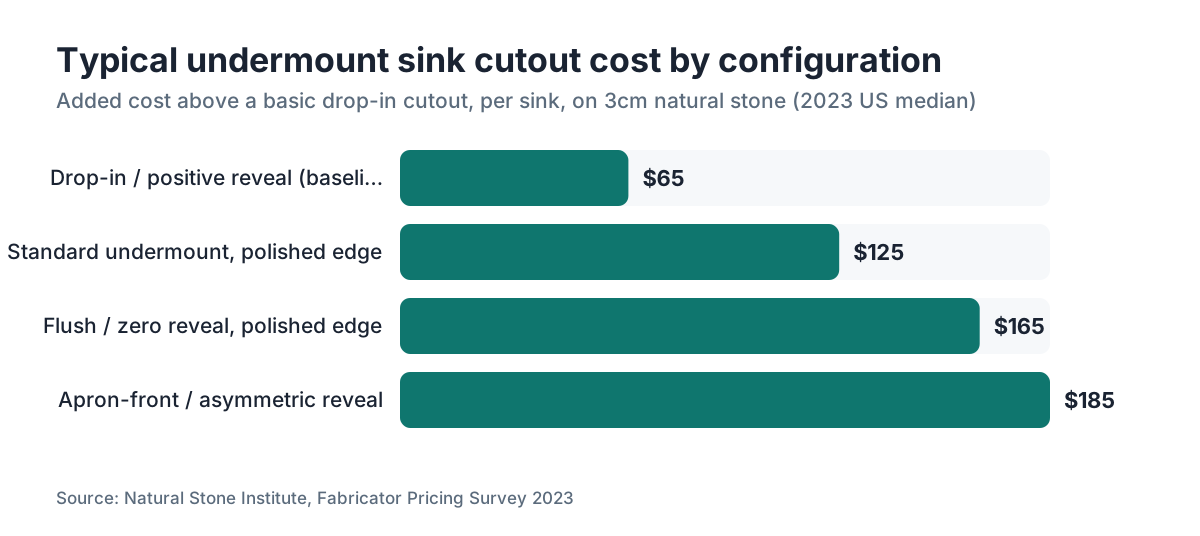
Cutout pricing varies more than almost any other line item in a stone quote. A 2023 survey by the Marble Institute of America (now the Natural Stone Institute) found that undermount sink cutout prices across North American fabricators ranged from under $50 to over $250 per cutout, with the median near $100 to $125 for a standard single-bowl undermount on 3cm stone. [1]
The variables that move the price:
- Material hardness (quartzite or hard granite costs more to cut and polish than softer limestone)
- Edge finish on the inside cutout edge (P3 or P4 polish adds labor)
- Corner radius (tight square corners take multiple tool passes and slow the process)
- Cutout complexity (apron front sinks, triple-bowl configurations, integrated drainboards)
- Template method (digital vs. hand-trace; digital may be a separate line item)
Some shops bundle the cutout into a per-square-foot slab price. Others charge it separately. When comparing quotes, ask flat out: "Does this price include the undermount cutout with a polished edge?" If the answer is no or vague, add $100 to $150 to the comparison number to make it apples-to-apples.
Fabricators using quoting software can attach cutout specs to a job automatically, which cuts down on missed line items. The best systems (including SlabWise's quoting module) let fabricators build reveal type into job templates so the labor cost follows the spec without manual entry.
What questions should homeowners ask their fabricator about sink reveal?
Most homeowners don't know to ask about reveal until they see unexpected charges or get a sink that looks slightly off. These five questions, asked before signing the contract, head off most of the common surprises.
-
"What reveal spec will you cut for my sink, and can I see it in writing on the work order?" The answer should include the dimension (e.g., 3/16" negative reveal) and the sink model and manufacturer cut sheet it's based on.
-
"Is the cutout edge polished, and is that included in the quoted price?" Some shops quote the raw cut and add polishing as an extra. Both are fine approaches, but you need to know.
-
"What is the minimum corner radius you'll cut for this sink and stone?" Relevant if you have a rectangular undermount. Tight corners on brittle stone crack. A shop that says "we can do sharp 90-degree inside corners" on marble or quartzite should explain how.
-
"Will you template with the actual sink or from a cut sheet?" Templating from the physical sink is more accurate. Cut sheets sometimes carry tolerances of plus or minus 1/16 inch that compound with fabrication tolerances.
-
"What happens if the reveal looks uneven on installation?" Know the shop's remake policy before, not after, you have a problem.
For more context on the full countertop process, the kitchen countertops guide covers scope from material selection through installation in one place.
Are there building codes or standards that govern sink reveal?
No federal building code specifies a sink reveal dimension. The International Residential Code (IRC) addresses plumbing rough-in, fixture clearances, and drain installation but does not regulate how much stone overhangs a sink bowl. [6]
The Americans with Disabilities Act (ADA) Accessibility Guidelines specify under-sink clearances for accessible kitchens and bathrooms, including knee clearance depth and counter height, but again do not specify reveal dimensions. The relevant section is ADA Standards for Accessible Design, Section 606 (Lavatories and Sinks), which requires a minimum 27-inch knee clearance height and specific reach range dimensions. [7] Reveal choices can affect counter thickness and edge profile near the sink, which do interact with ADA clearance math, but the reveal itself is not regulated.
NSF International publishes standards for commercial kitchen equipment and food-contact surfaces. NSF/ANSI 2 (Food Equipment) covers sinks used in commercial food service but applies to the sink itself, not the countertop cutout or reveal. [8]
The practical standard is craftsmanship expectation. The Natural Stone Institute publishes fabrication standards that include guidance on sink cutouts. Their Dimension Stone Design Manual addresses minimum edge widths, corner radii, and polishing grades, which are the closest thing to a formal standard for how sink reveals should be executed in natural stone. [9]
How does reveal choice differ for bathroom vanities versus kitchen sinks?
The same four reveal types apply in both settings, but the balance of choices shifts.
Bathroom vanity sinks split into two major categories: undermount bowls (same reveal logic as kitchen sinks) and vessel sinks, which sit entirely above the counter and need only a hole just large enough for the drain. Vessel sinks have no reveal in the traditional sense because the bowl doesn't touch the stone surface edge.
For undermount bathroom lavs, the reveal standard tracks kitchen work: 1/8 inch negative reveal is typical, but bathroom lavatories are often smaller and more curvaceous than kitchen sinks, so the inside cutout edge has more perimeter to polish and more curves to hold radius on. Labor per square inch actually runs higher on a small oval bathroom lav than on a large rectangular kitchen bowl.
Drop-in bathroom sinks stay common in secondary bathrooms and half baths. The same positive-reveal / crevice-cleaning tradeoffs apply.
One bathroom-specific consideration: vessel sinks on thin stone countertops (2cm slabs used in bathrooms) need a laminated edge at the drain hole to keep the drain collar from cracking thin stone when it tightens down. This is a fabrication detail your shop should flag if you specify a vessel on 2cm material.
Frequently asked questions
What is the standard sink reveal for undermount sinks?
The standard is 1/8 inch (about 3mm) negative reveal, meaning the stone overhangs the sink bowl by that amount around the entire perimeter. Some designers specify 3/16 inch for a more visible stone ledge. Going larger than 1/4 inch starts to look intentionally heavy. Consistency around the perimeter matters as much as the exact dimension.
How much does an undermount sink cutout add to countertop cost?
Expect $80 to $200 added over a basic drop-in cutout for a standard undermount with a polished inside edge on 3cm stone. The Natural Stone Institute's 2023 data found a median of $100 to $125 per cutout across North American shops. Complex shapes, tight corner radii, or hard exotics like quartzite push toward the top of that range.
Can I switch from a drop-in sink to an undermount without replacing the countertop?
Not cleanly. The cutout for a drop-in sink is sized to sit under the rim, while an undermount cutout needs to be sized to the bowl's outer dimension so the stone overhangs the bowl. These are different cuts. In some cases you can expand a drop-in cutout to accommodate an undermount, but that requires removing the top, re-cutting, and re-polishing the edge, which usually costs more than a new slab section.
What is the difference between a flush reveal and a zero reveal?
Flush reveal means the stone's inside edge aligns exactly with the sink's inner bowl wall. Zero reveal is used inconsistently, sometimes meaning the same thing, sometimes meaning the cutout matches the sink's outer bowl dimension so no stone at all overhangs the bowl. Ask your fabricator which definition they use and get the dimension in writing to avoid confusion.
Does reveal type affect how long the silicone seal lasts?
Reveal type affects where the silicone lives. Drop-in sinks have silicone on top, exposed to water and cleaning products, which typically degrades in two to three years and should be inspected annually. Undermount silicone is applied underneath, sheltered from direct exposure, and tends to last longer, though it's harder to inspect and re-seal without removing the sink.
Is a negative reveal or an undermount cutout harder to DIY?
Much harder. An undermount cutout requires holding tight tolerances around the bowl perimeter, polishing the inside edge to match the top surface finish, and templating from the actual sink or a precise cut sheet. Most experienced DIYers can manage a drop-in cutout with a jigsaw and router. Undermount work on natural stone or quartz is genuinely a shop job with professional equipment.
How does reveal affect granite versus quartz countertops?
Granite tolerates tight inside corners slightly better than most engineered quartz because natural variation in the grain hides minor inconsistencies. Quartz has a uniform surface that makes any deviation in the reveal line immediately visible. Fabricators often add a small additional charge for quartz undermounts to account for the extra care required on the inside polished edge.
What is a reveal on a farmhouse or apron-front sink?
Apron-front sinks have an exposed front panel that sits flush with or proud of the cabinet face. The reveal at the stone's back and sides follows standard undermount specs (typically 1/8 inch negative). At the front apron face, the stone usually butts directly to the apron or sits at zero reveal. This asymmetric spec adds template complexity and should be shown explicitly on the fabrication drawing.
Can you have different reveal measurements on the front, back, and sides of the same sink?
Yes, and this is actually common on non-rectangular sinks or farmhouse configurations. The front might be zero reveal where the apron face meets the stone, while the sides and back hold a standard 1/8 inch negative reveal. The reveal spec should be noted at each edge on the fabrication drawing, not assumed to be uniform around the perimeter.
Does reveal matter for vessel sinks?
No, in the traditional sense. A vessel sink sits entirely above the counter and only needs a drain hole through the stone, typically 1-3/8 to 1-3/4 inches in diameter. There's no bowl-to-stone edge relationship to specify. The relevant detail instead is hole diameter and whether the stone is thick enough at that location to support the drain fitting without a laminated edge build-up.
What is a reveal measurement on a quote and why does it matter?
Some fabrication quotes list the reveal spec (e.g., '3/16" undermount reveal, polished edge') as a line item or note. If your quote just says 'undermount cutout' with no reveal dimension, ask what they plan to cut. Without a spec on paper, you have no recourse if the result looks uneven. A documented reveal measurement is a simple quality control check that professional shops include as standard.
How does reveal interact with ADA sink clearance requirements?
ADA Standards Section 606 requires at least 27 inches of knee clearance below accessible sinks and specific reach range dimensions. Reveal itself doesn't change those clearances directly, but a very thick mitered edge built up at the cutout could reduce the knee clearance depth measured from the front of the counter. On ADA-compliant work, confirm the finished counter thickness at the sink edge as part of the clearance calculation.
Is a larger reveal (more stone visible) structurally stronger?
Not meaningfully. The structural concern at a sink cutout is the width of stone between the cutout edge and the counter edge, not the reveal dimension. As long as you maintain at least 1-1/2 to 2 inches of stone between the sink hole and the front edge of the counter (fabricators call this the 'deck width'), structural integrity is fine. A tiny or large reveal doesn't change that measurement.
Sources
- Natural Stone Institute (formerly Marble Institute of America), Fabricator Pricing Survey 2023: Undermount sink cutout prices across North American fabricators ranged from under $50 to over $250, with median near $100 to $125 for standard single-bowl undermount on 3cm stone.
- Natural Stone Institute, Dimension Stone Design Manual: CNC digital templating holds tighter tolerances than hand-traced templates for undermount sink cutouts; the manual covers minimum edge widths, corner radii, and polishing grades for sink cutouts in natural stone.
- Natural Stone Institute, Technical Bulletin: Fabrication of Granite: Granite and quartzite are suitable for tight negative reveals due to hardness and chip resistance on cut edges.
- National Kitchen and Bath Association (NKBA), Kitchen Planning Guidelines and Access Standards: NKBA kitchen planning guidelines address clearances and access requirements but leave sink reveal dimensions to fabricator and designer discretion.
- CDC, Handwashing and Food Safety: Sink Sanitation in Residential Kitchens: Crevices at sink rims and counter edges harbor bacteria; eliminating visible ledges at the sink joint reduces surfaces where food debris and microorganisms accumulate.
- International Code Council, International Residential Code (IRC) 2021, Chapter 27 Plumbing: The IRC governs plumbing rough-in and fixture clearances but does not specify countertop sink reveal dimensions.
- U.S. Access Board, ADA Standards for Accessible Design, Section 606 Lavatories and Sinks: ADA Section 606 requires a minimum 27-inch knee clearance height below accessible sinks and specific reach range dimensions; reveal dimensions are not specified.
- NSF International, NSF/ANSI 2 Food Equipment Standard: NSF/ANSI 2 covers food-contact surfaces in commercial kitchen sinks but applies to the sink fixture itself, not the countertop cutout or reveal.
- Natural Stone Institute, Dimension Stone Design Manual Vol. VIII: The Design Manual provides the closest thing to a formal industry standard for sink cutout execution in natural stone, including corner radii and polishing grades.
- NKBA, Bathroom Planning Guidelines and Access Standards: Bathroom lavatory undermount cutouts follow similar reveal conventions to kitchen sinks; vessel sinks require only a drain hole with no reveal specification.
- U.S. Department of Housing and Urban Development (HUD), Residential Remodeling Costs and Contractor Pricing Data: Regional variation in fabrication labor costs affects sink cutout pricing across the US market.
Last updated 2026-07-09