TL;DR
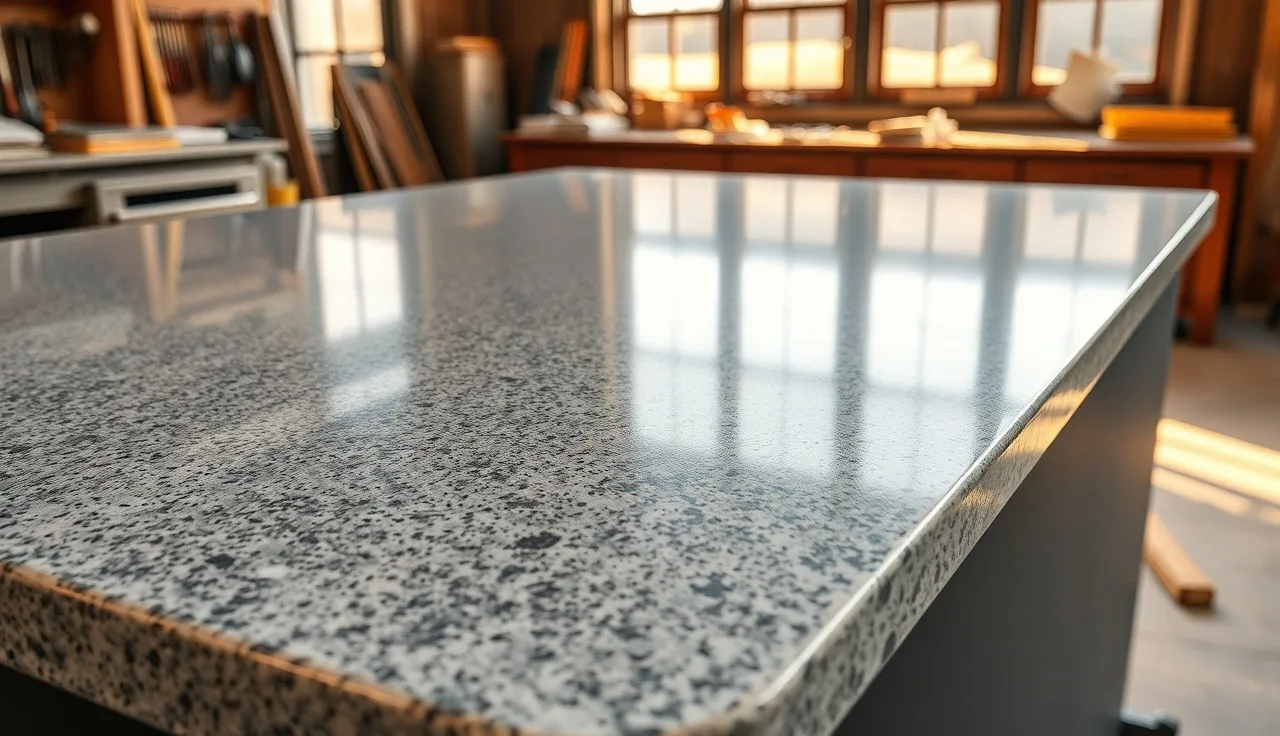
- A radius countertop is any countertop with a curved profile: a rounded corner, a swept curved front, or a full run of stone that follows a curved cabinet base.
- Fabrication adds $50 to $400 or more over a straight-cut job.
- The exact number turns on the radius size, the material, and how many curves you're asking for.
What exactly is a radius countertop?
A radius is a measured curve. In countertop work it means any piece of stone, quartz, laminate, or solid surface cut to follow a curved line instead of a straight one. That's the whole idea.
The curve shows up in a few spots. The most common is a rounded outside corner, where two runs of countertop meet and the stone sweeps in a smooth arc instead of ending in a sharp 90-degree point. You see it on kitchen islands constantly, because people brush past that corner all day. A tight arc of 1.5 to 2 inches is a small radius corner, and it barely reads as a curve until you run your hand over it. A 4 to 6 inch arc is obviously rounded and looks softer, more decorative.
The other common case is a curved run. The base cabinet itself curves, and the stone has to follow the shape. Curved islands, bow-front vanities, curved bar tops. All of these ask the fabricator to template the curve, cut it out of a slab, and eat more waste and machine time than any corner job.
One thing people mix up: 'radius' sometimes gets used for the edge profile. A bullnose edge is rounded in cross-section, but if the countertop run is still straight, most shops would not call that a radius job. True radius work means the plan-view shape of the stone is curved, meaning the outline curves when you look down at it from above.
What materials can be fabricated with a radius shape?
Almost anything can be cut to a radius. Some materials fight you more than others, and that shows up in the price.
Granite, quartzite, and marble all cut with a CNC waterjet or bridge saw, then get hand-polished along the curve. The stone doesn't care that the cut is curved. What costs money is that curved cuts leave oddly shaped offcuts nobody can reuse, so your effective material cost climbs. Granite countertops see the most radius work because granite is the highest-volume natural stone in most shops and fabricators have their CNC programs dialed in for it.
Engineered quartz like Cambria and Silestone cuts the same way as stone. Cambria countertops show up a lot on curved island tops because the color runs consistent, so the curved seam area doesn't look patchy the way some veined natural stone can.
Laminate and Formica countertops handle curves differently. Post-form laminate gets heat-formed over a mold, so gentle curves work but sharp ones don't. Custom laminate radius work usually means routing a substrate to shape and hand-wrapping the laminate, which can delaminate at tight curves. Most laminate fabricators hold a minimum radius around 6 to 8 inches for reliable results.
Corian countertops and other solid surface materials are the easiest to curve. You can thermoform the material with heat, bend a piece of Corian right around a curved cabinet, then sand and polish the seams until they disappear. That's why curved reception desks and hospital counters are almost always solid surface. [7]
Butcher block countertops cut to a radius on the same CNC gear, but the exposed end grain on a curved edge can look strange unless the finisher knows the material. Most butcher block radius work uses edge-grain panels instead of end grain for that reason.
Marble countertops need extra care on curves. The polished curved edge is all hand-finishing, and marble is soft enough to show grind marks if the tech rushes. Budget an extra 20 to 30 percent over granite pricing for polished marble radius edges.
How do fabricators cut and finish a radius countertop?
Two methods do most of the work: a CNC waterjet or bridge saw driven by a digital template, and hand-templating with a router jig for shops without full CNC. The digital route is more accurate and now the norm in busy shops.
The modern process starts with a template. The fabricator traces the curved cabinet or the shape the customer wants, using a laser templating device or a physical template board, then pulls that file into CAD/CAM software. The software nests the curved piece onto the slab to cut waste, then sends the file to the CNC bridge saw or waterjet. The waterjet cuts the curve in one pass with no chipping. The bridge saw takes several passes and usually leaves a rougher edge that needs more hand-polishing.
Then comes the edge. A curved edge can't run through a straight edge-polishing machine, so the fabricator works it with angle grinders and polishing pads, stepping through progressively finer grits from around 50 up to 3000 or higher for a mirror finish. This hand-work is the whole reason radius jobs cost more. A skilled finisher might spend 30 to 90 minutes on a single curved corner or edge run, against a couple of minutes for a straight run through the automatic edge machine.
Inside curves are harder still. Inside corners concentrate stress in natural stone and can crack if the radius is too tight. Most fabricators hold a minimum inside radius of 3/16 to 1/4 inch for granite to prevent cracking, and some refuse inside curves on marble entirely because of the breakage risk. [6]
Shops running countertop quoting and nesting software can generate the curved cut path automatically and lay out the slab to trim waste. That matters on expensive stone, where a sloppy nest can cost hundreds of dollars in material you throw away.
What does a radius countertop cost to fabricate?
Here's the answer homeowners actually want, and the honest version is that it swings a lot by shop, region, and the specifics of the curve. What follows is what real shops typically charge on top of the base countertop price.
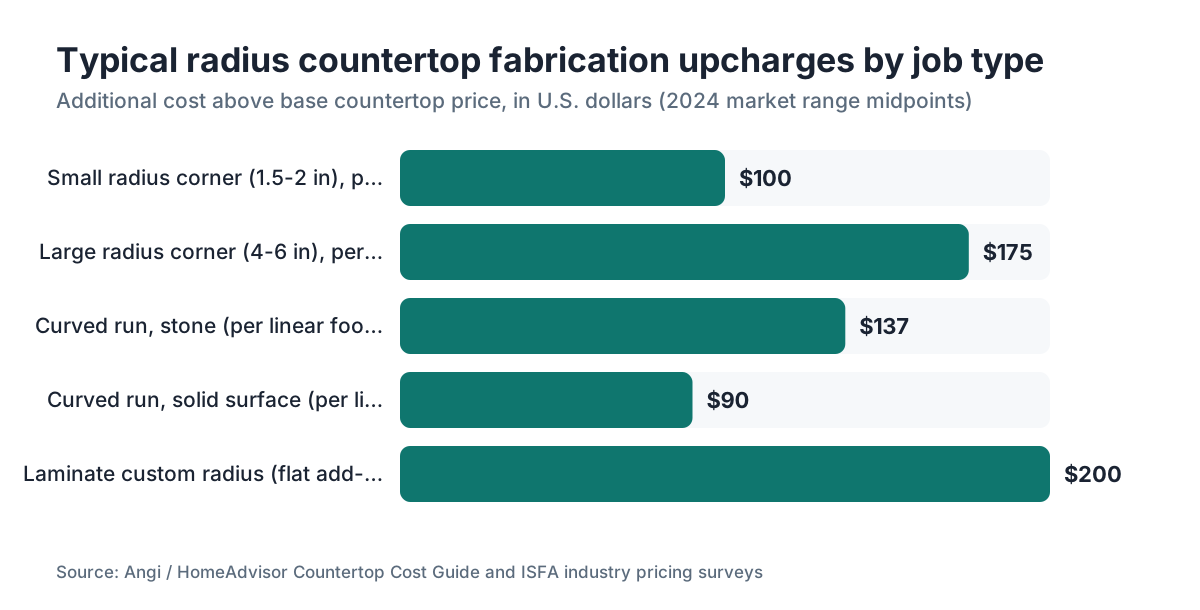
A simple rounded outside corner of 1.5 to 3 inches on a granite or quartz island is the most common request. Most shops charge $50 to $150 per corner over the base price. Some throw in one small radius corner free as a safety feature and charge for the rest.
A larger radius corner of 4 to 6 inches has more curved edge to hand-polish, so it usually runs $100 to $250 per corner.
A full curved run, where the entire front edge of an island or bar top follows an arc, gets priced by the linear foot of curved edge. Expect $75 to $200 per linear foot of curve on stone, above material and base fabrication. A 4-foot curved island front might add $300 to $800 to the job.
Solid surface curved runs can cost less per linear foot for gentle thermoformed curves, because there's little hand-polishing, but the setup and mold work for a custom curve can add a flat $200 to $500. Laminate radius work for a gently curved counter runs $100 to $300 extra depending on complexity, and tight curves often aren't feasible at all.
These are fabrication upcharges only. They sit on top of the base material price per square foot, the standard edge profile charge, the template fee, and the install charge. A full curved island in granite might land at $3,000 to $8,000 installed depending on island size, stone cost, and local labor. [1]
Geography moves the number hard. Shops in high cost-of-living metros charge 20 to 40 percent more than rural shops for the same work. Get at least three quotes on any curved project.
How does radius fabrication affect material waste and slab cost?
Most homeowners never think about this, and fabricators think about it every day. Cut a curve out of a rectangular slab and the offcuts come out oddly shaped. A rectangular offcut can get sold or used on another job. A curved offcut almost always hits the dumpster.
On a typical straight island top, a skilled fabricator nests the pieces with 15 to 25 percent waste. Add a large radius corner or a curved front and that piece can jump to 30 to 40 percent waste, depending on how the curve falls across the slab. [2]
Run the math. At $80 per square foot for a premium quartzite, with a finished piece of 15 square feet, going from 20 to 35 percent waste burns an extra 2-plus square feet, roughly $160 in stone you never use. That cost usually hides inside the upcharge the fabricator quotes, but not always. Some shops bill complex curved pieces as time and materials instead of a fixed upcharge, so ask how they handle it before you sign.
One practical point. If you're picking an expensive, heavily veined stone for a curved island, confirm the slab is big enough to nest the curved piece AND hold the vein direction you want. Sometimes you have to step up to a larger slab or accept a less ideal vein run. Either one changes the cost or the look.
What is the difference between a radius corner and a radius edge profile?
People confuse these two constantly, and mixing them up gets you a quote that doesn't cover what you actually want.
A radius corner is the shape of the countertop in plan view. Look down at the counter from above and the corner is curved instead of pointed. That's a cutting and finishing operation.
A radius edge profile is the cross-section of the edge. A bullnose edge is a rounded profile. An ogee has an S-curve. An eased edge is a slight softening of the top corner. Any of these profiles can go on a straight run or a curved run.
You can have a sharp 90-degree corner in plan view with a fully rounded bullnose profile. You can also have a curved corner in plan view with a flat pencil edge. They're independent choices, and the price for each is separate.
So be specific when you ask for a quote. Say something like: 'I want a 3-inch radius on the outside corner of the island, and a standard eased edge profile on all exposed edges.' That gets you the right work and the right number.
Where are radius countertops most commonly used?
Kitchen islands lead by a wide margin. A rounded island corner cuts the risk of hip and shoulder injuries from squeezing past a sharp stone corner, which is a real problem in a busy kitchen. The National Kitchen and Bath Association's planning guidelines recommend 42 to 48 inches of clearance around work areas, and rounded corners help when the clearance is tight. [3]
Bar tops and pub-height counters often get radius corners or fully curved fronts, both for looks and to let barstools pull up at an angle. A curved bar front seats more people than a straight run of the same length, which is why restaurant designers reach for them.
Bathroom vanities with curved fronts, the bow-front style, use radius countertops to match the cabinet shape. These show up in primary baths and powder rooms where a softer, furniture-like look is the goal. Marble countertops and white quartz are the popular picks for curved vanity tops.
Laundry rooms and mudrooms sometimes get curved corners on the folding counter. Less common, but handy in tight spaces.
Commercial work leans on radius fabrication heavily. Reception desks, nurses stations, and concierge counters almost always use curves, usually in solid surface or quartz, because the curve is the design.
How long does it take to fabricate a radius countertop compared to a straight job?
For a simple rounded outside corner on an otherwise standard stone project, plan on 30 to 90 extra minutes of hand-polishing, plus maybe 15 to 30 minutes of extra CNC programming if the shop doesn't already have that radius size on file. Most shops keep radius corner templates in their CNC library, so the real added time is mostly hand finishing.
A fully curved run is a bigger lift. A fabricator might spend an extra 2 to 4 hours on that single piece versus a straight piece of the same length: more template time, more careful CNC programming to dodge chipping at the curve, and longer edge polishing. At shop labor rates of $75 to $150 per hour for skilled stone finishing, that's $150 to $600 in extra labor alone. That's where the upcharge comes from. Federal wage data helps set a floor here; the Bureau of Labor Statistics tracks median pay for stone cutters and carvers, which shops build on with overhead and margin. [4]
Install runs longer too. Curved pieces are heavier per usable area (you cut them from a bigger billet), harder to work through doorways, and slower to set because the curve has to line up with the curved cabinet base. Budget an extra 30 to 60 minutes of install, which at installer rates of $75 to $125 per hour adds $50 to $125.
Lead time usually holds if the shop has open CNC capacity. If the shop is slammed, any custom or radius job can push your slot back a week.
What questions should you ask a fabricator before ordering a radius countertop?
The right questions save money and kill surprises. Here's what actually matters.
Ask whether the upcharge is per corner, per linear foot of curved edge, or a flat add-on per piece. Shops price this differently, and the structure tells you whether a second radius corner doubles the cost or comes in cheaper than the first.
Ask the minimum and maximum radius they can cut reliably in your material. A tight 1-inch radius on dark granite is doable. A 1-inch inside radius on marble is a breakage risk. Get their real constraints, not the answer they think you want.
Ask whether they use a digital template or a physical one for curved work. Digital templating is more accurate and cuts the odds of a curved piece showing up that doesn't fit the curved cabinet.
Ask how they finish the curved edge. A hand-polished curve should match the sheen of the machine-polished straight edges. Ask to see a sample or a photo of past work.
If you're using a heavily veined stone, ask how the curve hits the vein direction at the corner. Sometimes the vein runs into the curve in a way that looks off, and the shop should flag it before cutting, not after.
Ask what happens if the curved piece arrives and doesn't fit, cracks in fabrication, or the finish doesn't match. Stone fabrication has real failure modes. Know the shop's make-good policy before you hand over a deposit. Countertop installation problems from a curved piece not fitting the cabinet base are genuinely painful to fix after the fact.
Is a radius countertop worth the extra cost?
For most island corners, yes, and it's not close. The safety case is strong on its own. A sharp 90-degree stone corner at hip height in a busy kitchen is a real hazard, and $100 to $150 to round it off is cheap insurance. Kids and older adults get hurt on sharp corners most, and the Consumer Product Safety Commission tracks corner and edge impacts in its home injury surveillance data. [5]
For decorative curved fronts on islands or vanities, the value rides on how much the look matters to you and whether the cabinet already curves. Add a curved front to a straight cabinet run purely for style and you pay twice: for the curved countertop AND probably a curved cabinet front. The combined cost climbs fast. If the cabinet already curves and you're just matching it in stone, the upcharge is reasonable and the result looks intentional.
Radius work is hardest to justify on laminate in a budget remodel. The material savings from laminate vanish once you add $200 to $400 for custom radius fabrication. At that point you're often better off with a standard post-form laminate that already carries a gentle front radius. Laminate countertops in post-form profiles come with a built-in front edge radius and coved backsplash as standard, no upcharge.
For a fabricator, radius jobs carry higher margin per hour than straight work when priced right, but also higher breakage risk and longer cycle times. Shops that track true cost per job, including polishing time and material waste, usually find flat upcharge pricing undersells complex radius work. Time-and-materials pricing on curved runs is more accurate, just harder to sell to a homeowner who wants one firm number.
If you run a shop and want to price curved work faster without building a custom spreadsheet for every job, quoting tools built for stone fabrication, like the one at SlabWise, help you account for waste and hand-finishing time.
How do you care for and clean a radius countertop?
Care is the same as any countertop in the same material. The curve doesn't change the maintenance. What changes is that the curved edge collects crumbs and moisture at the bottom, where it meets the cabinet face, more than a square corner where the gap is small and defined. Keep that spot dry.
For stone radius counters, seal the curved edge the same as the field surface. Edges lose their sealer first because they take the most handling and cleaning contact. Check the curved edge during your annual sealer test: drop a little water on the edge and watch it. If it soaks in within about 4 minutes, reseal. [10]
For general cleaning of stone, see our guides on how to clean stone countertops and, for a specific material, how to clean quartzite countertops. The curved shape needs no special cleaner or trick. Just make sure your cloth reaches the transition point at the bottom of the curved edge where it meets the cabinet.
Frequently asked questions
What is the minimum radius size a fabricator can cut in granite?
For outside corners in granite, most shops cut a radius as small as 1 inch reliably with CNC equipment. Inside corners are tighter constrained because a small curve concentrates stress and can crack. A minimum inside radius of 3/16 to 1/4 inch is typical for granite. Marble and other softer stones need a larger minimum, usually 1/2 inch or more on inside corners, to avoid breaking during the cut.
Does a radius countertop cost more to install than a straight one?
Usually yes, by a modest amount. Curved pieces are harder to maneuver and need more careful alignment during install, especially against a curved cabinet base. Most installers add 30 to 60 minutes for curved pieces, which at typical rates of $75 to $125 per hour adds $50 to $125 to the install bill. Some shops fold this into a flat project charge instead of breaking it out.
Can you add a radius to an existing straight countertop after installation?
Not really. The radius gets cut from the slab before installation. You can't retroactively curve a corner on an installed stone countertop in any practical way. If you have a sharp corner and want it rounded, the fabricator has to cut and set a new piece. A small chip on a sharp corner can sometimes be eased slightly with hand tools, but a true radius corner takes re-fabrication.
What is the difference between a radius countertop and a waterfall countertop?
Completely different details. A radius countertop has a curve in its plan-view shape, so the outline of the stone curves when you look down at it. A waterfall countertop has a vertical panel of stone that drops from the surface straight to the floor, matching the thickness and material of the top. Waterfall edges work on straight or curved counters. A curved island can carry both a radius corner and a waterfall edge on the same piece.
How much extra stone material does a radius project use?
It depends on the radius size and how the curved piece nests on the slab. A small 2-inch corner radius wastes very little. A large curved run, like a 24-inch radius front edge on an island, can add 15 to 20 percent more waste than a straight cut of the same finished square footage, because curved offcuts are hard to reuse. On expensive stone at $80 to $120 per square foot, that extra waste is a real number to account for.
Can laminate countertops be made with a radius shape?
Yes, with limits. Post-form laminate heat-forms over gentle curves with a minimum radius around 6 to 8 inches, depending on the laminate thickness and substrate. Tighter curves risk cracking or delamination. Custom radius laminate work is possible but adds $100 to $300 and needs a skilled fabricator. For very gentle curves, post-form laminate is cost-effective. For tight or complex curves, solid surface materials are more practical.
Does quartz or granite hold up better on radius edges over time?
Both hold up well under normal use. The edge finish can show wear before the field surface does, because edges take more contact. Quartz tends to keep its polished finish slightly longer than granite on edges because it's non-porous and needs no sealing. Granite edges should be resealed annually as routine maintenance. Neither material is meaningfully better or worse for curved edges specifically; the durability gap between them at a curve is the same as anywhere else.
What is a full radius versus a partial radius on a countertop corner?
A full radius sweeps a full quarter circle, so a 3-inch full radius corner looks like the corner of a circle with a 3-inch radius. A partial radius is a shallower curve that cuts off less of the corner, giving a softer look than square without the full arc. Fabricators can cut any arc between these extremes with the right template, but most shops use standard 1.5-inch, 3-inch, and 6-inch sizes to keep programming and pricing simple.
Are radius countertops standard in new construction or are they custom?
Radius corners on islands are common enough in new construction that many fabricators treat a 1.5-inch to 2-inch safety radius as a default option with a small upcharge, close to a standard feature. Fully curved runs that match a curved cabinet base are always custom work. Builder-grade construction usually uses square corners to hold down cost, so any radius past the smallest safety chamfer is typically an upgrade the homeowner asks for.
How do I describe what I want to a fabricator so I get an accurate quote?
Be specific about three things: the location of the curve (which corner, which edge run), the radius size in inches (or describe it as small, medium, or large with a reference photo), and whether the curve is in plan view or just the edge profile. Give them the material and finish. If a curved cabinet is already in place, say so and hand over the dimensions. A sketch or photo beats any description.
What causes a radius countertop to crack at the curved section?
Three main causes: the radius is too tight for the material (stress concentrates at the curve), the piece got mishandled during transport or install, or there's a pre-existing fissure the fabricator missed. Inside radius corners are the highest-risk spot because they concentrate stress. Proper templating, a minimum radius suited to the material, and careful handling during delivery all cut the cracking risk hard.
How do fabricators price radius countertop work, and why does it vary so much?
Fabricators use three main approaches: a flat upcharge per curved corner, a linear-foot rate for curved edge runs, or time and materials. The spread across shops comes from differences in labor rates, CNC capability (older equipment means more hand-finishing time), local material costs, and how each shop chooses to package the work. Getting three quotes and asking each one to break out the radius upcharge separately is the only reliable way to compare.
Sources
- HomeAdvisor (Angi) - Countertop Installation Cost Guide: Granite countertop installation costs typically range from $2,000 to $8,000 for a kitchen project depending on size and complexity
- Natural Stone Institute - Fabrication and Installation Standards: Curved and non-rectangular pieces increase material waste compared to standard rectangular cuts
- National Kitchen and Bath Association - NKBA Kitchen Planning Guidelines: NKBA planning guidelines recommend 42 to 48 inches of clearance in kitchen work areas
- Bureau of Labor Statistics - Occupational Employment and Wage Statistics, Stone Cutters and Carvers: Median hourly wage for stone cutters and carvers in the U.S. provides a baseline for estimating shop labor rates
- U.S. Consumer Product Safety Commission - Home Safety Data: Kitchen injuries including impacts with countertop corners are tracked in CPSC home injury surveillance data
- Marble Institute of America (now Natural Stone Institute) - Stone Fabrication Technical Manual: Minimum inside radius recommendations for natural stone to prevent cracking during fabrication
- International Surface Fabricators Association (ISFA) - Solid Surface Fabrication Standards: Solid surface materials can be thermoformed for curved fabrication, with processing guidelines for minimum bend radii
- National Institute of Standards and Technology (NIST) - Manufacturing Extension Partnership: NIST MEP data on small fabrication shop operations and productivity benchmarks
- Marble Institute of America / Natural Stone Institute - Countertop Sealing Recommendations: Stone countertop edges should be sealed as part of routine annual maintenance, as edges experience higher wear than field surfaces
Last updated 2026-07-11