TL;DR
- A 10-foot quartz countertop costs roughly $830 to $2,700 installed, depending on slab grade, edge profile, cutouts, and your region.
- Material alone runs $20 to $100 per square foot.
- Installed, quartz averages $55 to $155 per square foot.
- Budget engineered quartz starts near $40 per square foot installed.
- Premium brands like Cambria can top $130 per square foot installed.
What does a 10-foot quartz countertop actually cost?
A 10-foot quartz countertop costs about $830 to $2,700 installed. A standard 25-inch-deep run gives you roughly 20.8 square feet of surface. At a mid-range installed price of $75 per square foot, that lands at $1,560. Go budget, around $40 per square foot, and you're near $830. Go premium, $130 or more per square foot, and you can push past $2,700 once you add an edge upgrade and a sink cutout.
Those are the real numbers, not showroom softballs.
Here's the catch nobody mentions upfront. Most fabricators bill a minimum slab charge, usually 25 to 35 square feet, so a single 10-foot section almost always hits that floor. You may pay for 25 to 30 square feet even when your counter is smaller than that.
The ranges here pull from home-improvement cost surveys and fabricator price sheets. Nobody has perfectly consistent data on this. Regional labor, local markup, and where the material ships from all move the number in ways no single average captures. The figures below reflect 2025 to 2026 pricing from homeowner-reported data aggregated by Angi and cross-checked against NKBA published benchmarks. [1][2]
What is the cost per square foot for quartz countertops?
Quartz costs $20 to $100 per square foot for material only and $55 to $155 per square foot installed. The gap between those two numbers is fabrication and installation labor, which adds $25 to $55 per square foot.
Material only is the slab price from a fabricator or warehouse. A basic white engineered quartz from a domestic warehouse might run $22 to $35 per square foot. A Calacatta-style quartz from a high-end brand sits at $55 to $90 per square foot in material cost. [3]
Installed pricing folds in cutting, polishing, edge work, and the install crew. Here's the quick-reference breakdown:
| Grade | Material only | Installed cost/sq ft | 10-ft run installed |
|---|---|---|---|
| Budget (basic solids, domestic) | $20, $35 | $40, $60 | $830, $1,250 |
| Mid-range (veined patterns, major brands) | $35, $65 | $65, $100 | $1,350, $2,080 |
| Premium (designer brands, thick slabs) | $65, $100 | $100, $155 | $2,080, $3,225 |
These installed figures assume a straight countertop with one eased edge, one sink cutout, and no seams. Every add-on moves your total. [1][2]
Installed quartz in 2026 runs roughly 8 to 12 percent higher than 2023 pricing, and most of that increase is labor rate growth in metro markets, not material cost.
How does quartz compare to granite countertop cost?
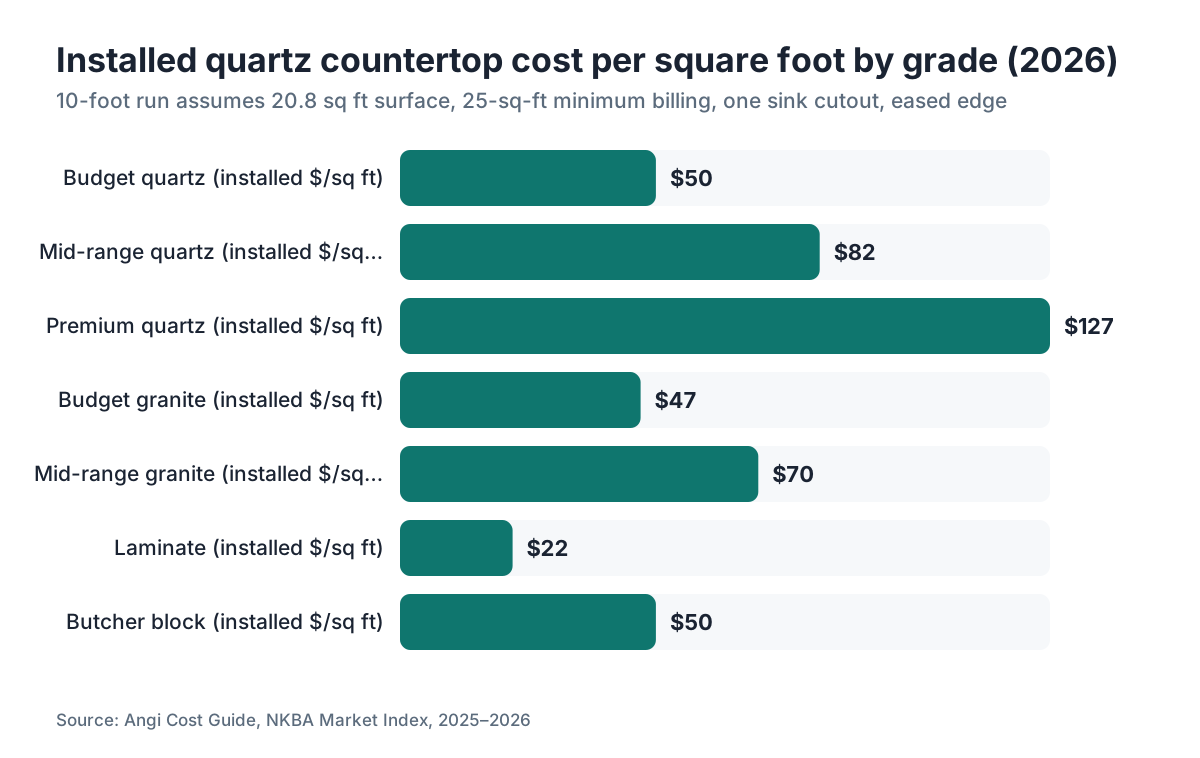
Quartz and granite cost about the same across most of the market. Installed granite runs $40 to $140 per square foot, which overlaps almost entirely with quartz. [4] The claim that quartz always costs more than granite is wrong. It depends on the tier.
Mid-grade granite sits around $60 to $80 per square foot installed. Budget granite (Level 1 or remnant slabs) comes in at $40 to $55 per square foot installed. Exotic granites like Blue Bahia or Lemurian Blue can push $120 to $200 per square foot installed. [4][5]
Granite is cheaper than quartz only at the very bottom of the market, because low-grade granite slabs cost less than engineered quartz equivalents. In the mid-range, $60 to $100 per square foot, the two materials cost about the same once labor is priced in.
A Level 2 granite and a mid-range quartz from a brand like MSI or Silestone will quote within $5 to $15 per square foot of each other at most fabricators. If you want the full cost breakdown on the stone side, read our granite countertops guide.
| Material | Installed cost range/sq ft | Notes |
|---|---|---|
| Quartz (budget) | $40, $60 | Engineered, non-porous |
| Quartz (mid) | $65, $100 | Most common kitchen choice |
| Quartz (premium) | $100, $155+ | Cambria, designer lines |
| Granite (budget) | $40, $55 | Level 1, limited patterns |
| Granite (mid) | $60, $90 | Most common granite install |
| Granite (premium) | $100, $200+ | Exotic origins, rare patterns |
| Laminate | $15, $30 | Laminate countertops |
| Butcher block | $35, $65 | Butcher block countertops |
What factors drive the price of a 10-foot quartz countertop up or down?
The installed price is never one number. It's five or six numbers stacked on top of each other. Here's what actually moves it.
Slab grade and brand. The biggest variable. A no-name engineered quartz from a big-box store costs half what a Cambria or Silestone premium line costs. Cambria countertops sit at the top of the range because Cambria manufactures in the US and controls its distribution tightly. Generic overseas quartz sits at the bottom.
Thickness. Standard used to be 3/4 inch (2 cm). Most residential installs now use 1.25 inch (3 cm), which drops the need for a laminated edge buildup and adds $5 to $15 per square foot. If your quote says 2 cm and you want the thicker look, ask.
Edge profile. An eased edge (a softened square) is usually in the base quote. Bullnose, ogee, and waterfall edges add $10 to $30 per linear foot. On a 10-foot counter with two exposed edges, an upgraded profile might add $200 to $600.
Cutouts. A standard undermount sink cutout runs $75 to $200 per opening. A cooktop cutout is similar. Faucet holes cost $20 to $60 each.
Seams. A 10-foot run usually needs no seam if the slab is large enough. But an L-shaped kitchen joining a 10-foot section to another run will need one, and seams add $50 to $150 each for the extra labor.
Backsplash. A 4-inch quartz backsplash adds linear footage and material cost. A full-height slab backsplash can add 30 to 50 percent to the total job.
Region. Labor rates in San Francisco or New York run 40 to 60 percent higher than rural Midwest markets. Material prices shift less, but still swing 10 to 20 percent depending on how close you sit to a distributor. [1]
How do fabricators calculate the price of your countertop?
Fabricators price by the square foot of material, not the running foot, because square footage drives their slab cost and cutting time.
Here's the math on your 10-foot counter. At 25 inches deep, that's 25/12 x 10 = 20.83 square feet of finished surface. The fabricator adds a waste factor, usually 15 to 25 percent for a simple straight run and higher for complex shapes or bookmatched patterns. That brings gross material to roughly 24 to 26 square feet. If the shop's minimum billing is 25 square feet, you hit the floor and pay for 25 square feet no matter what.
Then fabrication labor (edge polishing, cutouts, drilling) gets added as a per-linear-foot or flat-fee line. Installation is usually a flat trip charge plus a per-square-foot rate, and some shops bundle everything into one installed price.
Get a quote that shows the breakdown. An itemized quote with material, fabrication, edge profile, cutouts, and install labeled separately is far easier to compare against a second shop than an all-in number. Shops that run dedicated quartz quoting software, like SlabWise, tend to produce itemized quotes automatically, which makes apples-to-apples comparison possible.
Ask every fabricator three questions before you sign: What is your minimum square footage charge? Is 3 cm included? What does the edge upgrade cost? Those answers reveal most of the pricing variables.
Does quartz cost more to install than other countertop materials?
No. Quartz installation labor runs $10 to $30 per square foot, the same as granite. Both materials are heavy (3 cm quartz weighs 18 to 20 pounds per square foot) [6] and need professional handling and adhesive setting. You save nothing on installation by switching between stone materials at similar grades.
Laminate installs for $5 to $12 per square foot because it's light and needs no stone-handling gear. Formica countertops and Corian countertops also carry lower install labor than stone. If raw install cost is your main concern, those materials win on labor every time.
Quartz has one install edge over natural stone. It's engineered to a uniform thickness and flatness, so templating and fitting run slightly more predictable. Granite carries natural variation that can mean more shimming and adjustment time. A good fabricator already accounts for this, and your quote should reflect it.
For a full rundown of every material and its installed cost, see the kitchen countertops guide.
What are the hidden costs in a quartz countertop project?
The quote covers the countertop. The work around it can surprise you.
Tearout and haul-away. Removing your existing countertop runs $50 to $200, depending on material and who does it. Some shops include it. Most don't.
Plumbing reconnect. After an undermount sink goes in, a plumber reconnects the supply lines and drain. Budget $100 to $250 for that visit if they're not already on-site.
Cabinet leveling. Quartz needs a level substrate. If your cabinets have settled unevenly, shims and leveling add time and sometimes a separate carpenter visit. Not every install hits this. Older homes often do.
Support structures. Overhangs past 8 to 12 inches (the exact spec varies by fabricator) need corbels or steel brackets. A 16-inch breakfast bar overhang on an island needs brackets, at $30 to $150 each plus install.
Permits. Most jurisdictions don't require a permit for a countertop swap. But once the work ties into plumbing or electrical changes in a larger remodel, permit costs and inspection timelines enter the picture. Check your local building department. [7]
Sealer. Quartz is non-porous and never needs sealing, which is one real advantage over granite. That's a hidden cost you can cross off entirely.
How do quartz brands differ in price and is the premium worth it?
There are four rough tiers of quartz brands, and where you land in them matters more than any other decision in the project.
Big-box private label and generic imports (Home Depot's Stonemark, Lowe's Allen + Roth, unnamed imports): $20 to $40 per square foot material. Functional, often attractive, limited warranties. Quality control varies more than branded options.
Mid-tier branded quartz (MSI Q, Cosentino Silestone, Vicostone): $35 to $65 per square foot material. Consistent QC, deep selection, warranties covering manufacturing defects for 10 to 15 years.
Premium engineered quartz (Cambria, Caesarstone, Vadara): $65 to $100 per square foot material. Cambria is made in the US and warrants to the original purchaser for life. [8] Caesarstone is Israeli-made with decades of history. These brands command a premium and mostly earn it on consistency and warranty terms.
Ultra-premium and designer lines (top collections from any of the above, plus boutique brands): $90 to $130+ per square foot material. For clients who want a specific look and will pay for it.
My honest take: for most kitchens, a mid-tier brand is the right call. In a rental or a first home, the difference between a Silestone and a Cambria is invisible to 95 percent of buyers and renters. For a forever-home kitchen where you cook daily and care about the look 15 years out, the Cambria lifetime warranty is worth real money. But paying $130 per square foot when a $65 option looks nearly identical is just spending money.
How does quartz hold up over time and does that affect long-term cost?
Quartz is harder to damage than most people assume and easier to damage than the marketing implies. Rated 7 on the Mohs hardness scale, it shrugs off most kitchen knives and utensils without a scratch. [6]
The good side: no sealing ever, scratch resistance that beats most natural stone in daily use, and stain resistance from the resin binder.
The bad side: heat is the real enemy. Quartz carries 7 to 10 percent resin by weight, and that resin can crack or discolor from direct heat above 300 degrees Fahrenheit. Set a hot pan straight on quartz and you void most warranties and risk irreversible thermal shock. Granite handles heat far better. Always use trivets.
Repairs are possible but pricey. A stone restoration pro can fill a chip or crack with color-matched epoxy for $150 to $400 per repair. A full section replacement means re-fabricating and re-installing that piece, which approaches the original installed cost per square foot.
Long-term durability is genuinely good. A well-maintained quartz counter in normal residential use lasts 25 years or more without major trouble. The resin can yellow slightly under prolonged UV, so quartz near a skylight or in an outdoor kitchen (constant sun) can fade over the years. Most brands now use UV-stabilized resins, but read the warranty before installing in a sunroom. [9]
For care of stone surfaces, see how to clean stone countertops.
How can you get an accurate quote for your 10-foot quartz countertop?
Get three quotes minimum. This isn't overcaution. Stone fabrication is a local business, and pricing swings hard even inside one city. Two fabricators quoting the same slab and same edge profile can differ by 20 to 35 percent on the installed total.
Before you call anyone, measure your counter runs yourself. Write down length and depth for each section, count your cutouts (sink, cooktop), count your exposed edges, and decide whether you want a backsplash. You'll get faster, tighter quotes walking in with specifics instead of saying "a standard kitchen."
When quotes come back, ask for line-item breakdowns. You want material, fabrication, edge profile, cutouts, and installation each on their own line. A single all-in number works as a sanity check but fails at comparison shopping.
Shops running digital quoting tools (SlabWise is one built for stone fabricators) generate itemized quotes faster and with less room for error, which means fewer surprises on install day. If a shop can't hand you a written itemized quote, treat that as a yellow flag.
Ask about lead times too. Through late 2025 and into 2026, many shops are running 3 to 6 week lead times for templating and install. If you have a hard deadline (a closing date, a renovation finish), confirm availability before you pick a shop on price alone. [10]
Is a 10-foot quartz countertop worth the cost compared to alternatives?
Quartz hits a sweet spot most alternatives miss. It outlasts laminate and butcher block in a wet kitchen, needs none of the sealing that granite and marble demand, and costs less over a 20-year horizon than swapping out cheaper surfaces twice.
Laminate and Formica countertops run $400 to $600 for a 10-foot section installed, so the savings over entry-level quartz are real, roughly $400 to $800. On a tight budget or a short-term rental refresh, laminate is a legitimate choice.
Marble countertops cost about the same as quartz in material price and look beautiful, but they need sealing every 1 to 3 years, etch from acids like lemon juice and vinegar, and scratch more easily. In a heavy-use kitchen, marble is more maintenance at similar cost. Quartz is the better bet for most families.
Butcher block lands at $35 to $65 per square foot installed and works well for islands or prep zones. It needs oiling and eventual refinishing. Over 20 years the maintenance time adds up, though the refinishing material cost stays low.
For a first-time homeowner doing a kitchen remodel, mid-tier quartz in the $65 to $100 per square foot installed range is where I'd put my money. It appraises well, buyers read it as premium, and you won't think about it again for 20 years.
Frequently asked questions
How many square feet is a 10-foot countertop?
A 10-foot countertop at a standard 25-inch depth is about 20.8 square feet of finished surface. Fabricators typically add 15 to 25 percent for waste and cutting, so your job gets priced on 24 to 26 square feet of material. Most shops also carry a minimum charge of 25 to 35 square feet, so a 10-foot run often hits that billing floor regardless.
What is the cheapest quartz countertop option?
The cheapest installed quartz runs $40 to $55 per square foot, which puts a 10-foot section at roughly $830 to $1,145. To get there, look for basic solid-color or simple-pattern engineered quartz from big-box stores or small domestic distributors, skip edge upgrades, and get at least three quotes. Remnant slabs from a fabricator's scrap pile can drop cost further if your run is short enough to cut from one.
How much does Cambria quartz cost per square foot installed?
Cambria runs $80 to $130 per square foot for material alone. Installed, expect $120 to $175 per square foot depending on region, edge profile, and cutouts. A 10-foot section at mid-range Cambria pricing lands at $2,500 to $3,600 installed. Cambria warrants to the original purchaser for life, the strongest coverage in the quartz category, and that factors into the premium.
Does Home Depot or Lowe's quartz installation cost less than a local fabricator?
Big-box countertop programs typically run $55 to $90 per square foot installed using contracted local fabricators. Independent shops sometimes match or beat that, especially on higher-grade material, and usually carry more slab selection. The big-box route gives you convenience and one point of contact for disputes, but a dedicated fabricator often has more flexibility on edge profiles, remnant pricing, and scheduling.
How long does quartz countertop installation take?
The project runs in two phases. First, template day: a fabricator measures your kitchen precisely, usually 30 to 60 minutes. Then fabrication takes 3 to 10 business days in the shop. Install day itself runs 2 to 6 hours for a typical 10-foot kitchen. Total elapsed time from signing a quote to finished countertops is usually 2 to 6 weeks, depending on shop backlog.
Can you install quartz countertops yourself to save money?
Technically possible, not practical for most homeowners. A single 10-foot quartz slab at 3 cm weighs over 250 pounds and needs two to four people plus suction lifters to move safely. Cutting quartz requires a diamond-blade wet saw and produces silica dust that demands respiratory protection. [11] Most fabricators won't sell raw cut slabs for DIY, and mistakes are expensive. The labor savings rarely justify the risk.
Does quartz countertop cost vary by region in the US?
Yes, a lot. Labor rates in coastal metros like San Francisco, New York, and Boston run 40 to 60 percent higher than Midwest or rural Southern markets. Material prices vary less because major distributors operate nationally, but regional markup still shifts slab cost by 10 to 20 percent. A mid-range quartz that costs $80 per square foot installed in Memphis might run $115 in Seattle.
How does quartz compare to quartzite countertops in cost?
These are different materials despite the similar names. Quartzite is a natural metamorphic stone. Quartz is an engineered product. Quartzite costs $70 to $150 per square foot installed, generally more than engineered quartz at the same tier, and it needs sealing like granite. If you love natural stone and will maintain it, quartzite is worth a look, but it isn't cheaper than quartz.
What edge profiles are available for quartz and how much do they add?
A standard eased or straight edge is usually included in the base price. Beveled and bullnose edges add $5 to $15 per linear foot. Ogee, dupont, and more decorative profiles add $15 to $30 per linear foot. A 10-foot front edge upgraded from eased to ogee might add $150 to $300. Waterfall edges, where the material turns and drops vertically on an island end, add the most, often $200 to $500 per side.
Is quartz good for outdoor kitchens?
Generally no. Most quartz manufacturers explicitly void warranties for outdoor use. Direct sunlight yellows and degrades the resin binder over time. [12] The freeze-thaw cycle in cold climates is harder on quartz than on many natural stones. For outdoor kitchens, granite, porcelain slab, or concrete are better choices. Always check the warranty before specifying quartz in any semi-outdoor space.
What are the most popular quartz colors and do they cost more?
White and gray quartz, including Calacatta-style veined whites and solid grays, are the most popular kitchen choices. Entry-level solid whites cost the least. Elaborate veined patterns that mimic Calacatta or Carrara marble add $10 to $30 per square foot to material cost because they take more complex manufacturing. Black and deep charcoal tones are popular in modern kitchens and usually land in the mid-tier range without a significant premium.
Does a new quartz countertop increase home value?
Kitchen remodels recover roughly 60 to 80 percent of cost at resale on average, according to Remodeling magazine's Cost vs. Value report, though countertops alone aren't broken out separately. Real estate agents consistently cite stone countertops as a plus for buyer perception. Quartz reads as premium to most buyers, especially against laminate or tile. The value return is real but rarely dollar-for-dollar on a standalone swap.
How do I get an accurate quote without a sales appointment?
Measure your counter runs yourself: length and depth of each section in inches. Count cutouts (sinks, cooktops), note how many edges are exposed, and pick an edge style and thickness (2 cm or 3 cm). With those numbers you can submit an online quote request to most fabricators and get a ballpark before anyone visits. Shops with instant-quote tools can return a range within minutes of receiving your measurements and material choice.
Do I really have to pay a slab minimum on a small 10-foot job?
Usually yes. Most shops bill a minimum of 25 to 35 square feet because a partial slab still ties up a full sheet of material and shop time. A 10-foot run at 20.8 square feet plus waste sits right at that floor, so you rarely feel the minimum on this size job. On anything smaller, the minimum charge is where budget projects get surprised.
Sources
- Angi (formerly HomeAdvisor), Countertop Installation Cost Guide: Installed quartz countertop cost per square foot averages $55 to $155; mid-range is approximately $75/sq ft. Regional labor variation of 40 to 60 percent between high-cost coastal metros and lower-cost Midwest markets.
- National Kitchen and Bath Association (NKBA), Kitchen and Bath Market Index: NKBA publishes benchmark installed cost ranges for countertop materials used to cross-check per-square-foot pricing tiers.
- MSI Surfaces, Quartz Product Pricing: MSI Q engineered quartz material pricing reference for mid-tier branded quartz, $35 to $65 per square foot at distributor level.
- Natural Stone Institute (formerly Marble Institute of America), Cost Benchmarks: Average cost of granite countertop installation per square foot runs $40 to $140; mid-grade slabs average $60 to $80 installed.
- Natural Stone Institute, Granite Stone Varieties Technical Bulletin: Exotic granite varieties such as Blue Bahia can reach $120 to $200 per square foot installed due to rarity and import cost.
- Natural Stone Institute, Properties of Engineered Stone: Quartz surface is rated 7 on the Mohs hardness scale; 3 cm quartz slabs weigh approximately 18 to 20 pounds per square foot.
- U.S. Department of Housing and Urban Development, Home Improvement Permits Overview: Most jurisdictions do not require permits for countertop replacement alone; permits are triggered when work connects to licensed plumbing or electrical changes as part of a larger remodel.
- Cambria, Warranty Terms and Conditions: Cambria offers a lifetime warranty to the original purchaser covering manufacturing defects; Cambria is manufactured in the United States.
- Cosentino (Silestone), Product Technical Specifications: Quartz resin content is typically 7 to 10 percent by weight; UV-stabilized resin formulations are now standard in major brands to reduce yellowing from prolonged sun exposure.
- Remodeling Magazine, Cost vs. Value Report 2024: Kitchen remodels recover roughly 60 to 80 percent of cost at resale; stone countertops are cited as a positive buyer perception factor. Fabrication shop lead times of 3 to 6 weeks noted in 2024 and 2025 market conditions.
- Occupational Safety and Health Administration (OSHA), Silica Dust Exposure in Stone Fabrication: Cutting quartz produces crystalline silica dust requiring proper respiratory protection and wet-cutting methods; OSHA enforces permissible exposure limits for silica in fabrication shops.
- Caesarstone, Product Warranty Documentation: Caesarstone warrants against manufacturing defects for the lifetime of the product under residential use; outdoor applications and heat damage from direct contact above manufacturer thresholds void the warranty.
Last updated 2026-07-09