TL;DR
- Installing a countertop runs $15 to $250 per square foot installed, depending on material.
- Adding a sink to the same job costs $200 to $900 more for the cutout, undermount setting, and silicone seal.
- A typical 30-square-foot kitchen in stone runs $1,800 to $4,500 total, labor included.
- Material choice drives more than half that number.
What does countertop and sink installation cost overall?
For a standard kitchen with roughly 25 to 35 square feet of counter space, expect to pay $1,500 to $5,000 installed when you include a single sink cutout. That range covers everything from basic laminate with a drop-in sink to mid-grade quartz with an undermount bowl. High-end natural stone with a farmhouse sink can push $8,000 to $12,000 or more on the same footprint.
The number most fabricators and contractors quote is a per-square-foot installed price, which folds in the slab material, edge profile, cutouts, transport, and labor. Material is the biggest variable. The sink setup is a fixed add-on of $200 to $900 depending on sink type and whether a plumber reconnects the drain, which is billed separately.
Data aggregated by the National Kitchen and Bath Association puts the average countertop budget in a full kitchen remodel around $2,500 to $4,500, with stone surfaces claiming the upper band [1]. Homewyse's cost-to-install-countertops model for a basic granite installation lands in the $55 to $100 per square foot range for labor and materials combined, and it swings sharply by zip code [2].
One honest caveat. Every quote you see online, including Homewyse, is a model estimate. Actual prices depend on your local labor market, slab lot pricing the day you buy, and the complexity of your layout. Get three real quotes from local fabricators before you trust any online figure.
How much does each countertop material cost to install?
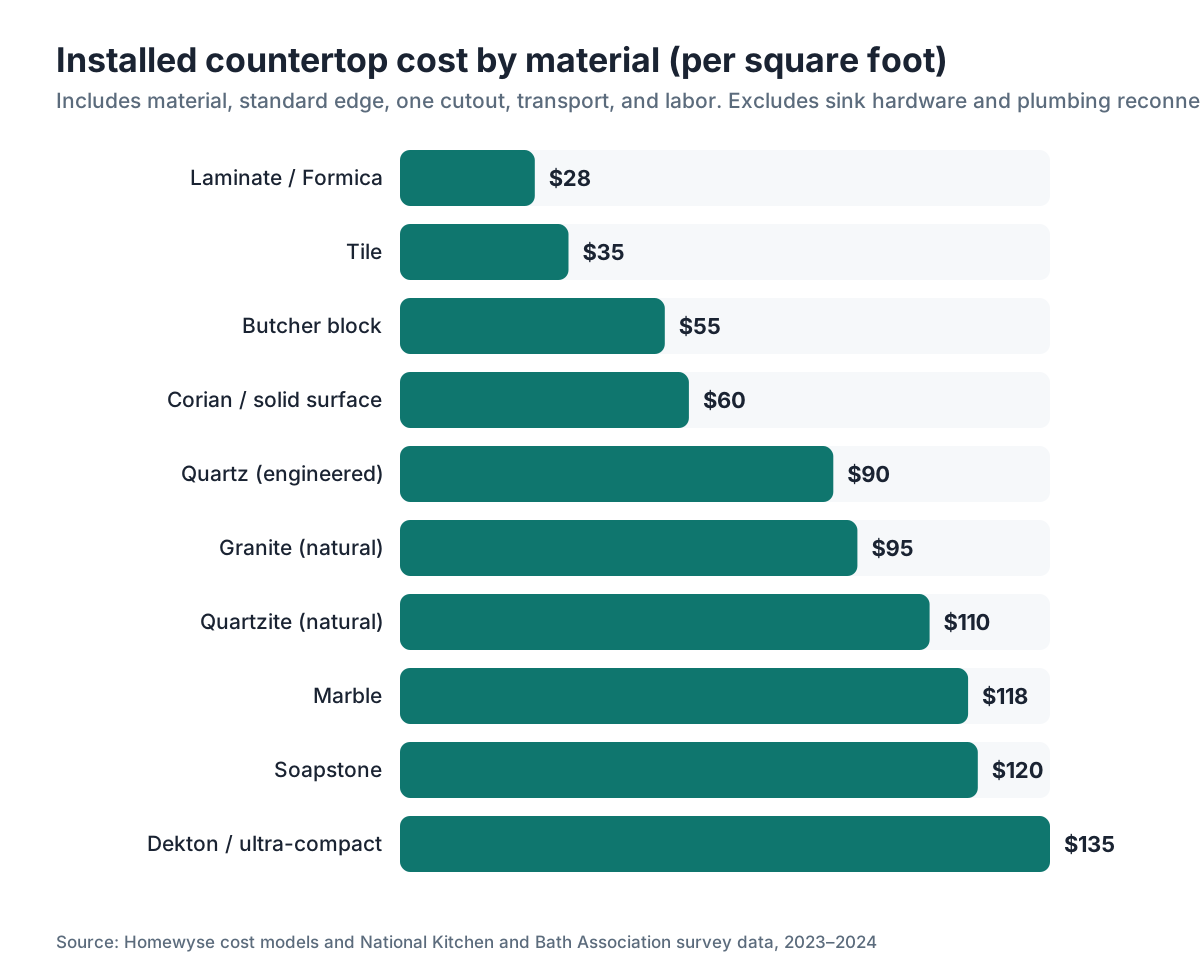
Material choice sets the floor and the ceiling for your project. Here are honest installed ranges per square foot (material plus standard labor, edge, and cutout prep, but not sink hardware or plumbing reconnection):
| Material | Installed Cost (per sq ft) | Notes |
|---|---|---|
| Laminate (Formica) | $15, $40 | Cheapest option; drop-in sinks only unless custom-built |
| Tile | $20, $50 | Grout lines are a maintenance issue; DIY-friendly |
| Butcher block | $30, $80 | Needs annual oiling; undermount sinks require extra sealing |
| Corian / solid surface | $40, $80 | Seams blend; sinks can be integrated for zero-seam look |
| Quartz (engineered) | $55, $130 | Most popular category; consistent pricing nationwide |
| Granite (natural) | $55, $140 | Price swings with slab lot; Homewyse granite install estimate: $55, $100/sq ft [2] |
| Quartzite (natural) | $70, $150 | Harder than granite; fewer fabricators can cut it |
| Marble | $75, $160 | Etches and stains; beautiful if you accept that |
| Soapstone | $80, $160 | Darkens with oil; scratches but self-heals somewhat |
| Dekton / ultra-compact | $90, $180 | Very hard to cut; fabricator experience matters a lot |
| Quarried stone slabs (exotic) | $150, $250+ | Gold quartzite, onyx, etc.; slab cost alone can hit $200/sq ft |
Laminate and formica countertops are genuinely good choices for rentals, laundry rooms, or tight budgets. The stigma is mostly outdated. Granite countertops sit in a sweet spot for durability and resale perception. Quartz and Cambria countertops cost more but give you better color consistency across the slab. Marble countertops are the highest-maintenance option in the bunch.
For butcher block countertops, the installed price looks affordable, but budget for annual maintenance or it will warp and stain within a few years. Corian countertops and other solid-surface products are underrated for integrated sink applications where zero seams matter.
How much does adding a sink cutout and installation cost?
The sink portion of the job has two costs that get mixed together: the fabricator's work and the plumber's work. Keep them separate in your head.
The fabricator cuts the hole, finishes the edges if it's an undermount, and sets the sink. The plumber reconnects the drain, P-trap, supply lines, and garbage disposal if there is one. Some countertop installers handle minor plumbing reconnects as a bundled convenience, but licensed plumbers are required in most jurisdictions for anything beyond a simple reconnect.
Fabricator-side sink costs:
- Drop-in (self-rimming) sink cutout: $100 to $200 in most shops. Simple radius cut, no edge finish required.
- Undermount sink cutout and set: $200 to $400. The exposed edge gets polished to match the surface, and the sink is epoxied and clip-set from below.
- Farmhouse (apron-front) sink: $250 to $500 more for the stone reveal cut and fitting work. Some apron sinks need cabinet modifications before the stone goes in, which is a carpenter's job, not a fabricator's.
- Integrated solid-surface sink: priced as part of the slab fabrication, often adding $400 to $800 to the total.
Plumber-side reconnect costs run $100 to $400 for a standard kitchen sink depending on your area. If you're also installing a new faucet or disposal, add another $150 to $300 for the plumber's time.
Total realistic add-on for a standard undermount kitchen sink with plumber reconnect: $400 to $800 on top of your countertop installed price [3].
What does labor cost for countertop installation?
Labor alone, separated from material, typically runs $10 to $35 per square foot for standard residential stone work. Simple layouts with one or two straight runs fall at the low end. Complex kitchens with multiple inside corners, islands, curved edges, or specialty edge profiles climb to $30 to $45 per square foot just for labor.
Most fabrication shops in the US don't split material and labor on the quote. They price by the finished square foot installed. That's standard practice. If a shop quotes material separately, you're likely dealing with a retailer who subcontracts installation, and you should ask exactly who shows up at your house and whether they carry liability insurance.
Two factors almost always add to labor cost without showing up in baseline estimates: removal and disposal of existing countertops ($100 to $300 depending on material and size), and cabinet repairs before the new surface goes on ($50 to $500 depending on condition). Both are worth budgeting.
Homewyse's cost-to-install-countertops model for a mid-grade kitchen pegs basic labor time at 3 to 5 hours for a typical install, separate from any sink work [2]. That matches what experienced fabricators describe for a straightforward single-run install.
What are the biggest factors that change the final price?
Seven things move the number more than most homeowners expect.
-
Square footage. Every extra foot of counter adds material and labor cost. Islands often price at a premium per foot because they need extra seaming or full-perimeter edge work.
-
Edge profile. A standard eased or beveled edge comes with most base quotes. Ogee, waterfall, chiseled, or double-radius profiles add $10 to $30 per linear foot. A 20-foot kitchen perimeter with a premium edge can add $200 to $600.
-
Number of cutouts. Each cutout (sink, cooktop, outlet box) takes machine time and careful positioning. Expect $100 to $350 per cutout beyond the standard one sink.
-
Seams. Slabs typically come in 5-foot to 6-foot widths. Longer runs need seams. Seams add labor time and, in stone, often require color-matched epoxy. Expect $50 to $150 per seam in labor, plus the seam's visibility affects resale perception.
-
Material hardness. Dekton, quartzite, and some porcelain slabs are harder to cut and polish than granite or quartz. Fabricators charge more for them. Ask directly whether your chosen material carries a surcharge.
-
Access and logistics. Third-floor walkup with a narrow staircase? An upcharge is coming. Difficult access can add $200 to $800.
-
Regional labor market. A fabricator in rural Tennessee prices differently than one in the San Francisco Bay Area. The same granite slab and install can differ by 40 to 60 percent purely on geography [4].
For a full breakdown of how the installation process works from template to final set, see our guide to countertop installation.
How do laminate and budget countertops compare in total installed cost?
If budget is the main constraint, laminate and tile are the honest answers. Laminate countertops installed with a drop-in sink typically run $800 to $1,800 for a typical kitchen, all in. Tile runs slightly higher because of grout work, landing at $1,200 to $2,500 installed. Both sit far below quartz or stone.
The tradeoff is durability and resale. Laminate scratches and swells at the seams if water gets in. Tile grout lines collect bacteria and stain. Neither performs well over the long haul without care. That said, if you're prepping a rental for the market or doing a cosmetic flip, laminate is not a mistake. It just isn't the best choice for a 20-year owner-occupied kitchen.
Butcher block falls in the middle, $30 to $80 per square foot installed. It looks warm and forgives knives, but any undermount sink is a long-term risk without careful, repeated silicone sealing around the cutout. Most woodworking fabricators actually recommend a drop-in stainless bowl with butcher block for that reason.
Solid surface like Corian sits at $40 to $80 per square foot and is probably the most underrated option for anyone who wants an integrated sink with no seam, easy repairs (surface scratches sand out), and consistent pricing. It doesn't have the stone look, but it works hard.
Do you need a separate plumber for sink installation?
Yes, in most cases. Countertop fabricators set the sink physically into the stone, clip it from below, and seal it with silicone. They stop there. Reconnecting the drain, P-trap, garbage disposal, and supply lines to a new faucet is plumbing work. Most states require a licensed plumber for any work beyond a simple reconnect on a pre-existing approved fixture [5].
In practice, some countertop crews will loosely reconnect a drain as a courtesy on a straightforward swap. If the faucet, disposal, or any supply line is also being replaced, you need a plumber. Budget $150 to $400 for a plumber on a standard kitchen sink job.
If you're getting new faucets, this is the moment to do it. The plumber is already under the sink. Adding a faucet to an existing service call costs far less than scheduling a separate visit.
One thing that trips people up: undermount sinks must be fully cured before the fabricator leaves. The epoxy and silicone need several hours to set before you run water. Plan to be without a kitchen sink for 24 hours after install [6].
How does bathroom countertop and sink installation compare to kitchen?
Bathroom vanity tops with integrated sinks or drop-in bowls run $200 to $1,200 for a standard 24-to-48-inch vanity top installed. Prefab cultured marble tops with a built-in bowl start around $100 to $200 for the material alone and are cheap to have installed. Custom stone vanity tops in granite or quartz cost more per square foot than kitchen stone (fabricators price small jobs at a higher rate because setup cost is the same regardless of size), typically $150 to $400 for the finished piece installed.
Bathroom installs run faster and simpler than kitchens. One faucet hole, one drain cutout, one straight or modest-L layout. Labor time is 1 to 2 hours in most cases. The per-square-foot price looks high on a 10-square-foot vanity top, but the total dollar amount stays modest.
For a master bath with a double-sink vanity and custom stone, budget $600 to $1,800 for the countertop, cutouts, and setting, plus $200 to $400 for the plumber to reconnect both drain assemblies and any new faucets.
Can you save money by doing part of the installation yourself?
Stone and quartz: no, and this is not a hedge. Engineered quartz and natural stone slabs weigh 15 to 20 pounds per square foot. A 30-square-foot kitchen has 450 to 600 pounds of material that must be carried, positioned to the millimeter, and set before it can shift. Fabricators carry specialized handling tools and vacuum lifters. Drop a slab and you're looking at a $1,500 to $5,000 replacement plus possible cabinet damage.
More practically, most fabricators won't separate templating, fabrication, and installation. They're liable for the product until it's set and signed off. To install it yourself, you'd have to buy the slab from a distributor raw, rent equipment, and find a shop willing to cut and polish it without installing it. That's a realistic path for very experienced DIYers, not a money-saver for most homeowners.
Laminate is different. Post-form laminate countertops (the kind with the rolled edge and backsplash built in) can be cut with a circular saw and set by a confident DIYer. Custom laminate needs a router and a steady hand but stays manageable. Go that route and you'll save $200 to $500 in labor, but the results are only as good as your prep work on the cabinet tops.
The one genuine DIY save is demo. Removing your existing countertop yourself before the fabricator arrives can take $100 to $300 off the quote. Just confirm with your fabricator first, because sometimes they want to verify cabinet level before the old top comes off.
Fabricators who run quoting in-house often use software that accounts for these add-ons automatically. SlabWise is one tool built for this. It lets shops produce itemized quotes (cutouts, edge profiles, sink charges) that homeowners can actually read, which makes comparing bids easier [7].
What questions should you ask before you hire a fabricator?
The quote is only part of what you're evaluating. Here are the questions that matter.
Is the price per square foot or a flat job price? Per-square-foot quotes are easier to compare across shops. Flat job quotes can hide assumptions about layout complexity.
What edge profile is included? Some shops include only an eased or pencil edge in the base price. If you want an ogee or waterfall, ask for the upcharge before you sign.
Do they handle the sink cutout and setting, or does that cost extra? Most shops include one cutout in the base price. Confirm in writing.
Who does the templating? Template accuracy determines whether your countertop fits. Some shops template with a laser measure system, others use cardboard or MDF templates. Ask about their process, especially for complex layouts.
Are they licensed and insured? Fabricators don't need a specialty license in most states, but they should carry general liability insurance. If a slab breaks inside your home, their insurance covers the damage, not yours.
What is the lead time from template to install? Industry standard is 5 to 14 business days from template to installation for in-stock material. Exotic slabs or busy season can push that to 4 to 6 weeks.
Do they remove old countertops, and what's the charge? Some shops include basic removal; most treat it as a separate line item.
Get answers in writing, not verbal. A good fabricator won't hesitate to put the specifics in the quote.
How can you get an accurate countertop quote before buying?
The fastest way to get a ballpark number is to measure your countertops yourself and use an online estimator as a starting point. Measure the length of each counter run, multiply by the depth (usually 25 inches for kitchens, 22 inches for baths), and add them together. Convert to square feet by dividing by 144. Most kitchens land between 25 and 45 square feet.
With that number in hand, the Homewyse cost-to-install-countertops model gives you a regional starting estimate before you meet a fabricator [2]. Their granite installation estimate for a mid-range project in 2024 ran $55 to $100 per square foot installed, depending on zip code. Use that as a sanity check, not a contract.
For real quotes, contact three local fabricators. Most offer free in-home or showroom estimates. Ask each one to quote the same job: same material, same edge, same number of cutouts. Price differences of 10 to 20 percent between shops are normal. Differences of 40 percent or more usually mean someone assumed something different about the scope.
If you want to see what a fabricator sees while building your quote, tools like SlabWise let shops generate transparent, itemized quotes that break out each cost component. Ask your fabricator if they can give you a line-item breakdown instead of just a total [7].
For kitchen countertops, the choice of material and layout is where the money goes. Lock in those decisions before you get quotes and the bids will actually be comparable.
How do you maintain a new countertop to protect your investment?
Stone surfaces need sealer. Natural granite and quartzite should be sealed on installation day and resealed every 1 to 3 years depending on porosity. Marble takes sealer even more readily but etches from acid no matter what, so the sealer protects against staining, not etching. For cleaning guidance on specific surfaces, see how to clean stone countertops, or the specific guides for quartzite and soapstone.
Quartz and engineered surfaces don't need sealing but hate prolonged heat. A hot pan set directly on quartz can discolor or crack the resin. Always use a trivet. This is one area where natural stone actually beats engineered stone: granite handles direct heat far better.
Undermount sinks need periodic inspection of the silicone bead where the stone meets the sink rim. That bead is the only thing keeping water out of the cabinet below. If you see the silicone cracking or pulling away, recaulk it immediately. A $10 tube of kitchen-grade silicone applied on a Saturday afternoon prevents a $500 cabinet repair later.
The National Association of Home Builders estimates countertop surfaces in a typical home last 15 to 50 years depending on material and care, with natural stone at the long end and laminate at the short end [8]. That lifespan range makes the premium for stone look a lot more reasonable when you amortize it over 30 years.
Frequently asked questions
How much does it cost to install a countertop and sink together?
For a typical 30-square-foot kitchen in quartz or granite, plan on $2,500 to $5,500 total installed, which includes the stone, edge profile, one undermount sink cutout and set, and standard labor. That number does not include a plumber to reconnect the drain and supply lines, which runs $150 to $400 separately. Laminate with a drop-in sink runs $900 to $2,000 for the same size kitchen.
What is the average cost per square foot for countertop installation?
Installed cost per square foot ranges from about $15 to $40 for laminate up to $150 to $250 for exotic natural stone. Quartz and granite, the two most common choices, run $55 to $130 per square foot installed. Those figures include material, standard edge profile, one cutout, transport, and labor. Edge upgrades and additional cutouts are usually billed as line-item add-ons.
Does the Homewyse granite countertop install estimate match real quotes?
Homewyse pegs granite countertop installation at roughly $55 to $100 per square foot depending on region. Real quotes from fabricators in mid-sized US markets tend to land in that same band for standard-grade granite with an eased edge. High-cost metros like San Francisco or New York run 20 to 40 percent above Homewyse's model. Use Homewyse as a floor estimate, then get actual bids from local shops to confirm.
How much does a fabricator charge just for the sink cutout?
A drop-in sink cutout typically costs $100 to $200. An undermount sink cutout with polished exposed edges costs $200 to $400. Farmhouse or apron-front sink cuts, which need more precision and a larger reveal, run $250 to $500. Most fabricators include one standard cutout in their base quote; confirm this before signing so you don't get surprised by an add-on.
Do countertop installers also install the sink plumbing?
No, not typically. Fabricators set the sink physically into the stone and seal it with silicone and clips. Connecting the drain, P-trap, garbage disposal, and supply lines is licensed plumbing work in most states. Budget $150 to $400 for a plumber to reconnect a standard kitchen sink. If you're also replacing the faucet or disposal, adding that to the same plumber visit saves money versus a separate service call.
How long does countertop installation take from start to finish?
The in-home installation itself takes 2 to 5 hours for a typical kitchen once the fabricated slabs arrive. But the full timeline from signing a contract to finished install is 5 to 14 business days for in-stock material: a few days for templating, then the fabrication queue. Exotic slabs or busy season can extend that to 4 to 6 weeks. Undermount sinks need 24 hours of cure time before you can run water.
Is it cheaper to install countertops and a sink at the same time?
Yes, always. The mobilization cost, which covers showing up with tools and a truck, is fixed whether you're doing one thing or ten. Combining countertop installation and sink cutout in one visit saves $150 to $300 compared to scheduling them separately. Same logic applies to the plumber: have them reconnect the sink on installation day, not on a separate call that carries its own trip charge.
What is the cheapest countertop material to install?
Laminate, including Formica brands, is consistently the least expensive at $15 to $40 per square foot installed. Tile is next at $20 to $50 per square foot. Both work fine functionally. The honest tradeoff is that laminate can't support an undermount sink (water infiltrates the seam over time) and tile grout lines need regular maintenance. For rentals or secondary spaces, laminate is genuinely smart.
How much does bathroom vanity countertop and sink installation cost?
A prefab cultured marble vanity top with integrated sink runs $150 to $400 installed on a standard 24-to-36-inch vanity. Custom stone vanity tops in granite or quartz run $150 to $400 for the finished piece, plus $100 to $200 for the sink cutout and set, plus $150 to $300 for a plumber. Total for a custom stone bath vanity with new faucet is typically $500 to $1,200.
Does removing an old countertop add to the installation cost?
Yes. Most fabricators charge $100 to $300 to remove and haul away an existing countertop. You can save that by demoing the old top yourself before the installer arrives, just confirm with your fabricator first since they sometimes want to check cabinet level before removal. Stone and tile removal takes more time than laminate. Concrete or tile with adhesive backing is the most labor-intensive to demo.
What edge profile adds the most cost to a countertop quote?
Waterfall edges (where the stone wraps vertically down a cabinet side) add the most cost because they require a full matching slab section cut and seamed on the vertical face. Expect $400 to $1,500 for a single waterfall end. Among traditional profiles, ogee and double-radius edges add $10 to $30 per linear foot over a basic eased edge. Simple eased, beveled, or pencil edges are usually included in the base per-foot price.
Does countertop material affect how long installation takes?
Somewhat. Laminate installs fastest, usually under 2 hours for a kitchen. Stone and quartz installs take 3 to 5 hours because pieces are heavier, seams must be aligned carefully, and the sink cutout edge polish takes time. Very hard materials like Dekton, porcelain, or quartzite take longer because they require slower cutting speeds and more frequent blade changes. Some shops add a hard-material surcharge for this reason.
Can you install a new countertop without replacing the sink?
Yes, if the existing sink is in good condition and the fabricator can template around it. Undermount sinks are typically removed before the new stone goes in and then reset in the new surface. Drop-in sinks can sometimes stay in place during template if geometry allows, though most fabricators prefer to disconnect them for a clean template. Keeping your existing sink saves $200 to $800 on materials and avoids a plumber visit if the supply lines aren't touched.
How much does a waterfall countertop edge add to the total cost?
A waterfall edge on one end of a kitchen island typically adds $400 to $1,500 to the total quote, depending on stone thickness and whether a matching slab section is available from the same lot. Both-end waterfalls on a large island can add $1,000 to $3,000. The material cost is significant because you need extra slab square footage for the vertical panel, and seam work must be exact for the pattern to look continuous.
Sources
- National Kitchen and Bath Association, 2023 Design & Industry Survey: Average countertop budget in a full kitchen remodel ranges from $2,500 to $4,500, with stone surfaces at the upper end.
- Homewyse, Cost to Install Granite Countertops: Homewyse model for granite countertop installation (materials and labor) runs $55 to $100 per square foot depending on zip code; basic labor time estimated at 3 to 5 hours for a typical install.
- HomeAdvisor (Angi), Sink Installation Cost Guide: Total realistic add-on for undermount kitchen sink with plumber reconnect is $400 to $800 on top of countertop installed price.
- U.S. Bureau of Labor Statistics, Occupational Employment and Wage Statistics, Construction Trades: Regional wage variation for construction and installation trades can differ 40 to 60 percent between low-cost and high-cost metro areas.
- U.S. Department of Labor, State Licensing Requirements for Plumbers: Most states require a licensed plumber for any plumbing work beyond a simple reconnect on a pre-existing approved fixture.
- Natural Stone Institute, Fabrication and Installation Guidelines: Undermount sinks set with epoxy and silicone require several hours of cure time before water contact; 24-hour wait is standard practice.
- SlabWise, Countertop Fabrication Quoting Software: SlabWise lets shops produce itemized quotes showing cutouts, edge profiles, and sink charges separately, making homeowner bid comparisons easier.
- National Association of Home Builders, Study of Life Expectancy of Home Components: Countertop surfaces in a typical home last 15 to 50 years depending on material and care, with natural stone at the long end and laminate at the short end.
- U.S. Census Bureau, American Housing Survey: Kitchen remodeling is one of the most common home improvement projects; countertop replacement is frequently cited among top kitchen updates.
- Environmental Protection Agency, WaterSense Program, Sink and Faucet Standards: EPA WaterSense standards apply to faucets installed during sink replacement projects; labeled faucets use at least 20 percent less water.
- Occupational Safety and Health Administration, Silica Dust in Stone Fabrication: OSHA regulates silica dust exposure in stone fabrication shops; engineered quartz cutting requires wet-cutting or HEPA ventilation controls.
Last updated 2026-07-09