TL;DR
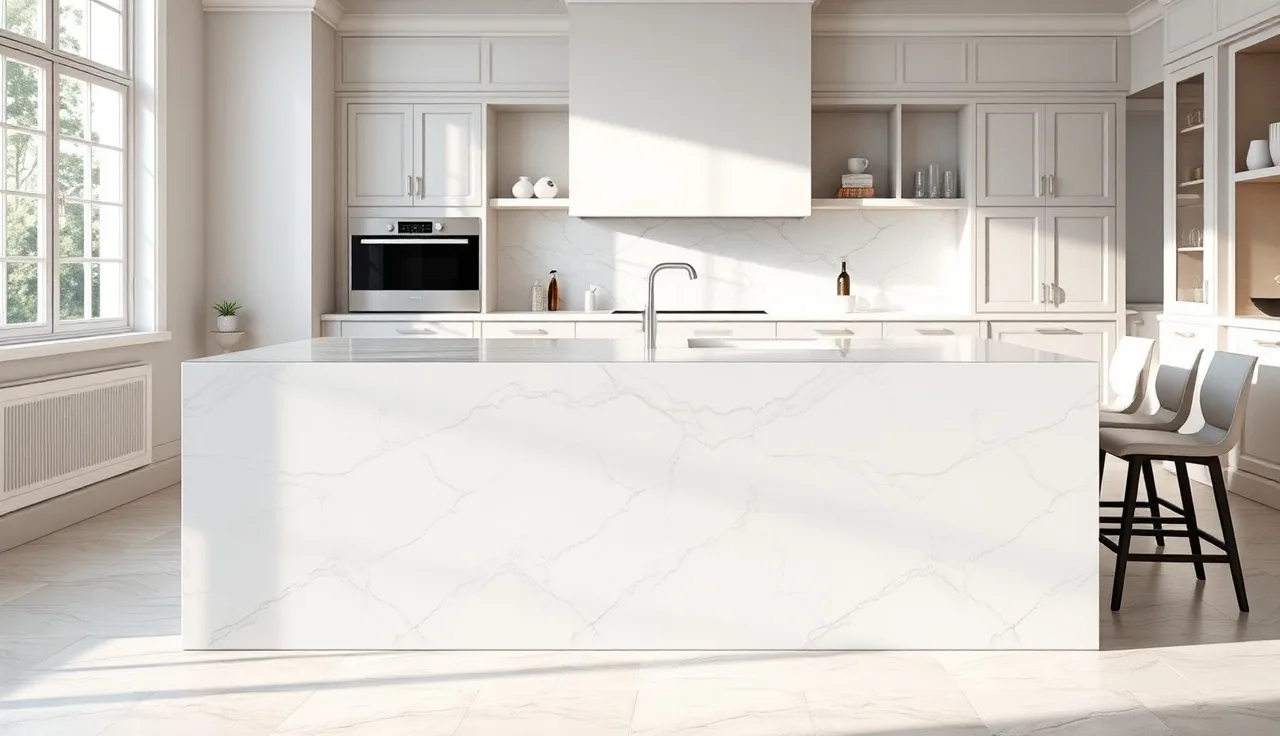
- A waterfall countertop runs the surface material vertically down one or both sides of an island or cabinet, straight to the floor, so the counter looks like it pours over the edge.
- Quartz and natural stone do it best.
- Expect to pay $500 to $3,000 or more above a standard countertop, depending on material, slab matching, and how many sides cascade.
What is a waterfall countertop?
A waterfall countertop turns the surface material 90 degrees at the edge of a cabinet or island and runs it straight down to the floor, like water falling off a ledge. The horizontal top and the vertical side come from the same material, or at least get matched so they look continuous. The cabinetry ends up looking like it floats inside a solid stone or wood shell.
You'll see it mostly on islands, though peninsulas and bar counters get the treatment too. It runs one side (single waterfall) or both (double waterfall). A double waterfall on a big island is a serious material commitment. You're paying for three slabs' worth of cuts instead of one.
The idea is old. Mid-century modern designers did it in laminate through the 1950s and 1960s. The current wave rides on book-matched marble and large-format quartz, which make the mitered corner joint almost disappear when the veins line up. Book-matching is the technique where two consecutive slices of stone open like a book so their veins mirror across the seam. A waterfall built with book-matched stone looks genuinely striking. Skip the book-match and the corner just looks like a seam, because that's what it is.
The side panel does a real job beyond looks. It protects the cabinet end from kicks, moisture, and stool bumps. On an island that takes daily abuse, that matters.
What materials work for a waterfall edge?
Any rigid countertop material can do a waterfall, but some do it far better than others. Material is the biggest decision you'll make here, because it drives cost, seam visibility, and how the thing ages.
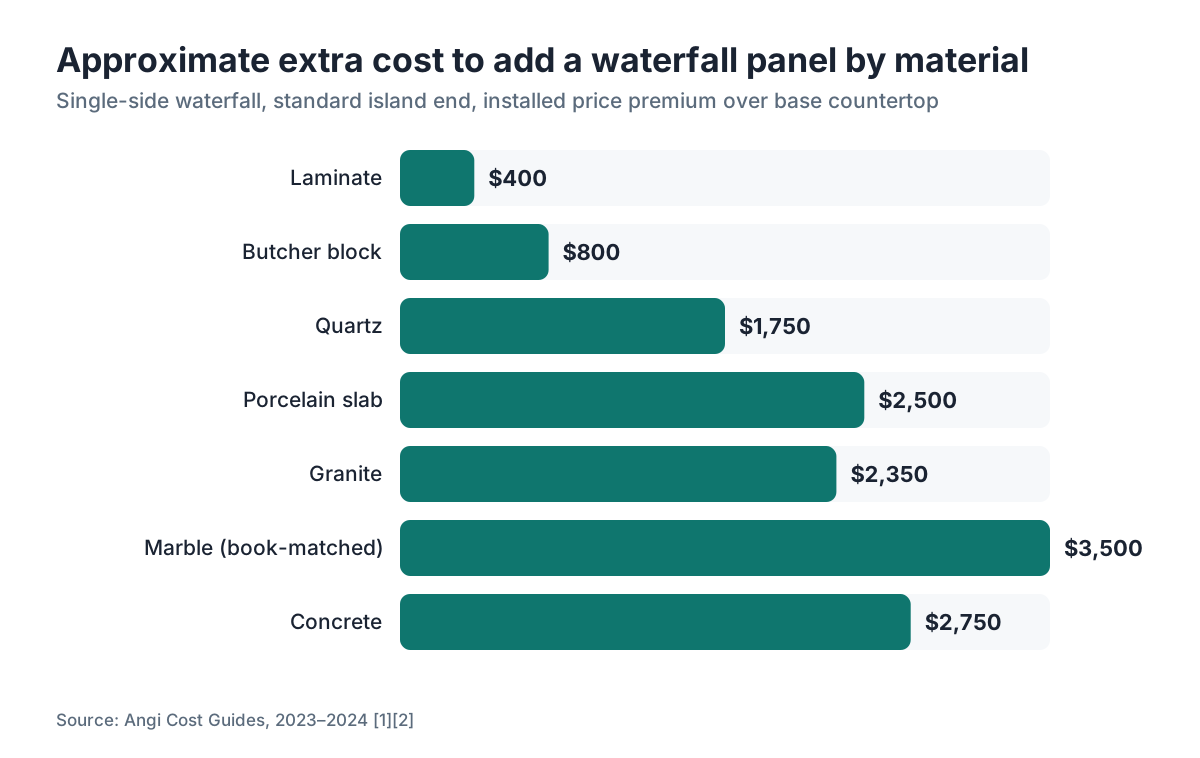
Quartz is the most popular pick today, and for good reason. Quartz countertops come in consistent, repeatable patterns, so matching veins from top to panel is more predictable than with natural stone. Engineered slabs run large, sometimes 63 by 126 inches, which cuts the odds you'll need a seam mid-panel. The miter at the corner hides well because quartz is uniform through its thickness. A quartz waterfall usually runs $1,000 to $2,500 for the added panels on top of the base countertop price. [1]
Marble is the premium pick. A continuous marble vein sweeping from horizontal to vertical is the image in every high-end kitchen magazine. The catch: natural veining never repeats, so true book-matching means cutting consecutive slices from one block and orienting them exactly. That takes skill, wastes material, and costs money. Marble countertops also etch and stain, so a floor-length marble panel in a busy kitchen shows wear faster than you'd hope. Budget $2,000 to $5,000 extra or more for a marble waterfall done right. [2]
Granite resists book-matching because its pattern is random, not directional, so the miter seam always shows to some degree. Granite countertops work fine as waterfalls if you accept that, and granite takes abuse well. The cost premium tracks close to marble but drops for common varieties.
Butcher block and wood read warm and tactile in a way stone never will. Butcher block countertops miter cleanly because wood is easy to cut. The problem is a wood panel running to the floor takes scuffs, water at the base, and pet damage. Oil it well and it holds. Neglect it and the bottom edge goes first.
Porcelain slabs are newer here. Large-format porcelain (sometimes sold as sintered stone) comes in 120-inch or longer slabs, resists stains, and cuts thin (6mm or 12mm) to shave weight off the vertical panel. The miter chips easily in the wrong hands, so fabricator skill matters a lot.
Laminate is honest about what it is. Cheap, available in nearly any pattern, and perfectly functional. The miter shows more than stone, but for a budget remodel it makes sense. Laminate countertops and the related Formica countertops pull off the look at a fraction of the stone price.
Concrete is niche. Concrete countertops can be cast with the vertical panel as one solid piece, which kills the seam entirely. You pay in weight, lead time, and cost.
| Material | Approx. extra cost for waterfall | Book-match possible? | Seam visibility at miter |
|---|---|---|---|
| Quartz | $1,000, $2,500 [1] | Pattern-matched, not true book-match | Low to medium |
| Marble | $2,000, $5,000+ [2] | Yes, with consecutive slabs | Very low when done well |
| Granite | $1,200, $3,500 [2] | Difficult | Medium to high |
| Porcelain slab | $1,500, $3,500 | Pattern-matched | Low to medium |
| Butcher block | $400, $1,200 | N/A | Low |
| Laminate | $200, $600 | N/A | Medium |
| Concrete | $1,500, $4,000 | N/A | None (if cast as one) |
How much does a waterfall countertop cost?
A waterfall countertop costs $500 to $3,000 or more above a standard countertop, and where you land depends on the base material, how many panels you need, whether you're book-matching, and your local labor rates. No single number fits every kitchen. Here's how to build the estimate.
Start with the standard countertop price for your material. Then add the waterfall premium, which splits into extra material and extra labor.
Extra material is simple math. A single waterfall panel on a 36-inch-tall cabinet with a 42-inch-wide end adds roughly 9 square feet of stone. At $60 to $150 per square foot installed for quartz, that's $540 to $1,350 for the panel alone. Natural stone runs $80 to $250 per square foot installed, putting the panel at $720 to $2,250. [1] These figures assume the fabricator cuts the panel from the same slab as the top. Need a second slab, and you're buying the full slab minimum.
Extra labor costs more than people expect. The miter at the corner has to be precise to a fraction of a millimeter, or you get a visible gap or a lip that catches crumbs. Most fabricators charge $50 to $150 per linear foot for a mitered waterfall edge, against $10 to $30 per linear foot for a standard eased or beveled edge. [3] A double waterfall doubles that charge.
Book-matching stacks on more. The fabricator orients and cuts consecutive slabs, which means buying two full slabs even if you only use material from one, plus extra template and layout time. Expect a 20% to 40% premium on fabrication labor when book-matching is specified. [3]
Add it up: a single-side quartz waterfall on a standard island runs about $800 to $2,500 over your project. A double-side book-matched marble waterfall on a large island adds $4,000 to $8,000 or more. If a quote comes in at $300 for a waterfall, ask exactly what's included. That price almost certainly buys an edge profile, not a floor-length panel. [1] [2]
Do one thing before you sign: get an itemized quote that separates material cost, linear-foot edge pricing, and any book-match or layout fee. That's what lets you compare shops honestly.
How is a waterfall countertop installed?
A waterfall install runs the same sequence as any stone job, with added steps for the vertical panel. Knowing the process helps you ask sharper questions and dodge the common surprises.
The fabricator templates the island first, measuring the top and each end precisely. For a waterfall, they also measure floor-to-underside-of-top on the cascade side and check whether the floor is level. An unlevel floor means the panel's bottom needs scribing or a small gap. Most shops leave a 1/8-inch gap at the floor and cover it with a thin bead of color-matched caulk rather than scribing stone to an uneven floor. That gap also gives the building room to move.
Back at the shop, the top and the panel come off the same slab whenever possible. The miter joint is the critical cut: both faces get cut at exactly 45 degrees so they meet at the corner with no gap. CNC machines nail this. Skilled hand-cutting can too, but it takes longer. Both faces get polished on the miter angle so the joint edge itself is finished.
On install day the top goes in first, set with silicone adhesive to the cabinets. Then the vertical panel gets dry-fit to check miter alignment before any adhesive touches it. If the fit is clean, the fabricator applies a two-part epoxy or color-matched polyester adhesive to the joint, clamps the panel, and lets it cure. Seam clamps (butterfly clamps or seam setters) pull the two faces tight while color-matched epoxy fills the joint.
The panel also gets bonded to the cabinet end with silicone from behind. It doesn't carry structural load, but it needs full adhesion so it can't flex and crack the miter over time. On tall or heavy panels, some fabricators add a clip or bracket at the top back edge for backup.
Install time for a single-waterfall island runs roughly two to four hours for an experienced team, versus one to two hours for a standard island. [3] Add an hour if the floor is badly unlevel or access to the space is tight.
What are the pros and cons of a waterfall edge?
The honest version: a waterfall looks beautiful when it's done well, but it costs real money and carries downsides the showroom won't mention.
Pros:
The visual impact is real. A clean waterfall, especially in a bold-veined material, makes an island look more finished and deliberate than any other edge treatment. It reads clearly in photos and in person.
The panel protects the cabinet end from daily wear. Chairs and stools bump island ends constantly. Stone takes that abuse better than painted wood.
For resale, a high-quality waterfall on a large island sets a listing apart. It signals the kitchen was built with care, not to the budget floor. Whether it returns full cost is a separate question (renovation ROI is notoriously hard to pin down), but it doesn't hurt.
Cons:
Cost leads the list. You're buying extra material, extra labor, and often a whole second slab to get the match. That money could go to better appliances, better hardware, or your bank account.
Seating gets complicated. Want bar stools at the island end where the waterfall lands? The panel is in the way. You keep the overhang on the opposite side, but you lose seating on the waterfall side entirely. Plenty of homeowners realize this only after install.
Repairs are hard. If the miter cracks or the panel chips, the fix is visible and messy. A cracked miter usually means refabricating both pieces.
The base is annoying to clean. Food and crumbs collect in the narrow floor gap, and you can't get a mop flat against it.
For the fabricators reading: a waterfall carries higher callback risk than a flat top. The miter sits under stress every time the building moves or the island gets jostled. Price the labor accordingly and match the adhesive to the material.
What's the difference between a waterfall edge and a waterfall countertop?
A waterfall edge is a front-edge profile: a flat, sharp right-angle drop with no rounding. A waterfall countertop is the whole design feature where material runs down the cabinet side to the floor. The two get confused constantly during quoting, and the price gap between them is enormous.
In the trade, a "waterfall edge" means the profile shape on the horizontal front edge of the counter. It looks like water falling straight off a surface. It's a profile choice, not a structural element, and it costs about the same as any other simple edge.
A "waterfall countertop" or "waterfall island" means the material extends vertically down the cabinet side to the floor. That's a full feature: extra material, a miter joint, and added install work.
When you call a fabricator, say exactly this if it's what you mean: "I want the countertop to continue down the side of the island to the floor." Say only "waterfall edge" and most fabricators assume the front profile, not a floor-length panel. The math is brutal: an edge profile change adds $20 to $80 per linear foot, while a true waterfall panel adds hundreds to thousands of dollars. [3]
Some shops use "waterfall" for both, which is why the itemized quote matters. Get it in writing.
Does book-matching actually matter, and what does it cost?
Book-matching matters a lot in veined materials and not at all in solid or consistent ones. In marble and quartzite with strong diagonal veins, it's the difference between a corner that flows and a corner that stops and restarts.
In veined marble or quartzite, the vein runs diagonally across the face. When the top meets the panel at a 90-degree miter, you want the vein to appear to flow around the corner. That means the two pieces come from adjacent cuts in the same block, oriented so the veins mirror across the seam. That's book-matching. When it works, the corner looks like one continuous surface. When it doesn't, the pattern clearly quits and starts over.
For quartz, true book-matching isn't possible, because each slab is manufactured on its own rather than cut from a single block. Some quartz lines produce "matched" slabs consistent enough to read as continuous, but it's not natural stone book-matching. In practice, a good fabricator gets quartz panels looking well matched by pulling slabs from the same production lot and orienting the pattern direction carefully.
For solid-color or low-variation material (a white quartz with no strong veining, say), book-matching is irrelevant. There's no pattern to align.
The cost starts with buying two slabs. Most fabricators have a one-slab minimum, and a book-match usually needs two. At $800 to $1,500 per slab, that's a real upcharge before labor even starts. Layout and orientation add another 15% to 30% to the fabrication cost. [2] [3]
On a budget, a bold solid-color quartz with no veining looks excellent as a waterfall and skips the book-match cost entirely. Want the full drama of a veined stone turning the corner? Then the book-match cost is unavoidable, and you should budget for it from day one.
How do fabricators quote a waterfall countertop job?
Fabricators price waterfall jobs differently from flat tops because the material yield, labor, and risk all climb. If you run a shop or estimate jobs, here's how the experienced crews approach it.
The core measurement is square footage: top surface plus the waterfall panel(s). Measure the panel as cascade height times width. A standard 36-inch-tall island with a 42-inch-wide end yields a 10.5 square foot panel (36 x 42 = 1,512 square inches, divided by 144). Add that to the top square footage for total material to price.
Price the miter edge as its own line item. Most shops charge $50 to $150 per linear foot of mitered waterfall edge, depending on material hardness and shop volume. A 42-inch panel means 3.5 linear feet of miter, so $175 to $525 for that joint alone. [3]
Book-matching, when specified, is a separate line covering the second slab and the extra layout time. Spell out who owns any leftover slab.
Transportation and install time both run higher on a waterfall, especially with a tall, heavy panel. A full-height panel in 3-centimeter marble weighs 80 to 120 pounds for a single 36x42-inch piece. Two installers and extra time, minimum. Price that labor honestly.
For shops running quoting software, waterfall panels are where manual math goes wrong most often, because estimators forget the miter edge or skip the check on whether a second slab is needed. Tools like SlabWise help fabricators account for those line items systematically during quoting, which cuts the odds of under-pricing a job that looks simple and isn't.
Homeowner side: ask to see the quote broken into material square footage, edge linear footage and type, any book-match or special layout fee, and install hours. That structure lets you compare three shops apples to apples.
What maintenance does a waterfall countertop require?
The horizontal surface needs the same care as any countertop of that material. The vertical panel adds a few specific things to watch, and the base at the floor is the weak point.
The base of the panel where it meets the floor takes the most risk. Even with a caulk bead, moisture creeps under the bottom edge over time. In kitchens with frequent spills or wet mopping, refresh the caulk at the base every few years. A waterfall panel in a bathroom or laundry room runs higher risk for moisture wicking.
On natural stone, sealing the vertical face matters as much as sealing the top. Lots of homeowners seal the top and forget the panel. Use the same sealer on the full exposed face. For stone care by material, the how to clean stone countertops guide covers marble, granite, and quartzite. For quartzite specifically, see the how to clean quartzite countertops article.
The miter joint is a maintenance point. The epoxy or caulk in the joint can discolor or open a hairline crack over time, especially if the island sits on a wood subfloor that moves with the seasons. Check it once a year. A discolored joint cleans up and gets touched with color-matched epoxy by a fabricator. A cracked one needs a pro.
Wood panels take the worst of it in the bottom 6 to 8 inches, from foot traffic, mop water, and pets. Refinish or re-oil that section more often than the top if wear concentrates there.
A clean damp cloth handles daily cleaning on most stone panels. Don't spray cleaner straight into the base-floor gap. Let the cloth do the work.
Is a waterfall countertop worth the money for most homeowners?
It depends on the island, the material, and how you use the space. The short version: a single-side waterfall on a large, prominent island you've already fitted with quality stone is a reasonable splurge. On a small prep counter, or when the base material is already stretching your budget, it's the first thing to cut.
If your island is large, prominent, and visible from the living area, a waterfall makes the kitchen feel more architecturally resolved. The premium pays off most when the island is already the centerpiece. Adding one to a small, tucked-away prep counter is a different calculation.
If seating on the waterfall end is a priority, reconsider. You'll lose it. If the island seats six and a waterfall panel on one end costs you two seats, weigh that functional loss against the visual payoff honestly.
Material changes the math too. A $400 butcher block waterfall on a wood island looks purposeful and costs almost nothing. A $4,000 marble book-match is a different animal. If the choice is a waterfall or upgrading elsewhere (a better range hood, higher-grade tile, more storage), pick the thing you'll touch every day.
On resale, the NAR's 2022 Remodeling Impact Report puts kitchen remodels at roughly 52% to 67% of cost recovered at resale on average [4], but no study I know of breaks value down to a single feature like a waterfall. It's unlikely to return its full incremental cost. It does make a property photograph well, which matters for first impressions.
My honest take: full kitchen renovation, large island, quality stone already chosen? A single-side waterfall is the kind of detail that makes the whole project feel done. Tight budget, or already stretching for the base material? Skip it and spend the difference on something you'll notice daily.
For context on base countertop decisions before you add a waterfall, the kitchen countertops overview is a good starting point.
What should I ask my fabricator before committing to a waterfall?
Before you sign, these questions head off the most common surprises. The single most useful one: ask to see the actual slab, not a sample.
See the real slab. A 2-inch sample square tells you almost nothing about how the full slab's veining wraps a corner. Go to the supplier yard, look at your specific slab, and mark the cuts you want.
Ask whether the top and the panel come from the same slab or whether a second slab is needed. If it's a second slab, ask whether you pay the full slab minimum or just for material used. That varies by shop policy.
Ask how the base of the panel gets handled at the floor. Will there be a gap? How big? What covers it? Is the floor level, and did anyone check?
Ask about seating. Planning stools on the waterfall end? Tell the fabricator before they template. It might change the design.
Ask for the warranty on the miter joint specifically. Some shops warranty seam and miter work separately. Some don't. Know before you sign.
Ask what happens if the slab cracks during fabrication or install. Waterfall panels break a little more often in transport because they're long, vertical, and freestanding. Confirm who eats the cost of a replacement slab if one breaks.
Ask for references or photos of completed waterfall installs from that shop. The miter quality and vein alignment on finished jobs tell you more about a shop's capability than any conversation will. SlabWise's fabricator directory helps you find and vet local shops that handle complex stone work.
Frequently asked questions
What is a waterfall countertop?
A waterfall countertop is a design where the countertop material, usually stone or wood, runs vertically down the side of a cabinet or island all the way to the floor. The top surface and the side panel come from the same material and join at a 45-degree miter, creating a continuous waterfall effect. It shows up most often on kitchen islands.
How much does a waterfall island countertop cost?
A single-side waterfall panel in quartz typically adds $800 to $2,500 to a standard countertop project. Marble or natural stone waterfalls with book-matching add $2,000 to $5,000 or more. Cost tracks material price per square foot, miter edge labor (roughly $50 to $150 per linear foot), and whether a second full slab must be bought to get the match.
What's the difference between a waterfall edge and a waterfall countertop?
A waterfall edge is a front-face edge profile, a sharp right-angle drop with no bevel or rounding. A waterfall countertop means the stone or wood continues down the full side of the cabinet to the floor. The price gap is large: an edge profile change adds tens of dollars per linear foot, while a true floor-length waterfall panel adds hundreds to thousands.
Can you put bar stools on a waterfall island?
Not on the waterfall side. The vertical panel fills the cabinet end, so there's no knee space for seating there. You can still seat people on the long sides or the opposite end. If seating on all sides matters, either skip the waterfall or put it only on an end you don't need for stools. Settle seating before the fabricator templates.
What material is best for a waterfall countertop?
Quartz is the most practical: consistent pattern, large slabs, and a miter that hides well. Marble gives the most dramatic result when book-matched, but it costs more and needs sealing. Butcher block fits a warm wood kitchen at a lower price. For budget projects, laminate and porcelain slab both work. The best choice depends on your kitchen's style, budget, and how much wear the surface takes.
How long does it take to install a waterfall countertop?
A single-side waterfall on a standard island takes an experienced two-person team roughly two to four hours, versus one to two hours for a standard island. Add time if the floor is unlevel, the panel is unusually large or heavy, or access to the kitchen is tight. Natural stone panels in 3-centimeter thickness weigh 80 to 120 pounds and need two installers.
Does a waterfall countertop need to be book-matched?
No, book-matching is optional. In materials without strong directional veining, like solid-color quartz or granite with random patterning, it isn't possible or relevant. It matters most in marble and quartzite with bold diagonal veins. Without it, the corner seam shows where the vein pattern shifts. Many waterfall installs look excellent without book-matching, especially in quartz.
How do I clean the base of a waterfall countertop where it meets the floor?
Use a damp cloth or a narrow brush on the seam where the panel meets the floor. Don't spray liquid straight into the gap, which can seep under the panel. Check the caulk bead at the base every year or two and re-caulk if it cracks or discolors. Keeping the floor dry around the base is the single best thing you can do to extend the panel's life.
Will a waterfall countertop add value to my home?
It can, but the evidence is indirect. The NAR's 2022 Remodeling Impact Report estimates kitchen remodels recover roughly 52% to 67% of cost at resale on average, though it doesn't break that out by feature. A high-quality waterfall makes an island photograph well and signals a well-finished kitchen. It probably won't return its full incremental cost, but it doesn't hurt resale. Treat it as something you'll enjoy while you live there.
Can a waterfall countertop crack over time?
The miter joint is the weak point. It can open a hairline crack if the building moves seasonally, the island gets jolted, or the adhesive went on wrong. Check the joint annually. Small discolored gaps touch up with color-matched epoxy filler. A fully cracked joint usually means refabricating both pieces. A rigid two-part adhesive plus full back-adhesion on the panel during install cuts crack risk a lot.
How thick should a waterfall panel be?
Most panels match the countertop thickness, either 2 centimeter or 3 centimeter for stone. Three centimeters (about 1.25 inches) is standard in the US and looks proportional on most islands. Two-centimeter panels weigh less, which helps on tall or wide panels, but look thinner at the miter. Porcelain slab waterfalls sometimes use 12mm or even 6mm material to shed weight without losing height.
What is the cheapest way to get the waterfall countertop look?
Laminate or Formica is the cheapest route, with a waterfall panel adding as little as $200 to $600 over a standard laminate countertop. Butcher block is the next step up at $400 to $1,200. Both look intentional without the stone price. Set on stone but on a budget? A single-side waterfall in a solid-color quartz (no veining to match) keeps material and labor as low as possible while still giving you the look.
Do waterfall countertops go out of style?
Any strong design statement carries that risk. The waterfall has shown up consistently in high-end kitchens since at least the 1960s and stuck around through multiple style cycles, so it has more staying power than pure trend details. Materials date faster than form: a bold color or pattern might feel dated in ten years, but the waterfall shape itself likely won't. In natural stone, it reads as architectural rather than fashionable, which ages better.
Can a waterfall countertop be added to an existing island after installation?
Yes, but it's complicated. A fabricator can template an existing island, fabricate a matching vertical panel, and glue it to the cabinet end. The hard part is matching an existing slab that may no longer exist. If your countertop is a discontinued quartz color or a one-of-a-kind natural stone, finding a close match is tough. Adding a waterfall during the original install is always easier and cheaper than retrofitting one later.
Sources
- HomeAdvisor (Angi), Countertop Installation Cost Guide: Installed quartz countertop costs range roughly $55, $155 per square foot; waterfall panels add material and edge costs on top of the base countertop price
- HomeAdvisor (Angi), Marble Countertop Cost Guide: Installed marble countertops range roughly $40, $200+ per square foot depending on grade and complexity; book-matching and waterfall work adds to this range
- Natural Stone Institute (formerly Marble Institute of America), Dimension Stone Design Manual: Miter joints for waterfall edges require precise 45-degree cuts; fabrication labor for complex mitered installations is priced as a separate line item by member shops
- National Association of Realtors, 2022 Remodeling Impact Report: Kitchen remodels recover approximately 52%, 67% of project cost at resale on average
- U.S. Geological Survey, Dimension Stone Statistics and Information: Marble, granite, and quartzite are classified as dimension stone; each is quarried in continuous blocks from which consecutive slabs can be cut for book-matching purposes
- Natural Stone Institute, Slab Matching and Veining Technical Bulletin: Book-matching in natural stone requires consecutive slab cuts from the same block oriented as mirror images; the technique is standard for high-end vertical waterfall applications
- U.S. Census Bureau, American Housing Survey: The American Housing Survey tracks material types for kitchen surfaces; stone countertops are among the fastest-growing categories in kitchen renovations
- Occupational Safety and Health Administration, Crystalline Silica: Stone fabrication of quartz and other engineered stone involves respirable crystalline silica; OSHA standard 29 CFR 1926.1153 sets permissible exposure limits relevant to waterfall panel fabrication
- International Masonry Institute, Stone Installation Standards: Vertical stone panels exceeding certain weight thresholds require mechanical anchoring; floor-length waterfall panels in 3cm stone can exceed 100 lbs and warrant adhesive plus backup support
Last updated 2026-07-09