TL;DR
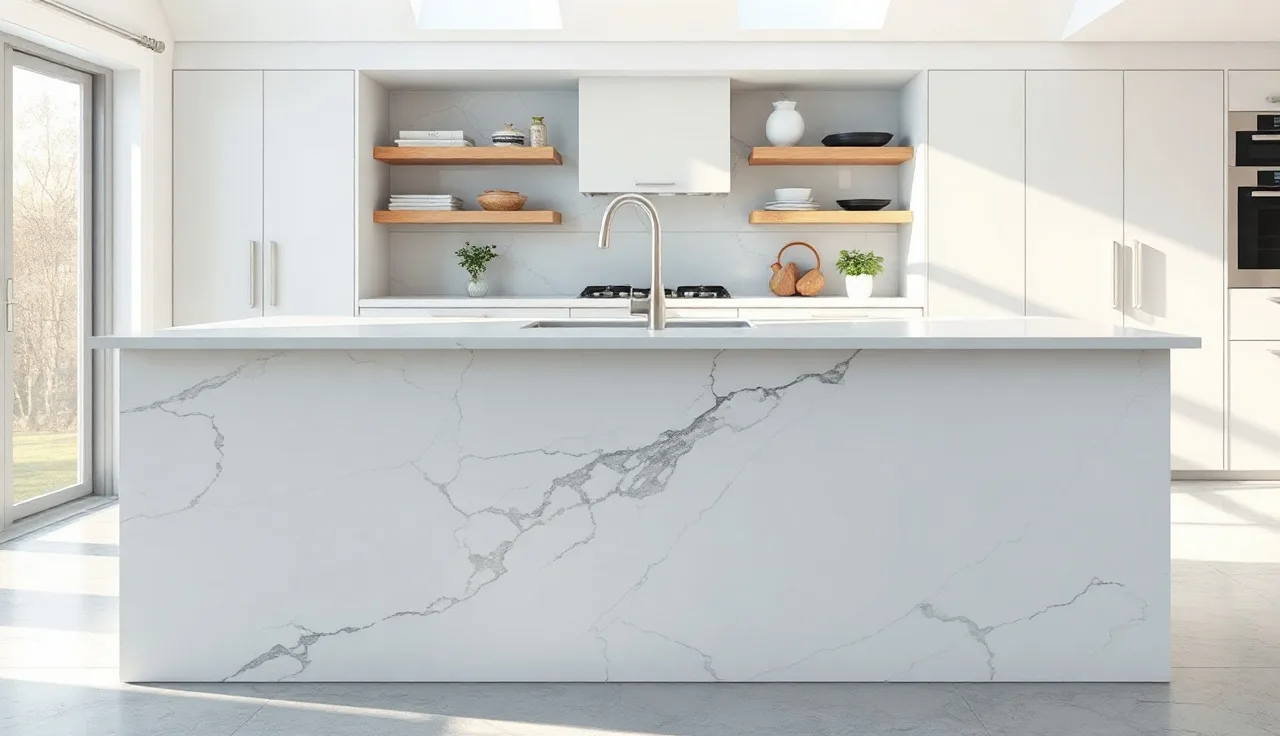
- A waterfall countertop edge extends the slab vertically down the exposed cabinet end to the floor, creating one continuous face.
- It works in stone, quartz, laminate, and wood.
- Fabrication runs $300 to $1,500 or more per end depending on material and complexity.
- It is a purely visual choice, and it lives or dies on the precision of the mitered joint.
What exactly is a waterfall countertop edge profile?
A waterfall edge is the continuous run of countertop material from the horizontal surface down the exposed end of the cabinet all the way to the floor. The slab appears to pour downward, hence the name. It is a design treatment, not a structural one.
Most countertop edge profiles are strictly two-dimensional: a bullnose, an ogee, a beveled edge. The waterfall is three-dimensional because it adds a full vertical panel bonded at a 90-degree (or usually mitered) joint to the horizontal slab. That changes the fabrication process a lot.
The look grew out of the minimalist and contemporary kitchens of the 2010s and stuck around because it reads clean in photos and hides cabinet end panels that many homeowners find unfinished. You see it most on kitchen islands, but it also shows up on peninsula countertops, bathroom vanities, and bar tops where a side is exposed to the room.
One thing to get straight upfront: "waterfall" is the design concept, not a router profile. A fabricator quoting a waterfall is quoting an extra panel of material plus joinery work, not a different shape on the slab edge.
How does a waterfall edge differ from standard countertop edge profiles?
A standard edge profile shapes the front lip of the horizontal slab. A bullnose rounds it. An eased edge softens the square corner. An ogee adds a decorative S-curve. A mitered edge hides the substrate by angling the face at 45 degrees. All of these are two-dimensional treatments on the same horizontal slab.
The waterfall adds a second slab panel, oriented vertically, running down the exposed end of the cabinet. That panel has to be cut so its grain or veining continues visually from the horizontal slab, a technique called book-matching or continuation matching. In natural stone that means cutting consecutive slabs or carefully orienting cuts within one slab. In engineered quartz and porcelain the material is consistent enough that matching is easier, but it still takes planning.
The joint between the two panels is usually a 45-degree miter cut on both pieces, so no raw substrate or slab thickness shows from any angle. Getting that miter flat and tight in quartzite or thick porcelain takes a bridge saw with a tilting head, careful polishing of the mitered faces, and epoxy bonding with color-matched filler. This is genuinely skilled work.
Laminate waterfall edges work differently, which is worth its own section below.
| Profile type | Adds a vertical panel? | Typical upcharge vs. straight edge | Best for |
|---|---|---|---|
| Eased / straight | No | $0 baseline | Any material, clean modern look |
| Bullnose | No | $5, $15/lin ft | Traditional and transitional kitchens |
| Beveled | No | $10, $20/lin ft | Contemporary, stone |
| Ogee | No | $15, $35/lin ft | Traditional, granite, marble |
| Mitered (no waterfall) | No | $20, $50/lin ft | Modern, hides substrate |
| Waterfall | Yes | $300, $1,500+ per end | Islands, peninsulas, modern design |
What does a waterfall countertop edge cost?
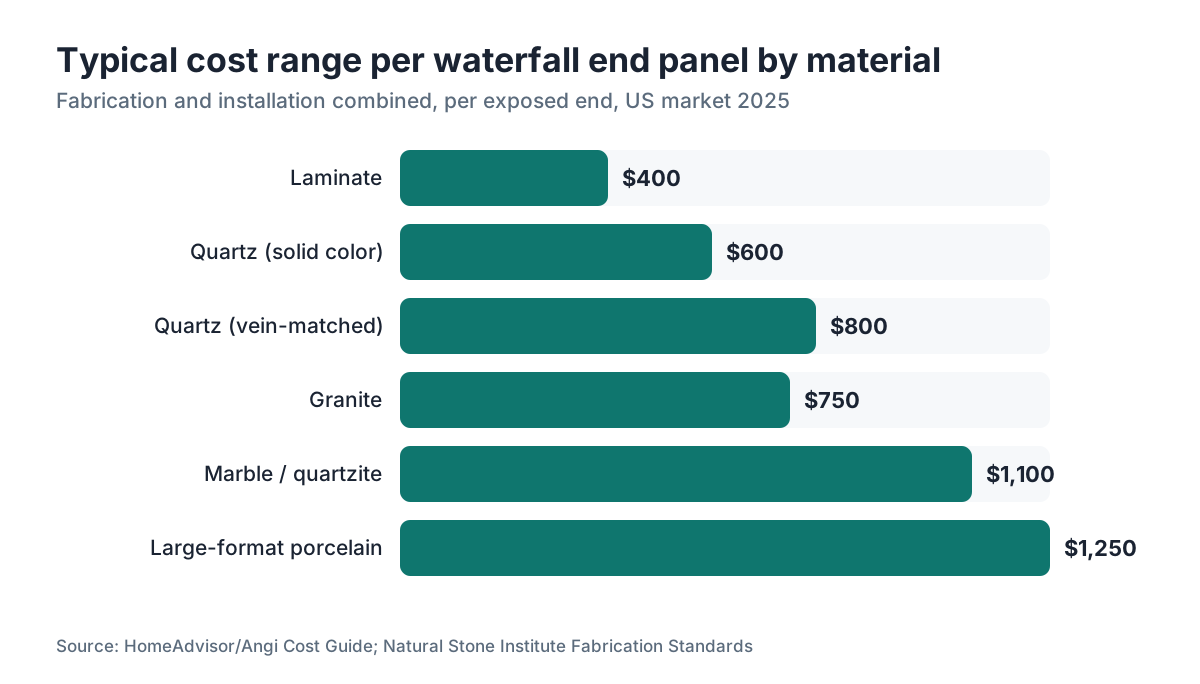
Any single number is misleading here, so here's the honest range. A complete waterfall end panel, including material, cutting, polishing, and installation, runs from about $300 for laminate to $1,500 or more for a book-matched natural stone panel on a thick island top. The most common quartz or granite waterfall lands between $400 and $900 per exposed end. [1]
Four cost drivers matter more than the material brand.
Slab thickness comes first. A 2 cm slab uses less material for the vertical panel than a 3 cm slab, but most designers spec 3 cm for islands because it looks more substantial. The vertical panel on a standard island running floor to 36 inches needs roughly 6 square feet of material per end once you plan for miter waste.
Veining continuity is second. A solid-color quartz waterfall is straightforward. A heavily veined marble or quartzite waterfall that has to match vein direction across the miter adds real layout and cutting time. Some shops charge a flat premium of $150 to $300 just for the matching work on a patterned stone.
Island length is third. A longer island may need two waterfall ends, which doubles the panel cost.
Labor market is fourth. A fabricator in a high cost-of-living metro charges more than one in a rural market. Polishing the mitered joint and doing the epoxy work alone can run $75 to $250 per joint depending on where you are. [9]
Shops running quoting software like SlabWise can price waterfall ends as line items with separate material area and labor rates. That makes it easier to show homeowners exactly what drives the number instead of dropping a lump sum that triggers sticker shock. [2]
Rough budget figure: plan $500 to $800 per waterfall end for a standard quartz or granite island in most US markets as of 2025.
Which countertop materials work best for a waterfall edge?
Quartz is the most forgiving material for a waterfall. Engineered stone is consistent enough that the vertical panel reads as a continuation of the horizontal slab without elaborate matching. Cambria, Silestone, and Caesarstone all fabricate cleanly at the miter. [/articles/cambria-countertops] If you care about vein continuity in a patterned quartz, confirm with your fabricator before ordering that the specific pattern allows it. [8]
Natural stone (granite, marble, quartzite) gives the most dramatic effect when the veins flow continuously from horizontal to vertical. It also carries the most risk if the slab isn't laid out carefully. Granite is harder and more forgiving to cut and polish at the miter than marble. Marble chips more easily at a 45-degree edge and needs careful handling on install. [/articles/marble-countertops] [/articles/granite-countertops]
Porcelain and sintered stone (Dekton, Neolith) work well but chip during miter cutting if you don't know what you're doing. Fabricators who don't regularly cut ultra-compact surfaces should not be cutting waterfall miters in these materials. The upside: large-format porcelain slabs (up to 120 x 60 inches) can run a waterfall to the floor without a seam, even on a deep island.
Butcher block and solid wood fit the waterfall look in a warmer, more organic kitchen. The joint is usually a straight butt joint rather than a miter, because wood moves and a rigid glued miter can crack over time. A cabinetmaker handles this differently from a stone fabricator. [/articles/butcher-block-countertops] [10]
Laminate does a waterfall too, and it gets its own section below because the approach is so different.
How does a laminate waterfall countertop edge work?
Laminate waterfall edges are more common than most designers think, and the look can come close to stone at a fraction of the cost. The difference is that laminate is built over a substrate (usually particleboard or MDF), so the waterfall panel is a separate substrate panel with laminate bonded to its face.
There are two approaches. The first is a straight-wrapped panel: a flat vertical substrate panel laminated on its face with the same sheet pattern as the top. The joint at the top gets covered with a matching edge strip, a wood edge cap, or a clean butt joint with laminate rolled onto the top's front edge. This is the cheapest option.
The second approach copies the mitered stone waterfall more closely. Some specialty laminate shops cut a 45-degree miter on the end of the horizontal top and the top edge of the vertical panel, then wrap the laminate continuously across the miter. This takes real skill and the right tooling, but the joint reads almost invisibly. Wilsonart laminate edge systems include banding designed for this, including their Chemsurf and solid-color lines that accept a rolled-and-bent edge on a radius former. [3]
Edge profiles for laminate add another layer of options. A wood edge profile (the laminate countertop wood edge profile) uses a solid wood strip routed to a bullnose, bevel, or ogee at the top edge of the horizontal slab before the waterfall panel goes on. It breaks up the pure laminate look with a warm wood accent that many homeowners like better than a hard laminate edge. Hardwood strips are typically 3/4 to 1 inch thick, glued and sometimes nailed to the substrate before laminating. [12]
On a tight budget, a laminate waterfall with a wood edge profile on the horizontal top runs $200 to $500 per end depending on the pattern and edge species. That's real value against stone. [/articles/laminate-countertops] [/articles/formica-countertops]
The catch with laminate waterfalls is moisture. The raw substrate edge at the floor has to be sealed or capped, and any water intrusion at that joint causes swelling. In a hard-use kitchen, wood or stone holds up better at the floor-level joint over the long haul.
What is the fabrication process for a stone waterfall edge?
It starts at the template stage. The fabricator templates the horizontal slab as usual and also measures the exact height from the top of the horizontal slab to the finished floor (or the flooring surface if the floor isn't in yet). That measurement sets the height of the vertical panel. An error here is expensive: a panel cut too short leaves a gap at the floor, and cutting a new one from natural stone can burn the entire material value of a slab.
Layout on the slab comes next. On a vein-matched waterfall, the fabricator marks the cuts on the slab face to keep the veining continuous across the future miter. This often means laying the slab flat on the saw table and projecting where the miter cut will fall against where the veining runs.
Then the miter cut. It's made on a bridge saw with the blade head tilted to exactly 45 degrees. Both the horizontal slab end and the top edge of the vertical panel get this cut. Precision here is measured in fractions of a millimeter. A miter that opens up even 1 mm across its length is visible and nearly impossible to fill cleanly in a stone with visible crystalline structure.
After cutting, both mitered faces get polished to match the top surface finish. This is the step many shops rush, and it's where quality shows. A polished miter reflects light the same way the top does, so the joint nearly disappears. A honed or unpolished miter leaves a dull line.
Installation means epoxy bonding the mitered joint with a two-part epoxy tinted to match the stone. The vertical panel usually sits on the cabinet end panel beneath it, and in some designs it's secured with additional brackets or adhesive to the cabinet side. The floor joint gets caulked rather than epoxied, so it can move slightly. [4]
Start to finish, a waterfall panel for a standard island adds two to four hours of fabrication time beyond a standard top, not counting material layout. That's the honest labor behind the upcharge.
Does a waterfall edge affect how countertops are measured and priced?
Yes, and this is where homeowners get confused by quotes. Standard countertop pricing is usually per square foot of horizontal surface. A waterfall end panel adds vertical square footage that gets measured and priced separately, because it needs its own cut, polish, and install.
A typical island 96 inches long and 36 inches deep has about 24 square feet of horizontal surface. Each waterfall end adds roughly 6 square feet once miter waste and offcut eat into the raw 9 square feet. In practice fabricators price waterfall ends as a flat line item per end, not purely by square footage, because the labor is more constant than the area. [6]
Shops also have to account for the fact that a waterfall job pulls more slab. A standard 96 x 36 island might fit on a single 120 x 55 slab. Add two 36 x 36 waterfall panels and you're pulling another 18 square feet, which may require a second slab or, at minimum, careful nesting to avoid waste. Nesting software that lays out both the horizontal top and the vertical panels in one shot helps here, because manual layout usually misses the tightest placement. [/articles/countertop-installation]
Ask for a separate line item for each waterfall end. Then you can see exactly what the design choice costs and decide whether two ends earn their keep against one.
What are the downsides or practical problems with waterfall edges?
The miter joint can crack over time. Stone moves very slightly with temperature and humidity, and a rigid epoxy miter between a horizontal and vertical panel concentrates stress right at the joint. In climates with big seasonal humidity swings, or homes with radiant floor heat, hairline cracking at the miter is more common than most showrooms admit. It's not a structural failure, but it looks bad and costs money to fix.
The joint is also a fingerprint magnet on dark stones. Epoxy fill, even when tinted well, has a slightly different sheen from the stone. On a highly polished black granite or dark quartz, the seam catches light in ways that show.
Cleanability at the floor is a real issue. The base of the vertical panel meets the floor, and that joint traps crumbs, spills, and pet hair. In a busy kitchen it needs sealing and regular cleaning. A stone or tile floor meeting the panel cleans up easier than a hardwood floor, where the joint can absorb spills.
Access to the cabinet end is permanently gone. Some island designs put electrical outlets or USB ports on the end panel below the counter. A waterfall panel usually covers those spots. Plan the electrical rough-in before you finalize the waterfall.
And cost. On a full remodel, two waterfall ends on a stone island can add $1,000 to $2,000 to the budget. That money could fund upgraded cabinet hardware, better lighting, or a nicer backsplash tile. Whether the waterfall is the best use of it depends entirely on your priorities.
How do you match veining across a waterfall miter joint?
Vein matching separates a mediocre waterfall from one that reads like a continuous flow of stone. The idea is simple: the vertical panel comes from the same slab, in a position where the veins running across the horizontal surface continue logically down the vertical face.
The most common technique is slip matching. The vertical panel is cut from the end of the same slab as the horizontal top, offset by the slab thickness. When the two pieces meet at the miter, the veining lines up approximately. It's never perfect, because cutting a miter removes material equal to the blade kerf, but on slabs with bold, flowing veins the effect is convincing.
True book matching, where the vertical panel is a mirror image of the horizontal slab end (like the pages of an open book), needs two identical slabs or a slab thick enough to re-saw. That's rare and expensive in countertop work, but it produces the most dramatic result on a highly figured stone like Calacatta marble.
Engineered quartz with a linear vein pattern (Calacatta-style quartz) slip-matches reliably because the pattern repeats predictably. Random or crystalline quartz patterns have no veining to match, so the joint is a non-issue.
The CNC or bridge saw has to be calibrated dead-on for miter cuts. A blade that drifts 0.5 degrees off 45 opens a visible gap at the joint face that no epoxy hides cleanly. Ask a fabricator how many waterfall miters they've cut in the past year. That's a fair screening question before you sign anything.
Is a waterfall edge right for your kitchen or bathroom?
The waterfall is a strong choice in a few specific situations and a poor one in others.
It works well on a freestanding island with a fully exposed end that's visible from a living area or entry. There, the waterfall resolves the awkward look of a countertop that just stops in midair over an exposed cabinet end. It reads as intentional design instead of an unfinished detail.
It works badly when the island end is tucked against a wall or an appliance, where the panel will never be seen. Paying $500 per end for a panel that stays hidden is a waste.
Floating bathroom vanities benefit from a waterfall on the exposed end for the same reason as an island. The scale is smaller, so the panel costs less.
If your design is traditional or transitional instead of contemporary, the waterfall looks off. It's a modern idiom and clashes with raised-panel cabinetry, ornate hardware, and warm wood tones. A mitered edge profile on the horizontal slab gives a tailored look without the vertical panel, and it fits better in most traditional kitchens.
If you love the look but you're watching the budget, a laminate or butcher block waterfall on a painted or natural-wood island delivers most of the visual effect for a lot less than stone. The honest trade-off is durability at the miter and at the floor, not looks.
Want to see how the waterfall option changes a quote in real time? The SlabWise instant quote tool lets you add waterfall panels as a line item and see the material and labor breakdown before you talk to a fabricator. It kills a lot of surprise at the shop.
How should you talk to a fabricator about a waterfall edge quote?
Most homeowner disappointment on waterfall jobs traces back to vague communication early on. A few specific questions protect you.
First, ask how the joint is made. A properly mitered 45-degree joint on both pieces is the standard for a professional finish. Some budget shops do a straight butt joint and cover it with a small bevel or a metal strip. That isn't wrong, but it looks different, and you should know what you're getting.
Second, ask whether the vertical panel is cut from the same slab as the horizontal top. If you care about vein matching, the answer has to be yes. If they plan to use a remnant from a different slab, you may get a poor match on a patterned stone.
Third, ask what the floor detail looks like. Does the panel rest on the subfloor or the finished floor? Is there a caulk joint? Will they leave a reveal? The floor joint is the spot most likely to fail or look messy, and a good fabricator has a planned answer.
Fourth, ask for a separate line-item price for each waterfall end. Then you know what the design choice costs on its own, apart from the horizontal top.
Fifth, for laminate jobs, ask which edge profile system they use for the waterfall joint. Wilsonart laminate edge systems and similar ones from Formica and Laminart include specific joinery solutions that beat shop-improvised methods. If the fabricator hasn't heard of these systems, that tells you something. [7] [12]
A fabricator who answers all five questions clearly and specifically has done this work before.
Frequently asked questions
What is the difference between a waterfall edge and a mitered edge on a countertop?
A mitered edge profile shapes only the front lip of the horizontal slab, cutting the face at a 45-degree angle so you see the stone face instead of the raw substrate thickness. A waterfall edge adds a full vertical panel that runs from the countertop surface all the way to the floor on an exposed end. The waterfall is a design concept; the miter is the joinery technique used to attach the waterfall panel.
Can you do a waterfall edge on a laminate countertop?
Yes. A laminate waterfall uses a separate substrate panel covered with matching laminate on the vertical face. The joint at the top can be a wrapped miter (more finished-looking) or a butt joint with an edge strip. Wilsonart and Formica both make laminate systems suited for this. Cost runs $200 to $500 per end, well below stone. Moisture resistance at the floor joint is the main long-term concern.
How much does a waterfall countertop edge cost in 2025?
Budget roughly $300 to $500 per end for laminate, $400 to $900 per end for quartz or granite, and $700 to $1,500 or more per end for marble or large-format porcelain. Book-matched or vein-matched natural stone adds $150 to $300 to those figures. These are fabrication-and-install totals, not material-only prices. Prices vary by market and shop.
Does a waterfall edge add to the square footage I pay for?
Yes. The vertical panel is additional material that the fabricator cuts, polishes, and installs separately from the horizontal top. Most shops price it as a flat line item per end rather than purely by square footage, because the mitered joinery labor is the main cost driver. Expect to see it as a separate charge on your quote, not rolled into the per-square-foot rate for the horizontal surface.
What materials cannot be used for a waterfall edge?
Almost any solid countertop material can work. Tile countertops are the main exception, because grout lines make a continuous waterfall look essentially impossible to execute cleanly. Ultra-thin surfaces (under 6mm) are also risky for miter cuts because the edge chips easily. Ceramic tile, mosaic surfaces, and very fragile hand-painted surfaces are not suited to the waterfall treatment.
How do you prevent the miter joint on a waterfall edge from cracking?
Use a color-matched two-part epoxy for the bond, not standard construction adhesive. Make sure the miter cuts are precise so there is no gap to stress the joint. Avoid applying the waterfall panel directly over radiant floor heat without discussing expansion with your fabricator. Caulk the floor joint rather than grouting or epoxying it rigidly, so the panel can move slightly with seasonal changes without stressing the top miter.
Can a waterfall edge be added to an existing countertop after installation?
It is possible but rarely practical. The fabricator would need to cut a miter on the end of the existing installed slab (very difficult in place), source matching material for the vertical panel, and make a tight joint. In almost all cases the better approach is to replace the top with a new slab cut to include the waterfall at the same time. Retrofitting adds more cost and risk than a new job.
What is a waterfall edge on a bathroom vanity, and is it different from a kitchen version?
Functionally identical: the countertop material continues vertically down the exposed cabinet end to the floor. Bathroom versions are smaller in scale (vanities are typically 21 to 24 inches deep versus 36 to 42 for an island), so the panel area is lower and the job costs less. The same material, joinery, and vein-matching considerations apply. Floating vanities with legs or a pedestal design are particularly well suited to the waterfall look.
Do waterfall edges work with quartz brands like Cambria or Silestone?
Yes, all major engineered quartz brands fabricate cleanly for waterfall applications. Because engineered quartz has a consistent, non-directional pattern in most colorways, vein matching is simpler than with natural stone. Brands with bold linear veining (like Cambria's Brittanicca or Calacatta lines) require the same slip-matching care as marble. Confirm with your fabricator that they stock enough of the pattern to cover both the horizontal top and the vertical panel before you commit.
What are laminate countertop wood edge profiles and how do they relate to a waterfall design?
A laminate countertop wood edge profile is a solid wood strip (typically hardwood like maple, oak, or walnut, 3/4 to 1 inch thick) applied to the front edge of the laminate substrate before the surface laminate is installed. It gives the countertop a warm, finished edge that reads as wood rather than raw laminate. On a waterfall laminate design, the wood edge typically runs along the top horizontal surface while the vertical panel uses the laminate face, creating a subtle contrast that looks intentional.
How thick should a countertop be for a good-looking waterfall edge?
Three centimeter (approximately 1.25 inch) stone or quartz slabs produce the most substantial-looking waterfall edge and are the industry standard for islands. Two centimeter slabs look thinner and can appear delicate at the miter joint, though they cost less. Some designers stack two 2 cm slabs at the edge to create a 4 cm mitered face (called a mitered laminated edge) before the waterfall panel, giving a dramatic thick appearance at lower material cost than a full 3 cm slab for the whole top.
Does a waterfall edge affect how much slab material I need to buy?
Yes, often significantly. Each vertical panel adds real square footage that must come from your slab. A pair of waterfall ends on a 36-inch deep island each need roughly 6 to 9 square feet of material. This can push a project that fits on one slab into requiring a second slab, which doubles your material cost for that portion of the job. Ask your fabricator to show you the slab layout with the waterfall panels included before finalizing the purchase.
Is the waterfall edge a trend that will look dated, or is it a classic design?
Nobody has a definitive answer here. The waterfall has been popular for over a decade in contemporary design, which suggests it has some staying power beyond a short trend cycle. That said, it is closely tied to the minimalist flat-front cabinet aesthetic, and design tastes do shift. In a forever home or a spec build targeting a specific buyer demographic, it reads as current and high-end. If you are optimizing for resale appeal across a broad buyer pool, a well-executed standard edge may be the safer choice.
Sources
- HomeAdvisor (Angi), Countertop Installation Cost Guide: Waterfall countertop end panels typically add $300 to $1,500+ per end to a countertop project depending on material and complexity
- SlabWise, countertop fabrication quoting software: Shops use fabrication quoting software to price waterfall ends as separate line items with distinct material area and labor rates
- Wilsonart, Edge Profiles and Laminate Systems product documentation: Wilsonart produces laminate edge banding and Chemsurf lines compatible with miter-wrapped waterfall edge applications on laminate countertops
- Marble Institute of America (Natural Stone Institute), Fabrication and Installation Standards: Mitered stone joints should be bonded with color-matched two-part epoxy; floor joints should be caulked to allow movement
- U.S. Census Bureau, American Housing Survey, Kitchen Remodeling Data: Kitchen remodeling is one of the most common home improvement projects; countertop replacement is among the top-cited upgrades
- National Kitchen and Bath Association (NKBA), Design and Specification Guidelines: Standard kitchen island countertop depth is 24 to 42 inches; standard height is 36 inches, establishing the dimensions used to calculate waterfall panel area
- Formica Corporation, Countertop Edge Profiles and Laminate Systems: Formica manufactures matching laminate edge banding systems used in waterfall and other edge profile applications for laminate countertops
- Cambria, Product Specification and Fabrication Guidelines: Cambria engineered quartz is suitable for miter-cut waterfall applications; linear-vein patterns such as Brittanicca require slip-matching by the fabricator
- U.S. Bureau of Labor Statistics, Occupational Outlook Handbook: Tile and Stone Setters: Stone fabrication and installation labor rates vary significantly by region and experience level, directly affecting waterfall edge pricing
- Forest Products Laboratory, USDA, Wood Handbook: Wood as an Engineering Material: Wood moves with moisture changes, which is why rigid glued miter joints in solid-wood waterfall countertops can crack and butt joints are often preferred
- Natural Stone Institute, Dimensional Stone Design Manual: Three-centimeter (approximately 1.25 inch) slab thickness is the industry standard for kitchen islands and countertops requiring structural integrity at unsupported spans
- Laminart, Edge Profile Systems for Laminate Surfaces: Specialty laminate fabricators use dedicated edge profile systems including wood edge banding to produce finished waterfall and other complex edge treatments
Last updated 2026-07-09