TL;DR
- 3 cm quartz countertops typically cost $50 to $120 per square foot fully installed in the US, with most kitchens landing between $2,000 and $5,500 total.
- Material grade, edge profile, number of cutouts, and your region drive most of the spread.
- Budget-tier brands start near $40/sq ft fabricated; premium brands like Cambria push past $100/sq ft before installation.
What does 3 cm quartz cost per square foot installed?
The honest installed range for 3 cm quartz is $50 to $120 per square foot, material and labor combined. That range isn't vague hedging. It reflects a real spread between a builder-grade 3 cm quartz slab from a wholesale distributor and a thick-vein Calacatta pattern from a premium brand, both cut and set by a professional fabricator in your kitchen.
Breaking that down, material alone (the fabricated slab, cut to your layout) runs roughly $25 to $65 per square foot depending on brand and color. Fabrication and installation labor adds another $15 to $40 per square foot, with higher costs in coastal metros like New York, Los Angeles, and Seattle, and lower costs in the South and Midwest.[1]
For a typical 40-square-foot kitchen countertop, that puts total project cost at $2,000 to $4,800. A large kitchen at 65 square feet can easily reach $5,500 to $7,800 installed, once you add edge upgrades and sink cutouts.
If a quote comes in below $45/sq ft installed, ask what's included. Some shops quote material-only or exclude the sink cutout, backsplash cuts, and haul-away. Those line items add up fast.
Why is 3 cm thicker than 2 cm, and does it cost more?
Quartz slabs are sold in two standard thicknesses: 2 cm (about 3/4 inch) and 3 cm (about 1-1/4 inches). Nearly every residential kitchen countertop installed today uses 3 cm. It's the industry default.
3 cm slabs are roughly 30 to 40 percent heavier than 2 cm, which means they need more raw material, cost more to ship, and take more effort to handle on-site. But they also don't require a plywood substrate to look substantial, and they take an eased or mitered edge cleanly without laminating pieces together. For a standard kitchen, those handling costs are already priced into the standard fabrication quote you'll receive.
2 cm quartz is still used for vertical applications (shower walls, backsplashes, furniture faces) and occasionally for commercial work where weight matters. If someone quotes you 2 cm for a kitchen countertop, that's unusual and worth questioning.
The price premium for 3 cm over 2 cm is roughly $5 to $10 per square foot on the material side, and that's almost always already reflected in the quotes you'll receive. You generally won't see a line item that says "3 cm upcharge." It's just what a kitchen countertop quote is based on.[2]
What does a full kitchen countertop project actually cost?
Here's how a real mid-range kitchen project breaks down. Assume 45 square feet of 3 cm quartz at $70/sq ft installed, a standard undermount sink cutout, and one eased edge upgrade.
| Line item | Typical range |
|---|---|
| Material (45 sq ft at $30, $45/sq ft) | $1,350, $2,025 |
| Fabrication and installation labor | $675, $1,350 |
| Undermount sink cutout | $150, $250 |
| Edge upgrade (eased or beveled) | $10, $20 per linear foot |
| Cooktop cutout | $100, $200 |
| Seam, if required | $0, $150 |
| Removal and haul-away of old tops | $100, $300 |
| Total (estimated) | $2,385, $4,525 |
Most homeowners in a mid-size city end up around $3,200 to $4,000 for a complete kitchen replacement with a name-brand 3 cm quartz. That's a reasonable number to hold in your head when evaluating quotes.
One thing that surprises people: the number of seams matters a lot. A large L-shaped or U-shaped kitchen may need two or three seams, each adding material waste and labor time. Shops typically charge nothing extra for a single seam but may add $100 to $200 for additional ones. Ask upfront.
How does brand choice affect 3 cm quartz price?
Brand is probably the single biggest lever on material cost. 3 cm quartz is engineered stone, roughly 90 to 95 percent ground quartz crystals bound with polymer resin and pigment.[3] The manufacturing process is similar across brands, but sourcing, design investment, slab sizing, and distribution margins vary a lot.
Entry-level brands available through big-box stores (think MSI Q Premium or Silestone's base line) often land at $25 to $40 per square foot for the fabricated slab. Mid-range brands like Caesarstone or Viatera run $35 to $55/sq ft. Premium brands, especially those with bold veining or larger slab formats, push $55 to $80/sq ft before you set foot in a fabrication shop.
Cambria countertops are a good example at the top end. Cambria is US-manufactured, sold exclusively through authorized dealers, and typically prices at $65 to $100 per square foot for the fabricated material alone. That's real money, but Cambria's lifetime warranty and consistent color lots are genuinely useful, especially on large kitchens where slab matching matters.
Here's the honest part: for most kitchens, a mid-tier brand at $40/sq ft and a premium brand at $75/sq ft are hard to tell apart after five years of use. You're paying partly for aesthetics and partly for the brand name. If you love a specific pattern, pay for it. If you're neutral, save the money.
What variables add the most cost to a quartz countertop quote?
Edge profile is the most common upsell in a quartz quote. A standard eased edge (flat top, slightly softened front corner) is usually included in the base price. Step up to an ogee, waterfall, or triple pencil edge and you're adding $15 to $35 per linear foot. A 25-foot perimeter kitchen can add $375 to $875 just from the edge choice.[4]
Cutouts add real labor time and waste material. An undermount sink typically adds $150 to $250. Each cooktop cutout adds $100 to $200. Faucet holes, if drilled separately, are usually $30 to $60 each.
Complicated layouts cost more. An island with a waterfall leg (where the slab wraps vertically down the side of the cabinetry) requires precise mitering and usually adds $300 to $800 depending on the size. Curved sections, inside corners with tight radii, and bump-outs all take more saw time and risk more slab loss.
Installation difficulty matters too. A second-floor kitchen means carrying heavy 3 cm slabs up stairs, which most shops charge for. Tight spaces, difficult access, or a project that requires setting tops in sections to navigate doorways all add labor.
One thing that doesn't add much cost but surprises people: backsplash cuts. If your quartz countertop includes a 4-inch or 6-inch quartz backsplash strip, that's typically cut from material you've already paid for and adds modest labor. A full-height quartz backsplash is a different story and gets quoted separately.
How does quartz compare in cost to granite, marble, and laminate?
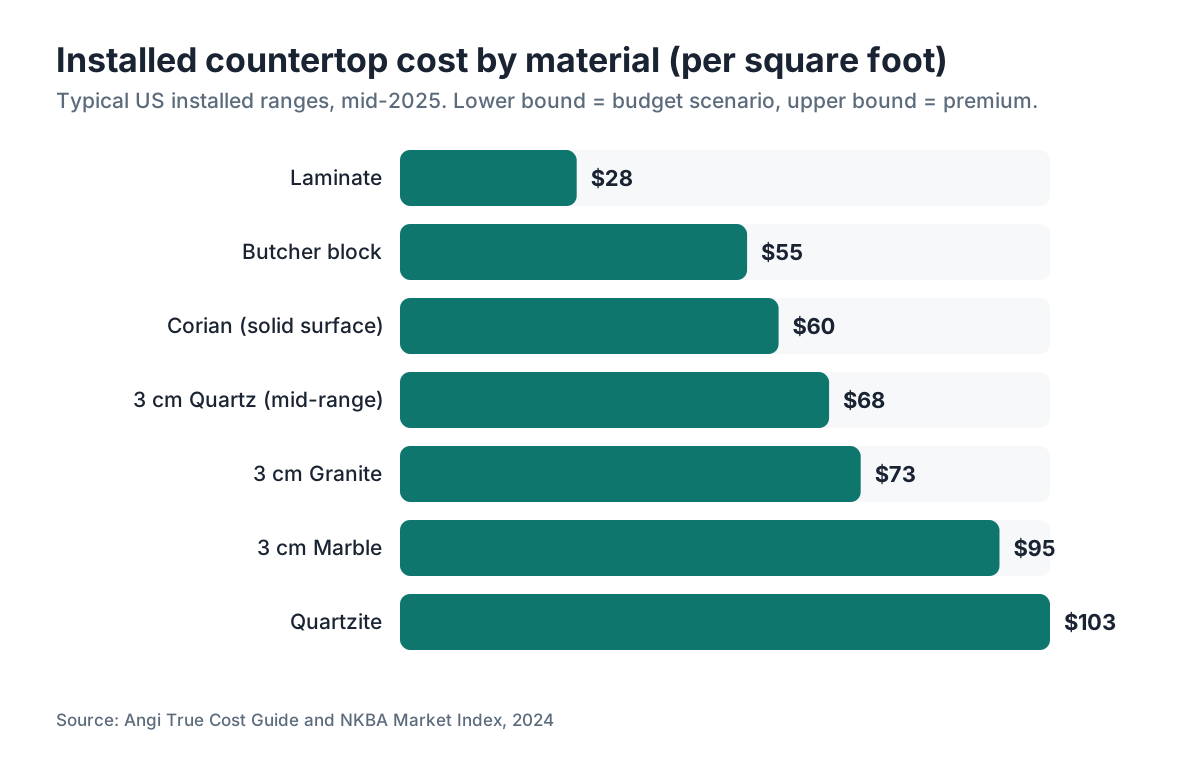
3 cm quartz sits in the middle of the countertop cost spectrum. Here's how it compares to common alternatives on an installed-per-square-foot basis.[5][6]
| Material | Installed cost per sq ft (typical range) |
|---|---|
| Laminate (Formica, etc.) | $15, $40 |
| Butcher block | $30, $80 |
| Corian (solid surface) | $40, $80 |
| 3 cm Quartz (mid-range brand) | $50, $85 |
| 3 cm Granite | $45, $100 |
| 3 cm Marble | $60, $130 |
| Quartzite | $65, $140 |
Granite countertops overlap heavily with quartz in price and are genuinely worth considering if you want natural stone character. Granite needs periodic sealing (every one to two years for most stones) and is porous, which some homeowners find inconvenient. Quartz is non-porous and never needs sealing, which is a real practical advantage in a busy kitchen.
Laminate countertops are the obvious budget choice. Modern laminate has gotten much better looking, but it's still laminate, meaning seams show, edges chip over time, and hot pans will damage the surface. If budget is tight, Formica countertops or Corian countertops are worth comparing before you commit to quartz.
Marble countertops cost more than quartz on average and require significantly more maintenance. Unless you specifically want the aesthetic and don't mind etching from acids, quartz gives you most of the visual without the upkeep.
For a full look at all the options before you decide, the kitchen countertops overview is a good place to start.
How do fabricators actually price 3 cm quartz jobs?
This section is mostly for fabricators and shop owners, but homeowners benefit from understanding it too, because knowing how shops price helps you read quotes intelligently.
Most shops price quartz jobs by measuring the actual square footage of countertop surface, then adding line items for edges, cutouts, and any special operations. The material cost is based on slab consumption, more than net surface area. A shop has to account for waste from cutting around corners, cutouts, and the saw kerfs themselves. Industry waste factors typically run 15 to 25 percent on a standard kitchen layout, higher on complex L-shapes or islands.[7]
So if your kitchen has 40 square feet of countertop, the shop probably needs to purchase or pull 48 to 50 square feet worth of slab material to complete the job safely. That waste is built into the per-square-foot price you see.
Material cost to a shop for mid-range 3 cm quartz runs roughly $12 to $25 per square foot at the slab level, depending on brand, distributor, and whether they're buying full slabs or remnants. By the time you add fabrication (saw time, CNC time, edge polishing, templating labor), a reasonable shop cost is $30 to $45 per square foot before markup. The markup covers overhead, delivery, installation labor, and margin.
Shops that use digital templating and nesting software can meaningfully reduce waste, which is part of why quotes vary between shops on the same material. A shop running optimized digital layouts on their saw may be able to price more competitively on the same brand of quartz. Tools like SlabWise help fabricators build accurate quotes and minimize slab waste, which ultimately keeps prices more honest for everyone.
For homeowners, the practical lesson is this: get three quotes. If one is 30 percent below the others with the same brand of material, ask what's different. Sometimes it's genuine efficiency. Sometimes something is missing from the quote.
Does quartz cost more or less at big-box stores versus local fabricators?
The honest answer is: it depends, and usually not in the direction people expect. Big-box quotes can look cheap up front and end up matching or beating a local shop only on paper.
Big-box stores like Home Depot and Lowe's sell quartz countertops through their countertop programs, typically partnering with regional fabricators. The prices can look attractive at first glance, but the quote often uses a limited brand selection (usually their house brands or specific partner brands), and the edge, cutout, and complexity pricing can add up quickly. The finished price for a typical kitchen is often comparable to, or higher than, a direct quote from a local shop.[8]
Local fabricators sometimes have better relationships with distributors, can offer a wider selection of brands, and often have more flexibility on job complexity. They may also be more willing to use a slab remnant for a small job, which cuts cost significantly.
That said, big-box programs come with the perceived safety of a national company handling the warranty. For homeowners who want that backstop and aren't comfortable vetting local shops, it's a reasonable trade-off.
Get at least one local fabricator quote alongside any big-box quote before you decide. Don't assume either is automatically cheaper.
What questions should you ask before signing a countertop quote?
A quote is only as useful as what's included in it. Before you sign, ask these questions specifically.
First: is the quoted price per square foot based on the net surface area I measured, or does it include a waste factor? Some shops quote on net; others quote on gross slab consumption. Both can be legitimate, but they produce different-looking per-square-foot numbers for the same total cost.
Second: what edge profile is included? If the quote says "standard edge," find out exactly what that means. Eased? Straight? Beveled? And what do upgrades cost?
Third: what cutouts are included and priced? Undermount sink, drop-in sink, cooktop, and faucet holes should each appear as line items or be clearly stated as included.
Fourth: does the price include removal of existing countertops? Most shops charge $100 to $300 for this. Some assume you'll demo your old tops yourself.
Fifth: who does the templating? Digital templates (laser or structured light scanning) produce more accurate results than hand templates and reduce the chance of a poor fit. Ask whether they template in person before fabrication.
Sixth: what's the lead time from deposit to install? Most residential quartz jobs run 7 to 21 days from templating to install, but backordered slabs, shop backlog, and holidays can extend that.[9]
For everything that happens after the tops go in, see the countertop installation guide for what to expect on install day.
How can you get the best price on 3 cm quartz without sacrificing quality?
A few tactics that actually work, in rough order of impact.
Buy from a remnant pile when your kitchen is small. Most fabrication shops keep a remnant rack of cut-down slabs from previous jobs. For a kitchen under 25 square feet or a bathroom vanity, a remnant can cut material cost by 30 to 50 percent. You get the same quality slab at a fraction of the price because the shop would otherwise discard the piece.
Avoid the trendy colors. Ultra-white slabs with bold veining are expensive because demand is high and they're often licensed patterns from premium brands. A simpler concrete-look or solid color in 3 cm quartz is often available from the same brand at $10 to $15 per square foot less.
Simplify the edge. The visual impact of a fancy edge is much smaller than its cost. An eased or slightly beveled edge looks clean, costs nothing extra, and nobody will notice you didn't choose the ogee.
Flex on timing. Shops are busier in spring and early summer. If you can schedule your job for January or February, some shops will negotiate on labor, especially if it fills a quiet week.
Get three quotes on the same brand and color. This is the single highest-leverage thing you can do. Take the same slab name and color, and get three fabricators to quote the same job. The spread is often $500 to $1,500 on a mid-size kitchen, purely from shop efficiency and pricing strategy.
Consider butcher block countertops for an island only. If you love the look of quartz but want to trim total cost, using quartz on perimeter counters and butcher block on the island is a legitimate design choice that cuts total spend.
If you want a tool to sanity-check a fabricator's quote or build your own layout estimate, SlabWise has an instant quote tool built for exactly this, at no cost to homeowners.
Does quartz countertop thickness affect durability and performance?
In practical terms, 3 cm quartz is more than strong enough for any residential countertop use. The National Kitchen and Bath Association (NKBA) doesn't mandate a minimum thickness for countertops, but 3 cm has become the de facto standard because it resists cracking during fabrication, transport, and installation far better than 2 cm.[10]
Quartz itself, regardless of thickness, is rated for scratch resistance, stain resistance, and heat resistance in most manufacturer specs. The Mohs hardness of quartz mineral is 7, which means most everyday knives won't scratch it. That said, the resin binder is softer than the quartz crystals, so aggressive cutting directly on the surface will eventually dull the finish. Use a cutting board.
Heat is the more important caution. Polymer resin in quartz can discolor or crack from sudden thermal shock, say, a hot pan pulled directly from a 500-degree oven and set on the counter. The discoloration is usually not covered under warranty.[11] Use trivets. This is true whether your slab is 2 cm or 3 cm.
For sealing: quartz doesn't need it. Unlike granite or quartzite, quartz is non-porous by manufacture. If someone tries to sell you a sealing service for quartz, that's unnecessary. For comparison, see what proper care looks like for natural stone in the how to clean stone countertops guide.
Frequently asked questions
What is the average cost to replace kitchen countertops with 3 cm quartz?
Most homeowners pay between $2,500 and $5,500 to replace kitchen countertops with 3 cm quartz, fully installed. A smaller kitchen (30 to 40 square feet) runs $2,000 to $3,500 with a mid-range brand. A larger kitchen (55 to 70 square feet) with an island and premium brand can reach $6,000 to $8,500. Region matters: coastal metros run 20 to 30 percent higher than the national midpoint.
Is 3 cm quartz worth the extra cost over 2 cm?
For kitchen countertops, yes. 3 cm is the standard thickness for a reason. It handles transport and installation stress without cracking, takes edge profiles cleanly without laminating, and looks substantial without a plywood buildup underneath. 2 cm quartz is fine for vertical applications or furniture, but for a kitchen work surface, pay the premium and get 3 cm.
How much does a quartz countertop cost per square foot for material only?
Material-only cost for 3 cm quartz (the fabricated slab, cut to your layout) runs $25 to $65 per square foot depending on brand. Budget and house-brand quartz starts around $25 to $35/sq ft. Mid-range brands like Caesarstone or Silestone run $35 to $55/sq ft. Premium brands like Cambria reach $65 to $85/sq ft for the material alone, before labor.
What edge profiles cost extra on a quartz countertop?
A standard eased edge is almost always included at no extra charge. Upgrades like a bevel, ogee, bullnose, dupont, or waterfall mitered edge typically add $10 to $35 per linear foot. A 25-foot kitchen perimeter with an ogee edge upgrade can add $375 to $875 to the total bill. The visual difference between eased and ogee is modest. The cost difference is not.
Does quartz countertop installation include removal of old countertops?
Not always. Many fabricators include demo and haul-away in their install quote, but some treat it as a separate line item at $100 to $300. Ask before you sign. If demo is excluded, you can do it yourself in most cases (shut off the water, disconnect plumbing, unscrew from below) but confirm your fabricator is comfortable arriving to a site where you've already demoed.
How long does it take to get quartz countertops installed after ordering?
Most residential quartz projects run 7 to 21 days from templating to installation. The typical sequence is: sign contract and pay deposit, wait for any slab to arrive (if not in stock), schedule a template appointment, fabricate over 3 to 7 shop days, then install. Busy seasons (March through August) stretch lead times. Asking about current lead time before you commit is smart.
Can you get a quartz countertop for under $1,000 total?
For a small bathroom vanity or laundry room, yes. A 15 to 20 square foot vanity top in a budget-tier 3 cm quartz can run $750 to $1,500 installed. For a full kitchen, a sub-$1,000 project is unrealistic unless you find a large remnant, do your own demo, and find a shop willing to price very aggressively. The material and labor alone on a typical kitchen exceed $1,000.
Does quartz need to be sealed?
No. Quartz countertops are manufactured to be non-porous and do not require sealing, ever. This is one of the genuine practical advantages over granite, marble, and quartzite, all of which need periodic sealing to resist staining. If a contractor or store offers to seal your quartz countertop, save the money. It's an unnecessary service.
How do quartz countertop costs vary by region in the US?
Regional variation is real and significant. Installed costs in coastal metros (New York, San Francisco, Seattle, Boston) typically run 20 to 35 percent above the national average. The South and parts of the Midwest tend to run below average. Labor rates, distributor networks, and local market competition all affect the final price. A quote in suburban Atlanta for the same brand and job may be $800 to $1,500 less than the same quote in Brooklyn.
What is the difference between quartz and quartzite countertops?
Quartz countertops are engineered: ground quartz crystals bound with polymer resin, manufactured in consistent colors and patterns. Quartzite is a natural metamorphic rock quarried in slabs, much like granite or marble. Quartzite is generally harder and more heat-resistant than engineered quartz but is porous and requires sealing. Quartzite typically costs more, running $65 to $140 per square foot installed versus $50 to $120 for quartz.
Is a waterfall edge on a quartz island worth the extra cost?
It's a purely aesthetic decision, but the cost is real. A waterfall edge requires an additional slab or a large piece to wrap vertically down one or both ends of the island. Labor includes precise miter cuts and careful alignment of the veining. Total add-on cost typically runs $400 to $1,200 depending on island size and slab pattern. If the look matters to you, budget for it. It won't improve function.
How do I compare quartz countertop quotes fairly?
Make sure each quote lists the same brand, color, and thickness; the same edge profile; cutout counts (sink, cooktop, faucet holes); whether demo and haul-away are included; and the total installed price, more than per-square-foot. A quote missing a $250 sink cutout and $200 demo looks cheaper than it is. Build a simple comparison sheet and fill in the same line items across all three quotes.
What are the most popular 3 cm quartz brands in the US?
The most widely installed brands in US residential kitchens include Caesarstone (Israeli-manufactured, widely distributed), Silestone (Spanish, owned by Cosentino), Cambria (US-manufactured, dealer-exclusive), MSI Q Premium (value-positioned, widely available), and Viatera (distributed through Lowe's). Each has strengths: Cambria offers a strong warranty and US sourcing; Caesarstone has a long US track record; MSI offers competitive pricing on consistent commercial-grade colors.
Sources
- US Bureau of Labor Statistics, Occupational Employment and Wage Statistics: Regional variation in construction and installation labor wages across US metro areas
- Marble Institute of America (now Natural Stone Institute), Dimension Stone Design Manual: Standard slab thickness designations and applications for engineered and natural stone countertops
- Breton S.p.A., inventor of the Bretonstone process (US Patent 4,698,010), referenced in NSF International Standard 51: Engineered quartz is composed of approximately 90 to 95 percent ground quartz bound with polymer resin
- National Kitchen and Bath Association (NKBA), Kitchen and Bath Market Index: Edge profile upgrades and countertop line item pricing structures in residential kitchen projects
- HomeAdvisor (Angi), True Cost Guide: Countertop Installation: Installed cost per square foot ranges for common countertop materials including quartz, granite, marble, laminate, and solid surface
- US Census Bureau, American Housing Survey: Kitchen remodel cost data and countertop material prevalence in US housing stock
- Tile and Stone Fabricator Alliance, Fabrication Best Practices Guide: Standard material waste factors of 15 to 25 percent for kitchen countertop layouts
- Consumer Reports, Kitchen Countertops Buying Guide: Comparison of big-box store countertop program pricing vs. local fabricator quotes for the same material
- National Kitchen and Bath Association (NKBA), Project Timeline Guidelines: Typical 7 to 21 day lead time from templating to installation for residential countertop projects
- National Kitchen and Bath Association (NKBA), Kitchen Planning Guidelines and Access Standards: 3 cm thickness as industry standard for residential countertops due to structural performance during handling and installation
- Caesarstone, Product Care and Warranty Documentation: Thermal shock and sudden temperature change can discolor or crack quartz resin binder and is excluded from manufacturer warranty coverage
Last updated 2026-07-10