TL;DR
- Tile countertops cost roughly $5 to $35 per square foot installed, depending on material and tile size.
- Ceramic and porcelain are the budget end; granite tile sits in the middle.
- The big trade-off is grout: tile beats slab pricing, but grout lines collect bacteria, stain, and crack.
- They work best for budget renovations, heat-heavy zones, or DIYers comfortable with thinset.
What are tile countertops and where do they still make sense?
A tile countertop is exactly what it sounds like: individual tiles set in thinset mortar on a substrate, with grout filling the joints between them. The substrate is typically cement board (also called cementitious backer unit or CBU), though some older installs used plywood or hardibacker. The grout joints are the defining characteristic, and they drive almost every complaint homeowners have about the format.
Tile countertops had their peak popularity in the 1980s and 1990s. By the early 2000s, engineered quartz and affordable slab granite started crowding them out of kitchens. But they didn't disappear, and for certain use cases, they're genuinely the right call.
Where tile still makes sense: outdoor kitchens, where freeze-thaw cycles would crack a slab or destroy a wood-based surface. Laundry rooms and utility zones where you need heat resistance on a strict budget. Rental properties where durability under rough treatment matters more than an unbroken slab look. DIY-friendly renovations where hiring a fabricator isn't in the budget. And bathrooms, where the format feels more at home anyway and grout-cleaning expectations are already established.
Where tile struggles: a busy cooking kitchen where the cook rolls dough, slides cutting boards, and wipes down the surface several times a day. Those grout lines trap food, darken, and crack under the thermal shock of a hot pan set down carelessly. They also make knife work awkward if the lines run across your prep zone.
How much do tile countertops cost per square foot?
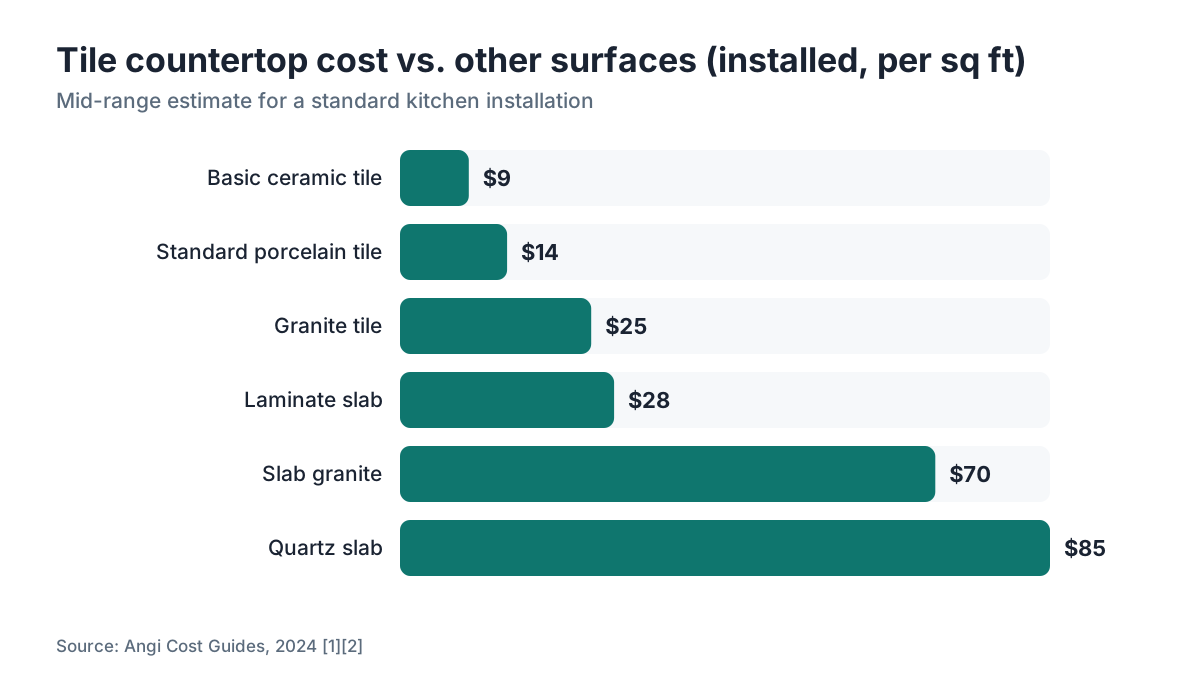
Installed cost for tile countertops runs from about $5 to $35 per square foot depending on material, tile size, edge treatment, and labor market [1]. That's a wide spread, so here's how the buckets break down.
| Tile type | Material only ($/sq ft) | Installed ($/sq ft) |
|---|---|---|
| Basic ceramic | $1, $5 | $5, $12 |
| Porcelain (standard) | $3, $10 | $8, $20 |
| Porcelain large-format | $5, $15 | $12, $28 |
| Granite tile countertop | $5, $15 | $15, $35 |
| Marble tile | $7, $20 | $18, $40 |
| Handmade/artisan ceramic | $8, $30 | $20, $50 |
Labor runs $4 to $12 per square foot for a competent tile setter, and that's the number most homeowners underestimate [1]. Large-format tiles (24x24 or larger) cost more to set because they require a perfectly flat substrate and more time to lay level. Mosaic tiles cost more because every square foot has more cuts and more grout lines to pack.
By comparison, installed slab granite typically runs $40 to $100 per square foot, and engineered quartz runs $50 to $120 [2]. So tile's cost advantage is real, especially at the ceramic end. The catch is that a slab lasts decades with minimal maintenance, and the maintenance hours on tile add up.
Don't forget to budget for: substrate (cement board plus fasteners, roughly $1.50 to $3/sq ft), thinset mortar ($0.50 to $1.50/sq ft), grout ($0.50 to $2/sq ft), a bullnose or edge tile for exposed edges, and sealer if you use natural stone or unglazed tile. A 30-square-foot kitchen island in standard porcelain, fully installed, typically runs $400 to $700 all-in, not counting any demo of the existing surface.
What materials can you use for tile countertops?
The choice of tile material changes everything: maintenance, feel, cost, and durability.
Ceramic is the classic entry point. It's made from clay fired at relatively low temperatures, it's widely available, and the glazed surface resists stains and cleans easily. The weakness is the tile body itself: if you chip through the glaze, the porous clay underneath absorbs stains and is harder to repair. Ceramic also has lower PEI (Porcelain Enamel Institute) ratings than porcelain for wear, so use PEI 3 or higher for countertops [3].
Porcelain is fired at higher temperatures and has a denser body than ceramic, which means it absorbs almost no water (water absorption under 0.5% per ANSI A137.1 [4]) and handles chips better because the color often runs deeper into the tile. Large-format porcelain slabs (often marketed as sintered stone or porcelain panels) can reach 120 inches long, which eliminates most grout lines and starts to look more like a true slab surface.
Granite tile countertop options use the same natural stone as slab granite, cut into tiles roughly 12x12 or 18x18 inches. You get the real stone look and the hardness of granite (about 7 on the Mohs scale [9]) at a fraction of slab cost. The grout lines are still present, and natural stone tile needs sealing. If you want a deeper look at what slab granite involves, see our granite countertops guide. The term "countertop tile granite" sometimes appears in search and refers to the same product, just from a different angle.
Marble tile offers the classic veining look at lower cost than marble slabs, but marble is calcium carbonate (Mohs 3 to 4), so it etches from acids like lemon juice, vinegar, and coffee [5]. Grout lines plus etching means more maintenance than almost any other tile option.
Mosaic tile (glass, stone, or ceramic in pieces under 2 inches) makes striking backsplashes but creates so many grout lines on a countertop that cleaning becomes a full-time job. I'd skip it for any functional prep surface.
Handmade or artisan tile has irregular surfaces that look beautiful in photos but create an uneven counter that's annoying to use. Great for a decorative island front or a low-use bar. Problematic as your main cooking surface.
What's the real problem with grout lines on countertops?
Grout is the conversation nobody wants to have before they install tile countertops, and the conversation everyone has six months later.
Standard sanded grout is porous. It absorbs cooking oils, tomato sauce, coffee, and anything else that pools in the joints. Unsanded grout (used in joints under 1/8 inch) is slightly less porous but still absorbs. Staining happens fast in a kitchen and is hard to reverse once set.
The FDA Food Code requires food-contact surfaces in commercial kitchens to be smooth, non-absorbent, and easily cleanable [6]. Grout joints fail that standard, which is why you don't see tile countertops in professional kitchens. Home kitchens don't have the same legal obligation, but the sanitation logic still applies.
Epoxy grout solves most of the absorption problem. It's non-porous, resists chemicals, and doesn't require sealing. The trade-off is price (roughly 2 to 4 times the cost of cementitious grout), difficulty of installation (it sets fast and is unforgiving), and the fact that it's nearly impossible to remove if you change your mind. For a kitchen tile countertop, epoxy grout earns the extra cost if you're committed to the format.
Even with epoxy grout, grout lines crack. Substrates flex slightly, temperature cycling expands and contracts the tile and the substrate at different rates, and settling in the cabinet base works the joints over time. A countertop that looked great at install starts showing hairline cracks in the grout within two to five years in most climates. Regrouting is a real maintenance task, not a hypothetical.
If you go the tile route, use 1/16-inch joints where your tile allows it, go with epoxy grout, seal any cementitious grout annually, and keep the joints as few as possible by choosing large-format tiles. That combination gets you as close to slab behavior as tile can manage.
How do tile countertops compare to quartz, granite slabs, and laminate?
The honest comparison table most buyers want:
| Factor | Ceramic tile | Porcelain tile | Granite tile | Slab granite | Quartz slab | Laminate |
|---|---|---|---|---|---|---|
| Installed cost ($/sq ft) | $5, $12 | $8, $20 | $15, $35 | $40, $100 | $50, $120 | $15, $40 |
| Grout lines | Yes | Yes (fewer if large-format) | Yes | No | No | No |
| Heat resistance | High | High | High | High | Moderate | Low |
| Scratch resistance | Moderate | High | High | High | Moderate | Low |
| Stain resistance (surface) | High (glazed) | High | Moderate (needs seal) | Moderate (needs seal) | Very high | Moderate |
| DIY-friendly | Yes | Moderate | Moderate | No | No | Yes |
| Lifespan (maintained) | 10 to 20 yr | 20 to 50 yr | 20+ yr | 30 to 50+ yr | 15 to 25 yr | 10 to 20 yr |
Quartz and granite slabs give you one unbroken surface that tile can't match, which is why they dominate new construction and renovation. See quartz countertops for a full breakdown of that material. For budget renovations where the goal is functional and affordable, laminate countertops and formica countertops actually compete directly with basic tile once you account for the grout maintenance.
The headline: tile wins on upfront cost and heat resistance. It loses on maintenance, hygiene, and feel. Slab wins on everything except price.
For a kitchen renovation where budget is the binding constraint, I'd price out large-format porcelain tile (fewer grout lines, epoxy grouted) against a laminate slab before deciding. The gap in maintenance labor over five years often closes the price difference.
Can you install tile countertops yourself, and how hard is it really?
DIY tile countertop installation is achievable for a patient first-timer, but it's not a weekend project you can wing. Three failure modes show up in almost every botched DIY tile job: an unlevel substrate, tiles that aren't lippage-free (meaning their edges don't align flush), and grout that wasn't sealed or went in at the wrong consistency.
Here's what the actual process involves. First, the existing substrate has to be flat to within 1/8 inch over 10 feet for standard tile, and tighter for large-format tile [7]. If your plywood base has high spots, you sand or grind them down. If it has low spots, you use a self-leveling compound. Then you add cement board (minimum 1/2 inch for countertops), fastened every 6 to 8 inches with corrosion-resistant screws, with the joints taped and thinset-bedded.
Next comes the layout. Dry-lay your tile first, starting from the most visible corner or front edge, to confirm your pattern and minimize slivers at the back wall. Mark your layout lines. Mix your thinset (polymer-modified for countertops, not standard wall thinset) to the consistency of peanut butter, comb it with the trowel size recommended for your tile size, and set tiles with spacers.
Cutting tile for the edges, sink cutout, and back wall requires either a wet saw or a snap cutter. Wet saws rent for $40 to $60 per day at most home centers. For a granite tile countertop, you'll want a diamond blade wet saw regardless.
Grouting comes 24 hours after setting, once the thinset cures. Mix to the consistency specified on the bag, pack it into the joints with a grout float, and haze-clean within 20 to 30 minutes. Seal cementitious grout 72 hours after install.
Total time for a 40-square-foot kitchen project: plan on 12 to 20 hours across two to three days. Material cost for the DIY version: $200 to $600 depending on tile selection, versus $600 to $1,400 for professional installation of the same tile. The savings are real if you have the patience.
How do you clean and maintain tile countertops?
Glazed ceramic and porcelain tiles are among the easiest surfaces to wipe down. Hot soapy water handles most spills, and the glazed surface doesn't react to acids the way marble or limestone does. The tile itself rarely needs special treatment.
The grout is the whole maintenance story. For cementitious grout, the routine is: weekly wipe-down with a mild all-purpose cleaner, monthly scrub of high-use joints with a stiff nylon brush (not metal, which abrades the grout), and annual resealing with a penetrating grout sealer. If you let grout staining go for six months or more, enzymatic tile cleaners or oxygen bleach (not chlorine bleach, which discolors colored grout) are the remediation tools.
Natural stone tiles (granite, marble) need sealing on the tile surface too, more than the grout. The simple test: put a few drops of water on the tile surface. If it beads up, the sealer is holding. If it absorbs within a few minutes, it's time to reseal. For granite tile, a penetrating impregnator sealer is the right product. The Marble Institute of America recommends testing sealers on an inconspicuous area first and following the manufacturer's dwell time exactly [5].
For general stone surface care, the same principles that apply to quartzite and other natural stone surfaces apply here. Our guide on how to clean stone countertops covers the full stone-safe cleaning protocol.
Heat is not a problem for the tile itself. Ceramic, porcelain, and natural stone all handle hot pots without damage. But repeated thermal cycling can work the grout joints, especially if the substrate isn't perfectly rigid. A trivet isn't required by the material, but it's still good practice for protecting grout longevity.
What substrate and installation materials do tile countertops require?
The substrate is where most tile countertop failures start, and it's the part homeowners and less experienced installers skip over.
For countertops, the Tile Council of North America (TCNA) recommends a minimum 3/4-inch exterior-grade plywood base, topped with 1/2-inch cement board, for a total substrate assembly of 1-1/4 inches [7]. The cement board gets bonded to the plywood with thinset and screwed with corrosion-resistant screws. Joints between cement board sheets get taped with alkali-resistant mesh tape, also bedded in thinset.
You cannot use standard drywall (gypsum board) as a countertop substrate. It will absorb moisture, swell, and fail. Some older countertops used sand-set mortar beds (a "mud job"), which are actually very stable but require skilled labor and add significant weight.
Thinset mortar for countertops should be polymer-modified. Unmodified thinset is fine for floors but doesn't have the bond strength needed for a countertop where tiles see prying, impact, and thermal cycling. The bag should say "polymer-modified" or list latex or acrylic polymer in the ingredients. Mix ratio matters: follow the bag instructions, and if the thinset skins over before you set the tile, scrape it off and re-trowel.
For large-format tiles (over 15 inches in any dimension), use a medium-bed mortar, which is formulated to prevent sagging and give better coverage under large tiles. Coverage under the tile should be 95% or better for countertops per TCNA guidelines [7]. The way to check: pull a tile up after setting and look at the back. You want thinset coverage on at least 95% of the tile back, with no large voids.
If you're running a countertop shop and quoting tile work alongside slab fabrication, the substrate and setting material costs are often underestimated in initial bids. Tools like SlabWise help fabricators price out mixed-material jobs more accurately, which matters when tile work and stone edging land in the same quote.
What are the best tile sizes and layouts for countertops?
Tile size directly affects how the finished countertop looks, how many grout lines you're living with, and how hard installation is.
Small tiles (4x4 inches) were the standard countertop tile for decades. They're easy to cut around sinks and appliances, require less substrate precision, and are forgiving for DIYers. But a 30-square-foot countertop in 4x4 tile has roughly 270 tiles and nearly 400 linear feet of grout joint. That's a lot of surface to keep clean.
12x12 tiles are the sweet spot for most countertops. Fewer grout lines, easier to lay level, and still manageable to cut for curves and sink cutouts with a rental wet saw. A 30-square-foot counter in 12x12 tile has about 30 tiles and roughly 55 linear feet of grout.
18x18 or 24x24 tiles push the grout count even lower and start approaching the slab look, but they require a flatter substrate and more skill to set without lippage. They're also heavier, which matters for freestanding islands.
Large-format porcelain panels (often 48x120 inches or similar) are the current trend at the high end. A single panel can cover a typical countertop run with zero or one grout joint, making the format genuinely competitive with slab surfaces on hygiene. Installation requires specialized tools (suction cups, support braces) and experienced labor, and material cost runs $15 to $40 per square foot just for the tile.
Layout orientation: running tiles parallel to the front edge of the counter (horizontal grid) looks the most traditional and is easiest to install. Diagonal layouts look more dynamic but waste more material in cuts, typically adding 10 to 15% to tile quantity. Herringbone and other complex patterns on a countertop are mostly an aesthetic statement, since the pattern hides under items on the counter most of the time anyway. Save the complex pattern for a backsplash where it's always visible.
Do tile countertops add value to a home or hurt resale?
This is where honesty matters more than optimism. Tile countertops in a kitchen are generally neutral-to-negative on resale value compared to slab surfaces in the current market, according to the National Association of Realtors' most recent Remodeling Impact Report, which ranks kitchen renovations by cost recovery [8].
Buyers shopping in the $300,000 to $600,000 range expect either quartz or granite slab countertops in kitchens. A tile countertop reads as a dated feature that will need updating, even if it's in perfect condition. That perception matters more than the actual functional performance of the tile.
The calculation changes in a few contexts. A very tight renovation budget where the alternative is damaged laminate: tile is a clear upgrade. A rental property or investment flip where buyer perception isn't the metric: functional durability wins. A home priced well below the neighborhood median where buyers have realistic expectations: tile fits.
Bathroom tile countertops are a different story. Tile still reads as appropriate and even desirable in bathrooms, particularly in classic or period-style spaces. Buyers don't penalize bathroom tile countertops the way they do kitchen tile.
If your goal is resale value maximization in a kitchen, quartz countertops and slab granite countertops both have better cost-recovery profiles than tile in most markets. If your goal is a functional, affordable surface you'll live with for ten-plus years, tile is a perfectly reasonable choice, with the grout maintenance as the known and accepted trade-off.
What does a tile countertop cost to repair, and how long do they last?
Individual tile replacement is one area where tile genuinely beats slab. If a single tile cracks or chips, you chisel it out, scrape the substrate clean, set a new tile, and regrout. The repair costs $20 to $80 in materials if you kept spare tiles, or $100 to $300 if a pro does it. Compare that to a chip in a quartz slab, which requires either an epoxy fill repair (visible up close) or in severe cases a full slab replacement.
Keep a half-dozen spare tiles from your original batch. Tile runs change color between production lots, and a tile bought three years after install from a different lot will never quite match.
Lifespan for a well-installed porcelain tile countertop with epoxy grout: 20 to 50 years for the tile itself. The limiting factor is usually the grout, which may need partial or full regrouting every 10 to 15 years depending on use and maintenance. Ceramic tile with cementitious grout in a busy kitchen: expect the first grout repair within 5 to 8 years.
Natural stone tile (granite, marble) lasts as long as the stone itself, which is essentially indefinite if not physically broken. The grout and the sealer are still the maintenance items.
The full cost of ownership over 20 years for a 40-square-foot kitchen tile countertop in standard porcelain: initial install at $12 to $20/sq ft ($480 to $800), one regrouting at $200 to $400, three to four sealer applications at $20 to $40 each, occasional grout cleaning supplies. Call it $800 to $1,500 total over 20 years. A quartz slab over the same period: $2,000 to $4,800 installed, minimal maintenance. Tile saves money over the period, but not as dramatically as the upfront price suggests once you account for maintenance.
Are tile countertops a good idea for bathrooms, outdoor kitchens, or laundry rooms?
Context changes the calculus considerably.
Bathrooms: tile is genuinely at home here. Vanity countertops see less abuse than kitchen countertops, cleaning expectations are well-established (bathroom tile is already a fixture), and the grout-cleaning routine that would feel tedious in a kitchen is no different from cleaning the shower tile most people already maintain. Porcelain or ceramic in 12x24 or larger format, epoxy grouted, is a solid bathroom countertop.
Outdoor kitchens: tile is one of the best choices. It handles freeze-thaw cycling better than most slab materials (though concrete countertops compete here). UV exposure doesn't affect ceramic or porcelain the way it can affect some resins in engineered stone. And if a tile cracks from an impact outdoors, repair is easy. Use a frost-rated porcelain tile for outdoor applications, check the tile's freeze-thaw rating in the specs, and use a grout formulated for exterior use.
Laundry rooms: practical and appropriate. Heat from dryers, water from the utility sink, bleach spills, the occasional dropped detergent bottle. Glazed ceramic or porcelain handles all of it. Nobody is staging a laundry room for resale photos.
Kitchen islands used as bar surfaces or serving areas (rather than prep surfaces): acceptable. The grout maintenance is still there, but a bar surface sees fewer food-preparation hazards than a main prep countertop.
Where I'd avoid tile: the primary kitchen prep countertop in a household that actually cooks. The grout maintenance is real and relentless in that environment. A butcher block countertop at a similar price point gives you a prep-friendly, repairable surface without grout lines, though it has its own maintenance requirements. And laminate countertops give you one continuous surface at competitive cost if budget is the driver.
Frequently asked questions
How much does it cost to tile a countertop?
Installed cost runs $5 to $35 per square foot depending on tile type. Basic ceramic runs $5 to $12 installed; standard porcelain runs $8 to $20; granite tile countertops run $15 to $35. A typical 30-square-foot kitchen counter in standard porcelain costs $400 to $700 fully installed including substrate, thinset, and grout. DIY installation cuts labor cost roughly in half.
What are the disadvantages of tile countertops?
Grout lines are the main problem. They absorb cooking oils, bacteria, and stains. They crack over time from thermal cycling and substrate flex. Even with epoxy grout, tile countertops need more maintenance than slab surfaces. The uneven surface also makes knife work and dough rolling harder. In kitchens, grout lines are a hygiene concern that slab surfaces completely avoid.
Is a granite tile countertop as good as a granite slab?
The tile itself is the same material as slab granite, with the same hardness and scratch resistance. The difference is the grout lines. A granite slab is one continuous surface, easier to clean, and reads as higher-end to buyers. Granite tile costs significantly less ($15 to $35 installed versus $40 to $100 for slab) but requires sealing both the tile and the grout, and shares all the grout maintenance issues of any tile format.
Can I install tile countertops myself?
Yes, with preparation. The process requires a flat substrate (within 1/8 inch over 10 feet), cement board underlayment, polymer-modified thinset, a wet saw for cuts, and patience. A 40-square-foot project takes 12 to 20 hours across two to three days for a careful first-timer. Renting a wet saw costs $40 to $60 per day. Material costs for a DIY install typically run $200 to $600, versus $600 to $1,400 for professional labor.
What kind of grout is best for tile countertops?
Epoxy grout is the best choice for kitchen countertops. It's non-porous, resists chemicals, and doesn't require sealing. It costs two to four times more than cementitious grout and is harder to work with because it sets fast. For bathroom or low-use countertops, a high-quality polymer-modified cementitious grout, sealed annually, is acceptable. Never use standard unsanded grout in a kitchen without sealing.
How do I clean tile countertops and keep grout from staining?
Glazed tile cleans easily with hot soapy water or an all-purpose spray. Grout needs weekly cleaning with a mild cleaner and monthly scrubbing with a nylon brush. Annual resealing with a penetrating grout sealer prevents most staining. For existing stains, oxygen bleach or enzymatic tile cleaners work better than chlorine bleach, which can discolor colored grout. Epoxy grout skips most of this routine.
Do tile countertops increase home value?
In kitchens, tile countertops are generally neutral-to-negative on resale value compared to quartz or granite slabs. Most buyers in the mid-to-upper market expect a continuous slab surface and read tile as outdated. In bathrooms, tile countertops don't carry the same penalty. For budget renovations replacing damaged laminate, tile is still an upgrade, but it won't match the cost recovery of a slab countertop in a competitive market.
What tile is best for countertops?
Porcelain is the best all-around choice. It has water absorption under 0.5%, higher density than ceramic, and good scratch resistance. For countertops, use PEI rating 3 or higher. Large-format porcelain (18x18 or larger) minimizes grout lines. Natural stone tiles (granite, marble) look great but need sealing. Ceramic is fine for bathrooms and low-use surfaces. Handmade or rustic tiles with uneven surfaces suit decorative applications better than prep counters.
How do I cut tile to fit around a sink?
A wet saw with a diamond blade is the right tool. Mark the cutout on the tile with a pencil, make relief cuts from the tile edge to the curve, then cut the curve in segments. For smooth curved cuts, a tile nipper works for small adjustments. An angle grinder with a diamond wheel can cut irregular shapes but takes more practice to control. Always wear eye protection and keep the wet saw reservoir full.
Can you put tile countertops outdoors?
Yes, and outdoor use is one of the better applications for tile. Use porcelain tile with a frost rating (check the tile specification sheet for freeze-thaw cycle rating). Avoid natural stone tile in climates with freezing temperatures unless the stone is rated for exterior use. Use exterior-formulated grout and a non-porous epoxy grout where possible. Tile handles UV exposure and temperature extremes better than many slab materials.
How thick should a tile countertop substrate be?
The TCNA recommends a minimum 3/4-inch exterior-grade plywood base topped with 1/2-inch cement board, for a 1-1/4-inch total substrate assembly. The cement board bonds to the plywood with thinset and gets fastened with corrosion-resistant screws every 6 to 8 inches. Joints between cement board sheets get taped with alkali-resistant mesh tape. Do not use standard gypsum drywall as a countertop substrate.
How long do tile countertops last?
Porcelain tile itself can last 20 to 50 years. Ceramic tile is similar if not physically damaged. The limiting factor is usually the grout: cementitious grout in a busy kitchen typically needs partial regrouting within 5 to 10 years. Epoxy grout extends that considerably. Natural stone tiles last essentially indefinitely if not broken. Keeping spare tiles from the original batch makes repairs much easier when a single tile eventually cracks or chips.
Are tile countertops sanitary enough for food prep?
The tile surface itself (glazed ceramic or porcelain) is smooth and non-porous, meeting basic food-contact hygiene standards. The grout lines are the problem: the FDA Food Code for commercial kitchens requires food-contact surfaces to be smooth and non-absorbent, a standard grout joints fail. Home kitchens don't have that legal requirement, but the sanitation logic stands. Epoxy grout minimizes this risk considerably. For primary food prep, slab surfaces are objectively easier to keep sanitary.
What's the difference between ceramic and porcelain tile for countertops?
Porcelain is denser and less porous than ceramic. ANSI A137.1 sets water absorption at under 0.5% for porcelain versus up to 3% or more for ceramic. In practice, this means porcelain handles chips better (the color often runs deeper), resists staining better if the glaze is scratched, and lasts longer in high-use applications. Ceramic costs less and is easier to cut for DIY work. For countertops, porcelain is worth the modest price premium.
Sources
- HomeAdvisor (Angi), Tile Countertop Cost Guide: Installed tile countertop costs ranging from $5 to $35 per square foot, with labor running $4 to $12 per square foot
- HomeAdvisor (Angi), Granite and Quartz Countertop Cost Guide: Installed slab granite runs $40 to $100 per square foot and engineered quartz $50 to $120 per square foot
- Tile Council of North America, PEI Wear Rating Guidance: PEI rating of 3 or higher recommended for countertop tile applications
- ANSI A137.1, American National Standard Specifications for Ceramic Tile (Tile Council of North America): Porcelain tile defined as having water absorption of 0.5% or less per ANSI A137.1
- Marble Institute of America, Care and Cleaning of Natural Stone: Marble etches from acids including lemon juice and vinegar; penetrating impregnator sealers recommended for natural stone countertops with testing on inconspicuous area first
- U.S. Food and Drug Administration, FDA Food Code 2022, Section 4-101.11: FDA Food Code requires food-contact surfaces to be smooth, non-absorbent, and easily cleanable; grout joints do not meet this standard
- Tile Council of North America, Handbook for Ceramic, Glass, and Stone Tile Installation: TCNA substrate flatness tolerance of 1/8 inch over 10 feet for standard tile, 95% thinset coverage required under countertop tile, and minimum substrate assembly of 3/4-inch plywood plus 1/2-inch cement board
- National Association of Realtors, 2022 Remodeling Impact Report: Kitchen countertop renovation cost recovery data showing slab surfaces outperform tile in resale value perception
- U.S. Geological Survey, Mineral Commodity Summaries: Stone (Dimension): Granite hardness referenced at approximately 7 on Mohs scale as a natural silicate stone
- U.S. Department of Housing and Urban Development, Residential Rehabilitation Inspection Guide: Substrate and backer board specifications for tile installations in residential settings
- National Institute of Standards and Technology, ASTM C1027 Standard Test Method for Determining Visible Abrasion Resistance of Glazed Ceramic Tile: PEI wear rating test methodology for glazed ceramic tile used to establish suitability for countertop applications
Last updated 2026-07-09