TL;DR
- 3cm quartz costs roughly $10 to 20 more per square foot installed than 2cm, mainly because 3cm slabs weigh more and skip the plywood substrate most fabricators add under 2cm.
- For a 40-square-foot kitchen, that gap is $400 to 800.
- Most U.S.
- fabricators default to 3cm for residential countertops today because it eliminates the substrate labor and looks better on exposed edges.
What does 2cm vs 3cm quartz actually mean in real measurements?
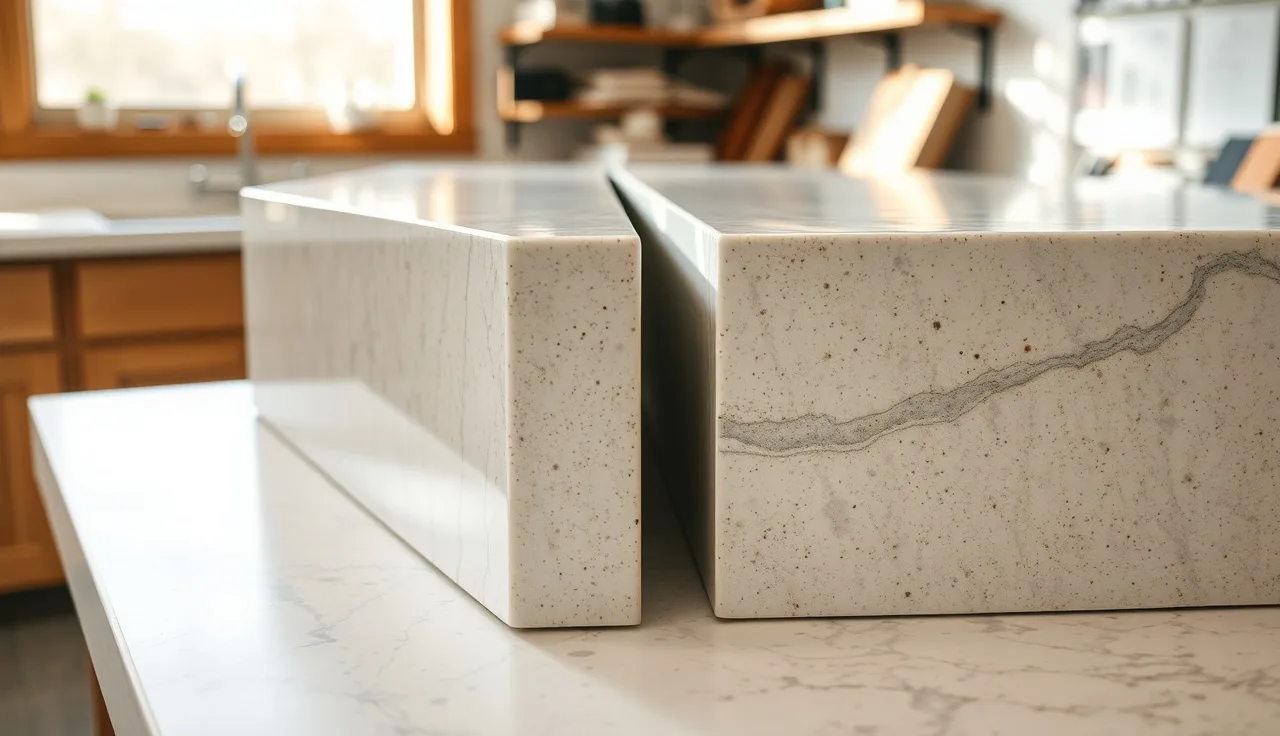
Two centimeters is about three-quarters of an inch thick. Three centimeters is just under one and a quarter inches. That half-centimeter difference sounds small, but it changes the slab's weight, how it handles edge profiles, and whether a fabricator needs to build a plywood backer beneath it.
Quartz manufacturers produce both thicknesses, but 3cm dominates the U.S. residential market. Cambria, for instance, offers its full slab line primarily in 3cm [1]. Caesarstone and Silestone both carry 2cm as a thinner option, mostly sold for vertical applications like backsplashes, shower walls, and some commercial projects where weight matters.
The practical difference you'll notice at home: a 3cm countertop has a chunky, substantial edge that looks finished even with a simple eased or straight polish. A 2cm slab on a horizontal surface needs either a laminated (double-stacked) edge to fake the thickness, or it gets installed over a plywood substrate so the cabinet deck can support it without flex. Neither approach is wrong, but each adds cost and complexity.
How much does 2cm quartz cost vs 3cm quartz per square foot?
Fabricators price quartz by the square foot installed, which bundles material, labor, edge work, cutouts, and delivery. Expect these ranges based on current shop pricing across the U.S. (prices vary by region and shop overhead, so treat these as benchmarks, not guarantees):
| Thickness | Material only (slab cost) | Installed (fabricated + set) |
|---|---|---|
| 2cm quartz | $20, $40/sq ft | $40, $65/sq ft |
| 3cm quartz | $28, $50/sq ft | $55, $85/sq ft |
The material gap between 2cm and 3cm for the same color line runs $5, $15 per square foot at the slab level, because 3cm uses more raw material and weighs more (roughly 7 to 9 lbs/sq ft for 2cm vs. 10 to 14 lbs/sq ft for 3cm, depending on the brand and aggregate density) [2].
But the installed cost gap is wider than the material gap. Here's why: 2cm jobs almost always require a 3/4-inch plywood substrate under the slab, which adds labor and material. That substrate runs $3, $8 per square foot depending on your market. When you factor that in, the total installed price of 2cm often lands closer to 3cm than the raw slab price suggests.
For a 40-square-foot kitchen, the all-in difference between a 2cm and 3cm job from the same color family is typically $400, $800. On a larger kitchen, say 60 square feet, the gap can reach $900, $1,200. That said, if you're looking at a premium 3cm color vs. an entry-level 2cm color, the color choice dominates the price difference more than the thickness.
If you want to compare these costs against other surface materials, see our guide to kitchen countertops for a broader view of what different materials run installed.
Why is 3cm quartz more expensive than 2cm?
Three reasons drive the premium.
First, raw material. A 3cm slab uses about 50% more quartz composite by volume than the equivalent 2cm slab. Quartz slabs are engineered stone, typically 90 to 93% ground quartz bound with polymer resins [3]. More material means higher slab cost straightforwardly.
Second, shipping and handling weight. A full 3cm jumbo slab (roughly 55" x 120") can weigh 500 to 600 lbs. The same color in 2cm weighs 350 to 425 lbs. Heavier slabs cost more to import from overseas manufacturers (most quartz sold in the U.S. is manufactured abroad, with significant production in Spain, Israel, India, and China) [4]. Freight costs flow into the distributor price and then into your quote.
Third, 3cm skips the substrate. Most fabricators build the plywood backer into a 2cm job automatically, adding $3, $8/sq ft in materials and labor. With 3cm, you skip that entirely. The slab itself is rigid enough to span cabinet runs without flex, so installation is cleaner and faster.
Where 3cm actually saves money is edge profiles. A 3cm slab has enough material to cut most edge profiles, including ogee, dupont, and waterfall faces, directly out of the slab. On a 2cm slab, a fabricator usually laminate-stacks a second piece of 2cm to hit minimum edge height for decorative profiles, which adds labor and a visible seam line on the edge face. Decorative edge work on 2cm can easily add $15, $25 per linear foot compared to the same profile on 3cm.
Is 2cm or 3cm quartz stronger and more durable?
3cm is stronger, full stop. The extra thickness means more resistance to cracking under point loads, which matters around sink cutouts and cooktop cutouts where the slab has less material bridging the opening.
The Marble Institute of America (now part of the Natural Stone Institute) has long recommended minimum 3cm thickness for residential horizontal countertop applications, precisely because of the span-over-cutout issue [5]. A 2cm slab without a plywood backer over a large sink cutout is a crack risk.
That said, if your fabricator installs 2cm over a full plywood substrate (which any good shop does), the plywood does most of the spanning work. The composite failure risk drops significantly. So in practice, a properly installed 2cm job lasts just as long as a 3cm job. You're not buying durability by going to 3cm if the 2cm job is done right.
Where 3cm wins long-term: if a cabinet settles, if someone sits on the edge, or if a heavy pot drops near a cutout, 3cm has more margin. It's not dramatic, but it's real.
Does thickness affect quartz countertop weight and cabinet support requirements?
Yes, and this matters more than most homeowners expect.
Standard base cabinets are built for countertop loads in the range of 5 to 15 lbs per square foot, which covers most countertop materials. A 3cm quartz slab at 10 to 14 lbs/sq ft lands at the upper end but is generally fine on well-built modern cabinets [2].
Old or cheap cabinets are a different story. If your cabinet boxes are flimsy, a heavy 3cm quartz run can cause face-frame racking over time. In those cases, some fabricators and installers actually prefer 2cm over substrate because the total system weight is lower.
For outdoor kitchens, RV countertops, or boat builds, 2cm is almost always the right call purely on weight. An outdoor kitchen island with 30 square feet of 3cm quartz adds 300 to 420 lbs to the structure. The same surface in 2cm is 210 to 270 lbs. That gap matters for concrete footings and frame design.
Weight also affects countertop installation labor costs. A heavier slab requires more people to carry it safely, longer time per piece, and sometimes mechanical lifts. Fabricators in tight urban rowhouses often prefer 2cm because maneuvering a 500-lb 3cm slab through a narrow stairwell is a liability event. See our full countertop installation guide for more on how shops handle heavy slabs.
What edge profiles work with each thickness?
This is where thickness has the most visible effect on finished cost and appearance.
| Edge Profile | 2cm (requires lamination?) | 3cm (direct cut?) | Approximate upcharge vs. eased |
|---|---|---|---|
| Eased / straight | No | Yes | $0 |
| Beveled | No | Yes | $2, $5/LF |
| Bullnose | No | Yes | $5, $10/LF |
| Ogee | Yes (must laminate) | Yes | $15, $25/LF |
| Dupont / Waterfall | Yes (must laminate) | Yes | $15, $30/LF |
| Stacked (mitered) | Yes (this IS the laminated look) | Yes | $20, $40/LF |
LF = linear foot.
With 2cm, fabricators laminate a strip of matching quartz to the underside of the front edge to build up the visual thickness. Done well, the seam is nearly invisible. Done poorly or with color mismatch, you'll see it. On lighter-colored quartz, the joint can show as a gray line. It's a legitimate finish, not a hack, but it does add cost.
For a standard 30-linear-foot perimeter on a kitchen, the lamination alone can add $150, $400 to a 2cm job. That pushes 2cm closer to 3cm territory again, particularly if you want anything more decorative than a simple eased edge.
Personal take: unless you have a weight constraint or a specific design reason to use 2cm, 3cm is the easier path for residential kitchens. The edge work is cleaner, the material is more forgiving around cutouts, and you don't need to explain the substrate to future buyers during a home sale.
When does choosing 2cm over 3cm actually make financial sense?
There are real situations where 2cm is the smarter choice, even on cost grounds.
Bathroom vanities are the obvious one. Vanity tops are smaller (typical 24" x 48" or similar), rarely have large cutouts, don't take heavy pot drops, and often need to fit under a medicine cabinet with limited headroom. The extra thickness of 3cm can crowd a low mirror or cabinet. Many fabricators quote 2cm as standard for bathroom counters and 3cm as a premium option there. Material savings on a small vanity top are real: a 10-square-foot vanity in 2cm vs. 3cm might save $100, $150, which is meaningful at that scale.
Laundry room counters and utility surfaces are another case. Nobody needs a thick, heavy edge profile in the laundry room. A clean 2cm surface over plywood substrate is more than adequate and costs less.
Budget-constrained full kitchens are a third scenario, but only if the cabinet boxes are solid and the fabricator is thorough with the substrate. If you're choosing between 2cm quartz and laminate countertops, the laminate might actually win on price for the same durability bracket, so run both quotes.
Commercial applications, like office kitchenettes and hotel projects, often spec 2cm because the weight saves money on structural support across many linear feet. The per-unit savings compound fast.
Finally: if your budget ceiling puts 3cm out of reach for the color you actually want, 2cm of that color installed correctly beats 3cm of a color you settled on. Color enjoyment matters more over a 10-year ownership period than thickness.
How do fabricators quote 2cm vs 3cm jobs differently?
Most residential fabricators default to 3cm for kitchen countertops and don't quote 2cm unless asked. The reasons are practical: 3cm jobs are faster to template, faster to install, and have fewer callbacks around substrate issues. Labor efficiency is real money to a shop.
When a customer requests 2cm, a thorough quote should break out the substrate separately so you can see what you're actually paying for. A quote that just shows a lower square-foot price without the substrate line is hiding part of the cost. Always ask: "Does this include the 3/4-inch plywood backer?"
Edge lamination should also appear as a separate line if you're getting anything beyond a simple eased edge on 2cm. I've seen quotes where it was buried in a flat "fabrication" fee and only surfaced when the invoice came.
For fabricators reading this: software that handles variable thickness pricing and auto-flags substrate requirements for 2cm jobs saves real back-office time. SlabWise's quoting tool lets shops set thickness-dependent rules so the substrate and lamination lines populate automatically rather than relying on the salesperson to remember every time.
For homeowners, the practical takeaway is to get quotes with both thicknesses in your target color, fully itemized, and compare the installed totals rather than the slab-only number.
Does quartz thickness affect resale value or home appraisals?
Directly, no. Appraisers and real estate agents don't line-item countertop thickness in valuations. What they note is the material category (quartz vs. laminate vs. tile vs. solid surface) and the overall condition and finish quality.
Indirectly, thickness can matter. A kitchen with visibly thin countertops (the 2cm eased edge profile reads as thinner to a buyer's eye compared to the chunky 3cm look most buyers have come to expect from HGTV renovations) might read as "budget remodel" even if the material quality is identical. That perception can shift a buyer's negotiating position, even if the appraiser doesn't care.
The National Association of Realtors survey on remodeling impact found that kitchen updates rank among the highest-return renovations, but the return data doesn't break out thickness as a variable [6]. Realistically, if you're renovating for resale, 3cm is the safer choice purely because it matches buyer expectations without raising questions.
If you're renovating for yourself and plan to stay 10-plus years, thickness matters a lot less than picking a color and finish you'll actually enjoy looking at every morning.
How do popular quartz brands handle 2cm vs 3cm availability?
Brand matters here because availability varies a lot.
Cambria offers most of its residential line exclusively in 3cm and doesn't publish 2cm as a standard residential option [1]. If you want Cambria, you're getting 3cm.
Caesarstone offers both 2cm and 3cm across most colors in its North American catalog. Their technical guide specifies 2cm for vertical applications and notes 3cm is standard for horizontal residential [7].
Silestone (Cosentino) similarly offers both, with 3cm as the default for kitchen countertops in the U.S. Their thinner options are marketed toward bath, furniture, and wall cladding applications [8].
IKEA sells quartz countertop sections (KASKER) in 2cm, which is part of why the price is lower than custom-fabricated quartz. But IKEA's product requires a continuous substrate below and limits cutout placement. It's a legitimate budget option for simple layouts, not a substitute for custom fabrication.
For premium brands like Cambria countertops, the 3cm default is baked into the product line, so the thickness question mostly applies if you're shopping non-Cambria brands or looking at slab remnants.
Import brands from China and India often come in both thicknesses, with 2cm sometimes available at $12, $22/sq ft at the distributor level, making the raw material much cheaper. Quality consistency is the variable to vet there.
What's the full cost comparison for a real kitchen job?
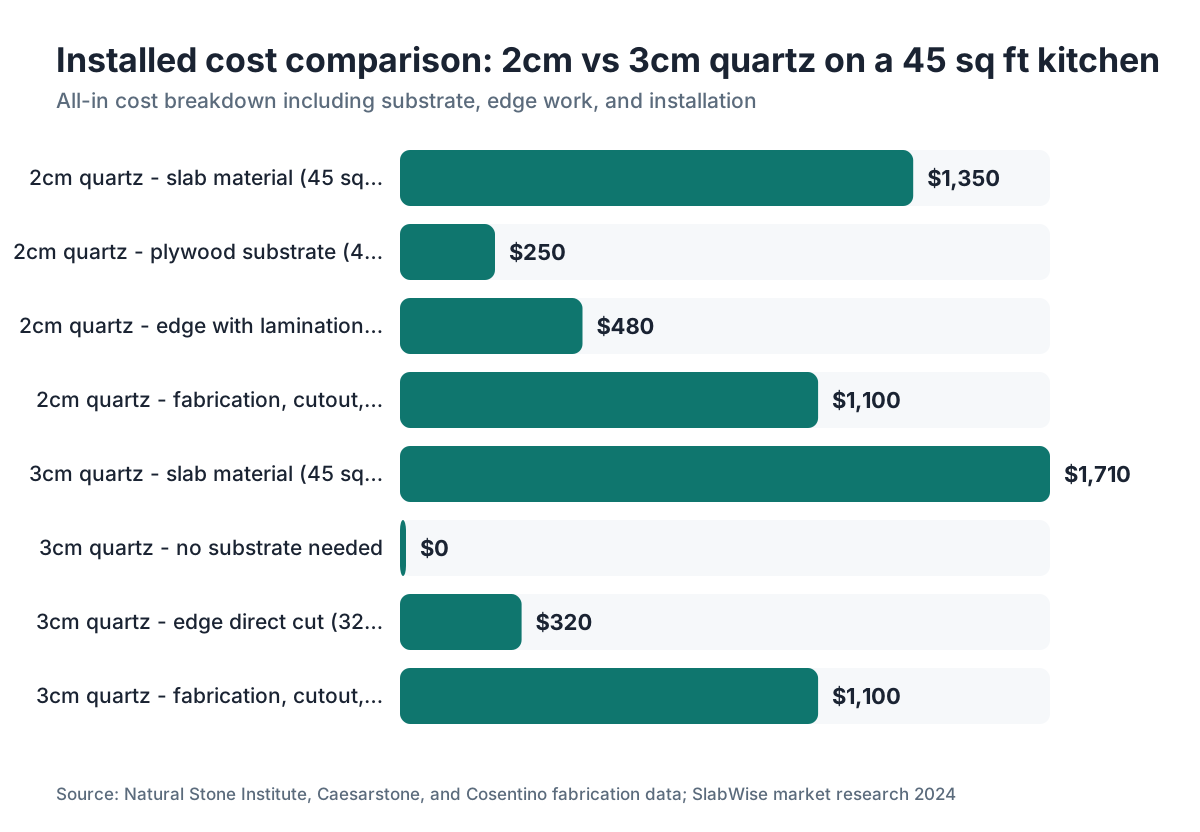
Let's run actual numbers on a medium-sized U.S. kitchen with 45 square feet of countertop and 32 linear feet of perimeter edge.
| Cost item | 2cm installed | 3cm installed |
|---|---|---|
| Slab material (45 sq ft) | $1,350 ($30/sq ft mid-range) | $1,710 ($38/sq ft mid-range) |
| Plywood substrate (45 sq ft) | $250 ($5.50/sq ft avg) | $0 |
| Fabrication labor | $600 | $600 |
| Edge (bullnose, 32 LF) | $480 ($15/LF incl. lamination) | $320 ($10/LF, direct cut) |
| Sink cutout (1) | $150 | $150 |
| Delivery + install | $350 | $350 |
| Total | $3,180 | $3,130 |
Yes, for this example the totals are nearly identical once the substrate and lamination are properly accounted for. The 3cm raw slab cost is higher, but 2cm's supporting costs close the gap almost completely on a standard mid-range job.
The situation where 2cm is genuinely cheaper: if you skip decorative edge profiles (go plain eased edge), skip the lamination upcharge, and already have a plywood substrate in place from a previous countertop. Then 2cm can save $200, $400 on a 45-square-foot kitchen.
The situation where 3cm is clearly cheaper overall: if you want decorative edge profiles, because the per-linear-foot cost on 3cm is $5, $15 less than laminated 2cm for the same profile.
Fabrication businesses tracking these line items across dozens of jobs monthly can see where margins go with each thickness. Tools like SlabWise's nesting and quoting features help shops track actual material yield per slab, which is where 2cm vs. 3cm cost differences really accumulate across a week's worth of jobs.
For homeowners comparing quartz against other materials at similar price points, granite countertops and marble countertops are worth looking at since natural stone also defaults to 3cm for residential use.
Are there environmental or sustainability differences between 2cm and 3cm quartz?
This one rarely comes up but it's a fair question.
Quartz manufacturing is energy-intensive. The Breton process, which most engineered quartz uses, involves high heat and vacuum vibration to cure the polymer-bound slab [3]. A 3cm slab uses more raw material and slightly more energy to manufacture than 2cm. If you're covering 45 square feet, 3cm uses roughly 50% more material mass than 2cm for the same surface area.
In practice, this doesn't move most purchasing decisions and the environmental data specific to quartz LCA (lifecycle assessment) by thickness isn't publicly available in detail. The bigger environmental variable for quartz is shipping distance, since most slabs travel from overseas manufacturing facilities. A 3cm slab weighs more and thus has marginally higher shipping emissions per square foot.
For homeowners with genuine environmental priorities, the comparison you'd want to run is quartz at any thickness vs. a reclaimed natural stone remnant or a rapidly-renewable surface like bamboo. Thickness is a minor variable in that picture.
Frequently asked questions
Is 3cm quartz worth the extra cost for a kitchen countertop?
For most residential kitchens, yes. Once you account for the plywood substrate and lamination work that 2cm requires, the installed price difference is often $200, $400 on a 45-square-foot kitchen, not the $500, $800 the raw slab price suggests. 3cm is faster to install, more forgiving around sink cutouts, and handles decorative edge profiles more cleanly. If budget is tight and you want a plain eased edge, 2cm over a good substrate is a legitimate option.
Can I use 2cm quartz without a plywood backer?
Only for vertical applications like backsplashes, shower walls, or cabinet door fronts. On a horizontal countertop surface, 2cm quartz needs a continuous rigid substrate, either plywood or the existing cabinet decking, to prevent flex and cracking. A 2cm slab spanning a sink cutout without backing is a crack risk. Any fabricator who skips the substrate on a 2cm horizontal job is cutting corners.
What's the average cost per square foot for quartz countertops installed?
Installed quartz (material, fabrication, and setting) runs roughly $55, $85 per square foot for 3cm in mid-range colors, and $40, $65 per square foot for 2cm before the substrate is added. Entry-level colors and simple layouts hit the low end. Exotic veining, large islands, or complex cutouts push toward the high end. Regional labor rates vary significantly, with metro areas typically running 20 to 30% higher than rural markets.
Does quartz thickness affect how the countertop looks?
Significantly on the edge. A 3cm edge profile looks naturally thick and substantial. A 2cm edge can look thin unless the fabricator laminate-stacks the edge, which adds a visible seam line. With light-colored quartz, that seam can show as a gray line. From the top, both thicknesses look identical. If you care about a bold edge profile like an ogee or dupont, 3cm is the cleaner execution.
How heavy is a 3cm quartz slab vs a 2cm slab?
A 3cm quartz slab weighs approximately 10 to 14 lbs per square foot depending on aggregate density. A 2cm slab of the same color runs about 7 to 9 lbs per square foot. A full jumbo 3cm slab (roughly 55" x 120") can weigh 500 to 600 lbs, which requires proper mechanical handling. This weight difference matters for outdoor kitchens, boats, RVs, and any situation where structural load is a design constraint.
Do fabricators charge more to install 2cm vs 3cm quartz?
Labor for the cut and polish is similar. The extra cost on 2cm jobs comes from the plywood substrate (material and installation labor, typically $3, $8 per square foot) and edge lamination if you want anything beyond a plain eased edge ($5, $15 extra per linear foot). Some shops charge a flat premium for 2cm jobs because they're less efficient to produce. Always ask for an itemized quote so you see where the cost is actually coming from.
Which quartz brands offer 2cm slabs for countertops?
Caesarstone and Silestone both offer 2cm in most color lines, marketed primarily for vertical and bath applications. Cambria's residential catalog is almost exclusively 3cm. IKEA's KASKER quartz sections are 2cm and come pre-sized, which works for simple vanity or kitchen layouts. Import brands from Asia often carry 2cm at lower price points. Availability varies by distributor; call your local slab yard to check current stock.
Is 2cm or 3cm quartz better for bathroom vanities?
2cm is often the better choice for bathroom vanities. Vanity tops are smaller, rarely have large cutouts that stress the slab, and sometimes need to fit under low medicine cabinets where the extra 5mm of 3cm would cause clearance issues. The cost savings on a small vanity (10 to 15 sq ft) are real: often $100, $200 less in material alone. A 2cm vanity top over a solid substrate is fully adequate for a bathroom environment.
Will my cabinets support the weight of 3cm quartz?
Standard modern base cabinets handle 3cm quartz weight fine. At 10 to 14 lbs per square foot, a 40-square-foot kitchen counter adds 400 to 560 lbs distributed across the full cabinet run, which is within normal design loads. Old or poorly built cabinets may need reinforcement. If you're unsure, a carpenter can inspect the box construction before templating. Outdoor kitchens and structural islands deserve a separate load calculation.
How much does edge lamination add to a 2cm quartz job?
Edge lamination (stacking a second 2cm strip on the front edge to fake 3cm thickness) adds roughly $5, $15 per linear foot depending on the profile and how visible the seam needs to be. For a kitchen with 30 linear feet of exposed edge, that's $150, $450 added to the 2cm job. Decorative profiles like ogee or dupont on 2cm add even more because the lamination is required and the cutting is more complex.
Does quartz thickness affect sealing or maintenance requirements?
No. Quartz is an engineered non-porous surface and doesn't need sealing regardless of thickness. Both 2cm and 3cm quartz resist staining from the same materials and clean the same way. Thickness has no effect on surface porosity, heat resistance, or scratch resistance. For care tips on engineered and natural stone surfaces in general, see our guide on how to clean stone countertops.
What is the standard quartz thickness in the U.S. for kitchen countertops?
3cm is the de facto standard for residential kitchen countertops in the U.S. as of the mid-2010s. Before roughly 2010, 2cm was more common and 3cm was a premium upgrade. The industry shifted because 3cm eliminates the substrate labor and looks better to most buyers. Some fabricators won't even quote 2cm for a kitchen install without a specific reason from the customer.
Can I mix 2cm and 3cm quartz in the same kitchen?
Technically yes, but it creates complications. If the 2cm surface is installed over plywood to match the 3cm surface height, the top surface planes can align. The edge appearance will differ if both surfaces are visible from the same angle, which looks odd. The more common approach is to use 3cm everywhere in the kitchen and reserve 2cm for separate areas like a laundry room or second bath where the two thicknesses are never side by side.
Sources
- Cambria - Technical Specifications: Cambria offers its residential slab line primarily in 3cm thickness for countertop applications.
- Marble Institute of America / Natural Stone Institute - Dimension Stone Design Manual: Engineered quartz slab weight ranges approximately 7 to 9 lbs/sq ft for 2cm and 10 to 14 lbs/sq ft for 3cm depending on aggregate density.
- Breton S.p.A. - Bretonstone Technology: Quartz surfaces are engineered stone composed of 90 to 93% ground quartz bound with polymer resins using vacuum vibration and heat curing.
- U.S. International Trade Commission - Certain Quartz Surface Products (Investigation No. 701-TA-606): Significant quartz slab production for the U.S. market comes from overseas manufacturers in Spain, Israel, India, and China.
- Natural Stone Institute - Fabrication and Installation Standards: Industry standards recommend minimum 3cm thickness for residential horizontal countertop applications due to span and cutout integrity requirements.
- National Association of Realtors - 2022 Remodeling Impact Report: Kitchen updates rank among the highest-return renovations per the NAR remodeling impact survey; thickness is not broken out as a variable.
- Caesarstone - Technical Documentation and Installation Guide: Caesarstone's technical guide specifies 2cm for vertical applications and notes 3cm as standard for horizontal residential countertops in North America.
- Cosentino / Silestone - Technical Data Sheet: Silestone offers both 2cm and 3cm, with 3cm as default for U.S. kitchen countertop applications and thinner options marketed for bath, furniture, and wall cladding.
- U.S. Bureau of Labor Statistics - Producer Price Indexes for Construction Materials: Regional labor rate variation affects installed countertop pricing; metro areas typically run 20 to 30% higher than rural markets based on construction trade wage data.
- Home Innovation Research Labs - Builder Practices Survey: 3cm quartz became the de facto residential countertop thickness standard in the U.S. by the mid-2010s as fabricators shifted from 2cm with substrate systems.
Last updated 2026-07-09