
TL;DR
- No single federal agency publishes an approved-stone list.
- Commercial kitchen countertops must meet NSF/ANSI 51, the food-equipment sanitation standard adopted by most state health codes.
- Non-porous, non-absorbent surfaces pass.
- Engineered quartz, properly sealed granite, and solid-surface materials generally qualify.
- Raw marble, untreated soapstone, and most porous stones typically fail without a compliant sealer or NSF-certified coating.
Who actually approves commercial kitchen countertops?
No federal list says "these stones are legal for commercial kitchens." The FDA sets food safety principles in the Food Code, but it does not certify individual countertop materials. What the FDA Food Code does is require that food-contact surfaces be "smooth, easily cleanable, and nonabsorbent" [1]. States adopt that language, and local health departments enforce it during inspections.
The practical approval mechanism is NSF/ANSI 51, a private standard developed by NSF International that covers materials and components used in food equipment [2]. Most state health codes either adopt NSF/ANSI 51 by reference or require materials that meet equivalent criteria. When a health inspector looks at your prep counter, they are essentially asking whether the surface meets NSF/ANSI 51's intent, even if they never say those words.
So the real question is not "is this stone on an approved list." It's "does this surface meet NSF/ANSI 51 and my local health code?" Those are answerable questions, and the rest of this article walks through them material by material.
What does NSF/ANSI 51 actually require for a countertop surface?
NSF/ANSI 51 sets four core material requirements for food-zone surfaces [2]. The surface must be:
- Smooth (no cracks, crevices, or rough spots that trap food or bacteria)
- Nontoxic (no leaching of harmful substances into food)
- Nonabsorbent (water absorption must be essentially zero at the surface)
- Corrosion-resistant (no degradation from typical food acids, cleaners, or sanitizers)
The standard uses the phrase "food-zone" to describe areas where food touches the surface directly, and it imposes stricter requirements there than in splash zones or non-food-contact areas. A prep counter where raw chicken lands is a food-zone surface. An architectural feature counter where menus sit is not.
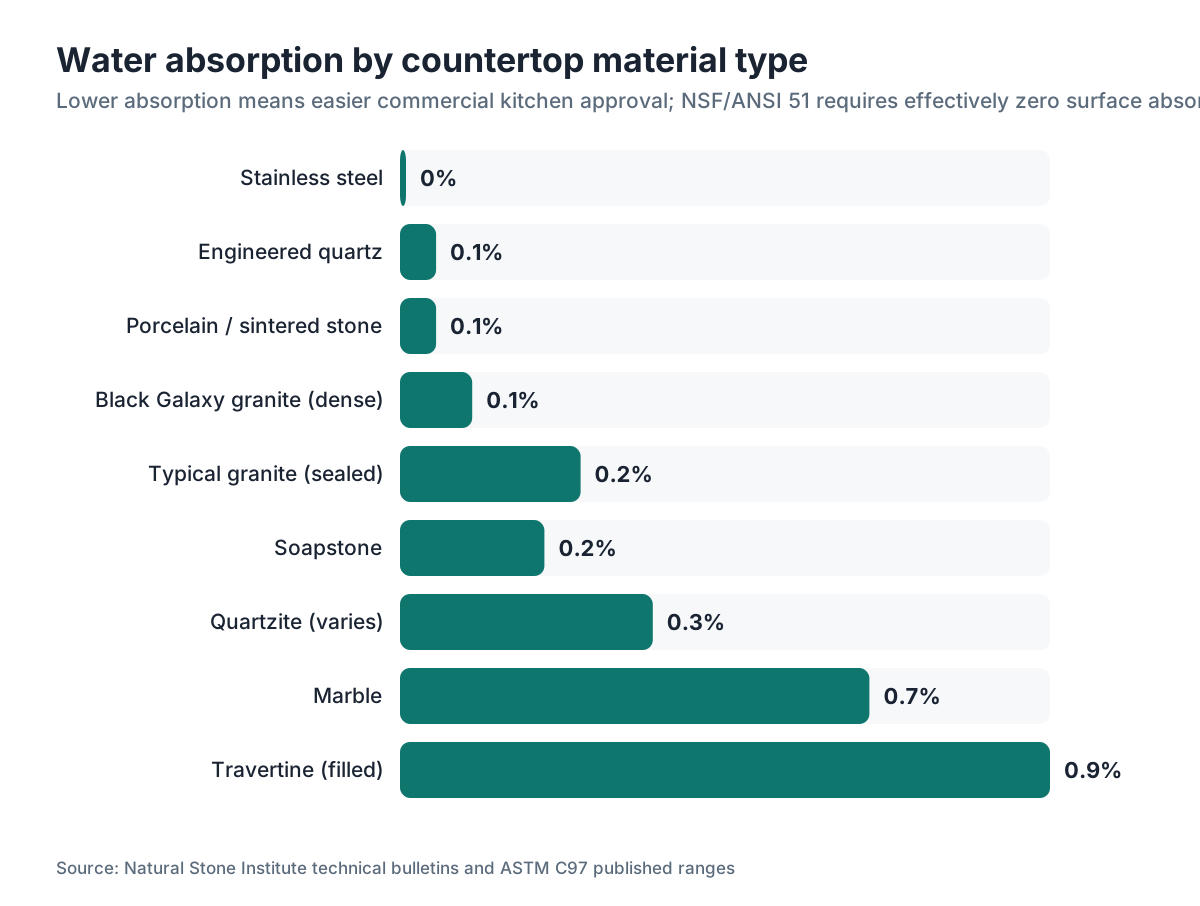
Absorption is the test that decides most stone. Granite has a water absorption rate anywhere from 0.1% to 0.4% by weight depending on the specific slab [3]. Engineered quartz runs below 0.1% and often 0.02% or less. The NSF threshold is effectively zero visible absorption at the surface, which is why many natural stones need sealing before they can qualify.
Sealers themselves can be NSF-certified. If a stone shop applies an NSF-listed sealer to a granite countertop, the sealed surface can meet the nonabsorbent requirement. The sealer has to be re-applied on schedule, and that maintenance obligation should be written into your commissary kitchen lease or food facility plan.
Which stones pass commercial kitchen inspections and which fail?
Here is how the common stone and stone-like materials map against NSF/ANSI 51 requirements. This is not a legal opinion. Your local health authority has final say.
| Material | Typical Absorption | Passes NSF/ANSI 51? | Notes |
|---|---|---|---|
| Engineered quartz | <0.1% | Yes | Factory-finished surface; no sealing needed |
| Sealed granite | 0.1 to 0.4% raw | Yes, if sealed | NSF-listed sealer required; re-seal annually or per mfr. |
| Unsealed granite | 0.1 to 0.4% | Typically no | Fails nonabsorbent test without sealer |
| Sealed quartzite | 0.1 to 0.5% raw | Conditional | Harder to seal than granite; verify sealer holds |
| Marble | 0.3 to 1.0% | Usually no | High absorption, acid-sensitive; etches with sanitizers |
| Soapstone | 0.1 to 0.3% | Conditional | Dense but often left oiled, not sealed; verify with inspector |
| Porcelain/sintered stone | <0.1% | Yes | Impervious; check grout lines in tile applications |
| Solid surface (Corian, etc.) | Nonporous | Yes, if NSF-listed | Many solid-surface products carry NSF 51 certification |
| Stainless steel | Zero | Yes | The benchmark material; all others compared to this |
| Laminate (Formica) | Low core, sealed face | Conditional | Needs a tight surface or an NSF-approved edge/seam treatment |
| Butcher block / wood | High | No for food prep | Wood prohibited in most food-prep zones; fine for non-food surfaces |
Engineered quartz is the easiest stone-category material to approve because the polymer resin binder makes the surface genuinely nonporous from the factory [4]. Brands like Cambria publish their NSF/ANSI 51 compliance documentation directly, which speeds up plan review.
Granite is the most contested material. A properly sealed slab with a documented NSF-certified sealer can pass. An unsealed slab almost never will. The catch is that "properly sealed" is a maintenance state, not a permanent material property. Some inspectors accept granite readily. Others are skeptical and ask for documentation.
Marble is a poor choice for commercial prep surfaces. Its absorption rate is higher than granite, it etches (the surface actually dissolves) when it contacts acidic foods or standard quaternary ammonium sanitizers, and etched areas lose their sealed finish fast. Using marble behind a bar as a decorative surface where drinks are prepared but food does not touch it directly is a different conversation.
Soapstone is dense and historically used in laboratory countertops, but food-service health inspectors are less familiar with it than lab safety officers are. If you want soapstone, bring a material data sheet and the relevant ASTM water absorption data to your plan review [5].
Does the FDA Food Code say anything specific about stone?
The FDA Model Food Code (2022 edition) does not name granite, quartz, or any other stone [1]. Section 4-101.11 states that materials used for food-contact surfaces shall be "safe," and Section 4-101.19 states multi-use surfaces shall be "smooth; free of breaks, open seams, cracks, chips, inclusions, pits, and similar imperfections" that may trap food or harbor bacteria.
The 2022 FDA Food Code has been adopted in full or substantial form by most states, though exact adoption varies [1]. California, Texas, and New York each have their own retail food codes that echo FDA language but add state-specific nuances. Check your state's adopted version, more than the federal model.
The practical enforcement point is simple. A health inspector applying FDA Food Code language will reject any stone surface that shows visible pitting, open fissures, or surface absorption during the white-towel test (pressing a damp white cloth to the surface and checking for color transfer). Granite with natural fissures that are unfilled and unsealed will fail that test.
Does a stone need to be NSF-certified, or just NSF-compliant?
This distinction matters, and it trips up a lot of fabricators and restaurant owners.
NSF certification means a manufacturer paid NSF International to test and list their product. The manufacturer's product appears in the NSF database and carries the NSF mark. Some solid-surface manufacturers and quartz brands pursue this.
NSF compliance means the material meets the technical requirements of NSF/ANSI 51 but has not been independently tested and listed. A piece of granite with an NSF-certified sealer applied per the sealer manufacturer's instructions falls in this category.
Most health departments accept either, as long as you can document the claim. For a plan review, bring the sealer's NSF listing number, the stone's ASTM C97 water absorption test results [5], and a written sealing maintenance schedule. That package is usually enough. If a health department insists on a product-level NSF mark and you're using natural stone, that's a problem, because stone slabs themselves are not individually listed products. Push back with the material data and the sealer certification.
Fabricators managing multiple commercial bids feel the overhead of tracking which sealer products carry active NSF listings. Tools like SlabWise let you attach material spec documents to jobs, so pulling that documentation for plan review takes minutes when a job moves to permitting.
How do seams and edge profiles affect commercial approval?
Seams are the most common inspection failure point on stone countertops in commercial kitchens. A visible gap, even 0.5mm, is a crack that traps food and bacteria. Health codes require seams to be "tight" or "sealed" such that no visible opening exists.
Epoxy-filled seams with a food-safe adhesive satisfy most inspectors. The epoxy itself should be food-safe. Standard countertop epoxies are generally inert when cured, but if a health department asks, choose an epoxy with FDA 21 CFR 175.300 compliance for incidental food contact [6].
Edge profiles matter too. A sharp undercut profile with a recessed area under the overhang can trap debris. Health inspectors prefer eased or straight edges on food-prep countertops because they are easier to clean and leave no hidden ledge. Decorative ogee or dupont edges that look great in residential kitchens are a liability in commercial use.
On install, the countertop should be caulked to the wall with a food-safe, mold-resistant silicone at the backsplash junction. Standard residential silicone is fine for material safety but may not be NSF-listed. NSF-listed silicone sealants are available from Dow and GE and add minimal cost.
What about granite specifically, given how popular it is?
Granite is the most commonly debated stone in commercial kitchen applications, and the debate is worth settling clearly.
Granite can be approved for commercial food-prep surfaces. The conditions: the slab must be sealed with a documented NSF-compliant or NSF-certified sealer, the sealer must be maintained on schedule, seams must be tight and epoxy-filled, and the surface must pass your local health inspector's visual and physical check.
Two things get granite rejected in commercial inspections more than anything else: natural fissures and a failing seal. Fissures are natural cracks in the stone that do not separate but look like seams. They are not defects in the fabrication sense, but a health inspector may call them open cracks. Ask your stone supplier for a slab with minimal fissuring if you're going into a commercial kitchen.
Water absorption data for granite comes from the Natural Stone Institute and through ASTM C97 testing. A stone with measured absorption below 0.4% by weight is generally acceptable with a quality sealer [3]. Some very dense granites, like Black Galaxy or Absolute Black, run below 0.1% and are much easier to approve.
For more on granite's properties and maintenance in food-adjacent settings, see our guide to granite countertops.
Are there stones that are simply off the table for commercial kitchens?
Yes. Some materials are nearly impossible to approve for food-prep surfaces regardless of sealing.
Marble is the clearest example. Its calcium carbonate composition means it reacts with acidic foods (citrus, vinegar, tomato) and with many commercial sanitizers that use quaternary ammonium compounds or hypochlorite. Etching damages the sealed surface, which then becomes absorbent in those spots. A health inspector who returns six months after opening will often find etched marble failing the nonabsorbent test. Marble can work in a bar back-bar surface or a pastry prep area where the inspector's standard is lower (non-food-contact designation), but not on a general prep surface.
Onyx and alabaster are even more porous than marble and should not be considered for any food-contact area.
Travertine has open pores by nature. Even filled travertine has voids that open with use. It does not pass.
Slate is dense and sometimes proposed, but it's variable. Some slate is tight-grained and nearly impervious. Other slate flakes. Without ASTM C97 data specific to that slab, approving slate is a gamble.
Brick, concrete block, and rough masonry surfaces are prohibited for food-contact areas outright in the FDA Food Code [1]. Polished concrete countertops (cast, not masonry) are a separate discussion and can be approved with proper sealing, but that is not a natural stone.
For reference on surfaces that handle the cleaning demands better, see how to clean stone countertops and how to clean quartzite countertops.
What do health inspectors actually look for during an inspection?
Health inspectors do not carry NSF handbooks. They apply judgment based on their training and their state's adopted food code. Here is what they physically check:
Smooth surface. They run a gloved hand across the counter. Rough spots, visible pitting, and open fissures fail.
Seams. They look for visible gaps at seams, at the backsplash joint, and at the sink cutout. Any gap that can trap food fails.
Absorption. Some inspectors use a simple water-bead test: drop water on the surface and see if it beads or soaks in. A sealed granite should bead well. An unsealed or worn-out-sealed granite will show a darkened wet spot within seconds.
Condition of the surface. Chips, cracks, staining, and discoloration all raise questions. A heavily used commercial granite that has lost its seal will show all of these.
Cleaning access. Can a sanitation worker get a cloth or sponge into every corner? Backsplash-to-counter joints, under-mount sink edges, and complex edge profiles all get scrutinized.
If you're prepping for a plan review or a first inspection, bring three things: the stone's ASTM C97 absorption data, the sealer's NSF listing or FDA compliance documentation, and a written maintenance schedule for re-sealing. That package answers the inspector's questions before they ask them.
State health departments that publish commercial kitchen construction guides include the California Department of Public Health [7] and the Texas Department of State Health Services [8]. Both are useful references even if you're in another state.
What is the best stone choice for a commercial kitchen countertop?
If you're asking what I'd specify for a commercial kitchen with no other constraints: engineered quartz wins, with porcelain and sintered stone a close second.
Engineered quartz is nonporous at the factory, available in large-format slabs that cut down on seams, easy to document for plan review, and it holds up to heavy daily sanitizer use. It does not etch. It never needs re-sealing. The documentation a health department wants is a single spec sheet. Brands like Cambria and Silestone publish their NSF/ANSI 51 data publicly [4].
Porcelain and sintered stone (like Dekton or Lapitec) have similar advantages and are more heat-resistant than quartz, which matters near cooking lines. They are harder to fabricate (slower cutting, higher tool wear, more expensive labor) but the surface is essentially bulletproof.
If your client is set on natural stone and the budget allows, a dense, low-absorption granite with documented sealing works. Budget for re-sealing every 12 to 18 months and budget for the documentation process. It costs more time than money, but it costs time.
For non-prep surfaces (pass-through windows, server stations, host stands), the requirements are lower and nearly any stone is fine. Spend the material budget on the prep surfaces where it matters legally, and use cheaper materials elsewhere.
Fabricators tracking material certifications, maintenance specs, and job documentation across multiple commercial accounts lean on job management tools. SlabWise's quoting software includes material spec attachment fields that keep commercial job documentation clean, which pays off when a client's health inspector asks questions six months after installation.
For surface comparisons beyond stone, see kitchen countertops, corian countertops, and laminate countertops.
Do the rules change for commissary kitchens or ghost kitchens vs. traditional restaurants?
The regulatory standard is the same: state-adopted food code, typically based on the FDA Food Code, enforced by local health departments. The surface requirements do not change because the business model is a ghost kitchen or commissary.
What changes is the inspection frequency and the scrutiny level. Commissary kitchens that license space to multiple tenants often face more frequent inspections because inspectors track multiple permitted operators back to one address. The countertops have to survive more aggressive cleaning cycles from more users.
Ghost kitchens sometimes operate in lower-cost industrial spaces where the build-out budget is tight. That's where the temptation to cut costs on countertop materials shows up. A laminate countertop with properly sealed edges can pass inspection, but a damaged laminate surface with exposed particleboard core absolutely will not [9]. If the budget is tight, sealed granite or engineered quartz is still the better long-term choice because it holds up to the cleaning chemistry better than laminate.
For where laminate can and cannot work, see laminate countertops and formica countertops.
Frequently asked questions
Is granite allowed in a commercial kitchen?
Yes, granite can be approved for commercial food-prep surfaces, but only when sealed with an NSF-compliant or NSF-certified sealer. Unsealed granite is porous and fails the nonabsorbent requirement in NSF/ANSI 51 and most state health codes. You'll also need documentation: the stone's ASTM C97 absorption data and the sealer's compliance letter or NSF listing number for your plan review.
Does engineered quartz automatically pass health inspections for commercial kitchens?
Engineered quartz is the easiest stone-category material to get through a commercial kitchen inspection because it's nonporous from the factory and requires no sealing. Most brands, including Cambria and Silestone, publish NSF/ANSI 51 compliance documentation. That said, seams still need to be tight and epoxy-filled, and the backsplash joint needs food-safe sealant. The material passes; poor installation can still fail.
Can you use marble in a restaurant kitchen?
Marble is nearly impossible to approve for direct food-prep surfaces in a commercial kitchen. It absorbs at 0.3 to 1.0 percent by weight, etches with food acids and many sanitizing chemicals, and cannot hold a seal reliably under commercial use. Marble can be used for non-food-contact decorative surfaces, like a bar front or dining counter, where the food code's surface requirements are less strict.
What does NSF/ANSI 51 actually require for kitchen surfaces?
NSF/ANSI 51 requires food-zone surfaces to be smooth, nontoxic, nonabsorbent, and corrosion-resistant. For stone countertops, the nonabsorbent requirement is the hardest to meet. Materials with water absorption above roughly 0.1 percent need a documented NSF-compliant sealer to qualify. The standard also addresses seam integrity: no open joints that can trap food or bacteria.
Does stainless steel have to be used in commercial kitchens or can stone substitute?
Stainless steel is the default material for commercial kitchen surfaces and remains the benchmark, but it is not legally required. Any surface that meets the FDA Food Code's smooth, nonabsorbent, and cleanable requirements can be approved. Engineered quartz, properly sealed granite, porcelain slab, and certified solid-surface materials are all accepted substitutes in most jurisdictions.
How often does sealed granite need to be re-sealed to stay compliant in a commercial kitchen?
Most sealer manufacturers specify annual re-sealing for commercial applications, though some high-penetration sealers claim 3 to 5 year cycles. In a commercial kitchen with daily sanitizer exposure, annual re-sealing is the conservative and defensible standard. Document every re-sealing event with the product used, the date, and who applied it. A health inspector who finds a worn-out seal has grounds to fail the surface.
Is soapstone approved for commercial kitchen use?
Soapstone can potentially be approved because it's relatively dense and nonreactive, but health inspectors are often unfamiliar with it. The traditional finish for soapstone is mineral oil, which is food-safe but does not seal the surface the way a penetrating sealer does. If you want soapstone in a commercial kitchen, bring ASTM C97 absorption data and a food-safe sealer spec to your plan review rather than relying on the inspector to know the material.
Can butcher block countertops be used in a commercial kitchen?
Butcher block and raw wood surfaces are prohibited for food-prep zones under the FDA Food Code because wood is porous and cannot be made nonabsorbent. Some jurisdictions allow wood surfaces for non-food-contact areas or as a cutting board insert within a larger nonporous counter. If you see butcher block in an existing commercial kitchen, it's likely in a non-prep role or grandfathered under an older inspection regime.
What edge profile is best for a commercial kitchen stone countertop?
Eased (slightly softened square) or flat-polish edges are the best choices for commercial food-prep countertops. They leave no hidden ledge under the overhang, are easy to wipe clean, and do not create a crevice at the wall junction. Decorative profiles like ogee, dupont, or shell edges have undercuts that trap food debris and are harder to sanitize. Keep edges simple on surfaces where health inspectors will be looking.
Does porcelain or sintered stone pass commercial kitchen requirements?
Yes. Porcelain and sintered-stone slabs (like Dekton or Lapitec) have water absorption below 0.1 percent and are highly resistant to acids and sanitizers. They meet NSF/ANSI 51 requirements and are increasingly popular in commercial kitchens near cooking lines because they also handle heat better than quartz. Fabrication costs more due to harder cutting, but the surface is extremely durable and easy to document for plan review.
Who enforces countertop material rules in a commercial kitchen?
Local health departments enforce food facility codes during plan review (before you open) and routine inspections (after you open). They apply your state's adopted food code, which is usually modeled on the FDA Model Food Code. NSF International writes the technical standard but does not enforce anything. Your state's health department website will have the specific code language and plan-review requirements for your jurisdiction.
What documentation should a fabricator provide for a commercial kitchen countertop job?
Provide the stone's ASTM C97 water absorption test results, the sealer's NSF listing number or FDA 21 CFR compliance letter, a written re-sealing maintenance schedule, and documentation that any epoxy or silicone used at seams and backsplash joints is food-safe. Package this as a single PDF for the client to submit with their plan review application. It saves everyone time and positions your shop as a commercial-capable fabricator.
Can a laminate countertop pass commercial kitchen inspection?
Laminate with an intact surface can pass inspection because the melamine face is smooth and nonabsorbent. The vulnerabilities are seams, edges, and corners where the particleboard or MDF core can be exposed. Any exposed core fails immediately. Laminate also degrades faster than stone under commercial cleaning chemistry. It's the lowest-cost option that can technically pass but has the shortest useful life in a high-use commercial environment.
Sources
- FDA, 2022 FDA Food Code, Section 4-101: FDA Food Code requires food-contact surfaces to be smooth, easily cleanable, nonabsorbent, and free of cracks, pits, and seams that trap food or bacteria
- NSF International, NSF/ANSI 51: Food Equipment Materials: NSF/ANSI 51 requires food-zone surfaces to be smooth, nontoxic, nonabsorbent, and corrosion-resistant
- Natural Stone Institute, Stone Specifications and Technical Bulletins: Granite water absorption ranges from approximately 0.1% to 0.4% by weight depending on the specific stone variety
- Cambria, Cambria NSF/ANSI 51 Compliance Documentation: Cambria engineered quartz publishes NSF/ANSI 51 compliance documentation and has a water absorption rate below 0.1%
- ASTM International, ASTM C97/C97M: Standard Test Methods for Absorption and Bulk Specific Gravity of Dimension Stone: ASTM C97 is the standard test method for measuring water absorption of dimension stone, used to document stone porosity for commercial plan reviews
- FDA, 21 CFR Part 175.300: Resinous and Polymeric Coatings: FDA 21 CFR 175.300 covers resinous and polymeric coatings, including epoxies, for incidental food contact compliance
- Texas Department of State Health Services, Retail Food Establishments: The Texas Department of State Health Services publishes retail food establishment rules and construction guidance
- FDA, FDA Food Code 2022, Section 4-202.11: Food-Contact Surfaces: FDA Food Code Section 4-202.11 requires multi-use food-contact surfaces to be smooth and free of breaks, open seams, cracks, chips, and pits
- NSF International, NSF Certified Products Database: NSF maintains a public database of certified food equipment products including solid-surface materials and sealers that carry the NSF mark
Last updated 2026-07-11