TL;DR
- The most affordable kitchen countertop materials are laminate ($15 to $40/sq ft installed), butcher block ($40 to $100), and tile ($10 to $50).
- Budget quartz and prefab granite sit mid-range at $55 to $90 and $40 to $65.
- What you save on material you can lose on bad installation or early replacement, so pick the option that matches how hard you actually use your kitchen.
What is the cheapest countertop material you can actually live with?
Laminate is the cheapest countertop material available in the U.S. by a wide margin. Installed costs typically run $15 to $40 per square foot depending on edge profile, region, and whether you hire a fabricator or a big-box contractor [1]. That is a real, finished kitchen counter, not a rough estimate.
Butcher block is the next step up, usually $40 to $100 installed, and it looks genuinely good in most kitchens. Ceramic tile can go even lower than laminate if you do the work yourself, with materials available for $2 to $10 per square foot at home improvement stores, though labor and grout maintenance make it harder to recommend as a long-term choice.
The honest answer to 'cheapest you can live with' depends on your cooking habits. Set hot pans directly on the counter and butcher block will scar. Cut directly on laminate and it will chip. Nobody escapes trade-offs at the low end, and pretending otherwise is how people end up replacing a $25/sq ft counter after three years and spending more than they would have on something better.
For most homeowners who want the lowest upfront cost and the fewest regrets, laminate from a reputable brand like Formica in a solid color or simple pattern is the practical pick. It wipes clean, resists most stains, and modern high-pressure laminate (HPL) is more durable than the peeling versions from the 1980s that gave it a bad name.
How much do affordable countertops cost per square foot, by material?
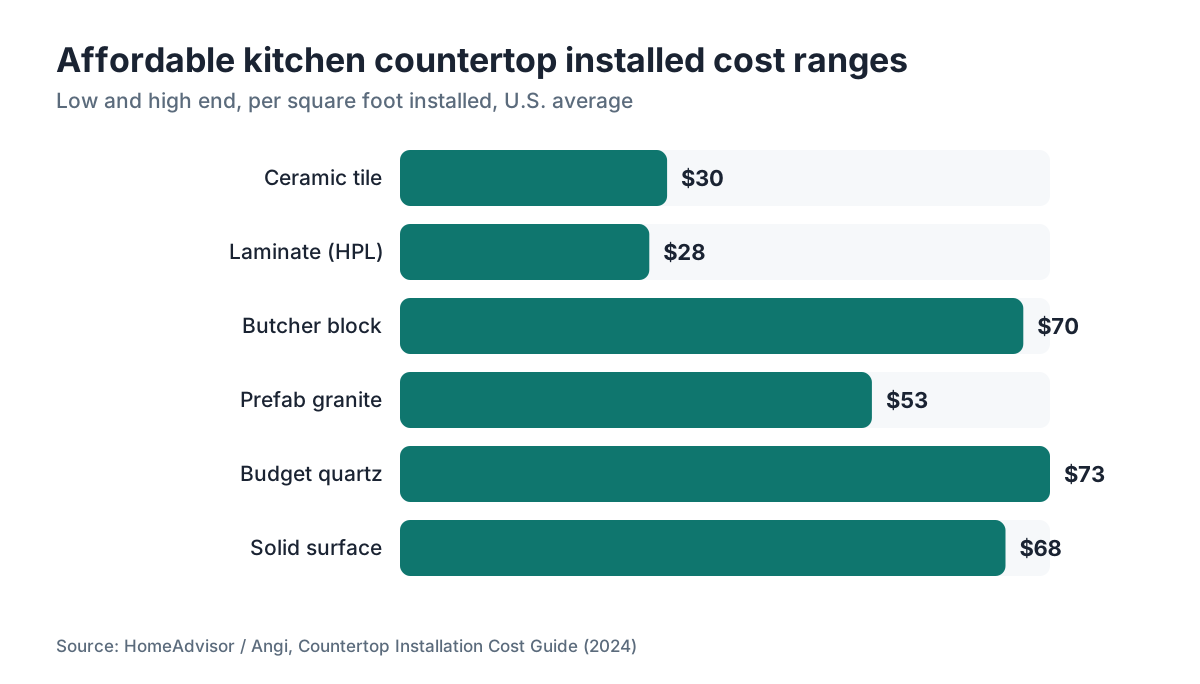
Here is a straight comparison of installed cost ranges. 'Installed' means material plus fabrication or installation labor, basic edge profile, and sink cutout. It does not include demolition of existing counters or plumbing reconnect.
| Material | Low (installed) | High (installed) | Notes |
|---|---|---|---|
| Ceramic tile | $10 | $50 | DIY lowers cost; grout needs sealing |
| Laminate (HPL) | $15 | $40 | Formica, Wilsonart; no seaming on wide runs |
| Butcher block | $40 | $100 | Needs annual oiling; avoid around sinks |
| Prefab granite | $40 | $65 | Pre-cut slabs; limited edge and color options |
| Concrete (DIY) | $15 | $50 | Labor-intensive; prone to cracking without steel |
| Budget quartz | $55 | $90 | Entry-level brands; less consistent patterning |
| Corian / solid surface | $45 | $90 | Repairable; no visible seams; Corian is the name-brand |
These ranges come from NKBA (National Kitchen and Bath Association) survey data and contractor price reporting from HomeAdvisor/Angi [1][2]. Regional variation is real. Labor in metro markets like New York or San Francisco can add 30 to 50 percent to any of these figures [7].
One fact trips up almost every homeowner: the price per square foot applies to the full countertop area as measured, not the net usable area. A 25-square-foot kitchen counter measured by a fabricator includes the sink cutout area, so your total installed price on laminate at $25/sq ft comes out around $625 before any add-ons. Kitchen countertops in an average U.S. kitchen run 25 to 35 square feet [2].
Is laminate still a good countertop option or has it been replaced by better materials?
Laminate is still an excellent countertop choice for the right household. Modern high-pressure laminate is 5 to 10 percent thicker than it was 20 years ago, the wear layer is harder, and the printed patterns are dramatically better. Formica and Wilsonart both make products that convincingly mimic marble, wood, and concrete at a fraction of the cost [3].
The real weakness of laminate is its substrate. Most laminate countertops use a particleboard or MDF core. Get that core wet, especially at the seams or around the sink, and it swells, delaminates, and eventually crumbles. Either avoid a stainless undermount sink in favor of a drop-in or overmount configuration, or seal the seam behind the sink perfectly. Skip that sealing step and you are back to square one in five years.
Aside from that one failure mode, laminate handles heat up to around 275 degrees Fahrenheit for brief contact, resists scratches well enough for normal use, and stays completely non-porous, so it never needs sealing. For rental properties, starter homes, or kitchens being staged for resale, laminate is a smart, unsentimental choice.
See laminate countertops for a closer look at brands, edge profiles, and installation details.
Is butcher block worth it as a budget countertop, or does it require too much upkeep?
Butcher block sits in an interesting middle ground. The material cost is genuinely low, $20 to $40 per square foot for edge-grain maple or birch from a lumber supplier, and it is one of the few countertop materials a capable DIYer can cut and install alone. That combination makes it one of the better affordable options.
The upkeep argument against it is real but overstated. A yearly coat of food-safe mineral oil, a few dollars at any pharmacy, covers routine maintenance. Scratches and stains sand out, which no other countertop material lets you do [8]. Heavy commercial use is a different story, but for a home kitchen with moderate traffic, butcher block holds up well.
The place to be careful is around the sink. Standing water is the enemy. End-grain butcher block (the classic chessboard pattern) is especially vulnerable because moisture wicks into the end fibers aggressively [8]. For a run that includes a sink, use edge-grain wood or swap in a different material at the sink section and keep butcher block on the dry prep areas.
See butcher block countertops for species comparisons, finishing options, and install tips.
What is the cheapest stone countertop option for a kitchen?
Prefabricated granite is the cheapest entry point into real stone. Prefab slabs are pre-cut to standard dimensions, typically 26 or 36 inches deep in 8-foot or 10-foot lengths, with a polished edge already applied. Because fabricators do not custom-cut every piece, the savings are real. Expect $40 to $65 per square foot installed for prefab granite at a big-box store or stone yard with a limited color selection [1].
The trade-off is limited choice and some quality variance. Prefab slabs often come from quarries that produce high volume, and the color range at any given retailer might be five or six options rather than hundreds. If you have a complex layout with multiple seams, the pre-set lengths may not work efficiently, and you end up paying for material you cannot use.
Custom slab granite, the kind a full fabricator cuts to your exact template, starts around $55 to $75 per square foot installed for common colors like Uba Tuba or Colonial White and climbs much higher for exotic stones. That is not really the budget category, but it is within reach if you pick a straightforward color and a simple edge profile.
Granite countertops goes deeper on grades, quarry sources, and what the price variation actually reflects.
How does budget quartz compare to affordable granite?
Entry-level quartz (engineered stone, roughly 90 percent ground quartz bound with polymer resin) starts around $55 to $75 per square foot installed and climbs quickly as you add thickness, premium brands, and complex patterns [4]. That puts it above prefab granite on price but competitive with custom granite.
What the extra money over granite buys you: no sealing, ever. Quartz is non-porous by manufacturing. It also holds more consistent coloring, which matters if you are matching cabinets or flooring precisely. Chip and scratch resistance is similar to granite for practical purposes.
What you give up: quartz is not heat-resistant the way stone is. The resin binder can discolor or crack under a hot pan placed directly on the surface. It is also heavier per square foot than most granite, which can matter for cabinet load in older homes.
For the budget-conscious homeowner, the honest comparison is simple. Prefab granite if you like natural variation and want the lowest cost. Budget quartz if you want zero maintenance and a consistent look and can stretch the budget $15 to $20 per square foot. Neither one is dramatically better. Pick based on your habits and your eye.
For a premium quartz brand comparison, see Cambria countertops to understand what the top of the quartz market looks like by contrast.
Can tile countertops really work in a modern kitchen, and how do you keep the grout clean?
Tile is the outlier in the affordable category because the material cost is genuinely the lowest available, sometimes under $5 per square foot for basic porcelain or ceramic, but the grout is the problem nobody fully solves.
Grout lines collect bacteria, stain from oils and wine, and demand active cleaning. Epoxy grout is harder and more stain-resistant than standard cement grout, and pairing it with a grid of large-format tiles (12x12 or larger) cuts the number of grout lines down to something manageable [5]. A tile counter in a lightly used kitchen or a rental can look fine for years. In a busy cooking household where olive oil and tomato sauce are daily events, grout maintenance becomes a real chore.
The modern version of this idea is large-format porcelain tile, 24x24 or bigger, installed with very thin grout lines, or even mitered and set as a nearly continuous surface. That approach can look sophisticated, but installation skill matters enormously, and a bad tile job with lippage (uneven edges) is worse than almost any other countertop failure.
The heat resistance is a genuine plus. A ceramic or porcelain tile counter will not burn, melt, or discolor from hot pans.
What costs more than people expect when buying cheap countertops?
The countertop material price is only part of what you pay. Here are the costs that catch homeowners off guard:
Demolition and disposal. Removing existing countertops, especially tile set in mortar or thick stone, can cost $200 to $500 in labor alone. Some contractors include this. Many do not.
Plumbing reconnect. Any countertop replacement involving a sink means disconnecting and reconnecting supply lines and the drain. A plumber charges $100 to $200 for that work, sometimes more. If the disposal or faucet is aging, you end up replacing those while you are in there.
Cabinet leveling. If your cabinets are not level, a stone or laminate counter will rock or crack. Getting cabinets shimmed and secured adds time and sometimes cost before the countertop even goes in.
Edge upgrades. The base price usually includes an eased or straight edge. A bullnose, ogee, or waterfall edge adds $10 to $30 per linear foot. On a 20-foot kitchen perimeter, that is $200 to $600 in add-ons.
Backsplash gap. When a new counter goes in at a different height than the old one, your existing tile backsplash may not reach the new surface. That gap needs tiling, which is its own project.
The total project cost for an average kitchen countertop replacement runs $900 to $4,500 depending on material and market, per NKBA data [2]. Focusing only on the per-square-foot material price without budgeting for the full project is how contractors win bids and homeowners get surprised.
When does it make sense to DIY affordable countertops vs. hiring a pro?
Laminate sheet goods and butcher block are the most DIY-friendly countertop materials. A homeowner comfortable with a circular saw, a router, and basic caulking can install either one in a weekend. The Formica DIY installation guide and YouTube tutorials for butcher block are genuinely good, and the skill ceiling is lower than tile work.
Ceramic tile is DIY-possible but demanding. Getting a flat, level substrate (typically 3/4-inch plywood plus cement board) and hitting consistent grout lines takes patience. The margin for error is low, and a poor tile job looks poor for a long time.
Prefab granite is physically manageable for DIY in simple layouts, but stone slabs are heavy (a 26x96-inch slab can weigh 150 to 200 pounds), and any crack during installation is unrecoverable. Stone fabrication companies typically will not warranty material they did not install.
Custom slab countertops, quartz or granite, should go to a pro. The templating, cutting, and polishing need equipment that costs tens of thousands of dollars to own. Fabricators who use software like SlabWise for digital templating and quoting turn around custom cuts faster and with less material waste, which keeps costs from climbing. That is not a sales pitch. It is the difference between a shop that runs efficiently and one that does not.
For a detailed walkthrough of what professional installation involves, see countertop installation.
How do you care for and clean affordable countertop materials?
Each material has a different care profile, and mixing up the rules causes the early failures that make cheap countertops look like bad investments.
Laminate: wipe with a damp cloth and mild dish soap. Avoid abrasive scrubbers, which scratch the wear layer. Never let water pool at seams. Do not cut directly on it.
Butcher block: wipe down after cooking. Apply food-safe mineral oil every few months, or when the wood looks dry. Sand out scratches with 120-grit sandpaper, then re-oil. Keep it dry around the sink.
Prefab or custom granite: wipe with pH-neutral soap. Seal once a year with a penetrating stone sealer (10-minute application). Avoid vinegar, citrus cleaners, and anything acidic, which etch the surface over time [9]. See how to clean stone countertops for detail.
Budget quartz: wipe with soap and water. No sealing required. Avoid bleach and highly alkaline cleaners, which can damage the resin. No hot pans.
Ceramic tile: the tile itself is nearly indestructible. Scrub the grout with a stiff brush and a baking-soda paste, or a commercial grout cleaner. Reseal cement grout annually.
Solid surface (Corian): wipe clean with soap and water. Light scratches buff out with a Scotch-Brite pad. Avoid high heat.
The universal mistake is using the wrong cleaner. Vinegar-based cleaners are popular and effective on many kitchen surfaces but will etch granite, marble, and some stones over repeated use [9]. Natural stone of any kind should stay away from acidic products. Full guidance for stone specifically is at how to clean quartzite countertops and the soapstone equivalent at how to clean soapstone countertops.
Which affordable countertop material adds the most resale value?
This is one area where the data is genuinely thin. The National Association of Realtors and NKBA track kitchen remodel ROI broadly, but they do not isolate countertop material at a granular level [6]. The general finding from NAR's remodeling impact surveys is that kitchen upgrades return roughly 67 cents for every dollar spent on resale, and that buyers notice countertops as one of the first visual signals of kitchen quality [10].
In practical terms, the materials that read well to buyers during a showing are quartz (clean, modern, no-maintenance story) and stone (perceived as premium). Laminate reads as 'builder-grade' or 'dated' to many buyers regardless of how new it is. Tile reads as 'older home' in most markets.
If your goal is staging a home for sale and you want the best appearance at the lowest cost, budget quartz at $55 to $75 per square foot installed is probably the sweet spot. You are not spending $120 for exotic marble, but you get a surface that photographs well and makes the kitchen feel updated.
If you are going to live in the house for ten or more years, resale value matters much less than daily function. Pick what works for how you cook and what you can afford without stress. The ROI math rarely favors the most expensive option.
The NAR 2023 Remodeling Impact Report notes: "The cost recovery for a complete kitchen renovation is approximately 67 percent" [6].
What questions should you ask a contractor before buying affordable countertops?
Cheap countertops and cheap contractors are a combination that amplifies every risk. Here are the questions that reveal whether a contractor knows what they are doing:
Ask: 'Is the template digital or paper?' Digital templating with a laser or photogrammetry system produces more accurate cuts and less waste. Paper templates are still fine for simple layouts but introduce more human error.
Ask: 'Who does the installation?' Some retailers quote fabrication and installation separately and subcontract the install. Knowing who is accountable matters when there is a problem.
Ask: 'What edge profile is included in this price, and what does each upgrade cost?' Get this in writing before you sign anything. Edge upgrades are a common place for quotes to jump after you have already committed.
Ask: 'What is the warranty on labor and materials?' One year is standard for labor. Material warranty depends on the manufacturer.
Ask: 'Do you seal stone at installation, or is that my responsibility?' Most fabricators apply a first seal on granite. Some charge extra. Know what you are getting.
Ask: 'What happens if the slab cracks during installation?' You should not pay for material breakage caused by installer error. Get the answer before, not after, the job.
For fabricators building or refining their quoting process, SlabWise handles templating, nesting, and quote generation in one platform. Shops that quote accurately win better jobs at better margins.
Get at least three bids. The spread between the highest and lowest bid on the same kitchen is often 40 to 60 percent, which tells you a lot about how differently contractors price labor and material waste.
Frequently asked questions
What is the cheapest countertop option for a kitchen?
Ceramic tile and laminate are the cheapest options. Tile materials can cost as little as $2 to $10 per square foot, though installation labor and ongoing grout maintenance add to the real cost. Laminate runs $15 to $40 per square foot installed and is the most practical low-cost choice for most homeowners because it is low-maintenance and durable when installed correctly.
How much does it cost to replace kitchen countertops on a budget?
A full kitchen countertop replacement on a budget runs roughly $600 to $2,000 for laminate or butcher block in an average-sized kitchen (25 to 35 square feet). That includes material, fabrication or installation labor, and basic edge work. Add $200 to $500 for demo and plumbing reconnect if your contractor does not bundle those in. Budget quartz or prefab granite stretches the total to $1,500 to $3,000.
Is quartz cheaper than granite for kitchen countertops?
At the budget end, prefab granite is cheaper, usually $40 to $65 per square foot installed versus $55 to $90 for entry-level quartz. Custom-cut granite and quartz overlap heavily in the $55 to $90 range. The real cost difference depends on the specific colors, edge profiles, and fabricator you choose rather than a flat material rule.
Does laminate look cheap in a kitchen?
Modern high-pressure laminate looks significantly better than the versions most people picture from 1990s kitchens. High-end laminate from Formica or Wilsonart in matte finishes or textured surfaces can pass for solid surface or even stone in photos. The tells are the edge profile (a wrapped laminate edge looks thinner than stone) and seam visibility. For what it costs, it looks good.
How long do budget countertops last?
Well-installed laminate lasts 15 to 20 years before wear becomes visible. Butcher block lasts 20 or more years with periodic re-oiling and occasional sanding. Prefab granite and budget quartz last 30-plus years under normal use. Ceramic tile can last indefinitely though grout may need replacing every 10 to 15 years. The weakest link in any cheap countertop installation is almost always labor quality, not the material itself.
Can you put hot pans directly on laminate or butcher block?
No, not safely. Laminate discolors and blisters from sustained heat above roughly 275 degrees Fahrenheit. Butcher block scorches and chars. Both materials need trivets or hot pads. Ceramic tile and stone (granite, quartzite) handle direct heat well. This is a real daily-use difference worth factoring into your material choice if you cook heavily and tend to set pans wherever they fit.
What is the most low-maintenance affordable countertop?
Laminate and budget quartz are the lowest-maintenance affordable options. Both are non-porous, require no sealing, and clean with soap and water. Quartz edges ahead on scratch resistance. Butcher block requires the most active care of any affordable material. Stone needs annual sealing. Tile needs grout maintenance. For a household that wants to spend zero time thinking about countertop care, laminate or quartz wins.
Is solid surface (Corian) a good affordable countertop choice?
Solid surface sits at the mid-point, $45 to $90 per square foot installed, and offers a benefit no other material in the affordable range can match: scratches and minor damage sand and buff out by a pro. Seams are nearly invisible when done well. It is not truly budget, but for a kitchen where a clean, unbroken look matters and you expect moderate wear, it is worth the extra money over laminate.
How do contractors price countertop installation and can you negotiate?
Most contractors price by square foot for material plus a flat or per-linear-foot rate for edges, cutouts, and labor. Negotiation is most effective on edge profiles (choosing a simpler edge saves real money), on combining projects (getting cabinets and counters done together), and on timing (slow seasons in your market, typically late winter, can yield 10 to 15 percent lower bids). Getting three quotes is the single most effective cost-control move.
What is prefab granite and is it a good deal?
Prefab granite is stone that has been cut to standard kitchen dimensions, edged, and polished at the factory rather than custom-fabricated for your specific kitchen. It costs $40 to $65 per square foot installed versus $55 to $85 for custom slab. The trade-off is limited color and size selection, and potential material waste if your kitchen layout does not fit the standard cuts. For a simple galley kitchen, prefab granite is a genuinely good deal.
What countertop material is best for a rental property?
Laminate is the best countertop material for rental properties. It costs the least, cleans easily, and is quick to replace between tenants when damaged. Butcher block is a distant second because tenants will cut directly on it and may not oil it. Stone looks impressive in listings but adds cost that rarely translates to proportionally higher rent in most markets.
Are there affordable countertops that look like marble?
Yes. High-quality laminate (Formica Calacatta or similar patterns), budget quartz with veining (Silestone Eternal Calacatta, for example), and large-format porcelain tile all mimic marble patterns convincingly at lower cost. None of them feel identical to real marble under the hand, but in photos and casual viewing they read clearly as marble-look. Real marble starts around $75 to $150 per square foot installed and requires more maintenance than any of the alternatives.
How do you keep grout clean on a tile countertop?
Seal cement grout with a penetrating grout sealer when first installed and re-apply annually. Wipe up cooking spills immediately. For deep cleaning, a paste of baking soda and water scrubbed with a stiff brush works well, as do commercial alkaline tile cleaners. Using epoxy grout instead of standard Portland cement grout at installation dramatically reduces staining and maintenance because epoxy does not absorb liquids.
Can butcher block countertops be installed around a sink?
Yes, but it requires care. Use edge-grain (not end-grain) wood at the sink run, apply a waterproof finish like Waterlox or Rubio Monocoat to the sink cutout perimeter before install, and seal the underside of the counter in that area. Maintain caulk between the sink and the wood. Water infiltration at the sink edge is the primary cause of wood counter failure, and it is preventable with proper finishing.
Sources
- HomeAdvisor / Angi, Countertop Installation Cost Guide: Installed countertop cost ranges by material including laminate ($15-$40), butcher block ($40-$100), prefab granite ($40-$65)
- National Kitchen and Bath Association (NKBA), Kitchen Design and Cost Survey: Average U.S. kitchen countertop area of 25 to 35 square feet; total kitchen countertop replacement project cost range
- Formica Group, Product Specifications and Durability Data: Modern high-pressure laminate construction and wear-layer improvements over legacy products
- Marble Institute of America (MIA+BSI), Countertop Material Pricing Overview: Entry-level engineered quartz installed cost range of $55 to $90 per square foot
- Tile Council of North America (TCNA), Handbook for Ceramic, Glass, and Stone Tile Installation: Epoxy grout is more stain-resistant and harder than standard Portland cement grout; large-format tiles reduce grout line density
- National Association of Realtors, 2023 Remodeling Impact Report: "The cost recovery for a complete kitchen renovation is approximately 67 percent" on resale
- U.S. Bureau of Labor Statistics, Consumer Price Index for Household Furnishings and Supplies: Regional labor cost variation data supporting 30-50% metro premium on installation trades
- U.S. Forest Products Laboratory (USDA), Wood Handbook: Wood as an Engineering Material: Moisture absorption behavior of end-grain vs. edge-grain wood; food-safe mineral oil finishing guidance
- Marble Institute of America (MIA+BSI), Care and Maintenance of Natural Stone: Annual penetrating sealer application recommended for granite; pH-neutral cleaners required; acids etch polished stone surfaces
- National Association of Home Builders (NAHB), What Home Buyers Really Want Study: Kitchen countertops among top features buyers notice first in home showings; stone and quartz perceived as premium
Last updated 2026-07-09